ISSN (e): 2250-3021, ISSN (p): 2278-8719
Vol. 08, Issue 12 (December. 2018), ||V (III) || PP 10-19
“Seismic Analysis of Light Weight Concrete Structure by
Response Spectrum Method”
Chandan Nirmal
1, R S Mishra
2&Dr. S K Jaiswal
31M-Tech Scholar, Dept. of Civil Engineering, BIT, Durg, India 2
Asst. Professor, Dept. of Civil Engineering, SSTC-SSITM, Bhilai Durg, India 3Professor, Dept. of Civil Engineering, BIT, Durg, India
Corresponding Author:Chandan Nirmal
Abstract:
Structural construction requires to forfeitattention in specific stresses generationdue to various loads in buildings via differentacting load. Seismic forces are occasionallydeep earth occurring vibrations but have high impact on the surfacial structural proficient unity of the building. Structural lightweight concretesincorporationoffer design flexibility, ductility and substantial economy by providing less dead load. The ductility of a reinforced structure is one of the most vital factors affecting its seismic act and behaviour. This work concentrate on analysis of structures with high-rise building under seismic effect based on Normal and Light weight RCC work, this study includes in structural sections. Reinforced light weight concrete section can provide an effective and economic solution to most of problems in average to high-rise buildings.Key Words
:
Seismic Loads, Light weight concrete, Flexibility & Ductility--- --- Date of Submission: 30-11-2018 Date of acceptance: 15-12-2018 --- ---
I.
INTRODUCTION
A concise conversation on the difference involving lightweight and normal weight concrete is desirable due to the design differences in the quality and density of aggregate. Numerous tests have been conducted on normal weight concrete but very few tests have been performed on lightweight structures. The term lightweight concrete itself describes a wide range of special aggregate bases. The specific gravities and in terms of density of compactness of these aggregates are significantly lower than that of normal weight concrete aggregates. Air is naturally trapped in the aggregate from its origin which causes the reduced weight of the concrete mixture. The properties of lightweight concrete vary with the type of aggregate and the source and size of the aggregate.
Seismic design for reinforced concrete buildings is an area of research since; the earthquake engineering has started internationally. The building assemblies get damage due to one or combined effect of other reason during earthquakes. Inspite of all the weakness in the structure, either code imperfections or error in analysis and designs, the structural configuration system has played a vital role in devastation. The IS: 1893 (Part-1): 2002 has suggested building configuration system in Section - 7 for the better performance of reinforced concrete buildings during earthquake disturbances.
One of the major contributors to structural damage in structures during strong earthquake is the discontinuities/irregularities in the load path or load transfer. The structure should contain a continuous load path for transfer of the seismic force, which develops due to accelerations of individual elements, to the ground. It is recognized that neither the complete protection against earthquakes of all sizes is economically feasible nor design alone based on strength criteria is justified. The basic approach of earthquake resistant design should be based on lateral strength as well as deformability and ductility capacity of structure with limited damage but no collapse.
1.1.
Objective of Study.The foremost objective of the present work is to examine the usability of the light weight concrete asa filling mass instead of normal weight concrete.Utility of lightweight concrete has been investigated by analysis on staad.pro software using response spectrummethod.
1) To study the effect of use of light weight concrete in seismic areas.
2) To compare the compressive, flexural and ductility strength with the given design specification of reinforced light weight concrete in seismic areas.
II.
LITERATURE REVIEW
Abdel hamid Charif et. Al. [1], “Ductility of reinforced lightweight concrete beams and columns” in Latin
American Journal of Solids and Structures vol.11 no.7 Rio de Janeiro Dec. 2014 found that Lightweight concrete members developed more ductile behavior than their normal concrete counterparts, and this enhanced ductility was more pronounced in columns subjected to axial compression forces.
Barbara Chang [2] “Ductile Reinforced-Concrete Beam-Column Joints with Alternative Detailing” at EERI
Annual Meeting February University of California, San Diego 2009 by found that Fracture of longitudinal beam rebar requires consideration (but for demands greater than 7% drift).
C. V. R. Murty et. Al. [3] “Some Concepts in Earthquake Behaviour of Buildings” a book published by Gujarat
State Disaster Management Authority in (2002) shows the structural behaviour of various building members under various condition of seismic loading.
Jan A. Overli et. Al. [4] “Increasing ductility in heavily reinforced LWAC structures” in Engineering
Structures Volumes 62–63, Jensen founded that the ductility index proved to be the same for beams with fibre or stirrups, and was almost doubled for beams with both fibre and stirrups and The effect of adding steel fibre reinforcement in the compressive gradient zone of full-scale, over-reinforced LWAC beams was much more pronounced regarding ductility than the effect achieved from tests of stress–strain relationships on cylinders with the same fibre reinforced LWAC.
Ninad P. Pawar et. Al. [5] “Ductility Requirements of Earthquake Resistant Reinforced Concrete Buildings”
concluded that In earthquakes, failure of buildings occurs due to non-ductile behaviour of its components, so following members should be designed with appropriate ductile detailing, for flexural members. The structural elements and their connections enhance the ductility of the structure which will enable the structure to absorb energy during earthquake and to sustain large inelastic deformation without sudden collapse of the structure.
H. Bomhard et. Al [6] “Lightweight concrete structures potentialities, limits and realities” This paper was
published as part of the Proceedings of the CI80 Congress on Lightweight Concrete, London; The International Journal of Lightweight Concrete, Volume 2, Number – 4 Dec, (1980) by concluded that Structural lightweight concrete can be economical especially in the combination of high load-bearing capacity and low density, but also by the low density alone.
Hjh Kamsiah Mohd. Ismail et. Al. [7] “Study of Lightweight Concrete Behaviour” This research work thesis
is carried (2004) and the initial findings have shown that the lightweight concrete has a desirable, strength to be an alternative construction material for the industrialized building system. The foamed lightweight concrete is not suitable to be used as non-load bearing wall as the compressive strength is 27% less than recommended. Nevertheless the compressive strength is accepted to be produced as non-load bearing structure.
X.-K. Zou et. Al. [8] “Optimal seismic performance-based design of reinforced concrete buildings using
nonlinear pushover analysis” published in Engineering Structures (2005) by concluded that, It has been demonstrated that steel reinforcement plays a significant role in controlling the lateral drift beyond first yielding and in providing ductility to an RC building framework. a restrictive move limit imposed on the steel reinforcement design variables is necessary to ensure a smooth and steady on vengeance of the inelastic drift design process.
The structural details, layout, location, loads coming and designing process and methodology adopted on it, is very much important in respect to analysis of any building for safety prospective point of view. Better the structural data available with the designer better will be the design result obtained. In case of seismic analysis of the structure the load data is very important such as dead load and the seismic load propagation path and vibration time period of earthquake.
The material used usually provides the stability as well as ductility to the structural members but if not properly employed may cause high dead load and stresses in building. Lightweight concrete insures lower dead weight or load and high ductility with low dense mass providing less compatible medium to seismic waves to propagate and making building structure safe from being damaged. Lower the dead weight or load higher the building could be raised with better seismic stability allowing safe damping of forces even if there is any structural damage it could save life of people by heavy weight structure under if any get trapped and easily could be removed.
III. METHODOLOGICAL BACKGROUND
The setupof this workconcentrates within; calamitous loss of life and wealth after seismic activity, leaving behind bulk of dismantled and scraped mass of structure. This is weighty and requires large machineries for removing of debried scrap.
Heavier the mass; higher will be the time period as well as the cost of removal and transportation at damping site, too will be on higher side. Large and big machinery requires large amount of fuel consumption and higher operational cost. Most importantly lighter the building structure mass lesser will be the chances of casualty and faster will be the rescue operation if required at an reasonable cost.
Estimate the probable seismic load coming on the building structure and design the structural members as per codal provision guidelines. Prevent brittle failure mechanisms to take place prior to ductile yielding. Moment resisting frame has three components namely Beams, Columns and Rigid joint between beams and columns.
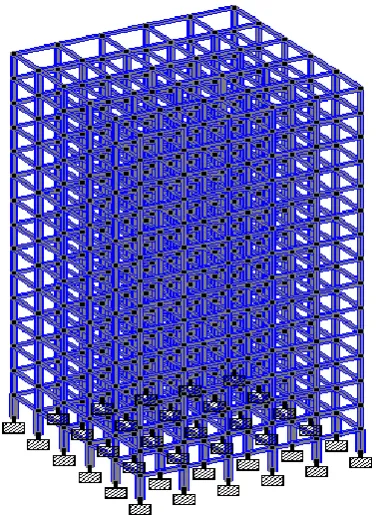
The experimental setup was done to analyze the effects of structural lightweight concrete seismic behaviour in High - rise building by framing out simulation model in STAAD.Pro software tool. The building is having fifteen stories and overall 44.8 m assembled as G + 14. The building to be analyzed here is completely made up of lightweight concrete; structural members include both horizontal and vertical members. The building is located at seismic zone II, which is highly prone to after seismic effects and regular seismic actions due to various internal disturbances.
Structural details of LWC (G + 15) building:
i. Number of storey =15 (G + 14)
ii. Height of storey = 2.8 m with G.F column and storey column 3.0 m iii. Cross-section of beams = 350 x 300
iv. Cross-section of columns = as follows 350 x 400 in Outer section, 400 x 400 in intermediatesection,
500 x 600 in corecolumnsand base.
v. Span of beam = 4m(x-dir) & 4 m(y-dir). vi. Grade of concrete = M35
vii. Grade of steel = Fe 415
viii. Dead Load = -1 factor load and-2.5 kN/m2 as floor load. ix. Live Load = -1.5KN/m2 on Floor and 2 on beams.
x. Seismic Load = As per IS: 1893– 2002,with Z = 0.1, xi. RF = 5, I = 1, SS = 1, DM = 0.045
Analysis of Building: Analysis is done by using STAAD. Pro under design consideration IS: 456 - 2000 and IS: 13920 - 1993.
Appling the Response Spectrum command loading for dynamic analysis. This capability allows for analyzing the structure for seismic loading. For any supplied response spectrum (either acceleration vs. period or displacement vs. period), joint displacements, member forces, and support reactions may be calculated. Modal responses are combined using the complete quadratic combination (CQC), methods to obtain the resultant responses. Results of the response spectrum analysis may be combined with the results of the static analysis to perform subsequent design. to account for reversibility of seismic activity, load combinations can be created to include either the positive or negative contribution of seismic results.
Where ri and rj are maximum responses in the ith and jth modes, respectively and αij is correlation coefficient
given by
Where ξi and ξj are damping ratio in ith and jth modes of vibration, respectively and 𝛽=
𝜔i
𝜔j and (𝜔𝑖 > 𝜔𝑗) also;
the range of coefficient, αij is 0 < αij< 1 and 1. αii =αjj = 1
Figure 3.1: LWC RCC structure framed in Staad.Pro
IV. RESULT ANALYSIS
A light weight concrete structure is analyzed on the basis of codal provisions and in STAAD.pro software with different specifications of design details as specified previously in methodology. The result analysis is obtained by the software as per the entered data. Here result is shown on the basis of tables and graphs obtained from analysis.
a. TABULAR RESULTS –
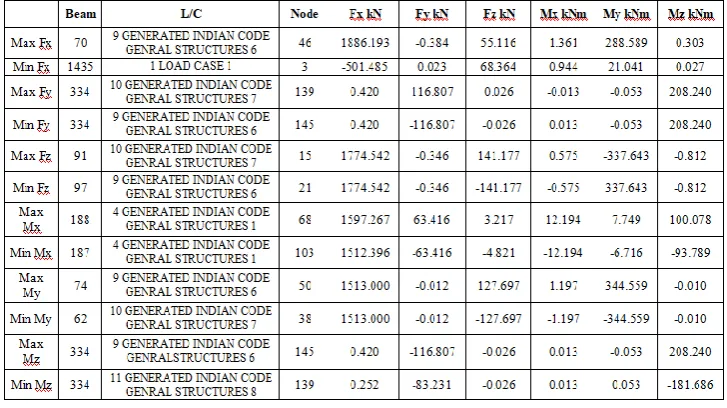
Table II - Max beam forces and moments under applied loads for M35 grade concrete with fe415
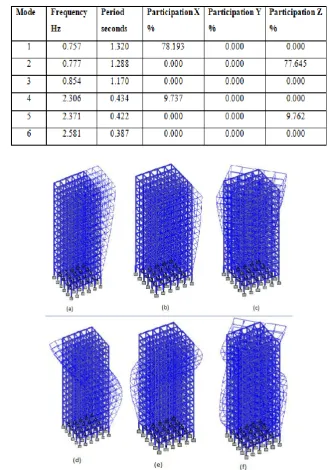
Figure 4.1: Mode shapes (a, b, c, d, e & f) for LWC RCC structure framed in Staad.Pro
b. GRAPHICAL RESULTS –
Graph II. – Shear Force (y – Direction) critical Beam No. 70 under combination load - 9.
Graph III. – Moments (z – Direction) critical Beam No. 334 under combination load - 10.
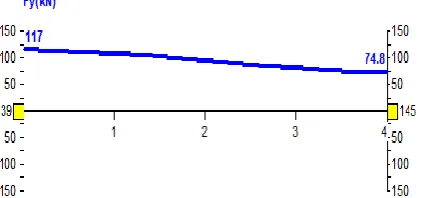
Graph IV – Shear Force (y – Direction) critical Beam No. 334 under combination load - 9.
Figure 4.2: RCC design details of beam No. 334 as per loads applied.
Graph V. – Comparison of Shear forces for NWC & LWC under applied loads.
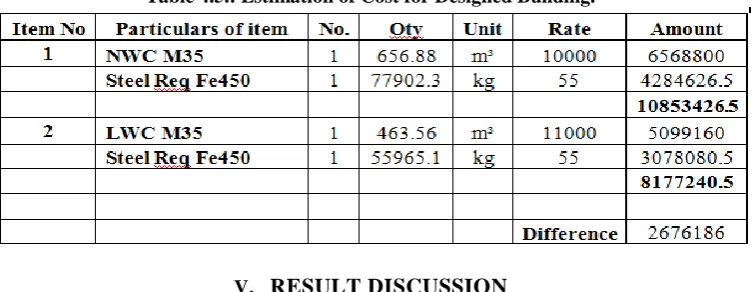
Figure 4.3: Comparison between materials i.e. concrete and steel requirement in construction as per LWC & NWC specifications under applied loads.
Table 4.5.: Estimation of Cost for Designed Building.
V.
RESULT DISCUSSION
In the dynamic analysis i.e. response spectrums CQC method is applied and the viability of the structure is checked. The structural evaluation of member like beam and column is tried to solve by providing examples like; beam (no. 70, 74, 91 & 334) and column (no. 188). This thesis work defines the basic adequacy of member against the applied load condition and combinations as per provisions allowed. It is observed that mass participation percentage is decreased by using lighter weight or say lower dense materials in filling. It also reduces the structural modes of failures under torsions, shear and bending, due to reduction in vibration media of member.
On comparison between normal weight and light weight RCC building structure under similar load cases; it have been observed that; Shearing, Tearing and Moments are considerably reduced in LWC Structure. The percentage of reinforcement required is also reduced for LWC RCC members as moment acting on the member gets reduced. The critical load case obtained in this analysis is load combination. The dynamic analysis results so obtained also; shows that structure undergoes high lateral deformation and deflection but remain safe even under critical values of forces.
Results as obtained astabular and graphical representations show that there is substantial fall down in shearing forces and moments along all coordinate axes under defined structural loads like; dead, live and seismic loadings. The loads causes significance vibrations, which make structure to deform or get displaced from connecting joints, or say; the node to node displacements. Statisticsguides that the structural entitiesassembliesare at most on critical region as if not appropriately investigated for seismic time period and its after affects (eg. bursting out of column and beams in lateral direction) which might be calamitous.
increased by using light weight concrete due to reduction in dense medium, which retards and dumps the seismic vibrations within it.
VI.
Conclusion
i. Light weight concrete structural members have lower value of joint displacement under axial and lateral loads applied as a result of seismic forces.
ii. Light weight concrete structural members have lower value of shear forces and bending moment applied as a result of seismic forces.
iii. Light weight concrete due to lower density reduces effect of seismic vibrations and reduces threat of structural collapse under base shear effect.
iv. Amount of reinforcement required in Light weight concrete structure made up of different grades like M35 lower the grade lesser will be the reinforcement area.
v. Amount of reinforcement required in Light weight concrete structure is lesser than Normal weight concrete. vi. Danger of story drift is reduced by increased stiffness within the structure along the floors. As the ductility
of structure is also increased by using light weight concrete as the shear reinforcement is enhanced.
vii. Even though the building collapsed made up of light weight concrete might help to reduce demolition cost and saving considerable life and accessories.
viii. Light weight concrete construction helps to save worthy amount of capital invested in any construction project.
References
[1]. Abdel hamid Charif et. Al. [1], “Ductility of reinforced lightweight concrete beams and columns” in Latin American Journal of Solids and Structures, vol.11 no.7; Rio de Janeiro Dec. 2014.
[2]. H. Bomhard (1980), [1] “Lightweight concrete structures potentialities, limits and realities” The International Journal of Lightweight Concrete, Volume 2, No – 4 Dec, Page No. 193 - 196.
[3]. Celik Ozyildirim (2009), [2] “Durability of Structural Lightweight Concrete” published in ESCSI Special Workshop on Lightweight Aggregate Concrete Bridges that was held May 7, 2008, Page No. 1 - 14.
[4]. CPWD (2007), [3] “How to make building earthquake – safe” A white paper issued by and IIT- Madras which stated that Building structure must be well planned and simple and well interconnected to be sufficiently ductile to bear seismic disturbances.
[5]. C. V. R. Murty (2002), [4] “Some Concepts in Earthquake Behaviour of Buildings” a book published by Gujarat State Disaster Management Authority, shows the structural behaviour of various building members under various condition of seismic loading. [6]. Danile F. Jensen (2014), [5] “Reliability Analysis for Shear in Lightweight Reinforced Concrete Bridges Using Shear Beam
Database” published in Utah State University for Civil Engineering journal Page No.
[7]. Hjh Kamsiah Mohd. Ismail (2004) [6] “Study of Lightweight Concrete Behaviour” in his research work thesis Page No 1 - 35. [8]. IS: 13920 -1993.
[9]. IS: 1893 – 2002. [10]. IS: 456 – 2000.
[11]. Mervyn Kowalsky (1999), [8] “Shear and Flexural Behaviour of Lightweight Concrete Bridge Columns in Seismic Regions” published Article in Aci Structural Journal · in January, Page No. 136 – 148.
[12]. Ninad P. Pawar (2015), [9] “Ductility Requirements of Earthquake Resistant Reinforced Concrete Buildings” published in International Journal of Innovations in Engineering Sciences and Technology: Civil, Vol. 1, issue.1, pp. 1-5 Page No 27 - 32. [13]. Werasak Raongjant [10] (2007) “Seismic Behaviour of Lightweight Reinforced Concrete in Shear Walls” published in M –Tech
thesis, Thailand.
[14]. X.- K. Zou & C.- M. Chan (2005), et. Al [11] “Optimal seismic performance-based design of reinforced concrete buildings using nonlinear pushover analysis” published in Engineering Structures; 27 1289–1302 May 2005.
[15]. Jan A. Overlia et. Al. [12] “Increasing Ductility in Heavily Reinforced LWAC Structures”
[16]. Anil k Chopra [13] “Dynamics of Structure –Theory and Applications of Earthquake Engineering” Pearson Educations 2009 [17]. Sin LH, Huan et. Al. [14] “Reinforced lightweight concrete beams in flexure” ACI Structure J. 2011; Page 108: 3 - 12.
[18]. Ahmad SH, et. Al. [15] “Flexural Behavior of Reinforced High-Strength Lightweight Concrete Beams” ACI Structure J. 1991; Page 88:69 - 77.
[19]. Bakken L et. Al. [16] “Ductility of lightweight aggregate concrete” Department of Structural Engineering: Norwegian University of Science and Technology; 2012.