Int. J. of Engg. Sci. & Mgmt. (IJESM), Vol. 4, Issue 3: July- Sep: 2014 [46-53]
INTERNATIONAL JOURNAL OF ENGINEERING SCIENCES &
MANAGEMENT
EXPERIMENTAL STUDY & ANALYSIS OF BLACK COTTON SOIL WITH
CCR & BA
Neeraj Kumrawat*
1, S.K. Ahirwar
2*1
Research Scholar, M.E.Transportaion Engg. SGSITS,(M.P.)
,India
2
Assistant Professor, Civil Engg. & Applied Mechanics Department, SGSITS,(M.P.)
,India
Abstract
The main objective of this experimental study is to improve the properties of the soil by adding the waste material which can cause environmental pollution. Calcium Carbide Residue and Bagasse Ash mixture which are waste product of acetylene gas factories and steel plant respectively has been selected to add in the soil sample in different ratios. The soil properties with and without adding of waste materials (Calcium Carbide residue and Bagasse Ash ) have been studied. An attempt has been made to use these waste material for improving the strength and CBR values of soil which will also prove environment friendly. Thus, from this experimental study will help in reduction of pollution and improvement of soil strength
.
Key-Words: Expansive soil, Calcium carbide residue; Bagasse Ash; Compaction; Stabilization
Introduction
The most available soils do not have adequate engineering properties to really bear the expected wheel load. So improvisations have to be made to make these soils better. These lead to the concept called soil stabilization which is any treatment (including technically, compaction) applied to a soil to improve its strength and reduce its vulnerability to water, if the treated soil is able to withstand the stresses imposed on it by traffic under all weather conditions without excessive deformation, then it is generally regarded as stable. Several highways pavement in Indian roads are failing due to lack of use of soil with adequate engineering strength. So the need for improvement of the engineering properties of soil has been a paramount concern to the transportation engineers. The ability to blend the naturally abundant black cotton soil with some chemical reagent to give it better engineering properties in both strength and waterproofing has been of paramount importance to the transportation engineers. Sugarcane straw is a major by product in the manufacturing of sugar in the sugar industries. Proper disposal of waste product has been a global concern.In order to make sugarcane straw a useful material.
Black Cotton Soil
Black cotton soil is the Indian name given to the expansive soil deposit in the central part of the country. Black cotton Soil is a residual soil, which have been formed from basalt or trap and contain the clay mineral montmorillonite that causes excessive swelling and shrinkage characteristics of the soil. The swelling behavior of the soil would depend largely on the type
of clay minerals that are present in these soils and proportions in which they are present.
BA (Bagasse Ash)
The bagasse ash is a residue obtained from the burning of bagasse in sugar producing factories. Bagasse is the cellular fibrous waste product after the extraction of the sugar juice from cane mills. It is currently used as a bio fuel and in the manufacture of pulp and paper products and building materials. For each 10 tons of sugarcane crushed, a sugar factory produces nearly 3 tons of wet bagasse which is a by-product of the sugar cane industry. When this bagasse is burnt the resultant ash is bagasse ash. baggasse ash is a pozzolanic material and it is usable as a soil stabilizer.
CCR (calcium carbide residue)
The calcium carbide residue is produced by a simple process, which is obtained from a reaction between CCR and water to formation of acetylene gas and calcium hydroxide. in a slurry form of calcium carbide residue mainly consists of calcium hydroxide Ca(OH)2, to improve the engineering properties of waste material by cementing agent it is an optional means of producing usable materials. high unit cost and energy intensive procedure of Portland cement are heavy force for the alternative cementitious additives. high content of natural pozzolanic materials in clayey soil, calcium hydroxide [Ca(OH)2] is a rich material can be used to produce high strength geo-material.
Int. J. of Engg. Sci. & Mgmt. (IJESM), Vol. 4, Issue 3: July- Sep: 2014
natural pozzolanic material in clay to invent a cementitious material.
The shear strength of the stabilized soil gradually increases with time, mainly due to the pozzolanic reaction.
CaC2 + 2H2O → C2H2 + CCR ……….(1)
Materials and Methods
Soil sample-
The soil sample is a problematic silty clay collected from the Shri Govindram Seksaria Institute of Technology and Science campus in Indore, (m.p.)India, at a depth of 2.8 m. This soil is an inland clay, which is sensitive to changes of water content. The soil contains high fine particle.its specific gravity is 2.62. the Liquid Limit 52.1% and Plastic Limit 25.2%. at the time of sampling the ground water bad disappeared. The natural water content was 20%.
Binder 1- CCR (calcium carbide residue)-Materials used as consisted of calcium carbide residue assigned as CCR and bagasse ash assigned as BA. The CCR was collected from the disposal area in the dry form, as in Fig. 1(b) and was sun dried for 2–3 days to reduce its high moisture content. After sun-dried, the CCR had a moisture content less than 3% and was then ground by a Los Angeles abrasion machine until the particles retained on sieve No. 325 less than 10% by weight. Calcium Carbide Residue (CCR) is a by-product of acetylene production process and its production is described in the following equation:
CaC2 + 2H2O → C2H2 + Ca(OH)2
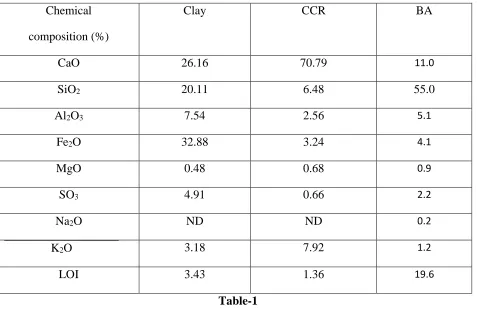
Calcium carbide residue consists mainly of calcium hydroxide, Ca(OH)2 and is obtained in a slurry form. From Eq, we have 64 g of calcium carbide (CaC2) which provides 26 g of acetylene gas (C2H2) and 74 g of CCR in terms of Ca(OH)2. the specific gravity of the CCR 2.32,the table 1. shows the comparison of chemical composition.
Chemical Properties of Clay, CCR and BA
Chemical
composition (%)
Clay
CCR
BA
CaO
26.16
70.79
11.0
SiO
220.11
6.48
55.0
Al
2O
37.54
2.56
5.1
Fe
2O
32.88
3.24
4.1
MgO
0.48
0.68
0.9
SO
34.91
0.66
2.2
Na
2O
ND
ND
0.2
K
2O
3.18
7.92
1.2
LOI
3.43
1.36
19.6
Int. J. of Engg. Sci. & Mgmt. (IJESM), Vol. 4, Issue 3: July- Sep: 2014
2.Bagasse Ash (BA)
Bagasse ash (BA) used in this study was obtained from the indore sugar industry, where it was burned to generate electricity at a temperature of approximately 600–800˚C. The original BA was not suitable for use as a pozzolanic material in soil stabilization due to its large particle size and high porosity.so the pozzolanic activity and the filler effect of industrial ash depends on its particle size and fineness; thus, the original BA was ground by using grinding machine until the particles retained on a 45 μm sieve (No. 325) were less than 3% by weight. The physical properties of ground BA are shown in table .Ground BA has a specific gravity of 2.27 and median particle size of 5.7 μm. The percentage of particles retained on a 45 μm sieve (No. 325) is 0.5% by weight.The chemical compositions of ground BA are shown in table.1 Its major component was 55.0% of SiO2, and the total amount of SiO2, Al2O3, and Fe2O3 was 64.2%, while the amounts of LOI and SO3 were 19.6% and 2.2%, respectively. It was noted that the LOI of the ground BA was higher than the limited value specified b ASTM: C618 for a class N pozzolan. Liquid limit 41 and Plastic limit
Non-plastic, Optimum moisture content (%) 48, and Maximum dry density (g/cm) 1.27
Methodology
Calcium carbide residue
Calcium carbide residue (CCR) is a by-product of the acetylene gas production process. It has high water content and must be dried for approximately 3–4 days to reduce its moisture content to approximately 1–2%. The CCR was ground by using grinding machine until the particles retained on a 45 lm sieve (No. 325) were less than 3% by weight. The physical properties of ground CCR are shown in Table 1. Ground CCR has a specific gravity of 2.42 and median particle size of 4.4 lm. The percentage of particles retained on a 45 lm sieve (No. 325) is 2.1% by weight. After grinding, the ground CCR has irregular particles with a crushed shape, as shown in Fig. 1b. The chemical compositions of ground CCR are reported in Table 2. The major chemical composition of ground CCR was 56.5% of CaO. In addition, the loss on ignition (LOI) of the ground CCR was 36.1%, which is very high.
Physical properties of the materials-
Sample
Specific gravity Retained on a 45 lm
sieve (No. 325)
(%) Median particle
size,d50 μm)
Ground BA 2.27
0.5
5.7
Ground CCR
2.42
2.1
4.4
Table-2
The clay was passed through a 16mm sieve to remove coarse particles. The unconfined compressive strengths were measured on cylindrical samples, which were compacted on both dry and wet sides of optimum water content. After 24 h of compaction, the stabilized samples were dismantled from the mold, wrapped in vinyl bags, and stored in a humidity chamber of constant temperature (25 to 30°C). Unconfined compression (UC) tests were run on the samples after 7 days of curing. The tests were performed under soaked and unsoaked conditions. The soaked condition simulates the attack of complex wet weather or rainy weather, where large amounts of water filters into the samples.
A singal variables was taken as fixed percentage and the experimental variable to check its effect on the results The following procedure was followed to achieve the objectives of this research:
Preparation and testing of the research soil to identify its physical and mechanical properties. the soil was passed through a 16mm sieve to remove coarse particles and soil was oven dried for 24 hours. To find out the mechanical properties, the oven dry and grinding a series of tests, such as Standard Proctor test, unconfined compression and California bearing ratio (CBR) tests were carried out. All the index and mechanical tests were carried out according to the American Society of Testing and Material Standards(ASTM).
Bagasse Ash (BA)
The baggase ash waste obtained from the sugar production plants burning of bagasse at a temperature
Int. J. of Engg. Sci. & Mgmt. (IJESM), Vol. 4, Issue 3: July- Sep: 2014
avoid pre-hydration until usage, after which it was mixed with the soil as a percentage of dry weight from 0 to 8 percentage. An interval of 2% was maintained in order to obtain different soil-bagasse ash and CCR mixes with fixed percentage of CCR as control. Typical oxide composition of bagasse ash is shown in table
Preliminary Tests
Laboratory tests were conducted to determine the index properties of the natural soil and soil-bagasse ash mixes in accordance with British Standards (BS, 1990a,b),and CCR was collected from the gas production company. the CCR was oven dried for 4 hours at 200˚C. the CCR passed through a sieve NO.200 (75μm).Oven drying and sieving of CCR. Testing the baggase ash and CCR to establish their properties. Adding bagasse ash and CCR to the soil and conducting the required tests, such as standard proctor, unconfined compressive strength and CBR. Using the CBR values determined for the soil with and without additives to determine the thicknesses of flexible pavements from special design figures. Analysis and comparison of the results.
Sample Preparation
Collected soil sample is first dried in direct sunlight; the clods are broken to get a uniform sample. The organic matters, small aggregates, broken wooden material, pieces of glasses are removed carefully from soil sample. Sample is kept in oven for drying to use in test at temperature 105 C for 24 hrs. The prepared sample is then used for the test specified in 3.2. The
weight of soil sample taken for test is replaced by percentage of weight of bagasse ash. Four different blends are prepared for replacement of soil in varying proportion of (2%,4%,6%,8%) and CCR was fixed at 5%.
Results -Grain size analysis
Sieve size(mm.) % Retained
10 0
4.75 7.5
2.36 24.78
1.18 31.66
0.600 19.84
0.425 4.80
0.300 3.20
0.212 3.10
0.150 1.28
0.075 3.02
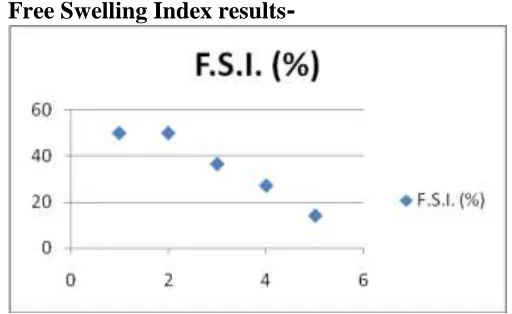
Free Swelling Index results
-
Int. J. of Engg. Sci. & Mgmt. (IJESM), Vol. 4, Issue 3: July- Sep: 2014
Liquid limit
plastic limit plasticity index
Plain soil
60
30
30
2%BA+5%CCR 55.8
41.8
14
4%BA+5%CCR
Non-plastic
-
-
6%BA+5% CCR
Non-plastic
-
-
8%BA +5%CCR
Non-plastic
-
-
Int. J. of Engg. Sci. & Mgmt. (IJESM), Vol. 4, Issue 3: July- Sep: 2014
Conclusion
The BA increases the maximum dry density of the blended CCR-stabilized clay, indicating a packing effect. However, this packing effect insignificantly improves strength
development.
The pozzolanic reaction plays a large role on strength development when the curing time is longer than 28 days.
The input of CCR reduces the maximum dry unit weight of the soil because the specific gravity of the CCR is lower than that of the soil. This reduction in maximum dry unit weight is associated with an increase in optimum water content. The effect of the reduction in soil plasticity on the water-sensitivity as a result of the input of CCR,The clay fabric is insignificantly changed with molding water content, resulting in lower water-sensitivity
The waste product i.e. Calcium Carbide Residue and Bagasse Ash can be used to increase the stability of soil.
The ratio of CCR and BA in the mixture that will increase stability of soil at
maximum extent is 5% & 6%.
From all the work we had done so far we can conclude that waste materials Calcium Carbide Residue and Bagasse Ash mixture can be used to increase the strength of the soil which also decrease the environmental pollution cause by these two.
References
[1]. Apichit Kampala1 and Suksun Horpibulsuk, Ph.D., P.E.(2013) “Engineering Properties of Silty Clay Stabilized with Calcium Carbide Residue” J. Mater. Civ. Eng. 2013.25:632-644
[2]. Horpibulsuk, S., Katkan,W., and Apichatvullop, A. (2008a). “An approach for assessment of compaction curves of fine-grained soils at various energies using a one point test.” Soils Found., 48(1), 115–126.
[3]. Horpibulsuk, S., Rachan, R., and Raksachon, Y. (2009). “Role of fly ash on strength and
microstructure development in blended cement stabilized silty clay.” Soils Found., 49(1),
85–98.
[4]. Moses, G and Osinubi, K. J(2013). “Influence of Compactive Efforts on Cement-
Bagasse Ash Treatment of Expansive Black Cotton Soil” World Academy of Science, Engineering and Technology.
Vol:7 2013-07-28
[5]. Songsuda Vichan, Runglawan Rachan(july2012) “Chemical stabilization of soft Bangkok clay using the blend of calcium carbide residue and biomass ash” Soils and Foundations 53 (2013) 272–281
[6]. Y. J. Du; Y. Y. Zhang; and S. Y. Liu (2009) “Investigation of Strength and California
Bearing Ratio Properties of Natural Soils Treated by Calcium Carbide Residue “ Geo-