Amalgamation of Spark Framework to Process
the Big Data in Industry 4.0
Vyshnave Vinayak Amith Hebbar
Student Student
Department of Industrial Engineering and Management Department of Industrial Engineering and Management
RIT, Bangalore RIT, Bangalore
Deepak Kumar Faculty
Department of Industrial Engineering and Management RIT, Bangalore
Abstract
In an Industry 4.0 factory, machines are connected as a collaborative community. So data generation has increased radically over the past few years. Such evolution requires the deployment of advance prediction tools, so that data can be systematically processed into information in order to elucidate uncertainties, render real-time solutions to industries and thereby make more “informed” decisions. Many industrialists believe that big data is a catalyst for greater contribution towards increasing profit margins and productivity. Big data is identified to be the fourth paradigm of science. In this paper we propose the amalgamation of Apache spark framework, a big data framework, in Industry 4.0 for faster data analytics and also state the astute advantages of Apache spark globally.
Keywords: Industry 4.0, Big Data and Apache Spark
________________________________________________________________________________________________________
I. INTRODUCTION
This research paper talks about the neoteric discoveries about Apache spark on a global scale. It specifically points out the astute advantages that Apache spark framework would bring along when executed on a large scale and that how different it is from the existing Hadoop framework on diverse lines. This paper also portrays information about Big Data analytics, Industry 4.0 and how the former two are currently integrated into one another. Finally, this research brings about a proposal or experimentation for how the latest Apache Spark framework would help industry 4.0 once successfully integrated.
‘Industry 4.0’ stands for the fourth industrial revolution. Other related terms include the ‘Industrial Internet’ or the ‘Digital Factory’. Industry 3.0 focuses on the automation of single machines and processes; Industry 4.0 emphases on the end-to-end digitization of all physical assets and integration into digital ecosystems with value chain partners. Generating, analyzing and communicating data seamlessly underpin the gains promised by Industry 4.0, which networks a wide range of new technologies to create value. [1]
Is ‘BIG-DATA’? When we combine several data sets consisting of a variety of data types, co-relations, trends and patterns, it usually forms a complex and a huge cluster like formation, which we call it as ‘Big Data’. In INDUSTRY 4.0 a huge amount of information is produced and collected on a daily basis that their processing and analysis is beyond the capabilities of traditional tools. However, there is a technology by which we can conduct analysis and that is Big Data. Big Data allows us to quickly and efficiently manage and use this constantly growing database. Big data analytics helps in analysis and separation of the key components of a business or an organization, it is like breaking up the cluster of data and extracting the important or germane information from it so as to make an informed decision and support effective transfer of knowledge to carry out business objectives taking into contemplation, the present scenario. [2]
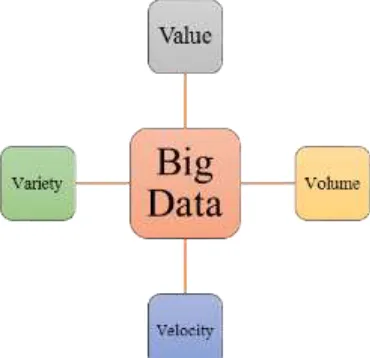
According to Forrester’s definition, Big Data consists of four dimensions (The 4V’s):
1) Volume: Refers to large amounts of any kind of data from diverse mix of sources, including mobile digital data creation devices and digital devices. The benefit from garnering, processing, and analyzing these large amounts of data generates a number of challenges in procuring valuable knowledge for people and companies.
2) Velocity: Refers to the speed of data transfers and that data should be in real time or close to real time. Velocity mainly means the speed of big data collection, processing and analysis.
(IJSTE/ Volume 4 / Issue 6 / 003)
Fig. 1: Characteristics of Big Data II. LITERATURE REVIEW
History of Big Data and Industry 4.0
Since its introduction, the Industry 4.0 initiative has been extensively deliberated and has migrated into the role of a popular science buzzword to simply relate evolving digital and advanced manufacturing technologies. Much of the shift towards Industry 4.0 has been driven by the emergence of ‘Big Data’, and the issues associated with the way industrial operations collect, manage and interpret their data remain predominant. The concept of big data and considerations of how to deal with such large datasets is an intrinsic challenge of any system operating in an Industry 4.0 environment as it typically renders traditional statistical processing methods useless due to its complexity and sheer size. It is well known that the rate of data generation, capture and storage is continually increasing and soon the volume of data generation in this field will require the consideration of potentially unbound datasets and continuous data streams. However, despite the enormous amounts of information that is being generated, relatively few companies involved in the manufacturing sector are utilizing this data. Current research efforts have attempted to provide comprehensive definitions of the necessary ‘criteria’ that need to be met, across all areas of the business. Others have attempted to illustrate how the paradigm will be implemented in the future. [4]
The Origin of Apache Spark
With the prevailing techniques and growing number of demand in this case ‘data’, data analytics consumes the most of the time in a given time frame. To cut time and speed things ‘APACHE SPARK’ was the framework that was released initially 30 months ago. The technology as born out of a project at University of California, Berkeley and is used for machine learning where, algorithms continuously make predictions from the same set of data. It is basically an open source cluster-computing framework, which allows its user programs to load data into a cluster’s memory and query it repetitively.
Spark was originally started by Matei Zaharia at UC Berkeley, AMP Lab in 2009, and open sourced in 2010 under a BSD license. In 2013 the project was donated to the Apache software foundation and switched its license to Apache 2.0 in 2014, Spark became a top level Apache project. In November 2014, an engineering team at ‘Databricks’ used Spark and set a new world record in large scale sorting.[5]
III. METHODOLOGY
The Apache Spark framework for Big Data Analytics
its business. Faster big data analytics leads to faster decision making scenarios which indeed leads to faster growth of an industry and when we consider the present-day market: fast is what sells, slow is no longer an option. As stated earlier big data related to Industry 4.0 consists of information like: manufacturing, production, scheduling, orders, demands and supply trends, customer services etc. Addressing such information so as to come up with an efficient solution should be a fast process so as to beat the competition at every level. When the demand is for faster big data analytics ‘Apache Spark’ would suffice all the needs. Spark has a framework, which allows it to be the data processing engine that operates in-memory, on RAM; this means there is no more reading and writing the data back to the discs or nodes like it happens in Hadoop. Currently, using the Hadoop framework underpinned by MapReduce, between every map and reduce task, data has to be read to the disc and written to disc which makes it a slower process taking into consideration the huge amount of data available for processing. If in the same scenario Spark is put into use, the information would largely stay in-memory and so would the processing. Thus, making it iterate the data faster. How fast will these happen? Well, tests prove that Apache Spark is 100 times faster than Hadoop in memory and 10 times faster on disc. For example: Last year, Spark Pureplay Databricks used Spark to sort 100 Terabytes of records within 23 minutes thus, beating Hadoop MapReduce’s 72 minutes. [6]
Fig. 2: Spark Logo Analysis to optimize process in Industry 4.0
Fig. 3: Analysis model
(IJSTE/ Volume 4 / Issue 6 / 003)
IV. PERFORMANCE MEASUREMENT
We are using the three enablers as a metric for performance measurement. The processing of information by hardware and software is faster and manpower as a prerequisite in an industry is reduced. Thus, the total cost and time required for the whole process is considerably retrenched. The three enablers are:
1) Hardware: Industry 4.0 infrastructure, in particular, cyber- physical production systems, enable advanced connectivity, that is, real time data acquisition from the physical world and information feedback from intelligent computational systems providing inputs to operators or actuators. In Industry 4.0 the flexible choice of devices and controls are available.
2) Software: The availability of cloud based software solutions for both storage and processing of data brings capabilities in the range of supercomputing within the reach of every user .The combination of this new power with more easily accessible advanced analytical techniques like the Apache Spark framework tool for big data analysis enables increase in profit for Industry 4.0, when used continuously across a full management cascade and across time horizons, while at the same time facilitating deeper understanding and further optimization.
3) People: People are still the most paramount factor of all. Looking at the human side of transformational impact more broadly, 4 types of proficiencies are required (1) IT expertise, (2) domain expertise, (3) advanced analytics know-how, and (4) change management skills. Finding all 4 competences present, in an organized manner within an organization is not frequently accomplished at the present time, although two new trends are emerging, firstly the creation of a data scientist function and secondly the availability of more user friendly software bringing expert knowledge within reach of domain experts. When analyzing the required skill set further it becomes clear that domain expertise is one of the most critical skill sets. In most companies this expertise resides within the engineering function, a function that is already acquainted with statistics through the education of the people involved and is therefore expected to be a key enabler for the introduction of Spark framework in Industry 4.0.
V. ADVANTAGES OF USING SPARK
1) Platform independent: Spark runs everywhere be it on Hadoop, Mesos, YARN, Standalone or in the cloud. It can access diverse data sources including HDFS, Cassandra, HBase and S3.
2) Speed: Spark runs 100 times faster than Hadoop. It has an advanced DAG execution engine that supports cyclic data flow and in-memory computations.
3) Spark encompasses a few of the Big Data bonuses: Spark SQL and SQL for structured data processing. MLlib for machine learning.
GraphX for graph processing. Spark streaming, for streaming data.
4) Ease of use: Spark offers over 80 high level operators that make it easy to build parallel applications which makes one use is interactively from the Scala, Python and R shells. [6]
VI. CONCLUSION AND DISCUSSION
Industry 4.0 proposes the prognostic manufacturing in the future industry and big data is a prevalent phenomenon that aims to provide an alternative to traditional solutions based on data analysis. The processing of data is faster using Apache Spark. The processing of big data in Industry 4.0 with exabytes of memory is 100 times faster in Spark when compared to Hadoop and other frameworks. We can ensure better decision-making capability in real time, thereby increasing the productivity and profit in an industry. Apache spark helps eradicate inconsistencies in time-framed decision-making.
Big data is considered to be the next frontier for innovation, productivity and competition. The basis behind this conclusion is the capability of big data in altering corporate ecosystems and innovation; leading to more accurate operational planning; changing competition by process transformation; tackling key challenges of business organization as well as exposing value of business organization by releasing organizational capabilities and value. The precise implementation of spark catapults a particular industry way ahead of its contenders in the market and also helps in getting ready for the future as one can effortlessly stratagem the current market trends and with a little foresight the same could be converted into future trends. Therefore the above tool is very useful in Industry 4.0 to process the data faster and to obtain maximum output in given time.
REFERENCES
[1] http://www.pwc.com/gx/en/services/advisory/2015-global-digital-iq-survey.html,2016 Global Industry 4.0 Survey,page no-6.
[5] Mr. Harjeet Singh Jaggi, Mr. Sunny S. Kadam*, “Integration of Spark framework in Supply Chain Management”, “7th International Conference on Communication, Computing and Virtualization 2016”,Procedia Computer Science 79 ( 2016 ), 1013 – 1020,page no-1017.