Rapid & Low-Cost Real World Deployment Of
Snake-Like Modular Robots Using Fused
Deposition Modeling And Evolutionary Robotics
Wei Shun Chee, Jason TeoFaculty of Engineering, Universiti Malaysia Sabah, Kota Kinabalu, Malaysia
Faculty of Computing & Informatics, Universiti Malaysia Sabah, Kota Kinabalu, Malaysia Email: [email protected], [email protected]
ABSTRACT: A significant challenge in evolutionary robotics is that the evolved solutions face significant and often insurmountable difficulties when attempting to cross the simulation- reality transference gap. As a result, most of the evolved solutions remain as conceptual designs that are constrained to perform only within the simulation environment. Moreover, the deployment of a fully autonomous robot is an extremely complex, costly, and time-intensive endeavor. In our previous investigations, we have successfully employed a multi-objective co-evolutionary approach to automatically design and optimize a fully autonomous snake-like modular robot to acquire different moving behaviours for effective locomotion. Following the promising research from our previous work, this line of investigation is extended in this study to specifically combine the evolutionary robotics approach with 3D printing in the form of fused deposition modeling to explore the transferability of the evolved solutions from simulation environment to real world deployment. The main goal of this study is to provide a rapid and cost-effective automated design, fabrication and deployment methodology for autonomous snake-like modular robot in order for real world applications. A total of three different moving behaviours were explored for the acquisition and real-world testing by the constructed snake-like modular robot for effective locomotion, which are the lateral undulation, vertical undulation and lateral rolling moving behaviours. Moreover, a unique slot-in method is introduced in this work in designing and fabricating the snake-like modular robot’s hardware parts to ease the robot assembling process. The results from this study show that the transference from simulated to real-world robots is indeed feasible and readily achievable where a transference accuracy of 87.05% was been achieved.
Keywords:Evolutionary robotics; Snake-like modular robot; 3D printing; lateral undulation; vertical undulation; lateral rolling.
1 I
NTRODUCTIONIN recent years, the snake-like modular robot have become increasingly popular in robotic design. This is due to the fact that the snake-like modular robot possesses multiple degrees of freedom that enable it to become one of the most flexible and versatile mobile robots in meeting the needs of the mobile robotics to carry out tasks in unknown and challenging envi-ronments [1]. Due to the high flexibility of the snake-like mod-ular robot, it allows the robot to be able to perform various types of undulation movements to acquire variety of locomo-tion capabilities to travel in almost every environment. Fur-thermore, they are able to frequently change between multiple moving gaits depending on the terrain encountered to maxim-ize its effectiveness in traversing in different terrain types. These properties are vital in the mobile robots’ design espe-cially in search and rescue missions to overcome different kinds of obstacles and adaptively travel in an unknown envi-ronment. The snake-like modular robot is physically designed to be in an elongated form, lacking in legs, compact in size, and highly redundant in locomotion. These enable the snake-like modular robot to easily navigate across small holes or thin gaps where humans are incapable to reach to carry out the assigned tasks or investigations. If there is an existence of obstacles, the snake-like modular robots can climb up and over the obstacles that are much taller than their body height. Since the snake-like modular robot is constructed with re-peated modular units, it is redundant in design. In another words, the robot is capable to continue its locomotion if there is a particular joint that is malfunctioning [2]. The snake-inspired robots were first introduced in the early 1970’s by Shigeo Hirose [3]. Since then, numerous snake-inspired robot designs have been conceived and prototyped. From the stu-dies conducted on previous researches in designing snake-like modular robots, it was found that snake-snake-like modular ro-bots are generally constructed by using repeated modular
con-troller of robot, Karl Sims used a directed graph genetic lan-guage to describe both the morphology and neural system of virtual creatures to be co-evolved through competitive strate-gies [9]. Paul and Bongard had used the evolutionary adapta-tion to evolve the controller and some aspects of the morphol-ogy of a bipedal robot in simulation such that the robot can move while keep it upright [10]. Teo was able to simultaneous-ly optimize both the controller and several extend of quadru-pedal artificial creatures morphology through co-evolution process by using the SPANN-CMM algorithm to produce artifi-cial organisms with significantly different locomotion beha-viours [11]. Gregor had used of contexts and context blocks in GP to co-evolve the control and morphology of robots [12]. Lipson implemented an evolutionary computation method to design and develop different stick-like robots by using bars of variable lengths, joints and linear actuators as building blocks of structure and artificial neurons as building blocks of control [13]. It was also found out that, better results are able to be obtained by hybridizing different evolutionary approaches in co-evolving and optimize the controllers and robot bodies compare to the classic evolutionary method [14], [15]. In the researches carried out in co-evolving both the morphology and controller of the modular robot, Haller had employed the ge-netic algorithm to co-evolve the central pattern generator (CPG) neural oscillators’ controller and the body structure of simulated multi-unit modular robots namely Neubot for under-water locomotion [16]. In different researches conducted by Maybach, Pouya and Yoshida, a genetic algorithm is imple-mented to co-evolve the configuration and control for homo-geneous modular robots to optimize for efficient locomotion gaits [17-19]. In one of the recent research work, Guettas had proposed an approach based on cooperative co-evolutionary genetic algorithm to design configurations and controllers of homogenous modular robots [20]. However, it was noting that the research works cited above are only emphasis on co-evolving the body configuration and oscillator controller of mul-ti-branching modular robots that constructed using multiple functional modular robot units as building blocks without impli-cate the snake-like modular robot. From the literature studies, it was discovered that there are only limited researches con-ducted on snake-like modular robot evolutionary design. Moreover, these researches had only implemented the evolu-tionary approach to optimize the controller of the simulated modular robot for robust movement without co-evolving its morphology. For example, Tanev had implemented the genetic programming (GP) to automatically design for the control sys-tem of the wheel-less snake-like robot to perform the side-winding locomotion [21]. Meanwhile, Pareda had used genetic algorithm to optimize the constant values of the proportional-integral-derivate (PID) controllers to generate movement in a snake robot [22]. For the transference of evolved morpholo-gies and control system to real world, it is necessary to review the robot fabrication process. With the invention of the 3D prin-ter, it opens a new avenue for rapid prototyping of customized goods at relatively low costs and short time frame. 3D printing, also known as additive manufacturing, employs a layer-by-layer printing basis to build up the entire structure. As the item is designed using 3D CAD software, it enables the software to measure thousands of cross-sections of the item to determine exactly how each layer is to be constructed [23]. While all 3D printers create objects using additive methods, there are dif-ferent approaches exists to deposit the material. Fused depo-sition modelling (FDM) is one of the most common additive
be-haviours are to be performed by the constructed snake-like modular robot, which are the lateral undulation, vertical undu-lation and lateral rolling moving behaviours. Each type of the robots is being designed differently in order to perform the par-ticular moving behaviour as in the simulation. All the body parts are fabricated corresponding to the dimension evolved in the simulation and the evolved control system is directly pro-grammed into the hardware controller to control the movement of every motor attached on the snake-like modular robot. The results obtained in the real world deployment are being ana-lysed and compared with the simulation results to obtain the transference accuracy able to be achieved.
2
S
NAKE-
LIKEM
ODULARR
OBOTD
ESIGN2.1 Morphology
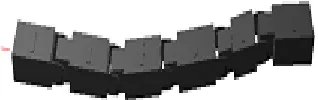
In this study, the snake-like modular robots are being designed differently in performing the lateral undulation movement, ver-tical undulation movement and the lateral rolling movement. The lateral undulation snake-like modular robot is constructed with all the segments connected to each other jointed by a servo motor as an actuator joint with yaw rotating axis as shown in Fig. 1.
Fig. 1. Morphology of lateral undulation snake-like modular robot.
The vertical undulation snake-like modular robot is constructed in the similar way as for the undulation snake-like modular robot except all the servo motors are rotating in pitch axis as shown in Fig. 2.
Fig. 2. Morphology of vertical undulation snake-like modular robot.
In order for the snake-like modular robot to perform the lateral rolling moving behaviour, the snake-like modular robot is con-structed with the actuating joints rotating in both pitch axis and yaw axis where the servo motors are being connected alterna-tingly with perpendicular rotating axis until the whole snake-like modular robot is formed. For instance, if the motor at-tached at a particular segment is having pitch rotating axis, the motor attached at the subsequent segment will have yaw rotat-ing axis as shown in Fig. 3.
Fig. 3. Morphology of lateral rolling snake-like modular robot.
In all the snake-like modular robots constructed they are hav-ing an infrared sensor mounted at the first segments and touch sensors installed on both sides of the segment which act as the input neurons for the artificial neural network (ANN) con-troller. It can be noticed that the joint connector which used to connect between segments is customized in a U shape. This allows the servo motor to be mounted inside to become an actuator joint to actuate the movement of every segment.
2.2 Controller
On the controller side of the snake-like modular robot, the ANN controller is employed to control movement of every ser-vo motor. However, the method of controlling the angle of the motors in performing the lateral rolling behaviour is different from the method in controlling the snake-like modular robot in performing the lateral undulation and vertical undulation. In order to generate the lateral undulation and vertical undulation movement, the same sinusoidal function is implemented to control the positioning angle of each of the motor. The sinu-soidal equation employed for the lateral undulation and vertical undulation movement is shown below,
2 3
1
sin
O
t
i
O
O
i
(1)Where,
θ = motor positioning angle O1, O2, O3 = ANN outputs
i = motor number t = time
On the other hand, from previous studies, it was shown that the lateral rolling behaviour of the snake-like modular robot can be generated by twisting its body. This can be done by generating two sinusoidal waves with phase shift of 90 degree to the pitch and yaw rotating axis of the snake-like modular robot [30], [31]. Based on the findings, the angle of pitch axis and yaw axis rotating motors are being controlled based on the equation shown below. From previous studies, it was shown that the lateral rolling behaviour of the snake-like mod-ular robot can be generated by twisting its body. This can be done by generating two sinusoidal waves with phase shift of 90 degree to the pitch and yaw rotating axis of the snake-like modular robot [30], [31]. Based on the findings, the angle of pitch axis and yaw axis rotating motors are being controlled based on the equation shown below,
2 3
1
,i
O
sin
O
t
i
O
pitch
(2)
2 3
1
,i
O
cos
O
t
i
O
yaw
(3)θpitch = pitch axis motor positioning angle
θyaw = yaw axis motor positioning angle
O1, O2, O3 = ANN outputs
i = motor number t = time
3 H
ARDWARED
ESIGN ANDF
ABRICATION3.1 Hardware Control
In this research, the Arduino Atmega2560 controller board shown in Fig. 4 is chosen to be used as the main controller for the snake-like modular robot where the evolved ANN controller is programmed into it to control the position angles of the ser-vo motors.
Fig. 4. Atmega2560 main controller board.
In order to actuate the snake-like modular robot to perform different movements, servo motors are being used as the ac-tuator joints between the segments. By using the servo motor, it allows positioning control where the angle of each servo mo-tor can be determined from the ANN output. The model of the servo motor to be used in this research is the G15 servo motor shown in Fig. 5.
Fig. 5. G15 servo motor.
In this research, a limit switch is used as the touch sensor to detect whether the body segment is in contact with other ob-jects while an infrared optical sensor is used to detect the present of the obstacles. Both components used in this study are shown in Fig. 6 and Fig. 7.
Fig. 6. Limit switch touch sensor.
Fig. 7. Infrared sensor.
In order to ensure the snake-like modular robot is constructed in a modular form such that each segment can be plugged-in or detached easily without reassembling the whole robot struc-ture, the daisy connected CD4021B shift registers which al-lows parallel-in serial-out shifting communication. The fabri-cated circuit board with shift register IC mounted on it is shown in Fig. 8.
Fig. 8. Fabricated shift register circuit board.
3.2 Hardware Fabrication
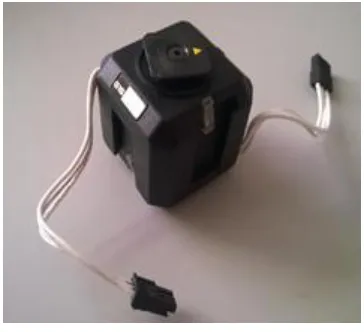
In this study, the snake-like modular robot is constructed with combination of rectangular segment blocks which are con-nected together through the actuator joints. Each body seg-ment of the snake-like modular robot is constructed using a rectangular block with 5cm width and 7cm height. Meanwhile, the length of the rectangular block is varying based on the segment length optimized from the simulation. In order to re-duce the construction time and effort, the slot-in method is employed to design the body structures of the snake-like modular robot. By using such approach, the snake-like mod-ular robot body parts can be easily assembled by slotting in the specific designed part into the holding slot. This also al-lows a particular part to be replaced without reassembling the entire robot. The segment block fabricated using 3D printing is shown in Fig. 9.
Due to the reason that there is an infrared sensor to be mounted on the first segment of the snake-like modular robot, the first segment block is designed with a mounting platform to hold the infrared sensor device as shown in Fig. 10.
Fig. 10. First segment block fabricated.
In this study, the joint connectors are used to link the modular segments together to form the entire functional snake-like modular robot. The joint connector is designed such that the servo motor is mounted inside making it to become a function-al moving joint to actuate the segment. The 3D printed joint connector is shown in Fig. 11.
Fig. 11. Joint connector of snake-like modular robot.
In order for the servo motor to be installed at the joint connec-tor to act as an actuaconnec-tor, a rotation connecconnec-tor is required. The rotation connector is used to hold the servo motor at the joint connector and allows the servo motor to perform a rotating motion. The rotation connector designed in this work is shown in Fig. 12.
Fig. 12. Fabricated rotation connector.
The servo motor is attached on the joint connector by inserting the rotating shaft into the bracket slot designed on the joint connector as shown in Fig. 13.
Fig. 13. Insertion of servo motor into joint connector.
Following that, the actuator joint is used to connect between segments by inserting the wedge connector on the segment block into the slot bracket slot on to the joint connector and servo motor as shown in Fig. 14.
Fig. 14. Connection parts between segment block and actua-tor joint.
A close look on the insertion of the segment block’s wedge connector into the bracket slot of the servo motor is shown in Fig. 15.
Fig. 15. Insertion of wedge connector into bracket slot.
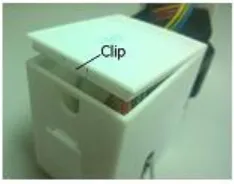
After all the electronic components had been inserted into the segment block with proper connection, the segment block will be enclosed with a 3D printed top cover as shown in Fig. 16.
Fig. 16. Insertion of top cover to enclose the segment block.
Fig. 17. Overview of constructed snake-like modular robot assembled with different body parts.
4 R
ESULTS ANDD
ISCUSSIONS4.1 Lateral Undulation Moving Behaviour
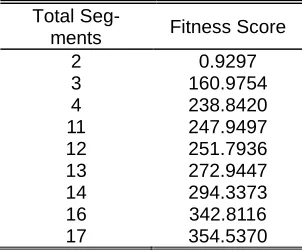
By employing the multi-objective co-evolutionary approach introduced in our previous study, the Pareto-optimal front of solutions obtained through the artificial co-evolutionary process for the lateral undulation snake-like modular robots is shown in Table 1.
TABLE1
PARETO-OPTIMAL SOLUTIONS OF LATERAL UNDULATION SNAKE-LIKE
MODULAR ROBOT
Total
Seg-ments Fitness Score
2 0.9297
3 160.9754
4 238.8420
11 247.9497
12 251.7936
13 272.9447
14 294.3373
16 342.8116
17 354.5370
In the physical testing conducted on the lateral undulation moving behaviour, a 4-segment snake-like modular robot is chosen from the Pareto-optimal set of to be fabricated for real world deployment. The 4-segment snake-like modular robot is chosen because it had attained a relatively high fitness score with significant less number of segments. The complete fabri-cated 4-segment snake-like modular robot is shown in Fig. 18.
Fig. 18. Fully constructed 4-segment lateral undulation snake-like modular robot.
After the snake-like modular robot is constructed, it is dispatched on the plywood floor placed in an open area to perform the evolved moving behaviour. The snake-like modular robot is al-lowed to perform the lateral undulation movement for 30 seconds as specified in the simulation. The goal to be achieved by the constructed snake-like modular robot is to propagate forward for the longest distance in a straight line. The moving behaviour
per-formed by the snake-like modular robot in the real world is shown in Fig. 19.
Fig. 19. Lateral moving behaviour performed by the 4-segment snake-like modular robot.
From Fig. 19, it can be seen that the snake-like modular robot is able to perform the lateral undulation moving behaviour to propa-gate forward by generating the sinusoidal motion using the entire body structure. During the locomotion process, the snake-like modular robot’s body is constantly in contact with the ground and it does not jerk or leap while performing the undulation move-ment. This shows the snake-like modular robot had successfully acquired the lateral undulation moving behaviour for locomotion. In addition, it has also shown that the snake-like modular robot is able to be optimised such that it can use its body segments to produce adequate amount of frictional force in the lateral direction to overcome the non-holonomic constraint for forward propaga-tion without the needs of passive wheels. The total distance tra-velled by the 4-segment snake-like modular robot in the simula-tion and real world is shown in Table 2.
TABLE2
DISTANCE TRAVELLED BY 4-SEGMENT SNAKE-LIKE MODULAR R O-BOT
Experiment
Total Dis-tance Tra-velled (cm)
Distance Deviated
(cm)
Simulation 122.4 32.3
Real world 102.9 0.6
evolved simulated solutions even though a large locomotion distance is achieved. The behaviour acquisition of the snake-like modular robot is evaluated based on visual assessment. The transference accuracy of the lateral undulation snake-like modular robot is calculated using the equation shown below,
% 100 2
25 .
0
s s rw s
s rw
y y y x
x x n
acquisitio Behaviour
TA (4)
Where,
TA = Transference accuracy xrw = real world distance travelled
xs = simulation distance travelled
yrw = real world deviated distance
ys = simulation deviated travelled
Based on the calculation, the transference accuracy able to be achieved by the constructed snake-like modular robot in perform-ing the lateral undulation forward movperform-ing behaviour is 70.26%. By investigating the reason for the side slip likely to occur in the physical testing, it was found that one of the causes which re-sulted in the snake-like modular robot to have a large deviated distance from the straight path compared to the simulated result is the variation of weight distribution between the actual constructed snake-like modular robot and the simulated snake-like modular robot. As a result, the interactive frictional forces produced by the robot body structures in reality are varied from the ideal simulated environment which indirectly affected the overall moving beha-viour. Moreover, it was also found that the 3D printed modular segment block is not having a perfectly flat base due to fabrica-tion constraints which has resulted in the uneven fricfabrica-tional force and caused the side slip likely to happen. From the analysis con-ducted on the lateral undulation moving behaviour, it was ob-served that the lateral undulation propagation movement of the snake-like modular robot is highly dependent on the frictional force. A slight change in the frictional force will vary the overall movement of the snake-like modular robot. In this physical expe-rimental run, the combined effect of the weight distribution devia-tion and variadevia-tion of the fricdevia-tional force ended up aiding the con-structed snake-like modular robot to propagate forward for a longer distance but also resulted in a side slip to occur while propagating forward. In conclusion, the evolved snake-like mod-ular robot was successfully transferred to the real world to per-form the lateral undulation moving behaviour to propagate for-ward.
4.2 Vertical Undulation Moving Behaviour
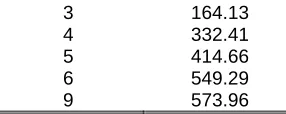
In this study, heterogeneous snake-like modular robots were evolved to perform the vertical undulation motion such that it can travel forward for the longest distance in straight line with-out falling. Furthermore, the snake-like modular robots are also optimized to perform small sinusoidal waves to propagate forward. There are total of six Pareto-optimal solutions ob-tained by using the multi-objective co-evolutionary algorithm is shown in Table 3.
TABLE3
PARETO-OPTIMAL SOLUTIONS OF VERTICAL UNDULATION SNAKE
-LIKE MODULAR ROBOT
Total
Seg-ments Fitness Score
2 31.36
3 164.13
4 332.41
5 414.66
6 549.29
9 573.96
With the intention to validate on the simulation results and analyse how the evolved vertical undulation moving behaviour will perform in the real world, the 6-segment snake-like mod-ular robot is selected from the Pareto-optimal front sets to be constructed for physical testing. The 6-segment snake-like modular robot which had appeared as the second best per-forming evolved solution in the Pareto optimal set is selected to be constructed instead of the best performing snake-like modular robot with nine segments because it possesses less number of segments and the fitness score was only varied slightly compared to the 9-segment snake-like modular robot. The morphology and controller of the snake-like modular robot is constructed based on the evolved results. The complete fabricated 6-segment snake-like modular robot is shown in Fig. 20.
Fig. 20. Fully constructed 6-segment vertical undulation snake-like modular robot.
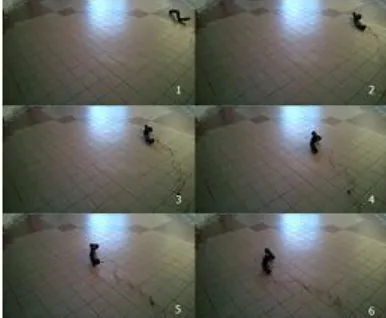
In the physical testing experiment, the vertical undulation snake-like modular robot is dispatched in an open area with plywood floor. A total of 30 seconds traveling time is provided for the snake-like modular robot to perform the vertical undula-tion movement. The goal to be achieved by the snake-like modular robot is to travel forward for longest distance in a straight line by performing the vertical undulation movement with small sinusoidal amplitude. The lateral undulation moving behaviour performed by the 6-segment snake-like modular robot is shown in Fig. 21.
From Fig. 21, it can be observed that the constructed snake-like modular robot is able to travel forward by using the vertical undulation moving behaviour. The body segments of the snake-like modular robot had a smooth translation in the ver-tical direction while performing the undulation movement. This enables the snake-like modular robots to possess a stable locomotion to propagate forward without falling over. Moreo-ver, the constructed snake-like modular robot does not jerk or show the hopping behaviour during the locomotion process. This shows that the evolved vertical undulation moving beha-viour is successfully acquired by the constructed snake-like modular robot. The results achieved by the snake-like modular robot in simulation and real world are shown in Table 4.
TABLE4
RESULTS OBTAINED BY 6-SEGMENT SNAKE-LIKE MODULAR ROBOT
Experiment
Total Dis-tance Tra-velled (cm)
Distance Deviated
(cm)
Vertical Height (cm)
Simulation 238.1 5.6 20.0
Real world 214.6 9.4 18.7
This shows that the constructed snake-like modular robot was not only able to acquire with the vertical undulation moving behaviour but it was also optimized to perform at a lower am-plitude sinusoidal movement. In calculating the transference accuracy of the constructed snake-like modular robot, the be-haviour acquisition, total distance travelled, total distance de-viated, and optimized amplitude height is taken into account. The behaviour acquisition of the constructed snake-like mod-ular robot holds 50% of the transference accuracy while the remaining 50% is evenly allocated to other aspects. The transference accuracy is calculated using the equation shown below,
% 100 3
3 5 .
0
s s rw
s s rw
s s rw
z z z y
y y x
x x n
acquisitio Behaviour
TA (5)
Where,
TA = Transference accuracy xrw = real world distance travelled
xs = simulation distance travelled
yrw = real world deviated distance
ys = simulation deviated travelled
zrw = real world height attained
zs = simulation height attained
From the calculation, 87.05% transference accuracy has been achieved in this experiment. This shows that fairly accurate re-sults are able to be transferred from simulation to the real world. Furthermore, it had also showed the viability of combining the evolutionary approach to 3D printing to resolve the designing and optimization problems in robotics design.
4.3 Lateral Rolling Moving Behaviour
In this study, heterogeneous snake-like modular robots are to be evolved to perform the lateral rolling moving behaviour to travel sideways for the longest distance following the straight path while maintaining the straight body orientation. There are total of Pare-to-optimal set obtained by using the multi-objective co-evolutionary algorithm is shown in Table 5.
TABLE5
PARETO-OPTIMAL SOLUTIONS OF LATERAL ROLLING SNAKE-LIKE
MODULAR ROBOT
Total
Seg-ments Fitness Score
2 4.17
3 35.93
4 573.43
5 708.80
6 923.52
7 1238.75
A solution from the Pareto-optimal set acquired is chosen to be constructed to deploy for the physical testing. For this purpose, a 7-segments snake-like modular robot from the Pareto-optimal set obtained is selected to be fabricated to conduct the physical test. The 7-segment snake-like modular robot is selected to be con-structed as it is the best performing solution obtained from the Pareto-optimal set. The successfully constructed snake-like mod-ular robot is shown in Fig. 22.
Fig. 22. Fully constructed 7-segment lateral rolling snake-like modular robot.
In the physical testing experiment is carried out on an open tiled floor where the constructed snake-like modular robot is dis-patched on the floor to perform the lateral rolling. A total of 30 seconds is provided for the snake-like modular robot to perform the rolling motion. After the experiment’s run time, the total dis-tance travelled by the snake-like modular robot is measured and recorded for analysis. The lateral rolling behaviour performed by the snake-like modular robot in the real world is shown in Fig. 23.
Fig. 23. Lateral rolling moving behaviour performed by 7-segment snake-like modular robot.
snake-like modular robot has orientated the body structure into a helix shape and progressively twisted its body to roll sideways during the locomotion process which is exactly the same as in the simulation. In addition, it can be noticed that the snake-like mod-ular robot does not continuous roll for the whole rolling process, but it requires a short pause after few continuously rolls to align its body orientation to acquire for the correct twisting position to per-form the rolling movement again. This is exactly the same scena-rio shown in the simulation. This shows the rolling moving beha-viour is successfully acquired by the constructed snake-like mod-ular robot. The total distance travelled by the 7-segment lateral rolling moving behaviour snake-like modular robot in both simula-tion and real world deployment is shown in Table 6.
TABLE6
DISTANCE TRAVELLED BY 7-SEGMENT LATERAL ROLLING SNAKE
-LIKE MODULAR ROBOT
Experiment
Total Dis-tance Tra-velled (cm)
Distance Deviated
(cm)
Simulation 557.9 6.7
Real world 476.3 147.2
From the results obtained, it had showed the constructed snake-like modular robot has attained 85.73% accuracy in term of the total distance travelled. However, it was found out that the con-structed snake-like modular robot is likely to deviate further apart from the travelling straight path while performing the lateral rolling moving behaviour. This might due to variation of the weight distri-bution between the simulation and the reality. Furthermore, the cable attached to the constructed snake-like modular robot which is used for power supply and data transmission purpose is also a factor that affects the overall behaviour and performance of the snake-like modular robot. This is because the cable always gets twisted and steers the robot sideways during the locomotion process. The transference accuracy accomplished by the con-structed snake-like modular robot is calculated by taking into ac-count the behaviour acquisition (50%), the total distance travelled (25%) and deviated distance (25%) as shown in Equation (4). Based on the calculation, the transference accuracy has been achieved in this experiment is 71.34%. This suggests that the multi-objective co-evolutionary approach proposed in this work is feasible to be implemented to automatically design and optimize snake-like modular robot to acquire the lateral rolling behaviour to travel sideways and to be able to transfer to the real world for physical deployment.
5 C
ONCLUSIONThis study has demonstrated the feasibility of employing the evolutionary robotics approach in tandem with 3D printing in the form of fused deposition modeling for the automatic design and deployment of fully autonomous snake-like modular robots to perform different moving behaviours for effective locomotion in the real world. Promising results have been obtained in this study where all the constructed snake-like modular robots had successfully acquired the lateral undulation, vertical undulation and lateral rolling moving behaviours to propagate forward or sideways both in simulation and in the real world. This study also showed that the evolved solutions obtained using the mul-ti-objective co-evolutionary approach introduced in our pre-vious work were not constrained to perform only within the simulation environment but were transferable to real world for
physical deployment. More importantly, by combining the evo-lutionary approach with 3D printing, this approach has opened up a new avenue for rapid and cost-effective approach for the design, fabrication and deployment of a wide range of func-tional robots in robotic design and manufacturing. With regards to the future work stemming from this research, more complex behaviours for the snake-like robot could be explored and evolved such as vertical grappling locomotion. Moreover, the simulation could also be extended such that the snake-like robot can be evolved to adapt to more challenging environ-ments or perform more specific tasks such as in underwater or airborne environments. In addition, the simulation environment could also be modelled closer to the real world scenario by taking into consideration the uneven distribution frictional force of the floor and the weight distribution deviation of the robot in order to reduce the imperfections of the simulation and robot fabrication respectively to minimise the transference gap be-tween the simulation and the real world.
A
CKNOWLEDGMENTThis research is funded under ScienceFund Project Ref: SCF0085-ICT-2012 granted by the Ministry of Science, Tech-nology and Innovation, Malaysia.
R
EFERENCES[1] A. Crespi, A. Badertscher, A. Guignard and A. J. Ijspeert, "AmphiBot I: An Amphibious Snake-like Robot," Robotics and Autonomous Systems, vol. 50, no. 4, pp. 163-175, 2005.
[2] J. K. Hopkins, B. W. Spranklin and S. K. Gupta, "A Survey of Snake-inspired Robot Designs," Bionispiration and Biomimetics, vol. 4, no. 2, 2009.
[3] S. Hirose, Biologically Inspired Robots: Snake-like Loco-motors and Manipulators, New York: Oxford University Press, 1993.
[4] C. Wright, A. Johnson, A. Peck, Z. McCord, A. Naaktgebo-ren, P. Gianfortoni, M. Gonzalez-Rivero, R. Hatton and H. Choset, "Design of A Modular Snake Robot," Intelligent Robots and Systems, pp. 2609 - 2614, 2007.
[5] K. Lipkin, I. Brown, A. Peck, H. Choset, J. Rembisz, P. Gianfortoni and A. Naaktgeboren, "Differentiable And Piecewise Differentiable Gaits for Snake Robots," Intelli-gent Robots and Systems, pp. 1864 - 1869, 2007.
[6] P. Liljebäck, K. Y. Pettersen, Ø. Stavdahl and J. T. Grav-dahl, "A Review on Modelling, Implementation, And Con-trol of Snake Robots," Robotics and Autonomous Sys-tems, vol. 60, no. 1, pp. 29-40, 2012.
[7] K. Dowling, "Limbless Locomotion: Learning to Crawl with a Snake," PhD Dissertation, tech. report CMU-RI-TR-97-48, Robotics Institute, Carnegie Mellon University, 1997.
[8] D. K. Pratihar, "Evolutionary Robotics—A Review," Sad-hana, vol. 28, no. 6, pp. 999-1009, 2003.
[10]C. Paul and J. C. Bongard, "The Road Less Travelled: Morphology in The Optimization of Biped Robot Locomo-tion," Intelligent Robots and Systems, vol. 1, pp. 226-232, 2001.
[11]J. Teo and H. A. Abbass, "Neuro-Morpho Evolution: What Will Happen If Our Body Is Not Symmetric?," Australian Conference on Artificial Life, pp. 261-275, 2003.
[12]M. Gregor, J. Spalek and J. Capak, "Use of Context Blocks in Genetic Programming for Evolution of Robot Morphology," ELEKTRO, pp. 286-291, 2012.
[13]H. Lipson and J. B. Pollack, "Automatic Design And Manu-facture of Robotic Lifeforms," Nature, vol. 406, pp. 974-978, 2000.
[14]L. M. Howard and D. J. D'Angelo, "The GA-P: A Genetic Algorithm And Genetic Programming Hybrid," IEEE Ex-pert, vol. 10, no. 3, pp. 11-15, 1995.
[15]W. P. Lee, J. Hallam and H. Lund, "A Hybrid GP/GA Ap-proach for Co-evolving Controllers And Robot Bodies to Achieve Fitness-specified Tasks," Evolutionary Computa-tion, pp. 384 - 389, 1996.
[16]B. v. Haller, A. Ijspeert and D. Floreano, "Co-evolution of Structures and Controllers for Neubot Underwater Modular Robots," in Advances in Artificial Life, vol. 3630, M. S. Capcarrère, A. A. Freitas, P. J. Bentley, C. G. Johnson and J. Timmis, Eds., Berlin, Springer Berlin Heidelberg, 2005, pp. 189-199.
[17]D. Marbach and A. J. Ijspeert, "Co-evolution of Configura-tion and Control for Homogenous Modular Robots," Ams-terdam, 2004.
[18]S. Pouya, E. Aydin, R. Möckel and A. J. Ijspeert, "Locomo-tion Gait Optimiza"Locomo-tion for Modular Robots; Coevolving Morphology and Control," Procedia Computer Science, vol. 7, p. 320–322, 2011.
[19]E. Yoshida, S. Murata, A. Kamimura, K. Tomita, H. Kuro-kawa and S. Kokaji, "Evolutionary Synthesis of Dynamic Motion And Reconfiguration Process for A Modular Robot M-TRAN," Computational Intelligence in Robotics and Au-tomation, vol. 2, pp. 1004 - 1010 , 2003.
[20]C. Guettas, F. Cherif, T. Breton and Y. Duthen, "Coopera-tive Co-evolution of Configuration And Control for Modular Robots," Multimedia Computing and Systems, pp. 26 - 31, 2014.
[21]I. Tanev, T. Ray and A. Buller, "Automated Evolutionary Design, Robustness, And Adaptation of Sidewinding Lo-comotion of A Simulated Snake-Like Robot," IEEE Trans-actions on Robotics, vol. 21, no. 4, pp. 632 - 645, 2005.
[22]J. C. Pereda, J. d. Lope and M. V. Rodellar, "Evolutionary Controllers for Snake Robots Basic Movements," in Inno-vations in Hybrid Intelligent Systems, E. Corchado, J. M. Corchado and A.
[23]B. Berman, "3-D printing: The new industrial revolution," Business Horizons, vol. 55, no. 2, p. 155–162, 2012.
[24]C. K. Chua, K. F. Leong and C. S. Lim, Rapid Prototyping, 3rd ed., Singapore: World Scientific, 2010.
[25]C. W. Hull, "Apparatus for Production of Three-dimensional Objects by Stereolithography". US Patent 4,575,330, 1986.
[26]J. Kruth, P. Mercelis, J. V. Vaerenbergh, L. Froyen and M. Rombouts, "Binding Mechanisms in Selective Laser Sin-tering and Selective Laser Melting," Rapid Prototyping Journal, vol. 11, no. 1, pp. 26-36, 2005.
[27]W. S. Chee and J. Teo, "Empirically Comparing Three Multi-Objective Optimization Approaches for the Auto-mated Evolution of Snake-Like Modular Robots," in Pro-ceedings of the International Conference on Artificial Intel-ligence and Pattern Recognition (AIPR 2014), Kuala Lum-pur, pp. 175-183, 2014, ISBN: 978-1-941968-02-4.
[28]W. S. Chee and J. Teo, "Simultaneous Evolutionary-Based Optimization of Controller and Morphology of Snake-like Modular Robots," in Proceedings of 2014 4th International Conference on Artificial Intelligence with Applications in Engineering and Technology (ICAIET 2014), Kota Kinaba-lu, pp. 37-42, 2014, ISBN: 978-1-4799-7910-3.
[29]W. S. Chee and J. Teo, "Using A Co-evolutionary Ap-proach to Automatically Generate Vertical Undulation And Lateral Rolling Motions for Snake-like Modular Robot," in Proceedings of 2014 IEEE International Symposium on Robotics and Manufacturing Automation (IEEE ROMA 2014), Kuala Lumpur, pp. 236-241, 2014.
[30]T. Baba, Y. Kameyama, T. Kamegawa and A. Gofuku, "A Snake Robot Propelling Inside of A Pipe with Helical Roll-ing Motion," SICE Annual Conference, pp. 2319 - 2325, 2010.