International Journal of Research in Engineering and Science (IJRES)
ISSN (Online): 2320-9364, ISSN (Print): 2320-9356
www.ijres.org Volume 4 Issue 3 ǁ March. 2016 ǁ PP.08-13
Prediction Based Link Stability Analysis In Markov
Decision Process
Meenakshi Subramanian
, PG STUDENTMR.S.M.Balamurugan
, ASSISTANT PROFESSORDepartment of EEE GKM college of Engineering and Technology Chennai
ABSTRACT:- Mobile Ad Hoc Networks (MANETs) consist of mobile nodes which are not controlled by any base station. Mobile nodes act as a major role because of performing the data transmission, route discovery, route maintenance. The packet loss occurs often while the nodes are moving out of range, or the node has not enough either path and link stability or neighbor node stability. In this paper we propose Prediction based network Stability Scheme (PNSS) to make a correct balance between stability of path, link, neighbor node and total mobile nodes to extend the network lifetime. The main proposed work is to reduce the packet loss and provide better stability using the stability model. Significant improvement is observed in the Quality of Service parameters like throughput, end to-end delay, packet delivery ratio and link breakage through simulations.
Index – MANET, Markov Decision Process, routing, packet delivery, energy consumption.
I.
INTRODUCTION
Mobile ad hoc networks (MANETs) differ from wired Internet protocol (IP) networks in several aspects. Ad hoc networks lack the centralized infrastructure found in both cellular and fixed networks. Nodes and infrastructure may be highly mobile. Ad hoc networks have a low bandwidth (kbps)
Wireless links and battery-operated nodes that require power-efficient operation. Several wireless routing protocols have been designed to provide communication in a wireless ad hoc environment. These routing protocols have to adapt frequent change in the ad hoc network topology. Routing protocols can be classified either as proactive, reactive or hybrid. Proactive protocols continuously learn the topology of the network by exchanging topological for routing in ad hoc networks were proactive distance vector protocols based on the information among the network nodes. Thus, when there is a need for a route to a destination, such route information is made available immediately. The early protocols that were proposed distance vector protocols based on the distributed Bellman–Ford algorithm. Optimized link state routing is an example of a proactive routing protocol. Reactive routing protocols invoke a route determination procedure „on demand‟. Thus, if a route is needed then some sort of global-search procedure is employed. Example of reactive protocols include ad hoc on demand distance vector (AODV) and dynamic source routing. The hybrid (reactive and proactive) routing protocol, which incorporates some aspects of the proactive and some aspects of the reactive protocols example zone routing protocol .There have been many research activities on developing efficient routing protocols, which includes mainly reactive protocols for MANETs as it is well known that proactive protocols are not optimal for rapidly changing topologies.
However, purely reactive protocols introduce additional latency (and possibly overhead) for real-time traffic. Qualitatively, reactive routing is preferred over the more traditional proactive routing techniques as the: (a) Mobility increases.
(b) Route concentration decreases.
(c) Number of active routes per node decreases.
II.
RELATED WORK
Rajendiran M et.al [1] proposed a new energy efficient algorithm with the aim to find a stable energy multicast host against host mobility. It is done by initially identifying the energy level of individual host in MANET and then transmitting the data packets. The proposed algorithm uses adaptive function for improving reliability and choosing a stable route. The basic steps used in designing the proposed algorithm are stated as follows. Individual node energy levels were calculated. The proposed algorithm uses a power function for growing reliability and chooses a stable route direction. The objective is to define some factors that are necessary for growing reliability and to choose stable route direction.
be computed at run-time (dynamic composition) based on the request. Dynamic composition looks for alternate sets of services in the current environment that can be composed to provide the required functionality. Services are modeled as directed attributed graphs, to find possible compositions. We leverage this work for service representation to find possible compositions and explore mechanism to execute such compositions in an opportunistic network.
Passarella et al. Investigated optimal policy for service execution in opportunistic networks. An optimal policy is derived for the level of replication to receive service results in minimal time but only a single service is requested and the service requester waits until a direct contact with service provider. Also, a few other works propose efficient schemes and use multi-hop paths for service discovery and invocation in opportunistic networks by using a set of proxies or location of the user. However, composition of multiple services is not considered in these works.
For composition of services, a number of middleware frameworks and architectures are proposed but these do not discuss the actual forwarding mechanism The use of multi-hop paths to send service requests and receive service outputs between nodes is considered by modeling the expected colocation time between nodes based on past interactions. However, it needs to be a connected path and service composition fails if participants do not remain directly connected. Moreover, in open environments, there may not be any history of past interactions which can be used to predict which devices will be connected at what time in future which can be used to predict which devices will be connected at what time in future.
In contrast to existing solutions, in this paper, service composition is performed using multi-hop paths that can relay service inputs to the service providers and then relay service results back to the service requestor even when an end-to-end connected path does not exist. None of the existing solutions enable service composition using opportunistic paths. Furthermore, alternative paths are considered (based on the service load on devices and the temporal distances between devices) to increase the success of composition.
SYSTEM DESCRIPTION
III.
SERVICE MODEL
3.1 Implementation of Prediction based NetworkStability Scheme (PNSS)
In the proposed PLSS scheme, there are 4 steps to achieve the predictive stability in whole network. These steps are stability of neighbor nodes, path from source to destination, calculation of mobile node stability and network lifetime prediction for a particular path. Stability is theQuality which asserts the network environment‟s consistency. In mobile ad hoc network, nodes are continuously moving from one place to another with a certain pause-time. Stability is an important parameter in such an environment. Here comes two types of stabilities Neighbor stability and Path stability. Neighbor Stability gives an idea of the neighbor‟s consistency in the network while Path stability gives an idea of the path‟s consistency from a source node to destination. Neighbor stability helps us to find out the stable neighbor being used as a next hop node. Path stability helps us to use always a stable path for sending packets.
3.2 Mobility Model
An MDP consists of a model with states, actions, transitions, and expected rewards. The states in the previous problem could be positions on the map. States are discrete, so the map would have to be divided into a grid or something similar. The actions then could be to move north, east, south, or west on the map. The transition probabilities tell you the chances that a certain action from a certain state takes you to different other states. For instance, if the robot was commanded to move north, there might be a large probability that it transitions to the next state north, and small probabilities it ends up east, west, or not move at all. The reward function tells you the expected reward received by taking an action from a state. In the previous problem this could be a large reward for reaching the goal, and a large negative reward for hitting a wall.
The process in carrying out an MDP solution is to observe the state in time step t, to choose anappropriate action, to receive the reward corresponding to that state and action, and to changethe state according to the transition probabilities. Note that the robot is in exactly one state at atime, that time is discrete, and all actions take one time step. The goal in solving an MDP is to create a policy (a method for choosing actions) that maximizes the expected lifetime reward. The lifetime reward is the sum of all rewards received. Thus a policy should not always maximize immediate reward, but also plan ahead. Future rewards are discounted by a factor for each time step they are in the future. This follows an economic principle of the effect of time on values. Also, this makes the math work in calculating lifetime reward. Without discounting, it could be possible to receive a small reward over and over to get an infinite reward, and this is not useful in choosing a policy. Typical discount factor might be 0.9.
T=SXA -> π(S) Where
T(s, a, s‟) S-> Source node A-> Action
S‟->Destination node
IV.
ALGORITHM DESCRIPTION
Prediction based network Stability Scheme (PNSS) to make a correct balance between stability of path, link, neighbor node and total mobile nodes to extend the network lifetime. The main proposed work is to reduce the packet loss and provide better stability using the stability model.
1. Node Deployment. 2. Initialization Phase:
INPUT : Core Node C, States S, actions A, Rewards R, Probability P. OUTPUT: Boundary Value S+1 =1
3. Reading Input and Output: INPUT: S = {A, B …N} A = {1, 2…N-1}
OUTPUT: S+1=1 Pi=0.3
Reward : Initial Reward =0 Intermediate Reward =0.2
Final Reward = 1
4. Computational Phase:
Compute probability function P= (0.3+1)
Divide the states by action. Calculate the transitions state by (Reward X Probability) 5. Optimization Phase:
Compute the Stable Path by compare the value of states. The higher value is assigned to the stable path.
6. Table Updating Phase:
Compare the values and choosing higher value updated value. 4.1 Stability of Neighbor Node
There are two parameters taken in to the consideration of neighbor nodes stability. i.e Mobility, Link loss Path mobility is measured using packets as follows:
Suppose if there are two nodes A and B then the mobility of node PQ 4.2 Stability of Path in Whole Network
Similarly, if there are „n‟ numbers of nodes then Mobility of path PS is measured as follows: Mob of path PS=Mob of PQ * Mob of QR * Mob of RS
Link loss of path PS= link loss of PQ+ link loss of QR+ link loss of RS. SIMULATION ENVIRONMENT
We evaluate the performance of the proposed algorithm via simulations in Mat lab. The simulation environment is set up with the parameters listed in the below table.
Parameter Name Value
Number of the sensor nodes 50
Mac Layer 802.11 DCF with RTS/CTS Simulation area 5-25 m/s
Mobility Pattern Random way point model Traffic Flow Constant Bit Rate(CBR) Packet size 512 bytes
Flow Rate 4 Packets/Sec Ratio Channel Rate 2 Mbps Simulation time 50 sec Transmission range 250 m
Table 6.1: Simulation Environment
PERFORMANCE ANALYSIS
V.
SIMULATION RESULTS:
Simulation is done with the help of Mat Lab. Here we have compared our proposed MDP algorithm with the DSDVR protocol. The comparison is done by the No. Of packets
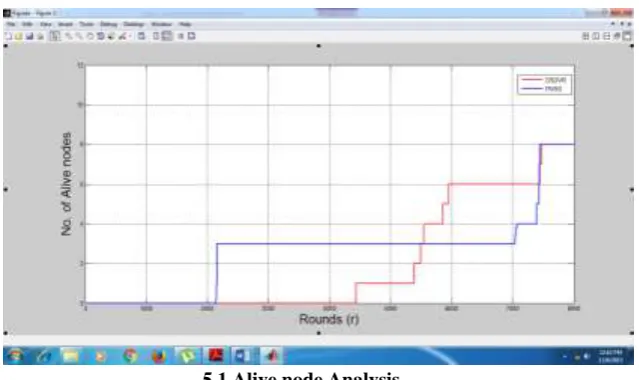
5.1 Alive node Analysis
The result so we obtained is depicted below, which shows the proposed algorithm has outperformed the DSDVR protocol in all scenarios.
It is the average number of messages successfully delivered per unit time.
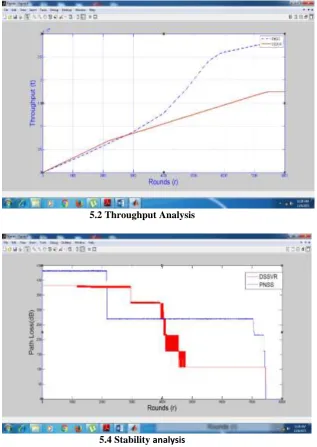
Fig. 5.1 shows each scheme‟s throughput performance, where throughput is calculated to be the number of data bytes delivered to the destination hosts. As compared with basic DSDVR and PNSS show better performance because of stability of route.
5.2 Throughput Analysis
5.4 Stability analysis
Figure 5.4 show the throughput 10, 20…50 for the 50 nodes scenario. Clearly our PNSS scheme achieves more network lifetime than the DSDVR scheme since it has both predicting stability features. Results of average network lifetime for the nodes,
VI.
CONCLUSION AND FUTURE WORK
6.1 Conclusion
achieves good packet delivery ratio, more network lifetime while attaining low delay, overhead, minimum energy consumption than the existing scheme DSDVR scheme while varying the number of nodes, node speed, and throughput and stability weight.
6.2 Future Work
In additionally, replication of service requests can be explored to reduce delays and improve percentage of completed service. Another direction of work, the effect of dropping service requests when expected delay is higher than the application requirements to offload the network resources is to be explored.
REFERENCES
[1] UmairSadiq, Mohan Kumar, Senior Member, IEEE, Andrea Passarella, and Marco Conti, “Service Composition in Opportunistic Networks: A Load and Mobility Aware Solution”, IEEE TRANSACTIONS ON COMPUTERS, VOL. 64, NO. 8, AUGUST 2015
[2] L. Pelusi, A. Passarella, and M. Conti, “Opportunistic networking: Data forwarding in disconnected mobile ad hoc networks,” IEEE Commun. Mag., vol. 44, no. 11, pp. 134–141, Nov. 2006.
[3] T. Spyropoulos, K. Psounis, and C. S. Raghavendra, “Efficient routing in intermittently connected mobile networks: The singlecopy case,” IEEE/ACM Trans. Netw., vol. 16, no. 1, pp. 63–76, Feb. 2008. [4] S. Nelson, M. Bakht, and R. Kravets, “Encounter-based routing in DTNs,” in Proc. IEEE Conf.
Comput. Commun., 2009, pp. 846–854.2
[5] A. Passarella, M. Conti, E. Borgia, and M. Kumar, “Performance evaluation of service execution in opportunistic computing,” in Proc. 13th ACM Int. Conf. Modeling, Anal. Simul. Wireless Mobile Syst., 2010, pp. 291–298.
[6] A. Passarella, M. Kumar, M. Conti, and E. Borgia, “Minimumdelay service provisioning in opportunistic networks,” IEEE Trans. Parallel Distrib. Syst., vol. 22, no. 8, pp. 1267–1275, Aug. 2011. [7] S. Kalasapur, M. Kumar, and B. A. Shirazi, “Dynamic service composition in pervasive computing,”
IEEE Trans. Parallel Distrib. Syst., vol. 18, no. 7, pp. 907–918, Jul. 2007.
[8] JaewookKwak, Chul-Ho Lee and Do Young Eun” High-order Markov Chain Based Scheduling Algorithm for Low Delay in CSMA Networks,” IEEE Trans. Parallel Distrib. Syst., vol. 22, no. 8, pp. 1267–1275, Aug. 2014.
[9] Ramalakshmi R and Radhakrishnan S, “Improving Route Discovery using Stable Connected Dominating Set in MANETS”, International journal on applications of graph theory in wireless ad hoc networks and sensor networks(GRAPH-HOC) Vol.4, No.1, March 2012,pp.15-25.
[10] Floriano De Rango, Francesca Guerriero and Peppino Fazio, “Link-Stability and Energy Aware Routing Protocol in Distributed Wireless Networks”, IEEE Transactions On Parallel And Distributed Systems, Vol. 23, No. 4, April 2012, pp.713-726.
[11] A. Chaintreau, P. Hui, J. Crowcroft, C. Diot, R. Gass, and J. Scott, “Impact of human mobility on opportunistic forwarding algorithms,”IEEE Trans. Mobile Comput., vol. 6, no. 6, pp. 606–620, Jun.2007.
[12] G. Sharma and R. Mazumdar, “Scaling laws for capacity and delay in wireless ad hoc networks with random mobility,” in Proc. IEEE Int. Conf. Commun., 2004, pp. 3869–3873.
[13] I. Rhee, M. Shin, S. Hong, K. Lee, and S. Chong, “On the Levy-walk nature of human mobility,” in Proc. IEEE Conf. Comput. Commun., 2008, pp. 924–932.
[14] K. Lee, S. Hong, S. J. Kim, I. Rhee, and S. Chong, “Slaw: A new mobility model for human walks,” in Proc. IEEE Conf. Comput. Commun., 2009, pp. 855–863.