Research on a New Kind of Robust Backstepping
Filter Derivative Control Method
Yue Zhi
Dept of Control Engineering, Naval Aeronautical and Astronautical University Yantai, China
Email: [email protected]
Junwei Lei and Jinyong Yu
Dept of Control Engineering, Naval Aeronautical and Astronautical University Yantai, China
Email: {leijunwei, yujinyong1024}@126.comAbstract—A novel Lyapunov function, which contains a
concept of transfer function, was constructed to prove the rightness of a new kind of robust backstepping filter derivative control method. Meanwhile, the relationship between Lyapunov function and transfer function was established, which is an important concept that can be applied in a large family of control systems. Also, the backstepping design technology is perfectly integrated with the PID control method, which was testified by the simulation result. And comparing with pure derivative method, better performance was achieved by the adopting of filter derivative method.
Index Terms—Lyapunov function, Transfer function, Filter
Derivativel, Backstepping
I.
I
NTRODUCTIONTransfer function is the most useful and important
concept in classic control theory. We have many methods
to analysis the stability of transfer functions such as
solving the root of polynomial of denominator[1,2].
Lyapunov function is one of the most important tools in
modern control theory. It can be used for the design of all
kinds of systems, especially for nonlinear complex big
systems. It is also a necessary tool to analysis the stability
of control system designed with modern control strategies
such as adaptive control or backstepping technology or
robust control, etc[3-6].Although there is no universal
rules to construct a Lyapunov function for a real system,
the Lyapunov function method is used widely for the
design and analyze of nonlinear systems and most
researchers like to use it because it is almost the only
effective meant to analyze a complex nonlinear
system[7-13]. Also it is a meaningful method because it
reveals the relationship between the stability of a system
and the virtual energy of a system, so it make the analysis
of the stability of a system to be a obvious simple
question from the energy point of view sight .
It is obvious that transfer function can be a useful and
meaningful part if it can be included in the controller
designed with modern control theory. But how to
integrate the above two kinds of ideas? And how to
analysis the stability of such kind of systems designed
with modern control theory and transfer function theory?
It is an interesting problem. Some of linear or nonlinear
control methods can be explained by the introducing of a
Lyapunov function, so it can make those methods easier
to be accepted by researchers. Also, it is meaningful to
find a Lyapunov function for an accepted old method
because we can get more close to the essence of stability
of nonlinear systems by thinking this problem from two
or more different angles[14-47]. In this paper, the
traditional design method, such as PID control and filters,
were perfectly integrated with the modern control method
such as backstepping technology. And a filter derivative
was constructed, which had better performance than pure
derivative control according to the numerical simulation
at the end of this paper. And the most important part is
that the relationship between transfer function and
Lyapunov function was revealed by constructing a new
type of Lyapunov functions which contains the traditional
transfer function.
II.
M
ODELD
ESCRIPTIONThe following two-order system is taken as an example
to illustrate the hybrid control of backstepping and
integral approach.
1 1 1 1 2
2 2 2
( )
( )
( )
( )
x
f x
f x
x
x
f x
f x
u
=
+ Δ
+
=
+ Δ
+
&
&
(1)
Assumption 1: there exists known constants
ci0and
1 i
c
such that
( ) 0 1d
i i i i i
f x x c c z
Δ −& ≤ +
.
III.
D
ESIGN OFC
ONTROLLERW
ITHP
URED
ERIVATIVEM
ETHODDefine a new variable as
1 1 1 dz
= −
x
x
, then the first
order subsystem can be written as
1 1
( )
1 1( )
2 1 dz
&
=
f x
+ Δ
f x
+
x
−
x
&
(2)
Design a virtual control as
2 1 1 1 1 1 1 1 1
1
1 1 1
1 1
( )
( )
dP D I
s t
x
f x
k z
k z
k
z dt
z
k sign z
k
z
ε
= −
−
−
−
−
−
+
∫
&
0 1 2 3 4 5 6 7 8 9 10 0
1 2 3 4 5 6 7
t/s
x1
Figure 1. Curve of x1(kD1=0)
0 1 2 3 4 5 6 7 8 9 10 0
1 2 3 4 5 6
t/s
x1
Figure 2. Curve of x1
(
kD1=1)
0 1 2 3 4 5 6 7 8 9 10 0
1 2 3 4 5 6
t/s
x1
Figure 3. Curve of x1 (kD1=kD2=1)
Define a new variable as
2 2 2 dz
=
x
−
x
, then the
following equation holds
(
)
1 1 1 1 1 1 1 1 1
2
2 1
1 2 1 1 1 1 1 1 1
(1 D) I ( ) d
P s t
k z z k z z dt z f x x
z
z z k z k z k
z
ε
+ + = Δ − +
− − −
+
∫
& &
(4)
Considering the second subsystem, we have
2 2( ) 2( ) 2 d
z& = f x + Δf x + −u x&
(5)
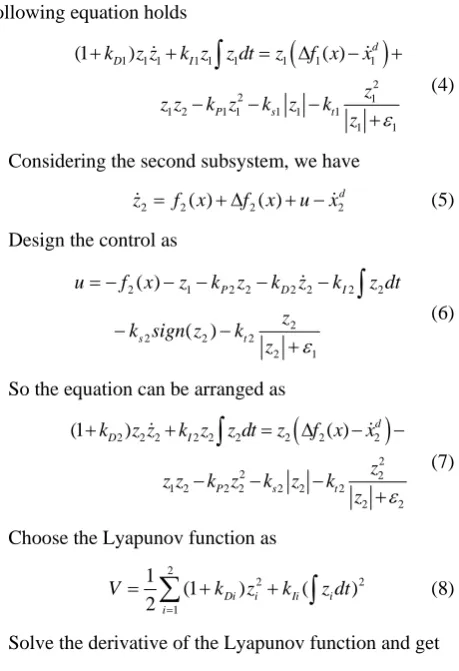
Design the control as
2 1 2 2 2 2 2 2
2
2 2 2
2 1
( )
( )
P D I
s t
u
f x
z
k z
k
z
k
z dt
z
k sign z
k
z
ε
= −
− −
−
−
−
−
+
∫
&
(6)
So the equation can be arranged as
(
)
2 2 2 2 2 2 2 2 2
2
2 2
1 2 2 2 2 2 2 2 2
(1 D ) I ( ) d
P s t
k z z k z z dt z f x x
z
z z k z k z k
z
ε
+ + = Δ − −
− − −
+
∫
& &
(7)
Choose the Lyapunov function as
2
2 2
1
1
(1
)
(
)
2
i Di i Ii iV
k
z
k
z dt
=
=
∑
+
+
∫
(8)
Solve the derivative of the Lyapunov function and get
(
)
22
2 1
( ) d i
i i i Pi i si i ti
i i i
z
V z f x x k z k z k
z
ε
=
= Δ − − − −
+
∑
& &
(9)
According to the assumption, there exist parameters
Pi
k
and
ksiwhich is big enough such that
0
V&≤
(10)
Now, it is easy to prove that the system is stable.
IV.
E
XAMPLE ANDS
IMULATIONConsidering the above two-order system, we choose
1 1 1 1 1 2 1
2 2 2 2 1 2
( )
3 ,
( )
sin(
)
( )
4 ,
( )
cos(
)
f x
x
f x
x x
x
f x
x
f x
x
x x
=
Δ
=
+
=
Δ
=
(11)
Then the two order system can be written as
1 1 1 2 1 2
2 2 2 1 2
3
sin(
)
4
cos(
)
x
x
x x
x
x
x
x
x
x x
u
=
+
+ +
=
+
+
&
&
(12)
We define the desired signal as
1 5 dx =
set the control
parameters as
kP1=5,
kIi=ksi=kti=5,
kP2 =20, and
do the simulation with parameter as
kD1=0and
1
1
Dk
=
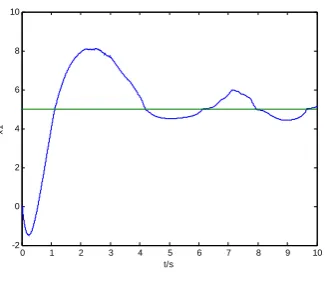
respectively, the simulation result can be shown as
Fig.1 and Fig. 2. We can know from the above figures
that the overshoot can be reduced by adopting the
backstepping and PD hybrid control method, also the
performance of the system can be improved. But we
should also point out that if the derivative coefficient
does not increase properly, oscillation will be caused
(For example, we choose
kD1=kD2=1to do the
simulation and the bad performance can be shown as Fig
3) or the system will become unstable (For example, we
choose
kD1=2,kD2 =1to do the simulation and the bad
performance can be shown as Fig.4). Also, in some
situation, the demand for simulation algorithm will
become very strict if the pure derivative item is used. In
other hand, it is very difficult to get some derivative
signals in many actual systems, so we will consider
adopting a filter derivative to take place the pure
derivative.
0 1 2 3 4 5 6 7 8 9 10 -2 0 2 4 6 8 10 12 14 t/s x1
Figure 4. Curve of x1(kD1=2,kD2=1)
V.
P
ROOF OFF
ILTERD
ERIVATIVEM
ETHODConsidering the above system
1 1 1 1 2
2 2 2
( )
( )
( )
( )
x
f x
f x
x
x
f x
f x
u
=
+ Δ
+
=
+ Δ
+
&
&
(13)
We define
1 1 1 dz
= −
x
x
and the first subsystem can be
written as
1 1
( )
1 1( )
2 1 dz
&
=
f x
+ Δ
f x
+
x
−
x
&
(14)
Design a virtual control as
2 1 1 1 1 1 1
1 1
1 1 1 1 1
1 1
( )
1
( )
d P DI s t
s
x
f x
k z
k
z
s
z
k
z dt
k sign z
k
z
τ
ε
= −
−
−
+
−
−
−
+
∫
(15)
where
1 1 s sτ
+is a filter which is used to get an
approximate derivative of the error
2
2
1 1
0,
2 1 1 2
z J
L J z
s s
τ
τ
= = ≥ =
+ +
(16)
Then we have
τ
L&+ =L Jand solve the derivative we
get
2 2
1 1 1 1 1
2 1
1 1 1
2 1 2 1
z
L J V z
s
z sz
z z z
s s
τ
τ
τ
τ τ
τ
τ
τ
= − = − + ⎡ ⎤ ⎡ ⎤ = ⎢ − ⎥= ⎢ ⎥ + + ⎣ ⎦ ⎣ ⎦ &(17)
Design
2 2 2 dz =x −x
then the following equation holds
(
)
2 1 1 1 1 1 1 1
1
2
2 1
1 1 1 1 2 1 1 1 1 1
1 1 1 2 1 ( ) D I d
P s t
k z
z z k z z dt
s
z
z f x x z z k z k z k
z
τ
ε
′ ⎛ ⎞ + +⎜ ⎟ + ⎝ ⎠ = Δ − + − − − +∫
& &(18)
Considering the second subsystem
2 2( ) 2( ) 2 d
z& = f x + Δf x + −u x&
(19)
We design the control as
2 1 2 2 2 2
1 2
2 2 2 2 2
2 1
( )
1
(
)
P D
I s t
s
u
f x
z
k z
k
z
s
z
k
z dt
k sign z
k
z
τ
ε
= −
− −
−
+
−
−
−
+
∫
(20)
Then the system can be arranged as
(
)
2 2 2 2 2 2 2 2
2
2
2 2
2 2 2 1 2 2 2 2 2 2
2 2 1 2 1 ( ) D I d
P s t
k z
z z k z z dt
s
z
z f x x z z k z k z k
z
τ
ε
′ ⎛ ⎞ + +⎜ ⎟ + ⎝ ⎠ = Δ − − − − − +∫
& &(21)
And the Lyapunov function can be chosen as
2 2 2 2 1
1
(
)
2
1
ii Ii i Di
i i
z
V
z
k
z dt
k
s
τ
=⎛
⎞
=
⎜
+
+
⎟
+
⎝
⎠
∑
∫
(22)
The derivative of Lyapunov function can be computed
as
(
)
22
2 1
( ) d i
i i i Pi i si i ti
i i i
z
V z f x x k z k z k
z
ε
=
= Δ − − − −
+
∑
& &
(23)
According to the assumption, there exist two big
enough parameters
kPiand
ksisuch that
0
V&≤
(24)
So it is easy to prove that the system is stable.
VI.
E
XAMPLE ANDS
IMULATIONNow the above system is used to do the simulation and
we set
1 1 1 1 1 2 1
2 2 2 2 1 2
( )
3 ,
( )
sin(
)
( )
4
,
( )
cos(
)
f x
x
f x
x x
x
f x
x
f x
x
x x
=
Δ
=
+
=
Δ
=
(25)
then the second order system can be written as
1 1 1 2 1 2
2 2 2 1 2
3
sin(
)
4
cos(
)
x
x
x x
x
x
x
x
x
x x
u
=
+
+ +
=
+
+
&
&
(26)
Define the desired value as
15
dx
=
and use the
backstepping and filter derivative hybrid control method,
and choose the control parameters
as
k
P1=
5
,
k
Ii=
5
,
k
si=
k
ti=
5
,
k
P2=
20
,
1
2
10.001
D0 1 2 3 4 5 6 7 8 9 10 0
1 2 3 4 5 6
t/s
x1
Figure 5. Curve of x1
0 1 2 3 4 5 6 7 8 9 10 0
1 2 3 4 5 6
t/s
x1
Figure 6. Curve of x1
0 1 2 3 4 5 6 7 8 9 10 -5
0 5 10 15 20
t/s
x1
Figure 7. Curve of x1
0 1 2 3 4 5 6 7 8 9 10 0
1 2 3 4 5 6 7 8
t/s
x1
Figure 8. Curve of x1
0 1 2 3 4 5 6 7 8 9 10 0
1 2 3 4 5 6
t/s
x1
Figure 9. Curve of x1
improve the performance of the system compared with
pure derivative method.
Considering that we further increase the uncertainties
of the system, we choose
22
( )
2cos(
1 2)
1f x
x
x x x
Δ
=
and use
pure derivative to do the simulation. Through a series of
simulations, we found a better one with parameters
as
k
D1=
0.5,
k
D2=
1
, and the simulation result can be
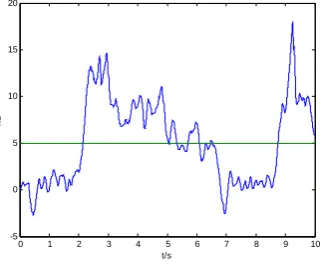
shown as Fig 6. It is obvious that if we want to reduce the
oscillation and make the curve smooth, we need to
increase the derivative coefficients. But the increase of
the derivative caused the system to be unstable
unexpectedly, which can be shown as Fig 7 where the
parameters are chosen as
k
D1=
2,
k
D2=
1
.
Later, used the filter derivative algorithm and chose
parameters as
k
D1=
2,
τ
1=
0.001
,
k
D2=
1,
τ
2=
0.1
, the
control effect is not very good, which can be shown as
Fig 8. And we changed the parameters as
1
5,
10.001
Dk
=
τ
=
and
k
D2=
3,
τ
2=
0.1
, and the
simulation result can be shown as Fig9. Also, the
parameters can be chosen in a big interval, and the
possibility that the system become unstable is reduced.
0 1 2 3 4 5 6 7 8 9 10 -2
0 2 4 6 8 10
t/s
x1
Figure 10. Curve of x1
VII.
C
ONCLUSIONSAbove of all, the main contribution of this paper can be
concluded as following points. First, a novel type of filter
derivative method was introduced to robust backstepping
design. Second, the relationship between transfer function
(an important concept in classic control theory) and
Lyapunov function (one of the most popular concept in
modern control theory) was established. What is very
different from other papers is that detailed and elaborate
simulations were done in this paper to research the
problem that how much uncertainties and how big an
amplitude of uncertainties can be solved by this filter
derivative method.
At last, the paper also shows some situations that the
proposed new method can not cope with and the reasons
are given to explain the result. Also, it points out our
future research field.
A
CKNOWLEDGMENTThe authors wish to thank their friend Heidi in Angels
(a town of Canada) for her help , and thank Amado for
his many helpful suggestions.
R
EFERENCES[1] Hao Lei,Wei Lin,Universal adaptive control of nonlinear systems with unknown growth rate by output feedback, Automatica 42 (2006) 1783-1789
[2] Hao Lei,Wei Lin,Adaptive regulation of uncertain nonlinear systems by output feedback: Auniversal control approach , Systems & Control Letters 56 (2007) 529– 537 [3] Swaroop D, Gerdes J C, Yip P P, Hedrick J K. Dynamic
surface control of nonlinear systems. In: Proceedings of the American Control Conference. Albuquerque, New Mexico: IEEE, 1997. 3028-3034
[4] Swaroop S, Hedrick J K, Yip P P, Gerdes J C. Dynamic surface control for a class of nonlinear systems. IEEE Transactions on Automatic Control, 2000, 45(10): 1893-1899
[5] Zhang, T., Ge, S.S. & Hang, C.C. Adaptive neural network control for strict-feedback nonlinear systems using backstepping design. Automatica, Vol. 36. No. 12 (2000) 1835-1846
[6] Chiman Kwan and F. L. Lewis. Robust backstepping control of nonlinear systems using neural networks. IEEE Transactions on systems, man and cybernetics,Vol. 30. No. 6 (2000) 753-766
[7] Junwei Lei, Xinyu Wang, Yinhua Lei, How many parameters can be identified by adaptive synchronization in chaotic systems? [J] Physics Letters A, Volume 373, Issue 14, 23 March 2009, Pages 1249-1256
[8] Junwei Lei, Xinyu Wang, Yinhua Lei, A Nussbaum gain adaptive synchronization of a new hyperchaotic system with input uncertainties and unknown parameters, [J] Communications in Nonlinear Science and Numerical Simulation, Volume 14, Issue 8, August 2009, Pages 3439-3448
[9] Xinyu Wang,Junwei Lei, Yinhua Lei,Trigonometric RBF Neural Robust Controller Design for a Class of Nonlinear System with Linear Input Unmodeled Dynamics[J]. Applied Mathmatical and Computation,185 (2007) 989 –1002
[10]Wang Xinyu, Lei Junwei, Design of Global Identical Terminal Sliding Mode Controller for a Class of Chaotic System,2006 IMACS Multiconference on Computational Engineering in Systems Applications(CESA ′2006), Tsinghua University Press,2006.10
[11]Xinyu Wang, Hongxing Wang, Hong Lei, Junwei Lei , Stable Robust Control for Chaotic Systems Based on Linear-paremeter-neural-networks, The 2nd International Conference on Natural Computation (ICNC'06) and the 3rd International Conference on Fuzzy Systems and Knowledge Discovery (FSKD'06), Sep 24-28, 2006, Xi-an, China
[12]GE S S,Wang C,Lee T H. Adaptive backstepping control of a class of chaotic systems[J]. Int J Bifurcation and chaos. 2000, 10 (5): 1140-1156
[13]GE S S, Wang C, Adaptive control of uncertain chus’s circuits[J]. IEEE Trans Circuits System. 2000, 47(9): 1397-1402
[14]Alexander L, Fradkov, Markov A Yu. Adaptive synchronization of chaotic systems based on speed gradient method and passification[J]. IEEE Trans Circuits System 1997,44(10):905-912
[15]Dong X. Chen L. Adaptive control of the uncertain Duffing oscillator[J], Int J Bifurcation and chaos. 1997,7(7):1651-1658
[16]Tao Yang, Chun-Mei Yang and Lin-Bao Yang, A Detailed Study of Adaptive Contorl of Chaotic Systems with Unknown Parameters[J] . Dynamics and Control. 1998,(8):255-267
[17]M.T. Yassen,Adaptive chaos control and synchronization for uncertain new chaotic dynamical system,Physics Letters A 350 (2006) 36–43
[18]H.Nijmeijer,M.Y.mareels.An observer looks at synchronization.IEEE Trans.on Circuits Syst.I.1997, (44):882-890
[19]M.T.Yassen.Chaos synchronization between two different chaotc systems using active control.Chaos,Solitons & Fractals.2005:23(4):131-140.
[20]H.N.Agiza,M.T.Yassen. Synchronization of Rossler and Chen chaotic dynamical systems using active control.Physics Letters A.2001,(278):191-197.
[21]Ming-chung Ho,yao-Chen Hung.Synchronization of two different systems by Using generalized active control. Physics Letters A.2002,(301):424-428.
[23]BemdaroM. An Adaptive approach to the control and synchronization of continuous time chaotic systems[J]. Int J Bifurcation and chaos. 1996,6(3):557-568.
[24]GE S S,Wang C,Lee T H. Adaptive backstepping control of a class of chaotic systems[J]. Int J Bifurcation and chaos. 2000, 10 (5): 1140-1156
[25] GE S S, Wang C, Adaptive control of uncertain Chua’s circuits[J]. IEEE Trans Circuits System. 2000, 47(9): 1397-1402
[26]Alexander L, Fradkov, Markov A Yu. Adaptive synchronization of chaotic systems based on speed gradient method and passification[J]. IEEE Trans Circuits System 1997,44(10):905-912
[27]Dong X. Chen L. Adaptive control of the uncertain Duffing oscillator[J], Int J Bifurcation and chaos. 1997,7(7):1651-1658
[28]Tao Yang, Chun-Mei Yang and Lin-Bao Yang, A Detailed Study of Adaptive Contorl of Chaotic Systems with Unknown Parameters[J] . Dynamics and Control. 1998,(8):255-267
[29]Oscar. Fuzzy control of chaos [J] . Int J Bifurcation and chaos. 1998.8(8): 1743-1747
[30]Liang Chen, Guanrong Chen, Lee Yang-Woo, Fuzzy modeling and adaptive control of uncertain chaotic systems[J]. Information Sciences. 1999, 121(1):27-37 [31]Liang Chen,Guanrong Chen.Fuzzy presictive control of
uncertain chaotic Systems using time series[J].Int J Bifurcation and chaos.1999,9(40:757-767.
[32]Chin Teng Lin.Controlling chaos by GA-based reinforcement learning neural network [J]. IEEE Trans On neural networks. 1999,10:846-859
[33]Gao Ping Jing et al. A simple global synchronization criterion for coupled chaotic systems. Solitons and fractals. 2003,(15):925-935
[34]Jianping Yan, Changpin Li. On synchronization of three chaotic systems. Chaos,Solitons and fracrals.2005,(23):1683-1688
[35]C.Sarasola,F.J.Torrealdea,A.D Anjou. Feedback synchronization of chaotic Systems[J].Int.J.Bifurcation and chaos.2003,13(1):177-191
[36]M.T.Yassen.Chaos synchronization between two different chaotc systems using active control.Chaos,Solitons & Fractals.2005:23(4):131-140
[37]H.N.Agiza,M.T.Yassen. Synchronization of Rossler and Chen chaotic dynamical systems using active control.Physics Letters A.2001,(278):191-197
[38]Ming-chung Ho, Yao-Chen Hung.Synchronization of two different systems by Using generalized active control. Physics Letters A.2002,(301):424-428.Jiang G.P., Tang K.S. A global synchronization criterion for coupled chaotic systems via unidirectional linear error feedback approach. Int. J. Bifurcation Chaos, 2002, 12(10):2239-2253
[39]Bu S.L., Wang S.Q.An algorithm based on variable feedback to synchronize chaotic and hyperchaotic systems. Physica D,2002,164:45-52
[40] Suykens. J.A.K, Robust nonlinear
H
∞synchronization of chaotic Lur’s system, IEEE Trans Circuit & System1997, 44(10):891-903[41]Michele B, Donato C. Synchronization of hyper-chaotic circuits via continuous feedback control with application to secure communication. Int. J. Bifurcation and Chaos, 1998,8(10):2031-2040
[42]Alexander L.Fradkov, A Yu.Markov. Adaptive synchronization of chaotic system phased on speed gradient method and passification. IEEE Trans on Circuit Syst.(I),1997,44(10):905-912
[43]Young_Hoon Joo, Leang-San shieh, Guangrong Chen, Hybrid state-space fuzzy model-based controller with dual-rate sampling for digital control of chaotic systems, IEEE Trans on Fuzzy Syst.(I),1999,7(4):394-408
[44]Alexander Pogromsky, Henk Nijmeijer. Observer-based robust synchronization of dynamical systems. Int,J. Bifurcation and Chaos,1998,8(11):2243-2254
[45]E.M.Elabbasy,H.N.Agiza,M.M.El-dessoky.Adaptive synchronization of lv System with uncertain parameters. Chaos,solitons and fractals. 2004,(21):657-667
[46]M.T.yassen. Adaptive synchronization of Rosser and lü systems with fully uncertain patameters. Chaos,solitons and fractals.2005,(23):1527-1536
[47]Ju H.Park. Adaptive sysnchronization of Rossler system with uncertain Parameters.Chaos, solitons and fractals.2005,(22):1-6.
Yue Zhi was born in Zouping, Shandong province of China on Dec, 1982. He received the B.S. degree in Electronic Automation and received the M.S. degree in Guidance, Control and Navigation from Naval Aeronautical and Astronautical University, China, in 2005 and 2008 respectively.
Now he is a Ph.D. candidate of Control Science and Engineering, Naval Aeronautical and Astronautical University, China. His current research interests include actuator and sensor nonlinearities, robust control and isolation of nonlinear systems.
Junwei Lei was born in Chibi, Hubei province of China on 9th Nov, 1981. He received the B. Eng degree in Missile Control and Testing and the Master Degree in Control Theory and Control Engineering from Naval Aeronautical Astronautical University, Yantai of China in 2003 and 2006 respectively. After that he continued his study there and received the Doctor degree in Guidance , Control and Navigation in 2010 .
He worked in NAAU as an assistant teacher in 2009 and became a lecture in 2010. His present interests are neural networks, chaotic system control, variable structure control and adaptive control.
Mr Lei studied in Canada Military Force and Language School in Base Bodern of Toronto from Jan to Jun in 2010.
Jinyong Yu was born in Haiyang, Shandong province of China in 1976. He received the B. Eng degree in Automation Engineering in Central South University in 1999 and received the Master Degree in Control Theory and Control Engineering from Naval Aeronautical Astronautical University, Yantai of China in 2002. He received the Doctor degree in Guidance, Control and Navigation from NAAU in 2006 respectively.