Multilevel Car Security Through Multimedia
Messaging Service
Sonal Namdev, Nishant Tyagi, Himanshu Tyagi, Anuj Kumar
JSS Academy of Technical Education, Department of Computer Science & Engineering, Noida-201301. Uttar Pradesh. INDIA. Meerut Institute of Technology, Department of Electronics And Communication Engineering, Meerut-250005. Uttar Pradesh. INDIA.
Meerut Institute of Engineering & Technology, Department of Information Technology, Meerut-250005. Uttar Pradesh. INDIA. Indian Institute Of Technology, Department Of Electronics And Communication Engineering, Roorkee. Uttrakhand. INDIA. Email: [email protected], [email protected], [email protected], [email protected]
ABSTRACT: For “Car Monitoring and Tracking System” two most crucial elements are integrated, they are monitoring and tracking system. In case any
intruder tries to breach security, this security system can send SMS and MMS if the owner is nearby. This system mainly features the use of MMS and database technology. Further, the local GSM/GPRS service provider can send photo of an intruder to user or/and police. Moreover, GPS is used to track the car when a theft has occurred. The implementation and testing results show the success of prototype in sending MMS to owner within 40 seconds and receiving acknowledgement to the database within 4 minutes. The timing and results are suitable to owner and police to take appropriate actions against intruder.
KEYWORDS: Car Monitoring; Car Alert; Tracking System; MMS; Database.
1. INTRODUCTION
For the security of Cars number of security systems had been produced but the results are not satisfactory. Since intruders are inventing cleverer techniques for vehicle stealing, for this purpose, there is a need to devise a powerful and strong security system. Car alarms are not showing their proper use in this area. These car alarm system do not cover large areas. The area remains in less than 100 m of range [1]. Interpol web results on vehicle crime shows that vehicle crime [2] has become the highly organized criminal activity which in turn affects the entire world. This crime is often linked to further crimes and terrorism. The main reason behind stealing vehicles is not only for the own sake of intruders. Sometimes the reason remains trafficking them to finance other crimes. They can also be used as bomb carriers or in the perpetration of other crimes [2]. End of December 2008, the database held more than 4.6 million record of reported stolen motor vehicles as in “Fig. 1”. Close to 151 countries use the database regularly, of whom 122 countries share their national stolen vehicle database records with INTERPOL. In 2008 more than 31,000 motor vehicles have been discovered worldwide through the Automated Search Facility-Stolen Motor Vehicle (ASF-SMV) database.
The different kinds of alert and monitoring products for car are: CARALL Multi Function Alarm System with Build in Key [6], Way Car Alarm with LCD Monitoring Pager [6], GSM Video Alarm C [7], GPRS/CDMA Wireless Surveillance Image Transmission [8], CCTV Safe Video Alert System [9], Security System for an Automobile via Mobile Phone [10], Autonomous Vehicle Monitoring and Tracking System [11], GPS/GSM/GPRS Vehicle Locator [12]. More details related to LR and specifications of security systems and components used in this project are described in references [13-19].
2. CONCEPT AND DESIGN OF CMAT MODEL
The crucial elements like monitoring, alerting and tracking are integrated to create a powerful security system which can send SMS to have fast response especially if the car is nearby. The picture of intruder will be sent via local GSM/GPRS service provider to police or security unit by using camera and MMS technology. To understand the proposed CMAT model, it is good to first to view the flowchart and components of the prototype of the model.
There are two parts of the model: the first part is installed in car and second part comprises of the outside car or PC system. The description of main components is as follow:
2.1 Side Part of Car
The side part of car consists of the microcontroller which is connected to a voltage supply, trigger button, camera and TTL to Rs 232 convertor connected to GPRS modem.
2.2 Programming and connection of PIC
The code is compiled then inserted to the PIC using the PIC Kit which converts the code into the HEX form and save in the PIC microcontroller.
2.3 Programming and GPRS modem connection We connect the GPRS modem with the PIC Kit, the following is the final complete circuit “Fig. 4”
Figure.4- final complete circuit
2.4 Database side
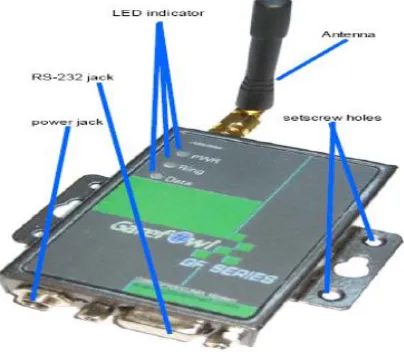
Figure. 5- GF-5000W MMS/GPRS MODEM
2.5 Programming
Here Microsoft Visual Basic is used where we program a gate to receive an MMS from the GPRS modem and insert it to the database which is compiled using Microsoft Access [6]. The following table 2 shows the description of the database table.
3. CMAT MODEL TESTING
The procedure for testing the CMAT model is as follows: Connect the power suppliers to all parts. Open the database graphical interface.
Connect the PC with the GPRS modem by choosing the right port and click connect.
Click the trigger button from the car side circuit. Wait the results.
The following “Fig.6” shows the main screen design or Database graphical interface for the CMAT model.
Following are the results obtained from CMAT testing.
3.1 Test No. 1
The first test was performed by clicking the trigger button which resulted in a MMS alert received to the mobile phone with a total delay of 45 seconds. “Fig.7” shows the mobile screen shoot as a test 1 result.
The MMS alert received to the database with a total delay of 6 minutes and 12 seconds. “Fig.8” shows the database screen shoot for the test 1.
3.2 Test No. 2
The MMS alert received to the database with a total delay of 4 minutes and 16 seconds. “Fig.10” shows the database screen shoot for the test 2.
3.3 Test No. 3
The second test was performed by clicking the trigger button which resulted in a MMS alert received to the mobile phone with a total delay of 37 seconds. “Fig.11” shows the mobile screen shoot as a test 3 result.
The MMS alert received to the database with a total delay of 56 seconds. “Fig.12” shows the database screen shoot for the test 3.
The test results can be summarized in the given table 3 with 3 extra tests.
These results show that, the MMS sent to a mobile phone takes less time than the time taken in MMS sent to the GPRS modem connected to the PC. The mobile phone will receive SMS within 40 seconds on average, while GPRS system receives SMS alert within 4 minutes on average. The differences are due to network availability. These results are quite acceptable.
4. CONCLUSION
The conclusion derived from this paper is that the CMAT model can be upgraded to a more advanced, portable and cost efficient system. In CMAT model, the photo of the intruder can be received within 4 minutes which is very helpful for police to take further actions.
5. FUTURE PROSPECTS
Finally, the novel methods proposed in this paper can be explored as easy to use techniques for automatic car tracking contributing to the “work in progress” vehicle safety research area.
REFERENCES
[1]. Brown, A. L. (1996). Vehicle Security Systems. Newnes.
[2]. http://www.interpol.int/Public/Vehicle/Default.asp
(Feb2010).
[3]. Kadar Jenayah. Statistics, www.rmp.gov.my (July 2009)
[4]. Regis J. B. Bates, (2001), GPRS: General Packet Radio Service, McGraw-Hill Professiona, New York.
[5]. Gwenaël Le Bodic, (2003), Multimedia Messaging Service: An Engineering Approach to MMS, Wiley; 1 edition, Washington.
[6]. Clare Churcher, (2007), Beginning Database Design: From Novice to Professional, Apress, Los Angeles.
[7]. Ben Forta, (2005), MySQL Crash Course (Sams Teach Yourself in 10 Minutes), Sams, New York.
[8]. [Simpson A. and Young M. L., (2003), Access 2003 All in-One Desk Reference for Dummies, For Dummies; 1 edition, New York.
[10]. Gurevich A., Borisov N. and Milikh G., (1997), Physics of Microwave Discharges: Artificially Ionized Regions in the Atmosphere, CRC; 1 edition, Singapore.
[11]. Product review:
http://www.fuzing.com/vli/00132281c200/NP1-NP4_GPR.
[12]. Emily M. Harwood, (2007), Digital CCTV: A Security Professional's Guide, Butterworth Heinemann, London.
[13]. Erme. N and Hasmawati. (2004), Security System for an Automobile via Mobile Phone, Final year project report, IIUM, Malaysia.
[14]. Carl J. Weisman, (2002), Essential Guide to RF And Wireless, Prentice Hall PTR; 2 edition, New York.
[15]. Ariffin.M. and Abd Wahid N., (2007), Monitoring and Alert System for Car, Final year project report, IIUM, Malaysia.
[16]. Bodic, G. L. (2005). Mobile Messaging Technologies and Services: MMS, EMS and MMS. Wiley, New York.
[17]. http://www.nowsms.com/documentation/Product
Documentation.overview.htm
[18]. Shaoji Ni and S.G. Haggman. “GPRS Performance estimation in GSM circuit switched services and GPRS shared resource systems.” Wireless Communications and Networking Conference, IEEE, 1999 .Pp 1417-1422, New Orleans, LA, USA, 1999.