Research Article
CODEN: IJPNL6
METHOD DEVELOPMENT AND VALIDATION OF SIMULTANEOUS ESTIMATION
OF ROSUVASTATIN AND OLMESARTAN IN BULK AND TABLET DOSAGE FORM
BY RP-HPLC
Elijabeth.Y*, Ramesh.B
1,K.Dhanalaxmi
2, Nagarjuna reddy
3*1
Department of pharmaceutical analysis, K.L.R College of pharmacy, Paloncha, Khammam,
A.P, India.
*Corresponding author e-mail:
[email protected]
ABSTRACTA simple, precise, accurate and rapid reverse phase high performance liquid chromatographic new method had been developed for simultaneous estimation of Rosuvastatin and Olmesartan in bulk and tablet dosage form. An Agilent XDB, C18 column having I’d of 150×4.6 mm and 5µm particle size was used. The new method was carried out in gradient program using mobile phase, 0.01M Potassium Dehydrogenate orthophosphate: acetonitrile (55:45 v/v) adjusted to pH-3.2 using dilute ortho phosphoric acid. Flow rate was adjusted to 1.0ml/min and effluents were monitored at 240nm. The retention time obtained for Rosuvastatin and Olmesartan was 2.61 and 5.13min respectively. The calibration curves were linear in the concentration range of 10-30µg/ml for Rosuvastatin and 50-150µg/ml for Olmesartan. The developed method was validated in accordance to ICH guidelines.
Key words: Rosuvastatin, Olmesartan, Acetonitrile, Buffer, RP-HPLC
.
INTRODUCTION
Rosuvastatin calcium is chemically [(E)-7[4-(4-fluorophenyl)-6-isopropyl-2-[methyl (methyl-sulphonyl) amino] pyrimidin-yl] (3R, 5S)-3, 5-dihydroxyhept-6-enoic acid] calcium salt. It belongs to a class of drugs called statins, which are employed to lower hypercholesterolemia and related conditions and to prevent cardiovascular diseases. It increases the number of hepatic low density lipoprotein receptors involved in the catabolism of LDL and also inhibits hepatic synthesis of very low density lipoprotein. A detailed survey of analytical literature for Rosuvastatin revealed few methods based on a variety of techniques such as UV-spectrophotometer, high performance thin layer chromatography (HPTLC) and HPLC. Since a HPLC method has many advantages over that of a HPTLC method for quantization, HPLC is often the first choice for developing an analytical method as compared to HPTLC. Till date, none of the reported analytical procedure describes a simple, satisfactory and
validated HPLC method for studying the effect of stress on pharmaceutical dosage forms as well as for assay and determination of content uniformity of Rosuvastatin calcium in tablet dosage forms. Olmesartan medoxomil (OLM) is a prodrug and hydrolyzed to Olmesartan during absorption from the gastrointestinal tract OML is a selective AT1 subtype angiotensin II receptor antagonist. OLM is described chemically as the (5-methyl-2-oxo-1, 3-dioxol-4-yl) methyl ester of 4-(1-hydroxy-1-methylethyl)-2-propyl-1-{[2-(1H-tetrazol-5-yl) [1, 1-biphenyl]-4-yl] methyl}-1H-imidazole-5-carboxylic acid. Hydrochlorothiazide (HCT), 6-chloro-3, 4-dihydro-2H-1, 2, 4-benzothiadiazine-7-sulphonamide 1, 1-dioxide, one of the oldest and widely used thiazide diuretics. Representative HPLC chromatogram and structures of Olmesartan medoxomil OLM (20 μg mL−1) and hydrochlorothiazide HCT (12.5 μg mL−1).OLM has not yet been officially described in any pharmacopoeia. OLM determination has been reported for single preparations or in combination with other antihypertensive drugs. The
International Journal of Pharmacy
USP describes an RP-HPLC method for the determination of HCT in tablets. Several analytical methods have been reported for the determination of HCT in pharmaceutical formulations including polarography, LC, HPTLC, and spectrofluorometry. A literature survey revealed that analytical methods have not been reported for the determination of OML and HCT in a combined tablet formulation. The present study was therefore aimed to provide such an economically viable RP-LC and HPTLC method.
MATERIALS AND METHOD
Chemicals and solvents: Pure samples of ROSUVA and OLME were obtained respectively from Spectrum pharma research solutions, Hyderabad, India. The commercial pharmaceutical preparation XARB-H containing 20mg and 40mg ROSUVA and OLME respectively (Marketed by Piramal Health care Pvt. Ltd).were procured from local pharmacy. Acetonitrile, Methanol and water used are of HPLC grade.
Instrumentation: The chromatographic separations were performed using HPLC-Waters alliance (Model-2695) consisting of an inbuilt auto sampler, a column oven and 2996 PDA detector. The data was acquired through Empower-2-software. The column used was Alliance C18 (150×4.6mm I’d, 5µm particle size). Meltronics sonicator was used for enhancing dissolution of the compounds. Dig sun pH meter was used for adjusting the pH of buffer solution. All weighing was done on sarotorious balance (model AE-160).
Chromatographic condition of method: An Agilent
XDB, C18 column having I’d of 150×4.6 mm and 5µm particle size was used. At ambient temperature. 1.36 g of Potassium dihydrogen orthophosphate was weighed and 1000ml of Milli-Q water was added to it. The mobile phase was considered buffer: acetonitrile. PH was adjusted to 3.2(0.02) with Ortho phosphoric acid and was filtered through 0.45µm PVDF membrane filter disc and was degassed. Flow rate was maintained at 1ml/min. The elution was observed at 240nm. Mobile phase was 55:45 (buffer: Actonitrile). Injection volume and runtime were 20 µl l and 10 mins respectively. In the ratio 55:45 retention time for Olmesartan and Rosuvastatin were observed to be 2.61 and 5.13 min respectively. The two peaks were well resolved with good peak shape and symmetry was obtained. Hence this method was finalized for the simultaneous estimation of Olmesartan and Rosuvastatin
Preparation of buffer solution: Accurately weighed 1.36 gm of Potassium Dehydrogenate orthophosphate (0.02M) was transferred into 1000ml volumetric flask. Add about 900ml of Milli-Q water and Sonicate to dissolve, then make up to 1000ml and then pH was adjusted to 3.4 using dilute Ortho phosphoric acid.
Preparation of mobile phase: The prepared phosphate buffer solution and acetonitrile was used as mobile phase in ratio 55:45.
Preparation of standard stock solutions: Accurately Weighed and transferred 20mg of Olmesartan and 40mg of Rosuvastatin and working Standards into a 10 ml clean dry volumetric flask, add 7ml of diluents , sonicated for 5 minutes and make up to the final volume with diluents.(standard stock). This was used for calibration purpose of both the drugs.
Preparation of sample solution: 5 tablets were weighed and calculate the average weight of each tablet then the weight equivalent to 5 tablets was transferred into a 100 mL volumetric flask, 80mL of diluents added and sonicated for 25 min, further the volume made up with diluents and filtered. From the filtered solution 0.2ml was pipette out into a 10 ml volumetric flask and made up to 10ml with diluents.
METHOD VALIDATION
The developed method was validated as per the ICH (International Conference on Harmonization) guidelines with respect to System suitability, Precision, Specificity, Linearity, Accuracy, Limit of detection and Limit of quantification.
Linearity: Aliquots of 0.25, 0.75, 1.0, 1.25, and 1.5 ml were taken from stock solution of concentration 1000µg/ml OLME and 500µg/ml ROSUVA, and then diluted up to mark with methanol. Such that the final concentrations were in the range 10-30µg/ml for OLME and 50-150µg/ml for ROSUVA. Volume of 10µl of each sample was injected in five times for each concentration level and calibration curve was constructed by plotting the peak area versus drug concentration. The observations and calibration curve were shown in Table 1 and Fig. 2, 3.
Estimation of Olmesartan and Rosuvastatin:
the mark with diluents methanol to obtain solution of OLME (20µg/ml) and ROSUVA (40µg/ml). The results were shown in Table-2. The chromatograms were shown in Fig-4, 5.
Accuracy: Accuracy of the method was done by recovery study. Sample solutions were prepared by spiking at about 50%, 100%, and 150% of specification limit to placebo and analyzed by the proposed HPLC method. Results are shown in Table-4.
Specificity: The specificity of the method was performed by injecting blank solution( without any sample) and then a drug solution of 20µl injected into the column, under optimized chromatographic conditions, to demonstrate the separation of both OLME and ROSUVA from any of the impurities, if present. As there was no interference of impurities and also no change in the retention time, the method was found to be Specific.
Limit of detection (LOD) and Limit of quantification (LOQ): The parameters LOD and LOQ were determined on the basis of response and slope of the regression equation. The linearity for OLME and ROSUVA was performed from 10-30µg/ml and 2.5-18.75µg/ml respectively.
System precision: Precision is the measure of closeness of the data values to each other for a number of measurements under the same analytical conditions. Standard solution of OLME (20µg/ml) and ROSUVA (40µg/ml) were prepared as per test method and injected for 3 times. Results are shown in Table-4.
Method precision: Three samples were prepared and analyzed as per the test method on same day and three different days and calculated the % RSD for assay of five preparations. Results were shown in Table- 5.
Robustness: Robustness studies were carried out by variations in flow rate, mobile phase compositions and temperature. It was observed that the small changes in these operational parameters did not lead to changes of retention time of the peak interest. The degree of reproducibility of the results proven that the method is robust.
System suitability test: The system suitability was determined by making six replicate injections from
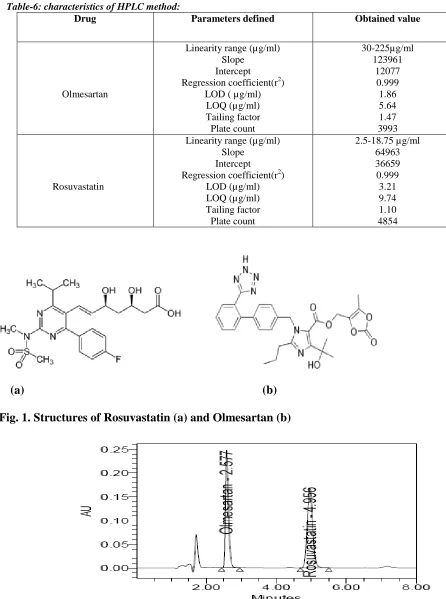
freshly prepared standard solutions. The observed RSD values were well within usually accepted limits (≤2%). Theoretical plates, tailing factor, resolution between OLME and ROSUVA were determined. The results are all within acceptable limits summarized in Table-6.
RESULTS AND DISCUSSION
The new method was developed by Olmesartan and Rosuvastatin. Nature of sample, its molecular weight and solubility decides the proper selection of stationary phase. The drugs OLME and ROSUVA were preferably analyzed by reverse phase chromatography and accordingly C18 column was
selected. The elution of the compounds from column was influenced by polar mobile phase. The ratio of phosphate buffer to Acetonitrile was optimized to (55:45) to give well resolved and good symmetrical peaks with short run time. The retention time of OLME and ROSUVA were found to be 2.611 & 5.138 min respectively. The linearity of the method was statistically confirmed. RSD values for accuracy and precision studies obtained were less than 2% which revealed that developed method was accurate and precise. The system suitability parameters were given in table-5. The analytical recovery at five different concentrations of OLME and ROSUVA was determined and the recovery results were in the range of 10-30µg/ml. Therefore proposed validated method was successfully applied to determine OLM and ROSUVA in tablet dosage form.
CONCLUSION
The new developed method is accurate, simple, rapid and selective for the simultaneous estimation of OLME and ROSUVA in Tablet dosage form. The retention time of OLME and ROSUVA were found to be 2.611 & 5.138 min respectively. The excipients of the commercial sample analyzed did not interfere in the analysis, which proved the specificity of the method for these drugs. The sample preparation is simple, the analysis time is short and the elution is by gradient method. Hence the proposed method can be conveniently adopted for the future quality control analysis in the combined formulation.
Table-1: Linearity
s.no
Concentration of
OLME in µg/ml OLME area
Concentration of
ROSUV in µg/ml ROSUVA area
1 10
1192845 20 1405952
2 15 1850914 30 1961437
3 20 2480230 40 2635705
4 25 3116334 50 3295767
Table-2: OLME and ROSUVA assay:
Drug
Label claim mg/tab
Amount found mg/tab
Label
claim(% ) S.D* % R.S.D
OLME 20 19.90 99.90 22443.53 0.84574
ROSUV 40 39.49 99.93 2948.472 0.101878
Table-3: Accuracy
% linearity level No. of
times
% recovery %mean recovery ± S.D % RSD
50
1 100.3527
100.52± 0.166744 0.165861
2 100.5608
3 100.6825
100
1 98.3923
99.7905± 1.232173 1.234671
2 100.6925
3 100.3083
150S
1 100.262
99.6064 ± 0.791952 0.794119
2 98.72363
3 99.81927
Table-4: System precession: INJECTIONS AREAS(OLME) AREAS(R0SUVA)
1 2625657 2897886
2 2634276 2897032
3 2646601 2892929
4 2673054 2894023
5 2658654 2893015
6 2683789 2889859
AVG 2653672 2894124
S.D 22443.53 2948.472
%R.S.D 0.845754 0.101878
Table-5: Method precession:
Drug % Assay Mean S.D % R.S.D
OLME
98.21623 98.04171 97.57332
98.08809
97.91057
98.26261
98.01542 0.250539 0.255612
ROSUVA
101.2046
100.14993
98.45324
100.9049
101.504
99.12103
Table-6: characteristics of HPLC method:
Drug Parameters defined Obtained value
Olmesartan
Linearity range (µg/ml) Slope
Intercept
Regression coefficient(r2) LOD ( µg/ml)
LOQ (µg/ml) Tailing factor Plate count
30-225µg/ml 123961
12077 0.999 1.86 5.64 1.47 3993
Rosuvastatin
Linearity range (µg/ml) Slope
Intercept
Regression coefficient(r2) LOD (µg/ml) LOQ (µg/ml) Tailing factor Plate count
2.5-18.75 µg/ml 64963 36659 0.999 3.21 9.74 1.10 4854
(a)
(b)
Fig. 1. Structures of Rosuvastatin (a) and Olmesartan (b)
REFERENCES
1. Kumar TR, NR, Kumar PK, Vinu MC, Kumar VV, Mullangi R, et al. Determination of Rosuvastatin in rat plasma by HPLC Validation and its application to pharmacokinetic studies. Biomed Chromatograms 2006; 20:881-887.
2. Vittal S, Kumar TR, Shitut NR, Vinu MC, Kumar VV, Mullangi R. Simultaneous quantization of Rosuvastatin and Gemfibrozil in human plasma by high performance liquid chromatography and its application to a pharmacokinetic study. Biomed Chromatograph 2006; 20: 1252-1259.
3. Mehta TN, Patel AK, Kulkarni GM, Suubbaiah G,Determination of Rosuvastatin in the presence of its degradation products by a stability‐indicating LC method. J AOAC Int 2005; 88(4):1142-1147.
4. Suslu I, Celebier M, Altnoz S. Determination of Rosuvastatin in Pharmaceutical Formulations by Suresh Kumar GV et al. PharmTech Res.2010, 2(3) 2021 Capillary Zone Electrophoresis. Chromatographia 2007; 66:65-72.
5. Uyar B, Celebier M, Altinoz S. Spectrophotometric determination of Rosuvastatin calcium in tablets. Pharmazie 2007; 62:411-413.
6. Sane RT, Kamet SS, Menon SN, Inamdar SR, Mote MR. Determination of Rosuvastatin calcium in its bulk drug and pharmaceutical preparations by high-performance thin layer chromatography. J Planar Chromatogr 2007; 18:194-198.
7. ICH-Q2B Validation of Analytical Procedures: 1996. Methodology International Conference on Harmonization of Technical Requirements for Registration of Pharmaceuticals for Human Use, Geneva, Switzerland. Indian Pharmacopoeia. Ghaziabad: The Indian Pharmacopoeia Commission; 2007 vol 3 p.1676-1678.
8. Dannana GS, Marothu VK. Extractive Spectrophotometric methods for the determination of Rosuvastatin calcium in pure form and in pharmaceutical formulations by using safranin O and methylene blue. E J Chem2007; 4(1):46-49.
9. Gupta A, Mishra P, Shah K. Simple UV Spectrophotometric determination of Rosuvastatin calcium in pure form and in pharmaceutical formulations. E J Chem. 2009; 6(1):89-92.
10. Murakami T, Konno H, Fukutsu, Onodera M, Kawasaki T and Kusu F.: Identification of a degradation product in stressed tablets of olmesartan medoxomil by the complementary use of HPLC hyphenated techniques. J Pharm Biomed Anal 2008, 47, 553.
11. Vipul P Rane, Kiran R Patil, Jaiprakash N Sangshetti, Ravindra D Yeole and Devanad B Shinde.: Stability indicating LC method for the determination of olmesartan in bulk drug and Pharmaceutical dosage form. Chromatographia, 2009, 69,169.
12. Lisiane Bajerski, Rochele C Rossi, Carolina L Dias, Ana M Bergold and Pedro E Froehlich. Stability indicating LC Determination of a new antihypertensive, olmesartan medoxomil in Tablets. Chromatographia 2008, 68, 991.
13. Celebier M, Altinoz S.: Determination of olmesartan medoxomil in tablets by UV-Vis Spectrophotometry. Pharmazie, 2007, 62(6):419.
14. Piyush Trivedi, Kartikeyan.C, Raman Kachave, Rajendra Bhadane.: stability-indicating assay method for estimation of olmesartan medoxomil and its metabolite. Journal of Liquid Chromatography & Related Technologies 2009, 10, 1516.
15. Patel CV, Khandhar AP, and Captain AD, Patel KT.: Validated absorption factor spectrophotometric and Reverse-phase High Performance Liquid Chromatography methods for the determination of Ramipril and Olmesartan Medoxomil in pharmaceutical formulations. Eurasian J Anal Chem 2009, 2, 159.