Email:{shegufta.b.ahsan, persia.aziz}@gmail.com, [email protected]
Abstract—In this paper, we present a new and efficient algorithm for solving the Longest Common Subsequence (LCS) problem between two run-length-encoded (RLE) strings. SupposeYˆ andXˆare twoRLEstrings having length
ˆ
k and `ˆrespectively. Also assume that Y and X are the two uncompressed versions of the two RLE strings Yˆ and
ˆ
X having lengthk and`respectively. Then, our algorithm runs inO((ˆk+ ˆ`) +Rlog log(ˆk`ˆ) +Rlog logω)time, where ω =k+`and R is the total number of ordered pairs of positions at which the twoRLEstrings match. Our algorithm outperforms the best algorithms for the same problem in the literature.
Index Terms—RLE, LCS, vEB Tree, Bounded Heap, Matched Block Calculation.
I. INTRODUCTION
S
UPPOSE two stringsX[1. . . n] =X[1]X[2]. . . X[n]and Y[1. . . n] = Y[1]Y[2]. . . Y[n] are given. A subsequence S[1. . . r] = S[1]S[2]. . . S[r], 0 < r ≤ n of X is obtained by deleting n−r symbols from X. A common subsequence of two strings X and Y, denoted lcs(X,Y) is a subsequence common to both X and Y. The longest common subsequence (LCS) problem for two strings is to find a common subsequence in both the strings, having the maximum possible length.
There is a string compression technique which is called run-length-encoding [1]. In a string, the maximal repeated string of characters is called a run and the number of repetitions is called the run-length. Thus, a string can be encoded more compactly by replacing a run by a single instance of the repeated character along with its run-length. Compressing a string in this way is called run-length-encoding and a run-length-encoded string is abbreviated as anRLE string. For example, theRLE string of the string bdcccaaaaaa is b1d1c3a6. Given two RLE
strings, the longest common subsequence problem for two RLE strings (Problem LCS 2RLE) is to find a common subsequence in both the strings, having the maximum possible length. In this paper, we present an efficient algorithm to solveProblem LCS 2RLE.
A. Literature Review
The problem of computing LCS when one or both of the strings are run-length-encoded has attracted significant attention in the literature. Freschi and Bogliolo [2] pro-posed anO(k`ˆ+`kˆ−`ˆˆk)time algorithm for finding the
longest common subsequence between two RLE strings, where ` and k are the lengths of the original strings X andY, respectively, and`ˆandkˆare the numbers ofruns in the RLErepresentations ofX andY, respectively.
An interesting and perhaps more relevant parameter for the LCS problem is R, which is the total number of ordered pairs of positions where the two strings match. Ef-ficient algorithms based on parameterRto solve theLCS problem for uncompressed strings have been proposed in the literature [3], [4]. Working with a similar goal, Mitchell proposed anO((R+ ˆk+ ˆ`) log(R+ ˆk+ ˆ`)) algo-rithm [5] capable of computing anLCSwhen both inputs areRLEstrings. Ann et al. [6] also proposed an algorithm for solving the same problem in O(ˆk`ˆ+ min(p1, p2))
time where p1, p2 denote the number of elements in
the bottom and right boundaries of the matched blocks respectively. Apostolico et al. [7] gave another algorithm for this problem which runs in O(ˆk`ˆlog(ˆk`ˆ)) time. To the best of our knowledge the latest work on this prob-lem are from Sakai [8] which proposes a solution of
O(ˆk`ˆlog log(min(ˆk,`, k/ˆ k, l/ˆ `, Xˆ ))) time where X is
the average difference between the length of a run from one input string and that of a run from the other. Notably, this is a conference paper which does not provide many proofs and details due to space constraints and we are still waiting for the journal version of the paper to be published to get all the details.
The variants of the LCS problem have also been investigated in literature. Liu et al. [9] proposed an
O(min(k`, `ˆ kˆ)) time algorithm and Ahsan et al. [10]
proposed anO(`+Rlog log ˆk)time algorithm for finding a longest common subsequence when one of the strings is RLEand the other is an uncompressed string. Farhana et al. [11] presented finite automata based algorithms for two recently studied variants of the classic LCS problem, namely, the Doubly-Constrained LCS (DC-LCS) and Hybrid-Constrained LCS (HC-LCS). Alam et al. [12] proposed an O(k`) algorithm to solve the Substring Inclusion Constrained LCS problem.
B. Our Contribution
Fig. 1. Blocks containing ‘*’ are the elements of setMfor(I)two uncompressed strings, where|M|=R=12, and(II)two
encoded strings, where|M|=R=3.
protein sequences to learn how homologous they are. The motivation of usingRLEstrings is to reduce cost in such computations because the DNA and protein sequences are mostly large and have consecutive identical characters.
We combine the idea and technique of Apostolico et al. in [7] and Iliopoulos and Rahman in [3], [15] to devise an efficient algorithm for Problem LCS 2RLE. Our main result is anO((ˆk+ ˆ`) +Rlog log(ˆk`ˆ) +Rlog logω)time algorithm, whereω=k+`.
C. Road Map
The rest of the paper is organized as follows. In Section II, we discuss about the notation and definitions that we have used throughout this paper. In Section III, we describe our algorithm. In Section IV, we discuss about the complexity of the algorithm. Finally, we briefly conclude in Section V.
II. PRELIMINARIES
Throughout this paper, we use the following conven-tions. We useXˆ = ˆX1Xˆ2. . .Xˆ`ˆto denote the
run-length-encoding of a string X, where Xˆj,1 ≤ j ≤ `ˆ is a maximal run of identical characters and|Xˆj|denotes the length of this run. We say that the length of the RLE string Xˆ is |Xˆ| = ˆ`. The length of string X, denoted `, represents the total number of characters in X. So ` =|X| =Pˆ`
j=1|Xˆj|. We usexj to denote the unique character comprising the runXˆj.
We maintain akˆ∗`ˆmatrixT (corresponding to the runs of characters inYˆ andXˆ), such thatT[i, j]contains the value of an optimal solution between the prefixesXˆ[1···j]
andYˆ[1···i].
Note that, the notation R and M may be used in the context of both compressed and uncompressed strings (Fig. 1). In both case, the concept remains the same. So,R is the total number of ordered pairs of positions at which the characters (character blocks) of two uncompressed (compressed) strings match. More formally, for com-pressed strings, we say a pair(i, j),1≤i≤ˆk,1≤j≤`ˆ defines a match ifxj=yi. Additionally, if xj =yi=α, then we say that the match (i, j) contains or is due to the character α. The set of all matches, Mis defined as follows:
Fig. 2. A path, consisting of character ‘c’ and starting from the
left corner ofT[2,2].
M={(i, j)|xj=yi,1≤i≤ˆk,1≤j≤`ˆ}
In Fig. 1, the blocks containing ‘*’ is a matched block. Observe that |M|=R.
We useCOU N Tjˆ
X(α)to denote the number of occur-rences of the character αin the uncompressed version of
ˆ
X1Xˆ2· · ·Xˆj, where 1 ≤j ≤ `. For example, in stringˆ ˆ
X = b3c2b7a5c6b1a6, COU N T7 ˆ
X(b) = 11, because in
the uncompressed version ofXˆ1Xˆ2· · ·Xˆ7, there are total
3+7+1 = 11occurrences ofb. The tablesCOU N Tjˆ
X(α), 1 ≤ j ≤ `ˆ and COU N Tˆi
Y(α), 1 ≤ i ≤ ˆ
k, can be computed easily in O(ˆk+ ˆ`)time.
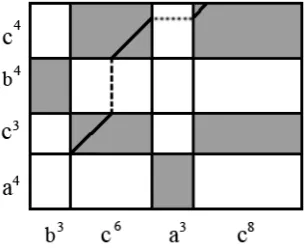
Fig. 2 illustrates the matrix of blocks for the input strings Xˆ =b3c8a3c8 andYˆ =a4c3b4c4. We say that a block(i, j)is dark if the corresponding characters match, i.e. yi =xj; block (i, j) is light if yi 6=xj. Sometimes dark blocks are referred to as matched blocks.
If T[i, j] is a matched block consists of character α, then a path starts from the lower-left corner of T[i, j]. While it traverses through block T[i, j], it goes at 45◦
with the bottom boundary. The path ends if it hits the upper-right corner of the block. Else if the path hits the top (right) boundary of the block, it goes vertically (horizontally) until it hits the next matched block (if any) at T[i, j0] where j + 1 < j0 ≤ `ˆ(T[i0, j] where i+ 1< i0≤ˆk). After entering thematched blockT[i, j0]
(T[i0, j]), again it traverses that block at 45◦ with the bottom boundary and when theupper-rightortoporright corner is reached, it repeats the same procedure described above. This procedure continues until either the path hits the upper-right corner of a matched block, or the path exceeds the boundary of T.
Fig. 2 shows an example of a path starting from the lower-left corner of T[2,2] which is a matched block consists of character ‘c’. It traverse at 45◦ insideT[2,2]
(solid path). While it reaches thetopboundary ofT[2,2], it starts traversing vertically (dashed path) until it hits the nextmatched blockatT[4,2]. Inside thismatched block, it again traverse at45◦ (solid path) and while it reaches the right boundary ofT[4,2], it starts traversing horizontally (dotted path) until it hits the nextmatched blockatT[4,4]. It traverse at45◦insideT[4,4](solid path) and reaches at
Fig. 3. Converting an arbitrary subpath into a forced subpath.
of T, this path which was started from T[2,2]ends its traversal.
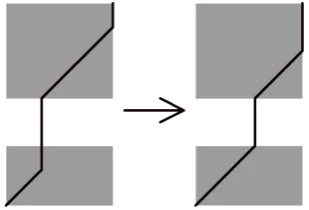
Apostolico et al. [7] first introduced the concept of a corner path which is a path entering a matched block only at the lower-left corner and exiting only through the upper-right corner. On the other hand, a path beginning at the lower-left corner of a matched blockis aforced path if it traverses matched blocksby strictly diagonal moves and, whenever the right (respectively upper) side of an intermediatematched blockis reached, it proceeds ,to the nextmatched blockby a straight horizontal (respectively vertical) “leap” through the light blocks in between. Intuitively, whenever we enter amatched blockin a lower-left corner, it will be the start of aforced path. Theforced pathstops when it hits either the right or the upper side and the path follows the side to the upper-right corner. Any arbitrary path can be converted to aforced path. The process is illustrated in Fig. 3.
We define RAN K(α, i, j) = COU N Tˆi−1 Y (α) − COU N Tjˆ−1
X (α) to be an attribute of a path starting from T[i, j] and containing character α. Maximum possible value of RAN K for any α ∈ Σ can be k as follows:RAN Kmax(α,ˆk,1)
= COU N Tˆkˆ−1
Y (α) − COU N T
1−1 ˆ
X (α) =
COU N Tˆkˆ−1
Y (α)−0≤k
Similarly, minimum possible value ofRAN K for any α∈Σcan be −` as follows:RAN Kmin(α,1,`ˆ) = COU N T1ˆ−1
Y (α) − COU N T
ˆ
`−1 ˆ
X (α) = 0 −
COU N T`ˆˆ−1
X (α)≥ −`
Clearly, all possible values of RAN K can be rep-resented by the numbers within the range [−`, k] that containsω=k+`values.
III. OURALGORITHM
In this Section, we present a new algorithm by ex-tending the concept of a path based solution for LCS between two RLE strings by Apostolico et al. [7]. To improve performance, we will use the techniques used by Iliopoulos and Rahman [3], [15].
In this algorithm, our plan is to compute only those T[i, j] for which (i, j)∈ M. The following information is kept for each forced path that starts from the block T[i, j]:(1)The starting location of the path, namely(i, j);
(2)the character of the match, i.e.α;(3)itsinitial value
(5,1) 16 0 16
(5,3) 16 7 9
(5,5) 16 17 −1
Fig. 4. Forced paths consist of same character never cross each other
and obey a top-down order which is maintained byRANK.
υin; and (4) its RANK. For a path, started at T[i, j], its initial valueυinismax(T[i0, j0]),1≤i0< i,1≤j0 < j. If i = 1 or j = 1, then initial value υin = 0. Naive calculation of υin may require the calculation of some T[i, j], for which (i, j)∈ M/ . But later we will present a novel algorithm to calculate the initial value υin by considering only the matched blocks.
It is clear from [7] that all characters which are matched on any given forced path will be identical. Also twoforced paths which proceed on matches of different instances of the same character will never cross each other (Fig. 4). Hence, the forced paths consist of same character obey a top-down order which is maintained by RAN K. So, the path, starting from T[i, j], and containing character αintersects any columnj0≥j according to the value of RAN K(α, i, j). For example, in Fig. 4 the forced paths consist of character ‘a’ and passing column5maintain an order according to their RAN K. Similarlyforced paths consist of character ‘a’ and passing row 5 maintain an order according to their RAN K. The calculation of the RAN K is explained in Table I.
Now consider a forced path of α, which starts at T[i, j] with an initial valueυin. When this path crosses column j0 > j, its value υ = υin+COU N Tj
0
ˆ
X(α)− COU N Tjˆ−1
Fig. 5. Deletion of a lower valued path which has higher RANK
i0 > i, its value will be υ = υin+COU N Ti
0
ˆ
Y(α)− COU N Tiˆ−1
Y (α).
So it is clear for a forced path ofαwhich starts at(i, j)
with an initial value υin that if a column j0, j≤j0 ≤`ˆ (row i0, i≤i0 ≤ˆk)is given, then thevalueof the forced path that crosses this column (row)can be computed in O(1)time, following O(ˆk+ ˆ`)time preprocessing.
T is an kˆ ∗`ˆmatrix such that T[i, j] contains the value of an optimal solution between prefixesXˆ[1···j]and
ˆ
Y[1···i], 1 ≤j ≤`ˆand 1≤i ≤k. From [7], it is foundˆ
that T[i, j] is the maximum of T[i−1, j],T[i, j −1]
and the value of the forced paths that cross block (i, j), including the one that starts on itslower-leftcorner. The set of forced paths can be divided into two groups. The first group contains all paths that cross column j below rowi, while thesecond groupcontains all paths that cross rowion the left of columnj. Our goal is to find the path with the highest score in each group, so that T[i, j] can be computed in O(1) time.
Below, we discuss how to find the path with maximum value in the first group. Here we consider forced paths that match the character α. Thesecond group and other characters can be handled similarly.
According to [7], it can be said that if we consider two forced pathsP1andP2with valuesυ10 andυ02respectively
when they cross column j0, and υ00
1 andυ200 respectively
when they cross column j00. Then those values obey the equality: υ01−υ20 =υ001−υ200.
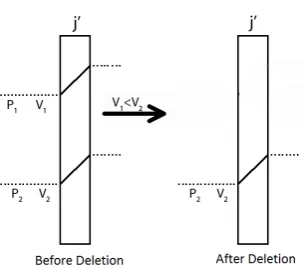
Therefore whenever a forced pathP1intersects column
j0 higher than another forced path P2, but the value of
P1 at j0 is smaller than the value of P2 atj0, then path
P1can be excluded from further consideration and hence
can be deleted (Fig. 5). Our goal is to maintain, in order, only the paths which have higher values than the paths below them.
In order to be able to maintain the above properties we use an elegant data structure (referred to as the vEB tree henceforth) invented by van Emde Boas [16] that allows us to maintain a sorted list of integers in the range
[1. . . n]inO(log logn)time per insertion and deletion. In addition to that it can return next(i) (successor element of iin the list) andprev(i)(predecessor element ofiin the list) in constant time.
Here, we use RAN K as the key of the vEB trees.
Fig. 6. Two closest paths to the upper-right corner ofT[i, j], one crossing the upper boundary of T[i, j]and another crossing the right
boundary ofT[i, j](partial view).
For each character α, two vEB trees are maintained, one (vEB(α,col)) maintaining the ordered list of paths
matching the character α and crossing columns and the other (vEB(α,row)) maintaining the ordered list of paths
matching the character α and crossing rows. These two trees will be used in dealing with all dark blocks that matchα.
Here since the paths are sorted according to their RAN Ks and values, it is sufficient to consider only two forced paths. These paths are the two closest paths to the upper-right corner of T[i, j], one that crosses the right side of T[i, j] and one that crosses the upper side of T[i, j]as shown in Fig. 6.
For each (i, j) ∈ M and containing letter α, a new record hRAN K, υini for the path started from the lower left corner of T[i, j]is inserted in vEB(α,col) and
vEB(α,row)according to itsRAN K. This new record is
called Recordnew. The current valueυ of the new path is calculated. The value υlef t of the record Recordpre, which is the predecessor of theRecordnewofvEB(α,col)
is calculated. If υ < υlef t, then Recordnew is deleted, otherwise thevalueυrightof the recordRecordsucwhich is the successor ofRecordnewis calculated. Ifυright< υ thenRecordsucis deleted and this process continues until in vEB(α,col), a successor of Recordnew with a greater valueis reached. This process is described in Algorithm 2. Similar operations are applied on vEB(α,row).
Now, Z = COU N Ti
ˆ
Y(α)−COU N T j
ˆ
X(α). In the vEB(α,col), thevalue Cof the successor ofZ (if any) is
calculated, which is the highest score of the forced paths on column j, below row i. This procedure is described in Algorithm 3. Similarly the highest score (R) of the forced paths on row i, left to columnj is calculated.
To compute the set M in the prescribed order (for a row by row operation) we can easily use the preprocessing of [17] which will run inO((ˆk+ ˆ`) +Rlog log(ˆk`ˆ))time. Now, we utilize the following facts observed in [17].
Fact 1: ( [17]) Suppose(i, j)∈ M. Then for all
(i0, j)∈ M,i < i0 (resp.(i, j0)∈ M,j < j0), we must haveT[i, j]≤ T[i0, j] (resp.T[i, j]≤ T[i, j0]).
Fact 2: ( [17]) The calculation of the entry
T[i, j],(i, j)∈ M,1≤i≤k,ˆ 1 ≤j ≤`ˆis independent of any T[p, q],(p, q)∈ M, p=i,1≤q≤ˆk.
structure requiresO(n)space.
By using Fact 1, it can be said that for a path starting from T[i, j], (i, j) ∈ M if i = 1 or j = 1, then its initial value υin = 0 else its initial value υin = max1≤e≤j−1(T[i−1, e]). To compute T[i, j], we also
have to find the value ofT[i−1, j]andT[i, j−1]. But it may happen that(i−1, j) ∈ M/ and/or(i, j−1) ∈ M/ . Recall on the other hand that we only want to spend computational time on (i, j) ∈ M. To handle this sit-uation, we use an arrayF of size `, which is initializedˆ to zero. In each iteration, after calculating the value of T[i, j], (i, j) ∈ M, F[j] is updated with the value of T[i, j]. So, by using Fact 1, it also can be said that for any iterationT[i, j], (i, j)∈ M,T[i−1, j] =F[j]and if
j= 1thenT[i, j−1] = 0elseT[i, j−1] =F[j−1]. Thus
by using F, we can avoid calculating blocks(i, j)∈ M/ . Now we formally present our algorithm LCS 2RLE I in Algorithm 1 which proceeds as follows. Recall that we perform a row by row operation. We always deal with two BoundedHeap data structures simultaneously. While considering row i, we already have the BoundedHeap data structure Hi−1 at our hand; now we construct the
BoundedHeap data structureHi. At firstHi is initialized to Hi−1. Due to Fact 1, as soon as we compute the T
value of a new match in a columnj, we can forget about the previous matches of that column. So, as soon as we compute T[i, j] in row i, we insert it inHi to update it for the next row, i.e. row i+ 1. And, due to Fact 2, we can useHi−1for the computation of theT values of the
matches in row i and do the update in Hi (initialized at first to Hi−1) to makeHi ready for row i+ 1. For each match (i, j) ∈ M and xj = yi = α, we insert a new record hRAN K, υiniinvEB(α,col)andvEB(α,row) for
the path started from the lower left corner of T[i, j] as described in Algorithm 2. To find the υin, we perform BoundedM ax(Hi−1, j) and thus skip calculation for (i, j)∈ M/ . Then we calculate the highest score(C) of the forced paths on columnj, below rowias described in Algorithm 3 and the highest score(R)of the forced paths on row i, left to columnj as described in Algorithm 4. Finally the value ofT[i, j]ismax(F[j−1],F[j], C, R). After that using the IncreaseV alue() operation, we update the value of T[i, j] in Hi. F[j] is also updated with the value of T[i, j].
IV. ALGORITHMANALYSIS
In this section we will discuss about the complexity of our proposed algorithm.
8: Step I: Insert a new forced path invEB(α,col)
and vEB(α,row) according to its RAN K, and
keep the paths sorted according to their value.
9: Step II : Find the highest score (C) of the forced paths on columnj, below row i.
10: Step III : Find the highest score (R) of the forced paths on rowi, left to columnj.
11: ifj= 1 then
12: temp= 0
13: else
14: temp=F[j−1] 15: end if
16: Step IV :T[i, j] = max(temp,F[j], C, R) 17: IncreaseV alue(Hi, j,T[i, j],(i, j))
18: F[j] =T[i, j] 19: end for
20: DeleteHi−1 21: end for
Algorithm 2 Step I Inserting a new path
1: Compute RAN K(α, i, j) = COU N Tˆi−1 Y (α) − COU N Tjˆ−1
X (α).
2: maxResult=BoundedM ax(Hi−1, j) 3: υin=maxResult.value
4: Insert a new recordhRAN K, υini for the new path intovEB(α,col) andvEB(α,row).
5: Compute the new record’s current valueυ at the end of the blockT[i, j]whereυ=υin+ min(|Yˆi|,|Xˆj|)
6: Compute the value υlef t of the record which is the predecessor of the new record.
7: ifυ < υlef t then
8: delete the new record.
9: else
10: Compute the value υright of the record which is the successor of the new record. If υright < υ, delete the old record. Continue until a record with a greaterυright is reached.
11: end if
Algorithm 3 Step II Finding the highest score of the forced paths on column j, below rowi
1: ComputeZ=COU N Ti
ˆ
Y(α)−COU N T j
ˆ
X(α)
2: Compute the value C of the successor ofZ in the vEB(α,col).
Algorithm 4 Step III Finding the highest score of the forced paths on row i, left to columnj
1: it is computed in an analogous way to Step II.
In our algorithm, we useRAN Kas the key of thevEB trees. Recall that, thisRAN K can be at least−`and at mostk. To represent the range[−`, k]a total oflogωbits are needed where ω =`+k. Hence, for our vEB trees, any insertion, deletion or membership operation can be done inO(log logω)time.
Precomputing the variables LEF T and T OP as in precomputing COU N Tjˆ
X(α) and COU N T i
ˆ
Y(α), i ≤ r < r0 ≤ ˆk and j ≤ c < c0 ≤ `ˆtakes O(ˆk+ ˆ`) time.
“Algorithm Pre”[17] requiresO((ˆk+ ˆ`) +Rlog log(ˆk`ˆ))
time. Each of the 2|Σ| vEB trees has at most Rnodes, and any insertion, deletion or membership operation takes
O(log logω) time. The BoundedHeap data structure
re-quiresO(log logω)for each operation.
In Step I (Algorithm 2), the BoundedM ax()
operation in Line 2 requires O(log logω). Line 4 also requires O(log logω). Line 10 requires
O((number of deletions) log logω). Since each deleted
block must previously have been inserted, the total number of deletion is O(R). So total complexity of Step I is O(Rlog logω+ log logω).
In Algorithm 1, Steps II and III in Line 9 and Line 10 respectively are computed inO(log logω), while Step IV in Line 16 requiresO(1) time.
We performSteps I to IV in Algorithm 1, Line 8 to Line 16 and Line 17 for theRmatched blocks. Therefore,
O((ˆk+ ˆ`) +Rlog log(ˆk`ˆ) +Rlog logω)time suffices to
compute the longest common subsequence of Xˆ andYˆ. Again, ifˆk= ˆ`= ˆn, thenO(ˆn+Rlog log(ˆn)).
From the above discussion, it is clear thatLCS 2RLE I solves ProblemLCS 2RLEinO((ˆk+ ˆ`)+Rlog log(ˆk`ˆ)+
Rlog logω) time. Again, if kˆ = ˆ` = ˆn, then O(ˆn+
Rlog log(ˆn)).
Table II summarizes the time complexity of the relevant algorithms mentioned in Sub-Section I-A. It is evident from Table II that, only Sakai [8]’s algorithm is compara-ble to our algorithm. That algorithm has to deal with the term(ˆk`ˆ)whereas our algorithm usesRto solve the same problem. In the very worst case R is O(ˆk`ˆ), which can be at best50% of (ˆk`ˆ). The impact of log log(. . .) term is mostly negligible. Hence our algorithm outperforms Sakai [8]’s algorithm.
V. CONCLUSION
Measuring the similarity between two strings through longest common subsequence is one of the fundamental problems in computer science. In this paper, we develop an efficient algorithm for solving the longest common subsequence problem between two run-length-encoded strings. Our algorithm runs inO((ˆk+ ˆ`)+Rlog log(ˆk`ˆ)+
Rlog logω) time, where ˆk and`ˆare the length of
run-length-encoded string Yˆ and Xˆ respectively, ω =k+` wherekand`are the length of the uncompressed version
TABLE II SUMMARY OFCOMPLEXITY
Reference Number Of RLE String
Time Complexity
This Algorithm
2 O((ˆk + `ˆ) + Rlog log(ˆk`ˆ) +
Rlog logω)
Mitchell [5] 2 O((R+ ˆk+ ˆ`) log(R+ ˆk+ ˆ`))
Ann et al. [6] 2 O(ˆk`ˆ+ min(p1, p2))
Apostolico et al. [7]
2 O(ˆk`ˆlog(ˆk`ˆ))
Sakai [8] 2 O(ˆk`ˆlog log(min(ˆk,`, k/ˆ k, l/ˆ `, Xˆ )))
Liu et al. [9] 1 O(min(kˆ`, `ˆk))
Ahsan et al. [10]
1 O(`+Rlog log ˆk)
of the two strings respectively andRis the total number of ordered pairs of positions at which the two run-length-encoded strings match. If ˆk= ˆ`= ˆn, then our algorithm works inO(ˆn+Rlog log(ˆn))time. Mitchell proposed an
O((R+ ˆk+ ˆ`) log(R+ ˆk+ ˆ`))algorithm [5], Apostolico et
al. [7] gave anotherO(ˆk`ˆlog(ˆk`ˆ))algorithm for this prob-lem. Ann et al. [6] also proposed anO(ˆk`ˆ+ min(p1, p2))
algorithm for solving the same problem, where p1, p2
denote the number of elements in the bottom and right boundaries of the matched blocks respectively. Our work obviously outperforms these algorithms.
Our future plan is to find a sophisticated solution for the constrained LCSproblem [19] by applying this technique.
REFERENCES
[1] E. F. E. Khalid Sayood,Introduction to Data Compression. Mor-gan Kaufmann Publishers Inc, 2000.
[2] V. Freschi and A. Bogliolo, “Longest common subsequence be-tween run-length-encoded strings: a new algorithm with improved parallelism,”Inf. Process. Lett., vol. 90, no. 4, pp. 167–173, 2004. [3] C. S. Iliopoulos and M. S. Rahman, “A new efficient algorithm for computing the longest common subsequence,”Theory Comput. Syst., vol. 45, no. 2, pp. 355–371, 2009.
[4] J. W. Hunt and T. G. Szymanski, “A fast algorithm for computing longest subsequences.”Commun. ACM, vol. 20, no. 5, pp. 350– 353, 1977.
[5] J. S. B. Mitchell, “A geometric shortest path problem, with application to computing a longest common subsequence in run-length encoded strings,”Technical Report Department of Applied Mathematics, SUNY Stony Brook, 1997.
[6] H.-Y. Ann, C.-B. Yang, C.-T. Tseng, and C.-Y. Hor, “A fast and simple algorithm for computing the longest common subsequence of run-length encoded strings,”Inf. Process. Lett., vol. 108, no. 6, pp. 360–364, 2008.
[7] A. Apostolico, G. M. Landau, and S. Skiena, “Matching for run-length encoded strings,”J. Complexity, vol. 15, no. 1, pp. 4–16, 1999.
[8] Y. Sakai, “Computing the longest common subsequence of two run-length encoded strings,” inISAAC, 2012, pp. 197–206. [9] J. J. Liu, Y.-L. Wang, and R. C. T. Lee, “Finding a longest
common subsequence between a run-length-encoded string and an uncompressed string,”J. Complexity, vol. 24, no. 2, pp. 173–184, 2008.
[10] M. S. R. Shegufta Bakht Ahsan, Tanaeem M. Moosa and S. Shahri-yar, “Computing a longest common subsequence of two strings when one of them is run length encoded,”INFOCOMP Journal of Computer Science, vol. 10, no. 3, pp. 48–55, 2011.
[11] E. Farhana and M. S. Rahman, “Doubly-constrained lcs and hybrid-constrained lcs problems revisited,”Inf. Process. Lett., vol. 112, no. 13, pp. 562–565, 2012.
80–82, 1977.
[17] M. S. Rahman and C. S. Iliopoulos, “Algorithms for computing variants of the longest common subsequence problem.” inISAAC, 2006, pp. 399–408.
[18] G. S. Brodal, K. Kaligosi, I. Katriel, and M. Kutz, “Faster algo-rithms for computing longest common increasing subsequences,” inCPM, 2006, pp. 330–341.
[19] Yin-Te and Tsai, “The constrained longest common subsequence problem,”Information Processing Letters, vol. 88, no. 4, pp. 173 – 176, 2003.
Shegufta Bakht Ahsan received his B.Sc. degree from the Department of Computer Science and Engineering (CSE), Bangladesh University of Engineering and Technology (BUET), Dhaka, Bangladesh, in 2011. He then joined Samsung Research Institute Bangladesh. He is currently a PhD student of University of Illinois ar Urbana-Champaign. His research interests involve Bioinformatics and various areas of Networking and Systems.
Syeda Persia Azizreceived her B.Sc. in Computer Science and Engineering (CSE) from Bangladesh University of Engineering and Technology (BUET), Dhaka, Bangladesh, in 2011. She then joined Samsung Research Institute Bangladesh as a Software Engineer. She is a graduate student of University of Illinois. Her research interests focus mainly on Networking and Bioin-formatics.