INTELLIGENT DESIGN
CHRISTOPHER BUCCAFUSCO,†MARK A.LEMLEY,††&JONATHAN S.MASUR†††
ABSTRACT
When designers obtain exclusive intellectual property (IP) rights in the functional aspects of their creations, they can wield these rights to increase both the costs to their competitors and the prices that consumers must pay for their goods. IP rights and the costs they entail are justified when they create incentives for designers to invest in new, socially valuable designs. But the law must be wary of allowing rights to be misused. Accordingly, IP law has employed a series of doctrinal and costly screens to channel designs into the appropriate regime— copyright law, design patent law, or utility patent law—depending upon the type of design. Unfortunately, those screens are no longer working. Designers are able to obtain powerful IP protection over the utilitarian aspects of their creations without demonstrating that they have made socially valuable contributions. They are also able to do so without paying substantial fees that might weed out weaker, socially costly designs. This is bad for competition and bad for consumers.
In this Article, we integrate theories of doctrinal and costly screens and explore their roles in channeling IP rights. We explain the inefficiencies that have arisen through the misapplication of these screens in copyright and design patent laws. Finally, we propose a variety of solutions that would move design protection toward a
Copyright © 2018 Christopher Buccafusco, Mark A. Lemley, & Jonathan S. Masur.
† Professor of Law, Associate Dean for Faculty Development, and Director of the Intellectual Property + Information Law Program, Benjamin N. Cardozo Law School, Yeshiva University.
successful channeling regime, balancing the law’s needs for incentives and competition. These proposals include improving doctrinal screens to weed out functionality, making design protection more costly, and preventing designers from obtaining multiple forms of protection for the same design.
TABLE OF CONTENTS
Introduction ... 76
I. The Centrality of Functionality ... 82
II. Screens at the Intersection of Copyright and Design Patent ... 86
A. The Theory Behind Doctrinal and Costly Screens ... 87
B. Private Value, Social Value, and Screens ... 89
C. Doctrinal Screens and the Selection of IP Regimes ... 95
1. The Utility Patent Baseline ... 95
2. Copyright Law. ... 96
3. Design Patents ... 100
D. Costly Screens within IP ... 105
III. The Breakdown of Functionality Screening ... 109
A. Star Athletica and the Lowering of Copyright Law’s Functionality Bar ... 110
B. The Failure of Design Patent’s Screens ... 113
C. The Additional Problem with Overlapping Trade Dress Protection ... 118
D. The Dystopian Reality of IP Screening ... 121
IV. What Is to Be Done? ... 124
A. Reining in Overpowered Design Rights ... 124
B. Election of Rights ... 127
C. Narrowing the Scope of Design Rights ... 132
D. Raising the Cost of Design Protection ... 134
E. Optimal Design Screening ... 137
Conclusion ... 139
INTRODUCTION
and costly screens to channel designs into the appropriate regime— copyright law, design patent law, or utility patent law—depending upon the type of design. In doing so, it seeks to strike a balance between under- and over-protection and to ensure that stronger rights over functional elements are limited to those who satisfy the higher threshold of utility patents. The objective is to prevent designers from obtaining “backdoor patents” through another IP regime.1
IP law in the U.S. has two primary regimes for promoting creativity in the aesthetic or ornamental aspects of product design: copyright law and design patent law.2 In theory, these separate regimes
exist to handle different sorts of products, with different sorts of costs and benefits arising from IP protection.3 Copyright protection is
available for any works that are at least trivially original, it arises without registration or substantial examination, and it lasts for about a century.4
Design patent protection, by contrast, is only available for ornamental inventions that are novel and nonobvious, it requires an application and pre-grant examination to commence, and it lasts for only fifteen years.5 Based on these differences alone, any rational
designer would clearly prefer copyright protection over design patent protection.
Traditionally, however, copyright law’s useful articles doctrine has prevented many designers from taking advantage of its lower threshold and longer duration.6 The useful articles doctrine channeled functional
designs into the design and utility patent regimes rather than the copyright regime.7 Only works that had significant, independent
aesthetic content—and only that aesthetic content—could receive copyright protection. Any aspect of a design that was partly functional could not be protected under copyright.8
While copyright law typically screened out functional aspects of
1. Two of us have discussed the social value of screening out functionality elsewhere. See generally Christopher Buccafusco & Mark A. Lemley, Functionality Screens, 103 VA.L.REV. 1293 (2017). We won’t repeat that discussion here.
2. See infra Part II.C. A third regime—trademark law—is also sometimes used to protect designs. We treat trademark law separately in this Article.
3. By “product design” we refer to a wide variety of products in the fields of applied art and industrial design, including consumer electronics, clothing, bicycles, furniture, and automobiles. 4. See infra notes 84–96 and accompanying text.
5. See infra notes 122–26, 152 and accompanying text.
6. See 17 U.S.C. § 101 (2012) (“A ‘useful article’ is an article having an intrinsic utilitarian function that is not merely to portray the appearance of the article or to convey information.”). 7. Buccafusco & Lemley, supra note 1, at 1327–32.
works from protection, design patent law made it easier to protect functional creations. Design patent protection is supposed to extend only to the ornamental aspects of a work, but design patent law— unlike copyright law—has traditionally afforded at least some protection to parts of a work that are both ornamental and functional.9
This grant of IP rights over partly functional elements is important. When IP law grants protection to useful or functional features of a product rather than merely aesthetic or ornamental ones, it can convey substantial market power.10
This market power imposes costs on both consumers, who must pay higher prices, and subsequent designers and inventors, who must license the existing IP or find ways to design around it.11
If IP law allows claimants to gain some protection for functional aspects of a design, it should not do so easily or cheaply. It should insist that they have contributed something of high value, and it should be circumspect about the protection it offers. The most direct way of accomplishing this is for IP law to channel designs into the proper IP regime: copyrights for designs that are purely ornamental, design patents for hybrid ornamental designs that are mixed with some functional elements, and utility patents for truly functional elements. In this Article, we explain how IP law can and should use two separate techniques—doctrinal screens and costly screens—to perform this channeling function.
Doctrinal screens use substantive legal rules that exclude certain sorts of claims from a given regime. Different IP regimes’ varying creativity thresholds and functionality prohibitions are doctrinal screens. For instance, the rules governing functionality in copyrights, design patents, and utility patents are canonical doctrinal screens. So too is the rule that a designer may obtain a design patent only if she demonstrates that her design is new and nonobvious or that an author obtains a copyright only if her work is original.
Costly screens, by contrast, channel designs into different regimes by altering the costs of obtaining rights.12 Costly screens influence
9. Id. at 1350–51.
10. See infra notes 37–45 and accompanying text (explaining why functionality can lead to market control).
11. See Christopher Buccafusco, Stefan Bechtold & Christopher Jon Sprigman, The Nature of Sequential Innovation, 59 WM.&MARY L.REV. 1, 16–18 (2017) (describing and analyzing the choice between using existing IP and inventing around it); see also infra note 45 and accompanying text.
creators’ behavior by changing the price of access to legal rights. Applying for a patent can be costly and time consuming; an applicant must usually hire a lawyer and pay various fees imposed by the Patent and Trademark Office (PTO). Copyright registration, by contrast, costs very little, and registration isn’t even required for a copyright to exist. In this Article, we demonstrate how IP law can effectively use doctrinal and costly screens in tandem to optimize design innovation.
The system that has been in place for channeling designs between copyright, design patent, and utility patent laws should work well if it were operating as intended. Copyright law has a low creativity threshold—because the designer need not demonstrate novelty and nonobviousness—and no costly screen. But copyright has also traditionally had a strict doctrinal screen based on functionality that should channel designs that incorporate functional elements toward design patent law. There they would meet a high doctrinal creativity screen (novelty and nonobviousness) and a costly application screen. The combination of high doctrinal and costly screens should ensure that inventors obtain some control over functional elements only when they have created designs that are genuinely innovative and likely to generate substantial social value.13
Unfortunately, however, the actual operation of IP law’s channeling techniques is very different. Neither copyright law nor design patent law applies the sorts of screens that theory and law require. First, consider copyright law after the U.S. Supreme Court’s recent decision in Star Athletica v. Varsity Brands.14 That opinion
fundamentally altered copyright law’s functionality screen, potentially allowing highly functional products to obtain copyrights.15 As a result,
a variety of products that the law had excluded from the realm of copyright may now be able to take advantage of its low creativity threshold, lack of examination, and long duration to gain competitive advantages over functional product features.
Things are even worse in design patent law. As discussed, design patent law is built around three limitations: a doctrinal screen (a high creativity threshold), a costly screen (expensive examination), and a
677, 681 (2012) (discussing the social value of costly screens); Jonathan S. Masur, Costly Screens and Patent Examination, 2 J.LEGAL ANALYSIS 687, 699–702 (2010) [hereinafter Masur, Costly Screens].
short duration (fifteen years of protection).16 In fact, though, none of
these limitations have proved especially significant. The creativity threshold is trivially low, and examination costs would deter virtually no potential claims. And while design patent duration is relatively short, the difference between it and copyright duration is often insignificant. Many designs have useful lifespans of only fifteen years or fewer.17 Thus, design patent law, as it currently operates, also isn’t
making effective use of doctrinal or costly screens.
For example, numerous design patents cover incredibly trivial ornamentation. Examples include a triangular marking post,18
crisscrossed straps on a sports bra,19
a walrus plush toy,20
or a skull-shaped vodka bottle.21 All of these designs cleared the PTO’s novelty
and nonobviousness screens, and all of the patents have been asserted in litigation against competitors.22
What is more, the plaintiffs’ design patent rights won’t be limited to nonfunctional aspects of their designs. In Sport Dimension, Inc. v. Coleman Co., Inc.,23 the plaintiff asserted a design patent that covered
the highly functional shape of a life jacket flotation device with armbands.24 Nevertheless, in a 2016 opinion, the Federal Circuit held
that the design’s functional elements, not just its ornamental elements, were covered by the design patent.25 This substantially broadened the
plaintiff’s design patent rights to cover the design’s utility. The opinion gave the plaintiff the ability to block competitors who attempt to market flotation devices that perform the function in the same way, even if they have no desire to copy the ornamental elements of the flotation device. This will increase costs to other designers and,
16. See Sarah Burstein, The Patented Design, 83 TENN.L.REV. 161, 171–73 (2015). 17. See infra notes 239–40 and accompanying text.
18. U.S. Patent No. D525,721 (filed July 25, 2006). 19. U.S. Patent No. D709,668 (filed July 29, 2014). 20. U.S. Patent No. D780,854 (filed Mar. 7, 2017). 21. U.S. Patent No. D589,360 (filed Mar. 31, 2009).
22. See Complaint at 13, Quan v. Ty, Inc., No. 1:17-cv-05683 (N.D. Ill. filed Aug. 3, 2017) (plush toy, supra note 20); Complaint at 11, Lululemon Athletica Canada, Inc. v. Under Armour, Inc., No. 1:17-cv-00915-UNA (D. Del. filed July 7, 2017) (alleging patent infringement upon the sports bra patent, supra note 19); Complaint at 7, Globefill Inc. v. Maud Borup, Inc., No. 0:14-cv-04776 (D. Minn. filed Nov. 17, 2014) (vodka bottle, supra note 21). For more examples, see
DESIGN LAW, design-law.tumblr.com [https://perma.cc/7C59-ZC3D] (last visited June 30, 2018).
23. Sport Dimension, Inc. v. Coleman Co., 820 F.3d 1316 (Fed. Cir. 2016).
24. Id. at 1318–19. The design, shape, and placement of the armbands were determined by the size of human bodies and their ability to keep the wearer afloat, making them highly functional. That is, for these types of flotation devices, function determined form.
ultimately, to consumers.
Worse still, under current interpretations of the law, creators need not choose whether to acquire a copyright or a design patent or a utility patent; they can potentially obtain all three. That means that errors in either copyright or design patent can multiply.
In sum, then, the problem is simple: it is too cheap and too easy to get design protection from various IP regimes, and the current rules make design protection too strong. The operation of these laws does not sufficiently protect consumers or promote ongoing innovation.26
Solving this problem is trickier, and it involves understanding the related roles of doctrinal and costly screens. We offer a series of suggestions to bring design protection more in line with its goal of improving social welfare. First, we might require designers to elect either copyright or design patent protection, or at least require designers to disclaim any copyright term after design patent protection ceases. That was the rule before 1974, and it would solve many of the problems that stem from overlapping protection.27
Second, we could weaken the rights that both copyright and design patents provide, thus reducing the incentive to overclaim design rights. While Star Athletica
is a large step backward in this regard,28 courts still have room to
reinvigorate the doctrinal screens governing copyright and design patents. And both the PTO and the courts could begin applying an appropriately rigorous creativity threshold for design patents. Congress could also step in to prevent abuse of design rights, for example, by incorporating an independent invention defense into design patent law. Finally, consistent with one author’s previous work,29
it may be that it is simply too cheap to obtain strong design rights. We suggest that the PTO increase application and maintenance fees for design patents and use the money for improved examination.
Our aim is not to render design protection ineffective. Nor is it to
26. See Mark P. McKenna & Christopher Jon Sprigman, What’s In, and What’s Out: How IP’s Boundary Rules Shape Innovation, 30 HARV.J.L.&TECH. 491, 543 (2017) (arguing that we may need stronger channeling doctrines between utility patents and other doctrines).Thirty years ago, Jerry Reichman worried that we might face the opposite problem—not enough protection for designs. J.H. Reichman, Design Protection and the New Technologies: The United States Experience in a Transnational Perspective, 19 U.BALT.L.REV. 6, 14 (1989). But the law has changed dramatically since then, so our worry now is too much protection, not too little. 27. In re Yardley, 493 F.2d 1389, 1394–96 (C.C.P.A. 1974).
28. See infra notes 192–93 and accompanying text.
debate whether design rights are a good idea at all.30 Rather, we assume
that there will be some protection for designs; our goal is to try to align the private and social value of design rights in IP to prevent overclaiming and abuse of those rights. As the system currently stands, that means we need to make design rights weaker, harder to get, or both.
In Part I, we explain why functionality is important to the choice of IP regimes. In Part II, we discuss the theory behind doctrinal and costly screens and how Congress attempted to use them to channel designs into the appropriate IP regime. When operating properly, these screens could provide appropriate incentives to designers while minimizing social costs. Unfortunately, as we document in Part III, design screening is not working, leaving us with a system that may be the worst of all possible worlds. In Part IV, we offer several possible solutions to this problem.
I. THE CENTRALITY OF FUNCTIONALITY
Copyrights and patents exist to encourage the production of socially valuable creations and innovations by granting people certain exclusive rights to the works and inventions they produce.31 When
authors and inventors obtain these rights, they can charge higher prices for the goods that embody their works and inventions than they otherwise could.32
These higher prices provide an economic incentive to engage in the costly efforts that creating and innovating entail.33
But IP rights also impose costs of their own. By granting some people rights to make certain products, IP laws make purchasing those
30. For scholarship engaging with this debate, see Sarah Burstein, Costly Designs, 77 OHIO
ST.L.J.107 (2016) [hereinafter Burstein, Costly Designs]; Burstein, supra note 16; Peter Lee & Madhavi Sunder, The Law of Look and Feel, 90 S.CAL.L.REV. 529 (2017); Mark P. McKenna & Katherine J. Strandburg, Progress and Competition in Design, 17 STAN.TECH.L.REV. 1 (2013). 31. Christopher Buccafusco & Jonathan S. Masur, Intellectual Property Law and the Promotion of Welfare, in RESEARCH HANDBOOK ON THE ECONOMICS OF INTELLECTUAL
PROPERTY LAW 2 (Ben Depoorter & Peter Menell eds., forthcoming 2018), https://ssrn.com/
abstract=2905936 [https://perma.cc/4EQH-FV9S].
32. WILLIAM M. LANDES & RICHARD A. POSNER, THE ECONOMIC STRUCTURE OF
INTELLECTUAL PROPERTY LAW 13 (2003).
products more expensive for consumers, many of whom will be priced out of the market.34
In addition, IP rights also can impose substantial costs on other creators who want to develop their own works and inventions or improve existing ones. They now have to pay license fees or engage in expensive and risky efforts to design around existing rights.35
For these reasons, IP laws—including those that protect design—attempt to balance the incentives provided to the current round of creators and the costs imposed on consumers and the next round of creators.36
At the center of this question is whether or to what extent the IP right can be used to protect functional aspects in claimed works and inventions.37 Society stands to benefit when innovators develop new
techniques to build safer buildings or more efficient appliances, or to better treat diseases.38 But often there are only a limited number of
ways to design functional products.39
Scientists and engineers have only discovered so many ways of safely and effectively treating high blood pressure or designing anti-lock brakes. This means that granting inventors exclusive control over the functional features of product design can also give them substantial market power and enable them to price access to those products far above their marginal cost.40 For
34. Christopher Buccafusco & Jonathan S. Masur, Innovation and Incarceration: An Economic Analysis of Criminal Intellectual Property Law, 87 S.CAL.L.REV. 275, 282 (2014); Mark A. Lemley, Ex Ante Versus Ex Post Justifications for Intellectual Property, 71 U.CHI.L. REV. 129, 129 (2004).
35. Buccafusco, Bechtold & Sprigman, supra note 11, at 5 (noting that subsequent inventors can “build around” existing inventions); Lemley, supra note 34, at 142–43.
36. See generally Lemley, supra note 34 (discussing how IP protection affects the incentives of creators, consumers, and subsequent inventors).
37. This is not the only reason for the doctrinal differences between the regimes. Scholars have asserted numerous rationales to explain, for example, why copyright and patent laws impose different creativity thresholds. See 1 PAUL GOLDSTEIN,GOLDSTEIN ON COPYRIGHT § 2.2.1 (3d ed. 2013); Jeanne C. Fromer, A Psychology of Intellectual Property, 104 NW.U.L.REV. 1441 (2010) (using the psychology of creativity to analyze the differences in protectability standards between patent and copyright law); Clarisa Long, Information Costs in Patent and Copyright, 90 VA.L.REV. 465, 495 (2004); Dale P. Olson, Copyright Originality, 48 MO.L.REV. 29, 34 (1983). 38. See Buccafusco & Masur, supra note 34, at 283–84.
39. One example is the pocket multi-tool described by U.S. Design Patent 707,091. The device comprises several tools built into one small structure, including a bottle opener, screwdriver, smartphone kickstand, set of hex wrenches, and so forth. The device is only able to perform these functions because of its shape and design, and thus design and function are inextricably linked. Nonetheless, the PTO allowed a patent on the device, which the owner asserted. See, e.g., Caffeinate Labs, Inc. v. Vante, Inc., No. 16-12480-GAO, 2017 WL 2889031, at *2 (D. Mass. July 6, 2017).
example, pharmaceuticals sell for much higher prices when they are covered by a patent than after generic producers have entered the market.41 By contrast, taste is less limiting than utility. You may really
want the new Taylor Swift album, but it has alternatives: you don’t need
it in the way you need a cancer treatment. There are many other differences between these IP regimes, including the damages that plaintiffs can obtain and the defenses available to accused infringers, and we will discuss a variety of these distinctions. But our focus is on functionality, because it is through the protection of function that a creator can most easily turn a design right into a powerful market position.
Accordingly, IP law must be careful about granting exclusive rights to functional features of products. The utility patent regime is the principal home for scientific and technical inventions that improve the ways products work.42
But a variety of utility patent law doctrines stringently police access to exclusive rights. An inventor seeking a utility patent must prove that her invention is “novel”43
and “nonobvious”44—not only that she is the first to create it, but also that
it is more than the predictable combination of preexisting elements. The inventor must also demonstrate that the invention is useful and describe how it should be used.45
All of this must be proved to the satisfaction of an examiner at the PTO before a utility patent is issued. Utility patents also require the payment of substantial fees, both to obtain the patent and to keep it in force for its full lifetime.46
Given these high demands on functional inventions, some innovators attempt to skirt the rigors of utility patent law by seeking
price products above marginal cost, copyrights and design patents would have no meaningful incentive effects. See Mark A. Lemley & Mark P. McKenna, Is Pepsi Really a Substitute for Coke? Market Definition in Antitrust and IP, 100 GEO.L.J. 2055 (2012) (making this point). We merely claim that, given a certain scope for IP rights, those covering functional or utilitarian aspects of design are likely to convey more market power because of the limited range of competitive options.
41. See Rena M. Conti & Ernst R. Berndt, Specialty Drug Prices and Utilization After Loss of U.S. Patent Exclusivity, 2001-2007, in MEASURING AND MODELING HEALTH CARE COSTS 273 (Ana Aizcorbe, Colin Baker, Ernst Berndt & David Cutler eds., 2018).
42. McKenna & Sprigman, supra note 26, at 504n.45. 43. 35 U.S.C. § 102 (2012).
44. Id. § 103 (“[A patent] may not be obtained . . . if the differences between the claimed invention and the prior art are such that the claimed invention as a whole would have been obvious before the effective filing date of the claimed invention to a person having ordinary skill in the art to which the claimed invention pertains.”).
protection through either the copyright or design patent regimes. These types of rights can amount to “backdoor utility patents.”47
A designer would not be able to patent the wheel, because she is not the first inventor. But if she can get a copyright or trademark in the round design, she might effectively get some of the same control over the wheel without having to clear utility patent law’s novelty and nonobviousness hurdles. Thus, the copyright and design patent regimes must themselves police creators who attempt to gain IP protection for functional features of their products without spending the time and money and meeting the higher standards of utility patent law.48
Ideally, utility patent, design patent, and copyright laws work together to appropriately channel different kinds of creations into the correct legal regime—the one that maximizes the law’s benefits net of costs. In the next section we explain the tools the law uses to perform this channeling. Before we do so, however, we should explain why, for now at least, we focus primarily on utility patents, design patents, and copyrights, rather than trademark law. Although each of these fields falls under the rubric of intellectual property protection, their foundations differ in important ways. Congress’s power to grant copyrights and patents is grounded in the Progress Clause of Article I, section 8 of the Constitution.49
Copyrights and patents are intended to stimulate creativity and innovation. In the context of product designs, this means that Congress should use its power to grant copyrights and patents over product designs to optimize innovation.
Trademark law is—or at least is supposed to be—different. Congress’s power to establish and protect trademarks comes from the Commerce Clause of the Constitution.50 That power is exercised, not
47. See Buccafusco & Lemley, supra note 1, at 1305; Viva R. Moffat, Mutant Copyrights and Backdoor Patents: The Problem of Overlapping Intellectual Property Protection, 19 BERKELEY
TECH.L.J.1473,1523–24(2004).
48. See generally Buccafusco & Lemley, supra note 1, at 1301–03 (highlighting the anticompetitive implications of an improper balance between copyright law and utility patent law); McKenna & Sprigman, supra note 26 (highlighting the inconsistent line-drawing in different IP regimes); Viva R. Moffat, The Copyright/Patent Boundary, 48 U.RICH.L.REV. 611 (2014) (advocating for a bright-line rule rejecting copyright protection for industrial designs); Pamela Samuelson, Strategies for Discerning the Boundaries of Copyright and Patent Protections, 92
NOTRE DAME L.REV. 1493 (2017) (listing strategies for navigating the boundaries between
copyright law and utility patent law).
49. U.S.CONST. art. I, § 8, cl. 8 (“Congress shall have Power . . . To promote the Progress of Science and useful Arts by securing for limited Times to Authors and Inventors the exclusive Right to their respective Writings and Discoveries . . . .”).
primarily to promote creativity and innovation, but rather to protect consumers from confusion in the market.51
Trademarks, which can include the design of a product or its trade dress, prevent consumers from being misled about, for example, whether a particular shoe is made by Converse or not.52 To the extent that Congress allows
designers to claim exclusive rights to product designs via trade dress law, it is not doing so to promote innovative designs. But because trade dress does, in fact, affect innovation in design, we address its interactions with copyright and patent law in Parts III and IV.
II. SCREENS AT THE INTERSECTION OF COPYRIGHT AND DESIGN PATENT
Before the government awards a valid design right to a private party, it must have some way of determining that doing so will further the goals of the IP system. One way to do this is to limit protection to designs that meet certain doctrinal thresholds.53
A court, and sometimes also the PTO, scrutinizes the design to determine whether it warrants protection under the relevant IP doctrines. But doctrine is only one tool for screening out designs that do not deserve protection. The government also uses costly screens—fees and other expenses that someone seeking an IP right must pay—as a means of screening out rights that would do more social harm than good.54
These two approaches can be complementary and are frequently applied in tandem. Indeed, doctrinal screens often serve as a driver of costly screens. The higher the doctrinal threshold that a party must pass
51. See, e.g., LANDES &POSNER, supra note 32, at 167–68; Stacey L. Dogan & Mark A. Lemley, Trademarks and Consumer Search Costs on the Internet, 41 HOUS.L.REV. 777, 786 (2004) (“[T]rademarks contribute to economic efficiency by reducing consumer search costs.”); Nicholas S. Economides, Trademarks, in THE NEW PALGRAVE DICTIONARY OF ECONOMICS
AND THE LAW 601, 602 (Peter Newman ed., 1998) (describing the savings for consumers in
product searches as one of “[t]he primary reasons for the existence and protection of trademarks”); Nicholas S. Economides, The Economics of Trademarks, 78 TRADEMARK REP. 523, 525–27 (1988) (discussing the economic benefits of marks that apprise consumers of products’ unobservable features). See generally Mark P. McKenna, The Normative Foundations of Trademark Law, 82 NOTRE DAME L.REV. 1839 (2007) (arguing that trademark law before the 20th century was based on unfair competition rather than consumer protection, but noting that they are both serving similar goals in protecting a functioning market).
52. For additional examples, see Qualitex Co. v. Jacobson Prods. Co., 514 U.S. 159, 167 (1995); Two Pesos, Inc. v. Taco Cabana, Inc., 505 U.S. 763, 763 (1992).
53. See Christopher Buccafusco, Zachary C. Burns, Jeanne C. Fromer & Christopher Jon Sprigman, Experimental Tests of Intellectual Property Laws’ Creativity Thresholds, 92 TEX.L. REV. 1921, 1923–31 (2014).
in order to claim a right, the more that party will have to spend—in attorney’s fees and other costs—in perfecting and obtaining the right. And the more expensive it is to obtain the right, the more valuable it must be to make it worth the trouble of trying to obtain it. The laws establishing utility patents, design patents, and copyrights, and delineating the boundaries between the three, all balance the costs and benefits of rights provision. Importantly, however, each of these fields attempts to strike this sort of balance in different ways. They differ in terms of how easily rights are granted, and with respect to the scope and duration of the rights that people receive. Accordingly, the screens that separate the three fields, and that separate protectable from unprotectable creations within each field, are different as well.55
In the sections that follow, we describe the operation of these screens and the ways in which they do or do not achieve optimal policy objectives. First, however, we begin by describing the operation of screens in general and the manner in which they are designed to function.
A. The Theory Behind Doctrinal and Costly Screens
As we discussed in Part I, IP protection involves tradeoffs between social benefits and costs. The goal of the IP system is to grant rights only when doing so will produce net social benefits.56
In addition, the strength of the IP right determines both the incentive it creates to produce further creativity and also the costs it imposes on third parties. The stronger the right, the greater the incentives it creates, but also the greater the costs it imposes. Given a menu of different IP rights, the legal system should grant the appropriate right to maximize net social benefits relative to other kinds of rights.57
Screens affect these tradeoffs by ensuring that not every right is granted to every party that seeks it and that the parties who do get rights get the appropriate ones, neither too strong nor too weak.
Accordingly, one naïve theory of screens would hold that stronger IP rights should be accompanied by higher and costlier screens.58
Before a party can obtain a more valuable right, it should be forced to pass a more rigorous test, satisfy a higher legal standard, pay higher
55. Buccafusco & Lemley, supra note 1, at 1301.
56. See Buccafusco & Masur, supra note 38, at 4–5 (explaining the policy aims behind a coherent system of IP rules).
57. Id.
costs, and so forth. This approach is facially plausible and perhaps intuitively appealing, but it is also wrong. The reason is that the objective of a screen is not merely to impose the highest hurdles to the strongest or most powerful IP rights. Some of the strongest rights are also the most socially valuable, in that they have encouraged the most beneficial research.59
Strong rights may be necessary to provide powerful incentives to create. Rather, the objective of a screen is to separate those rights that are socially beneficial from those that are socially harmful, not necessarily the weak rights from the strong.60
Moreover, in the case of designs, where creators have multiple options for obtaining IP rights, the objective behind these screens is to channel creators into selecting the type of IP protection that will generate the greatest social benefits net of costs.61
As noted above, we can limit access to IP rights in two fundamental ways: by imposing doctrinal barriers a creator must clear, or by raising the cost of obtaining a right. We call the former approach a “doctrinal screen” and the latter a “costly screen.” Doctrinal screens and costly screens operate in slightly different ways. A doctrinal screen acts as a firm bar against certain types of design rights. If the design does not satisfy the necessary doctrinal conditions, it does not qualify for protection. A properly calibrated doctrinal screen will refuse protection to designs when the social costs of granting a design right outweigh the benefits. Consider, for example, a creativity threshold for IP rights. By imposing such a threshold, the law judges that designs that cannot meet some standard of cleverness or novelty are unlikely to generate sufficient social benefits to justify the costs associated with IP protection.62
This is a type of doctrinal screen. Costly screens, on the other hand, force applicants to choose whether or not to pursue a certain type of design right.63
That is, whether or not an applicant could qualify for a right doctrinally, she must determine whether or not the costs of obtaining and keeping the right are worth it to her.64
59. Id. at 713. 60. Id. at 692.
61. Cf. MATTHEW ADLER &ERIC A.POSNER,NEW FOUNDATIONS OF COST-BENEFIT
ANALYSIS 32 (2006) (describing the object of social planners as maximizing benefits net of costs).
62. See Dan L. Burk & Mark A. Lemley, Policy Levers in Patent Law, 89 VA.L.REV. 1575, 1578 (2003) (explaining patent law’s utilitarian framework and the ways in which IP laws are calibrated to generate net social benefits).
B. Private Value, Social Value, and Screens
The law’s goal in applying either sort of screen is to align private incentives with social value. We can think of design rights as falling into one of four categories based on the relationship between private and social value.65 First, consider the private value of the right—the value
of the right to its owner. IP rights can have “low” private value, meaning that putative owners will not be able to generate significant income from the ownership of the right. Or they can have “high” private value, meaning that putative owners will be able to generate significant income from the ownership of the right. This income could arise through making products covered by the right, licensing the right to others, or litigation over the right.
Second, consider the social value of the right plus the underlying design—whether the underlying design, with an IP right attached to it, produces net costs or net benefits for society. These rights (plus their accompanying designs) can have positive social value or negative social value. The IP right by itself creates only social costs: it makes it more difficult and expensive for consumers or other designers to make use of the design. However, the underlying design might create significant social value: it might be creative or attractive, and consumers might be willing to pay significant amounts of money to use it. Consequently, the IP right (coupled with the associated design) might have positive social value (if the design is worthwhile and valued by the public) or negative social value (if the design is largely worthless) on the whole.
Thus, there are four categories of rights: (1) high private value/positive social value rights; (2) high private value/negative social value rights; (3) low private value/positive social value rights; and (4) low private value/negative social value rights.
Table 1: Four Possible Types of IP Rights
Social
value
Private value
1. High private
value/Positive social
value
2. High private
value/Negative social
value
3. Low private
value/Positive social
value
4. Low private
value/Negative social
value
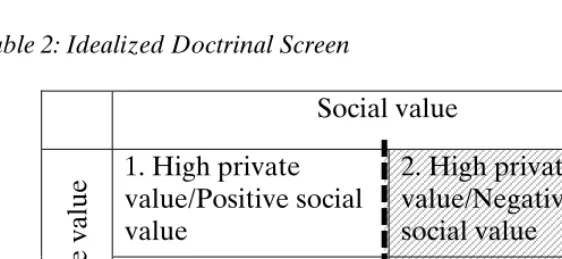
Doctrinal screens are meant to separate rights based upon social value. They should prohibit the creation of IP rights that are predicted to have negative net social value. That is, a well-calibrated doctrinal screen is meant to draw a vertical line between the positive social value rights in boxes 1 and 3 from the negative social value rights in boxes 2 and 4, permitting the former and blocking the latter.
Table 2: Idealized Doctrinal Screen
Social
value
Private value
1. High private
value/Positive social
value
2. High private
value/Negative
social value
3. Low private
value/Positive social
value
4. Low private
value/Negative
social value
and—if they were granted—would likely generate net social harm.66
Other doctrinal tests, such as the utility requirement for utility patents and the idea/expression distinction in copyright law, perform similar functions.67
Of course, even well-calibrated doctrinal screens will not function perfectly. Requirements such as novelty and nonobviousness are only proxies for positive social value. For instance, imagine a design patent application involving a new and nonobvious design, but one that the designer would have created whether or not she was able to obtain a patent.68 A patent on this design would create negative social value,
because (a) the valuable design would exist regardless, and (b) the patent will increase costs for consumers and subsequent designers. Merely satisfying doctrinal IP requirements does not guarantee that the IP right will create social value. IP doctrines are only proxies for social value, and not always ideal ones. And of course not all doctrines are properly calibrated, nor are they always properly applied. The doctrine might be too lax or too stringent, and courts or the PTO may err when evaluating whether a given right satisfies the doctrinal requirements.
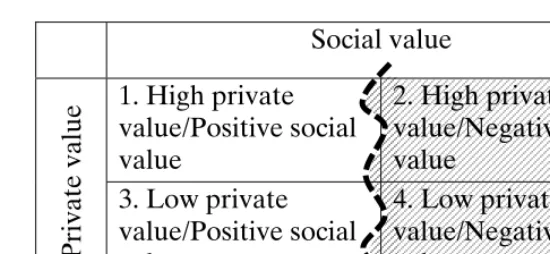
Thus, no IP doctrine actually succeeds in drawing a perfect vertical line down the center of Table 1. Any system of doctrine will inevitably permit some negative social value rights to see the light of day and block some positive social value rights. Table 3 illustrates the imperfections in doctrinal screens. Accordingly, even if doctrinal screens are well-calibrated—and certainly if they are not—there is a potential role for some other type of screen to play.
66. See Stephen Yelderman, The Value of Accuracy in the Patent System,84 U.CHI.L.REV. 1217, 1244–46 (2017).
67. See infra notes 71–72, 81, 115 and accompanying text.
Table 3: Realistic Doctrinal Screen
Social
value
Private value
1. High private
value/Positive social
value
2. High private
value/Negative social
value
3. Low private
value/Positive social
value
4. Low private
value/Negative social
value
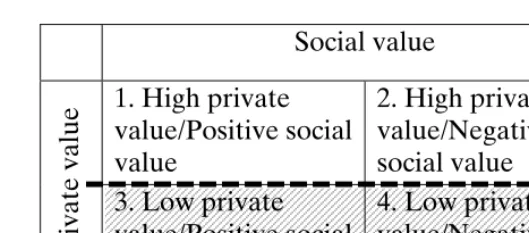
Herein lies the motivation for costly screens. A costly screen is simply a requirement that an applicant expend some amount of money or undertake some costly activity to obtain, maintain, or enforce a given legal right. The costly screen can take the form of an application fee, a maintenance fee, or even a procedural hurdle that the IP owner must overcome that will cost time or money to clear. Costly screens may also arise because compliance with some aspect of the law is expensive, such as the need to hire a lawyer to prosecute a patent. Because it is the IP applicant or owner who must bear the expense, costly screens affect IP rights differentially based upon their private value. That is, a costly screen draws a horizontal line between the high private value rights in boxes 1 and 2 and the low private value rights in boxes 3 and 4. For high private value rights, costly screens are irrelevant. If the rights are highly valuable to their potential owner, the owner will invest the money to obtain them regardless of the cost.69 But
if the rights have low value to their owners, the costly screen will deter the putative owner from obtaining the right in the first place.
Table 4: Idealized Costly Screen
Social
value
Private value
1. High private
value/Positive social
value
2. High private
value/Negative
social value
3. Low private
value/Positive social
value
4. Low private
value/Negative
social value
Costly screens are a second-best solution because they will not eliminate IP rights that fall into box 2, namely rights that have high private value (so creators will pay to obtain them) but negative social value.70 For example, if someone could claim the exclusive right to
publish stories about star-crossed lovers, she would be able to obtain substantial private value from doing so, but it would clearly make society worse off to allow a single author to exclude others from writing novels with that storyline. No costly screen would prevent a creator from applying for a copyright or patent on such a valuable idea. A doctrinal screen is necessary. For this reason, copyright law’s idea/expression doctrine71 prevents people from obtaining such rights.
No matter how much people would be willing to pay to obtain a copyright over an idea or a utility patent over a product of nature, a doctrinal screen prevents them from doing so.72
Instead, the function of a costly screen is to eliminate or curtail the number of low private value IP rights. If the costly screen exceeds the value of the right to its putative owner, the owner will not seek (or maintain or enforce) the IP right. Of course, the private value of the right is not what policymakers really care about—their focus is the
70. Costly screens are also regressive—they tax the least valuable IP the most. That might be a feature, not a bug, in many cases, though, because the ones that are taxed the most in percentage terms are the ones that are the least valuable.
71. 17 U.S.C. § 102(b) (2012) (“In no case does copyright protection for an original work of authorship extend to any idea, procedure, process, system, method of operation, concept, principle, or discovery, regardless of the form in which it is described, explained, illustrated, or embodied in such work.”).
social value of the right.73 Costly screens will reduce the number of low
private value/negative social value rights (box 4), which is good, but they will also reduce the number of low private value/positive social value rights (box 3), which is bad.74
Accordingly, costly screens are appropriate when the number of potential low private value/negative social value rights (box 4) is high and the number of potential low private value/positive social value rights (box 3) is low, and they are counterproductive when the reverse is true.75
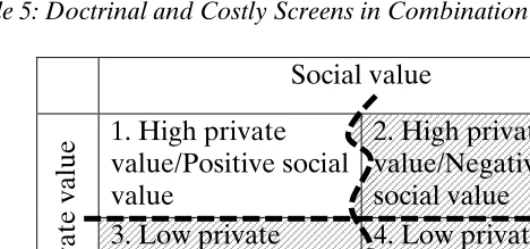
Table 5 displays the simultaneous operation of doctrinal and costly screens.
Table 5: Doctrinal and Costly Screens in Combination
Social
value
Private value
1. High private
value/Positive social
value
2. High private
value/Negative
social value
3. Low private
value/Positive social
value
4. Low private
value/Negative
social value
Doctrinal screens and costly screens can and do exist side-by-side in a wide variety of legal regimes.76 At the boundary between
copyrights, design patents, and utility patents, doctrinal screens and costly screens play important complementary roles. Doctrinal screens sort designs between the copyright, design patent, and utility patent regimes, determining which will qualify for each category. And then within those three doctrinal regimes, costly screens (or their absence) determine the types of rights that creators will seek to obtain. For the system to function properly, the two types of screens must be well-calibrated to perform these operations in tandem.
73. Fagundes & Masur, supra note 12, at 695–97. 74. Id. at 695–98.
C. Doctrinal Screens and the Selection of IP Regimes
Now that we have laid out the principles behind doctrinal and costly screens, we turn our attention to the IP doctrines through which these screens are meant to operate.
1. The Utility Patent Baseline. Because our focus is functionality, our baseline is the utility patent regime. Utility patents were designed to protect functional inventions, and indeed they can only be used to protect functional inventions.77 Before an inventor can obtain a utility
patent, however, she must surmount a series of doctrinal and costly screens that are implemented (directly or indirectly) through examination by the PTO. The inventor must demonstrate to the PTO that her invention is within the realm of utility patent law,78 is new and
nonobvious,79
is sufficiently developed and disclosed,80
and that it has useful applications.81 In addition, the high cost of obtaining a utility
patent functions as a costly screen that eliminates a significant number of low private value rights.82 The PTO’s examination of patents is not
always rigorous or effective, and the costly screen imposed is not terribly high relative to the private value of the most significant patents.83
Nonetheless, utility patent law couples the IP regime that is most protective of functionality with the most stringent doctrinal and costly barriers to entry. In the sections that follow, we compare copyright law and design patent law against this baseline. We explore the extent to which they can be used to obtain “backdoor” protection for functional elements and the legal responses to the possibility of
77. See Kevin Emerson Collins, Patent Law’s Authorship Screen, 84 U.CHI.L.REV. 1603, 1613–15 (2018).
78. 35 U.S.C. § 101 (2012) (listing patentable subject matters). 79. Id. § 102(a) (novel); id. § 103 (nonobvious).
80. Id. § 112 (requiring that the invention be described and enabled). 81. Id.
82. Masur, Costly Screens, supra note 12, at 701.
such protection.
2. Copyright Law. On its face, copyright law would appear to be the most favorable place for creators to turn in search of backdoor utility patents. Copyright law imposes the lowest creativity threshold for protection, and, once granted, copyright protection lasts the longest. To prevent this sort of doctrinal arbitrage, copyright is meant to have the strictest set of functionality screens, traditionally limiting its availability only to works with no, or very modest amounts of, functionality.
Obtaining a copyright is incredibly easy. Federal copyright protection exists from the moment that a work is fixed in a tangible medium of expression.84
Creators need not demonstrate any substantial cleverness to obtain copyright protection.85 A work is
protectable if it is original, which means that it was not copied from another source and that it evinces some creativity that is just a bit more than entirely trivial.86
So while the Supreme Court rejected a copyright claim for a telephone white pages directory because it was insufficiently original and creative,87
courts have upheld protection for yellow pages directories,88 fairly simple photographs,89 and three-note
sequences of music.90
Copyright law sets the creativity hurdle incredibly low, enabling virtually any work with a spark of cleverness or novelty to sail over.91
Copyright protection is also cheap. Authors don’t need to pay any money or file any paperwork to obtain copyright protection.92 Every
reader of this article has created at least one and probably several
84. Christopher Sprigman, Reform(aliz)ing Copyright, 57 STAN.L.REV. 485, 487–88 (2004). 85. Feist Publ’ns, Inc. v. Rural Tel. Serv. Co., 499 U.S. 340, 345 (1991).
86. 17 U.S.C. § 102(a) (2012) (“Copyright protection subsists, in accordance with this title, in original works of authorship fixed in any tangible medium of expression . . . .”).
87. Feist, 499 U.S. at 361–63.
88. See Key Publ’ns, Inc. v. Chinatown Today Publ’g Enters., Inc., 945 F.2d 509 (2d Cir. 1991).
89. See Schrock v. Learning Curve Int’l, Inc., 586 F.3d 513 (7th Cir. 2009); Mannion v. Coors Brewing Co., 377 F. Supp. 2d 444 (S.D.N.Y. 2005). But see Ets-Hokin v. Skyy Spirits, Inc., 225 F.3d 1068 (9th Cir. 2000).
90. See Newton v. Diamond, 388 F.3d 1189, 1192 (9th Cir. 2014) (assuming without deciding that a three-note sequence of a musical composition could have evinced sufficient originality to be copyrightable).
91. Buccafusco, Burns, Fromer & Sprigman, supra note 53; Joseph Scott Miller, Hoisting Originality, 31 CARDOZO L.REV. 451, 464, 488–89 (2009).
copyrights today, just by living an ordinary life. Creators need not register their works with the Copyright Office, although they may do so for a nominal fee,93 and the Office will generally grant registration
without meaningful examination of the claimed work.94
If they do want the additional benefits of copyright registration, creators can pay $40 and fill out a very simple form online,95
no lawyers or bankers required. For this nominal sum, they get quite a bit. Copyright protection isn’t just easy to obtain; it also lasts for a really long time. Most copyrights last for about a century or more.96
Copyright law offers creators a regime with a trivial creativity bar and incredibly long protection, and one that does not require meaningful examination. Creators who cannot meet utility patent law’s strict utility and nonobviousness requirements or who desire longer protection are often tempted to seek copyright protection instead. To combat this behavior, Congress erected strict functionality screens to prevent misuse.97 In some cases, copyright law simply denies protection
to entire categories of works because they are deemed too functional.98
However expressive cooking or yoga might be, creators cannot rely on copyright law for protection in these fields.99
In other cases, such as
93. Id. § 408 (“[T]he owner of copyright . . . may obtain registration of the copyright claim by delivering to the Copyright Office the deposit specified by this section, together with the application and fee specified by sections 409 and 708. Such registration is not a condition of copyright protection.”).
94. See Thomas G. Field, Jr., Judicial Review of Copyright Examination, 44 IDEA 479, 482 (2004).
95. See Fees, U.S. COPYRIGHT OFFICE, https://www.copyright.gov/about/fees.html [https://perma.cc/82TZ-S9RG]; Registration Portal, U.S COPYRIGHT OFFICE, https://www. copyright.gov/registration [https://perma.cc/ZK23-LYR7].
96. 17 U.S.C. § 302. For many works, copyrights last for the life of the author plus an additional seventy years postmortem. Id. For other works, including works made for hire or works created before 1978, copyright typically lasts for ninety-five years from the date of first publication. Id.
97. Buccafusco & Lemley, supra note 1, at 1303; Samuelson, supra note 48, at 1497. 98. Buccafusco and Lemley refer to this as an “Exclusion Screen.” Buccafusco & Lemley, supra note 1.
99. Bikram’s Yoga Coll. of India, L.P. v. Evolation Yoga, LLC, 803 F.3d 1032 (9th Cir. 2015) (denying copyright protection to a series of yoga poses); Lorenzana v. S. Am. Rests. Corp., 799 F.3d 31 (1st Cir. 2015) (denying copyright protection to chicken sandwich); Publ’ns Int’l, Ltd. v. Meredith Corp., 88 F.3d 473, 482 (7th Cir. 1996) (denying copyright protection to constituent recipes in a cookbook protected by a compilation copyright). For scholarships commenting on this topic, see Christopher Buccafusco, Authorship and the Boundaries of Copyright: Ideas, Expressions, and Functions in Yoga, Choreography, and Other Works, 39COLUM.J.L.&ARTS
computer software, copyright law allows limited protection for the relatively few expressive aspects of such works while also filtering out any of their functional content from protection.100 Copyright
protection, if it exists for a computer program, should not cover any of its aspects that relate to efficiency or compatibility, leaving those free for others to copy and use.101
Most important for design, however, is the regime that Congress created for handling pictorial, graphic, and sculptural works. Congress was concerned that industrial designers would attempt to use copyright law to gain exclusive rights over the designs of “useful articles” such as clothing, furniture, or appliances.102
Because these items are intrinsically functional, easily obtainable exclusive rights could impose substantial and unwarranted costs on the public and subsequent creators.103 To avert this risk, the Copyright Act
imposes additional eligibility criteria on useful articles.104
Such works are copyrightable only if and only to the extent that they contain “pictorial, graphic, or sculptural features that can be identified separately from, and are capable of existing independently of, the utilitarian aspects of the article.”105
The useful articles doctrine was intended to exclude from copyright protection works of industrial design, including designs that successfully marry form and function.106
The artistic yet simultaneously functional design of a chair leg, automobile hood, smartphone, or garment were unprotectable via copyright.107
Protection could extend only to purely nonfunctional features of useful articles such as a hood
100. Comput. Assoc’s. Int’l v. Altai, Inc., 982 F.2d 693, 707–10 (2d Cir. 1992) (creating a test to filter out the functional elements of computer software); see Peter S. Menell, Rise of the API Copyright Dead: An Updated Epitaph for Copyright Protection of Network and Functional Features of Computer Software, 31 HARV.J.L.&TECH.305,328 (2018) (analyzing the Altai abstraction-filtration-comparison test); Pamela Samuelson, Functionality and Expression in Computer Programs: Refining the Tests of Software Copyright Infringement, 31BERKELEY TECH. L.J. 1215, 1220 (2016) (same).
101. See, e.g., Altai, 982 F.2d at 708–09. But see Oracle Am., Inc. v. Google, Inc., 750 F.3d 1339, 1367 (Fed. Cir. 2014) (extending protection to the functional aspects of a computer program’s interface component).
102. 17 U.S.C. § 101 (2012) (“A ‘useful article’ is an article having an intrinsic utilitarian function that is not merely to portray the appearance of the article or to convey information.”). 103. See Christopher Buccafusco & Jeanne C. Fromer, Fashion’s Function in Intellectual Property Law, 93 NOTRE DAME L.REV. 51, 52 (2017).
104. Id.
105. 17 U.S.C. § 101.
106. H.R.REP.NO. 94-1476, at 49–50, 54–55, reprinted in 1976 U.S.C.C.A.N. 5659, 5662–63, 5667–68.
ornament or printed decal. That is, copyright would only attach to features of a work that existed solely to portray its appearance or convey information.108
For example, the Second Circuit denied the designer of the “Ribbon Rack” bicycle rack copyright protection even though the work was aesthetically appealing and had won numerous design awards.109
The aspects of the design that were expressive, such as the shape of its curves, were also intrinsically related to its functionality. By contrast, the same court upheld copyrights in decorative belt buckles, because the buckles’ shape did not affect their utility and was entirely superimposed on the functional aspects of the designs.110
Thus, copyright law’s useful articles doctrine allowed creators to obtain protection for solely nonfunctional aspects of their designs, but it rejected claims based on design elements that intermixed functional and nonfunctional components.111
Beyond the useful articles doctrine, copyright law also includes a variety of other features meant to balance its power and scope. On one hand, copyright law offers reasonably broad protection against competition. Copyright owners can prevent not only literal or exact duplications of their designs but also those that are substantially similar to them.112 This can include works that have the same “aesthetic
appeal” as the copyrighted work.113
On the other hand, copyright law limits this otherwise broad scope in a number of ways. First, copyright only prohibits actual copying: a designer sued for infringement can defend herself by proving that she independently created the allegedly infringing design, even if the prior and subsequent designs are identical.114 Second, copyright law narrows the scope of an author’s
copyright to her expression of a particular idea, rather than to the idea itself. For example, the designer of a jeweled pin the shape of a bee
108. 17 U.S.C. § 101 (defining “useful article”); see also Buccafusco & Fromer, supra note 103. 109. See generally Brandir Int’l, Inc. v. Cascade Pac. Lumber Co., 834 F.2d 1142 (2d Cir. 1987) (considering the functionality of an artistic bicycle rack).
110. See generally Kieselstein-Cord v. Accessories by Pearl, Inc., 632 F.2d 989 (2d Cir. 1980). 111. That law has recently changed in significant respects as a result of the Supreme Court’s Star Athletica decision. We discuss that decision in Part III.A.
112. See, e.g., Yurman Design, Inc. v. PAJ, Inc., 262 F.3d 101, 111 (2d Cir. 2001).
cannot prevent everyone else from producing bee-shaped jewelry.115
Third, copyright law’s fair use doctrine permits certain kinds of copying that are deemed socially valuable or that don’t interfere with the copyright owner’s market exploitation.116
Although comment and criticism are the paradigmatic examples of fair use, it can also include instances of copying that are motivated by the need to access functional features of a work.117 Finally, copyright law limits the damages that a
victorious copyright holder can receive. Copyright apportions damages for infringing and noninfringing elements.118 That is, even if a design is
held to infringe an existing copyright, the copyright owner can only recover damages based on the proportion of lost royalties attributable to the copying.119
She cannot recover royalties attributable to other, noncopyrighted elements of the infringing product.120
Thus, at least since the 1976 Copyright Act (“1976 Act”), copyright law has coupled an incredibly low creativity screen, a low cost of acquisition, and a long term of protection with a rather robust functionality screen and a number of doctrines that limit the right’s power. Although purely nonfunctional works could obtain protection with ease, functional works were meant to be excluded from the regime. In particular, creators of industrial designs were meant to be channeled into the design patent or utility patent regimes instead of copyright.
3. Design Patents. For creators seeking IP protection over ornamental designs, design patent law offers the primary alternative to
115. Herbert Rosenthal Jewelry Corp. v. Kalpakian, 446 F.2d 738, 741–42 (9th Cir. 1971). 116. See 17 U.S.C. § 107 (2012) (“[T]he fair use of a copyrighted work . . . , for purposes such as criticism, comment, news reporting, teaching . . . scholarship, or research, is not an infringement of copyright.”). For a discussion of the market effect of fair use, see Jeanne C. Fromer & Mark A. Lemley, The Audience in Intellectual Property Infringement, 112 MICH.L. REV. 1251 (2014).
117. Sony Comput. Entm’t, Inc. v. Connectix Corp., 203 F.3d 596, 603 (9th Cir. 2000) (holding that copying to access unprotected functional elements constitutes fair use); Sega Enters. Ltd. v. Accolade, Inc., 977 F.2d 1510, 1522 (9th Cir. 1992) (same).
118. See generally Rogers v. Koons, 960 F.2d 301 (2d Cir. 1992); Roulo v. Russ Berrie & Co., 886 F.2d 931 (7th Cir. 1989); Frank Music Corp. v. Metro-Goldwyn-Mayer Inc., 886 F.2d 1545 (9th Cir. 1989).
119. 17 U.S.C. § 504(b).
copyright.121 Design patents protect the ornamental features of a
utilitarian article of manufacture.122
While design patent law’s ornamentality requirement has been treated as a functionality bar, it has been applied in a far more relaxed manner than copyright law’s useful articles doctrine.123 Thus, in contrast to copyright law, where
functionality is supposed to be rigorously policed, design patent doctrine is more tolerant of claims that mix ornamentality with utility.124
Design elements are eligible for protection whenever there are other alternatives to the claimed element.125 Because there is often
at least one other way of achieving a function—even if it isn’t quite as good—design patents often include substantial functionality that is mixed with ornamentality.
Both the PTO—which reviews design patent applications—and the federal courts have enabled creators to include functional elements within the scope of their design patents. Claimants have been allowed to protect design features that do more than merely portray appearances or convey information but also contribute to how the design works and have substantial functional value. So although design patent claims should be “construed in order to identify the non-functional aspects of the design,”126 what counts as “non-functional” in
the design patent context is broader than it has been in copyright law. The Federal Circuit has consistently permitted design patents that cover functional elements that contribute to a product’s usefulness or efficiency. Consider, for example, the shoe design at issue in L.A. Gear, Inc. v. Thom McAn Shoe Co.127 Although each element of the
plaintiff’s shoe design contributed to the shoe’s function, the court
121. Congress has considered a number of other design protection regimes in the last hundred years. See Shira Perlmutter, Conceptual Separability and Copyright in the Designs of Useful Articles, 37 J. COPYRIGHT SOC’Y U.S.A. 339 (1990). Congress has even adopted a separate design protection regime for vessel hulls. 17 U.S.C. § 1301.
122. 35 U.S.C. § 171 (2012) (design is “for a[] [utilitarian] article of manufacture”).
123. See, e.g., Robert C. Denicola, Applied Art and Industrial Design: A Suggested Approach to Copyright in Useful Articles, 67 MINN.L.REV. 707, 707–08 (1982) (“Design patents long offered the possibility of protection for the ornamental design of a useful product.”).
124. Buccafusco & Lemley, supra note 1. Indeed, Charles Colman has argued that ornamentality was viewed as a negative thing by the courts for much of the history of design patent law. Charles E. Colman, Design and Deviance: Patent as Symbol, Rhetoric as Metric: Part 2, 56 JURIMETRICS J.1 (2015). If so, that may have pushed designers to seek protection for the functional aspects of their products.
125. Jason J. Du Mont & Mark D. Janis, Functionality in Design Protection Systems, 19 J.
INTELL.PROP. L. 261, 281–85 (2012).
upheld the plaintiff’s design patent because the overall design of the shoe was not “dictated by the use or purpose of the article.”128
That is, although these elements served a utilitarian purpose, they were still protectable because competitors could achieve the same purpose with different designs.129 Even though the design elements served a
utilitarian function and even though they may have been the best way to achieve that function, they were still included within the scope of the plaintiff’s claim.130
In perhaps the Federal Circuit’s most comprehensive discussion of functionality screening, the court in Richardson v. Stanley Works, Inc.131
explained that design patents would only be declared invalid if
“the patented design is primarily functional rather than
ornamental.”132
Thus, many designs that were substantially functional but not primarily so would be upheld.133 The court upheld the plaintiff’s
patent covering the “ornamental” design of a multifunction tool, which in this case included the shape of the tool’s edges and corners.134 But
whatever “ornamental” meant here, it certainly didn’t mean entirely nonfunctional. The shape of a hand tool’s corners and edges will contribute significantly to its comfort, manipulability, and durability. These are aspects of the design that copyright law’s useful article doctrine would traditionally have screened out for being simultaneously aesthetic and functional.135
128. Id. at 1123.
129. Id. In Europe, by contrast, the availability of alternative designs does not foreclose a finding of functionality. Judgment of 8 March 2018, DOCERAM GmbH v. CeramTec GmbH, C-395/16, EU:C:2018:172, paragraph 32. For a discussion of that case, see Jens Schovsbo & Graeme B. Dinwoodie, Design Protection for Products That Are “Dictated by Function,”in THE EU
DESIGN APPROACH:AGLOBAL APPRAISAL (Annette Kur, Marianne Levin & Jens Schovsbo
eds., Edward Elgar Publishing forthcoming Nov. 2018), https://ssrn.com/abstract=3164916 [https://perma.cc/ZD49-A5M6].
130. See Perry J. Saidman, Functionality and Design Patent Validity and Infringement, 91 J. PAT.&TRADEMARK OFF.SOC’Y 313, 317 (2009) (“[I]f the individual de facto functional features of an article . . . claimed in a design patent were removed from consideration prior to applying the ordinary observer infringement test, there would in most cases be nothing left of the patented design to compare to the accused design.”).
131. Richardson v. Stanley Works, Inc., 597 F.3d 1288 (Fed. Cir. 2010). 132. Id. at 1293–94.
133. The court “factored out” functional elements of a multi-function tool design from the scope of the plaintiff’s claim when it came to deciding infringement. These elements included the handle, the hammer-head, and the jaw, because they were “driven purely by utility.” Id. at 1294. 134. Id. at 1296.