Laura A. Fogarty. Measuring Trends and Efficacy: An Analysis of the British Museum’s Facebook. A Master’s Paper for the M.S. in L.S degree. April, 2016. 39 pages. Advisor: Denise Anthony
There is a distinct lack of current and specific guidance on the creation of content for social media in cultural heritage institutions. This study aims to remedy that lack of specificity by examining user responses to social media strategies employed by cultural heritage institutions and in so doing, identify and evaluate emerging trends in social media content generation. In order to accomplish this task, the researcher conducted an analysis of the British Museum’s Facebook page. This consisted of evaluating posts according to a coding schema and recording the level of user response to each post. This method allowed the researcher to identify past, present, and emerging trends as well as the efficacy of each trend in terms of user interaction.
Headings:
Museum Studies
Cultural Property
Social Media
MEASURING TRENDS AND EFFICACY:
AN ANALYSIS OF THE BRITISH MUSEUM’S FACEBOOK
by
Laura A. Fogarty
A Master’s paper submitted to the faculty of the School of Information and Library Science of the University of North Carolina at Chapel Hill
in partial fulfillment of the requirements for the degree of Master of Science in
Library Science.
Chapel Hill, North Carolina
April 2016
Approved by
_______________________________________
Table of Contents
Introduction ... 2
1.1 Purpose of Study ... 4
Background ... 6
1.2 Communication and Education ... 6
1.2.1 Social Media ... 9
1.3 British Museum ... 11
1.3.1 History... 11
1.3.2 Web Presence ... 12
Methodology ... 15
1.4 Sample ... 15
1.5 Codebook ... 17
1.6 Limitations ... 19
Findings ... 20
1.7 Post Production ... 20
1.8 Post Efficacy ... 23
1.9 Education Posts ... 25
1.10 Emerging Trends ... 29
Discussion... 32
Introduction
“The museum is no longer sacred or untouchable; rather, the museum is open to scrutiny, from within its walls and from an increasingly
discriminating public.” (Anderson, 2004, p. 1)
It is a truth universally acknowledged that times are hard in the cultural heritage
community. Given the prevalence of new media applications and the emphasis on
accessibility, one would think that cultural heritage institutions would be leading the
charge into this brave new world of knowledge and accountability. New potential uses of
collections emerge at a dizzying rate, such as natural history collections serving as
windows to evolutionary processes (Holmes, et al., 2016). Yet, progress is severely
compromised by fatally reduced funding streams, slashed budgets, and a systemic lack of
awareness from users and funding agencies alike. These combine to create a vicious cycle
of constant reduction of staff and services. This state of arrested potential leaves society
pondering the relevance of museums and their collections, which only exacerbates
institutions’ struggle to engage their users and promote awareness of their collections.
The Atlantic recently published a series of articles focused on this very topic, cataloging the struggles of natural history museums after the U.S. National Science
Foundation placed a hold on the “Collections in Support of Biological Research Program-
a scheme that funds the care, organization, maintenance, and cataloguing of biological
collections” (Yong, 2016). The first piece challenged the view of museum “collections as
world” by arguing that “they are time capsules that contain records of past ecosystems…
archives that provide clues about raging epidemics, environmental pollution, and hidden
extinctions” (Yong, 2016).
The follow up piece highlighted the lost opportunities for the vanished funding
and presented the sobering consequences of the funding freeze, which included
insufficient care for collections, closure of institutions, and an inability to attract
professionals to the necessary field of taxonomy. In a state of bewilderment, Hopi
Hoekstra, the curator of Harvard’s Museum of Comparative Zoology, questioned the
timing of the decision:
“These funds are so important to keeping these collections accessible- from maintaining specimens in conditions amenable to long-term preservation, to digitizing skeletons so the data is available to researchers worldwide, to recording collecting location in large databases so that researchers can look at global patters of change… collections are getting more use than ever before, so why pull the plug now? It just doesn’t make sense” (Yong, 2016).
Upon publication, both articles appeared on the front page of the Atlantic website and the articles have since garnered 10,500 views.
Serendipitously, in early April the popular news aggregator and supreme purveyor
of listicles, Buzzfeed,published a post featuring a beautiful selection of the Smithsonian’s Museum of Natural History’s unseen collections. Each photo allowed users to experience
the inner workings of one of the largest and most respected cultural institutions in the
world from the comfort of their chosen mobile device (Gallant, 2016). The post appeared
on the site’s “trending now” page, which has a threshold of 10,000 views. The article did
community made a conscious decision to fight to prove their relevance to a world that
increasingly sees them as obsolete.
These articles illustrate a desire within the museum community to destroy any
vestiges of the museum as a sacred or untouchable space. Museums are more than
monuments of a bygone era filled with the treasures and rubbish of generations. They are
active and engaged entities, eager to contribute and promote knowledge. To engage users,
they embraced nontraditional media platforms. If a museum wants to be a relevant
member of the modern world, an active online presence is a virtual necessity. Presently,
that entails possessing at least one, preferably several social media accounts.
1.1
Purpose of Study
Given the ubiquity of social media in our society it is not surprising that many
museums created the required accounts and now they are faced with the need to create a
stratagem to engage users through content. Several of the more established museum
social media accounts employ a discernable strategy. Unfortunately, most reports on
these strategies are woefully out of date, or suffer from a curious lack of specificity when
it comes to generating content. They happily promote general practices, such as what
time of day to post, while blithely ignoring the question of what to post (Spiliopoulou,
Mahony, Routsis, & Kamposiori, 2014, pp. 291-296).
This study aims to remedy that lack of specificity by examining the user response
to social media strategies employed by cultural heritage institutions and in so doing,
identify and evaluate emerging trends in social media content generation. In order to
Facebook page. This consisted of evaluating posts according to a coding schema devised
by the researcher and recording the level of user response to each post. This method
allowed the researcher to identify past, present, and emerging trends as well as the
Background
The quest to make the cultural heritage community relevant in contemporary
society is not a new one. In fact, some foresighted members of the profession came to this
realization nearly a century ago. John Cotton Dana’s landmark article, “The Gloom of the
Museum” (1917), outlined his vision of the future role of museums:
“Tomorrow, objects of art will be bought to give pleasure, to make manners seem more important, to promote skill, to exalt handwork, and to increase the zest of life by adding to it new interests; and these objects being bought for use will be put where the most people can most handily use them: in a museum planned for
making the best use of all it contains, and placed where a majority of its community can quickly and easily visit it.” (Dana, 1917, p. 3)
While not all of his predictions came to pass, his concept of a community centered
museum is in line with recent efforts for cultural heritage institutions to not only descend
from the ivory tower of academia, but to make the ivory tower superfluous.
Part of the problem lies with the institutional history of cultural heritage
organizations. Traditionally, they served as bastions of academia with all of the inherent
associations: exclusivity, reactionary, ethnocentricity, internally focused, collection
driven, assumed value and authority.
1.2
Communication and Education
In a world that values accessibility, the ivory tower is untenable. Therefore, the
new museum aims to be inclusive, proactive, multicultural, user focused, as well as
The quest for the user centered museum began nearly a century ago, with Dana’s
recommendation of thoughtful design of collections spaces, convenient locations, strict
accession guidelines, popularizing collections, brand marketing, creation of education
mandates, and inter-museum cooperation (Dana, 1917). All of these measures seem
eminently reasonable and show a remarkable amount of foresight. However, one of the
reasons that they seem so sensible is that the implementation is still under discussion. In
particular, popularizing collections, brand marketing, and education mandates sound
remarkably similar to current issues in the field and so the journey to a user-centered
museum continues.
Twenty-five years later Theodore Low entered the conversation with his article,
“What is a museum?”, where he proclaimed that museums possessed “the power to make
people see truth, the power to make people recognize the importance of the individual as
a member of society” and they “must not fail to recognize their responsibility” (Low,
1942, p. 30). Alas! Power struggles between institutional departments severely
compromised the potential of the museum. Low saw education as being the primary
mission of the museum, but the other departments were skeptical and determined to
maintain their prior level of importance by refusing to support education (Low, 1942, p.
32). Low’s mission for museums differed substantially from Dana’s, but they did agree
on a few things. Low called for departmental cooperation and unity to promote “popular
education” for the masses, not just the elites (Low, 1942, p. 40). This sounds like Dana’s
call for inter-cooperation and educational mandates.
Another twenty years passed and museums still pondered their mission and the
communications model, which stated that “communication was a simple linear process
involving a communicator, a message, and a receiver…” (Laws, 2015, p. 27). However,
some museum professionals were dissatisfied with this approach due to the nebulous role
of museum collections within this model. Duncan Cameron numbered among the
dissenters and believed that the “responsibility for the content in a museum, the
transmitter, lay with the museum’s curator/exhibitor, that museumgoers were the
receptors, and that objects were the medium of communication” (Laws, 2015, p. 27).
These communications models gave rise to the linear ‘hypodermic needle’ theory,
which became popular during the 1980s. The characterization of users as passive
receivers served as the keystone of the theory. This passivity allowed the museum to
‘inject’ ideas into the consciousness of receivers (Morley, 1980). Low would be pleased,
but this marked a radical departure from Dana’s ideal user-centered museum. Thankfully,
the1980s also saw the rise of a movement known as The New Museology, which
challenged the idea of the user as a passive receiver. Hugues de Varine declared that the
“visitor is not a docile consumer… but a creator who can and should participate in the
building of the future- the museum’s research” (Laws, 2015, p. 28).
These ideas grew and expanded beyond the scope of the museum and exhibitions
in the 1990s; the museum was reimagined as a part of its social environment and the
users viewed as fully autonomous beings (Hooper-Greenhill, 1991). This period also saw
the rise of the World Wide Web and in 1994, the International Council of Museums
(ICOM) mandated the use of the Web in fulfilling the social mission of museums (Parry,
In the late 1990s, museums began their relationship with the Web by using their
institutional websites to promote museum education, conservation efforts, marketing
events and exhibitions, as well as providing access to proprietary learning resources
(Marty & Jones, 2012) (Parry, 2007). The primary aim was to promote accessibility of
information and resources, although it should be noted that there were also some
ambitious, early virtual museum experiments by the Natural History Museum and the
community-launched WebLouvre created during this period (Bowen, 2010). Museum
professionals and engaged community members were eager to “capitalize on the potential
of the Web by using it as a means to discover how to become more relevant” (Trant &
Bearman, 1997).
1.2.1 Social Media
1.2.1.1 History
Meanwhile, the Web began to evolve into a platform for human communication
and expression in addition to a repository for information (Rellie, 2006). The rise of the
personal computer ensured that eventuality by fundamentally changing the way that
people interacted with information (Hujiboom, et al., 2009). Thus, the rise of social
media seems inevitable. In this instance, social media is defined as the platforms that
allow community members to engage with each other by creating profiles and online
content (Kaplan & Haenlein, 2010). In any case, the rise of the user-centric Web caused a
veritable explosion of social media platforms catered to specific user groups including
Myspace (2003), Facebook (2004), Flickr (2004), YouTube (2005), Twitter (2006),
defeated platforms left in the dust. Users choose the platforms that fit their needs and
enable them to improve their quality of life (Rangaswami, 2008).
The prime case of this phenomenon is the rise and fall of Myspace, which peaked
in 2005 only to fall on hard times in 2011 due to a series of administrative and strategic
blunders, which can be boiled down to a failure to adapt (Gillette F. , 2011). The best
platforms adapt and integrate well with the rest of the web ecosystem much like the best
cultural heritage institutions (Pett, 2012, p. 4). However, no platform is proof against
failure. The field of technology is a highly volatile one. For example, Flickr and Tumblr
are owned by the embattled Yahoo, so there is an ongoing conversation about the future
of the platforms, despite their strong user base (Swanner, 2016).
1.2.1.2 Cultural Heritage Institutions and Social Media
In the museum field, the earlier goal to provide access to materials continued
unabated as demonstrated by the abundance of digitization projects (Russo, Watkins,
Kelly, & Chan, 2006). The 2000s featured a shift to enhancing community engagement.
To that end, institutions began using their sites and databases to gather user feedback. By
2005, museums began entering into partnerships with one another to establish external
online projects to expand the network of museum related sites (Rellie, 2006).
Additionally, museums began to maintain blogs, valued for their ability to foster direct
communication between the institution and the user.
Despite the varied possible applications of social media the majority of museums
saw adopting social media as “going too far” (Laws, 2015, p. 34). Popular caveats
included: copyright, terms of service changes, privacy concerns, exposure of
behavior, lack of expertise, maintenance and preservation, varying user experience, state
and government guidelines, institutional buy-in, participation vs. lurking, consumption of
limited staff resources, etc.… (Pett, 2012, p. 13). Although there are definitely members
of the community who continue to abstain from social media for these reasons, it seems
that the majority of them overcame their scruples.
It was only a matter of time before all “social media crossed all gender, political,
economic and age borders and became the pervasive means of communication around the
world” (Laws, 2015, p. 37). The rise of social media provided these institutions with an
ideal platform to engage and track their users. It allows them to explore new modes of
engagement and “the hope is that social media will help visitors engage with collections
in more meaningful ways than as mere spectators, help museum staff access a new pool
of knowledge from the public, and foster networks that result in broader local and global
stewardship for heritage (Laws, 2015, pp. 39, 108).
Out of the plethora of available platforms, cultural heritage institutions display a
marked preference for Facebook, Twitter, Instagram, Tumblr, Pinterest, YouTube and
Flickr. All of these platforms are notable in their focus on visual media, supporting
conversations, and the ability to track user engagement via likes, favorites, pins, etc.…
Thus, they simultaneously promote awareness, receive user feedback, and track user
engagement with as little as 140 characters.
1.3
British Museum
1.3.1 History
Founded in 1753, the British Museum became the first national public museum in
this possible and served as the basis for the museum’s collection. Housed in the
seventeenth century mansion, Montagu House, the museum gave free entry to “all
studious and Curious Persons” and continues to do so to this day (The British Museum,
2009). In its early years, the museum received 5,000 visitors yearly.
The nineteenth century saw the expansion of the museum collection, with the
acquisition of the Rosetta Stone (1802), the Townley collection of classical sculptures
(1805), and the controversial Parthenon sculptures (1816). In an effort to keep up with the
rapid expansion of the collection, the museum began acquiring buildings. In addition to
housing the collection, the leaders of the museum focused on research and making the
collections more accessible to their visitors through the creation of educational resources.
As a result of these efforts and the major acquisitions, visitation rose substantially.
During the twentieth century, the museum dedicated itself to its mission to
provide and expand public services. Notable achievements include the publication of the
first summary guide (1903), appointment of the first guide lecturer (1911), refurbishment
of the galleries (1970s), establishment of an education department and publishing
department (1970s), and the creation of additional exhibition space (1939-1962) (The
British Museum, 2009).
1.3.2 Web Presence
This mission continues in the present day. In 2011, the museum became the
United Kingdom’s most visited attraction with 5,800,000 visitors with the website
drawing comparable page visits. Evidence of their advancements includes the launch of
the institutional website, which provides digital access to the museum’s collection,
also states “By 2012, the Museum’s presence in London will be complemented by a
globally accessible media resource, including multimedia products, digitized archives and
broadcast programs which will make the Museum’s world-class collections available to a
global audience” (British Museum , 2008). In addition to these lofty goals, they use their
online presence to “increase revenue… through increased membership… and enhanced
ticket sales” (Pett, 2012, p. 6).
In order to achieve these goals, the marketing and web teams expanded the
museum’s web presence. Notable projects include the Hajj exhibition (2012), Grayson
Perry Exhibition (2011-2012), A History of the World radio program (2010),
Wikipedian-in-resident project (2010), implementation of QR code and glyph based
technology, and the launch of a museum blog (2010) (Pett, 2012). In addition to this
impressive roster of projects, the museum uses a variety of social networks.
Currently, the website links to the museum’s Facebook (1,142, 267 likes),
Twitter (723,000 followers), Google+ (69,777 followers and 10,722,026 views),
YouTube (22,774 subscribers), Soundcloud (554 followers), Pinterest (10,900 followers),
Instagram (374,000 followers), and Tumblr (followers not available).
Based on these metrics, it is no surprise that the marketing and web teams focused
their attention on Facebook (Spiliopoulou, Mahony, Routsis, & Kamposiori, 2014). The
museum’s Facebook began in May 2009 and as of April 2016, published over 2,500
posts. In October 2010, the page hit the 25,000 likes milestone, followed by 150,000 likes
in 2011, and 1,000,000 in 2016. The page’s growth as measured by likes, exploded
between 2011 and 2016 with an increase of 850,000 likes. As of 2011, the page’s primary
“to broadcast information about the Museum and partner museums activities worldwide, information on scientific research, excavation discoveries, and elicit commentary and ‘likes’ for posts via inviting people to interact and give examples of how certain events are celebrated in their part of the world” (Pett, 2012, p. 10).
In 2014, the mission shifted slightly, with less emphasis on user interaction: “The
primary purpose of the online activity is to promote interesting exhibit objects and inform
people about current and future exhibitions taking place in the museum” through an
emphasis on visual content (Spiliopoulou, Mahony, Routsis, & Kamposiori, 2014, p.
Methodology
The goal of this study is to examine the user response to social media strategies
employed by cultural heritage institutions and in so doing, identify and evaluate emerging
trends in social media content generation and, in particular, the types of content produced
and the effectiveness of the different types of content. In order to accomplish this task,
the researcher conducted an in depth analysis of one institution’s use of a social media
platform. This consisted of evaluating posts according to a coding schema and recording
the level of user response to each post. This method allowed the researcher to identify
past, present, and emerging trends as well as their effectiveness in engendering user
participation.
1.4
Sample
After reviewing various popular cultural heritage institutions’ social media
presences, the researcher selected the British Museum’s Facebook page for evaluation.
The researcher based this choice on several factors. First, the British Museum is a popular
subject for other researchers interested in tracking social media strategy. Therefore, the
researcher gained insight into the professional communities’ evaluation of the museum’s
social media presence by reading various internal and external reports (Spiliopoulou,
Mahony, Routsis, & Kamposiori, 2014), (Pett, 2012). Although the previous reports
limited time window. Consequently, this study will fill a gap in scholarship by
identifying categories of social media posts and their effectiveness at eliciting user
responses.
Second, the museum’s Facebook has been in continuous operation since May 2009,
making it one of the most prolific and stable elements of the museum’s social media
presence. This in turn, allowed the researcher to see the evolution of content production
and post efficacy over a period of seven years. Additionally, it also hosts a greater
variety of content than some of the museum’s other social media platforms.
The researcher evaluated the museum’s Facebook posts from May 2009 up to early
April 2016. The evaluation process consisted of manually viewing and assigning each
post to a category using a coding schema. The researcher identified six main categories:
Special Interest, Education, Events, Exhibitions, Institution, and User Participation.
These terms were selected in part due to the influence of previous researchers’
categorization, but mostly due to this researcher’s impressions of the museum’s social
media strategy (Pett, 2012). Through the process of open-coding, the researcher
modified, refined, and added categories as new patterns became apparent.
In addition to coding each post’s primary content type, the researcher noted any
relevant trends, also listed in Table 2. Trends are defined as topics that can be applied to the main categories. Thus, the coding process allowed the researcher to track emerging
trends. In fact, the researcher initially identified Special Interest posts as a trend, but after
performing an initial review of the data set, decided to retroactively add it as a primary
category. This decision is supported by the sharp uptick in Special Interest posts shown in
Many of the posts were multi-functional and so each post could easily apply to
more than one category. Therefore, each post was cross-coded toward every applicable
category and trend, in order to most accurately assess which types of content occur most
often. For an example of coding a post that fits multiple categories and trends, see Table 1.
Table 1
Example Category Trend
Education; Exhibitions; User
Participation
Behind the Scenes; News
The post engages the audience by asking a question, educates users about collections and
object handling, and simultaneously promotes an upcoming exhibition. In addition, the
post is focused on providing the user with a behind the scenes look at the exhibition as
well as a review of the upcoming exhibition. For a more in depth explanation of terms
and additional sample posts, see Table 2.
The third part of the data gathering process required the researcher to compile the
number of likes, shares, and comments for each post. Once the figures were recorded, the
researcher added them together to determine the level of user interaction, and then
divided them by the total number of posts in that category. The resulting figure
determined the effectiveness of the post.
The codebook (Table 2) was developed to define the categories and trends assigned to each post. The researcher based categories and trends on anticipated and observed
types of outreach content. The categories and trends were iteratively revised to reflect any
unanticipated posts as they arose. The final codebook is displayed below.
Table 2.
Examples Categories Trends
Special Interest:
Promoting awareness of a particular topic or event
Holiday, Special Day/Event, Sporting Event
Education:
Providing users with educational resources
Behind the Scenes, Conservation, Birthday, This Day in History
Events: Providing users with event information
Exhibitions: Providing exhibitions information
News
Institution: Providing information specific to the institution Fundraising, History, Information, Membership, Professional Development, Shop User Participation: Actively engaging users
1.6
Limitations
This study sought to identify the effectiveness of different types of outreach
content produced by the British Museum’s Facebook page, but the researcher did not
have access to the Facebook Insights tool, which shows specific metrics such as post
reach, post views, and user engagement. Although access to this tool would have been
useful, the researcher believes that the tracking of likes, shares, and comments is
sufficient for the purposes of this study.
Additionally, it should be noted that once a post reaches 1,000 likes, Facebook
rounds the remaining likes down to the nearest hundred. For example, a post that received
1,507 likes displays as 1.5 K likes. Due to the volume of posts and the difficulty of
ascertaining the exact number, the researcher used the number displayed.
The design of this study necessitated a tight focus on one museum and one social
media platform and the researcher believes that this methodology imparts valuable
insights. However, these results cannot be considered representative of the entire field.
Finally, the researcher made every attempt to be consistent during the coding process, but
Findings
A total of 2,503 posts were analyzed from the Facebook page. Each post was
coded in a comprehensive Excel spreadsheet. Due to the volume of data, the researcher
created a series of graphs to illustrate the results. Any graphs that track the evolution of
trends year-to-year exclude data from 2016 in order to avoid skewing the results.
1.7
Post Production
Figure 1 shows the total posts generated per category. The most prevalent types of posts are Education, Exhibitions, and User Participation. This suggests that these types
of posts form the core of the museum’s social media content.
0 200 400 600 800 1000 1200 1400 1600 1800 2000
Special Interest
Although this breakdown is certainly illuminating, it does not show the different
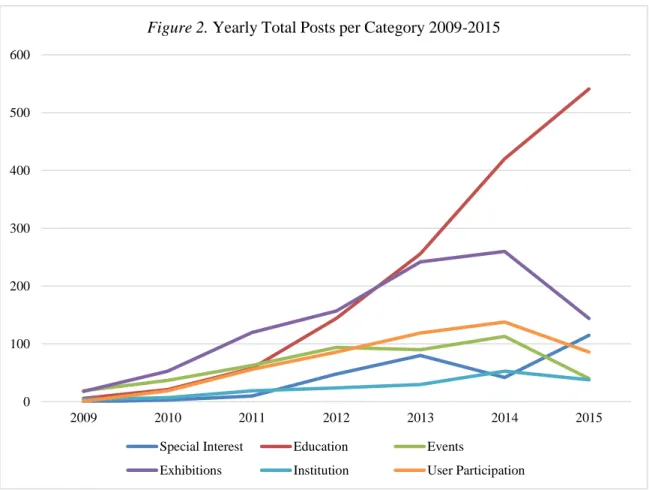
categories’ evolution over time. These results are shown in Figure 2. Once again, Education posts are by far the most prevalent. However, the results indicate that
Exhibitions, Events, and User Participation are in a marked decline.
In particular, the relationship between Education and User Participation puzzled
the researcher, who expected a higher correlation based on the experience of coding the
posts. Figure 3 provides a visual representation of the number of posts cross-coded as both Education and User Participation and how they relate to the total output of
Education posts. This result was once again lower than the researcher expected based on
the experience of coding the posts. 0
100 200 300 400 500 600
2009 2010 2011 2012 2013 2014 2015
Figure 2. Yearly Total Posts per Category 2009-2015
Special Interest Education Events
Determined to discover the source of this trend, the researcher generated an
annual breakdown of posts classified as both education and user participation, which can
be found in Figure 4. This graph reveals that the number of dually classified posts steadily increased from 2010-2014 with a slight drop off in 2015. After reviewing the
data, the researcher discovered the source of the decrease. In 2014, many of the
Education posts began with a question for the user before continuing on to the
educational content. In 2015, this format was not as prevalent. In order for a post to be
classified as User Participation, the writer must actively engage the audience by asking a
question or requesting feedback. Therefore, the 2015 posts no longer met the researcher’s
criteria for User Participation posts.
89% 11%
Figure 3.Percentage of Education/User Participation Posts
Total Education Education/User Participation Posts
0 10 20 30 40 50 60 70 80 90
2010 2011 2012 2013 2014 2015
1.8
Post Efficacy
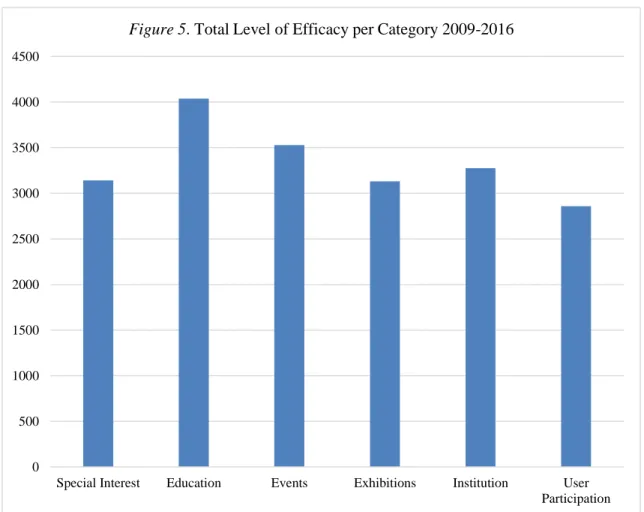
Now the question is whether or not these posts are effective. In order to simplify
the data, the researcher aggregated all of the likes, shares, and comments and then
divided the result by the total number of posts per category. The results are displayed in
Figure 5. Unsurprisingly, Education is still in the lead, but it is followed closely by Special Interest posts. Institution posts prove to be very effective as demonstrated by the
disparity between the number of generated posts and their efficacy level. Exhibitions and
User Participation are pretty evenly matched, which is surprising given the difference in
their respective numbers of generated posts.
0 500 1000 1500 2000 2500 3000 3500 4000 4500
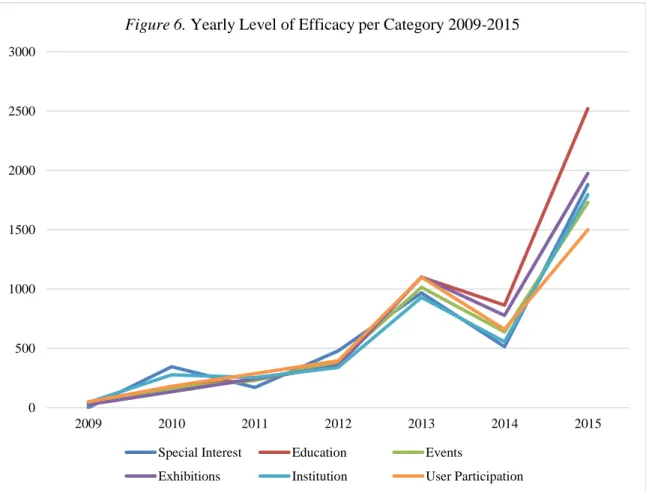
As shown in Figure 6, Education posts were the most effective, particularly after 2013. However, it also illustrates that there was a pronounced drop off in effectiveness in
every category in 2014 followed up by an all-time high in 2015. Returning to Figure 2, this drop in responsiveness corresponds to peak post production in every category except
for Special Interest while the rise in effectiveness in 2015 corresponds to a dip in
production. Although the researcher cannot definitively identify the cause of this
correlation, it seems likely that the museum overextended itself and overwhelmed its
followers with content. Thus, the marked decrease in post production for 2015 shows that
fewer posts do not necessarily compromise effectiveness.
0 500 1000 1500 2000 2500 3000
2009 2010 2011 2012 2013 2014 2015
Figure 6. Yearly Level of Efficacy per Category 2009-2015
Special Interest Education Events
1.9
Education Posts
The results are in, and Educational posts rule the museum’s social media
presence. Due to Education posts’ domination in terms of production and effectiveness,
the researcher felt that a closer examination was warranted, especially considering that
Education posts were the most heavily cross-coded and possessed the highest number of
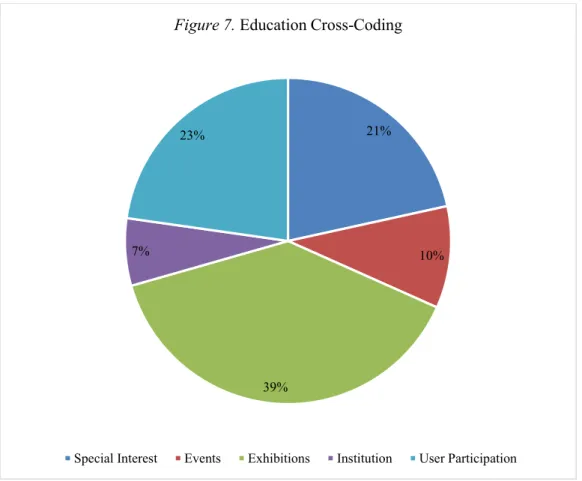
relevant trends. Keeping this fact in mind, the researcher created Figure 7, which illustrates the production of cross-coded posts. Exhibitions are by far the most prevalent
cross-coded category, which is unsurprising due to their status as the second most
produced type of post. Nevertheless, it indicates that the museum is eager to provide
educational content based on their exhibitions. User Participation and Special Interest
posts claim the majority of the remaining cross-coded posts.
21%
10%
39% 7%
23%
Figure 7. Education Cross-Coding
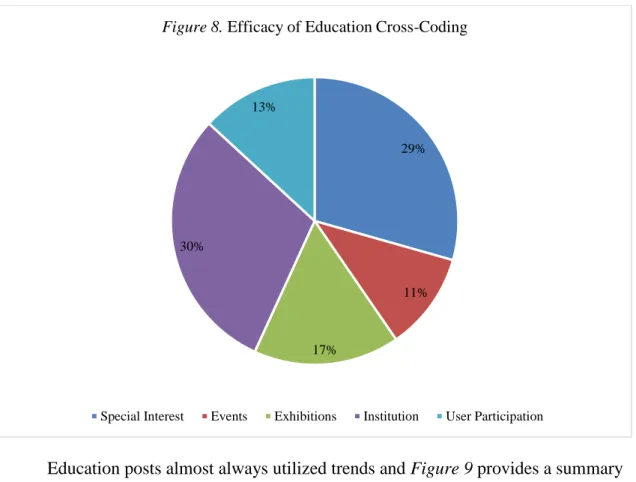
Meanwhile, Figure 8 displays the effectiveness of each cross-coded category. Surprisingly, Institution and Special Interest posts are evenly matched in terms of
effectiveness. Given the significantly lower production of Institution posts, this displays
the value of these types of posts in fostering user responses. Trends found in Institution
posts include: Fundraising, History, Information, Membership, Professional
Development, and Shop. Museum Information and History trends are especially popular
with the museum’s users.
Special Interest posts are the second most effective and are very closely matched to
Institution posts. Special Interest trends include Holidays, Special Awareness Events, and
Sporting Events. Special Interest/Holiday posts are especially popular with the museum’s
users. In 2015, there was a post with an aggregated effectiveness score of 18,968. Of
course, this was a Christmas post, so its users were more eager than usual to like,
comment, and share. Nevertheless, this demonstrates the efficacy of Special Interest and
Education posts almost always utilized trends and Figure 9 provides a summary of post production for the most popular trends. They include: Mystery Object, Behind the
Scenes, Conservation, Birthday, News, and This Day in History posts.
Education/Birthday posts are the most prevalent type by a relatively narrow margin.
These are usually short posts that celebrate the birth of a famous individual with a
relevant item from the museum’s collection. This Day in History and Behind the Scenes
Education posts trail only slightly behind.
29%
11%
17% 30%
13%
Figure 8.Efficacy of Education Cross-Coding
Figure 10 shows the efficacy level of each of the trends. Predictably, Birthday and This Day in History posts dominate when it comes to efficacy. They are very useful
tools because they allow the museum to promote their collections and educate their users,
all while capitalizing on the user’s sense of altruism. Behind the Scenes and Conservation
showed a reasonable amount of efficacy, but the remaining trends, Mystery Object and
News did not appear to perform nearly as well. This may suggest that these types of posts
are not worth the time put into developing them. However, the small post production of
Education/News provides a rationale for their low efficacy score. That leaves the
Education/Mystery Object posts, which is discussed in the following section. 11%
4%
6%
22%
32% 25%
Figure 9. Education Trends
1.10
Emerging Trends
Although all of the trends qualify as trends in museum social media strategy, only
one is an emerging trend, the Education/Mystery Object post. Its premise is a simple
guessing game. The post consists of a challenge from the museum to their users, to
identify the item in the post. In this way, they can actively engage their users and
simultaneously provide a learning opportunity that promotes the collection. All of these
are excellent goals, but that is all for naught if no one is engaging with the posts.
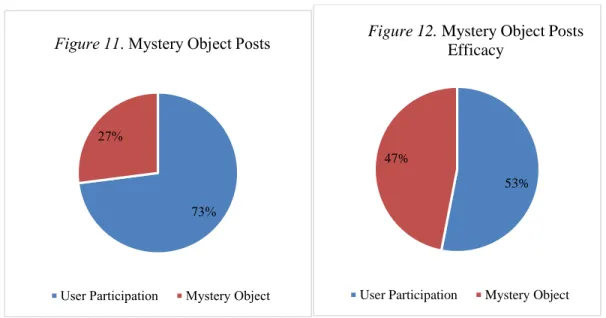
Currently, Mystery Object makes up 27% of all User Participation posts and claim 47%
of the generated shares, likes, and comments (As shown by Figure 11 and Figure 12
respectively).
10%
15%
9%
14% 24%
28%
Figure 10. Efficacy of Education Trends
Mystery Object Conservation News
Considering the fact that the User Participation category stretches back to 2009
and the first Mystery Object post did not appear until 2012, this is an impressive amount
of growth over a relatively short period. Figure 13 documents the growth in the number of posts for Mystery Objects. This is a new initiative, so the increase in posts from over
the past three years is not especially remarkable. However, Figure 14 is a different story. The researcher created separate graphs because when post production was compared to
efficacy, it was impossible to differentiate the lines, bars, or columns meant to show
production. That is to say that these posts are performing extremely well in terms of
efficacy. Although Mystery Object posts suffered the same 2014 downturn as all others,
they sprang back in 2015 and give every indication that they will continue to perform
well in 2016. Therefore, the reason for the Mystery Object post’s seemingly poor
performance in Figure 10 was due to its status as an emerging trend, in contrast to established trends.
73% 27%
Figure 11. Mystery Object Posts
User Participation Mystery Object
53% 47%
Figure 12. Mystery Object Posts Efficacy
0 10 20 30 40 50 60
2012 2013 2014 2015
Figure 13. Mystery Object Posts
0 200 400 600 800 1000 1200 1400
2012 2013 2014 2015
Discussion
One of the primary goals of this study was to fill gaps in the literature regarding
emerging trends in social media content generation through conducting an in-depth
analysis of an institution’s social media presence over time. The researcher believes that
promoting an increased understanding of historical social media trends will benefit the
profession as a whole, by allowing them to use the insights to better engage with users.
The British Museum exhibited six main types of social media content: Special
Interest, Education, Events, Exhibitions, Institution, and User Participation. Out of those
six categories, Education was by far the most popular type, both in terms of post
generation and efficacy, although Exhibits and User Participation also made strong
showings. Due to this discovery, the researcher focused the rest of the analysis on the
cross-coding and trends of the education posts.
These efforts were rewarded by the identification of several key trends within the
general Education posts. These included: Mystery Object, Conservation, News, Behind
the Scenes, Birthday, and This Day in History Posts. The latter two proved to be the most
prevalent and effective in terms of garnering user interaction, but the researcher was most
intrigued by the Mystery Object posts. Over the course of this intensive analysis, the
researcher determined that the mystery object posts were indicative of a successful
Conclusion
This study began by examining the struggle of museums to prove their relevancy
in a world that is often unaware of their existence or their potential usage. The current
strategy to combat this lack of awareness is to adopt the tools of the target audience. This
stratagem led to the mass adoption of social media by museums. However, many of them
struggle to produce content that attracts and keeps users. When the researcher examined
the literature, it did not yield guidance on the creation of specific, effective social media
post generation. In addition, the information provided did not track the efficacy over
time. Therefore, the researcher examined a well-established and robust institution’s most
stable social media platform in order to gather the relevant information.
The findings of this study suggest that there are several key categories of social
media posts, including Special Interest, Education, Events, Exhibitions, Institution, and
User Participation. Using these key categories, the researcher was able to gain insights
into the production of effective social media content as well as historical and emerging
trends. However, the researcher recognizes that these findings are by no means
universally applicable. Therefore, future avenues of research include putting the results of
this study in the context of the field as a whole through comparing the differing functions
Bibliography
Anderson, G. (2004). Introduction. In G. Anderson (Ed.), Reinventing the museum: historical and contemporary perspectives on the paradigm shift (pp. 1-7). New York: Altamira Press.
Bowen, J. P. (2010). A brief history of early museums online. The Rutherford Journal. British Museum . (2008). Strategy to 2012. Retrieved from British Museum:
http://www.britishmuseum.org/pdf/Strategy%20to%202012%20web%20version.
Cameron, D. F. (1968). A viewpoint: the museum as a communications systemand
implications for museum education. Curator: the museum journal, 11(1), 33-40. Dana, J. C. (1917). Prologue. In The gloom of the museum (Vol. 2). Woodstock: Elm
Tree Press.
Fthenakis, L. (2014, 04 10). Social Media and the Museum. Retrieved from Public History in the Digital Realm: www.lisafthenakis.wordpress.com
Gallant, L. (2016, April 6). Inside the vast archives of the smithsonian's natural history: the secret world of museum samples. Retrieved from Buzzfeed:
http://www.buzzfeed.com/lauragallant/inside-the-vast-archives-of-the-smithsonians-museum-of-natur#.awnNyym4b
Gillette, F. (2011, June 22). The rise and inglorious fall of myspace. Retrieved from Bloomberg:
Hooper-Greenhill, E. (1991). Museum and gallery education. Leicester: Leicester University Press.
Hujiboom, N., van den Broek, T., Frissen, V., Kool, L., Kotterink, B., Meyerhoff
Nielsen, M., M., & Millard, J. (2009). Public services 2.0: The impact of social
computing on public services. European Commission Joint Research Centre Institute for Prospective Technological Studies.
Imagemakers. (2011). Digital participation and learning: 22 case studies. Retrieved from Heritage lottery fund:
https://www.hlf.org.uk/file/13158/download?token=7Orcd-Qwz9uoYfr5XjTkZnG4jRHrU8E0T9BcR7U1YVk
Kaplan, A. M., & Haenlein, M. (2010). Users of the world, unite! the challenges and
opportunites of social media . Business horizons, 53(1), 59-68.
Laws, A. S. (2015). Museum websites and social media: issues of participation, sustainability, trust and diversity (Vol. 8). Berghahn Books.
Liew, C. L. (2014). Participatory cultural heritage: a tale of two institutions' use of social
media. D-Lib Magazine, 20.
Low, T. (. (1942). What is a museum? . In G. Anderson (Ed.), Reinventing the museum: historical and contemporary perspectives on the paradigm shift (pp. 30-43). Marty, P. F., & Jones, K. B. (2012). Museum informatics: people, information, and
technology in museums. New York: Taylor & Francis.
Morley, D. (1980). The nationwide audience. London: British film institute.
Parry, R. (2007). Recoding the museum: digital heritage and the technologies of change.
Pett, D. (2012). Use of social media within the british museum and the museum sector.
Archaeology and digital communication: towards strategies of public engagement, 83-102.
Rangaswami, J. P. (2008, 01 18). Why I still use facebook, and other musings on social networks. Retrieved from Confused of calcutta:
http://confusedofcalcutta.com/2008/01/18/why-i-still-use-facebook-and-other-musings-on-social-networks/
Rellie, J. (2006). Ten years on: hopes, fears, predictions and gambles for UK museums
on-line. Museums and the Web. Toronto.
Russo, A., Watkins, J. J., Kelly, L., & Chan, S. (2006). How will social media affect
museum communication? Nordic Digital Excellence in Museums (NODEM).
Oslo.
Spiliopoulou, A. Y., Mahony, S., Routsis, V., & Kamposiori, C. (n.d.). Cultural
institutions in the digital age: british museum's use of facebook insights.
Participations, 11(1), 286-303.
Swanner, N. (2016). If (when?) yahoo goes under, who should buy flickr and tumblr.
Retrieved from The Next Web:
http://thenextweb.com/insider/2016/03/12/yahoo-goes-buy-flickr-tumblr/#gref
The British Museum. (2009). History of the British Museum. Retrieved from The British Museum:
http://www.britishmuseum.org/about_us/the_museums_story/general_history.asp
Trant, J., & Bearman, D. (1997). Museums and the web: a conference, a community, and
a challenge. Archives & Museum Informatics.
Whitaker, Z. (2014). Moving with the crowd: gauging the prevalence and execution of
crowdsourcing in archives.
Yong, E. (2016, March 2016). Funding freeze hits natural history museum collections: the national science foundation has paused a grant scheme biological collections afloat, scientists are mad. Retrieved from The Atlantic:
http://www.theatlantic.com/science/archive/2016/03/funding-freeze-hits-natural-history-museum-collections/474981/
Yong, E. (2016, February 8). Natural history museums are teeming with undiscovered species: tracking them down is a globe-trotting adventure that rivals any jungle expedition. Retrieved from The Atlantic: