Opening the Door Outside for Students with Autism Spectrum Disorder through Inclusive Experiential Education
Angelica M. Ford
University of North Carolina at Chapel Hill
Approved:
__________________________________ Advisor—Dr. Cheryl Bolick
__________________________________ Second Reader—Jessica Ambsbary
__________________________________ Thesis Professor—Dr. Sharon Palsha
Abstract
Contents
Abstract 2
Introduction 4
Methods 13
Literature Review 16
Autism Spectrum Disorder Characteristics 17
Gardening Interventions 22
Animal Assisted Therapy 29
Benefits of Simply Being Outdoors 34
Theoretical Framework 41
Results 43
Guideline 1—Holistic Skill Building 44
Guideline 2—Involvement of Bronfenbrenner’s Spheres 48
Guideline 3—Maintain a Low Ratio 52
Guideline 4—Challenge and Support 55
Discussion 60
Application of Guidelines 60
Implications 64
Limitations 67
Future Research 69
Conclusion 73
References 74
Opening the Door Outside for Students with Autism Spectrum Disorder through Inclusive Experiential Education
Autism Spectrum Disorder (ASD) is a neurological disorder that the CDC reports affects 1 in 59 children as of 2018 (Centers for Disease Control, 2014). This number is up from 1 in 150 as of 2000. As the prevalence of ASD has grown, so has the number of potential interventions to improve the health, education and wellbeing of individuals with ASD. ASD truly reflects a spectrum of possible presentations. The phrase, “once you’ve met one person with autism, you’ve met one person with autism” is strikingly accurate. The DSM-5 diagnostic criteria for ASD include deficits in social communication and interaction as well as restriction and repetition of behavior, interests, or activities (American Psychiatric Association, 2013). Additionally, the DSM-5 stipulates that the symptoms must be present early in development, though the criteria allow that the symptoms may not be fully manifested until later in development or may be masked through intervention and strategies learned later in development. The symptoms also must cause significant impairment, socially, occupationally, or in another area of functioning (American Psychiatric Association, 2013).
Within the criterion that explains deficits in social communication, several different presentations are detailed (American Psychological Association, 2013). One possible
and understanding relationships. Play is further specified as an area of possible difficulty, as well as an apparent lack of interest in peers or difficulty to adjust to a given social context (American Psychological Association, 2013).
Under the criterion of restricted and repetitive behaviors, interests, or activities, several manifestations are specified and to receive a diagnosis, two must have been or must currently be present. These manifestations include stereotyped or repetitive movement, speech, or use of objects (American Psychological Association, 2013). This could present as echolalia, which is repeating speech back, lining up toys, or using memorized scripts when speaking. Another manifestation is inflexibility when it comes to routines and consequent distress when these routines are not followed. Restricted, fixated interests describe another possible manifestation. A fourth possible presentation is hyper- or hyporeactivity to sensory input (American
Psychological Association, 2013). Many of these possible presentations of ASD are inter-connected and affect other aspects of life. For example, restricted and fixated interests may interfere with ability to develop reciprocal relationships. The diagnostic criteria most relevant to the purpose of this thesis are challenges related to acquiring and utilizing social skills and challenges with processing sensory information. The purpose of this thesis is in part to analyze and synthesize the research that looks to improve these skills.
What is Experiential Education?
teacher in front of his class. In response, he left the school and travelled with his mother, hiking and boating. This anecdote is a good example of what Hahn wished to see more of in school— doing instead of listening (Hanford, 2015). Imagination, coping strategies, physical exercises and concentration on tasks of interest and tasks not of interest were parts of the grading criteria Hahn later developed in his life. One of the key pieces of education for Hahn was providing challenge. One specific method to provide challenge used by Hahn was implementing adventures that took place in nature (2015). This is particularly helpful to use with children of any ability level, as it presents ample opportunity for celebrating success and helps protect against learned
helplessness, a psychological concept that is characterized by giving up in the face of hardship instead of persevering or attempting different strategies when faced with a problem (Koegel & Mentis, 1985). A second key piece to experiential education is an opportunity for reflection: what went well? what did we succeed at? where did we have challenges? This reflection allows for growth.
placed in a role only of receiving and storing knowledge. Conversely, instructors are placed in a restricted, didactic role of depositor of knowledge. Experiential education gives room fro instructors and students to go through the process of learning and relearning together (Kolb, 1984).
Teacher education program at the University of North Carolina at Chapel Hill have implemented experiential education. Glazier et al. (2017) explored methods to use in the classroom beyond didactic methods, which may not be the most beneficial for all students. As long as experiential experiences remain educative and lead to growth and continuity, the
transformation caused by the experience leads to knowledge being gained. Here, both instructors and students were moving together on a task, which lead to reciprocal learning, not unlike joint attention. By having both the instructors and students working side-by-side, the “banking” model of education that Kolb (1984) warns against is at least somewhat prevented. Challenges are met head on, by both students and instructors when experiential education is incorporated. Itin (1999), referenced by Glazier et al. (2017), categorizes these challenges as physical, moral, social, emotional, intellectual and spiritual.
Howden (2012) provides an example of experiential education in action with learning to ride a bike. He states first that mental confidence and ease are two important elements when learning to ride a bike, but these elements are not formally taught in the classroom setting. The aim of experiential education is to mediate the conflict between the mental and the physical. With this mediation, “it is believed that the potential to fulfill broad learning outcomes, such as increasing self esteem, enhancing interpersonal relationships and improving leadership
It is important to note additional experiential education terminology, such as brain-based learning and project-based learning, which will be used later in this thesis when discussing the guidelines to curriculum development. These two terms fall under the umbrella of experiential education. Brain-based learning is an overarching term used to describe a type of learning that emphasizes meeting children at their developmental level when teaching them, regardless of whether their level is what is considered standard for their age. In summary, there is no need to rush education (Stixrud & Johnson, 2018). Project-based learning (PBL) and the authentic audience are two concepts that are somewhat intertwined. PBL is a strategy that utilizes engaging teaching methods that empower students through their own action. The authentic audience partners with these projects, showing students that their action can have real-world implications. For example, students could work to improve a park by writing proposals to local government officials (Halvorsen & Duke, 2017).
This thesis will examine and synthesize the literature on interventions that include the principles of experiential education in order to develop an informed, evidence-based curriculum to support the learning of children with ASD. In addition to experiential education literature and theory, Bronfenbrenner’s (1977) social-ecological model of development guided the premise of this review. In this model, children are placed at the center of nested social spheres that expand from immediate family to community environment to cultural happenings. Experiential
education is an exciting field, constantly evolving, and leaving plenty of room for
specify the categories of outdoor environments into gardening and experiences facilitated by animals, or Animal Assisted Therapy (AAT) (Etherington, 2012; Fung, 2015; Lowe et al., 2014; Maber-Aleksandrowicz et al, 2016; Maynard, 2007; Robinson and Zajicek, 2005; Ward et al., 2013;). The literature review chapter explains successes with these intervention methods, helping to support Howden’s concept that bridging the physical and mental worlds leads to promising results.
It is the interest of this researcher to dive deeply into the research on ASD and
experiential education before looking to see how the two bodies of research inform each other. This has not yet been done in either field of research and the researcher of this thesis is seeking to begin this work through this document. The outdoor environment provides opportunities central to environmental education. As a result, studies included in the review all used some element of outdoor life.
Outdoor Interventions
The farm environment provides a location for outdoor learning that is supportive of students with ASD. This type of environment provides a safe and quiet environment outside, with access to nature and animals to be used as possible methods of intervention or therapy (Ferwerda-van Zonneveld et al., 2012). Farming allows for both Animal Assisted Therapy (AAT) and gardening interventions to occur in one location.
2013). Horses in particular may be beneficial for sensory issues when used as an intervention called therapeutic horseback riding (Ward et al., 2013). As both verbal and nonverbal
communication are difficult for some with ASD, increased sociability in the presence of a therapy animal is an easy intervention that can be utilized in any setting given the training of the animal.
On the other side of the farm, research on gardening suggests it to be a potentially
powerful intervention for children, though the majority of the research is focused on neurotypical children rather than neurodivergent children (Dyment & Bell, 2006; Flick, 2012; Lowe, 2014; McArdle et al, 2013; Robinson & Zajicek, 2005;). Denmark’s forest schools place outdoor play as a key part of one’s education (Maynard, 2007). The Danish notion of an ideal childhood includes “a sense of connection with nature and environment” (Maynard, 2007, p. 320).
Maynard (2007) also mentions the idea of giving small achievable tasks to complete, which is a goal that is compatible with gardening. One begins by digging a hole, placing the seed in the hole, covering the hole with dirt and watering the seed. Each piece of this can be celebrated, and the growth of the plant can also be celebrated. Horticulture therapy, a type of treatment that uses the natural environment and natural plant material to target specific goals, is another place in research that demonstrates potential as an intervention for children with ASD (Flick, 2012).
Why Go Outside?
A natural environment provides a more diverse context in which to play and learn, leading to increased inclusive outcomes for the students who take part in the environment. Inclusion in this context refers to acceptance by peers in play rather than inclusion in the
classroom (Dyment & Bell, 2008). Modification and accommodation to each school and student population’s needs is easy to accomplish. Space, and how it is utilized, can be powerful. By providing a variety of play areas, students are able to find their own place outside, taking on appropriate challenges based on their abilities or having time to relax by themselves without fear of social consequences. Green spaces and gardens can be kept in mind when building homes or schools, so it is not too far of a reach to keep these possible learning spaces in mind when
building therapy offices, afterschool programs or daycares (Dyment & Bell, 2008; Lowe, 2014). The idea of using outdoor spaces for educational purposes is not a foreign one; a quick search will locate several different organizations striving to get students outdoors and
environmentally active. Thus, It is not too fantastical to imagine these organizations
of individuals with ASD; for example cognitive-behavioral intervention, applied behavior analysis based strategies, technology-aided instruction and intervention (Hardman et al., 2017). Instead, this thesis is suggesting the use of experiential education intervention to be used as a potential supplement to these interventions.
Methods
The bulk of this study is a review of the existing literature in several currently distinct fields of research. The aim of this study is to find a meeting point between these topics, as there are many opportunities to combine multiple interventions into one holistic program.
Additionally, this study aims to provide guidelines for future development of outdoor
curriculum. Lastly, this topic warrants and deserves future research and critical analysis; this should only serve as an introduction and a beginning of a bridge between the once isolated fields of autism research, animal assisted therapies, gardening and horticultural therapies, and outdoor experiential education in general.
To collect and review existing literature, UNC Chapel Hill’s Library’s website as well as the InterLibrary Loan process was utilized. In addition, Google scholar was used as a search engine to find existing literature online from reputable journals beyond the scope of UNC-Chapel Hill’s online library. Search queries were as follows: “farm-based education,” “animal therapy intellectual disabilities,” “gardening as intervention for intellectual disabilities,” “outdoor education autism,” “picky eating and autism,” “forest schools Denmark,” “sensory garden autism,” “farm and autism,” “outdoor classrooms autism,” “autism and attachment,” “joint attention AAT,” “sensory interventions for autism,” “sensory rooms autism,” “outdoor experiential education,” “horticulture therapy,” “comorbid disorders ASD,” “sensory
integration,” “camp ASD,” “AAT,” “Microbacterium vaccae serotonin, “soil and serotonin,” and “forest bathing.” These searches were conducted from January to August 2018.
search queries were added throughout the literature review process; for example, horticulture therapy was a term that was introduced on February 28th after meeting with individuals already in the field. The term “forest bathing” was also introduced after a conversation with a
horticultural therapist. The website Edutopia was utilized to find definitions and articles on experiential education language. Edutopia is a source for educators on effective educational methods that are research-based. The terms “brain-based learning” and “project-based learning,” were researched through Eduptopia’s search function.
In addition to identifying articles through search terms, a number of articles were recommended through conversations with individuals in the fields of experiential education, horticulture therapy and special education. For example, a horticultural therapist suggested researching forest bathing as well as the connection between serotonin and the bacteria M. vaccae that can be found in soil. A PhD candidate at UNC-Chapel Hill provided knowledge on sensory playgrounds, which eventually led to the search query of sensory gardens. Additionally, a UNC faculty member suggested experiential education language such as “project-based learning” and ‘brain-based learning,” terms that proved to be helpful when researching support for the guidelines to future curriculum development.
educational settings, from formal educational settings such as classrooms to more informal places of learning, such as museums.
A note on language: throughout this literature review, the language surrounding the diagnosis of ASD has been standardized. Other literature in the field uses terms such as autism or autistic, but for the sake of clarity, this review will only use the term ASD to refer to the
Literature Review
Two distinct bodies of research exist—one, which focuses on ASD characteristics, and another, that looks more in depth at experiential education. Some overlap between these two fields has already occurred, and this literature review serves as a periphery scan of the existing overlap. This literature review first aims to describe some of the characteristics found in ASD and delve into the challenges they can pose to the individual (Lin et al., 2012; Mayes et al., 2011; Sharp et al., 2013; Solomon et al., 2008). Once this has been established, it becomes more
appropriate to discuss interventions to aid in the reduction of these problems, whether they are sensory, social, or some other category, or seek to make behaviors more adaptive. First, the researcher conducted a scan of the literature around horticulture therapy and gardening was conducted (Dyment & Bell, 2008; Lee et al., 2011; Lowe et al., 2014; Robinson & Zajicek, 2005), followed by a scan of animal assisted therapy (Fung, 2015; Grigore & Bazgan, 2017; Maber-Aleksandrowicz et al., 2016; Scorzato et al., 2017; Ward et al., 2103). Lastly, the literature review concludes with a final category that encompasses adventure programs, care programs, camps and other general outdoor experiences (Ferwerda-van Zonneveld, 2012; Hung & Thelander, 1978; Martin et al., 2015; McArdle et al., 2013; Zachor et al., 2017). Each section uses a time order to make sense of the articles as each of these fields of study is still developing today.
towards developing a more comprehensive curriculum for students with ASD and other
disabilities. These gaps motivate this entire literature scan, as the benefits of some interventions are not the same as the benefits of others, but little research to date makes connections between the interventions. The literature review seeks to explain the compounded potential benefits of multiple experiential education interventions.
Autism Spectrum Disorder Characteristics
The first section of the literature review will focus on those characteristics of ASD that relate to outdoor experiential education techniques. Sociability, comorbidity, sensory processing, and picky eating will be examined more closely than the many other characteristics identified in the DSM-5 (Lin et al., 2012; Mayes et al., 2011; Sharp et al., 2013; Solomon et al., 2008).
children. Solomon et al. (2008) analyzed the impact of parent-child interaction therapy on the shared affect of children with ASD.
The participants in this study were boys aged 5-12 with a diagnosis of high functioning ASD who demonstrated behavioral problems. During parent-child interaction therapy sessions, parents were coached to reinforce positive behaviors in their children rather than punish negative behaviors (Solomon et al., 2008). The Eyberg Child Behavior Inventory (ECBI), which keeps track of the frequency and severity of conduct problems as identified by the parents, and the Parenting Stress Index-Short Form (PSI-SF), which measures stress in parent-child dyad, were used to measure data. The treatment consisted of two phases. The first phase contained a child directed interaction in which the parents become attuned to the child and give positive attention while ignoring negative behavior. After 8 sessions, parents demonstrated mastery of this skill. Phase two included the parental coaching, where parents were instructed to give clear, direct, concise and age-appropriate commands (Solomon et al., 2008).
Comorbidity. The features of ASD and the features of other disorders have the capacity to overlap. This can make it a challenge to diagnose potential comorbid disorders that may be present in one individual. Mayes et al. (2011) explains that while features of other disorders may overlap with features of ASD, the motivations behind those features may differ. Repetitive actions provide one example: this behavior may derive from pleasure or anxiety depending on whether it is a feature of ASD or OCD respectively. Previous to Mayes et al.’s (2011) research, studies revealed that anxiety is the most common disorder to co-occur with ASD; almost half of the participants in a previous study met the criteria for anxiety (Leyfer et al., 2006). Mayes et al. (2011) examined anxiety, depression and irritability as potential comorbid conditions. Little is known about comorbidity and it is the first to compare parent ratings for children with ASD parent ratings of children with other disorders (Mayes et al., 2011). Similar to much research in the field of ASD, more is being learned about this topic every day.
A total of 1,390 participants aged 6 to 16 took part in this study. 233 of these participants had been diagnosed with high functioning autism (HFA)/Asperger’s, 117 had been diagnosed with low functioning autism (LFA), and 853 participants had different clinical disorders, including ADHD, anxiety, depression, acquired brain injury and mental retardation without autism. The remaining participants were considered typically developing children. The Pediatric Behavior Scale (PBS) was used as a measure for parents to rate their children on a four-point scale from 1, “not at all a problem” to 4, “very often a problem.” The higher the score, the more severe the problem behavior is. The highest score recorded was a 100 (Mayes et al., 2011).
having a score of 54 and a score of 42 for participants with LFA. In this case, participants with HFA were significantly more depressed than participants with LFA. In the category of
irritability, both participants with HFA and LFA had high scores, 88 and 84 respectively. Overall, participants with HFA had significantly higher scores than typically developing
participants on all 10 anxiety items and 9 out of 10 depression items, suggesting that anxiety and depression may be frequently co-occurring with ASD (Mayes et al., 2011).
Sensory Processing. Another characteristic of ASD relevant to this literature review is sensory processing differences. Lin et al. (2012) studied sensory integration dysfunction and what potential interventions can be used to minimize negative effects. The researchers begin by explaining why the topic is worth investigating. With sensory integration dysfunction may come additional problems, such as hyperactivity, difficulty concentrating and sitting still, or
concentrating too much on irrelevant stimuli. Lin et al. (2012) also highlight that sensory needs fall on a spectrum; thus interventions should be varied to meet the varied needs individuals with sensory processing dysfunction may have. The specific sensory processing strategies under investigation in this study sought to improve activity level and intensity and energy expenditure, while also reducing feet-swinging (Lin et al., 2012).
The intervention took place over the course of 8 weeks, and included 1-2 hours of
vestibular sensory processing, a weighted vest, which corresponded to proprioceptive sensory processing and a beanbag, which corresponded to tactile sensory processing. The mixed type of sensory processing used a combination of these devices. The participants receiving these interventions were kindergarteners in Taiwan. These participants did not have ASD and instead were individuals who had tested in the 73rd percentile or higher on the Test of Sensory
Integration Function. To measure physical activity, the Actical monitor was implemented which has the ability to measure energy expenditure, frequency and intensity of action. A survey was later administered to teachers that contained questions regarding the effects of the training and their ability to be integrated into teaching and the classroom setting (Lin et al., 2012).
After the intervention, the results revealed that those who received the intervention showed a significant decrease in activity level and feet-swinging. Additionally, 83.3% of teachers surveyed believed that the sensory processing strategies could be implemented in the classroom and into their teaching styles. It was also reported that there was an improvement in concentration during class, better emotional behavior and a reduction in activity levels. 75% of these teachers wanted to continue to implement the intervention, which may also serve as a testament to the success of the interventions (Lin et al., 2012).
childhood and adolescence. All of the 17 studies included a comparison group in order to gather quantitative data (Sharp et al., 2013).
This meta-analysis found food selectivity to be the primary type of feeding problem, followed by food refusal and behavioral rigidity at mealtime. In 7 % of the studies, there was a combination of the other categories present. In all studies, it was reported that if one has a diagnosis of ASD, they are around five times more likely to have a feeding problem than if they did not have an ASD diagnosis. Specifically looking at key nutrients for development, there was a significantly lower consumption of calcium and protein in comparison to neurotypical peers (Sharp et al., 2013). Sharp et al. discuss the gap in the literature on feeding and nutrition problems as a need to be addressed. Only about .3% of articles published in the Journal of Autism and Developmental Disorders are on feeding and nutrition (Sharp et al., 2013).
Gardening Interventions
A garden has a lot to offer, whether one is actively gardening or merely taking in the benefits of gardening, both through eating the produce or taking in the outdoor environment. This next section of the literature review describes the literature supporting gardening interventions lead to positive outcomes (Dyment & Bell, 2008; Lee et al., 2011; Lowe et al., 2014; Matthews & Jenks, 2013; Robinson & Zajicek, 2005).
participants of this study were neurotypical elementary students in 3rd, 4th and 5th grade (N=281). Teachers were given curriculum and attended training sessions intended to familiarize the teachers with the program. Topics on horticulture, health and nutrition, environmental science and leadership were included in the program. This curriculum exists in the 1999 Texas agricultural extension service Junior Master Gardener’s handbook and consisted of three types of activities: individual, group and community service (Robinson & Zajicek, 2005).
The Youth Life Skills Inventory (YLSI) and a 4-H National Youth Assessment survey was used to gather data both before and after the garden intervention was put in place (Robinson & Zajicek, 2005). The researchers evaluated the impact of the one-year garden program on the life skill development of elementary students. They found that the program was successful. Students had a significantly higher overall life skills score after receiving the intervention. This was an improvement of 1.5 points on average. The authors highlight, in particular, the benefits on self-esteem through the use of a garden program.
their campus. A range of socioeconomic statuses was represented by a total of 21 responses. The questionnaire asked respondents to give their opinions on the greening of the school as well as how they see its relation to social inclusion on intersections of gender, class, race and ability (Dyment & Bell, 2008).
More generally, the questionnaires revealed that, at least in perception, greening school grounds leads to more inclusive social interactions and therefore was successful in its intentions. The addition of trees, shrubs, water features and gathering areas made the space in which they occupied feel more inclusive. One parent interviewed in Dyment and Bell’s (2008) study
explained specifically the value that a shaded section of the play area provided for children with autism:
It was the Special-Ed kids that hung out in that area. And a lot of autistic kids hang out in the shade and just hold on to a tree. So if you ask me, that was why we did it. You don’t have to go any further for an answer — that was pretty powerful to me … that those kids are not getting picked on and they feel they’re secure at recess. (p. 175)
The research suggests that the inclusion experienced through greening of school
campuses is made possible in part by allowing students to have input in the process (Dyment & Bell, 2008). There was 52% agreement among responders that greening created a more inclusive environment for differing abilities. In more open responses, respondents explained that the diversity of play areas allowed for a diversity of individuals to have their own space to be
greening may lead to individual behavioral benefits as well as community level benefits (Dyment & Bell, 2008). A more diverse environment allows inclusion to occur through positive social dynamics that are difficult, if not impossible, to develop when resources are limited and play is restricted to a basketball blacktop (Dyment & Bell, 2008).
Forest Bathing. Lee et al., (2011) explored potential positive effects of a less
conventional method of intervention called forest bathing. Forest bathing is defined as “taking in the forest atmosphere” (Lee et al., 2011, p. 94). Researchers in the past suggested that the forest is a place that has the potential to promote health and well-being. However, there is a lack of scientific evidence for these potential benefits. Lee et al. (2011) sought to provide such scientific evidence by looking at the physiological effects of being in a forest setting in comparison to an urban setting. Data were collected through the assessment of a few different biological markers (Lee et al., 2011).
A number of measures were implemented to test the physiological effects of the varying settings. A method used to assess human autonomic activity, the variance of the high frequency band of HRV, was used as an index of parasympathetic nervous activity. Cortisol levels were measured by taking samples of saliva as a way to measure stress levels. Pulse and blood pressure were also measured. Additionally, a subjective psychological measure was taken using semantic differential techniques to assess subjective feelings, such as refreshment (Lee et al., 2011).
The results of the study revealed significantly higher activity of the parasympathetic nervous system when participants were exposed to forest stimuli rather than urban stimuli, meaning that when exposed to the green, outdoor elements of a forest rather than the speed and concrete of an urban environment, participant’s bodies physiologically relaxed. There were also significantly decreased levels of cortisol in forest stimuli rather than urban stimuli, but this effect may not be as long lasting, as there were no significant differences between the settings after the 15 minutes had passed. Along these same lines, the participants presented a significantly lower pulse value in the forest setting. There was no significant difference in blood pressure between the two settings. Psychological measures showed more feelings of comfort and refreshment while exposed to forest stimuli than urban stimuli. One limitation of this study is the sample studied, as the demographic studied was limited to just 12 adult Japanese men. Due to the small sample size, the generalizability of the results to other genders, ages and ethnicities, which may have different physiological responses, is unknown (Lee et al., 2011).
their view, a well-designed environment can promote independence, social interaction, access, affordability and evolution. In this design, it is also important to be mindful of the multiple presentations of sensory processing; individuals can be either hypo- or hypersensitive to stimuli (Lowe et al., 2014).
This study also took the form of a case study, with three projects at the center of each case study. These projects were on housing, sensory preferences and gardens. Within these projects, four design themes, growth and development, triggers, robustness and support tools, were implemented (Lowe et al., 2014). Elements of the design included visual tools, which can allow for non-verbal communication. Other elements focused on leisure activities, occupational activities, exercise activities and special interest activities that are unique to each individual. In each of these designs, the activities have the capacity of growing in complexity, similar to what is seen in Dyment and Bell’s (2008) study (Lowe et al., 2014). This increasing complexity allows individuals enjoying the garden to go at their own pace independently, moving to more complex tasks and gaining subsequent self-confidence. By allowing for individuality, the resident of the house can feel at home and more in control of their surroundings (Lowe et al., 2014).
Similar to other studies in the field, Lowe et al. (2014) gathered observational findings, which have a limitation in the risk of subjectivity. After the projects completed, lower levels of anxiety and increased levels of concentration, social interaction and communication were observed. Lowe et al. (2014) does specify a potential limitation to these kinds of projects in that it is challenging to find a generic set of guidelines for designing living spaces for those with ASD.
Mayes et al., 2011). Matthews and Jenks (2013) investigated a potential method to alleviate the symptoms of anxiety that may be co-occurring in children with ASD, as well as a potential method to improve cognitive function. It is important to note that this study is unique in the nature of its research and more research on this topic must be completed. This study examined the microbiota that exists in an individual’s gut and whether the makeup of this microbiota has the potential to affect the central nervous system, implicating behavior in the process. Previous research in the subject demonstrates that probiotics have a positive effect on features associated with anxiety-related conditions. Matthews and Jenks (2013) specifically studied Mycobacterium vaccae, which previous researchers suggest may reveal improved health and cognitive function for participants with terminal lung cancer. Importantly, M. vaccae is found in water, soil and vegetation, and has antigens that may involve the neurotransmitter serotonin. This is the same chemical used in SSRI’s, which are used to treat anxiety disorders. Matthews and Jenks (2013) hypothesized that the presence of M. vaccae would decrease stress response in mice, making it easier for mice to complete a complex maze and do so with fewer anxiety-related behaviors (2013).
From this experiment, the researchers determined that the experimental group that received M. vaccae completed the maze twice as fast as the control group that did not receive M. vaccae. Anxiety behaviors in both groups decreased as mice progressed through the maze. However, the control group did exhibit more anxiety behaviors, though this was not a large enough difference to be considered significant. Within the same study, a few other experiments took place. One of these experiments removed the M. vaccae as a food reward. The results remained constant to the previous experiment in that the experimental group of mice still completed the maze faster. However, the groups differed on the anxiety behavior of grooming. Strength of memory was also tested in another experiment, revealing that the experimental group still completed the maze faster then the control group even after 7 weeks from the initial
exposure to M. vaccae. An elevated zero maze was implemented to look more closely at anxiety-related behaviors. The sides of these mazes are open spaces, which have the capacity to induce fear. The only significant effect found in this experiment was in the behavior of head dipping over the side of the maze. Mice in the experimental group did this behavior more frequently, indicating less anxiety. Lastly, the researchers tested the level of activity in the control and experimental conditions. Mice were placed in an activity cage that measured the distance travelled. There was no significant difference between the two conditions.
Animal Assisted Therapy
The research on animal assisted therapy (AAT) is more recent than research focused on gardening programs. In addition, these studies focus more on individuals with ASD or
2105; Grigore & Bazgan, 2017; Maber-Aleksandrowicz et al. 2016; Scorzato et al., 2017; Ward et al., 2013).
Therapeutic horseback riding. Ward et al. (2013) conducted one of the earlier studies that utilized horses as the therapeutic animal. Here, therapeutic horseback riding (TR) was used to provide a multisensory experience for people with disabilities.to determine potential
improvement in joint attention, social responses and communication overall through the use of TR. To accomplish this, 21 children with a diagnosis of autism were recruited for a 10-week intervention (Ward et al, 2013).
Findings taken from the GARS-2 showed that the six-week break away from the intervention brought scores back to where they were prior to the TR intervention. While the intervention was in place, social interaction and mean scores on the autism index decreased from very likely autistic to possibly autistic. There was also a significant multivariate effect for time with SPSC, showing that there was a significant increase in first six weeks, a significant decrease at week 16 that remained stable during break, and a significant increase again at week 30. In addition to the data taken from the three aforementioned measures, qualitative data provided by the teachers indicated improvements (Ward et al., 2013).
Therapy dog. Fung (2015) adds to the AAT literature with his case study of a 7-year-old boy with ASD and a trained therapy dog. This study was specifically concerned with the
potential increase in social behaviors in children with ASD that could be accomplished through AAT. Fung (2015) discusses the challenges with nonverbal and verbal communication that can arise with ASD. Further, Fung (2015) explored the sustainability of an intervention of this nature.
Three times per week for a total of 14 sessions, the boy and the dog spent 20 minutes together. These sessions were completed in the following four phases: building dog-child
Fung (2015) was successful in finding an increase in social behavior, approximately doubling the score taken prior to beginning the intervention. The increase was seen especially with nonverbal social behavior, specifically in waiting and joint attention. A decrease in nonsocial behavior from a score of 85 to a score of 66.3 was shown. Verbal social behavior remained infrequent across all phases of the intervention (Fung, 2015). At a follow up session intended to collect post-intervention measurements after some time had passed, social behavior had declined to 27.1%, while nonsocial behavior was at 70%. This reflects that when the dog's presence faded, so did the contingent social behavior. Fung suggests that future studies provide more time for the client and the therapist observing participant-dog interactions to develop communication throughout the sessions (Fung, 2015).
Scorzato et al. (2017) also saw the potential of AAT to assist individuals who experience behavioral, cognitive and/or motor problems. Here, animals were viewed as “agents of
socialization and providers of social support and relaxation” (Scorzato et al., 2017). Participants between the ages of 20 and 58 participated in 20, 30-minute sessions with trained therapy dogs, where each session became more complex in the participants engagement with the therapy dog. Participants began by merely observing the dog, and moved upwards in complexity to calling, feeding, grooming, playing with, walking and finally completing group activities with the dog and dog handler (Scorzato et al., 2017).
attention to determine why the results of this study revealed that effect while others in the field have not (Scorzato et al., 2017).
Grigore and Bazgan (2017) studied the use of AAT with children with ASD on a case-by-case basis. The research question at hand referred to AAT's ability to increase socio-emotional abilities in children with ASD. Based on previous research, this study hypothesized that the use of AAT would improve interaction skills with adults, social behavior and emotional self-control. Further, the researchers believed that AAT would help to develop emotional expressiveness as well as recognition and interpretation of emotional expressions. Not only was it hypothesized that AAT would lead to these improvements, but it was also hypothesized that it would be more successful than other therapies (Grigore & Bazgan, 2017).
To test these hypotheses, case studies were used to collect longitudinal and qualitative data. Observations of the children took place from June 2016 to April 2017 with four children between the ages of three and nine. The diagnoses of these children included infantile autism, language and hearing delays, and in one case, hyperkinetic disorder and convergent strabismus. A six-year-old dog trained for AAT served as a therapy dog for the study. To measure outcomes of adult interaction skills, social behavior, emotional expressiveness and appropriate emotion recognition, surveys were given to therapists and parents. One therapist surveyed was trained in AAT and the other was an applied behavior analysis therapist (Grigore & Bazgan, 2017). The hypotheses developed by Grigore and Bazgan (2017), namely that AAT intervention improves social and emotional skills, were all supported through these experiments.
disabilities. The literature reviewed consisted of 10 studies, of which most utilized dogs as the therapeutic animal, though some studies featured horses and guinea pigs and donkeys were used once in two different studies. The literature reviewed ranged from studies conducted in 1989 to 2012 (Maber- Aleksandrowicz et al., 2016).
This literature review presented a few key findings. With the use of AAT, 9 out of 10 studies saw an increase in socialization and an improvement in cognitive function. An improvement in cognitive functions, concentration, or attention was found in 7 out of the 10 studies, with three studies having a p-value of .01, meaning it was very unlikely that these results were found by chance. Two out of the 10 studies had results indicating a positive impact on emotional well being, while 4 out of the 10 had results supporting an improvement in behavior-autonomy. Unfortunately, but still significantly, one study actually saw deterioration of the behavior in males who were identified as having severe intellectual disorders (Maber-
Aleksandrowicz et al., 2016). Other literature reviews provides important information about the potential impacts of a whole field of study.
Benefits of Simply Being Outdoors
A wealth of research that looks broadly at the outdoors as a potential resource for development has been conducted, and this portion of the literature review looks at these
programs that work specifically to help individuals with ASD or who are otherwise considered vulnerable. Studies specifically exploring outdoor programming, care farms, and outdoor play were analyzed in this section (Ferwerda-van Zonneveld, 2012; Hung & Thelander, 1978; Martin et al., 2015; McArdle et al., 2013; Zachor et al. 2017).
children of all ages and abilities, and those designed for students with ASD can be used as an intervention (Hung & Thelander, 1978). In addition, some outdoor programming is a bit more strenuous than camp, and falls under a category of its own: adventure program (Zachor et al., 2017).
Summer Camp. Hung and Thelander (1978) studied the potential benefits of a residential
summer camp intended to serve the population of children with ASD. Camp activities were paired along with training classes that aimed at improving generalizing language and self-help skills and reducing undesirable behavior. This particular camp lasted three weeks and had a one-to-one staff-to-child ratio, a trend among self-reported successful programs. The staff consisted of trained occupational therapists, special education instructors, speech pathologists and
undergraduates who served as counselors and swim instructors. A total of 18 campers were studied and they ranged from age 5 to 13. The spectrum is wide and the sample studied represents a wide range of characteristics and presentations. Many children communicated nonverbally or with limited verbalizations. In addition, some of the undesirable behaviors expressed were hand biting and aggression (Hung & Thelander, 1978).
As for the structure of the camp schedule and activities, the first day of camp was used as an adjustment period, allowing campers to get comfortable in their new settings. The following four days established a baseline for future assessment. After this period, the training classes began. The training classes implemented a contingent food and token reinforcement system. When analyzing the data collected from the study, the researchers emphasized consistency of training and objectivity when recording data (Hung & Thelander, 1978).
research studies include the cost associated with running a camp of this nature, which cost
98,000 dollars in Hung and Thelander’s (1978) study. Another potential limitation not mentioned in the report comes with the age of this study. Much has changed since 1978, both in the rhetoric around ASD and the interventions used. With the limitations in mind, the data collected during the camp revealed that 79% of campers showed an improvement in language by at least 15% from baseline to the end of the program. Additionally, 66.67% improved 15% or more in the category of self help skills. If not in those specific categories, Hung and Thelander (1978) reported that every child improved 15% or more in at least one area of treatment. As for the study’s qualitative data, Hung & Thelander (1978) administered a survey to parents asking for feedback. The parents were enthusiastic about the program and gave positive feedback for the experience overall.
Adventure Program. Similar to the camps discussed by Hung & Thelander (1978),
one’s spatial environment and in fine motor movement. Lastly, a hammock and rope swing was implemented as an intervention to build trust and provide relief and rest (Zachor et al., 2017).
The researchers found significant improvements in social-communication, social
cognition and motivation. In addition, the measurement scale Vineland Adaptive Behavior Scale (VABS) showed skills in communication, daily living skills, socialization and motor movement increased significantly after the duration of the program. The Social Responsiveness Scale (SRS) differed between the intervention group and the control group that did not attend the adventure program. There was a reduction in severity of behaviors overall for the intervention group while there was an increase in severity for the control group. The same trend was observed in the specific categories of communication, cognition, motivation and autistic mannerisms. Lastly, this study indicated that restrictive and repetitive behaviors became more pronounced over the time period in the control group, and this same trend was not observed in the experimental group that attended the adventure program (Zachor et al., 2017).
Researchers discovered important characteristics of care farms. These characteristics included the character of farmer and the quality of the environment. A safe and quiet
environment was considered important, as well as the presence of animals. From the perspective of the farmers, the main concern expressed was the quality of care they could provide. Farmers expressed not knowing how to manage behavioral problems, as well as experiencing pressure to expand their farm. To accumulate this data, interviews were conducted with farmers on care farms (Ferwerda-van Zonneveld et al., 2012).
Seven farms in total were surveyed. Of these, four out of the seven had agricultural production and served as a care facility, while the other three served primarily as care facilities as their core business (Ferwerda-van Zonneveld et al., 2012). This supports the idea that animal assisted therapy (AAT) and horticulture can exist on the same platform. The ratio of farmer to individuals using the care farm facilities was kept low and typically a five-to-one ratio. The smallest ratio represented was two-to-three Most of the farmers surveyed had some sort of background with ASD; two farmers expressed gaining this background through their own reading. Care farmers serve as an intermediary between the child receiving services, the
caretakers of that child and the other important individuals in that child’s life, such as therapists. With this in mind, farmers expressed that it is important for them to possess qualities of patience, empathy, consistency and flexibility. Within the farms, the animals present for potential AAT interventions included cows, horses, sheep, goats, chicken, dogs and cats (Ferwerda-van
Zonneveld et al., 2012). These animals in particular all have the capacity to provide some degree of attention and care to those who interact with them.
defined as those experiencing homelessness, domestic abuse, alcohol or drug use in the home. The researchers sought to combine care, therapy and education into one supportive intervention (McArdle et al., 2013). The participants consisted of 70 children aged 4-5 that lived in a
disadvantaged area. Cohorts consisted of 8-10 children that met one afternoon a week for a period of 10 weeks. The ratio of child to staff was kept low from 2:1 (McArdle et al., 2013).
To gather qualitative data, the methodology was ethnographic and child-centric. To accomplish this, unintrusive-participant observers gathered data without causing discomfort or threatening to affect child's behavior. A socio-cultural analysis looked specifically at the development of resilient characteristics. In addition to the observational data, questionnaires were also distributed to teachers both prior to and after the intervention’s completion. The questionnaires featured questions on physical, emotional, behavioral and social abilities (McArdle et al., 2013). To measure each child’s well-being, the researches used the PERIK model, an observation scale, which looks at competence and positive development, and has the following dimensions: making contact/social performance, control/thoughtfulness, self-assertiveness, emotional stability/coping with stress, task orientation and pleasure in exploring (McArdle et al., 2013).
confidence was exhibited among the majority of participants. Further, some participants even exhibited physiological effects related to sleep, fitness and fine motor skills. Overall, this
program was found to be successful in developing resilient personality factors among vulnerable children through use of outdoor play (McArdle et al., 2013).
Even more generally than outdoor programming, but still important to keep in mind, is outdoor free play. Martin et al. (2015) brings play into the focus, explaining its importance in that it gives a space for age-appropriate activities with one’s peer group to take place. Within this space, there are opportunities for positive interactions that can give confidence and build
communication and socialization skills. Children who are not typically developing, including those with ASD, can benefit from more structure in their outdoor play both for safety and social reasons. However, few educators have any instruction on how to guide this play for more
successful interactions. Martin et al. (2015) advocate for professional development packages that can provide information on procedures to give, such as written or verbal instructions, modeling and role-playing. This should be considered sustainable, on-the-job training that also includes monitoring and feedback (Martin et al., 2015).
The level of interaction with target children after the intervention began increased immediately and substantially above the data taken at baseline. This pattern continued during a maintenance period after the intervention with three of the four students. One student had lower levels during the first maintenance session. From the study, it became more apparent that the longer the teacher’s received the intervention, the greater the increases in the children’s level of solitary or social play. However, the nature of this study is not one that could have a control, so it is important to keep in mind that causation can only be speculated. Based on the results that suggest that the play behavior increased only in the presence of the intervention given to teachers, Martin et al. (2015) speculate that professional development is an effective method of improving teacher instructional interactions, which may have positive collateral effects on students’ play activity (2015).
Theoretical Framework
The guidelines presented in this thesis apply the elements of the research in experiential education that Kolb (1984), Hahn (Hanford, 2015), and Howden (2012) each have set forth already. In addition, this literature on experiential education-based interventions should also be analyzed within the theoretical framework of Bronfenbrenner’s ecological model of human development (1977). Bronfenbrenner was interested in the ways human development was studied in the past, and believed that there was a misconnection in the focus of the research; researchers were only interested in the individual who was the subject of the study. Bronfenbrenner (1977) argued that the environment of the individual was paramount to understanding any individual, or the results of any given study.
microsphere, mesosphere, exosphere and macrosphere emanating out from the center. The microsystem consists of the immediate setting of the individual, which may be the home or the school. The mesosphere consists of the systems of microspheres that affect an individual (Bronfenbrenner, 1977). Children with ASD interact with a number of service providers, including, but not limited to, occupational therapists, speech pathologists, physical therapists, and special education teachers, as well as their families. In a school setting, these individuals may interact with even more interested professionals, like school psychologists, school
counselors, and school social workers (Hardman et al., 2017). The microsphere and mesosphere are important for analysis because of the sheer amount of microspheres they are in. The
exosphere considers major institutions, like the government and media, while the macrosphere considers larger institutional structures, like the political, educational and social systems (Bronfenbrenner, 1977).
Results
This section attempts to find the middle ground between ASD and different models of experiential education, such as gardening interventions, animal assisted therapy and outdoor programming for youth. For the sake of this thesis, the results section will take the form of suggested guidelines for curriculum development based on empirical research that seek to combine these once distinct categories into more comprehensive, tangible interventions. Below, there are four suggested guidelines put forth by the researcher that were developed through analysis of trends in the literature review data. The guidelines are (a) to view skill-building holistically; (b) involve the individual’s family in any given program; (c) maintain a low ratio; and (d) provide support and challenge. It is intended that these guidelines can be implemented in formal and informal learning environments. Trends informing these guidelines were apparent early on in the process, but were not quantifiable until the data analysis was complete; for example, the trend of utilizing a low ratio appeared in many studies, but for how many studies and how low to keep the ratio was not seen more clearly until data analyses were complete.
Guideline 1—Holistic Skill Building
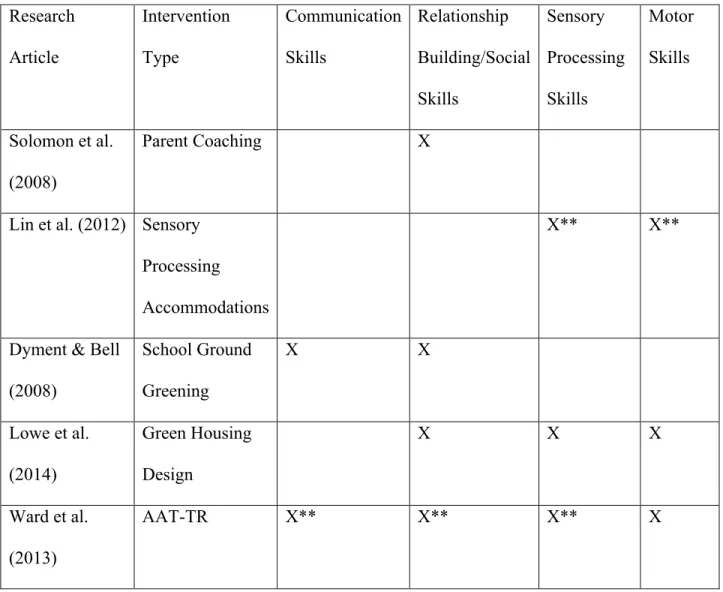
The studies (N=19) included in the literature review all named skills they were hoping to improve through the use of their intervention or program. These skills ranged from, but were not limited to, nonverbal and verbal communication to resiliency to social, cognitive and motor skills. Of particular interest were communication, social, sensory processing, and motor skills, as these are characteristics of ASD, which were included in 14 studies that are included in the table below. These skills were specified by researchers in their studies as objectives of the intervention and were not the subjective label of the researcher of this thesis. In Table 1, these skills are specified as headings of the table, while an X in the box next to the research title coordinates to that study specifying this skill as a target skill. Table 1 is not comprehensive and does not reflect all of the different skill objectives the researchers included in this literature review sought to improve.
Social communication and relationship building. ASD is marked by deficits in social communication and interaction, including communication skills, relationship building/social skills, and nonverbal and verbal communications that are utilized in relationship building (APA, 2013). Communication skills and social skills appear to be somewhat intertwined and often appeared in conjunction with one another (Dyment & Bell, 2008; Fung, 2015;
are unique from the other studies in that they were not focused on individuals with ASD, and instead looked at the populations of typically developing students in a classroom setting or vulnerable children respectively. Despite not looking to close deficits in communication or social skills, they still aimed to improve these skills.
Sensory processing. Sensory processing was another skill of interest and corresponds to a feature of ASD. People with ASD can be either hypo- or hyper-reactive to sensory input, and this sensitivity could be in any sense, whether this would be taste, touch, smell, sight, or hearing. Another presentation of differences in sensory processing is the potential for individuals with ASD to display an interest in unusual aspects of the environment, which again could be a fixation of any sense (APA, 2013). Only four studies sought to improve sensory processing. All four of these studies were interested in individuals with ASD as the population studied. Of these studies, two were AAT interventions, one focused on implementing nature and greening methods in housing designs, and one looked specifically at sensory processing interventions. Addressing sensory processing skills is missing in all studies that were categorized under outdoor
programming, and in three of these studies is the only skill missing. At least as far as the scope of this thesis, sensory processing is the skill of least focus for interventions
Motor skills. Lastly, building motor skills in interventions was analyzed. Deficits in motor skills for individuals with ASD can present as stereotyped or repetitive motor movements. More specifically, this can refer to an odd gait, clumsiness, and other abnormal motor signs, for example, walking on tiptoes (APA, 2013). Nine studies addressed motor skills in their
strategies, and one studied green housing design. Eight of the nine studies were interested specifically in individuals with ASD.
As can be seen in Table 1, some categories of interventions lacked a focus on certain skills, while others emphasized these skills. On the other hand some interventions did an exceptional job at including all four of these skills. Nearly all AAT studies boosted social skills and motor skills, while outdoor programming generally improved communication and motor skills. As an example of combining different types of interventions together, Etherington (2012) posits that seamless inclusion of animals in gardening interventions is possible.
Table 1. Outcome Variable Skills Research Article Intervention Type Communication Skills Relationship Building/Social Skills Sensory Processing Skills Motor Skills
Solomon et al. (2008)
Parent Coaching X
Lin et al. (2012) Sensory Processing Accommodations
X** X**
Dyment & Bell (2008)
School Ground Greening
X X
Lowe et al. (2014)
Green Housing Design
X X X
Ward et al. (2013)
Fung (2015) AAT X X
Maber-Aleksandrowicz et al. (2016)*
AAT X X X X
Scorzato et al. (2017)
AAT X** X**
Grigore & Bazgan (2017)
AAT X X
Hung & Thelander (1978) Residential Summer Camp X Ferwerda-van Zonneveld (2012)
Care Farms X
McArdle et al. (2013)
Outdoor Play X X X
Martin et al. (2015)
Outdoor Play teacher training
X X X
Zachor et al. (2017)
Outdoor Adventure Program
X** X** X**
Guideline 2—Involvement of Bronfenbrenner’s Spheres
Bronfenbrenner’s (1977) model can be used to conceptualize any child regardless of whether they are typically or atypically developing. Children do not exist in a vacuum and instead exist is a series of nested communities. For children with ASD, the microsphere that revolves around the individual consists of not only the family, the school, and the neighborhood, but also a host of allied service team members interested in best serving the child. Additionally, children with ASD may have more difficulty advocating for themselves due to communication barriers, so families can be important in helping to advocate for the child (Hardman, 2017). Professionals can better understand the child they are giving service to by partnering with families (Hardman et al., 2017). Better understanding leads to more appropriate interventions. Additionally, family involvement can improve the lives of other family members as well as the child receiving service (Hardman et al., 2017). Parents are helpful resources when building interventions and programs because they know their child better than any other professional helping to serve. To ignore parents is to ignore a vital asset.
important with children. This recognizes the importance of the individual level, as did many other interventions in this literature review. It is suggested that interventions and programs look to the microsphere specifically for support. The mesosphere can be engaged by asking for community buy-in to programs and interventions.
By including the family, research suggests that a benefit exists in its potential to build resiliency, a skill that was not the focus of many studies focusing on children with ASD. McArdle (2013), one of the few studies with a focus on building resilience, also notes a lack of family involvement for children who they considered vulnerable—those children experiencing homelessness, substance abuse, and domestic abuse. For the sake of the study, vulnerability did not include individuals with ASD, but it would not be unreasonable to consider children with ASD to be vulnerable. McArdle (2013) references Newman and Blackburn (2002) to define resilience, where it operates, and what can be protective factors. Resilience is the ability to recover from stressful life events and productively move forward. The family is one of the three arenas in which resilience factors operate, along with the child and the environment.
Additionally, one of the specific qualities that lead to resilience is “the presence of at least one unconditionally supportive parent or parent substitute” (Newman & Blackburn, 2002, p. 7). All children are at risk for stressful life events, and this does not exclude children with ASD, who experience many life stressors.
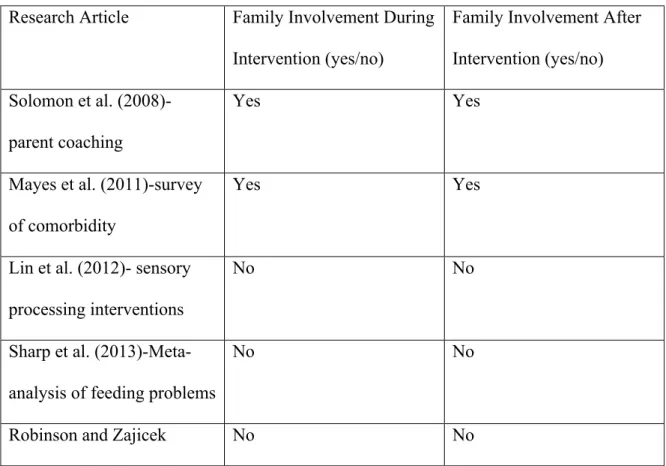
2008). Solomon et al. (2008) is a parent coaching intervention, so to involve the family was a core objective of the study. Mayes et al. (2011) asked for parent rating scales of behavior during the intervention using the Pediatric Behavior Scale both during the intervention and after the intervention had ended. Lowe et al., (2014) asked for families to be involved in the design process of greening adult residents with ASD’s homes.
Six studies involved families after the intervention had taken place (Dyment & Bell, 2008; Grigore & Bazgan, 2017; Hung & Thelander, 1978; Mayes et al., 2011; McArdle et al., 2013; Solomon et al., 2008). Of these six studies, four asked for family involvement by way of a survey or questionnaire following the intervention requesting feedback (Dyment & Bell, 2008; Grigore & Bazgan, 2017; Hung & Thelander, 1978; McArdle, et al., 2013). These four did not ask for parental involvement before the intervention began.
Table 2. Family Involvement
Research Article Family Involvement During Intervention (yes/no)
Family Involvement After Intervention (yes/no) Solomon et al.
(2008)-parent coaching
Yes Yes
Mayes et al. (2011)-survey of comorbidity
Yes Yes
Lin et al. (2012)- sensory processing interventions
No No
Sharp et al. (2013)-Meta-analysis of feeding problems
No No
(2005)
Dyment & Bell (2008)-school ground greening
No Yes
Lee et al. (2011) No No
Lowe et al. (2014)-green housing design
Yes No
Ward et al. (2013)-AAT-TR No No
Fung (2015)-AAT No No
Maber-Aleksandrowicz et al. (2015)
No No
Scorzato et al. (2017)-AAT No No
Grigore & Bazgan (2017)-AAT
No Yes
Hung & Thelander (1978)-Residential summer camp
No Yes
Ferwerda-van Zonneveld (2012)-Care farms
No No
McArdle et al. (2013)-Outdoor play
No Yes
Martin et al. (2015)-Outdoor play teacher training
No No
Zachor et al.
(2017)-Outdoor adventure program
Guideline 3—Maintain a Low Ratio
It is important to note how ASD characteristics can uniquely present themselves in each individual. Again, it is necessary to make mention of the width of the spectrum. As a result, it can become increasingly difficult to create one program or intervention that fits the needs of all the individuals with ASD that are involved (Lowe et al., 2014). Beyond the characteristics of an individual’s ASD, there is also the natural variability of life, regardless of ability. Different children have different interests, likes, dislikes, and future goals, and these should also be kept in mind when designing interventions and programs for all children, both exceptional or typically developing. Maintaining a low ratio, even as small as a one-to-one ratio, is one technique that can be employed to allow for each individual to get the most out of the program or intervention through personalization.
With a low ratio, the possibility for shared affect between individuals becomes more possible. Solomon et al. (2008) refers to shared affect, which they define as “moments where both child and parent are engaged in happiness, laughter, smiling, or affectionate touch” (p.
1768). In this study, the low ratio refers to the parent-child dyad, a personal interaction between two people. The intervention used in the study, PCIT, increased the level of shared affect (Solomon et al., 2008). The results indicated that shared affect was negatively correlated with parental perceptions of negative behavior. Additionally, shared affect can lead to a number of positive outcomes for typically developing individuals, such as increases in compliance, frustration tolerance, or kindergarten readiness. Solomon et al. (2008) found that it can also be beneficial for children with ASD.
matched participants to horses that best suited their needs. Physical factors, like the height and weight of students was taken into account when making matches. Additionally, these matches were based on observations of the sensory needs and behaviors of each participant. Lin et al. (2012) divides sensory processing into 4 different types: vestibular, proprioceptive, tactile, and mixed. Variability exists within these types as well, creating unique sensory preferences for each individual. Presentations of sensory differences vary across the spectrum and it is generally best practice to have flexibility in accommodation (Lin et al., 2012). Ward et al. (2013) was utilizing brain-based learning techniques by matching horses to meet the unique needs of participants. Through this process, the researchers were more interested in meeting the participants where they were currently at developmentally and appropriately serving them in order to help the students build skills. It does not matter as much where they “should” be.
community centers, and therapy offices can be designed around individual sensory and personal preferences.
A lower ratio makes it easier to implement brain-based learning, as demonstrated by the methods of Ward et al. (2013), Lin et al., (2012), and Lowe et al. (2014). It can be difficult to cater a program to a group of 30 children, trying to appropriately design the program to each child’s developmental level. With a smaller ratio, the staff members can attempt to meet each child where they are in their journey to development and skills building. There is no drive to get some children to “catch up” or ask other children to be patient and wait for their fellow group mates when the ratio can be kept low and the staff member can work more individually with children.
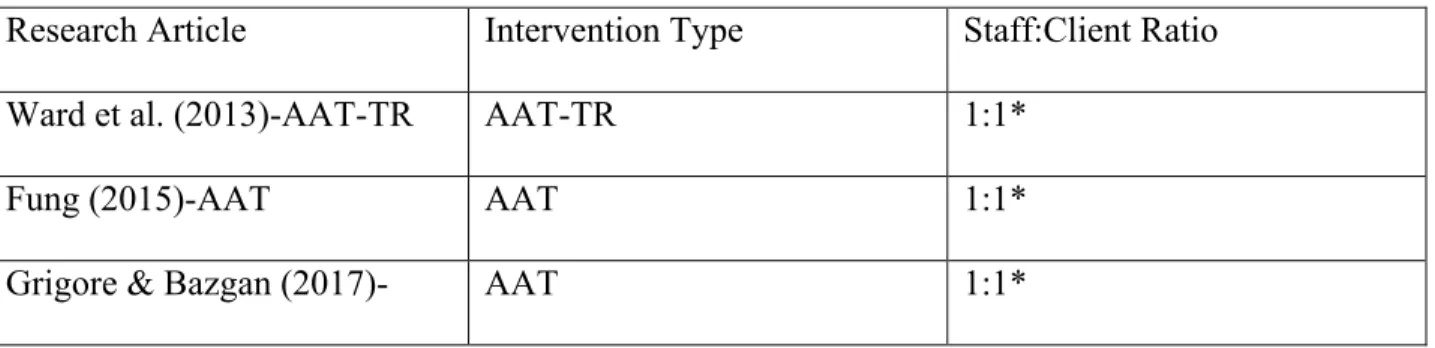
Table 3 displays each research article that specifies a ratio between the staff and those receiving the intervention, here described as the clients (N=8). Of the studies that give ratios (N=8) for staff to client interactions, the vast majority were small ratios. Five of the eight studies had a 1:1 ratio represented (Fung, 2015; Grigore & Bazgan, 2017; Hung & Thelander, 1978; Martin et al., 2015; Ward et al., 2013). For three of these studies, an animal was categorized as the staff member, as the animal was the key part of the therapy being administered. Zachor et al. (2017) represents the largest ratio represented, and the outlier of the group. This study was an outdoor adventure program that utilized a ratio of 3 staff members to 51 clients.
Table 3. Staff: Client Ratio Chart
Research Article Intervention Type Staff:Client Ratio
Ward et al. (2013)-AAT-TR AAT-TR 1:1*
Fung (2015)-AAT AAT 1:1*
AAT
Hung & Thelander (1978)-Residential summer camp
Residential Summer Camp 1:1
Ferwerda-van Zonneveld-Care farms
Care Farms 5:1 – 2:3
McArdle et al. (2013)-Outdoor play
Outdoor Play 2:1
Martin et al. (2015)-Outdoor play teacher training
Outdoor Play teacher training 1:1
Zachor et al. (2017)-Outdoor adventure program
Outdoor Adventure Program 3:51
*staff here refers to animal used in therapy Guideline 4—Challenge and Support