Sharif University of Technology
Scientia IranicaTransactions E: Industrial Engineering http://scientiairanica.sharif.edu
Sustainable supplier selection and order allocation: An
integrated delphi method, fuzzy TOPSIS, and
multi-objective programming model
M. Rabieh
a;, A. Fadaei Rafsanjani
a, L. Babaei
a, and M. Esmaeili
b a. Faculty of Management and Accounting, Shahid Beheshti University, Tehran, Iran.b. Industrial Management, Faculty of Management and Accounting, Allameh Tabataba'i University, Tehran, Iran. Received 25 September 2017; received in revised form 18 March 2018; accepted 16 July 2018
KEYWORDS Sustainable supplier selection;
Order allocation; Fuzzy TOPSIS; Multi-objective programming; Epsilon constraint method;
Weighted sum method.
Abstract. The purpose of the current study is to select suppliers and determine their order allocation in a way that the performance of the sustainability of the supply process gets optimized on the whole. In this research, after reviewing the literature and investigating the supply chain of the case study (Iran Khodro's supply chain) through Delphi method, a set of evaluation criteria related to the performance of the suppliers in economic, social, and environmental terms was identied. In the next stage, by using the identied criteria, the multi-objective mathematical integer programming was presented to solve the problems of supplier selection and order allocation. The suggested mathematical programming in this research is designed to be multi-product, single-period, and multiple sourcing. Fuzzy TOPSIS method is applied to calculate the qualitative parameters that are used in the suggested mathematical programming. Ultimately, the mathematical model suggested in the research is solved by two methods, i.e., epsilon constraint method and weighted sum method. Moreover, the Total Value of Sustainable Purchasing (TVSP) is calculated for both cases. The comparison of these two methods indicates that, in this research, the results of the weighted sum method are more ecient than those of the epsilon constraint method.
© 2019 Sharif University of Technology. All rights reserved.
1. Introduction
The sustainability of the supply chain has received great attention in the earlier decade{both in the do-main of academic researches and in practice. Because of the rise of global competition and the pressure exerted by dierent stakeholders in the supply chain, especially governmental lawmakers and social and en-vironmental activists, most organizations are required to consider sustainability in their performance.
Com-*. Corresponding author.
E-mail address: m [email protected] (M. Rabieh) doi: 10.24200/sci.2018.5254.1176
bining two concepts of sustainable development and supply chain management makes sense under the man-agement of a sustainable supply chain [1]. Elkington was the rst who coined \the Triple Bottom Line" (TBL) to dene sustainability [2]. The aforementioned phrase consists of economic, social, and environmental terms. Hassini et al. dened sustainability as the ability to manage an organization by considering long-term purposes that are related to economy, envi-ronment, and society [3]. The World Commission on Environment and Development takes sustainable development as a kind of development that meets the needs of the present without compromising the ability of future generations to meet their own needs [4]. The cooperation of all members, including suppliers,
manufacturers, distributors, retailers, and managers, is necessary to access and maintain sustainability in the supply chain. Therefore, supplier selection and evaluation as signicant elements in the supply chain (according to the criterion of sustainability) play a key role in the sustainability of the supply chain. Multi-Criteria Decision-Making (MCDM) and various exact and ecient heuristic methodologies have been used to solve the Supplier Selection Problem (SSP) in the literature [5]. The basic questions that are used in the literature for decision-making models are as follows: How many suppliers are need? Which suppliers should be selected? What is the optimal ordering policy for each supplier [6]? Cooperation with suppliers with a good status in economic, social, and environmental terms can enhance the performance of the supply chain in respect of sustainability. In addition, it sets the scene for moving towards sustainable development [7]. Accordingly, organizations are bound to apply new indices to ensure sustainable development-a case that is not taken into consideration appropriately. These indices are known to be indices of sustainability that result in the sustainability of the system. The indices of sustainability, in a general classication, are categorized into economic, social, and environmental indices. The aforementioned indices highlight both the relationship among human beings and the relationship between human being and environment on the path toward development and progress. Sustainability will be taken into account in most elds such as agriculture, engineering, construction, production, and designing. The point to be considered is that the sustainability of the system is the intersection of economic, social, and environmental indices [8].
The purpose of the current study is to select suppliers and determine their order allocation in a way that the performance of the sustainability of the supply process gets optimized on the whole. In this research, the indices of sustainability with regard to the triple bottom line (economic, environmental, and social) will be taken into consideration for selecting the supplier of auto parts in the supply chain of Iran Khodro company. In the integrated model suggested in this research, rstly, the criteria for evaluating the performance of the suppliers are identied through Delphi method. Then, according to the given and approved criteria, a multi-objective mathematical integer programming model will be developed. By using real data from the supply chain of the case study, the aforementioned model will be solved. The solution process is implemented through the epsilon constraint method and the weighted sum method.
The structure of the present paper is as follows: the second section provides a review of the theoretical background and relevant literature which deal with sustainable supplier selection. The methodology of the
research including the Delphi technique, mathematical modeling, and solution processes is presented in the third section. Sensitivity analysis and management applications are given in the fourth section. Finally, the fth section consists of the conclusion and recom-mendations for further research.
2. Review of literature: Sustainable supplier selection
The sustainable supplier selection can be considered as the same classical supplier selection problem in which social and environmental criteria alongside economic ones are taken into account for selecting and evaluating the suppliers [9]. Sustainable supplier selection as a critical and signicant decision in the supply chain can be inuential in the extent of overall sustainability in the given supply chain [10]. Sustainable supplier selection necessitates evaluating the performance of the suppliers according to a combination of evaluation criteria of the triple bottom line. The literature related to sustainable supplier selection will be reviewed in terms of sustainable supplier selection criteria and sustainable supplier selection methods.
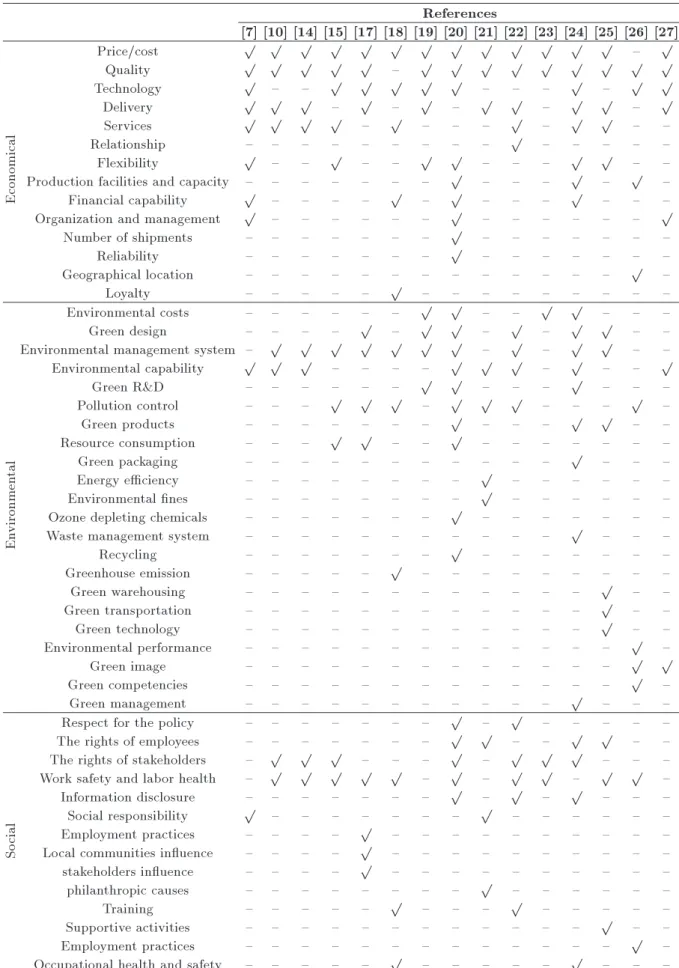
2.1. Sustainable supplier selection criteria Most studies done in the area of sustainable supplier selection have focused solely on environmental and eco-nomic aspects [11-13]. In recent years, some researchers have endeavored to take into account the social aspect of sustainability either separately or parallel with the other aspects in supplier selection problem [14-18]. Table 1 presents the criterion for supplier evaluation done in the most important recent researches. The aforementioned studies consist of cases in which all of the three aspects of sustainability have been taken into consideration for evaluation.
As can be observed from the given table, price/cost, quality, and delivery are the most important economic criteria. It should be noted that pollution control, green design, environmental management sys-tem, and environmental capabilities are among the most signicant environmental criteria. Lastly, work safety and labor health and the rights of stakeholders are considered to be the most dominant social criteria, which are used in the area of sustainable supplier selection.
The other point to be highlighted is that although many have been published about supplier selection, the studies done about sustainable supplier selection are not adequate. According to the investigations carried out, it seems that environmental indices in the form of greenness have been used more in recent years to evaluate performance and select suppliers. However, economic, social, and environmental indices have been taken into account rather less simultaneously
Table 1. Summary of sustainable supplier selection evaluation criterion and their references. References
[7] [10] [14] [15] [17] [18] [19] [20] [21] [22] [23] [24] [25] [26] [27]
Economical
Price/cost p p p p p p p p p p p p p { p
Quality p p p p p { p p p p p p p p p
Technology p { { p p p p p { { { p { p p
Delivery p p p { p { p { p p { p p { p
Services p p p p { p { { { p { p p { {
Relationship { { { { { { { { { p { { { { {
Flexibility p { { p { { p p { { { p p { {
Production facilities and capacity { { { { { { { p { { { p { p {
Financial capability p { { { { p { p { { { p { { {
Organization and management p { { { { { { p { { { { { { p
Number of shipments { { { { { { { p { { { { { { {
Reliability { { { { { { { p { { { { { { {
Geographical location { { { { { { { { { { { { { p {
Loyalty { { { { { p { { { { { { { { {
En
vironmen
tal
Environmental costs { { { { { { p p { { p p { { {
Green design { { { { p { p p { p { p p { {
Environmental management system { p p p p p p p { p { p p { {
Environmental capability p p p { { { { p p p { p { { p
Green R&D { { { { { { p p { { { p { { {
Pollution control { { { p p p { p p p { { { p {
Green products { { { { { { { p { { { p p { {
Resource consumption { { { p p { { p { { { { { { {
Green packaging { { { { { { { { { { { p { { {
Energy eciency { { { { { { { { p { { { { { {
Environmental nes { { { { { { { { p { { { { { {
Ozone depleting chemicals { { { { { { { p { { { { { { {
Waste management system { { { { { { { { { { { p { { {
Recycling { { { { { { { p { { { { { { {
Greenhouse emission { { { { { p { { { { { { { { {
Green warehousing { { { { { { { { { { { { p { {
Green transportation { { { { { { { { { { { { p { {
Green technology { { { { { { { { { { { { p { {
Environmental performance { { { { { { { { { { { { { p {
Green image { { { { { { { { { { { { { p p
Green competencies { { { { { { { { { { { { { p {
Green management { { { { { { { { { { { p { { {
So
cial
Respect for the policy { { { { { { { p { p { { { { {
The rights of employees { { { { { { { p p { { p p { {
The rights of stakeholders { p p p { { { p { p p p { { {
Work safety and labor health { p p p p p { p { p p { p p {
Information disclosure { { { { { { { p { p { p { { {
Social responsibility p { { { { { { { p { { { { { {
Employment practices { { { { p { { { { { { { { { {
Local communities inuence { { { { p { { { { { { { { { {
stakeholders inuence { { { { p { { { { { { { { { {
philanthropic causes { { { { { { { { p { { { { { {
Training { { { { { p { { { p { { { { {
Supportive activities { { { { { { { { { { { { p { {
Employment practices { { { { { { { { { { { { { p {
in the area of sustainable development. In this regard, previous studies suer from some weak points, the resolution of which seems to be a necessity. For example, in some studies, only economic and environ-mental indices have been considered, while, according to the denition of sustainability, all indices including the economic, environmental, and social ones must be highlighted [10].
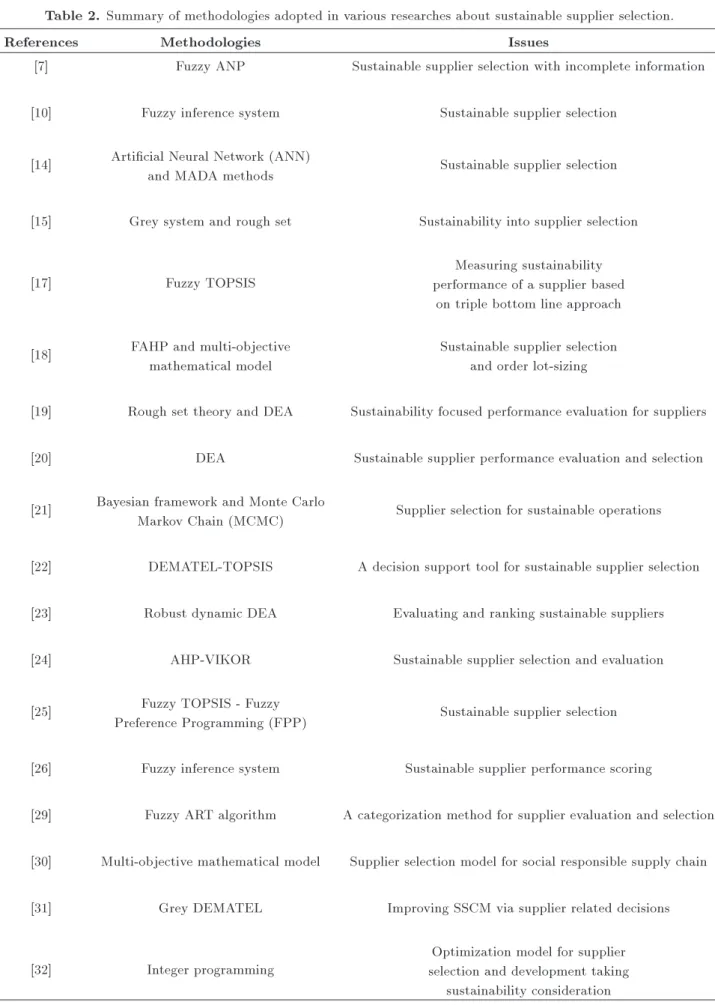
2.2. Sustainable supplier selection method Over recent years, researchers have utilized dierent methods to resolve the supplier selection problem in a sustainable environment. In 2013, Seuring reviewed 306 papers about sustainable supply chain and green supply chain published between 1990 and 2010. He reached the conclusion that, in the aforementioned time period, only 36 papers were quantitative and the rest were qualitative. Therefore, there remains the necessity of more qualitative research in this area. The ndings of this research indicate that, due to the diculty underlying the modeling of social impacts, the given index has not been taken into account suciently in quantitative models [28]. Qualitative approaches adopted in some of the most important recent researches in this area are summarized in Ta-ble 2.
One of the ecient methods to resolve a sus-tainable supplier selection problem is mathematical modeling which has been used in some of the mentioned researches in Table 2. Since the current study concen-trates on mathematical modeling, the characteristics of some of the multi-objective models in the area of sustainable and green supplier selection will be pre-sented in what follows. Mafakheri et al. (2011) adopted a two-phase approach to explore supplier selection problem and determine the amount of order allocation. In the rst phase, the supplier evaluation criteria (price/cost, delivery, quality, and environmental per-formance) and their sub-criteria are dened based on AHP method. Then, the amount of order allocation to each supplier will be specied by a multi-objective linear mathematical model. The objective functions of the mentioned model consist of minimization of total cost and maximization of total value in the supply process. Demand, production capacity, and stock levels at the end of each period are among the constraints of the model [33]. In the research conducted by Shaw et al. (2012), the supplier selection problem in the supply chain was tackled with the amount of carbon emission. In their study, AHP method was used to determine the weight of the criteria. Then, a multi-objective linear mathematical fuzzy model was presented. The mathe-matical model of this research included four objective functions, namely minimization of cost, total number of returned goods due to lack of quality, delivery with delay and greenhouse gases emission. In addition,
the constraints of demand, production capacity of the suppliers, budget, and the maximum amount of carbon emission were taken into consideration in this model [34]. Afshar Bakeshlou et al. (2017) developed a multi-objective fuzzy linear programming model for a green supplier selection problem. They used a set of evaluation criteria in ve major clusters including cost, quality, service, technology capability, and envi-ronmental criteria. They also applied a hybrid fuzzy MODM method to solve the proposed model. The objective functions of their model consist of purchase cost, total quality, service level, technology capability, and environmental function [35].
Nazari-Shirkouhi et al. (2013) presented an in-teractive two-phase Fuzzy Multi-Objective Linear Pro-gramming (FMOLP) model to solve a supplier selection problem under multi-price and multi-product condi-tions. Their model minimized total purchasing and ordering costs, number of defective units, and late delivered units ordered from suppliers [36]. Kannan et al. (2013) rated the suppliers with fuzzy TOPSIS method in order to solve green supplier selection problem and determine their allocation. Then, they drew from multi-objective linear mathematical model to specify the allocation to each of them. The objective functions of this model comprise minimization of total cost and maximization of total desirability function in the supply process. The constraints of this model are as follows: demand, capacity, and the maximum number of acceptable defective goods [37]. In the study done by Trapp and Sarkis (2016), a linear zero-one optimization programming model was presented such that suppliers selection and development on the one hand and sus-tainability considerations on the other were examined at the same time. The objective function of this model includes the maximization of the performance of total sustainability in the supply process. On the other hand, the production capacity, the minimum and max-imum number of suppliers, quality, delivery, training cost, and price are known to be the constraints of this model [32]. In the model presented by Azadnia et al. (2015), rstly, a set of evaluation criteria related to all three aspects of sustainability was established by using opinions of company's experts and existing criteria in the literature. Next, the weight of the criteria was calculated based on FAHP approach. After that, a multi-objective mathematical model was presented to solve the sustainable supplier selection problem and determine their order allocation in a multi-product and multi-period case. The objective functions of this model consist of the minimization of total cost and maximization of qualitative economic advantage, environmental advantage, and social advantage. The constraints of the model include production capacity, warehouse space, and stock level at the end of the period [18].
Table 2. Summary of methodologies adopted in various researches about sustainable supplier selection.
References Methodologies Issues
[7] Fuzzy ANP Sustainable supplier selection with incomplete information [10] Fuzzy inference system Sustainable supplier selection
[14] Articial Neural Network (ANN)
and MADA methods Sustainable supplier selection [15] Grey system and rough set Sustainability into supplier selection
[17] Fuzzy TOPSIS
Measuring sustainability performance of a supplier based
on triple bottom line approach
[18] FAHP and multi-objective mathematical model
Sustainable supplier selection and order lot-sizing
[19] Rough set theory and DEA Sustainability focused performance evaluation for suppliers [20] DEA Sustainable supplier performance evaluation and selection
[21] Bayesian framework and Monte Carlo
Markov Chain (MCMC) Supplier selection for sustainable operations [22] DEMATEL-TOPSIS A decision support tool for sustainable supplier selection [23] Robust dynamic DEA Evaluating and ranking sustainable suppliers [24] AHP-VIKOR Sustainable supplier selection and evaluation
[25] Fuzzy TOPSIS - Fuzzy
Preference Programming (FPP) Sustainable supplier selection [26] Fuzzy inference system Sustainable supplier performance scoring
[29] Fuzzy ART algorithm A categorization method for supplier evaluation and selection [30] Multi-objective mathematical model Supplier selection model for social responsible supply chain [31] Grey DEMATEL Improving SSCM via supplier related decisions
[32] Integer programming
Optimization model for supplier selection and development taking
3. Research methodology 3.1. Case study
Automobile is one of those products that has a great deal of interaction with the environment and people throughout the course of its life cycle and at the time of usage. Therefore, apart from economic considera-tions, the social and environmental aspects must be taken into account in all stages of its designing and development. Considering the rise of pressures and the concerns of governments and non-governmental organizations, the given issue has achieved greater importance day by day. Furthermore, it will turn into one of the customer requirements for satisfaction with the products of an organization in the future. The automobile supply chain in Iran is a case in point. Accordingly, the policymakers in this area are fully aware of social and environmental issues apart from economic interests.
The supply chain of Iran Khodro Company is the case study of the present research. The management of the supply system of parts needed in this chain and correspondence with the suppliers are borne by Sapco Company. As a matter of fact, Sapco Company assumes responsibility for technical designing and sup-plying the parts, which are required by Iran Khodro Company. The mission of this company is to provide raw material, parts, and automobile accessories for the Industrial Group of Iran Khodro and foreign and domestic target markets. This is done through ecient management of the supply process-from designing to assembly and identifying competitive advantages in the supply network to improving them to global levels, all of which are aimed at the achievement of the strategic purposes of Iran Khodro Group. Sapco Company cooperates with more than 550 domestic and foreign suppliers at the moment. In addition, Sapco provides the Industrial Group of Iran Khodro with the raw material, parts, and automobile accessories. The responsibilities in the areas of production and after-sale services are shouldered by the same company. In Sapco Company, all orderings are done based on Kanban system. Kanban card volume is a coecient of container quantity. The number of running Kanban cards is specied in accordance with the supply waiting time and the performance of the suppliers for each part. In order to conduct the present research, 31 parts used in the engine of four car types made by Iran Khodro Company were selected. These parts are manufactured and provided by 45 suppliers. The purpose of the current study is to resolve the sustainable supplier selection problem and determine the optimal order allocation in a way that the total sustainability of the supply process gets optimized. To achieve this goal, rst and foremost, the appropriate criteria for sustain-able supplier selection in the case study company are
identied. Then, the mathematical model and compe-tent suppliers of each intended part will be selected. Lastly, the allocation to each of them will be specied. In fact, despite the emphasis on sustainability in recent years, qualitative researches in this area are not enough. It needs to be explained that in most of the previous studies, only economic and environmen-tal dimensions are considered in sustainable or green supplier selection, and social aspects of sustainability are somewhat taken for granted at the same time. In this regard and in order to ll the research gap, the present study is important. Therefore, compared to previous researches, the strength of this research is using real data and applying a new set of criteria that have not been applied in similar studies so far. They include PPM, C/100, deviation from the target price, and quality index of supply.
3.2. The suggested integrated model
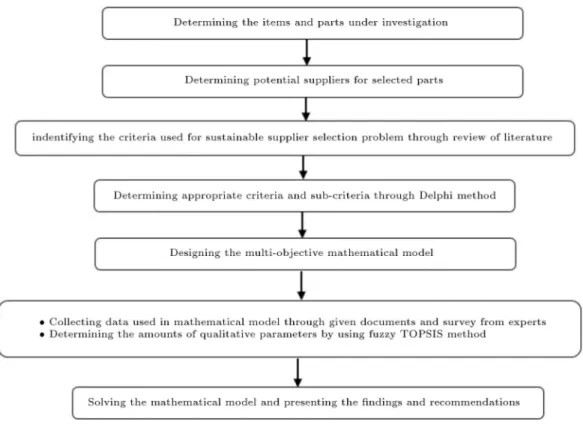
In the present research, apart from investigating the theoretical background and reviewing the literature, the research gaps on the one hand and criteria and methods used for sustainable supplier selection prob-lem on the other hand are presented. At the same time, in order to get familiarized with the criteria and methods used to select the supplier in the supply chain of Iran Khodro, several interviews with the experts and professionals of the case study company (Sapco Company) were conducted. Additionally, the method for selecting the suppliers was examined. After speci-fying the parts and the potential suppliers of each part, the theoretical background and the literature related to sustainable supplier selection problem helped identify a set of selection and evaluation criteria. Then, the Delphi method was utilized to screen the given criteria and rate them. These were based on the opinion of the experts in the company. Afterwards, the criteria drawn from the Delphi method were taken into account as three major indices of sustainability. Fuzzy TOPSIS method was used to specify the weight and value of some of the parameters (qualitative parameters whose numerical data did not exist based on the evaluations of the company). Next, the mathematical model was solved, whose ndings are presented. The suggested research framework is given in Figure 1.
3.2.1. Identifying sustainable supplier selection criteria through the delphi method
Delphi method is a multi-stage technique to collect data in cases where the subject matter is abstract. Written responses are given priority over assembling a group of experts. The purpose of Delphi method is to reach consensus through numerical estimations with the possibility of open discussion and revision of opinions at the same time [38]. The participants of Delphi are experts, specialists, or panelists. They need
Figure 1. Stages of the research.
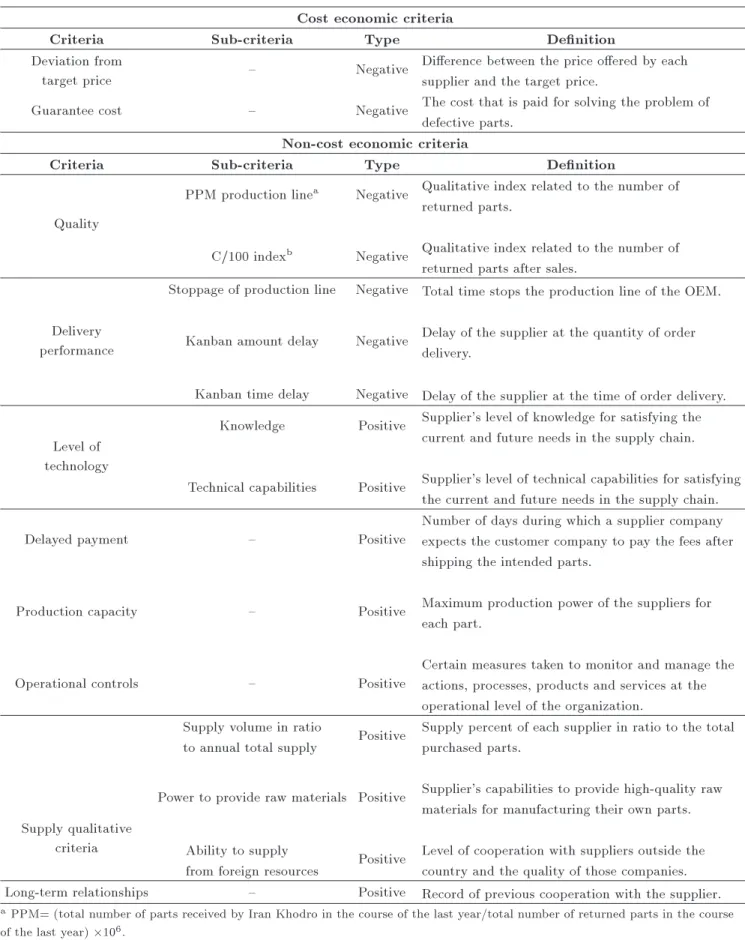
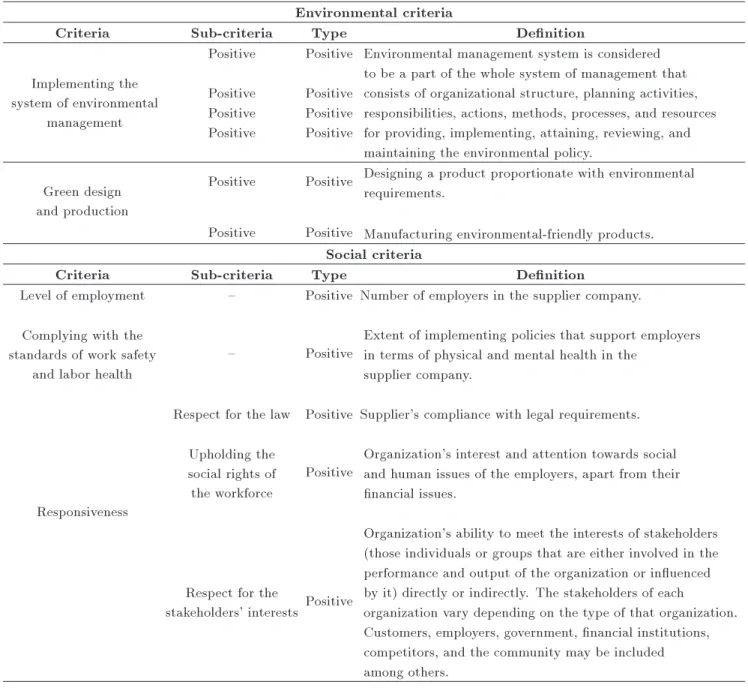
four qualities: knowledge and experience in the subject matter, tendency, adequate time to take part in the survey, and ecient communicative skills. It should be noted that panelists' capabilities, panel size, and the selection method are among the key parameters of the study [39]. In the Delphi method utilized in the current research, 10 persons were selected as experts. They were required to rate 32 criteria about supplier selec-tion in the quesselec-tionnaire based on their signicance. The criteria given in the Delphi questionnaire were chosen according to the theoretical bases and experts' opinions in the company. In this questionnaire, a ve-choice Likert scale was used. Furthermore, Kendall's coecient of concordance was applied to determine the extent of consensus among the members of the panel in the present research. Accordingly, a consensus among the experts resulted after conducting three rounds; consequently, the nal criteria for sustainable supplier selection were specied. These criteria and their denitions are given in Tables 3 and 4.
3.2.2. Mathematical model of the problem
As shown in Table 2, nancial criteria are essen-tially categorized into two groups: cost and non-cost. Concerning non-cost economic criteria, quality and production capacity are taken to be the constraints of the model and the rest will be considered in the objective function. In addition, all environmental and social criteria are given in the objective function. Since annual evaluations are conducted, there are numerical
data in the case study company for some of the criteria that have been used in the model. Furthermore, for those which are qualitative, rating will be done through fuzzy TOPSIS method. Such qualitative criteria consist of the level of technology, implementing the system of environmental management, green design and production, responsiveness and observation of rules related to work safety, and labor health. In order to determine the score of each supplier based on the given qualitative criteria and the judgment of the company's experts, a fuzzy TOPSIS questionnaire was developed. After distributing this questionnaire to them, they were required to evaluate the performance of each of these suppliers with fuzzy numbers in terms of the given qualitative criteria.
The mathematical model suggested for this re-search is single-period and multi-product. The problem will be modeled for a set of parts used in four types of nished products (automobile).
Assumptions of the model and conditions of the problem
In order to formulate the mathematical model for the sustainable supplier selection problem, the following assumptions are taken into account:
1. Demand for each part is fully met. In other words, shortage of any parts is not allowable;
Table 3. Selected economic criteria and sub-criteria for sustainable supplier selection and evaluation Cost economic criteria
Criteria Sub-criteria Type Denition
Deviation from
target price { Negative Dierence between the price oered by eachsupplier and the target price. Guarantee cost { Negative The cost that is paid for solving the problem of
defective parts. Non-cost economic criteria
Criteria Sub-criteria Type Denition
Quality
PPM production linea Negative Qualitative index related to the number of
returned parts.
C/100 indexb Negative Qualitative index related to the number of
returned parts after sales.
Delivery performance
Stoppage of production line Negative Total time stops the production line of the OEM.
Kanban amount delay Negative Delay of the supplier at the quantity of order delivery.
Kanban time delay Negative Delay of the supplier at the time of order delivery.
Level of technology
Knowledge Positive Supplier's level of knowledge for satisfying the current and future needs in the supply chain.
Technical capabilities Positive Supplier's level of technical capabilities for satisfying the current and future needs in the supply chain.
Delayed payment { Positive
Number of days during which a supplier company expects the customer company to pay the fees after shipping the intended parts.
Production capacity { Positive Maximum production power of the suppliers for each part.
Operational controls { Positive
Certain measures taken to monitor and manage the actions, processes, products and services at the operational level of the organization.
Supply qualitative criteria
Supply volume in ratio
to annual total supply Positive Supply percent of each supplier in ratio to the totalpurchased parts.
Power to provide raw materials Positive Supplier's capabilities to provide high-quality raw materials for manufacturing their own parts. Ability to supply
from foreign resources Positive Level of cooperation with suppliers outside thecountry and the quality of those companies. Long-term relationships { Positive Record of previous cooperation with the supplier.
a PPM= (total number of parts received by Iran Khodro in the course of the last year/total number of returned parts in the course
of the last year) 106.
bC/100= (total number of delivered automobiles in the course of the guarantee period/total number of Sapco's returned items
Table 4. Selected environmental and social criteria and sub-criteria for sustainable supplier selection and evaluation. Environmental criteria
Criteria Sub-criteria Type Denition
Implementing the system of environmental
management
Positive Positive Environmental management system is considered to be a part of the whole system of management that consists of organizational structure, planning activities, responsibilities, actions, methods, processes, and resources for providing, implementing, attaining, reviewing, and maintaining the environmental policy.
Positive Positive Positive Positive Positive Positive
Green design and production
Positive Positive Designing a product proportionate with environmental requirements.
Positive Positive Manufacturing environmental-friendly products. Social criteria
Criteria Sub-criteria Type Denition
Level of employment { Positive Number of employers in the supplier company. Complying with the
standards of work safety and labor health
{ Positive
Extent of implementing policies that support employers in terms of physical and mental health in the
supplier company.
Responsiveness
Respect for the law Positive Supplier's compliance with legal requirements. Upholding the
social rights of the workforce
Positive
Organization's interest and attention towards social and human issues of the employers, apart from their nancial issues.
Respect for the
stakeholders' interests Positive
Organization's ability to meet the interests of stakeholders (those individuals or groups that are either involved in the performance and output of the organization or inuenced by it) directly or indirectly. The stakeholders of each
organization vary depending on the type of that organization. Customers, employers, government, nancial institutions, competitors, and the community may be included among others.
nalized exclusively for a given part. A supplier can be selected in case its order allocation is more than the allowable range that has been specied by the company. This assumption prevents very low order allocations since it is not cost eective. To this end, a percentage of the total demand for each part is specied for each supplier as the order base. The model is developed in a way that no allocation is dedicated to amounts less than the minimum order.
Notations of the mathematical model
The notations used for the mathematical model of the present research are given below:
Indices of the model
i Type of part, i = 1; 2; :::; m; j Number of Suppliers, j = 1; 2; :::; n; k Type of nished product, k =
1; 2; :::; K. Parameters of the model
ij Deviation of the price proposed by the
jth supplier from the target price for the ith part;
gij Cost of guarantee for part i that will
be oered by supplier j;
Dik Demand for part i that will be used to
CAij Production capacity of the jth supplier
for the ith part;
P P Mij PPM quality index (index of returned
parts) of the jth supplier for the ith part;
AP P Mij PPM maximum value that is allowable
for the ith part;
Cij C/100 quality index (index of returned
parts) of the jth supplier for the ith part;
ACi C/100 maximum value that is allowable
for the ith part;
DLij Score of the jth supplier in delivery
performance;
Tj Score of the jth supplier in technology
level;
Rj Score of the jth supplier in payday
resistance;
COj Score of the jth supplier in operational
controls;
LRj Score of the jth supplier in long-term
relationships;
CSj Score of the jth supplier in quality
index of supply;
Ej Score of supplier j in terms of
environmental criteria;
Sj Score of supplier j in terms of social
criteria;
Lij Minimum percentage of demand for
part i that will be purchased from supplier j.
Decision variables
Xij Number of part i that will be purchased
from supplier j;
Yij Order allocation or non-allocation to
supplier j to supply part i (binary variable).
Objective functions
The mathematical model of the current study consists of four objective functions, which are given in Eqs. (1) to (4). Cost economic criteria will appear in the rst objective function. According to the mentioned objec-tive function, the total cost (deviation from the target price and cost of guarantee) will reach its minimum amount. Eq. (2) deals with non-cost economic criteria according to which non-cost economic performance reaches its maximum amount. In the given, the rst section points to the total performance of the selected suppliers in terms of delivery performance. The following sections refer to the performance of the suppliers in technology level, payday resistance,
oper-ational controls, long-term relationships, and quality index of supply, respectively. It should be noted that among non-cost economic criteria, except for delivery performance which is calculated based on the intended part, the data for all the other ones depend on the supplier. Accordingly, the formulas of the second objective function for this group of criteria are divided by the total demand. In this way, there will be an equal scale for all of them. Eq. (3) maximizes the environmental score of the whole process of supply, which results from the multiplication of the total environmental score of each supplier by the allocation amount. Eq. (4) pertains to maximizing the social performance of the whole process of sustainable supply.
Constraints
Eq. (5) refers to the constraint of demand. This constraint ensures that the demand for each part will be fullled. The constraints of quality (PPM and C/100 criteria) are given in Relations (6) and (7). According to these two constraints, only those parts that meet the minimum quality standards are selected. In Relation (8), the constraint of minimum order amount from each supplier is given. This constraint prevents the selection of suppliers with very low order amount. In addition, a supplier will be selected only in case the allocation amount is more than the minimum that has been specied. According to Relation (9), the allocation of each part to a supplier must be less than the production capacity of the respective supplier. Re-lations (10) and (11) demonstrate type and range of the decision variables. Relations (12) and (13) relate to the type of decision variables in the mathematical model.
MinZ1= m X i=1 n X j=1
ijXij+ m X i=1 n X j=1
gijXij m X i=1 X ; (1)
MaxZ2= m X i=1 n X j=1
DLij:Xij+ m X i=1 n X j=1
Tj PKXij k=1Dik
+Xm
i=1 n
X
j=1
Rj PKXij k=1Dik
+Xm
i=1 n
X
j=1
COj PKXij k=1Dik
+Xm
i=1 n
X
j=1
LRj PKXij k=1Dik
+Xm
i=1 n
X
j=1
CSj PKXij k=1Dik
; (2)
MaxZ3= m X i=1 n X j=1
MaxZ4= m
X
i=1 n
X
j=1
SjXij; (4)
s.t.:
n
X
j=1
Xij = K
X
k=1
Dik 8i; (5)
n
X
j=1
P P MijXij K
X
k=1
AP P MiDik 8i; (6)
n
X
j=1
CijXij K
X
k=1
ACiDik 8i; (7)
Xij YijLij K
X
k=1
Dik 8i; j; (8)
Xij CAijYij 8i; j; (9)
Xij 0 and integer 8i; j; (10)
Yij = 0; 1 8i; j: (11)
As it was mentioned, the presented model in this research is multi-product and single-period. Further-more, it is multi-objective and mixed integer. Such a model needs a multi-objective problem-solving method, which will be given in what follows.
3.2.3. Solving the mathematical model
In this study, two methods are presented to solve the multi-objective mathematical model of sustainable supplier selection. They are explained in general terms in the following section.
The augmented "-constraint method
The multi-objective mathematical programming method is considered to be an analytical method that is used widely in the domain of multi-objective programming problems. In multi-objective programing problems, there is more than one objective function. Usually, there is no one optimal solution for optimizing all objective functions at the same time. As a consequence, the goal is to nd a set of Pareto solutions to the problem. Although each Pareto solution is optimal for one objective function, the given solution will distance at least one of the other objective functions from the optimal amount. The weighted sum method and the epsilon constraint method are two known methods for solving multi-objective programming. The method to solve the multi-objective mathematical model in this research is the augmented "-constraint method (AUGMECON).
The privilege of the mentioned method is that it generates appropriate Pareto solutions only and avoids ineective solutions on the other hand. The general form of the multi-objective optimization problem by using this method is as follows [18]:
Max (f1(x); f2(x); :::::; fn(x))
s.t : x 2 S: (12) In the above formula, S represents the allowable range. In order to solve the given model with the epsilon constraint method, initially, one of the objective functions needs to be considered as the main objective function. By considering one of the objective functions each and every time, the problem should be solved and the optimal solutions achieved. Afterwards, except for the main objective function, the other functions must be placed into the constraint method as follows:
Max
f1(x) + @
s2
r2 +
s3
r3 + :::: +
si
ri + :::
sn
rn
s.t.:
f2(x) s2= "2
f3(x) s3= "3
: : : fn(x) sn= "n
(13)
si2 R+ x 2 S i 2 [2; n]:
The optimal solutions of the model are achieved through parametric variables on the right side of the added constraints (epsilons). ri is the variation range
of the solutions that result from the ith objective function:
ri = P ISfi NISfi: (14)
In the above-mentioned formula, P ISfi is the best
solution (positive ideal solution) for the ith objective function, while NISfi is considered to be the worst
solution (negative ideal solution) for the same objective function. Positive and negative ideal solutions for each objective function are the best and worst solutions that result from solving the model through that objective function only{without taking into account the other objective functions. In addition, @ is a very small number between 0.001 and 0.000001. si plays the role
of a slack variable corresponding with the ith objective function. If ri is divided into li equal segments, li+ 1
dierent points will ensue. The value of each point can be calculated by the following equation:
"i = NISfi+
ri
li ; (15)
where stands for the point number. This solving method needs to be used for all the vectors of ".
Therefore, n
i=2(li+1) optimal sub-problems will come
into being. Drawing from the above approach and considering the second objective function (non-cost economic criterion) as the main objective function, the problem will change as follows:
Max Z =
m X i=1 n X j=1
DLij:Xij+ m X i=1 n X j=1
Tj PKXij k=1Dik
+Xm
i=1 n
X
j=1
Rj PKXij k=1Dik
+Xm
i=1 n
X
j=1
COj PKXij k=1Dik
+Xm
i=1 n
X
j=1
LRj PKXij k=1Dik
+Xm
i=1 n
X
j=1
CSj PKXij k=1Dik
+ @(sr1
1+
s3
r3 +
s4
r4); (16)
s.t.: m X i=1 n X j=1
ijXij m X i=1 n X j=1
gijXij s1= "1 8i; j;
(17) m X i=1 n X j=1
EjXij s3= "3 8i; j; (18)
m X i=1 n X j=1
SjXij s4= "4 8i; j: (19)
Weighted sum method
The weighted sum method is one of the methods to solve multi-objective problems. Unlike the epsilon constraint method in which one of the functions will be considered as the main one and the rest will lie in the constraint, in the weighted sum method, the problem will be transformed into a single-objective one and solved accordingly. The general form of a multi-objective mathematical model given in Relation (12) can be recongured into a single-objective problem as follows [18]:
Max
n
X
i=1
wifi: (20)
wi is the relative weight of each of the objective
func-tions. In this method, rst and foremost, each of the objective functions will be optimized separately. Then, the negative ideal solution (worst solution) and the positive ideal solution (best solution) will be calculated for each one. Then, the normalized amounts of each objective function will be determined for minimization objective functions and maximization objective
func-tions through Eqs. (21) and (22), respectively.
fn
i = NISNISfi fi fi P ISfi
; (21)
fn
i = P ISfi NISfi fi NISfi
: (22)
Total value of sustainable purchasing
In the aforementioned formulas, PIS and NIS are the best and worst solutions, respectively, that have been obtained for each objective function. After normalizing the objective function, all of them will be transformed into Eq. (23). Accordingly, the nal solution will be calculated by solving the mathematical model with one objective.
Maxf =Xn
i=1
wifin: (23)
In order to facilitate the process of decision-making about selecting the best optimal Pareto solutions and comparing the solving methods with one another, the fuzzy approach will be applied as follows [18]. For the minimization objective function, the amount of mem-bership function will be calculated through Eq. (24). In addition, Eq. (25) is used to determine the amount of membership function for the maximization objective function: l i= 8 > < > :
1 fl i fimin fmax
i fil
fmax
i fimin f
min
i fil fimax
0 fl
i fimax
(24) l i= 8 > < > :
1 fl i fimin fmax
i fil
fmax
i fimin f
min
i fil fimax
1 fl
i fimax
(25)
where fl
i stands for the amount of the ith objective
function in the lth optimal Pareto solution. Addi-tionally, l
i signies the amount of fil membership
function. The total amount of membership function for the lth optimal Pareto solution will be calculated through the following formula which, in its own place, shows the total value obtained by solving the model. In Eq. (28), Wi represents the relative weight of the
objective function, which has been obtained according to the experts' opinions and through AHP method. The solution with the highest amount of TVSP (Total Value of Sustainable Purchasing) will be chosen as the best solution:
T V SPl=Xn i=1
4. Result, sensitivity analysis, and managerial implications
Drawing from two solving methods that were ex-plained, the model will be solved and the optimal points will be calculated for both methods. Moreover, the allocation amount to each supplier will be determined for the respective optimal point. It needs to be highlighted that in the epsilon constraint method, is taken to be equal to 0.0001 ( = 0:0001), and li
is considered to be 4 for all three constraints. In other words, each variation range (r) is divided into 5 equal segments and, on the whole, 125 sub-problems will follow. Epsilon amount will be calculated for each point and, accordingly, the model will be solved. Pareto solutions are obtained in this stage. Out of 125 solved problems, 88 points are known to be allowable and the rest are non-allowable. The relative weights of objective functions determined according to the judgment of the company's experts on the one hand and through AHP method on the other are given in Table 5. The amounts obtained through the two solving methods are presented in Table 6. It should be noted that the base for selecting the optimal point is TVSP amount, which needs to be larger.
In the row related to the dierence of amounts in the above table, the absolute modulus of the dierence of amounts calculated from the two methods and, in the last row, the absolute modulus of the dierences are divided by the amounts obtained by the weighted sum method. It can be observed that the solutions obtained by the two solving methods are not signif-icantly dierent. For the second objective function (maximization of non-cost economic performance) and the social objective function, the results obtained by the epsilon constraint method are considered to be better. Concerning the other objective functions,
Table 5. Relative weights of objective functions obtained by AHP method.
Cost Non-cost
economic Environmental Social
0.525 0.320 0.077 0.078
the weighted sum method provided more appropriate solutions. Therefore, the comparison base for the appropriateness of the solving method in the present research is taken to be TVSP amount, which needs to be larger. It must be so because the amounts of all objective functions and their weights are included at the time of calculation. TVSP amount obtained by the weighted sum method is a little more than that by the epsilon constraint method. For that reason, considering the given data in this research and the obtained epsilon amounts, the weighted sum method has provided better results. Accordingly, here, the continuous priority of this method over epsilon constraint method is not implied. Depending on the amounts of parameters and the number of points in the epsilon constraint method, the results will vary in a similar vein. In addition, in the weighted sum method, 8 suppliers (out of 45 suppliers) were not given allocation. By taking into account the dierence in the number of allocations in the two solving methods, the amount allocated to 18 suppliers appeared to be equal in the given methods.
In order to analyze the eect of parameter changes on the nal results of the mathematical model, the following three cases are taken into consideration:
1. Change of demand parameter in case the other parameters remain constant;
2. Change of the environmental parameter of green design and production in case the other parameters remain constant;
3. Change of the social parameter of work safety and labor health in case the other parameters remain constant.
The results of the above-mentioned cases have been obtained by the weighted sum method. In what follows, they will be compared with the optimal amounts obtained through the main solving process. The results of these three cases are presented in Tables 7-9.
In case of an increase in the parameters of de-mand, due to the dierence of the supply amounts of the given parts, the problem does not have an optimal solution. In case of a ten-percent decrease in the
Table 6. Comparing the amounts of objective functions and TVSP obtained by two solving methods. Solving method/functions Cost Non-cost economic Environmental Social TVSP
Epsilon constraint 4331808.818 21207263.322 292910.630 286607.661 0.682 Weighted sum 4056964.442 19335795.71 297496.995 286455.835 0.704 Absolute value of dierence
between two methods 274844.376 1871467.612 4586.365 151.826 0.022
Table 7. Optimal amounts of the objective function in case of a ten-percent increase/decrease of demand parameters. Changes/functions Cost Non-cost economic Environmental Social TVSP
Main model 4056964.442 19335795.71 297496.995 286455.835 0.704 Ten-percent decrease of demand 3624523.761 17509165.05 270947.236 259699.553 0.763
Percent of changes 10.6 9.4 8.9 9.3 8.4
Ten-percent increase of demand Without allowable range
Table 8. Optimal amounts of the objective functions in case of a ten-percent increase/decrease of green design and production parameter.
Changes/functions Cost Non-cost economic Environmental Social TVSP Main model 4056964.442 19335795.71 297496.995 286455.835 0.704 Ten-percent decrease of
environmental parameter 4056964.442 19335795.71 273012.992 286455.835 0.611
Percent of changes 0 0 8.2 0 13.2
Ten-percent increase of
environmental parameter 4056964.442 19335795.71 321980.997 286455.835 0.688
Percent of changes 0 0 8.2 0 2.2
Table 9. Optimal amounts of the objective functions in case of a ten-percent increase/decrease of work safety and labor health parameter.
Changes/functions Cost Non-cost economic Environmental Social TVSP Main model 4056964.442 19335795.71 297496.995 286455.835 0.704 Ten-percent decrease of social parameter 4056964.442 19335795.71 297496.995 268924.737 0.610
Percent of changes 0 0 0 6.1 13.3
Ten-percent increase of social parameter 4056964.442 19335795.71 297496.995 303986.932 0.688
Percent of changes 0 0 0 6.1 2.2
amounts of demand parameters, it can be observed that the decreasing percentage of the objective func-tions and TVSP amount are considerably close to the changes of demand parameter.
In case of a change in the environmental parame-ter, as shown in Table 8, only the amount of the third objective function and, by extension, TVSP amount will change. It is observed that, in both cases, i.e., increasing and decreasing environmental parameters, TVSP decreases compared to the original state. The reason for this is that, according to experts, the weight of the environmental objective function is much lower than that of the economic functions.
Like the former case, as the social parameter changes, only the amount of the fourth objective func-tion and TVSP amount will change. In addifunc-tion, since the social objective function and the environmental objective function are equal in terms of weight, the
amount of changes of TVSP in this case and the former one is equal.
In summary, the presented method in this re-search can play a helpful role in dierent organizations in the process of identifying a set of sustainability parameters proportionate with the respective organi-zation. Such parameters can be utilized for evaluating the performance of the organization or its suppliers. Nowadays, large organizations are paying more and more attention to social and environmental issues. Therefore, as one of the most important industries in Iran, the automobile industry should be more sensitive and attentive to these issues. By doing so, the aforementioned industry can raise the quality level of production and move towards sustainable development in society. The proposed model for this research can be considered as a tool for evaluating the sustainability of suppliers in the domain of the automobile industry.
In the present situation, order allocation to sup-pliers in the domain of the automobile industry in Iran is not done based on their sustainable performance. Such a phenomenon leaves serious and signicant im-pacts on environment and society both at the moment and in the future. Therefore, it is suggested that Sapco Company as the director of Iran Khodro's supply chain management consider the given criteria in this research and highlight them as inuential factors in evaluating the performance of suppliers. By doing so, Sapco Company can improve the performance of its supply chain in economic, social, and environmental elds.
5. Conclusion
In the area of supplier selection, two issues are of great importance. Firstly, the selection of criteria and sub-criteria were found to pave the ground for evaluating the performance of suppliers as correctly as possible. Secondly, a method was utilized for selecting the best suppliers and determining their order allocation. Both areas were addressed in the present research. After identifying a set of specic criteria and sub-criteria in the case-study industry, an all-inclusive method was presented to evaluate the suppliers' sustainability performance and their order allocation.
In this study, supplier selection in the supply chain of automobile (Sapco Company) was done based on evaluation criteria in three groups, namely eco-nomic, social, and environmental. The criteria used in the present study were derived from the cooperation on behalf of experts in the case-study company and through Delphi method. It should be noted that some of the criteria used in this research have not been applied in similar studies so far. PPM, C/100, deviation from the target price, and quality index of supply are among such criteria. Then, 31 parts used to make four types of nished products were selected to conduct this research. These parts are manufactured by 45 suppliers. In order to calculate those parameters for which there was no exact numer-ical amount, following the judgment of the experts in the case-study company, fuzzy TOPSIS method was utilized. The purpose of the current study is to select the nal suppliers and determine their order allocation in a way that the performance of the sustainability of the supply process gets optimized on the whole. In this study, a mathematical model was used to select sustainable suppliers and determine their order allocation. The mathematical model suggested for this research was multi-objective, single-period, and multi-product. In addition, it was multiple in terms of sourcing. The objective functions of the model consisted of minimization of cost, maximization of non-cost economic performance, maximization of environ-mental performance, and maximization of suppliers'
social performance. On the other hand, the constraints of the model included demand, capacity, quality, and minimum order amount among others. To solve this model, two methods were utilized: epsilon constraint method and weighted sum method. After solving the model through the two mentioned methods, it was observed that the results obtained from weighted sum method were found to be better based on TVSP. In addition, it was concluded that by changing economic, environmental, and social parameters, one can change the total value of sustainable supply almost with the same proportion.
By taking into account the importance of supplier selection and the increasing attention to the issue of sustainability in recent years, the following topics are suggested for future research and extending sustainable supplier selection problem:
Considering uncertainty in calculating the parame-ters of the model, especially demand and capacity;
Developing a mathematical model to calculate en-vironmental and social criteria in accordance with parts. For example, cases in which carbon emission or pollution caused by manufacturing each product can be measured.
References
1. Azadnia, A.H., Saman, M.Z.M., Wong, K.Y., Ghadimi, P., and Zakuan, N. \Sustainable supplier selection based on self-organizing map neural net-work and multi-criteria decision-making approaches", Procedia-Social and Behavioral Sciences, 65, pp. 879-884 (2012).
2. Gimenez, C. and Tachizawa, E.M. \Extending sustain-ability to suppliers: a systematic literature review", Supply Chain Management: An International Journal, 17(5), pp. 531-543 (2012).
3. Hassini, E., Surti, C., and Searcy, C. \A literature review and a case study of sustainable supply chains with a focus on metrics", International Journal of Production Economics, 140(1), pp. 69-82 (2012).
4. Seuring, S. and Muller, M. \From a literature review to a conceptual framework for sustainable supply chain management", Journal of Cleaner Production, 16(15), pp. 1699-1710 (2008).
5. Mahmoudi, A., Sadi-Nezhad, S., and Makui, A. \An extended fuzzy VIKOR for group decision-making based on fuzzy distance to supplier selection", Sci-entia Iranica, Transactions E, Industrial Engineering, 23(4), pp. 1879-1892 (2016).
6. Rabieh, M., Modarres, M., and Azar, A. \Ro-bust - fuzzy model for supplier selection under uncertainty: an application to the automobile in-dustry", Scientia Iranica, Transactions E, Indus-trial Engineering, 25(4), pp. 2297-2311 (2018). DOI: 10.24200/sci.2017.4456.
7. Buyukozkan, G. and Cifci, G. \A novel fuzzy multi-criteria decision framework for sustainable supplier selection with incomplete information", Computers in Industry, 62(2), pp. 164-174 (2011).
8. Rosen, M.A. and Kishawy, H.A. \Sustainable manu-facturing and design: Concepts, practices and needs", Sustainability, 4(2), pp. 154-174 (2012).
9. Genovese, A., Lenny Koh, S.C., Bruno, G., and Esposito, E. \Greener supplier selection: state of the art and some empirical evidence", International Journal of Production Research, 51(10), pp. 2868-2886 (2013).
10. Amindoust, A., Ahmed, S., Saghania, A., and Bahreininejad, A. \Sustainable supplier selection: A ranking model based on fuzzy inference system", Ap-plied Soft Computing, 12(6), pp. 1668-1677 (2012).
11. Handeld, R., Walton, S.V., Sroufe, R., and Melnyk, S.A. \Applying environmental criteria to supplier as-sessment: A study in the application of the analytical hierarchy process", European Journal of Operational Research, 141(1), pp. 70-87 (2002).
12. Lu, L.Y., Wu, C.H., and Kuo, T.C. \Environmental principles applicable to green supplier evaluation by using multi-objective decision analysis", International Journal of Production Research, 45(18), pp. 4317-4331 (2007).
13. Kannan, G. and Vinay, V.P. \Multi-criteria decision making for the selection of CAD/CAM system", In-ternational Journal on Interactive Design and Manu-facturing, 2(3), pp. 151-159 (2008).
14. Kuo, R.J., Wang, Y.C., and Tien, F.C. \Integration of articial neural network and MADA methods for green supplier selection", Journal of Cleaner Production, 18(12), pp. 1161-1170 (2010).
15. Bai, C. and Sarkis, J. \Integrating sustainability into supplier selection with grey system and rough set methodologies", International Journal of Production Economics, 124(1), pp. 252-264 (2010).
16. Punniyamoorthy, M., Mathiyalagan, P., and Parthiban, P. \A strategic model using structural equation modeling and fuzzy logic in supplier selection", Expert Systems with Applications, 38(1), pp. 458-474 (2011).
17. Govindan, K., Khodaverdi, R., and Jafarian, A. \A fuzzy multi criteria approach for measuring sustain-ability performance of a supplier based on triple bottom line approach", Journal of Cleaner Production, 47, pp. 345-354 (2013).
18. Azadnia, A.H., Saman, M.Z.M., and Wong, K.Y. \Sustainable supplier selection and order lot-sizing: an integrated multi-objective decision-making process", International Journal of Production Research, 53(2), pp. 383-408 (2015).
19. Bai, C. and Sarkis, J. \Determining and applying sus-tainable supplier key performance indicators", Supply Chain Management: An International Journal, 19(3), pp. 275-291 (2014).
20. Azadi, M., Jafarian, M., Saen, R.F., and Mirhedaya-tian, S.M. \A new fuzzy DEA model for evaluation of eciency and eectiveness of suppliers in sustainable supply chain management context", Computers & Operations Research, 54, pp. 274-285 (2015).
21. Sarkis, J. and Dhavale, D.G. \Supplier selection for sustainable operations: A triple-bottom-line approach using a Bayesian framework", International Journal of Production Economics, 166, pp. 177-191 (2015).
22. Orji, I. and Wei, S. \A decision support tool for sustainable supplier selection in manufacturing rms", Journal of Industrial Engineering and Management, 7(5), pp. 1293-1315 (2014).
23. Youse, S., Shabanpour, H., Fisher, R., and Saen, R.F. \Evaluating and ranking sustainable suppliers by robust dynamic data envelopment analysis", Measure-ment, 83, pp. 72-85 (2016).
24. Luthra, S., Govindan, K., Kannan, D., Mangla, S.K., and Garg, C.P. \An integrated framework for sus-tainable supplier selection and evaluation in supply chains", Journal of Cleaner Production, 140, pp. 1686-1698 (2017).
25. Fallahpour, A., Olugu, E.U., Musa, S.N., Wong, K.Y., and Noori, S. \A decision support model for sus-tainable supplier selection in sussus-tainable supply chain management", Computers & Industrial Engineering, 105, pp. 391-410 (2017).
26. Ghadimi, P., Dargi, A., and Heavey, C. \Sustainable supplier performance scoring using audition check-list based fuzzy inference system: a case application in automotive spare part industry", Computers & Industrial Engineering, 105, pp. 12-27 (2017).
27. Mousakhani, S., Nazari-Shirkouhi, S., and Bozorgi-Amiri, A. \A novel interval type-2 fuzzy evaluation model based group decision analysis for green supplier selection problems: A case study of battery indus-try", Journal of Cleaner Production, 168, pp. 205-218 (2017).
28. Seuring, S. \A review of modeling approaches for sus-tainable supply chain management", Decision Support Systems, 54(4), pp. 1513-1520 (2013).
29. Keskin, G.A., _Ilhan, S., and Ozkan, C. \The Fuzzy ART algorithm: A categorization method for supplier evaluation and selection", Expert Systems with Appli-cations, 37(2), pp. 1235-1240 (2010).
30. Aliakbari, A. and Seifbarghy, M. \A supplier selection model for social responsible supply chain", Journal of Optimization in Industrial Engineering, 8, pp. 41-53 (2011).
31. Su, C.M., Horng, D.J., Tseng, M.L., Chiu, A.S., Wu, K.J., and Chen, H.P. \Improving sustainable supply chain management using a novel hierarchical grey-DEMATEL approach", Journal of Cleaner Production, 134, pp. 469-481 (2016).
32. Trapp, A.C. and Sarkis, J. \Identifying Robust port-folios of suppliers: a sustainability selection and devel-opment perspective", Journal of Cleaner Production, 112, pp. 2088-2100 (2016).
33. Mafakheri, F., Breton, M., and Ghoniem, A. \Supplier selection-order allocation: A two-stage multiple cri-teria dynamic programming approach", International Journal of Production Economics, 132(1), pp. 52-57 (2011).
34. Shaw, K., Shankar, R., Yadav, S.S., and Thakur, L.S. \Supplier selection using fuzzy AHP and fuzzy multi-objective linear programming for developing low car-bon supply chain", Expert Systems with Applications, 39(9), pp. 8182-8192 (2012).
35. Afshar Bakeshlou, E., Arshadi Khamse, A., Goudarzian Asl, M.A., and Sadeghi, J. \Evaluating a green supplier selection problem using a hybrid MODM algorithm", Journal of Intelligent Manufacturing, 28(4), pp. 913-927 (2017).
36. Nazari-Shirkouhi, S., Shakouri, H., Javadi, B., and Keramati, A. \Supplier selection and order allocation problem using a two-phase fuzzy multi-objective lin-ear programming", Applied Mathematical Modelling, 37(22), pp. 9308-9323 (2013).
37. Kannan, D., Khodaverdi, R., Olfat, L., Jafarian, A., and Diabat, A. \Integrated fuzzy multi criteria deci-sion making method and multi-objective programming approach for supplier selection and order allocation in a green supply chain", Journal of Cleaner Production, 47, pp. 355-367 (2013).
38. Windle, P.E. \Delphi technique: assessing component needs", Journal of PeriAnesthesia Nursing, 19(1), pp. 46-47 (2004).
39. Keeney, S., McKenna, H., and Hasson, F., The Delphi Technique in Nursing and Health Research, John Wiley & Sons (2010).
Biographies
Masood Rabieh received his PhD from Tarbiat Modaress University, Iran. He is an Assistant Pro-fessor at the Department of Industrial Management at Shahid Beheshti University, Iran. His research interests include operations research, system dynamics & systems thinking, supply chain management and project management.
Abbas Fadaei Rafsanjani rst studied Business Management at the University of Shahid Bahonar in Kerman province. Then, he studied at Shahid Beheshti University, Tehran, where he received an MA Industrial Management degree. His research interests and publication lie in the eld of project management and optimization. He has contributed articles to the International Journal of Advanced Manufacturing Technology.
Leila Babaee is a PhD student in Industrial Manage-ment (production and operation) at the DepartManage-ment of Industrial Management at Shahid Beheshti University, Iran. Her research studies include sustainability in supply chain, supply chain management, and supply chain network design.
Mahdi Esmaeili is a PhD student in Industrial Man-agement (production and operation) at the Depart-ment of Industrial ManageDepart-ment in Allameh Tabataba'i University, Tehran, Iran, He is the Head of Logistics Engineering in Supplying Automative Parts CO, Iran. His research interests include logistics, supply chain management, transportation, and lean production.