National Joint Registries and the United States
By James Fraser
A Master’s Paper submitted to the faculty of the University of North Carolina at Chapel Hill in partial fulfillment of the requirements for the degree of Master of Public Health in
the Public Health Leadership Program. Chapel Hill
2010
Advisor and First Reader
Date
Second Reader
Abstract
Background: On May 3, 2010 the Board of the American Joint Replacement Registry (AJRR) held its first meeting. After decades of debate and examination of existing joint registries, the American Academy of Orthopaedic Surgeons (AAOS) has recently determined that establishing the AJRR is a worthwhile project. This study will analyze the benefits and drawbacks of developing a national joint registry in the United States and will suggest the best design for the AJRR.
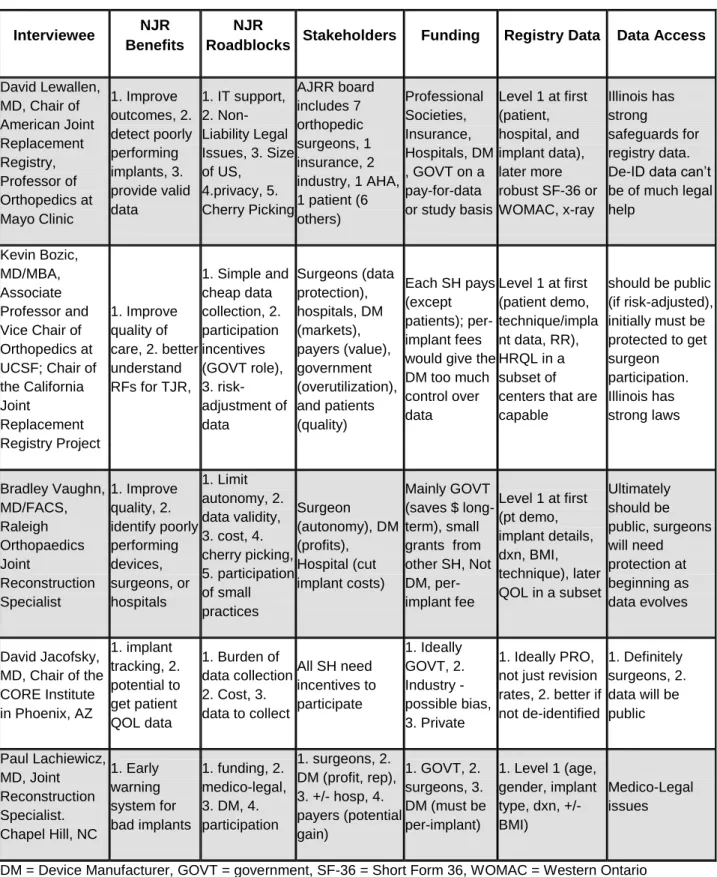
Methods: In addition to conducting literature reviews of existing domestic and foreign joint registries, this study interviewed a variety of orthopaedic surgeons, including the chair of the AJRR, to gain unique perspectives on the future of an American joint registry.
Results: Of 12 foreign national registries examined, 10 obtain the bulk of funding directly from the government, 9 are run by professional orthopaedic societies, and 6 mandate registry participation. Domestic joint registry proponents claim benefits of registries to include detecting poorly performing implants, gathering epidemiological data, and
determining risk factors for bad outcomes. Major obstacles facing joint registries include the cost and burden of data collection and validation, encouraging surgeon participation, and determining what outcomes to measure.
Conclusions: Barriers to the successful establishment of a national joint registry in the United States include the vast scale and cost of data collection and the need to appease all major stakeholders (surgeons, device manufacturers, hospitals, patients, payers, and government). If well-run, however, the AJRR could yield substantial benefits including the ability to detect poorly performing devices, gather epidemiological data, and ultimately improve the quality and value of total joint replacement.
Acknowledgements
Perspectives
When I began research on this topic, my early readings instilled in me a sense that a National US Joint Registry was not only a good idea, but also a relatively straightforward problem to solve. By following the model of other successful national registries, like that of Sweden, I felt the US could establish its own national joint registry without much difficulty. What I learned by the culmination of this study, however, was that the American joint replacement industry presents a uniquely complex challenge for
Table of
Contents
Abstract... ii
Acknowledgements ... iii
Perspectives ... iv
Table of Contents ... v
List of Tables and Figures ... vii
List of Interviewees ... vii
Introduction ... 1
Methods ... 3
Results ... 4
Discussion ... 8
Tables and Figures ... 15
Appendix 1: Systematic Literature Review ... 21
Appendix 2: Appropriate Outcome Measures for Joint Registries ... 30
Appendix 3: Foreign National Joint Registries ... 35
Appendix 4: Interview Protocol
...
40List of Tables and
Figures
Table 1. Higher Levels of Data Collected by National Registries…………... ………....……15
Table 2. Comparison of Foreign National Registries…………..………..…..16
Table 3. Potential Benefits and Drawbacks of National Joint Registries...…………...…...17
Tables 4. Regional US Registries………..………...18
Figure 1. Timeline of National Registries…..……….…………..19
Table A-1. Critical Appraisal Table of Results of Literature Search……….…28
List of Interviewees
Dr. Kevin Bozic, MD, MBA. Associate Professor and Vice Chair of Orthopaedics at the University of California San Francisco, Chair of the California Joint Replacement Registry Project. Experienced joint reconstruction surgeon who has published extensively on payment reform in Orthopaedics.
Dr. David Lewallen, MD, Professor of Orthopaedics at the Mayo Clinic in Rochester, Minnesota. Chair of the American Joint Replacement Registry.
Dr. David Jacofsky, MD, Chair of the CORE Institute (Center for Orthopaedics Research and Education) in Phoenix, Arizona. Extensive publications in orthopaedics and joint reconstruction.
Dr. Paul Lachiewicz, MD, Joint Reconstruction Specialist in Chapel Hill, NC. Dr. Lachiewicz has collected outcomes data on all of his own patients in a personal joint registry over his career.
Introduction
In 2009, the American Academy of Orthopaedic Surgeons (AAOS) incorporated the American Joint Replacement Registry (AJRR) in Illinois 1 . This moment marked the culmination of decades of research and debate over the value of total joint registries and the plausibility of creating a national joint registry in the United States 2-8 . Despite the recent founding of the AJRR, the future of outcomes research in the American joint replacement industry is far from clear. It will take months for the board of the AJRR to work out the complexities of establishing a national joint registry, and years for the database to achieve its goal of covering more than 90% of hip and knee replacements 3, 9 . The purpose of this study is to analyze the benefits and drawbacks of creating a national joint registry in the United States and to determine the best strategy for designing and implementing the AJRR.
According to the literature, the major benefits of joint registries include improving patient outcomes 10-15 , detecting underperforming devices 12, 14, 16-19 , and gathering epidemiological data on joint replacement 10, 12-14 . In addition, a growing number of foreign and domestic joint registries have shown other benefits to include reduced revision rates and lower costs 12, 16, 20 . For example, over the lifetime of the Swedish joint registry, revision rates have decreased from 17% to 7%, and the Australian registry reported a 0.6% reduction in revision rates over its first year 1, 7 . By comparison, a 2% reduction in American revision rates could yield annual savings of $65.2 million, and as much as $1.3 billion over ten years 1 .
The major roadblocks to establishing joint registries include the reluctance of surgeons and hospitals to participate 10, 12, 16, 17, 19 , the high cost and burden of data collection and
validation 10, 12, 14-17 , and a sense of inferiority compared to large randomized controlled trials 11, 16
22 . In the face of such challenges, several joint registries at home and abroad have struggled to
produce worthwhile outcomes data 22, 23 .
If the AJRR is to succeed, it must learn from the experiences of other joint registries and anticipate the unique challenges that an American joint registry will face. As Dr. David
Lewallen, Chair of the AJRR, said, “If we pull off a registry here in the US, in one year we’ll collect more data than all the other registries around the world… It’s kind of a staggering
Methods
To gain a variety of perspectives and opinions, this study used several different approaches to gather information on joint registries. In addition to conducting a systematic literature review on joint registries (Appendix 1), I conducted separate focused literature reviews on the variety of outcomes to measure in joint replacement (Appendix 2), foreign national joint registries (Appendix 3), and regional US joint registries. Finally, a series of in-depth interviews with orthopaedic surgeons interested in joint registries or joint reconstruction provided opinions and insights otherwise unavailable in the literature.
Included in this text are the focused literature reviews that used PubMed and
GoogleScholar to identify publications that discussed joint replacement outcomes measures or existing foreign and domestic joint registries. The analysis excluded any national registries founded after 2004 since too little time has passed to fairly evaluate them, as well as any registries whose information was not available in the English literature. Regional US joint registries were selected based on the information available in the literature, online, or through personal interviews.
After receiving Internal Review Board exemption, I recruited eight joint specialists with an interest in joint registries by email for an interview. Five surgeons agreed to participate in the study and all were asked the same set of questions from an interview protocol. The interviews were voice recorded, transcribed, and coded into summary tables (Appendix 4).
Results
Here I will summarize the results from my investigation into appropriate joint registry outcome measures, foreign national registries, and domestic US registries.
Outcome Measures
The feasibility and value of any joint registry rest largely on the types of outcomes data researchers choose to collect. Attempting to gather too much data may discourage registry participation, while collecting too little data may limit the utility of the database 24 . In the past, joint registries and orthopaedic surgeons have largely focused on pain and functionality measures when tracking patients after joint implants 25, 26 . A wave of recent literature has stressed the importance of focusing on more patient-oriented measures such as quality of life 25, 27-31 . As the American Academy of Orthopedic Surgeons (AAOS) sets out to create its own
national joint registry in the United States, they must determine which type of outcomes data will be most useful down the road.
To begin, we need to review the common terms used to describe registry data collection. In fact, I have not yet identified a formal set of data definitions, and it appears that registry
proponents use language without necessarily agreeing on uniform standards. From my research, I have determined that most people mean the following when they mention data “levels.” Level 1 data track implant performance and typically include patient demographics
collected, although Sweden, Norway, the UK, and Australia do include cost data in their registries. Cost might be considered “Level 4” data, since it is likely always to attract the most
controversy. On the other hand, as the discussion below will make clear, people do believe that collection of cost data is on the horizon, so one day it may be regarded as a straightforward piece of information, like other Level 1 data, to be considered in value-based purchasing and quality improvement planning
Several studies have analyzed the best tools for measuring health related quality of life (HRQL), or Level 3 data, in joint registries. One study concluded that the two shortest
assessment tools had the best performances: the Short Form 12 (SF-12) for generic measures and the Oxford-12 for disease specific examination 28 . Another study from the New Zealand National Joint Registry found that, by using the Oxford hip and knee scores, they could
accurately predict which patients were at increased risk for early failure and thus required closer monitoring 32 . Unfortunately, there is no consensus in the literature or among orthopaedic surgeons as to the best way of measuring “Level 3” data. Some surgeons worry that these
measurement tools lack the sensitivity and standardization to warrant inclusion a national US registry 3, 24 . In 1998, Hawker et al. sampled 1750 Medicare joint replacement patients and mailed each a packet with a general information questionnaire, an SF-36, and a WOMAC (Western Ontario and McMaster University Osteoarthritis Index). When the vast majority of patients who responded to the survey reported little or no problems 2-7 years post-operation, the researchers realized that these HRQL tools lacked the sensitivity to detect differences in knee replacement patients in short-term follow-up 33 . In light of these concerns, it is likely too early for the AJRR to attempt to collect data beyond Level 1.
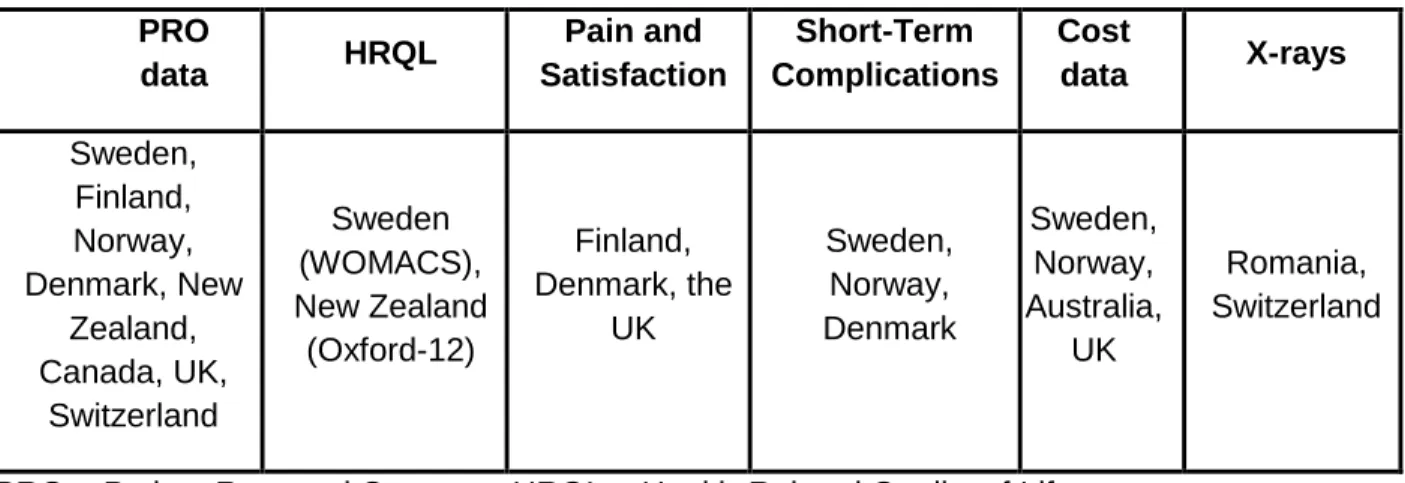
patient reported outcomes (8/12), cost data (4/12), short-term complications (3/12), and x-rays (2/12).
Foreign National Joint Registries
Sweden established the first national hip and knee total joint registry in 1979 12 . Over the next three decades, more than 20 other countries founded their own joint databases 16 . The timeline (figure 1) depicts the history of national joint registries over the last 35 years but
excludes registries that do not record data in English (Catalonia (Spain), the Czech Republic, France, Germany, Hungary, Moldova, Turkey, and others) 16 . This timeline suggests that a process known as policy diffusion is responsible for the spread of national joint registries. In the 15 years after the establishment of the Swedish registry, only two other national registries were formed, both in Scandinavia (Finland and Norway). In the 15 years from 1990-2005, however, there was a sharp increase in the number of national joint registries, as another two dozen popped up on three different continents. Possible explanations for this recent increase include an improved ability of surgeons and hospitals to collect registry data and the fact that it took some 10-20 years before the true benefits of the earliest Scandinavian joint registries became clear.
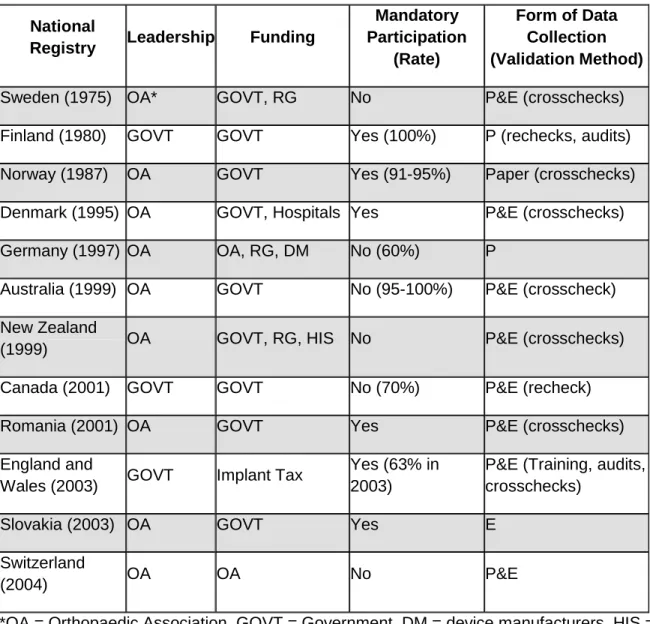
The details of twelve national registries, selected based on the availability of information, are summarized in table 2. Professional orthopaedic societies are in charge of three quarters, or 9 out of 12, of the national registries, but their national governments manage the Finnish, Canadian, and English databases 17 . The government is the primary source of funding for all national registries except for those in Germany, England, and Switzerland 17 . Half of the twelve registries mandate participation by surgeons and hospitals and the overall coverage rates range from 60% (Germany) to nearly 100% (Finland) 16, 23 . All national registries except that in
form of electronic data entry 17, 23 . The majority of countries make registry data publicly available, while only New Zealand, Slovakia, and Switzerland limit database access to physicians 17 .
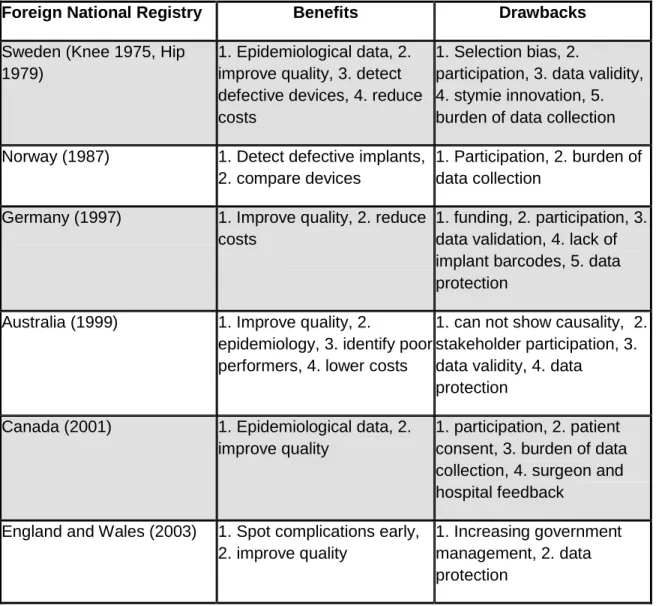
Table 3 summarizes the benefits and drawbacks to six national registries. Proponents claim that the major benefits of running national registries include improving the quality of joint replacement care, detecting defective devices, gathering epidemiological data, and reducing costs 10, 11, 21, 23, 34 . The major challenges and drawbacks of national registries were
encouraging surgeon and hospital participation, minimizing the burden of data collection and validation, and obtaining sufficient long-term funding 10, 11, 21, 23, 34 .
Domestic US Registries
There is wide variation among regional joint registries in the United States. On one end of the spectrum, some private surgeons track their own patients’ outcomes and record the data
in small personal registries 35 . On the other end, large hospital systems and academic centers have designed joint registries that may cover dozens or even hundreds of orthopaedic surgeons 13, 15, 20 . The Mayo clinic founded the first US joint registry in 1969, a full decade before
Sweden began its own hip and knee registry 15 . Mayo surgeons have since entered data on each of their almost 100,000 total joint patients 3 . Table 4 summarizes the five domestic US registries included in this analysis. Each of the registries claimed an improved ability to detect poorly performing devices and surgical techniques. As an example, the Kaiser Permanente registry detected that patients with unicompartmental knee arthroplasties (UKA) had much higher revision rates than did patients who received total knee arthroplasties, a finding the caused network surgeons to perform fewer UKAs with an estimated systems savings of
cost of data collection and validation, which made it difficult to encourage surgeon and hospital participation. Most of the registries collected higher levels of data, but there was little
standardization between the types of data that registries collected. The HealthEast registry and the Kaiser registry both collected cost data. The annual cost of running a registry ranged from $20,000-$500,000, with per-entry rates ranging from a low of $12 (HealthEast) to a high of $500 (UCSF) 2, 3, 13, 15, 20, 22 .
Discussion
Over the last three decades, more than two dozen countries have established some form of a national joint registry. As the Scandinavian registries matured, orthopaedic surgeons around the world became more convinced of the potential benefits of large scale implant databases. With the help of a national registry, Sweden has reduced its revision burden to 4-5% for total joint replacement, compared to an estimated 7-8% in the United States 12 . The Norwegian registry exhibited the ability of national joint registries to detect poorly performing devices by successfully identifying and removing several sub-par joints from the market 34 . As the younger national registries begin to achieve similar benefits, many feel that the time has come for the U.S. to move forward with its own national joint registry.
power to detect nuanced differences between devices and techniques. Assuming an average revision rate of 5% at 10 years, researchers would have to randomize and follow 4,000 patients for at least a decade in order to have an 80% chance of detecting a standard deviation for an implant with a 30% worse revision rate (6.5% vs. 5%) 12 . As a result of these challenges facing RCTs, establishing a national registry seems to be a relatively superior method for collecting long-term arthroplasty outcomes data.
Even though the American Joint Replacement Registry (AJRR) was incorporated in 2009, its success is far from guaranteed 35 . While a handful of regional US joint registries have experienced varying levels of success, previous efforts to develop a larger national joint registry have failed 3, 35 . One obstacle is the staggering size and cost of the US joint replacement industry. In 2006, for example, US surgeons implanted almost 1 million artificial hips and knees at an aggregate cost of $37 billion 36 . The number and cost of total joint replacements is increasing rapidly, with projections that the industry will cost payers $58 billion as early as 2015 37 .
In addition to the enormity of the American joint replacement industry, the complex and evolving nature of the US health care system presents its own challenges for the successful establishment of a national joint registry. Most foreign countries with registries benefit from the simplicity of single-payer, government-run medical systems. The decentralized, fee-for-service, multi-payer system in the United States complicates large-scale outcomes research. Several orthopaedic surgeons have complained that the US reimbursement system is “quality blind” and
wrongly rewards quantity over quality 38 . In addition, the US joint industry has come under fire in recent years for a sometimes too cozy relationship between device manufacturers and surgeons. In 2007, the four largest joint makers in the US agreed to pay $311 million in penalties for paying “sham” consulting fees to surgeons for choosing to use their devices 39 .
perverse incentives remains in the system. If the US had its own national joint database, it would be easier for surgeons to choose the best devices and techniques for their patients without biased input from the device manufacturers.
With these challenges in mind, the AAOS must be pragmatic in its design and
implementation of the AJRR. If a national joint registry in the US is to succeed, it must address three critical factors. First, a national registry needs to provide incentives for all stakeholders to participate in developing the database. Second, the AJRR must secure robust long-term financial support, most likely from the government. Finally, a successful national joint registry must emphasize simple and limited data collection at the start. The following discussion suggests how the AAOS could best meet these criteria and thus establish a well-run national joint database.
The importance of tracking long-term patient outcomes in surgery is not a new idea. In the early 1900s, Ernest Codman, a pioneering American orthopaedic surgeon at Harvard, began to document the post-operative course for all of his patients. When he faced resistance to this idea from his colleagues, Codman wrote in 1917 that “It is against the individual interests
of the medical and surgical staffs of hospitals to follow up, compare, analyze, and standardize all their results… (p. 53)40 .” Almost a century later, Codman’s words ring true in the debate
surrounding a national joint registry in the US. Despite the widespread belief that joint registries can be beneficial, each stakeholder in the debate (surgeons, device manufacturers, hospitals, patients, and payers) are concerned that they could lose out if the AJRR fails to consider their viewpoints. History has shown that, without the support of each stakeholder group, a joint registry will struggle to survive.
every patient 4, 35 . Even after data is collected, surgeons are concerned that, without proper risk-adjustment, data may wrongly favor surgeons who “cherry pick” patients most likely to do
well 3, 38 . Other surgeons fear that a joint registry could be used in medical liability cases or that a joint database may ultimately be used to limit their autonomy 4 . If the AJRR is going to get widespread surgeon buy-in, it will have to limit the burden and cost of data collection placed on surgeons, ensure the validity and risk-adjustment of its data, and convince surgeons that a registry will be informative, but not punitive.
Another major voice in the registry debate comes from the device manufacturers. In 1989, an early attempt at establishing a national joint registry in the US was abandoned in the face of opposition from implant makers 35 . The device industry is mainly concerned that a registry will be used to mandate which implants surgeons can, and cannot, put into patients. In addition, any cost-savings that a registry achieves through cost-effectiveness analysis likely means less revenue for some manufacturers. In an attempt to get the device manufacturers on board, the AAOS has allowed for the industry to have one seat on the board of the AJRR 3 . While this is a good start, the AJRR must walk a fine line between including the device
manufacturers and permitting them too much control over the registry data 2 . In the end, it will be most important for the AJRR to convince the device manufacturers that a national joint registry could benefit them by helping to identify the best implant designs and spurring innovation 2 .
their own risks and benefits for joint replacement, which could provide a foundation for increased shared decision making with patients 2 . Finally, payers should like the idea of a national registry because it has the potential to curb overutilization of expensive, unproven new devices and could help reduce the rate of costly revisions. Despite all of these benefits,
hospitals are concerned about mandates to collect new information, patients fear the privacy of their data, and payers worry they could foot the bill for the registry. To assuage these concerns, the AJRR must remind hospitals, patients, and payers of their potential benefits from a joint registry and convince them that any short-term sacrifices will be counterbalanced by long-term gains.
The last, and perhaps most important, group to consider in designing and implementing a national joint registry in the US is the government. While Americans are more suspicious of big government than are citizens in some of the other countries with national registries, I see no way for the AJRR to succeed without federal support. First, the AAOS estimates that a national joint registry will cost between $18 and $20 million annually once it is up and running 1 . While the AJRR has received more than a million dollars in start-up funds from various professional orthopaedic societies 1 , it is extremely unlikely that groups like the AAOS and the American Society of Hip and Knee Surgeons could provide adequate long-term funding for the AJRR without imposing a per-implant tax or some other self-financing mechanism. After all, the only national registries (Germany, Switzerland, and the UK) that don’t get the bulk of their funding
from the government have struggled to get high coverage rates and produce valid data 17, 23 . The AJRR has shied away from government support to date because they fear that federal money is unreliable from year-to-year and comes with too many strings attached, most notably the fear that the government may manipulate the data to show the results they desire 3 .
replacement patient over 65, omitting only laterality and implant details. The registry could use the Medicare database as a foundation for the larger national registry, or at least learn from some of the data collection systems used by CMS. Second, the government could help incentivize participation in the national registry. The Physician Quality Reporting Initiative and the Reporting of Hospital Quality Data Initiative are two CMS projects that are currently pushing physicians and hospitals to collect more outcomes data 2 . With the recent appointment of the quality-minded Don Berwick to CMS chief, more initiatives of this sort will undoubtedly be on the near horizon. Third, the government could help by creating laws that could protect registry data. For example, the Virginia Legislature passed the Patients Rights Amendment to protect the state’s joint registry data from attorneys as a means to convince orthopaedic surgeons to
participate in data collection 22 . A similar law at the national level could ensure that registry data is used to change behaviors and improve performance, but not to punish surgeons, hospitals, or device manufacturers with sub-par performance. Finally, the government must realize that it has a lot to gain from a well-run national joint registry. As the largest payer for total joint replacements, CMS could see tens if not hundreds of millions of dollars in savings over the long-term 3 .
The last rule for establishing a successful national joint registry in the US is to begin by collecting a small amount of data that is simple to record. At the start, a national registry should collect only level 1 data: unique patient identification number, patient age and sex, laterality, diagnosis, device details, and surgical technique. Limiting a registry to level 1 data will lessen the burden and cost of data collection for hospitals, surgeons, and their staff. In addition, the omission of potential hot-button pieces of data like cost analysis will mean that certain
in the short-term, it would be possible to collect higher levels of data at a subset of capable hospitals 2-4, 35 . The main reason to limit the data collection at the national level is to encourage the smaller hospitals and practices to participate in the registry. Essentially, it is worth trading higher levels of data for higher levels of participation.
In conclusion, the time for starting a national joint registry in the US has arrived. The success of foreign joint registries has shown surgeons, hospitals, and the government the potential benefits of a national US registry. Even with the current momentum for the project, the obstacles to establishing a national joint registry are substantial. In addition to the vast size of the US joint industry, the decentralized US Healthcare system and the plurality of stakeholder opinions create a uniquely difficult task for the AJRR. In the face of great challenge, however, lies great opportunity. If well-run, an American joint replacement registry would dwarf all of the other national registries. This data could help change the behaviors of surgeons, hospitals, device manufacturers, payers, and even patients in an effort to achieve a safer, higher quality, and more efficient joint replacement care. As Dr. David Lewallen, head of the AJRR, said, “Everybody’s ship floats higher if the quality of the outcome is better – everybody has a stake in
Tables
Table 1. Higher Levels of Data Collected by National Registries PRO
data HRQL
Pain and Satisfaction
Short-Term Complications
Cost
data X-rays
Sweden, Finland, Norway, Denmark, New
Zealand, Canada, UK,
Switzerland
Sweden (WOMACS), New Zealand
(Oxford-12)
Finland, Denmark, the
UK
Sweden, Norway, Denmark
Sweden, Norway, Australia,
UK
Romania, Switzerland
Table 2. Comparison of Foreign National Registries
National
Registry Leadership Funding
Mandatory Participation
(Rate)
Form of Data Collection (Validation Method)
Sweden (1975) OA* GOVT, RG No P&E (crosschecks) Finland (1980) GOVT GOVT Yes (100%) P (rechecks, audits) Norway (1987) OA GOVT Yes (91-95%) Paper (crosschecks) Denmark (1995) OA GOVT, Hospitals Yes P&E (crosschecks) Germany (1997) OA OA, RG, DM No (60%) P
Australia (1999) OA GOVT No (95-100%) P&E (crosscheck) New Zealand
(1999) OA GOVT, RG, HIS No P&E (crosschecks) Canada (2001) GOVT GOVT No (70%) P&E (recheck) Romania (2001) OA GOVT Yes P&E (crosschecks) England and
Wales (2003) GOVT Implant Tax
Yes (63% in 2003)
P&E (Training, audits, crosschecks)
Slovakia (2003) OA GOVT Yes E
Switzerland
(2004) OA OA No P&E
Table 3. Potential Benefits and Drawbacks to Foreign National Joint Registries
Foreign National Registry Benefits Drawbacks
Sweden (Knee 1975, Hip 1979)
1. Epidemiological data, 2. improve quality, 3. detect defective devices, 4. reduce costs
1. Selection bias, 2.
participation, 3. data validity, 4. stymie innovation, 5. burden of data collection Norway (1987) 1. Detect defective implants,
2. compare devices
1. Participation, 2. burden of data collection
Germany (1997) 1. Improve quality, 2. reduce costs
1. funding, 2. participation, 3. data validation, 4. lack of implant barcodes, 5. data protection
Australia (1999) 1. Improve quality, 2.
epidemiology, 3. identify poor performers, 4. lower costs
1. can not show causality, 2. stakeholder participation, 3. data validity, 4. data
protection Canada (2001) 1. Epidemiological data, 2.
improve quality
1. participation, 2. patient consent, 3. burden of data collection, 4. surgeon and hospital feedback
England and Wales (2003) 1. Spot complications early, 2. improve quality
Table 4. Regional US Registries’ Benefits, Drawbacks, Data Collection, and Funding
Regional US
Registry Benefits Drawbacks Data Funding
Mayo (Rochester, MN), 1969 1. Track complications, 2. epidemiological data, 3. detect bad devices
1. Data validation, 2. burden of data collection, 3. cost, 4. patient consent
1. Level 1, 2. Pain and Function Department, $500,000/yr Health East Hospitals (St. Paul, MN), 1991
1. Improve outcomes, 2. epidemiological data, 3. detect bad devices
1. Data validation, 2. burden of data collection, 3. loss to follow-up
1. Level 1, 2. cost Private, $20,000/year, $12/procedure UCSF (San Francisco, CA), 1995
1. Facilitate research, 2. epidemiological data
1. Labor intensive, 2. costly
1. level 1, 2. functional outcomes, 3. QOL
$500,000/year for 4 surgeons, 900 procedures (> $500/implant); funded through research grants Kaiser Permanente National Joint Replacement Registry (San Diego, CA), 2001
1. Improve outcomes, 2. Reduce costs, 3. identify poor
performers
1. Surgeon and hospital
participation, 2. validating data
1. Level 1, 2. Level 2 (infection, DVT), 3. Cost No data Virginia State Registry (Virginia), 2003
1. Identify poor performers, 2. reduce costs
1. Scale of US, 2. US attorneys, 3. US healthcare system, 4. participation 5. manufacturers barcodes
1. level 1 data
Figure 1. National Joint Registers Timeline
Sweden Finland Norway
Denmark
Germany
New Zealand
Australia Romania Canada
Slovakia England & Wales
Switzerland
1980
1979 1987 1997 1999 2001 2003 2004
Timeline showing the years that hip and knee registries were established
16,171990 Italy
Scotland
Figures
Appendix 1 –
Systematic
Literature ReviewMethods:
An initial PubMed search on 3/20/2010 with the MeSH terms “Arthroplasty” and “Registries” yielded 215 hits with the limitations of “last 15 years, humans, and full text.”
An analysis of the titles of these 215 publications produced 44 papers that dealt both with joint registries and hip or knee replacements. After an abstract review, any study that failed to deal with the benefits and drawbacks of a hip or knee joint registry with potential applicability to a future US joint registry were excluded and the resulting 9 full text publications were analyzed and included in the literature review.
In an effort to collect recent publications that may not have been categorized within the MeSH database, a second PubMed search on 3/23/2010 was conducted with the following search criteria: (Registry[tw] OR register[tw] or registries[tw] or registers[tw] OR database[tw] or databases[tw]) AND (Arthroplasty[tw] OR “knee replacement”[tw] or ”hip replacement”[tw] or “joint replacement”[tw]) and limited to the last 90 days. This
search resulted in 60 hits and a review of titles excluded 53 studies that failed to discuss the benefits and drawbacks of hip or knee joint registries. Of the resulting 7 articles, two papers were included in this systematic review based on abstract reviews.
Limitations of these searches include the reliance on published papers, proper MeSH categorization, and studies included in the PubMed database. Several of the included studies are, however, themselves reviews of a variety of existing joint registers 16, 17 . Some of these studies included a significant portion of formerly unpublished data
indicating that this review was sufficient to answer the study question without further evidence.
Results:
The results of the 11 publications included in this systematic review are summarized in table A-1. A chronological discussion of each study’s strengths,
weaknesses, results, and conclusions helps paint a clearer picture of the potential benefits and best design of a National Joint Registry (NJR) in the United States. While the design and structure of each study varied significantly, a detailed analysis sought to extract the same basic data and inferences from each publication. The conclusion addresses the recurring trends from this literature review in an effort to answer the study question.
In 2010, Bohm et al. published a retrospective analysis of the Canadian National Joint Registry (CNJR). The strengths of this study were its recent publication (2010) and its tracking and analysis of data through 2007. Weaknesses of this publication included a relatively short history (CNJR began in 2000), an unsuccessful NJR (only collects data on 41% of eligible joint replacements), and potentially poor external validity to the United States. The study mentioned that the major potential benefits of a NJR included its ability to collect epidemiological data and improve outcomes through surgeon and hospital feedback. Challenges for establishing the CNJR included lackluster
Graves published an opinion piece comparing clinical trials and registries based on his experience with and understanding of the Australian National Joint Registry. The strengths of this study included its recent publication (2010), its direct discussion of the benefits and drawbacks of a joint registry, and a comparison to a registry’s alternative:
clinical trials. As an opinion piece, this work suffered from a reliance on professional opinion, the lack of detailed methodology, and a potential lack of external validity outside of Australia. According to Graves, the potential benefits of a NJR include improving patient outcomes, ongoing quality assurance, and broad inclusion of joint replacements. A potential shortcoming of registries included their inability to determine causality (as is the case with RCTs). In conclusion, Graves claims that both RCTs and registries are critical to the progress of the joint replacement industry and should be used in tandem to ensure high-quality and efficient delivery of care 11 .
Serra-Sutton et al. (2009) of Spain published a comparative analysis and
literature review of existing national joint registers. The strengths of this article included a detailed methodology, a comparison of multiple foreign registries, and summary tables of main results. Weaknesses of this paper were the exclusion of NJRs without websites or information available in English. The results suggested that potential benefits of national registries include decreasing the wide variability of devices and techniques and controlling costs in joint replacement. According to the authors, difficulties facing NJRs included incomplete participation, appropriate data collection, and the costs of
maintaining the database. Serra-Sutton claims that a successful NJR should have collaboration among all stakeholders, leadership of an orthopaedic society, and effective methods of data dissemination and feedback 16 .
historical review of foreign registries, summary results tables, and 100% response rate from contacted registries. Several limitations of this study included an exclusion of registries that were not well-established, thus potentially biasing the results to favor successful registries. Kolling et al. listed potential benefits of registries as facilitating patient and implant tracking, providing surgeon feedback, and making data publicly available. Potential hurdles facing the creators of a NJR could be obtaining sustainable funding, using revision rates as a main outcome, getting complete participation,
consenting patients, and a large burden of data collection. In conclusion, the authors recommended that registries should use a national patient ID#, streamline data collection, obtain guaranteed finance, provide surgeon anonymity, and make data publicly available 17 .
In 2007, Robertsson published an informal review of several national joint
registers in comparison with the Swedish Knee Arthroplasty Register (SKAR). While this paper lacked a detailed methodology and relied on the author’s personal experience and
expertise, its main strength was its author as Robertsson has published extensively on the world’s longest-standing National Joint Register. Among the potential benefits of a
NJR, Robertsson listed the ability to collect demographic as well as outcomes data, stimulate quality healthcare delivery, facilitate recalls, and reduce costs. Potential pitfalls of joint registries according to Robertsson included selection bias, incomplete
Gioe et al. (2006) conducted a retrospective analysis of the HealthEast joint registry, a regional database of 44 orthopedic surgeons in St. Paul, Minnesota that began in 1994. Among the strengths of this paper were a detailed discussion of a US joint registry and a comparison with other joint registries. Weaknesses included the relatively small size of the HealthEast registry and the potential for the authors to bias their study in favor of joint registries. Gioe et al. claimed that potential benefits of a NJR were the gathering of epidemiological data, timely feedback, and the real-time
identification of defective devices or techniques. Several potential drawbacks included the incomplete collection of data, invalid data collection, use of revision rates as the main outcomes, and the cost of the database (calculated at $12/procedure for
HealthEast). Among the authors’ main conclusions for a successful joint registry were limiting a surgeon’s burden of data collection, facilitating cost negotiations with joint
manufacturers, and providing surgeons with worthwhile feedback 13 .
In 2005, Philipson et al. performed a mailed survey of 405 orthopedic surgeons in England and Wales with questions about the newly implemented NJR. Several
strengths of this study included the collection direct surgeon feedback and reasonable survey design and methodology. Drawbacks of this study were the low response rate of surgeons (63%), the lack of varied stakeholder perspectives, and the brevity of the questionnaire. Despite these weaknesses, the authors discovered that potential benefits of the English joint registry from a surgeon’s perspective included detecting
be used to increase government management of the industry, allowing surgeon
leadership of the registry, and making surgeon information confidential when providing feedback 21 .
In 2004, Graves et al. published another study that was a retrospective analysis of the Australian National Joint Registry (ANJR). The major strength of this work for this project was its discussion of the process of starting a large, nation-wide joint registry. Several weaknesses of the study included a lack of detailed methodology and the relatively short history of the ANJR (began in 1999). Among the potential benefits of a NJR, Graves et al. listed epidemiological data, improved outcomes, facilitated recalls, device comparability, and the education of surgeons. Potential drawbacks mentioned were the persistently high revision rates after joint replacement in Australia, the burden of paper data collection, cooperation from device manufacturers, and the choice of appropriate registry data. In the end, the authors suggested that a successful registry should give all stakeholders a say in designing the NJR, provide confidential feedback, and build of existing regional registry that have been successful 14 .
system, the high cost of data collection, the potential for selection bias, lack of
participation, breach of privacy, and the possibility of surgeon liability. While no unified conclusion was drawn from this exchange, the two authors presented to options for the future of data collection in the US joint industry: a national registry or large clinical trials 18 .
In 2000, Havelin et al. published a retrospective analysis of the Norwegian Joint Registry. The main strength of this analysis was its discussion of a long-standing and successful joint registry (began in 1985). Several drawbacks of this study included a lack of international comparisons and a joint registry that included more than just hip and knee replacements. The authors motioned potential benefits of a registry to be the ability to detect inferior devices and compare devices. The major hurdle to cross in running a registry was total participation by surgeons and hospitals. In order to get a successful registry, the authors claimed that a country must get more than 95% of procedures, be able to track devices, and not attempt to collect too much data 19 .
In 1997, Berry et al. published a retrospective analysis of the Mayo Clinic joint registry in Minnesota. The main strength of this study was its discussion of a long-standing regional joint registry in the US while its weaknesses included a lack of
international comparisons, its publication date in 1997, and the potentially poor external validity outside of Minnesota. Among the potential benefits of a joint registry, Berry et al. mentioned the ability to discover the most effective device, technique, and patient
Several trends emerge from an analysis of these articles. The most commonly mentioned benefits of starting a joint registry included 1. the ability to detect
underperforming joints (7 citations), 2. improving patient outcomes (5 citations), and 3. gathering epidemiological data in addition to outcomes data (4 citations). On the other hand, the most commonly addressed challenges facing the creation of a successful joint registry were 1. lack of participation (6 citations), 2. obtaining long-term finance (5
citations), 3. the burden of data collection (5 citations), and 4. the data validation process (5 citations). Less cited potential benefits included the ability to provide worthwhile feedback (4) and reduce costs of joint implantation (2). Less frequently mentioned hurdles to establishing a joint registry were obtaining stakeholder support (4), providing surgeon confidentiality (3), inability to determine causality as in RCTs (3), the need for patient consent (2), and the use of revision rates as the main outcome (2).
Table A-1: Study Designs, Strengths, Weaknesses, and Conclusions
Study Design; Country Strengths Weaknesses Potential
Benefits
Challenges & Drawbacks
Bohm et al. 2010
Retrospective Analysis of the Canadian NJR; Canada Recent publication, tracking of data through 2007 New and struggling NJR (began 2000), may lack external validity 1. Epidemiological data, 2. improve outcomes
1. Participation, 2. patient consent, 3. burden of data collection
Graves. 2010 Opinion Piece Comparing Registries and Clinical trials; Australia Recent publication, comparison to alternative (i.e. RCTs) Lacks detailed methodology, relies on expert opinion, lack of external validity
1. Improve outcomes, 2. no exclusions, 4. stakeholder participation 1. RCT superiority Serra-Sutton et al. 2009
Kolling et al. 2007
Comparative Analysis and Literature Review of Existing NJRs; England Detailed methodology, Summary Tables, 100% Resp. Rate from NJRs surveyed Excluded registries that were not well-established (bias towards
successful NJRs)
1. Easy patient and device tracking, 2. surgeon feedback, 3. publicly available data
1. funding, 2. participation, 3. patient consent, 4. burden of data collection
Robertsson, O. 2007
Informal Review of Various Knee arthroplasty registers; Sweden/England Author is biggest name in publication on NJRs in the leading NJR country of Sweden Lacks detailed methodology, Relies on personal experience and expertise 1. demographic data, 2. establish best practices, 3. stimulates quality, 4. facilitates recall, 5. reduce costs
1. Selection bias, 2.
participation, 3. valid data, 4. burden of data collection
Gioe et al. 2006
Retrospective Analysis of Regional US Joint Registry; St. Paul, Minnesota, United States Published by Directors of HealthEast Registry, compares registries
Potential bias to overstate registry success, small regional registry (44 surgeons) 1. TJR epidemiology, 2. timely feedback, 3. ID risk factors for poor
outcomes
1. data
validation, 2. loss to follow-up, 4. cost
Philipson et al. 2005
Mailed Survey to 405 orthopedic surgeons in England/Wales Direct surgeon feedback, quantitative data collection
Short survey, low response rate (63%), lack of other stakeholder perspectives
1. Spot complications early, 2. improve quality
1. data
protection, 2. surgeon
representation
Graves et al. 2004
Retrospective Analysis; Australia
Discusses process of starting a NJR
No detailed methodology, short history of ANJRR (began in 1999) 1. epidemiology, 2. improve outcomes, 3. facilitate recalls, 1. Australian RRs very high (20-24%), 2. DM Swiontkowski and Maloney. 2002 Editorial and Author Reply; United States Provides both pro and anti-NJR viewpoints among US surgeons
Very Brief, Lack of Methodology, Expert Opinions
1. US Medicare database could springboard NJR, 2. detect bad devices, 3. facilitate recall
1. no single pay system, 2. cost,
3. selection bias, 4. participation,
5. privacy, 6. liability
Havelin et al. 2000
Retrospective Analysis of the Norwegian Joint Registry; Norway successful NJR, relatively long history (began 1985) Lacks international comparisons
1. Detect inferior implants as early
1. participation
Berry et al. 1997
Retrospective Analysis of the Mayo Registry; Minnesota, US Analysis of long-standing US regional registry Small registry, Mayo is different from rest of US, 13yo publication
1. Discover most effective device, technique, and patient selection
Appendix 2 - Outcome Measurement in Total Knee Arthroplasty
The feasibility and value of any joint registry rest largely on the types of
outcomes data researchers choose to collect. Attempting to gather too much data may overburden surgeons and other information gatherers and discourage registry
participation, while collecting too little data may limit the utility of the database. In the past, joint registries and orthopaedic surgeons have largely focused on pain and
functionality measures when tracking patients after joint implants 25, 26 . A wave of recent literature has stressed the importance of focusing on more patient-oriented measures such as quality of life 25, 27-30, 30, 31 . As the American Academy of Orthopedic Surgeons (AAOS) sets out to create their own national joint registry in the United States, they must determine which type of outcomes data will be most useful down the road.
In the past, joint replacement surgeons have tracked outcomes such as mortality, morbidity, complication rates, and implant survival. While these measures can be
essential for detecting defective devices or rare systems failures, the vast majority of patients do not experience such negative outcomes for more than a decade 5 . For example, more than 90% of patients experience little pain, functional impairment, or implant failure within the first 10-15 years after joint replacement 5 . In effect, joint replacements have progressed to a point where these outcome measures are not sensitive enough to detect nuanced differences between patients’ post-operative
courses 26, 41 .
In 1989, the American Knee Society set out to design a practical yet exacting outcome measure to better track patients’ pain and functionality after total knee
KSS did help standardize traditional outcome measurement and has achieved relatively widespread acceptance in the joint replacement literature 43-46 . Despite this success, some orthopaedic surgeons continue to question the usefulness and reliability of the KSS as an outcome measure. In 2000, Scottish researchers examined the KSS and found that inter-observer variability ranged by as much as 16-21 points for the same exact patient 47 . Three years later, the same researchers conducted a head-to-head comparison between the KSS, the British Orthopedic Association Score (BOAS), and the Oxford-12 and again determined that the KSS had poor reliability relative to the other measures 48 . While these studies had small sample sizes and forced surgeons to use foreign assessment tools, they do raise important questions about the utility and
accuracy of the KSS. In addition to reliability issues, the KSS requires surgeons or other data collectors to spend a significant amount of time assessing patients, recording data, and calculating scores. When considering the possibility of including measures like KSS in a joint registry, it appears that this traditional measure would be both too unreliable and overly burdensome to information gatherers to be of clinical or practical value.
Orthopaedic surgeons thus find themselves in a true Catch-22 when it comes to appropriate outcome measures for joint replacement patients. Traditional measures like mortality and implant survival have become less useful as their incidence has declined, while more sensitive measures of pain and functionality like the KSS suffer from poor reliability and the overburdening of data collectors. In an effort to bypass this dilemma, a growing number of researchers and surgeons have begun to support the collection of qualitative outcomes in joint replacement.
been developing tools to analyze patients’ health status. The major goal of AHRQ has
been to gather and make available data that will result in improved clinical decisions and ultimately better population health 49 . In the 1980s, increasing awareness of the value of health status and quality of life measures sparked a debate over the future importance of Healthcare Related Quality of Life (HRQL) 50 . Most conceptualizations of HRQL include dimensions of physical and social function, mental health, and general health
perceptions 51 . In recent years, orthopaedic surgeons have begun to view HRQL measures as a potentially essential tool to assess the outcomes of joint replacement patients 41 .
Health Related Quality of Life measures are broadly categorized as generic or disease specific. Generic measures are useful for assessing overall health status and offer the most generalizable comparisons between different diseases and populations 50 . Among the hundreds of generic measures to assess HRQL are the Short Form 36 (SF-36), quality of well being (QWB) scale, and the Nottingham Health Profile 27, 33 . Disease specific measures, on the other hand, are designed to assess more limited disease states and smaller patient populations and often benefit from being more simple, cheap, and reliable than generic measures. Examples of more disease specific HRQL
measures pertinent in orthopaedics include the Western Ontario and McMaster University’s Index of Osteoarthritis (WOMAC), Lequesne, and the Oxford-12 25
. While a myriad of generic and disease specific measures are available for researchers to assess HRQL, orthopaedic surgeons must design or choose the best available tests to consider for use in a widespread data collection effort like a joint registry.
Fortunately, the joint replacement literature contains a modest number of articles that assess the utility of various HRQL measures. In fact, several countries have
resources. The National Institute for Health and Clinical Excellence (NICE) in Britain uses quality and cost-effective measures such as quality-adjusted life years (QALYs) to assess and improve patient outcomes 52 . In Sweden, where a national joint registry has existed for decades, researchers recently conducted a study assessing several HRQL measures for knee replacement patients. In this cross-sectional mailed survey of a random sample of 3600 Swedish TKA patients, investigators compared four generic (Nottingham Health Profile, SF-12, SF-36, and Sickness Impact Profile) and three disease specific questionnaires (Lequesne, Oxford 12-item Knee Score, and WOMAC) based on response rate, time to complete, validity, and reliability. After analyzing their results, the researchers concluded that the two shortest assessment tools had the best performances: the SF-12 for generic measures and the Oxford-12 for disease specific examination 28 . This study again exhibits the advantages to using practical and concise assessment tools when collecting large volumes of population health data.
Of course, any tool that attempts to measure quality outcomes struggles from the same challenges that face traditional outcome measures in orthopedics like mortality and failure rates. Foremost among these challenges is striking the appropriate balance between creating an assessment tool that is sensitive enough to detect subtle variations in outcomes, while avoiding measurement strategies that are overly complex and difficult to conduct or analyze. In 1998, Hawker et al. sampled 1750 Medicare TKA patients and mailed each a packet with a general information questionnaire, an SF-36, and a
WOMAC. When the vast majority of patients who responded to the survey reported little or no problems 2-7 years post-operation, the researchers realized that these HRQL tools, much like their traditional TKA outcome measure counterparts, lacked the
variations to manifest, this study warns of implementing HRQL measures on a population-wide basis.
In conclusion, the wide variety of traditional and qualitative outcome measures leaves the creators of a national joint registry in a conundrum. Traditional outcome measures such as mortality, clinical pain and function, and implant survival have been measured for decades but often fail to detect nuanced differences in modern artificial joints. Investigational qualitative measures offer lots of promise but are difficult to quantify, lack widespread acceptance, and can be time consuming and burdensome to administer. In light of these challenges, I feel that a nascent joint registry in the US must first focus on the traditional outcome measures simply because they are easy to record and interpret. Even if they are less sensitive then they used to be, the number of annual TKAs has already surpassed 500,000 in the United States alone and is rapidly
increasing. With such a huge number and variety of implants, it will still be essential for a joint registry to track traditional outcomes in order to detect rare device defects or failures in addition to expected failure rates ten or twenty years post-implantation. As for quality measures, it seems that the time is not yet appropriate to incorporate tools such as the SF-36, QWB scale, or the WOMAC because they have been shown too
overburden data collectors and also lack sensitivity in measuring TKA outcomes. If anything, the shortest and most concise quality measures like the SF-12 and the Oxford-12 hold the most potential benefit for a joint registry. In the end, creating a registry at all is an enormous challenge and step forward for the US joint replacement industry and researchers must not overcomplicate the database and risk losing the current
Appendix 3 – Foreign National Joint Registries
On May 3, 2010 the newly formed board of the American Joint Replacement Registry held its first meeting 3 . Thirty-five years before that meeting, the first national joint registry was formed in Sweden in 1975 12 . Since that time, more than twenty other countries have established their own national joint registry. Of these, fifteen registers are documented in English and at least another eight are kept in other languages, including Catalonia (Spain), the Czech Republic, France, Germany, Hungary, Moldova, Slovakia, and Turkey 16 . Even Malawi has recently established a national register for knee and hip replacements 53 . While the experience of each national registry is
somewhat unique, their relative successes and failures can provide important lessons for the AAOS as it sets out to establish the first American National Joint Replacement Registry.
revision rate of 5% at 10 years, researchers would have to randomize and follow 4,000 patients for at least a decade in order to have an 80% chance of detecting a standard deviation for an implant with a 30% worse revision rate (6.5% vs. 5%) 12 . As a result of these challenges facing RCTs, the process of establishing a national registry seems to be a relatively reasonable method for collecting long-term arthroplasty outcomes data.
While each country’s healthcare system presents unique challenges, all national
joint registers face many of the same obstacles: encouraging surgeon and patient participation, collecting worthwhile and valid data, and obtaining long-term guaranteed financing. Joint replacement surgeons may understand and appreciate the benefits of a national registry, but many fear that such data collection systems could increase their workload, sacrifice their autonomy in selecting certain devices and techniques, or even as evidence against them in malpractice disputes. Only a handful of the national registers mandate participation, and as a result coverage rates range from lows in Germany (60%) and Canada (70%) to inclusion of almost 100% of procedures in Denmark, Australia, and Finland 14, 16, 23 . In an attempt to maximize surgeon
participation and increase coverage rates, some national registries have formed steering committees, performed clinical audits, guaranteed anonymous data-reporting, or created formal training programs for the entering registry data 16, 34 . The Australian registry, which began in 1999, took a piecemeal approach to obtaining surgeon and hospital participation by progressively expanding the register state-by-state until they achieved near 100% coverage in 2002 14 . Another barrier to near-complete registry coverage is lack of patient participation. In 2003, for example, only 63% of British patients provided their consent for registry participation and only 90% of patients agreed in Canada 17 . To get around this problem, the majority of registries don’t require patient consent or make it
A second hurdle for national registers is choosing an effective way to collect and validate registry data. All national registers use implant survival, determined by time to revision, as the main registry outcome 12, 17 . To collect this data, most registers have either a paper or electronic form filled out at the time of operation that includes a patient identification number, details of the implant and operation, and information about the hospital where the operation occurred 16 . Currently, the bulk of the information is recorded on paper since several national registers have complained that electronic data entry is still more costly and time-consuming 14, 16, 17 . Many surgeons have interest in collecting higher levels of data such as patient satisfaction and quality-of-life, but only a minority of national registries have successfully began to document this information 16, 17 . As a result of these experiences, it seems that an American joint registry should begin by collecting a minimum of essential data on paper before advancing to higher levels of data or electronic entry of registry information.
A brief discussion of the failed German joint registry helps illustrate the importance of obtaining long-term guaranteed financing in the establishment of a
properly input registry data as 31% of implants lacked proper identification and 6% of registry entries did not even include the date of operation, thus making it impossible to obtain critical outcomes measures such as time to revision 23 . Other lessons from the German experiment include the need for manufacturers to share their implant barcode information with the registry and the need to have mechanisms in place to ensure that data collection is complete and valid 23 . As a result, the German registry represents an unfortunate example of what can happen when a national joint registry is not well-planned or properly financed. Of particular concern for the AJRR is the fact that it, similar to Germany, will attempt to finance the registry through professional society grants and a per-implant charges on each device 3 .
Despite the failings of the German joint registry, most countries have
experienced varying degrees of success in establishing their national joint registries. The long-standing Swedish arthroplasty register has helped reduce their revision burden to 4-5%, compared to an estimated 7-8% in the United States 12 . Registries have also proven successful in their ability to detect poorly performing devices and techniques as the Norwegian registry has withdrawn several uncemented and two cemented implants from the market 34 . The Australian registry has learned that, in the rare case of a device recall, a national register is the only efficient way to track down and notify patients who received a specific implant 14 . In addition, national joint registries have succeeded in collecting valuable demographic data, stimulating hospitals and surgeons to perform at their best, and providing the opportunity for cost analyses 12 .
Appendix 4 – Interview Consent, Protocol, and Summary Table
Evaluating the Potential Benefits and Plausibility of a National Joint Registry in the United States
James Fraser
University of North Carolina at Chapel Hill
IRB Study #: Consent Form Version Date:
Principal Investigator: James Fraser
UNC-Chapel Hill Department: Public Health Leadership
Faculty Advisor: Sue Tolleson-Rinehart, PhD
UNC-Chapel Hill Department: Public Health Leadership & Pediatrics
Advisor Phone #: 919.843.9477
Advisor E-mail: [email protected]
Study Contact Phone #: 704-516-5359
Study Contact E-mail: [email protected]
[Introductory script, embedding study information and agreement to participate:]
I have asked to interview you because of your knowledge of joint replacement registries. I am interested specifically in your views of how joint registries can and cannot contribute to better joint replacement outcomes.
My advisor for this research is Dr. Sue Tolleson-Rinehart, who is a faculty member of the UNC Schools of Public Health and Medicine. We hope that this project can advance understanding of the role of registries in improving orthopaedic quality of care. To this end, we hope that the results of this study will be published in a scholarly journal. The interview will consist of several open-ended questions, and should last anywhere from 20 minutes to one hour, depending on the availability of your time and what you want to tell me. You have the right to end the interview at any time. I would like to record this interview on a digital voice recorder to ensure that I have the most accurate record of your comments. However, I will not record this interview without your
permission.
If you do grant permission for this conversation to be recorded, you have the right to revoke recording permission at any time. The digital interview files created will be kept password-protected on my computer and the computer of my faculty advisor, Dr. Tolleson-Rinehart, until I transcribe the interview. After the transcript is made, the files will be deleted. This transcript will also be kept password-protected on our computers, and only Dr. Tolleson-Rinehart and I will know this password. I will be happy to provide you with a copy of the interview’s transcript at your request.
I will not identify your comments by name in my written work unless you grant me permission to do so today. If you do not grant this permission, I will identify you by position only – for example, “An orthopedic surgeon at an Eastern academic medical center.”
If you have any questions about the research now, please ask. If you have questions later about the research, please contact me by phone at 704-516-5359 or by e-mail at [email protected] or [email protected]
Dr. Tolleson-Rinehart and I hope to publish the results of this project, and will be glad to make findings available to you. If you wish to ask Dr. Tolleson-Rinehart any questions about the study, please send a message to [email protected] or call 919.843.9477. Before we continue, would you please agree to any or all of the statements I’m about to read?
I AGREE to having this interview tape recorded with a digital voice recorder.
my name my title direct quotes from this interview
. .
Name of Participant Date
Thank you for your help with my project! Now we are ready to begin.
Interview Protocol
1. As you know, the US has not previously had national joint registries. In your view, why is the AAOS now setting out to do this in the US?
2. I have searched and read the literature on joint registries, and I think I
understand them, but I would greatly value knowing your views. In general, what do you think are the main benefits to establishing a national joint registry in the United States?
3. And what roadblocks to getting the registry established do you see?
4. Does your own orthopaedics service track patient outcomes after total joint replacements?
4.a. (if yes) How do you do it? What information do you collect?
4.b. (If no) Can you tell me why your service isn’t doing this now?
5.a. (if they do NOT spontaneously mention this): Do you think it will be important for a registry to collect data like patient satisfaction and patient-reported health-Related Quality of Life data?
6. I understand that a national registry is likely to require collaboration between surgeons, manufacturers, hospitals, patients, and payers in establishing a registry. Can you tell me what roles you think these different groups will play?
6.a. In your view, which of these groups is likely to have the most influence in shaping what the registry will look like?
7. And what about a government role in establishing a registry? What should that role be?
7a. (If NOT spontaneously mentioned): Should the government fund the creation of the registry, do you think?
7.b. What policies or legislation do you think might help establish a national joint registry? For example, the Virginia state registry pushed for the enactment of a Patients’ Rights Amendment that prohibited attorneys from accessing registry data – do you think these or other kinds of policies should be implemented in a national registry?
8. Finally, who should have access to registry data? The general public? Just Surgeons? Researchers? Device manufacturers?