John B. Anderson, Jr. MD. April 14, 2007
A Master's paper submitted to the faculty of the University of North Carolina at Chapel Hill in partial fulfillment of the requirements for the degree of Master of Public Health in
Table of Contents
I. Introduction ...•....•... 3
II. The Burden of Chronic Disease ...•. .4
Ill. Prevention and Control. ...• 15
I. Introduction
public health capabilities are not sufficiently developed to implement programs that will address the underlying determinants of this growing problem. There will also be
financial consequences tbat develop as a result of the impact of this illness burden on a country's workforce and macroeconomic development. Heart disease, diabetes and stroke, for example, are estimated to reduce the gross domestic product by 1 to 5% per year in low to middle income countries.3 The combination of lower birth rates and increasing life expectancy in developing countries will increase that segment of the population that is susceptible to chronic disease. This increases the importance of crafting appropriate strategies and programs to respond to this growing problem. This paper will present an overview of the extent of the problem, explore the determinants behind the rise in non-communicable disease and discuss possible solutions. While there will be discussion of the global consequence of this problem, the focus will be on Latin American countries.
II. The Burden of Chronic Disease
There are three communicable diseases tbat attract a majority of attention from international aid agencies: HN/AIDS, tuberculosis and malaria. Data from the World Health Organization (WHO) shows that these diseases account for only 12% of the deaths in low-income countries and 11% of the Disability Adjusted Life Years (DALY) lost. In contrast, cardiovascular disease alone accounts for a 27% mortality rate and 9% of DALY lost in low-income countries1. Disability Adjusted Life Years is an approach to
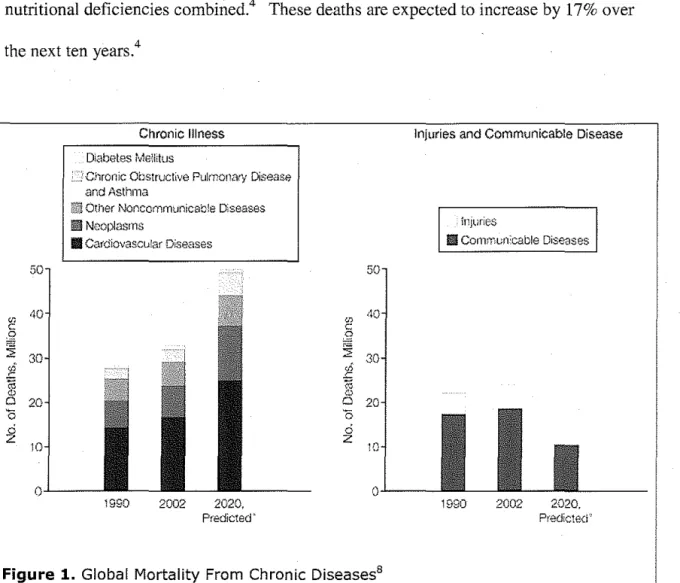
life. Using this method, the burden of adult chronic disease will account for 80% of the DALY lost in developed countries and 70% in middle-income nations.7 The WHO's statistics show that non-communicable accounts for 60% of the deaths worldwide each year and almost half of the global burden of disease. This translates into an estimated 35 million deaths worldwide in 2005 attributable to chronic disease, which is double the number that died from all infectious disease, maternal and prenatal conditions and nutritional deficiencies combined.4 These deaths are expected to increase by 17% over the next ten years.4
"'
c:g
a:
:;;
30
E
;;;8
200
ci
z
Chronic Illness
Diabetes Memtus
· ''j Chronic Obstrucllve Puknon8r':l Disease and Asthma
0e Other Noncommunicable Diseases
II Neoplasms
Ill Cafdiova.scular Diseases
1990 2002 2020, Predicted' oi ~
8
'iS ci zlnjuties and Communicable Disease
injlwies
II Corwnun:cable Diseases
o.L_ __
_
1990 2002 2020.
Predict Hi"
Figure 1. Global Mortality From Chronic Diseases8
Yach D, Hawkes C, Gould CL, Hofman K, The Global Burden of Chronic Diseases, Overcoming Impediments to Prevention and
This trend is especially alarming in Latin American countries where chronic diseases are the leading cause of premature death and disability, accounting for 44% of the deaths among men and women below the age of 70 and contributing to almost 50% of the DALY lost in the region.4 Cardiovascular disease is a major killer in these countries, causing 31% of the deaths and it is predicted that ischemic heart disease and stroke rates will nearly triple over the next two decades.4 Cancer deaths have experienced a 33% increase since 1990 resulting in 20% of the chronic disease mortality.4 This number is only expected to increase. The WHO estimates that 56% of all cancer deaths in 2000 were in developing countries? Diabetes is on the increase worldwide with estimates of 366 million cases in 2030, 298 million of whom will live in developing countries. 8 Chronic respiratory disease is also increasing at an alarming rate in the developing word, primarily as a result of smoking. By 2020, chronic obstructive pulmonary disease (COPD) is expected to become the third leading cause of mortality across the world.7 The graph below highlights the distribution of these causes.
cardovasoJardlseases
MaligBlt ll':qllasms
llJu-l'es _
FlespUata'.f tnfecna1s ~ <ITCOC respra'ta"j d~e;
HtY.lADS
Pafnatal cordt1a1s
o·onhoeal diseaies )t· n -~~.
l\ben:tJOSIS ~
C.gest'le d!seaiei ~
Ch!ldllo:l dtsei6es ~
M.:iana b-~.-~
.
Ciabeles mahtJs l!!tl ~~1L.
·· ·· ··
1 ···· ···1o·se.¥-eS of 1le g=nta.JJinaysJS'Eill )I:J ow-rn:ntahtj m-.-e~cpng cru1t1es
tiaJ!opsfCh•ab•c dsa·c~rs !a3 ~X ... !~~-'.!!.~ .. ---~~~~·~"~r~~~J
MaBnal cordticm
10'='----l----l----l---'----lf----o 3100 4(),)J 6000 8000 10000 1.2 000
Deaths (000)
World Health Report, Shaping the Future. Chapter 6, WH08
Cardiovascular disease, diabetes and cancer will be used to discuss and illustrate the issues that developing countries face as a result of this chronic disease epidemic.
Cardiovascular Disease
Cardiovascular disease is the leading cause of death in developing countries, accounting for twice the number of deaths from HIV I AIDS, tuberculosis and malaria combined. As was mentioned previously, this is especially true for Latin American countries, accounting for a third of all deaths and only expected to increase.4 Developed countries are experiencing a decline in age-adjusted death rates for CVD, even though the overall disease burden is increasing. This is the result of an aging population that has access to prevention and treatment resources allowing people to either delay the onset or live longer with their chronic illness. As a result, nearly 80% of the CVD deaths in the developed world occur after the age of 60, while this occurs in only 42% of the deaths in the developing world.5 This morbidity and mortality is primarily occurring during the population's working years, with the resultant decline in a country's productive workforce.
when deaths from CVD and cancer predominate, but prevention and treatment avoids early deaths and prolongs survival. This transition has been compressed in developing countries, resulting in an anticipated 120% increase in CVD for women and 137% increase for men between 1990 and 2020. The majority of Latin America falls into stage three, with some of the poorer countries falling into stage two where they are still at risk for malaria and dengue fever.5 This description is significant in that countries continue to face the "double burden" of increasing cardiovascular disease along with the challenges posed by communicable disease problems that are still a reality.
Hypertension is also an important risk factor for cardiovascular disease and its prevalence is growing in low to middle income countries. Mexico has reported an
increase in the disease from 26% in 1993 to 30% in 2000.4 There is a trend in developing countries towards increasing urbanization which is also associated with higher rates of hypertension. Urbanization is associated with an increased dependence on motorized transportation, more sedentary jobs and less physical activity. There are also dietary changes that often involve increased caloric intake from sugars, energy-rich
carbohydrates, saturate fats and higher sodium intake. The combination of lower levels of awareness in the population and less than adequate treatment resources have resulted in an increasing morbidity from this condition. Men have a higher prevalence of the disease and are less well treated than women.14 This may also have an impact on the workforce as a consequence of increasing cardiovascular mortality. There is some thinking that an adverse environment during fetal life and early infancy may predispose an individual to risk factors for CVD. This would place the populations of developing countries at higher risk due to the previous decades of poorly nourished infants who will now survive into adulthood with increased susceptibility to vascular disease.14 This association between low-birth weight infants and later development of chronic disease is a true phenomenon, but the explanation may be more genetic than exclusively environmental.18 As
developing countries do progress through the epidemiological transition and move towards greater "Westernization", the incidence of hypertension will also be expected to mcrease.
be linked to both changes in diet and the level of physical activity. Energy-dense foods with higher carbohydrate content are readily available and less expensive. The sugar content of the world's food supply is increasing and there has been an increase in the consumption of animal-source foods. This trend has also been accompanied by a decrease in fresh fruits, vegetables, whole grains and legumes as part of a regular diet. There is an increase in the use of motorized transport and energy-saving devices, more sedentary employment as the population moves away from agricultural work into service sector jobs and less engagement in physical exercise. 15 The availability of video games, computers and television certainly contribute to this more sedentary lifestyle. These "Western" lifestyle and dietary changes are not completely linked to urban environments, but can also be found in the rural environment as well. In Latin American countries surveys from 2002 showed that 50 to 60% of adults and 7 to 12% of children were overweight or obese.4 This increase in obesity and lack of physical activity is especially concerning in children and adolescents, as these patterns of behavior tend to persist into adult life. The fact that obesity has such a significant contribution to the disease burden in the developing world is directly linked to this association with hypertension, diabetes and ultimately cardiovascular disease.
Diabetes
This rise in overweight and obesity has led to an epidemic in the prevalence of type II diabetes in the developing world. Type II diabetes tends to occur in adulthood, is
the year 2025 80% of all the new cases of diabetes will be in the developing world. Seven out of ten countries with the highest number of people living with diabetes are in the developing world.16 In Latin American countries, 35 million people are currently affected with the disease and this number is expected to double by the year 2025. There were close to 300,000 deaths in this region that could be attributed to diabetes in 2003. The societal costs were also estimated to approach $65 billion in 2000.4
The health care infrastructure in developing countries is ill suited to meet the demands of this growing epidemic. Low and middle-income countries will account for less than 15% of the global diabetes spending despite this increase in prevalence of the disease. Said another way, more than 80% of the medical care for diabetes occurs in the world's wealthiest countries. 19 Those that are in greatest need of care are least able to provide the resources or have the ability to pay for it. Direct health care costs related to diabetes range from 2.5% to 15% of annual health care budgets in countries that already struggle to provide health care to their citizens.20 There is also the indirect cost to the economy of decreased worker productivity.
The cost to individuals and their families is also staggering. Diabetes is a chronic condition, requiring long-term medical care and often resulting in long-standing
medical care. There is also a lack of access to appropriate health care which can lead to a delay in the diagnosis of diabetes with the resultant increase in complications. This is especially damaging to those with type I diabetes due to their requirement for insulin, which is frequently unavailable. It has been reported that only 3% of patients are treated with insulin in the developing world as opposed to 13% in the developed world.16 Without appropriate treatment using insulin, these patients will suffer premature disability and death.
The medical complications associated with diabetes are also devastating. The association with cardiovascular disease has been discussed earlier. Diabetes is
responsible for over one million amputations a year, at least 5% of worldwide blindness and the largest cause of chronic kidney failure.16 Chronic kidney disease progresses to kidney failure, or end-stage renal disease, which requires dialysis treatment or kidney transplant. It is estimated that by the year 2030, more than 70% of the patients with end-stage renal disease (ESRD) will be from developing countries.17 Diabetes is responsible for between 9 to 20% of ESRD in the developing world. In 2003 diabetic kidney disease was the most common cause ofESRD in 9 out of 10 Asian countries.2 In China, the proportion of cases of ESRD caused by diabetic nephropathy increased from 17% in 1990 to 30% in 2000? The developing world does not possess the necessary resources to
disease, which is especially important in patients that are most likely suffering from diabetes and hypertension.
Cancer
Cancer is following the same path as other chronic illnesses in the developing world, with major increases in both mortality and incidence. The WHO estimates that the cancer death toll could reach 9 million by 2015.20 A large percentage of these deaths will occur in the developing world, as evidenced by the nearly 60% that were thought to have occurred in 2005.20 This increase is significant in Latin America and the Caribbean where there were 479,000 cancer deaths in 2002, a 33% increase from 1990.20 The same factors that are responsible for the increase in other non-communicable disease are also at play with this increase in cancer diagnosis and death. The population is becoming more "Westernized" and there is growing urbanization, both of which are associated with increasing tobacco use and changes in dietary habits. By the year 2020, the total number of new cases in the developed world is expected to increase by 29%, but in the
developing world an increase of 73% is forcast.19
The "double burden" of disease; the increase in chronic disease while still feeling the impact of communicable disease, is also mirrored in the growing cancer incidence. Low to middle income countries have a higher rate of cancers that can be attributed to
diagnosed are far below those available in the developed world. This is true for adult as well as childhood malignancies.
Cervical cancer in women serves to illustrate this point well. This is the leading cause of death in women in Latin America and the Caribbean, accounting for 37,600 deaths a year.20 There is a strong association between certain types of the HPV virus and cervical cancer. The developed world has experienced a significant decline in mortality from this disease through regular screening of women with pap smears. A new HPV vaccine is now available that is given to adolescents before they become sexually active that will result in even a greater decline in the incidence of cervical cancer. Developing countries are limited in their economic and healthcare infrastructure and are not well equipped to offer these services. More that 80% of the new cases of cervical cancer will occur in the developing world and will account for up to 250,000 deaths annually.19 Patients often have incurable disease when they first present for treatment as a result of the lack of access to adequate preventive care. There may also be regional differences in the malignant potential for certain HPV viruses. HPV31 and HPV58 virus types are more likely to advance to cervical cancer in Latin America and China when compared to the
. . E 19
expenence m urope.
such as Kaposi's sarcoma and non-Hodgkin's lymphoma.19 Add these cancers to cases of breast, lung, colon and prostate that are more often seen in the developed world and it is no wonder that developing nations are struggling with this problem.
Just as it does with cardiovascular disease, tobacco use is the single greatest environmental threat to the incidence and mortality of cancer in the developing world. While the rate of smoking is declining in some industrialized countries, it continues to climb in low to middle income countries, particularly in young people and women.19 The rate of breast cancer is much higher in the developed world, but delayed detection and poorer access to effective treatments have resulted in worse outcomes in the
developing world. Dietary factors are thought to have some bearing on the development of colon cancer. As the developing world adopts more of a "western" dietary pattern consistent with less fiber, whole grains and fruits, the incidence of colon cancer will increase. The overweight and obesity epidemic is expected to also result in an increase in pancreatic, endometrial and prostate cancers that are associated with this risk factor. 20
III. Prevention and Control
response of government and society to these emerging issues will require changes in policy, improvements in infrastructure and concerted public education programs in order to realize improvements in health. These are challenges that the developing world is ill suited to meet and the international community has been slow to acknowledge.
One of the more significant societal and environmental changes has been the
migration of populations from rural to urban areas. The lure of employment, improved educational opportunities and the possibility of an enhanced lifestyle have helped to contribute to this demographic transition. This movement is occuning across the globe and is expected to increase. The world population living in urban areas increased from 36.6% in 1970 to 44.8% in 1994 and is expected to reach 61.1% by 2025.23 This change is associated with movement to a more Western environment with the concomitant changes in diet and level of physical activity. Diets that are higher in saturated fat, sodium content and carbohydrates have been coupled with the decrease in grains, fresh fruits and vegetables. These foods tend to be less expensive, are easily available and have been marketed more extensively, particularly to the younger population.
Interestingly enough, this dietary change experienced in the urban environment has also had an influence on rural areas as well. Marketing efforts, television, the increased availability of processed foods and the desire to appear more "modern" has resulted in changing dietary patterns in these areas as well. 23
can be effective.13 Changing the types of fats in food by reducing the trans-fatty acid content has been an effective and relatively inexpensive approach. As an example, the Netherlands was able to reduce the trans-fat content of the food supply from about 6% of the energy content to approximately 1% in a single decade.13 Legislation could also be introduced to decrease the salt content of manufactured food products helping to decrease the prevalence of hypertension.
Education will also be an important component of this population approach.
Government agencies, such as Ministries of Health, in combination with schools, work sites and community groups will be important in delivering the message about adopting a healthier diet and lifestyle. The message should also be linked with action plans that include offering healthier meals at schools and promoting non-motorized transportation at work sites.13 In developing countries that are stretched for resources, these interventions have been shown to be cost-effective according to the Disease Control Priorities Project of the WHOY Coronary artery disease events could be reduced by 4% through
community media campaigns and efforts to replace saturated fats with monounsaturated fats in manufactured food products. The total cost is estimated at US$1.80 to US$4.50 per capita per year depending on the region. The incremental cost-effectiveness ratio would range from US$1,865 per DALY averted in South Asia to US$4,012 per DALY saved in the Middle East and North Africa.13 These same assumptions hold true for substitution of polyunsaturated fat for trans-fat and for reducing the salt content of foods.
discourage automobile use and encourage walking and bicycle transportation can have a positive impact. The contrast between Singapore, where policies have been enacted that discourage automobile use and promote walking and cycling, and China, where families have incentives to purchase automobiles through lower taxes and foreign financing, is emblematic of the challenge facing low to middle income countries.13
The past several decades have seen the development of global markets for goods and services that has spread to both developed and developing countries. In the industrialized world this has lead to improvements in national income levels, but the same cannot be said of the low to middle income countries.22 This failure of globalization to improve the national income levels of developing countries has indirectly impacted both their
government's ability to provide health related resources and the individual's ability to access healthcare services. The marketing and production of tobacco and other products with adverse impacts on health has also taken on a global approach.
the 1980s resulted in an overall increase in tobacco use, especially in poor countries.22 The availability of illicit tobacco products over the Internet and online marketing efforts to promote tobacco products have grown, often with the support of tobacco companies. There is variability in the political willingness and capacity to implement the tobacco control policies of the World Trade Organization in developing countries.
Because of its addictive nature, prevention is the best way to control tobacco use. Several interventions have been successful in achieving this goal and in reducing tobacco consumption. Increasing the tax on tobacco has been one such effective approach,
especially on lower-income groups and youth.13 Studies have suggested that the effect of raising taxes and increasing the price of tobacco may be twice as high in low to middle income countries as in higher income countries. 13 Tobacco use has also been restricted in public places causing a reduction in secondhand smoke and creating barriers for current smokers. This also serves to stigmatize smokers, making the practice socially
Considering adjustments for purchasing power, the cost of tobacco products actually fell in most developing countries from 1990 to 2000.13
Prevention and control efforts are dependent on an adequate healthcare deli very system and an appropriate public health infrastructure to provide effective interventions and surveillance activities. Developing countries will continue to experience the "double burden" of responding to both the continued communicable disease burden and the increasing prevalence of chronic disease. The approach to chronic disease entails
responding to multiple problems over an individual's lifetime and requires an integrated approach the cuts across multiple medical specialties, patients, families and the
community. Typically, those individuals who are at the greatest risk for contracting disease and experiencing significant morbidity and mortality receive the most attention from the healthcare system. Patients with diabetes and hypertension, for example, consume a large part of the healthcare dollar. On the contrary, risk factors are widely distributed throughout the population and addressing these will require a different approach. The greatest impact will come from prevention and control of these risk factors, requiring collaboration across multiple sectors of society in these low to middle income countries. The capacity of developing nations to respond to non-communicable disease prevention is weak and their ability to increase capacity is limited.Z2 Health care spending by developing countries as a percentage of their gross domestic product is half that spent on health care in developed countries. Low to middle income countries spend about $74 per capita on health care, compared with $2,700 in high-income countries.5 Most health systems in these countries continue to focus on treatment rather than
implement them is limited. An adequate healthcare workforce is lacking and access to health services is limited by one's ability to purchase those services. As an example, lower cost options do exist in the area of secondary prevention of cardiovascular disease, but they are underutilized. The generic, multi -drug regimen of an aspirin, a statin for cholesterol management, metoprolol, a beta blocker for its cardia-protective effects, and Iisinopril, an ACE inhibitor for hypertension control, has been shown to effectively reduce the morbidity of CVD.5 The combination could produce a cost-effectiveness ratio of US$310 to US$390 per QALY gained, but only 10 to 20% of those who would
potentially benefit are given these medications.5 Cancer is another area where diagnosis and treatment are often delayed as a result of poor resources. Patients do not often seek treatment until their disease is far advanced and incurable. In developed countries, 80% of patients with cancer of the breast, cervix and mouth are diagnosed at an early stage, whereas in developing countries the figure is only 20%.21 This lack of early detection and prevention is largely responsible for the disparity in mortality experienced by the developing world, an almost 5-fold increase in death rates.19
The response of governing and policy making bodies from around the world to the non-communicable disease epidemic has paled in comparison to the resources committed to communicable disease. Heads of state who attended the 08 summit in 2000
from around the world and found a high level of awareness about chronic disease, but there was a decided lack of follow through. Only 33% of countries had budget lines for chronic disease, while most countries lacked comprehensive policies and an integrated approach to prevention and surveillance.8 The WHO has begun to pay increasing attention to chronic disease care, both as a global entity and through its regional offices. The global strategy on "Prevention and Control of Non-communicable Disease" was published in 2000 and a subsequent report on "Diet, Physical Activity and Health" was released in 2002-2004. The landmark resolution on the "Framework Convention on Tobacco Control" was accomplished in 2003. This was the first time the WHO had used its treaty-making right to address a global public health threat. 8 A report from the WHO Secretariat given to the 120'h session of their Executive Board published in January of 2007 outlined a global strategy for prevention and control of non-communicable diseases.3 In spite of that attention, the resources committed to chronic disease by the WHO are small. The WHO spends only $0.50 on chronic disease (all non-communicable disease except mental health) per death per person compared with $7.50 for leading communicable diseases.8
Academic institutions and schools of public health in the United States are instrumental in training large numbers of public health officials from developing
countries and yet a review of their curriculum shows a lack of focus on chronic disease in their international health programs. 8 Research support also continues to focus on
National Institute of Health, now allocates one third of its resources to chronic disease research and training in the developing world.8
Aid agencies and donors continue to commit the majority of their funding to
communicable disease support. Funding agencies view infectious diseases as treatable with medications and vaccines and as possessing a time course that can have funding limits. Chronic diseases, on the other hand, are life-long problems with multiple determinants. Official Overseas Development Aid to the health sector contributed $2.9 billion in 2002, with only 0.1% allocated to chronic disease. The true figure may be higher since about 30% of Overseas Development Aid goes to basic health services, of which a proportion would benefit chronic disease programs, but the total still falls short of what is required. 8 There has been some support for tobacco control from the UN foundation and the Rockefeller Foundation, but the Bill and Melinda Gates foundation does not include chronic disease care in its portfolio.8
chronic disease and this is a function of private markets. NGOs did contribute work to the development of the WHO's Framework Convention for Tobacco Control, but overall their response to attacking the chronic disease problem has been lacking.
The United Nation's Millennium Development Goals are eight goals that have been agreed upon by all the world's countries with a target date of 2015.24 Goal number 6 proposes to attack "IllY/AIDS, malaria and other diseases", but there is no mention of non-communicable disease in this statement. The 2006 report publishes achievements in the fight against IllY/AIDS and malaria, but does not address the problems from CVD, diabetes, strokes and cancer that kill a much greater number of people. Other UN initiatives such as the Population Fund and the Children's Fund also fail to include programs targeted at risk factors for prevention and control of chronic diseases. 8
developing countries and there is the belief that these resources should be focused on
controlling communicable diseases before approaching chronic illness prevention. This
approach may not be valid in that certain infectious diseases can cause cancer; tobacco
use increases mortality from tuberculosis, and antiretroviral therapy in HIV -infected
persons increases the risk of CVD. 8 Chronic disease programs need to be in place along
side those dedicated to infectious disease. Tobacco control programs will have an impact
here as well as programs to provide vaccination against HPV infections that are linked
with cervical cancer. Chronic disease control programs are not overly expensive and
interventions can be implemented with proven, cost-effective strategies.
N. Conclusion
Chronic diseases are the greatest cause of morbidity in the world and nowhere is this
truer than in the developing world. This trend is expected to only increase over the next
several decades with little hope for improvement. Developing countries are experiencing
the epidemiological transition of movement away from morbidity and mortality strictly
confined to malnutrition and infectious disease pandemics towards death and disability
related to chronic illnesses. This transition is far from complete though, leaving these
countries still facing the "double burden" of responding to communicable and
non-communicable diseases. Increasing pressure from urbanization, poverty, globalization
and poor literacy will continue to burden the governmental systems, social agencies and
healthcare systems in the developed world. The development of multiple risk factors
to an increasing prevalence of cardiovascular disease and diabetes with a subsequent negative impact on the workforce.
The effort to address this global problem will require action on three broad fronts. First, non-communicable disease must occupy a significant place on the agenda of organizations such as the WHO, the United Nations, the World Bank and other NGO's. While the WHO has been a leader in this area, appropriate strategies and funding must be developed and promoted by all these agencies. They will need to collect and provide accurate data about the impact of this problem on the world's health and economy. Second, governments in these low to middle income countries will need to develop and implement policies that address the determinants of chronic disease risk factors. This would include tobacco control and food product legislation along with transportation plans that will encourage alternatives to automobile use. Global companies will have to be held accountable for their marketing practices that promote unhealthy behaviors. Funding will be needed for educational programs directed at healthy lifestyles and diet. This should happen in schools, workplaces arid in the public sector. These governments will also be in a position to negotiate for access to inexpensive therapies for treatment. Third, the healthcare workforce will need increased development and training.
families, the community and the healthcare providers. Countries will need aid and
support to develop strategies that allow economic growth in the setting of preserving the
ability of all citizens to lead healthy lives and preserve a legacy of health for future
generations. Unless we strengthen our efforts to address this growing epidemic, the
promise of a better life will continue to be only a dream for an increasing segment of the
References
1. Anderson GF, Chu E. Expanding Priorities-Confronting Chronic Disease in Countries with Low Income. NEJM.356;3: 209-211.
2. Hossain P, Kawar B, El Nahas M. Obesity and Diabetes in the Developing World-A Growing Challenge. NEJM. 356;3: 213-215.
3. World Health Organization. Prevention and control of noncommunicable diseases:
implementation of a global strategy. World Health Organization, Geneva, Switzerland;
Jan. 2007, EB120/22.
4. Pan American Health Organization. Regional Strategy and Plan of Action on an
Integrated Approach to the Prevention and Control of Chronic Diseases, including Diet, Physical Activity and Health. Pan American Health Organization, Washington, D.C.,
Sept. 2006, Available at http://www.paho.org/English/GOV/CD/CD47-17-e.pdf,. Accessed Feburary 17, 2007.
5. Gaziano T, Reducing the Growing Burden of Cardiovascular Disease in the Developing World. Health Affairs. 2007, 26;1:13-24.
6. Greenberg H, Raymond S, Leeder S, Cardiovascular Disease and Global Health: Threat and Opportunity. Health Affairs. 2007, Available at:
http://content.healthaffairs.org/cgi/reprint/hlthaff.w5.31 vl. Accessed Feb 10,2007. 7. Boutayeb A, Boutayeb S. The Burden of Non Communicable Diseases in Developing Countries. International Journal for Equity in Health. 2005; 4:2: 1-8.
8. Yach D, Hawkes C, Gould CL, Hofman K, The Global Burden of Chronic Diseases, Overcoming Impediments to Prevention and Control. JAMA, 2004; 291;21: 2616-22. 9.Alberti K, Insulin Dependent Diabetes Mellitus: a Lethal Disease in the Developing World, BMJ, 1994;309: 754-755.
lO.McQueen D, Continuing Efforts in Global Chronic Disease Prevention. Preventing Chronic Disease Public Health Research, Practice and Policy. Available at
http://www.cdc.gov/pcd/issues/2007 /apr/07 _0024.htm. Accessed March 12, 2007. Vo14:2; 1-2.
11. World Health Organization. Neglected Global Epidemics: three growing threats. World Health Organization. Geneva, Switzerland; 2003. Available at:
http://www.who.int/whr/2003/chapter6/en/. Accessed March 17, 2007.
13.World Health Organization. Disease Control Priorities Project, Priorities in Health. World Health Organization. Geneva, Switzerland. Available at:
http://www.dcp2.orgfpubs/Pffi. April2006, 97-128. Accessed February 10,2007. 14. Fuentes R, Ilmaniemi N, Laurikainen E, Tuomi Iehto J, Nissinen A, Hypertension in Developing Economies: a Review of Population-Based Studies Carried our from
1980-1988. Journal of Hypertension. 2000, 18:521-529.
15. Prentice A, The Emerging Epidemic of Obesity in Developing Countries. International Journal of Epidemiology 2006;35:93-99
16. World Diabetes Foundation. Diabetes Facts. Diabetes Atlas, 2"d and 3'd ed., 11106. Available at. http://www .worlddiabetesfoundation.org/composite-35.htm. Accessed on March 17,2007.
17. Barsoum R, Chronic Kidney Disease in the Developing World, NEJM. 2006;354;10:997-999.
18. Zimmet P, Globalization, Coca-Colonization and the Chronic Disease Epidemic: can the Doomsday Scenario be Averted?. Journal of International Medicine. 2000;247:301-310.
19. Kanavos P, The Rising Burden of Cancer in the Developing World. Annals of Oncology. 2006;17 (Supplement 8):15-23.
20.World Health Organization. Diabetes Cases Could Double in Developing Countries in
Next 30 Years, but the Increase Could be Slowed Through Prevention. World Health
Organization. Geneva, Switzerland. 2003. Available at:
http://www. who.int/mediacentre/news/releases/2003/pr86/ en/index. html Accessed March 18, 2007.
21. World Health Organization,. Prevention and Control of Noncommunicable Diseases. World Health Organization, Regional Office for the Western Paicfic, Manila,
Phillipinnes, September 18, 2000.
22. Beaglehole R, Yach D, Globalisation and the Prevention and Control of Non-communicable Disease: the Neglected Chronic Disease of Adults. The Lancet. 2003;362:903-908.
23. Yusuf S, Reddy S, Ounpuu S, Anand S, Global Burden of Cardiovascular Diseases: Part I: General Considerations, the Epidemiologic Transition, Risk Factors and Impact of Urbanization. Circulation. 2001; 1 04;2746-27 53.