“Force,” ontology, and language
David T. BrookesDepartment of Physics, Loomis Laboratory of Physics, 1110 West Green Street, Urbana, Illinois 61801-3080, USA Eugenia Etkina
The Graduate School of Education, 10 Seminary Place, New Brunswick, New Jersey 08901, USA 共Received 15 September 2008; published 25 June 2009兲
We introduce a linguistic framework through which one can interpret systematically students’ understanding of and reasoning about force and motion. Some researchers have suggested that students have robust miscon-ceptions or alternative frameworks grounded in everyday experience. Others have pointed out the inconsis-tency of students’ responses and presented a phenomenological explanation for what is observed, namely, knowledge in pieces. We wish to present a view that builds on and unifies aspects of this prior research. Our argument is that many students’ difficulties with force and motion are primarily due to a combination of linguistic and ontological difficulties. It is possible that students are primarily engaged in trying to define and categorize the meaning of the term “force” as spoken about by physicists. We found that this process of negotiation of meaning is remarkably similar to that engaged in by physicists in history. In this paper we will describe a study of the historical record that reveals an analogous process of meaning negotiation, spanning multiple centuries. Using methods from cognitive linguistics and systemic functional grammar, we will present an analysis of the force and motion literature, focusing on prior studies with interview data. We will then discuss the implications of our findings for physics instruction.
DOI:10.1103/PhysRevSTPER.5.010110 PACS number共s兲: 01.40.Fk, 01.40.Ha I. INTRODUCTION
Students’ difficulties with force and motion have a long history in physics and science education research. Some re-searchers have observed a stable pattern of student reasoning about force and motion. Many students believe that a con-stant force is required to sustain concon-stant rate motion and that when the force is removed, the object stops moving.1–7 Reproducible patterns of reasoning such as this have been given different names such as “alternative conceptual frameworks,”8“misconceptions,” “naive beliefs,” and “naive theories,”9 or “intuitive beliefs.”10 Students’ naive beliefs about force and motion have been described as or experi-mentally found to be robust and resistant to instruction.2,8,10,11 Many of these researchers have noted a similarity between students’ naive models of force and mo-tion and historical models developed by the ancient Greeks, medieval philosophers, or early physicists such as Galileo and Newton.2,3,9,12–18
Other researchers have noted in various experiments and/or theorized that students do not apply force concepts very consistently across a variety of problems.6,19–26 Re-searchers have called this phenomenon “knowledge in pieces.” These pieces have been called phenomenological primitives,19 facets,25or cognitive resources.27These pieces of knowledge are smaller or “minimal” abstractions of ev-eryday experiences. The knowledge in pieces model views both student reasoning and expert understanding as a dy-namic process in which resources are activated by contextual cues.28 Students explain motion and its causes by invoking different phenomenological primitives, facets, or resources depending on the context of the situation. Some of these pieces of knowledge or resources involve “force as mover”19 or “actuating or maintaining agency.”23
Rather than compare and contrast these two explanations any further, we will focus on two common underlying
as-sumptions that researchers share, irrespective of theoretical standpoint.
共1兲 Up to now, most researchers have assumed that our human experience of motion and its causes in the physical world is a qualitatively non-Newtonian experience. Thus the physical models or resources that we extract from that expe-rience include ideas such as “a constant force is required to sustain constant rate motion.” In turn, it is generally assumed that such models or resources sufficiently account for stu-dents’ confusion about force and motion when they enter their first physics course.3–5,7,9,12,13,19,23,29–33
共2兲The second point is subtler yet pervades much of the early research. Researchers have often focused on what is different between expert physicists’ reasoning and novice students’ reasoning rather than looking for similarities. “Na-ive beliefs” researchers tend to say that students’ ideas are wrong and should be confronted and replaced by “scientific” theories 共see Ref. 11 for example.兲 Early “knowledge in pieces” researchers19 tend to argue that students’ intuitions are often correct, but their reasoning lacks the global coher-ence of scientific reasoning. In the spirit of the modern re-sources view,28 in this paper we will explore ways in which physics students’ reasoning is similar to the reasoning of ex-pert physicists.
A. Language as a representation
Our review of the literature about the force and motion difficulty suggests that there is a great deal of agreement among all researchers about the underlying theoretical as-sumptions with regard to共a兲the source of students’ inappro-priate reasoning and共b兲the idea that students are not reason-ing with the logical coherence of practicreason-ing scientists. In addition, many researchers notice a similarity between
stu-dents’ reasoning about force and motion and examples of historical theories of force and motion. This has lead to an explanation that students’ difficulties, as well as the historical difficulties of physicists, stem from their similar experiences with the natural world.3,33
In this paper we will build on the prior research on stu-dents’ difficulties with force and motion and explore how students’ reasoning on this topic can appear both stable and resistant to instruction and yet fragmentary and context de-pendent at the same time. To better understand these seem-ingly contradictory data, we are going to suggest that we explore the interaction between language and cognition and the role that this interaction may play in students’ reasoning about force and motion. We will suggest that students’ well-documented difficulties can arise from their use and interpre-tation of language as well as their physical experiences and the interplay between the two.
Our main research questions are the following:共1兲What role is language playing in students’ difficulties with force and motion? 共2兲 Can we gain deeper insights into student cognition with a more careful and systematic analysis of their language? To answer these questions we will begin by recognizing that language in physics functions as one of the ways of representing physical ideas.34Other common repre-sentations are graphs, equations, diagrams, etc. These differ-ent represdiffer-entations are used共a兲by physicists to communicate with each other, 共b兲 by teachers to communicate physical ideas to their students, and共c兲by students to communicate their understanding to each other, to the teacher, or to an education researcher. Information theory has shown that two people need a shared repertoire and coding scheme in order to communicate.35 From this perspective we can think of communication and learning as a process of active negotia-tion of meaning between the sender and the receiver rather than an act of conveying information from a sender to a receiver.36Our goal is to understand how language functions as part of this communication process and whether it is con-nected to and gives us insights into students’ difficulties with force and motion. We think that a full understanding can only be achieved by examining in turn how language is used and understood by physicists, physics students, and teachers or researchers.
1. Physicists
When physicists create their theories, they must negotiate the meaning of their theories and the meaning of the lan-guage that they use to describe those theories. Some re-searchers have suggested that the similarity of students’ na-ive beliefs and historical models stems from the similarity of their physical experience.
In this paper we are going to show how physicists in history engaged in a complex process of meaning negotiation with regard to the concept of force and the language they used to describe that concept. We will suggest that although they may be less sophisticated and have very different epis-temological commitments, students also must negotiate the meaning of words in their physics class in order to develop understanding. Thus, if we understand what the physicists
were struggling with, it may inform us about what our stu-dents are struggling with.
2. Students
When students encounter representations of ideas in the classroom, they must negotiate the meaning of those repre-sentations with their teacher and with each other.34,37 Lan-guage is one of these representations. Researchers have pointed out that students bring their wealth of physical expe-riences to the physics classroom. However, students also bring with them a wealth of language conventions that they have learned. The Sapir-Whorf hypothesis38–40 suggests that these language conventions can influence how students inter-pret the world. Students also have to learn the specialized meanings that physicists attach to certain words 共e.g., “force”兲 and learn the connections between their physical intuitions and those specialized meanings.41
There is substantial evidence that students understand the meaning of the word “force” fundamentally differently from the accepted physics definition. Data from interviews and surveys show that many students who have difficulties with force and motion treat the word “force” as equivalent in meaning to one or more of the following terms: “energy,” “momentum,” “inertia,” “strength,” and/or “power.”2,4,22,42–47 Relatively few students see “force” as equivalent meaning to a “push” or an “action.”43It seems that many students view force as an innate property of an object rather than an inter-action between two objects.32,48
Researchers have pointed out that the everyday usage of the term “force” in English is markedly different from the physics meaning. They suggest that these difficulties could be connected to students’ difficulties with force and motion.49–51 It has also been shown that students who can distinguish the physics meaning of force from everyday meanings do better at answering conceptual questions similar to those in the Force Concept Inventory52as well as numeri-cal problems where forces are involved.53
3. Teachers and researchers
When teachers and researchers try to understand what stu-dents are really thinking through the medium of language
共either in a classroom discussion by means of writing in an exam or talking in an interview setting兲, this process is also an act of meaning negotiation between student and teacher or researcher. What students mean by force and what the in-structor or researcher interprets that word to mean may be two very different things. Thus we may be diagnosing a dif-ficulty when there is none or, conversely, thinking our stu-dents have real understanding when they do not.32,45,53–57 Likewise, if we are able to understand better what our stu-dents are saying and what they are hearing in what we say, then we may be able to understand better what they are struggling with and facilitate their learning.
Physics education researchers have suggested that stu-dents’ conceptions of “force” may be reinforced by how in-structors speak about force and the imagery that their lan-guage evokes.49,58,59 As mentioned above, students often view force as an innate property of an object rather than an
interaction between two objects. Researchers have suggested that locutions like “force of bat on ball”58 and “forces im-partedto a body”49 encourage this idea.
Touger59 suggested that students may “…infer that force is a concrete noun共a thing or a person兲 and thus an agent, that is, the doer of the action, rather than the action itself…” from locutions such as “the force acts…” or “the force pulls.…”
Schuster57 showed that the way in which a question is asked can make a big difference to how the student responds. In an interview study, students were shown a diagram of a ball thrown straight up. A point共point A兲was shown halfway up共the ball was moving up at this point兲. When one student was asked, “what forces are there on the ball at A?” the student indicated a force in the direction of motion. How-ever, when the question was rephrased as “are there any other objects pulling or pushing on the ball at this moment at position A?” the same student responded, “only the Earth, downward…and…well…maybe your throw, but that was earlier, not now…though its effect is still there.” It is impor-tant to emphasize that physicists consider these two ques-tions to be equivalent in meaning.
II. LANGUAGE AND COGNITION A. Introduction
It has been suggested that the structure of human lan-guage may reflect aspects of the human mind’s organization of experience.60Some modern linguistic approaches that try to make explore the connections between language and cog-nition are “cognitive linguistics” and “cognitive semantics.” Researchers from both these traditions have used linguistic or semantic methods to understand how humans understand the idea of “force.”61,62
Probably the most complete analysis of everyday lan-guage about motion and its causes has been done by Talmy.62 It turns out that our everyday conceptual understanding of motion and its causes is far more sophisticated共as indicated by our language兲 than may initially appear from studies of physics students. Our everyday language contains many ele-ments that could be interpreted as a qualitative Newtonian model. In particular, we speak about changes in motion of one object that are initiated by other objects 共“the lamp toppled because the ball hits it”兲or we suggest that an agent is necessary to sustain steady state motion in the presence of resistance 共“the wind kept the ball rolling despite the long grass”兲. The concept of properties of motion that die out because of resistance to the object’s motion is also well es-tablished by Talmy’s analysis. 共For example, a property of motion such as momentum is implicit in the statement “the ball kept rolling despite the long grass.”兲
While Talmy’s analysis is too complex to review any fur-ther in this paper, we will use one important linguistic pattern that he uncovered in his research. In Talmy’s “force dynam-ics,” humans appear to naturally distinguish between objects that are causing other things to happen versus objects that are either simply “in the way” or having something done to them by the active object, whether its presence is implied or ex-plicitly stated.
Johnson’s “force image schemas”61 follow a similar pat-tern to Talmy’s ideas. Like Talmy, Johnson saw the concept of “force” intertwined with the concept of cause. He then elaborated how the concept of causation is grounded in em-bodied experience. For example, “the congressmen pushed the bill through congress,” just as “John pushed the ball through the loop.” Force image schemas are essentially an examination of the structure of causation. It appears from Johnson’s research and earlier research with Lakoff63that the image schema of “containment” and the notion of “bound-ary,” “in,” and “out,” 共all aspects of our embodied experi-ence兲are fundamentally important to elaborating the idea of causation. We will use the idea of Lakoff and Johnson of containment in this paper to analyze students’ conceptions of force.
Both Johnson and Talmy developed their ideas of “force image schemas” and “force dynamics,” respectively, as cog-nitive linguistic or semantic accounts of the general human concept of causation. Thus their work extends beyond ours. Since the concept of “force” itself is intricately bound up with causation, our work will indeed use their ideas, in par-ticular, 共i兲 the image schema of containment 共Lakoff and Johnson兲and共ii兲the idea of active and passive participants
共Talmy兲. Our approach is also somewhat distinct from Johnson’s force image schemas or Talmy’s force dynamics. In both their approaches the authors conceptualize force as a fundamental aspect of embodied experience. Each then elaborates how the concept of force and causation is grounded in embodied experience. In contrast we will nar-row our focus and explicitly consider how the word “force” itself 共not the general concept of causation兲 is elaborated metaphorically in language. Neither Johnson nor Talmy have considered this in their work, rather treating “force” as a metonym for cause.
To analyze language and conceptual structures in physics we have incorporated ideas from systemic functional gram-mar into prior cognitive linguistic approaches. We will show how this combined approach may be applied productively to analyze physicists’ and physics students’ speech and writing.64We will describe this approach below.
B. Physics language is metaphorical
Lakoff and Johnson63suggested that human language and human conceptual system are largely made up of uncon-scious conceptual metaphors. We have applied this idea to physics, suggesting that physicists speak, write, and reason using conceptual metaphors.64–66 Lakoff and Johnson de-fined conceptual metaphor as “systematically using inference patterns from one conceptual domain to reason about another conceptual domain.”63Through continual usage, the meaning of conceptual metaphors can become quite literal. For ex-ample, physicists often say that “a net force causes an object to accelerate,” suggesting the conceptual metaphor:force is an agent. When we talked to physicists, they were often surprised, at first, when we suggested that a sentence like “a net force causes an object to accelerate” was metaphorical. However, after a short discussion, they would readily admit that it is another object, not the force, which is the agent of a
particular object’s change in motion. Such a reaction toward unconscious metaphorical language is a hallmark of the pres-ence of a conceptual metaphor. Conceptual metaphors are more than linguistic devices; they reflect our “embodied” experience and are used to draw inferences about more ab-stract domains.
C. Physicists’ conceptual metaphors encode analogies Sutton67,68 suggested that scientists’ metaphors encode analogies. We have extended this idea, suggesting that con-ceptual metaphors in physics encode historical analogies in the development of physics. For example, the idea of force as an agent of motion or changes in motion may be traced back to the ancient Greek philosophers who wrote about “force” as a “a world forming spirit” 共Anaxagoras兲 or a “prime mover” 共Aristotle兲.69 The Greeks were making an analogy between the abstract concept of “force” and the more culturally well-understood idea of a powerful being or god who could affect change.
D. Metaphors are productive modes of reasoning We have hypothesized that physicists’ conceptual meta-phors function as labels for productive modes of reasoning and/or ways of speaking about physical systems. The appli-cability and limitations of these conceptual metaphors are well understood by the physicists who use them.64–66 Physi-cists readily admit, after a short discussion, that it is easier to just say “a net force causes an object to accelerate” rather than to talk about “the momentum transferred to an object by other objects because of the interactions between them.” Thus “a net force causes the object to accelerate” becomes a productive shorthand that physicists use to talk about all the other objects that are interacting with the object of interest.
E. Ontological categories and ontological metaphors It has been suggested that humans divide the world into ontological categories. We have shown that this idea can be applied to models in physics. The elements of a physical model: the objects or systems of objects, interaction laws, force laws, state laws, etc,70may be mapped to the ontologi-cal categories of matter, processes, and physical states.64,66,71,72In cognitive linguistics, Lakoff and Johnson73 argued that all systems of conceptual metaphors have an on-tological component. Conceptual metaphors often give ab-stract concepts an existence as concrete objects or things. For example, the sentence “a force causes the object to acceler-ate” suggests an ontological metaphor: force is a living en-tity.
To unite these two views and systematize our linguistic analysis, we have hypothesized that ontological metaphors in physics language are realized asgrammatical metaphors.64,66 A grammatical metaphor can occur when a term is given a grammatical function that does not correspond to its lexical
共dictionary兲 meaning. These grammatical metaphors are ubiquitous in the language of physics. For example, Newton defined force共vis impressa兲as “…anaction exertedupon a body in order to change its state….”74 Today, physicists
readily understand the meaning of a sentence such as “a gravitational force acts on the book.” Although “a gravita-tional force” functions as a grammatical agent in this sen-tence, physicists understand that this sentence describes a processof interaction between the book and the Earth—the meaning of the term “force” that seems to contradict its grammatical function共as a noun group兲in the example sen-tence. Functional grammarians have suggested75 that the el-ements of a sentence can be divided intoparticipants共nouns or noun groups兲,processes共verbs or verb groups兲, and cir-cumstances共generally adverbial or prepositional phrases兲. In order to unify the metaphorical and grammatical views, we have suggested that grammatical participants should be mapped to the ontological category ofmatter, and grammati-calprocessesrepresent ontologicalprocesses.64,66共 Ontologi-calphysical statesalso have unique grammatical representa-tions but are not important for our analysis of force.兲 For example, in the statement “a net force causes the object to accelerate,” the noun groups “a net force” and “the object” are the grammaticalparticipants. They should be mapped to the ontological category of matter. The verb group “causes…to accelerate” is the grammatical process and it should be mapped the ontologicalprocesscategory. Further-more, functional grammar naturally distinguishes between
共1兲participantsthat aredoingsomething共either implicitly or explicitly兲 to something else 共e.g., “a force acts,” “a force causes the object to accelerate”兲and共2兲participantsthat are having somethinghappen to them.共For example, “object A exertsa forceon object B,” “a forcewas applied to D,” “the forcechanged direction.”兲In case共1兲, “force” can be thought of as an “active”participant. In case共2兲, in all the examples, “force” can be thought of as a “passive”participant either being passed around or having something happen to it— agency is often left implicit or ambiguous. We have proposed that “active”participantsmay be mapped to the ontological subcategory of living matter; “passive” participants should be mapped to the ontological subcategory of nonliving matter.64,66 Since physicists agree that force is not a living entity, force, functioning as an active grammatical partici-pant共e.g., “a force acts…”兲, represents agrammatical meta-phor. This mapping between grammar and ontology is ben-eficial in the following ways:
共1兲 It allows us as researchers to understand how physi-cists and physics students are ontologically categorizing terms and concepts when they speak. In short, we suggest that our analysis can give us a window into students’ cogni-tion.
共2兲It allows us to make our analysis of language in phys-ics systematic and reproducible. When a grammatical meta-phor is identified in physics language, it represents the onto-logical component of the conceptual metaphors that physicists use. The theoretical framework is summarized in Fig.1 below.
III. FRAMEWORK APPLIED TO FORCE
In this section our goal is to show how the linguistic framework just described is applicable to physicists’ lan-guage about force and how it can help to tease apart the
subtle meanings that may be constructed from physicists’ language. We will trace the development of historical lan-guage about force by identifying underlying patterns of grammar in the metaphorical language that physicists have used both past and present. In later sections we will use the grammatical patterns we have identified to interpret students’ understanding of the force concept and how it relates to mo-tion.
A. Historical development of physicists’ language about force In our analysis of historical and modern physicists’ lan-guage about force, we have identified four distinct metaphors that physicists use to describe the force concept. In the sec-tions that follow, we will show how each metaphor is distin-guished by the location of the force and the role that the force plays. While these four metaphors do not exhaust all the possible ways in which force is conceptualized, they cover the most common ways in which physicists talk about force. We also recognize that our analysis does not cover all landmark events in the conceptual development of the idea of “force,” including the modern view in which many physi-cists view force as an extraneous concept altogether.69While this is an important view, we are considering the case where students are being taught about Newton’s laws and therefore being exposed to an approach that includes the force con-cept.
1. Force is an agent
We suggest that the force is an agent metaphor histori-cally became a useful way of speaking about force even though the concept of divine agency had been rejected. For example, Leonardo da Vinci wrote: “force I define as an incorporeal agency, an invisible power…”69. Descartes wrote: “but I desire now that you consider what the gravity of this Earth is, that is to say,the force which unites all its parts and which makes them all tend toward its center…关our emphasis兴.”69In modern times, physicists often say or write “a force acts on an object” or “a net force accelerated the object.”
From the examples, we may observe the following pat-tern:
共1兲 Role. If we examine all the examples shown above
共from da Vinci and Descartes to modern physicists兲we can
see a common grammatical structure. In each case, the term “force” is functioning as an active grammaticalparticipant, an object that is doing something to another object 共 gram-matical participant兲. For example, “the force…makes them all tend toward its center.”
共2兲 Location. Prepositions such as “on” suggest that the force isexternalto the object共s兲that it is interacting with.
2. Force is an internal desire or drive
This metaphor has two separate themes that emerged dur-ing the middle ages. The first theme represents purely a way of talking about how objects interact. The second theme was seriously entertained as a theory during the middle ages. The first theme is based directly on Plato’s philosophy of attrac-tion and repulsion. For example, Copernicus wrote: “I think that gravity is…a certain natural appetition 关desire兴given to the parts of the Earth by divine providence of the Architect of the universe….”69
Although Kepler explicitly rejected the idea of force as an internal desire in a literal sense, his writings are still pep-pered with the metaphor. Kepler wrote in the early 1600s: “gravity is a mutual affection among related bodies which tends to unite and conjoin them.”69
The second theme is the impetus model of motion, formu-lated by Buridan and others. As an example of the second theme, consider Buridan’s writing: “…he关God兴has given to each of them 关the celestial spheres兴 an impetus which kept them moving since then….”69
Nicholas of Cusa: “the child takes the 关spinning兴 top which is dead…, without motion, and wants to make it alive…The spirit of motion, evoked by the child, exists in-visibly in the top…关When兴 the spirit ceases to enliven the top, the top falls.”69
This line of language is almost nonexistent in the lan-guage of modern physics. However, a metaphorical and grammatical analysis of this language is essential for our understanding of students’ reasoning. An analysis of the ex-amples from both themes reveals a common pattern:
共1兲Role.Our analysis is identical to that described above for theforce is an agentmetaphor. In each case, the “force”
共referred to as “appetition,” “affection,” “impetus,” or “spirit”兲functions as an active grammatical participantthat drives the object to action.
共2兲 Location. In addition, each of the statements above contains a clear clue as to the location of the force. In each case, the force appears to reside inside the object that is moving or spinning. Words such as “given to” and preposi-tions such as “in” indicate the presence of the forceinside the object.
Thus to identify the presence of the force is an internal desire or drivemetaphor we must identify both force func-tioning as an active grammatical participant,and the pres-ence of a conceptual container metaphor that suggests that the force is either inside the object or a property of the ob-ject. Words such as “given to,” “in,” “inside,” “of,” and pos-sessive case共e.g., the object’s force兲will be used to identify the container metaphor.63
3. Force is a passive medium of interaction
This line of reasoning is historically the most complex and we shall only provide a cursory analysis here. This meta-FIG. 1. A model of language in physics.
phor encompasses all cases where the motion or changes in motion of one object are interpreted as being caused by the action of another physical object rather than a force. In turn, force functions to elaborate the causal mechanism of the in-teraction. The mechanism of interaction takes two basic forms.
The first form is grounded in an analogy to a disturbance in a medium.共Namely, the ancient Greek idea that the effect of the moon was transmitted by the Earth’s atmosphere.兲In this line, Bacon wrote about force as a “species,” a distur-bance in a corporeal medium that pervaded all space. This idea was taken up by Descartes, Hooke, and Euler, who all proposed ethereal models to explain how one object could exert an influence on the other at a distance.
The second form is the metaphor that “force” is some sort of passive substance that is exchanged between two objects. For example, Newton began his definition of impressed force thus: “an impressed force is an action exerted upon a body….”69 This definition is interesting because Newton clearly defines the ontological status of impressed force as a process, yet force is functioning as a passive grammatical participant. The process by which verbs and verb groups are turned into nominal groups in scientific language is dis-cussed in detail in Ref. 76. In modern language, physicists say “object A exerts or applies a force on or to object B.” In this language force functions in the same sense as “paint” in the sentence, “I applied paint to the wall.” Theprocess na-ture of the term “force” contradicts its grammatical function, i.e., a grammatical metaphor is present.
From the examples, we may observe the following pat-tern:
共1兲 Role. “Force” functions grammatically as a passive participant. It is something that is being passed by one object to another. The force does not directly do anything to any other participant on its own. In our coding scheme linking grammar to ontology, “force” is mapped tononliving matter in such cases.
共2兲Location.In the example, “object A exerts or applies a force on or to object B,” the force is external to the two objects. This is suggested by the prepositions “on” and “to.” Both prepositions suggest the force makes contact with the surface of object B but do not suggest that the force meta-phorically goes inside object B.
4. Force is a property of an object
The fourth and final usage of the word “force” in physics is one where force is spoken about as a property of an object
共identified by the presence of the container metaphor兲, but functions as a passive grammaticalparticipantrather than an active one. This metaphor emerged last in the historical velopment of physicists’ language about force. Newton de-fined force as both anaction 共impressed force兲 and also as property of motion 共vis insita or force of inertia兲. Leibniz also wrote about force共vis viva兲as a property of motion. For example, “…two soft or unelastic bodies meeting together lose some of their force….”69 In the original French version of this letter, Leibniz77referred to this force asforces actives or simplyforce.
From the examples, we may observe the following pat-tern:
共1兲Role:“Force” functions as a passive grammatical par-ticipant.
共2兲Location.The force may be interpreted metaphorically as a property of the object due to the presence of a container metaphor. In Leibniz’s example, this is identified by the pres-ence of “their force,” suggesting that the force belongs to the bodies Leibniz is speaking about.
Language such as that displayed by Leibniz lasted a re-markably long time in the history of physics. Despite attempts74 to disambiguate “force of inertia” 共vis insita,vim motricem, orvis inertiae兲from “living force,”共vis viva,force vive, or force actives兲 these terms were still present in the mid-19th century. Joule still used the term vis viva in his writings in 1840, and Helmholtz’s seminal energy conserva-tion paper of 1847 was entitled “Über die Erhaltung der Kraft” 共On the Conservation of Force兲.78 Today, physicists reserve the word “force” for Newton’svis impressabut still frequently talk about force as a property of an object, for example, “the tensioninthe rope” or “the weight ofan ob-ject.” Such prepositional phrases indicate the presence of the metaphorforce is a property of the object.
B. Discussion 1. Four metaphors
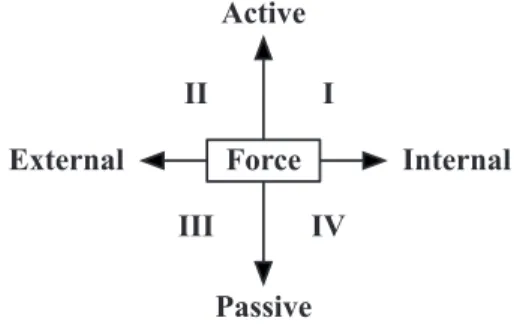
What we realize from this analysis of how the four force metaphors emerged is that we can separate physicists’ lan-guage about force along two orthogonal dimensions with each of the four metaphors falling into one of four quadrants
共see Fig. 2 and Table I兲. The two dimensions are 共1兲 the location of the force 关either internal or external to the ob-ject共s兲 concerned兴 and共2兲 the roleof the force as either an activeobject or a passive object. The location of the force can be identified by a metaphorical analysis, considering the presence of prepositions such as “in” and “of” 共container metaphor= internal兲 or “on” and “to” 共surface metaphor = external兲, while therole of the force is identified by how the force functions grammatically in a sentence 共active or passiveparticipant兲. A summary with examples is shown in TableI.
2. Refining ontological categories
One final key point needs to be made about this analysis of the historical development of force concepts and the
cor-Force Active
Passive
External Internal I
II
III IV
responding development of language used to describe the concept of force. To make this point we must make the dis-tinction between the definition of a physical quantity such as accelerationaជ=dvជ/dtand a causal relation that relates physi-cal quantities to each other.70An example of a causal relation would be Newton’s second law that relates the physical quantities of acceleration and mass into a causal relation:aជ =Fជnet/m. In the historical record that we have presented, bothF=mvandF=mv2 were written down共often in words
rather than symbolically; hereFstands forvim motricemor quantitate motusandvis viva, respectively兲; however there is no indication that F=mv and F=mv2 were written as a
causal relations. All the evidence共apart from Buridan him-self兲 presented above shows that physicists were trying to write down the definition of a physical quantity or property of motion. Clagett79 agreed with our interpretation. In an extensive historical analysis of mechanics in the middle ages, he concluded that impetus underwent an ontological shift from a cause of motion to an effect of motion sometime between the late 16th century and early 17th century共around the time of Galileo兲. In our model 共Fig.2兲, this is a move-ment from quadrant I to quadrant IV.
Taking a broad overview of history, we observe the con-cept of force moving from causing motion to an effect of motion or a quantity of motion. We see new concepts of force being introduced共vis impressa兲when a new distinction needed to be made. It is only rather recently in the history of physics that the concepts of kinetic energy and momentum were separated out from the “force” category and been given their own distinct names rather than being referred to as types of force.
We suggest that our analysis has uncovered a prototypical example of a central cognitive activity in physics that has not had sufficient attention paid to it in the research literature. Historically we see physicists engaged in trying to define and refine the meaning and ontological status of the term “force” in their descriptions of motion and its causes. We term this activity “ontological disambiguation.”
IV. STUDENTS’ DIFFICULTIES WITH FORCE AND MOTION: AN EXAMPLE OF ONTOLOGICAL
DISAMBIGUATION
This historical analysis may inform us about how our stu-dents are thinking about force and motion. Traditionally edu-cation researchers have taken students’ reasoning about force and rewritten it as a causal relationship either as Fs=␣v, whereFsdenotes the “supply of force” and␣is a constant of proportionality,46 or as F
net=mv.80 They then proceed to
show that this relationship leads to incorrect predictions about the motion of objects.80We wish to propose an alter-native view. In Table II we have placed, side by side, the words of students and the words of some of the famous play-ers in the development of mechanics.
The remarkable similarity共between students and the his-torical figures兲of the statements compared in TableIIwas a pivotal moment in our research process. Appreciating what Newton and Leibniz were struggling with prompted us to begin to question whether we had fully understood what our students were struggling with when they made such state-ments. We suggest that some students are engaged in an analogous act of ontological disambiguation. We will use “ontological disambiguation” to mean any struggle to define and ontologically categorize the meanings of physical terms including their context-dependent role describing a physical theory. We wish to hypothesize the following.
A. Hypothesis 1
Many students who appear to have the force and motion difficulty are well aware that motion continues undiminished
共without any internal or external intervention to sustain the motion兲 when all external resistance is removed. In their doctoral dissertations, Driver,8 Tasar,82 and Yuruk83 all pre-sented examples of this from student interviews. Elby21 noted this point anecdotally. Anecdotally, we too have both observed this apparent conflict in our students. We suggest that many students do not believe that a force is needed to sustain constant speed motion. As we showed in Sec.I, re-TABLE I. Summary of the four metaphors and examples of historical and modern usage in language.
Quadrant I II III IV
Metaphor Force is an internal desire or drive.
Force is an agent. Force is a passive medium of interaction.
Force is a
property of an object.
Historical examples Kepler: “Gravity is a mutual affection among related bodies
which tends to
unite and conjoin them.”
Da Vinci: “Force I define as
an incorporeal agency, an invisible power….”
Newton: “An impressed force is an action exerted upon a body….”
Leibniz: “…two soft or unelastic bodies meeting together,
lose some of their force….”
Modern language examples
The moon is attracted to the Earth.
A force causes an object to accelerate. A force acts on an object.
Object A exerts or applies a force on or to object B.
The tension in the rope. The weight of an object.
searchers have observed that students see force as an “innate property” of an object. We are suggesting that many students have a notion of impetus as aneffect orproperty of motion rather than a cause of motion. Thus students’ reasoning is perfectly consistent with a Newtonian conception when they suggest that there is a force in the direction of motion if we understand that they are talking about a force of motion共i.e., momentum or energy兲 rather than an impetus necessary to sustain motion.
B. Hypothesis 2
The historical analysis presented above is a typical ex-ample of ontological disambiguation and should serve as a model for the same struggle that our students are having. Some students may neither possess a model in which a force is needed to sustain a constant rate motion nor be applying a “force as mover” p-prim in certain contexts. These students may simply be struggling to disambiguate cause and effect relationships, struggling to decide what to call a “force” and struggling to understand when共if ever兲 it is appropriate to talk about force as a cause of motion or an effect of motion. Both the stubbornness and the context dependence of the force and motion difficulty are accounted for by the ontologi-cal disambiguation view.
V. STUDENTS’ DIFFICULTIES WITH FORCE AND MOTION: A NEW LOOK AT OLD DATA
A. Introduction
We will test hypothesis 1 against a large body of interview data that has been published over the last 30 years. Students’
difficulties with force and motion are probably one of the most studied student difficulties in science education. Tradi-tionally researchers have interpreted students’ reasoning as indicating a belief that a constant force is required to sustain constant rate motion.
If our idea that students see force as a property of motion rather than a property of the object necessary to sustain mo-tion is correct and we assume that a metaphorical or gram-matical analysis of their language can reveal what they are really thinking, we predict that if we analyze students’ rea-soning about force and motion, most will fall into quadrant IV of Fig.2rather than quadrant I. If students are recruiting Buridanian ideas, then they will fall into quadrant I. If stu-dents are recruiting Aristotelian ideas, their reasoning should fall into either quadrant II or III. 共Aristotle’s idea of forced motion required an external agent to sustain motion, e.g., the air behind the flying arrow.兲
B. Method
There are many papers published those document stu-dents’ difficulties and present examples of “typical” student responses in interviews. In this study we followed the fol-lowing methodology. We gathered as many research papers as we could find on students’ difficulties with force and mo-tion. We used two methods of search. The first was a re-search database re-search in ERIC and google scholar. The sec-ond was to use physics education research resource letters such as that in Ref.84. We narrowed our sample to 12 papers or books that contained codable transcripts of student reason-ing about force and motion.2,3,6,8,14,16,46,47,81,85–87Most impor-TABLE II. Comparison between inventors of mechanics and modern students.
Student Physicist
“A force of inertia,” “the power also has a force.”a “Thevis insitaor innate force of matter is a power of resisting…”共Newton兲b“…thisvis insitamay,
by a most significant name, be calledvis inertiae or force of关inertia兴.”共Newton兲c
“I mean the weight of the ball times the speed of the ball…. Momentum is…a force that has been exerted and put into the ball so this ball now that it’s traveling has a certain amount of force….”d
“Bodies of equal weights and moved with equal velocities have equal forces….”共Galileo兲b
“…a combination of the velocity and the mass of an object. It’s something that carries it along after a force on it has stopped…. Let’s call it the force of motion….”d
“…mathematicians…estimate the motive force by the quantity of motion or by the product of the mass of the body into its velocity.”共Leibniz兲c
“I understand that关friction and air resistance兴 adversely affect the speed of the ball…they sort of absorb some of the force that’s in the ball….”d
关Talking about a pendulum兴“…a body falling from a certain height acquires a force sufficient to return it to the same height…unless the resistance of the air and other slight obstacles absorb some of its strength….”共Leibniz兲c
aReference2. bReference69. cReference74. dReference81.
tantly we only chose examples where students were claimed
共by the researchers兲 to have the standard force and motion difficulty, namely, that a constant force was necessary to sus-tain constant rate motion.
We coded students’ explanations of their reasoning into one of the four quadrants of Fig. 2 using the methods we have already developed.
1. Role
Theroleof the force was coded as follows: the force was coded active 共causing or sustaining兲 the motion when the following occur:
共1兲Force functioned as an active grammaticalparticipant. For example: “theforceis keeping the object moving,” “the powermakes it go,” “theforceis moving it on,” “theenergy produces action,” or “theforceacts….”
共2兲Any obvious suggestion that the force was necessary for the object to move, that motion was a result or conse-quence of a force. For example, “ifthere is no force thenit cannot not move”; “the force is zerothereforeit stops.” The presence of words such as “if, then, therefore, because,” etc., are the essential cues.
The force was codedpassive共an effect, property, or result of motion兲when the following occur:
共1兲Force functioned as a passive grammaticalparticipant. For example, “the force in the object dies out,” “the car’s forceswitches direction,” “the powerhas stopped…,” “fric-tion absorbs theforce in the ball,” and “the object loses or expends someforceas it plows through the air.”
共2兲Force was spoken about as a result or consequence of motion. For example, “the object is no longer movingsothe force is zero,” “the velocity is constantso the force is con-stant,” and “there is no force because the object has stopped.”
If the role of “force” was unclear or ambiguous, we coded it “ambiguous.” There are two possible cases:
共1兲 Functional grammarians Halliday and Martin76 sug-gested that structures such as “as the force decreases and the car slows” denote two concurrent events. The cause-effect relationship is ambiguous. There is no “if-then” structure or conjunction such as “so” that denotes one resulting from the other. Such cases were coded ambiguous because of insuffi-cient evidence of the role of the force in relation to the ac-companying process.
共2兲 Students sometimes used a confusing mix of active andpassivein the same paragraph.
2. Location
The location of the force was coded as follows: clear evidence that the force wasinsidethe object or aproperty of the object was coded as “internal.” Clear evidence that the force was external to the objects, being passed around in some way, was coded “external.” Cases where the location of the force could not be reliably identified were coded “am-biguous.”
C. Results
Out of 49 student explanations gathered from 12 different studies, spanning 34 years, theroleof the term “force” was
coded as follows: 33% of explanations were coded active, 47% of explanations were codedpassive, and 20% were am-biguous. Out of the same 49 explanations, location was coded as follows: 6% coded “external,” 27% coded “inter-nal,” and 67% of the statements left thelocationof the “mo-tion force” ambiguous. Inter-rater agreement was 100% after discussion.
D. Discussion
The key finding from coding the transcripts is that a ma-jority of students共47%兲showed a conception of the “motion force” as a passive participant in the events rather than an active mover. Indeed, some students may be activating a model in which a “motion force” is needed to sustain a con-stant rate motion in the given circumstances, however the majority of students do not display such reasoning in the examples we studied. This result supports our hypothesis that many students, similar to the historical physicists, are con-ceiving of force as a property of motion rather than an im-petus that is necessary to sustain motion.
VI. CASE STUDIES
We will consider two case studies drawn from two differ-ent Ph.D. dissertations. Through an examination of these case studies, we will show how reinterpreting students’ dif-ficulties with force and motion as a problem of ontological disambiguation 共hypothesis 2兲 helps us to understand their reasoning better. In both these cases, students appear to be interacting with each other and with the researcher in an environment that seems to promote open discussion, sense making, and ontological disambiguation.
A. Case study 1
We will use this case study to show that a student’s seem-ingly incomprehensible reasoning is, in fact, quite reasonable if we recognize the student’s difficulty as one of ontological disambiguation rather than a fundamental misconception or as a misapplication of a context-dependent p-prim.
Tasar82 recounted an example of a discussion with a stu-dent concerning the force and motion misconception. “F.T.” is the author and “June” is the student.
The interviewer asks June what motion would be like in a frictionless environment:
FT: If there wasn’t friction how do you get things move? June: You just have to like initiate motion and then it just continues.
FT: You still need a force?
June: Yeah. I think so I mean it’s not just gonna move on its own, you have to start it. Something it has to act on the mass to make it move.
FT: and if there is no friction what will be the speed of that object?
June: It is gonna be constant.82
Note that June never mentions the word force. She clearly understands that an agent is needed to initiate the motion of an object. She also seems to think that the object will keep moving at a constant speed without external or internal
in-tervention. Her understanding appears to be qualitatively Newtonian. This interpretation is further corroborated by her comments below.
The interviewer gives a concrete example of pushing a chair on ice, considering that ice is close to a frictionless surface:
FT:…and what would be the subsequent motion after I take my hands off it?
June: I think, if there is no friction it is just gonna keep going.82
June appears to understand that once you stop pushing the object it simply keeps going at a constant speed. The inter-viewer has clarified that her hands are no longer touching the chair so it is clear that June believes nothing is needed to keep the chair going. Minutes later the interviewer rephrases the question about an object on a frictionless surface to June: FT: Okay. If there is no force, what would be the speed? If there is no force, that means?
June: It is gonna stop?82
Based on June’s final response, Tasar suggests that June has gone back to the “motion implies force” misconception. diSessa and others pointed out that such examples are evi-dence for the locality and contextual depenevi-dence of students’ knowledge and reasoning in physics.19,21
We wish to propose a different interpretation of the tran-script quoted above. Until the final excerpt, June appears to understand that another object needs to interact with the ob-ject of interest to “initiate共the兲motion” of that object. Once that interaction has ceased, motion continues unabated. It appears that only once the interviewer invokes the term “force” that June appears non-Newtonian in her reasoning. However, according to our hypothesis, if June believes that the word “force” refers to a property of an object’s motion
共roughly synonymous with momentum兲 then June’s re-sponses are totally consistent. If an object has no momentum, which means it is not moving. Hence June’s final uncertain response: “It is gonna stop?” It may be plausible that a stu-dent can reason inconsistently from 1 min to the next without being aware of it. However, another plausible explanation is that June believes that her two answers are consistent. Our linguistic interpretation of the force and motion difficulty provides the key to this consistency. June is confused be-tween the dual ontological statuses of force as an interaction between two objects共Newton’svis impressa兲versus force as a property of motion 共Newton’s vis inertiae兲. Or rather she has not made this distinction clear in her understanding. Our interpretation is that June has no misconception at all. She only has a difficulty understanding the specialized meaning of “force” as physicists use it. The context dependence of her responses reflects the necessary process of ontological dis-ambiguation and refinement
B. Case study 2
In her dissertation, Yuruk83presented interview transcripts and journal entries from a group of students who were re-quired engage in activities such as “poster drawing, journal writing, group debate, concept mapping, and class and group discussions.” The activities of her experimental group were
aimed at getting students to engage “metaconceptual knowl-edge and processes.” It was hypothesized that by being aware of their past beliefs, monitoring their understanding, and evaluating the plausibility and usefulness of their con-ceptions, they would learn physics better and develop a deeper understanding than a control group that did not en-gage in such metacognitive or monitoring activities. Apart from the initial poster activity described below, students did not appear to have been explicitly asked to analyze their language about force.
We will trace the progress of one of Yuruk’s subjects
共Lisa兲. Initially Yuruk diagnosed Lisa as having the force and motion misconception although it appears to us 共from the transcripts that Yuruk presents兲 that Lisa is qualitatively Newtonian in her understanding. She is aware that an object on a frictionless surface keeps moving at a constant rate without outside or internal intervention. 共Rather similar to the case of June shown above.兲
At some point near the start of the intervention, students were required to make a poster about their understanding of the term “force.” Lisa described her understanding of the meaning of force as “like energy being applied to an object.”83
As Lisa’s understanding of Newton’s laws developed, she reflected in a journal entry: “The main difference in my ini-tial and current ideas is the idea that inertia is a force. I said that there was a force if the object was moving even the applied force was long gone.”83Note that she does not sug-gest that this inertia is making the object move.
In another journal entry, Lisa reflected:
I said a force is motion and therefore an object after being pushed still has my definition of force.If you define force as an interaction my statement is wrong. It’s all a word game. What I thought of as included in my definition of force, Newton called inertia. Newton’s definitions and laws better explain motion.It divides my definition of force into different groups based on what happens to the objects 关our emphasis兴.83
Note how Lisa’s distinction between inertia and force is identical to Newton’s definitional distinction betweenvis in-ertiae and vis impressa.74 Lisa’s trajectory toward under-standing provides clear evidence that language and ontologi-cal categorization are at the heart of her learning about force and motion. From the transcripts of Lisa’s discussions and her journal entries, we see that her learning about force is best described as an act of ontological disambiguation rather similar the though processes of the physicists analyzed in the section above. Other students in Lisa’s experimental group presented similar reflections that suggest that ontological dis-ambiguation of language was playing a big part in the devel-opment of their understanding.
C. Discussion
We have presented examples of two already published case studies of students struggling with the ideas of force and motion. Our hypothesis is that some students are having dif-ficulty understanding the ontological status of the force con-cept in physics. More specifically, they are struggling to
dis-ambiguate limitations and applicability of force and/or other objects as causes of changing motion of a particular object from force as an effect or property of motion in much the same way as physicists did in the historical development of force and motion concepts. The two examples we have pre-sented support our hypothesis and show how students’ rea-soning may be understood better through the lens of onto-logical disambiguation. Students’ difficulties and the apparent context dependence of their reasoning are both ex-plained by the ontological disambiguation hypothesis.
VII. DISCUSSION AND IMPLICATIONS
The evidence we have presented supports our hypotheses that 共1兲students view force as a property of motion rather than a “sustainer” of motion and 共2兲 learning about force involves an act of ontological disambiguation where students have to refine their understanding of what the term “force” means in physics.
Our linguistic analysis has provided us with deeper in-sights into how students reason about force and motion. If grammar and metaphor correctly reveal what students are thinking, then only a minority of students appear to have a Buridanian impetus model of force and motion, while the majority of students have a conception of force as a property of motion, similar to the understanding of Galileo, Newton, Leibniz, and others. We believe that our students might come into their physics course with a qualitative view of motion similar to that of Newton and others but have not yet made the ontological distinction in language between properties of motion共such as inertia, momentum, and energy兲, referred to as “force” and Newton’s vis impressa or impressed force. Much of what we have found students to be struggling with may fit well with the “coordination” model of conceptual development.88
Understanding our students better
We suggest that in many cases, when a student puts in the “force that my hand gave it” into the free body diagram for a projectile, he or she is asking the instructor the following: “What should I call ‘force’? Is it a property of the object’s motion or an interaction? Does it quantify something about the interaction between two objects or does it quantify a property of the object?” And then under the category of properties, “does it quantify someactivityof the object共what we would call, with hindsight kinetic energy兲 or does it quantify a property of the motion?共What we now term mo-mentum.兲” From this metaphorical point of view, students’ confusion is hardly a misconception, but an analogous struggle to refine and define terms, to build on their
experi-ence and refine their every day language in the context of learning physics. From the historical point of view, the dif-ficulty of this struggle cannot be underestimated and may go a long way to explaining the stubbornness of these “miscon-ceptions.” After all, if we as teachers are not answering the real question students are asking, how can we expect our students to figure it out? In summary, part of student learning is an act of negotiation of meaning between the instructor and the student.
In this paper we have shown that the combination of grammar, ontology, and metaphor can reveal underlying pat-terns of consistency in physicists’ language. This linguistic framework can also explain why students struggle so much with certain ideas and why many so called “misconceptions” are so “resistant to instruction.” In summary, physicists’ lan-guage indicates that they categorize the concept of “force” into different ontological categories, depending on context. In the case of ontological disambiguation, we, the teachers, may simply be failing to hear the questions our students are asking. Namely, students need help sorting out the different ways in which the concept of force is categorized ontologi-cally rather than help being disabused of certain mistaken ideas they might have.
We can make no claim that this approach accounts for all student difficulties or even accounts for all instances of a particular difficulty. It is quite possible that some fraction of students who ask “should I include the force my hand gave it?” are asking an ontological question, as we suggest, while another fraction of students have an impetus model in which force is necessary to sustain motion. But we want to suggest that this approach opens up a whole new dimension of un-derstanding of what our students are thinking. In many cases it can help us recognize and answer students’ questions in a different and possibly more appropriate way. In many cases our framework can help us account for much of both the inherent stability of students’ responses to a given situation and the contextual dependence of their reasoning and appar-ently fragmentary nature of their ideas. If learning physics involves learning torepresentphysics, then learning physics must involve a refinement of terminology and cases in lan-guage. And part of the teacher’s role in the classroom must be to support that learning process—something that we, as teachers, are often unaware of.
ACKNOWLEDGMENTS
We would like to thank Yuhfen Lin for her help in search-ing through the extensive literature on students’ difficulties with force and motion and three anonymous reviewers whose insightful comments strengthened and streamlined this paper.
1J. K. Gilbert and D. M. Watts, Concepts, misconceptions and
alternative conceptions: Changing perspectives in science edu-cation, Stud. Sci. Educ. 10, 61共1983兲.
2I. A. Halloun and D. Hestenes, Common sense concepts and
mo-tion, Am. J. Phys. 53, 1056共1985兲.
3M. McCloskey and R. Kargon, inOntogeny, Phylogeny, and
His-torical Development, edited by S. Strauss共Ablex, Norwood, NJ, 1988兲, pp. 49–67.
4L. C. McDermott, Research on conceptual understanding in
me-chanics, Phys. Today 37共7兲, 24共1984兲.
5P. T. Mildenhall and J. S. Williams, Instability in students’ use of
intuitive and Newtonian models to predict motion: the critical effect of the parameters involved, Int. J. Sci. Educ. 23, 643 共2001兲.
6D. H. Palmer, The effect of context on students’ reasoning about
forces, Int. J. Sci. Educ. 19, 681共1997兲.
7N. Sadanand and J. Kess, Concepts in force and motion, Phys.
Teach. 28, 530共1990兲.
8R. P. Driver, Ph.D. thesis, University of Illinois at Urbana–
Champaign, 1973.
9M. McCloskey, A. Caramazza, and B. Green, Curvilinear motion
in the absence of external forces: Naïve beliefs about the motion of objects, Science 210, 1139共1980兲.
10M. McCloskey, Intuitive physics, Sci. Am. 248, 122共1983兲. 11G. J. Posner, K. A. Strike, P. W. Hewson, and W. A. Gertzog,
Accommodation of a scientific conception: Toward a theory of conceptual change, Sci. Educ. 66, 211共1982兲.
12A. Caramazza, M. McCloskey, and B. Green, Naïve beliefs in
⬘⬘sophisticated’’ subjects: Misconceptions about trajectories of objects, Cognition 9, 117共1981兲.
13A. B. Champagne, L. E. Klopfer, and J. H. Anderson, Factors
influencing the learning of classical mechanics, Am. J. Phys.48, 1074共1980兲.
14J. Clement, Students’ preconceptions in introductory mechanics,
Am. J. Phys. 50, 66共1982兲.
15N. J. Nersessian and L. B. Resnick, inProceedings of the
Cogni-tive Science Society共Lawrence Erlbaum, Hillsdale, NJ, 1989兲, Vol. 11, pp. 412–420.
16R. Osborne and P. Freyberg, Learning in Science: The
Implica-tions of Children’s Science共Heinemann, London, 1985兲.
17B. Shanon, Aristotelianism, Newtonianism and the physics of the
layman, Perception 5, 241共1976兲.
18M. S. Steinberg, D. E. Brown, and J. Clement, Genius is not
immune to persistent misconceptions: Conceptual difficulties impeding Isaac Newton and contemporary physics students, Int. J. Sci. Educ. 12, 265共1990兲.
19A. A. diSessa, Toward an epistemology of physics, Cogn.
In-struct. 10, 105共1993兲.
20A. A. diSessa, N. M. Gillespie, and J. B. Esterly, Coherence
ver-sus fragmentation in the development of the concept of force, Cogn. Sci. 28, 843共2004兲.
21A. Elby, What students’ learning of representations tells us about
constructivism, J. Math. Behav. 19, 481共2000兲.
22M. Finegold and P. Gorsky, Students’ concepts of force as applied
to related physical systems: A search for consistency, Int. J. Sci. Educ. 13, 97共1991兲.
23D. Hammer and A. Elby, inPersonal Epistemology: The
Psychol-ogy of Beliefs about Knowledge and Knowing, edited by B. K. Hofer and P. R. Pintrich 共Erlbaum, Mahwah, NJ, 2002兲, pp. 169–190.
24D. Huffman and P. Heller, What does the force concept inventory
actually measure?, Phys. Teach. 33, 138共1995兲.
25J. Minstrell, inResearch in Physics Learning: Theoretical Issues
and Empirical Studies–Proceedings of an International Work-shop in Bremen, Germany, edited by R. Duit, F. Goldberg, and H. Niedderer共IPN, Kiel, 1992兲, pp. 110–128.
26R. N. Steinberg and M. S. Sabella, Performance on
multiple-choice diagnostics and complementary exam problems, Phys. Teach. 35, 150共1997兲.
27D. Hammer, in The Proceedings of the Enrico Fermi Summer
School in Physics, Course CLVI, edited by E. Redish, C. Tarsi-tani, and M. Vicentini共Italian Physical Society, 2004兲.
28D. Hammer, A. Elby, R. E. Scherr, and E. F. Redish, inTransfer
of Learning from a Modern Multidisciplinary Perspective, ed-ited by J. P. Mestre 共Information Age, Greenwich, CT, 2005兲, Chap. 3, pp. 89–119.
29J. Bliss and J. Ogborn, Force and motion from the beginning,
Learn. Instr. 4, 7共1994兲.
30A. Eryilmaz, Effects of conceptual assignments and conceptual
change discussions on students’ misconceptions and achieve-ment regarding force and motion, J. Res. Sci. Teach. 39, 1001 共2002兲.
31I. A. Halloun and D. Hestenes, The initial knowledge state of
college physics students, Am. J. Phys. 53, 1043共1985兲.
32L. Leboutet-Barrell, Concepts of mechanics among young people,
Phys. Educ. 11, 462共1976兲.
33M. Sequeira and L. Leite, Alternative conceptions and history of
science in physics teacher education, Sci. Educ. 75, 45共1991兲.
34J. L. Lemke, presentation given at a conference in Barcelona,
2004 共http://www-personal.umich.edu/jaylemke/papers/ barcelon.htm兲.
35M. J. Reddy, in Metaphor and Thought, 2nd ed., edited by A.
Ortony 共Cambridge University Press, Cambridge, 1993兲, pp. 164–201.
36A. Sfard, When the rules of discourse change, but nobody tells
you: Making sense of mathematics learning from a commogni-tive standpoint, J. Learn. Sci. 16, 565共2007兲.
37J. L. Lemke, Talking Science: Language, Learning, and Values
共Ablex, Norwood, NJ, 1990兲.
38E. Sapir, inCulture, Language and Personality, edited by D. B.
Mandelbaum共University of California Press, Berkeley, Los An-geles, 1957兲, pp. 65–77.
39B. L. Whorf, inLanguage, Thought, and Reality: Selected
Writ-ings of Benjamin Lee Whorf, edited by J. B. Carroll共MIT, Cam-bridge, MA, 1956兲, pp. 134–159.
40B. L. Whorf, inLanguage, Thought, and Reality: Selected
Writ-ings of Benjamin Lee Whorf, edited by J. B. Carroll共MIT, Cam-bridge, MA, 1956兲, pp. 207–219.
41D. J. Grayson, Concept substitution: An instructional strategy for
promoting conceptual change, Res. Sci. Educ. 24, 102共1994兲.
42I. Galili and V. Bar, Motion implies force: Where to expect
ves-tiges of the misconception?, Int. J. Sci. Educ. 14, 63共1992兲.
43J. B. Gerhart, Physics students: ⬘a mirror for physics history’,
AAPT Announcer 19, 54共1989兲.
44C. Ioannides and S. Vosniadou, The changing meanings of force,
Cognit. Sci. Q. 2, 5共2002兲.
45D. G. Schuster, inProceedings of the International Seminar on
Misconceptions in Science and Mathematics, edited by H. Helm and J. D. Novak 共Cornell University, Ithaca, NY, 1983兲, pp. 253–257.