Recovering What
Makes Planning
Relevant
Emil Malizia
Background
In the late nineteenth and early twentieth centuries when city and regional planning became a profession, planners did important work in the realms of public health,
fire safety, natural resource conservation, civic and social reform, city efficiency, housing improvements, and city beautification. The founders espoused many bold plans to
shape the future of cities. These long-range plans were to be both comprehensive and serve the public interest.
Now, planners rarely participate in the dialogue about how cities should be planned and designed. We ceded this ground to architects, geographers, sociologists, urban economists, real estate developers, attorneys, environmentalists, journalists, and others. We are conspicuous by our absence. We seem comfortable generating land use plans for local jurisdictions even though we know that integrated land use and transportation planning is needed at the regional scale. We abandoned health and safety in favor of public welfare. As a result, we embrace weak goals like “livability” and vague slogans like “making great communities happen” instead of addressing public interest dimensions of fundamental importance.
evidence-based ideas about how to plan places and spaces in the visioning exercises we lead.
The American Planning Association’s leadership
recognizes these problems and is trying to elevate the
importance of the planning enterprise on many fronts. APA seeks to increase the status of the planning profession,
assist planners in the trenches, find more effective ways
to serve the public interest, and win stronger public and political support for planning. To accomplish these important objectives requires a better understanding of
how the planning field became narrow and what can be
done to increase its relevance.
Viewpoints on Regaining Relevancy
Emil Malizia
Lawrence Susskind
Alexander Garvin
Nancy Grden
In this piece, four planners from a diversity of backgrounds provide their views on the role and future of the
planning profession. At times provocative and critical of the profession, these contributions are meant to
encourage and provoke further conversation surrounding the purpose of our profession and the changes we
need to make.
Emil Malizia, FAICP, is Professor and outgoing Chair of the Department of City and Regional Planning at UNC-CH. His
expertise is in the related fields of real estate development,
economic development and urban redevelopment.
Lawrence Susskind is the Ford Professor of Urban and
Environmental Planning at MIT and Chief Knowledge Officer at
the Consensus Building Institute.
Alexander Garvin combines a career in urban planning and real estate with teaching, architecture, and public service. He is President and CEO of AGA Public Realm Strategists and Adjunct Professor of Urban Planning and Management at Yale University, where he has taught for 45 years.
Nancy L. Grden is General Manager for Genomind, a personalized medicine company for neuropsychiatry. With
Carolina Planning Volume 37
From Substance to Process
The critical period was the 1960s
and early 1970s. Before that time, city and regional planning was primarily physical planning that guided land use and coordinated infrastructure investments. The public interest was served by accommodating and mitigating the impacts of urban growth. The newly established Department of Housing and Urban Development provided funding for local comprehensive planning, whereas other federal agencies required local planning to access various domestic assistance programs.
Three movements had profound impacts during this period, and planners changed their approach to practice in response. The war movement engendered an anti-establishment mindset that questioned top-down notions
of what was best. The civil rights movement emphasized
local self-determination and the importance of democratic participation at the grass roots level. The environmental movement revealed the destructive impacts of economic growth and urban development. In addition, the urban riots demonstrated the failure of urban renewal to address the real problems of the urban poor.
As part of “the establishment,” city planning came
under fire during the 1960s and 1970s for “top-down” planning. Jane Jacobs became the most famous critic exposing the flaws of planning thought and action during
that period. Planners were associated with modernist architecture, especially for public housing projects, that imparted the negative image of density that plagues us to this day. Planners were trapped by physical determinism that helped justify super blocks, super highways, and the use of urban renewal to destroy viable neighborhoods. Finally, physical planning seemed inadequate and less
salient than the emerging fields of environmental planning,
social policy planning, and community and economic development.
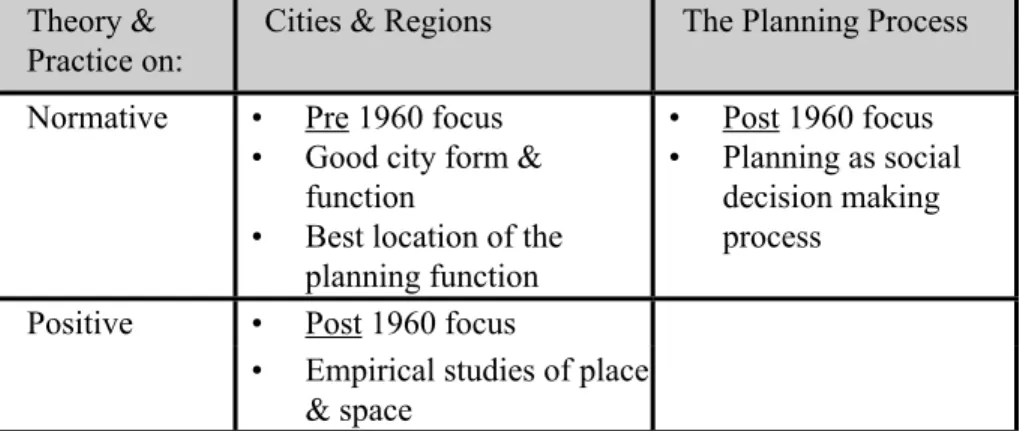
Until that time, the theory of planning primarily consisted of normative ideas about cities and regions. With the ascendance of the Chicago School, planning theory was linked to the social decision-making process. The normative issue became good planning process, not good urban form, and planners were tasked with participating in that process. Process theory evolved from rational
decision making to satisficing, incrementalism, advocacy,
and other more recent strands. Process theory has had positive impacts on practice that should not be ignored. Planners now listen to the public and work hard to turn
vague and conflicting ideas into consensus visions of the
future. Planners are now suspicious of designs for the built environment that have no connection to the day-to day behavior of urban residents. Planners often function as
fair arbiters when urban growth and development conflicts
with conservation and preservation of resources.
However, this shift to process imposed significant
costs. As noted, planners are seldom part of debates about the “good city.” We learned much about the spatial behavior
of households, firms and local institutions, but we have not
found consistent and effective ways to use this knowledge of the city to inform normative views (see Table 1).
Furthermore, participatory planning has weaknesses that cannot be easily overcome. No participatory process can truly represent the existing community. Any input or feedback planners receive is biased by class, age, race, and education, among other factors. Although a strident minority can have its way or an overpowering majority can ignore minority interests without consequence, the more serious problem is representing future members of the community who will be affected by planning. Which existing stakeholder can represent the interests of future in-migrants or unborn children?
Recovering Relevance
Normative theory about cities and regions is needed to help us become more rational about our ends—means
rationality is not sufficient. With substantive/ends
rationality trumping process and procedural rationality,
planning could become wiser as well as more efficient. We
need to use behavioral theory and empirical evidence based on that theory to do more than point out the unintended consequences of public intervention. We should use what we know to forecast potential outcomes.
Our knowledge base about economic, social, and environmental forces is far from complete. Still imperfect knowledge of existing and future behavior can provide useful ideas about the way cities should be planned and designed. Planners can re-enter the debate about the good city with facts that may be more compelling than the untested opinions that abound. Planners could apply
this knowledge to find what works in specific geographic
contexts to test new forms of practice.
We can become more relevant by redefining planning in terms of three basic tenets. First, we need to define
the public interest as achieving public health and safety. Physical and economic security is deemed very important Theory &
Practice on: Cities & Regions The Planning Process Normative • Pre 1960 focus
• Good city form & function
• Best location of the planning function
• Post 1960 focus • Planning as social
decision making process
Positive • Post 1960 focus
• Empirical studies of place & space
move from neighborhood to city to region without having jurisdictional constraints become binding.
Planners and Planning
Trying to Find Their
Way in the World
Lawrence Susskind
If you were lost in the woods, what would you do?
You would try to find your way out, of course. You would need to get your bearings, figure out where you were
headed, and navigate appropriately given the terrain in which you were trapped. Some of my planning colleagues at the University of North Carolina appear to be lost. Moreover, they think the whole profession has lost its way – lost its professional identity, given up whatever authority it once had, and misplaced its vision of the future.
Let’s look more closely at how and why the North Carolina folks are feeling so disoriented. They seem to have awakened from a dream in which planners had the authority to tell everybody what to do, the power to impose their will on anyone who didn’t agree with them and a monopoly on good ideas. Ah, now I see the problem. They were dreaming about a place and time that never existed. So, of course, they are feeling out of sorts now that they have opened their eyes.
The primary reason that planning and planners exist in the 21st century is because markets of all kinds inevitably fail. As any student of economics knows, markets and free enterprise, when left unchecked, create monopolies. Those who control capital gobble up smaller companies in a never-ending quest to increase their return to capital. And, that’s what is happening in our political economy. In addition, we know that markets generate externalities, especially as free riders try to take whatever advantage they can. And, we know that free enterprise underinvests in or entirely ignores the need to maintain and provide public goods. Furthermore, unfettered markets do not provide opportunities for people without
sufficient resources – intellectual or financial capital – to
get into the game. Markets have no inclination to correct these asymmetries. Only government or civil society (or the two working together) can provide the regulatory oversight needed to constrain monopolies and police free riding (thereby guaranteeing the public the freedom of choice it wants). Only government and civil society
working together can ensure sufficient investment in and management of common pool resources. And, finally, only
democratically-elected governments can guarantee basic by the community, and public health is broad enough
to encompass all areas of planning from the physical to
the economic/financial.1 Identifying public health and
safety as primary goals would provide a sound basis for defending ideas about sustainability, smart growth, transit-oriented development, and the like. The profession would join others addressing life-and-death issues and enjoy the positive recognition that would follow.
The other two basic tenets suggest the means by which we should pursue health and safety goals. Following Mumford’s admonishment to see things whole, planning should become more comprehensive. APA’s current effort to re-think the comprehensive plan in light of global environmental challenges underscores this tenet (PAS
Report Number 567). Comprehensive planning needs to
be more inclusive to remain relevant, but comp plans will not succeed if they remain jurisdiction bound. Planning must expand its geographic scope to the regional scale to become truly comprehensive.2
Third, planners need to extend the planning horizon significantly to address health and safety goals effectively. Planning for time horizons beyond 20 or 30 years should
become the norm. Planners have the expertise to blend forecasts, behavioral and technical knowledge, and
alternative designs to define the planning agenda. With
control of the agenda, planners will gain considerable authority. The point is not to reestablish top-down planning with no public input. Rather, the intent is to channel public participation into evidence-based debate that would render the input far more useful.
Beyond these three tenets, planners need to do more than formulate better long-term comprehensive plans. Using government powers to regulate, tax and spend, we need to implement plans. The acid test of professional relevance will rest on our ability to take meaningful actions that make communities healthier and safer places by changing the regional landscape for the better in the years ahead.
Endnotes
1 In the 19th and early 20th centuries, the emerging
planning profession was trying to reform cities that were disease-ridden and dangerous places. Planners helped improve public health and safety by reducing the incidence
of the infectious diseases inflicting urban dwellers with
sanitary and storm sewers, paved streets, safe drinking water, better housing, public parks and open space,
public transportation, zoning, subdivision regulations,
Carolina Planning Volume 37
pointed out policies, programs and projects that can ensure
greater fairness while enabling groups with conflicting
priorities a out these to reconcile their differences?; (4) Have we suggested ways in which new technologies, new institutional arrangements and changes in public policy
can help communities come closer to realizing their goals?;
(5) Have we successfully implemented what stakeholders
and officials were trying to accomplish?
In their new book, Practical Wisdom, Barry Schwartz
and Ken Thorpe, point out that rules and incentives won’t
be sufficient to achieve these goals. To get better results, anyone providing professional services must figure out
what the right reasons are for doing the right things in each situation. Aristotle called knowing the right thing to do
in a specific situation, “practical wisdom”. He dubbed it
the highest virtue. In training professional planners we
need to help them figure out the right things to do for the
right reasons. And, while moral judgments are always open to interpretation, it is our job to press students to be explicit about their ethical obligations and not just their
technical responsibilities. As Schwartz and Thorpe point
out, professionals engaged in every-day efforts to promote social, political and environmental improvements will have much happier lives if they can explain who they are trying to help and why.
I don’t think planners are lost. I don’t think they have gone astray. They just need to be reminded what they are trying to achieve and why. We are training implementation specialists committed to helping government and civil society improve the quality of life, particularly for those least able to fend for themselves, in the face of the inevitable failures of markets and free enterprise.
Empowering the
Planning Profession
Alexander Garvin
Dwight Eisenhower once remarked, “Plans are worthless, but planning is everything” (1957). Indeed, plans that change nothing are worthless. There are a small number of plans however, that helped to change daily life for the better. The 1909 Plan of Chicago, for example, led to the widening of more than 100 miles of arterial streets and to the conversion of the shore of Lake Michigan into a nearly continuous twenty-four-mile strip of parkland. Plans can be useful, but as Eisenhower understood very well, anyone who wants to change anything must do more than publish a document—they must engage in a process that leads to actual changes to a neighborhood, city, suburb, or region. Sadly, today very few people who call themselves of planners and planning to help accomplish these goals.
While government and civil society often fall victim to problems of their own, like corruption, they are the only antidote to market failure.
Planners should be experts in building the social
and political capital required to legitimize government
efforts to regulate runaway markets. One way in which the power of markets can be channeled productively is to
help define and protect property rights. They should also
take the lead in investing in public goods and ensuring that basic research accumulates. These provide a platform on which markets can build. Planners need to do all these
things in ways that emphasize transparency, accountability, and the overarching importance of scientific and technical
information; otherwise, they won’t be viewed as legitimate. So, to my North Carolina friends, wake up! Get with it. Your job is to equip the next generation of planners to take concerted action to improve the quality of life, especially for those who don’t have the resources to do this for themselves. You’ll have to prepare your students to operate on international, national and regional policy levels as well as at the municipal and neighborhood scale. To have “agency” (as you call it), your graduates will have to understand the dynamics of the elaborate institutional web in which they must operate, either in this country or elsewhere. They will need a range of tools to enable a full spectrum of stakeholders and decision-makers to
reach informed agreements; and, they must be sufficiently humble to realize that the systems and networks they are
tinkering with are much too complex and unpredictable to
be modeled or manipulated with confidence.
Many years ago, I argued that planners could and should establish their competitive advantage by
emphasizing their ability to catalyze action and help
stakeholders and government administrators get things done—this would make them “implementation specialists.” Other professions might think they know what needs to be done, but planners should be the ones who can actually make things happen. Sometimes this requires knowing how to design small-scale experiments, monitor the results, and then get the parties to agree on the continuous adjustments required to move forward. Sometimes it might mean forging agreement about what hasn’t worked in the past and why. If planners want to get better at doing
these things, they must have confidence in their ability to
improvise. Are you ready to do that? Will your curriculum and pedagogical strategies achieve these goals?
What we don’t need are planners with “bold visions”
who think their expertise entitles them to define for others
assert itself “with ever growing insistency” until proposed changes actually happen.
I can hear the outraged chorus of “planners” objecting to this vision-forward and technology-based approach. They will assert that it “excludes” the public from determining its own destiny and transfers power to a small group of “elite” planning professionals. On the contrary: individuals, who are trained to use these new technologies, and do so successfully, will empower the
public. For the first time, every citizen will be able to select among different practical, financeable, and implementable
alternatives (some proposed by one team of planners and some by other planners) and decide on which future they wish to select for their community.
Isn’t it time for some university to hire a faculty that will devise a curriculum that will help future city planners learn the skills they need to return to the business of change?!
References
President Dwight D. Eisenhower, Speech to the National Executive Reserve Conference, Washington D.C., November 14, 1957.
A View from a Private
Sector/Public Sector
Planner
Nancy Grden
Consider the following headlines in 2012:
“Zappo’s Founder Tony Hsieh Spends $350 Million of His Own Money to Make Sin City (Las Vegas) a Start-Up Hub” (BusinessWeek )
“50 Most Innovative Companies - James Corner Field Operations Redesigns Urban Industrial Remnants” (Fast Company)
“PPACA (National Health Reform) Opens Door for States to Privatize Medicaid” (Kaiser Foundation) “Hampton Roads Fortune 500 CEOs Team Up With Cities to Explore Shared Service Pilot” (Virginian-Pilot)
Every day, news and media channels abound with examples of new players, especially in the private sector, taking the reins of areas traditional managed by urban and
regional planners. It is easy to interpret these significant
city planners engage in this sort of change-oriented activity and thus cannot be said to engage in planning.
Community leaders, visionaries, reformer-critics,
bankers, architects, landscape designers, public officials,
and private developers are among the many people who work hard at changing things. They may not call themselves planners, but they are today’s neighborhood, city, suburban, and regional planners. Most people who do
call themselves planners collect data, fill out forms, prepare
environmental impact statements, process applications for
government action (to change zoning or approve suburban
subdivisions or shopping malls), or play some other passive role. The rest do little more than facilitate public meetings that empower others to do the planning.
The planning profession itself is responsible for the marginal and diminishing role it currently plays in
changing things. Over the past fifty years planners gave
up their role in providing skilled services that could not be provided by anybody else involved in planning. Instead planning education concentrates on “policy” rather than
design, engineering, finance, or other practical skills. Secondly, people entering the field are no longer trained
to devise inspiring visions of the future. Lastly, planners
do not learn how to assess financial feasibility in a manner that will convince a developer, a financial institution, or
an investor; inspire a suitable implementation entity to adopt a project or take the steps necessary to create one; build public support; or identify and obtain the necessary legislative action.
It should surprise no one that elected public officials
and operating agency administrators believe it is their role, rather than an urban planner’s role, to make and administer policy. Consequently, they are ready to reduce funding for “urban planners” who are not doing anything administrators cannot do themselves. Moreover, planners’ inability to play any particularly distinctive role results in their frequent replacement by other bureaucrats. These bureaucrats can process paper without making policy pronouncements or delay projects they dislike for policy reasons.
To paraphrase Daniel Burnham, the co-author of
what is arguably the nation’s first and most successful
comprehensive plan, most 21st century city planners ‘make little plans’ that do not ‘stir the blood.’ Yet, the computer and the internet provides the profession with the opportunity
to create appealing visions along with the financing,
marketing, and implementation strategies to bring them to fruition. Younger planners and some schools responded
to this need to define for the profession a new, enhanced
role by developing skills in Google Earth, Geographic Information Systems (GIS), Adobe Photoshop, Microsoft Excel, or the other computer, and internet resources. These new technologies provide planners with the ability to display information and ideas in a manner that everybody
Carolina Planning Volume 37
engagement was establishment of the company’s “National Advisory Board on Improving Health Care for Seniors and People with Disabilities,” which was unique for a private company, yet common in the public sector.
Anticipating dominoes/interdependencies is also a perpetual issue in the private sector and one that is frustrating for all audiences – i.e. how to address, politically, culturally, and programmatically, the complex but siloed web of social services, housing, transportation, and education for recipients.
Taking the long-term view, despite short-term state budget challenges, was equally important in considering funding, medical programs that address the patient holistically, and long-term services that support consumer independence. The company coalesced internal program development staff with external advocates and policy experts to design new systems of care that are both
cost-effective and simplified for consumers to navigate.
So how can the practice and profession of planning exert its leadership in the future? Graduate planning programs are uniquely situated to bring together thought leaders, practitioners, and students to cross-pollinate ideas and applications for building the relevancy of the profession. For example, programs can create curricula, task forces, and/or freestanding “centers for public sector innovation,” patterned on centers of entrepreneurism or innovation found in business schools. These programs would encourage students to seek internships and work experience in the private sector and other “sites of
influence,” especially those companies which work through
a public-private model. They could develop and implement training curricula in the core competencies and supplement with outside adjunct faculty and mentors/coaches who continue to train on these techniques in multiple settings. Programs could establish joint degree programs across the university, such as joint planning and business, or joint planning and health sciences. They could assist graduating students with placements in non-traditional planning jobs and careers, such as corporate development and strategic
planning, privatized IT service companies, and venture capital/development organizations. They could also seed
fund and provide technical support to start-up companies focused on social entrepreneurism to solve public sector problems.
Planning by its nature is visionary. The planning profession, and the people it attracts, must lead in bringing these ideals and practices to today’s rapidly changing world.
I feel the reverse is true – and planning is more relevant than ever! However, the profession needs to re-invent
itself to influence and adopt new and emerging models of
inciting change in society today. The planning discipline is not alone in its need for re-invention. Institutions and endeavors ranging from journalism to higher education
to finance are seeking new models of engagement and
relevance in today’s rapidly changing world. The planning
field is evolving from more centralized centers of subject matter expertise to models that influence through multiple
levels of leadership and collaboration among experts. Fortunately, planners are particularly well equipped to lead
and influence change in society. The planning profession’s
core competencies – (1) managing multiple constituencies, (2) anticipating dominoes/interdependencies, and (3) taking the long-term view – are core tenets and areas of training not encouraged in many professions, let alone implemented.
Planning no longer just happens through federal,
state, or local planning offices. Planners need to consider alternative “sites of influence” from which to lead and
effectuate change – companies from the Fortune 500
to start-ups, non-profits, and web entities. Expanding relationships with these alternative organizations opens
new opportunities for new forms of collaboration, information sharing, and leadership. As one example, public-private partnerships are an evolving and successful structure to bring together private sector resources that can address public sector challenges. Private sector partners who understand and have experience with the public sector are as important as public sector partners who understand and have experience in the private sector.
Consider Medicaid and Medicare, two public healthcare programs managed by the private sector.
Signed into law in 1965, these programs cover over 30% of Americans, and will increase significantly with full
implementation of the Patient Protection and Affordable Care Act (ACA) in 2014.
Over two-thirds of Medicaid beneficiaries are
covered through private sector managed care and insurance programs. One such company is Amerigroup, a Fortune 500 company with only government clients. I served as
their Chief Marketing Officer, which proved to be a unique
opportunity to experience how the public and private sectors can work together to achieve a common goal – improving the quality and affordability of healthcare for
the poor and the elderly. The experience emphasized for
me the importance of bringing planning principles such as the three mentioned above into everyday business practice. The company has its own well-developed, strategic planning process, not relegated to the periphery, but instead led by engaged company executives.