1
DESIGNING A SYLLABUS OF COLLABORATIVE ENGLISH TEACHING FOR PHYSICS STUDY PROGRAM
Esti Junining
Universitas Brawijaya Malang, Indonesia
Abstract: The recommended model of teaching English for students of non-English department is collaborative
teaching which provides subject lecturer‘s involvement
in the curriculum design. This paper reported the process of designing a syllabus of collaborative teaching for ESP teaching in Indonesian context. As a part of curriculum design, this ESP syllabus focuses on content area reading in the area of physics. Several text types commonly used in physics department and vocabulary building of academic word lists and the ones related to physics area study were elaborated as well. The paper concludes that the implementation of this program needs high commitment from the stakeholders in order to make the program successfully implemented.
Keywords: collaborative English teaching, Physics Study Program, curriculum design, syllabus design
INTRODUCTION
2
On the basis of this innovation, this paper begins with the rationale of designing a syllabus for collaborative English teaching, followed by the background of writing the syllabus including the curriculum, university, learners and the status of ESP, as well as the aims and objectives of designing the syllabus. The explanation of the syllabus will be elaborated at the end of this paper.
LITERATURE REVIEW
Teaching English for students of non-English department has been reported to have never achieved the set of aims intended as the purpose of teaching and learning due to several constraints influencing the implementation in all levels of its operation (Winarni, 2005:93). Problems identified include the low level of students‘
English proficiency on entry to university and the fact that remedial English programmes lack prestige and resources, take place in large classes, are timetabled for antisocial hours, are allocated 2 semester credit units only, are non selective by language competence, extremely heterogeneous both inter-institutionally and even intra-institutionally (Sadtono, 1995; Coleman, 1997).
A more recent study on teaching English for students of non-English department at Brawijaya University found that the background knowledge of instructors was also a potential difficulty (Winarni, 2005). Most had graduated with degrees in English Education, Applied Linguistics, and English Literature.
Such a condition would lower the motivation of the students and meaningful learning is not likely to take place. Further, Winarni
(2005) stated that there was mismatching between the students‘ need, the English teachers‘ want and the subject lecturers‘ requirements. It
was recommended that there would be a model of English teaching that could accommodate the three parties involved.
Collaborative teaching between English teacher and subject lecturers can serve as a bridge between the students and the English
3
p. 85) that collaborative teaching establishes confidence and positive relationship between team teachers and students. This positive relationship could be in the form of action which is always previously based on negotiation on disciplinary cultures (Barron, 2002, p. 303). Supporting this, Dudley-Evans & John (1998, p. 42-48) stated that collaboration is a continuum, from low interaction (cooperation) to high interaction (team teaching).
Collaborative Teaching comprises teaching a class with two adult educators who may not be from the same field of teaching and who share planning, teaching and evaluating responsibilities (Little, 2005). This is different from the typical EAP teaching in which the English teacher has to work by him/herself to decide the goal of EAP teaching. There is no coordination between English teacher and subject lecturer in designing EAP curriculum. Each of them works alone without cooperating pedagogically. This kind of EAP teaching technique is risky for weaknesses that could affect the students‘ low
achievement in English. In order to overcome such problems collaborative English teaching is recommended to undertake.
Several benefits could be gained from implementing collaborative teaching. First, benefit for students and the second, that for teachers. In collaborative teaching, the students could enhance much benefit from the extra time which teachers have to share with the students. This is good because an English teacher used to handle large number of students in typical EAP teaching, in which not all
students‘ activity got attention from the teacher. Thus it could help
4
The Curriculum
Due to the absence of ESP curriculum in Brawijaya University, this syllabus is designed for the students of Physics Study program to raise the motivation in learning English using more relevant teaching materials. The course seeks to enable the students to recognize their strengths and needs in language learning and to give them the confidence to use English more effectively to achieve their own goal.
It also seeks to develop the students‘ skills of independent learning
outcome of the classroom.
The School
This proposed syllabus will be designed specifically to fulfill the need of ESP curriculum at Brawijaya University, one of the state universities in Indonesia, which is located in Malang, East Java. Brawijaya University has 12 (twelve) faculties namely Medicine, Economics, Natural Sciences, Social Sciences, Law, Engineering, Agriculture, Fishery, Administrative Sciences, Culture Studies, Agricultural Technology and Animal Husbandry. However, there is no specific curriculum designed for equipping the students with English skills.
The Students
The number of the students studied at Brawijaya University increases annually with different level of English proficiency. However, the proposed syllabus is also designed to measure the
students‘ English proficiency level with 400 score of TOEFL for the
entry level and 450 score of TOEFL for the exit level. The technique of measuring the students‘ entry and exit level is by using TOEFL
Equivalent scores, in which the entry level is 400 and the exit level should be 450.
5
syllabus is proposed to fulfill the need of ESP teaching and learning for the university level.
METHOD
As this study is conducted to develop teaching syllabus, the suitable research design of the study is Research and Development (R&D). Research and Development (R&D) is a research conducted to develop and validate educational products such as textbook, instructional media, teaching method, syllabus, and so forth (Borg and Gall, 1983). In addition, Latief (2012) defines R&D as a research design aimed at developing educational products such as curriculum, syllabus, text books, instructional media, modules, assessment instruments, etc. In other words, R&D creates an educational product as the result of the research. In this study, the final output is the ESP syllabus used for Study Program of Physics in Universitas Brawijaya.
According to Borg and Gall (1983), the steps in the R & D cycles used to develop the syllabus consist of research and information collecting, planning, preliminary form of product development, preliminary field testing, and main product revision. While Latief (2012) stated the steps to be conducted in R&D are identifying classroom problems, reviewing related references, planning, reviewing the product, validating the product to related experts, trying out the product in a small scale and revising, and the last publishing the final product. On the other words, several steps must be accomplished in conducting R&D.
6
Study program. In addition, the English teachers were kept abreast with the development in recent theories and practices in teaching EAP.
FINDINGS AND DISCUSSION The Proposed Syllabus
Due to the wide scope of ESP teaching at the university level, this syllabus is limited for teaching the students of Physics Study Program. The type of syllabus used in this syllabus is a text-based and content based syllabus. A text based syllabus is a type of syllabus that is built around the texts and samples of extended discourse (Richards & Rodgers, 2001, p. 163). It is also a type of integrated syllabus because it combines elements of different types of syllabus. In addition to this, this syllabus is also arranged on the basis of content that is organized around themes, topics or other units of content. A Content Based Instruction (CBI) refers to an approach to second language teaching in which teaching is organized around the content information that students will acquire, rather than around linguistic or other type of syllabus (Richards & Rodgers, 2001, p. 204). One of the reasons of using this CBI is that it has similar characteristics of ESP teaching by Hutchinson and Waters (1987) in the way that it describes the role of learner, teachers and materials. In terms of the learner‘s roles, the goal of CBI is to encourage the ESP learners to become autonomous learners and equip them with collaborative modes of learning. Regarding the role of teachers, Richards and Rodgers (2001) suggest that English teachers should be equipped with content knowledge in order to make the learning more effective. In this collaborative teaching syllabus, this absence could be fulfilled by the existence of the content subject lecturer. The materials that facilitate language learning are the materials that are used typically with the subject matter of the content course.
7
The objectives of this syllabus are as follow:
1. The students can understand some reading strategies such as skimming, scanning, previewing, and predicting.
2. The students can identify main facts and details of some texts in the area of physics
3. The students can relate cause and effect of some texts in the area of physics
4. The students can identify sequence of events of some texts in the area of physics
5. The students can predict outcomes of some texts in the area of physics
6. The students can infer meaning from contextual clues of some texts in the area of physics
7. The students can understand variety of text types in the area of physics and text organization.
8. The students will understand the vocabulary of academic word list
9. The students will understand technical vocabularies commonly used in Physics texts.
Description of Syllabus
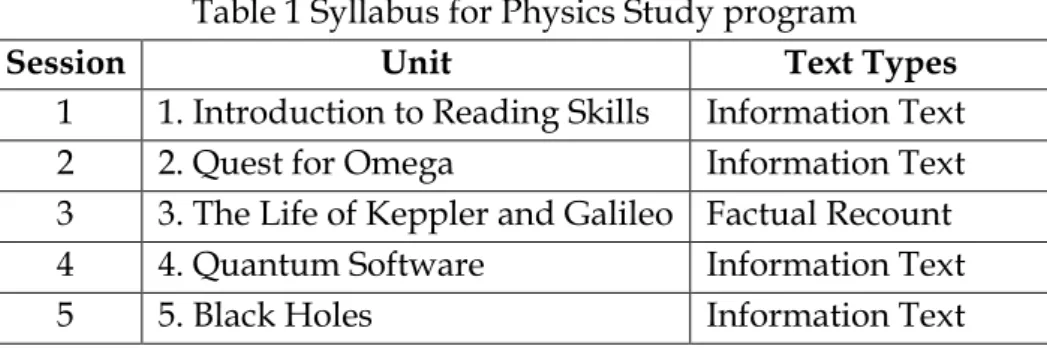
The syllabus of this collaborative English teaching for Physics Study program is designed on the basis of the units as instructional blocks. There are 12 units arranged for a 21-hour course. These 12 units are arranged in the following descriptions:
Table 1 Syllabus for Physics Study program
Session Unit Text Types
1 1. Introduction to Reading Skills Information Text
2 2. Quest for Omega Information Text
3 3. The Life of Keppler and Galileo Factual Recount
4 4. Quantum Software Information Text
8
6 6. Newton Informative Recount
7 Mid-term Examination
8 7. Temperature Information Text
9 8. Why is Ice Slippery Argumentative text
10 9. Journey to the Red Planet Descriptive Text
11 10. New Products Explanation
12 11. How to Writing a Report Instruction
13 12. Free Activities
14 Final Examination
Scope and Sequence
The scope of the content includes 80% understanding language skills comprises of 50% reading comprehension skills, followed by speaking, listening and writing (each weighs 10%) and the rest 20% for understanding language components including understanding grammar and vocabularies in context.
The sequenceof the contents is arranged on the basis of ―whole to part‖ meaning that the material at the beginning of a course
focuses on the overall organization of the topic. For example, in terms of reading skills, the students are given four reading skills namely skimming, scanning, previewing and predicting before practicing them in reading comprehension exercises. Regarding the writing skills, the students are given preliminary theories of summarizing an article using theories of abstract writing before asking them to write an abstract.
The Content of the Syllabus
The contents of the course include the following types of content:
Reading skills including scanning, skimming, predicting and previewing
Variety of reading texts in the area of physics
9
Vocabularies of the academic words (around 570 academic headwords)
Technical Vocabularies commonly used in physics texts (3000 words)
CONCLUSION
This ESP syllabus is designed to fulfill the need of Physics department students to read content area of reading in EFL context. The main objective is on reading skills and strategies with three focus area namely reading comprehension skills, strategies, attitudes and behavior, reading of different text types in the area of physics, and understand vocabularies of academic word list and their usage in some texts in the area of physics are rooted from Barrett taxonomy of reading sub skills to understand content area of reading. The integration of reading sub skills and content area of reading in physics department is intended to fulfill the need of Physics department students in mastering both reading in the area of physics and EFL reading skills and strategies. Thus the optimum achievement
and students‘ motivation in ESP learning in Physics Study program
could be fulfilled satisfactorily.
REFERENCES
Barron, C. (2002). Problem-Solving and EAP: Themes and issues in a collaborative teaching venture. English for Specific Purposes, 22, 297 – 314.
Borg & Gall (1983). Research Methodology. Cambridge: Cambridge University Press.
Coleman, H. (1997). Analysing language needs in large organization.
10
Dudley – Evans, T., & St. John, M.J. (1998). Developments in ESP: a Multi-Disciplinary Approach. Cambridge: Cambridge University Press.
Hutchinson,T. & Waters, A. (1987). English for Specific Purposes. Cambridge. Cambridge University Press.
Latief, M. A. (2012). Research Methods on Language Learning: An Introduction. Malang: Universitas Negeri Malang Press.
Little, P. F. B. (2005). Peer coaching as a support to collaborative teaching. Mentoring and Tutoring Journal, 13 (1), 83-94.
Richards, J. C. and Rodgers, T. (2001). Approaches and Methods in Language Teaching. New York: Cambridge University Press.
Sadtono, E. (1995). English at the College Level in Indonesia. In Perspective: Pengajaran Bahasa Inggris di Indonesia. Malang: Satgas Dokumentasi dan Publikasi Karya Ilmiah, Seksi Kajian Bahasa dan seni FPBS IKIP Malang.
11
Appendix. Syllabus of English for Physics Study Program
SYLLABUS OF
ENGLISH FOR PHYSICS STUDY PROGRAM
School : Brawijaya University Program : Physics Study Program Semester : I
Level : Pre-Intermediate
Subject : English for Physics Study Program
No Aims Focus Area
(FA)
Learning
Objectives (LO) Sources
1 Develop
reading skills, strategies, attitudes and behavior and text type-specific comprehension skills and strategies, strengthened by exposure to wide
vocabulary of academic word list and the most common vocabulary of academic word list used in the texts in the area of physics. 1.Reading comprehen-sion skills, strategies, attitudes and behavior 1.identify main facts and details of some texts in the area of physics
1. Mikuley, B.S and Jeffries, I. (1996). More Reading Power.
Longman Ferguson, K. (1999).
2. Measuring the Universe: the Historical Quest to Quantify Space. London: Headline Book Publishing
3. Milburn, G.J. (1998). The Feynman Processor. An Introduction to Quantum Computation. Australia: Allen and Unwin
12 3.identify
sequence of events of some texts in the area of physics
4.predict
outcome of some texts in the area of physics
4. Angrist, S.W. & Hapler, L.G. (1967). Order and Chaos. Laws of Energy and Entropy. Australia: Penguin Books
5. www.kidcosmos.org
6. www.nineplanets.org
7. www.wikipedia.org
8. www.academicwordlist.org
9. Grolier Encyclopedia
5.infer meaning from contextual clues of some texts in the area of physics 2. Reading of
different text types in the area of physics
6.understand organization of variety of text types in the area of physics 3.Understand vocabularies of academic word list and their usage in some texts in the area of physics 7.understand some vocabularies of academic word list