Do Women Advance Women?
A Study of Female Representation in Latin America
By Lauren G. Kent
A Thesis submitted to the faculty of the University of North Carolina in partial fulfillment of the require- ments of a degree with Honors in
Political Science.
2017
Acknowledgements
This paper would not have been possible without a great deal of support, teaching, and guidance from all the people who helped me throughout my undergraduate career. First and foremost, I would like to thank my thesis advisor and professor, Dr. Evelyn Huber, for her continual guidance, insightful comments, and support throughout the research process.
I would also like to thank the members of my thesis defense committee, Dr. Hollie Mann and Dr. Lynn Owens, for taking the time to read my research and help me improve it. All three of my readers have pushed me to grow and learn both inside and outside of the classroom, and I cannot thank them enough for the help and mentorship they have given me during my
undergraduate career.
Table of Contents:
Introduction 4
Chapter One: Substantive Representation and Critical Mass Theory 5
Chapter Two: Theory and Hypotheses 12
Chapter Three: Methodology 20
Defining Women’s Issues 20
Research Design 23
Limitations of Data 24
Case Study Selection 25
Chapter Four: Quantitative Analysis 28
Introduction 28
Quantitative Findings 28
Chapter Five: Case Study Analysis 34
The Case of Female Representation in Argentina 35 The Case of Female Representation in Costa Rica 43 The Case of Female Representation in The Dominican Republic 50
The Case of Female Representation in Chile 57
The Case of Female Representation in Uruguay 66
Chapter Six: Conclusions 73
Further Research 74
Introduction
The number of women in parliaments and legislatures across the globe has nearly doubled in the last ten years. What happens when more women enter politics, and what impact does that have on the lives of female constituents? Drawing on substantive representation theory, many claim that women are the best at representing women. Previous literature also suggests that although there is no critical mass of women required in a legislature to enact change, increasing the percentage of women can make it easier for female legislators to put women’s issues on the agenda.
This project applies the current body of Western-centric literature to Latin America, where women’s advancement is met with resistance from machismo culture, and has been historically encumbered by authoritarian regimes and imperialism. Through case studies focused on Argentina, Costa Rica, The Dominican Republic, Chile, and Uruguay, I explore the legislative effects of increased female representation in Latin America. This project aims to answer
numerous questions regarding female representation, including: Does having more women in the legislature lead to the passage of more laws related to women’s interest? Do these laws become more meaningful as the number of women increases? And does the influence of female
legislators extend beyond the legislature and into other areas of government?
In other words, do women advance women, or is the formula for increasing women-centric legislation far more complicating than electing more female legislators?
Chapter One: Substantive Representation and Critical Mass Theory
There is a great deal of prior research on how to advance female political participation and representation. However, the research on results of women’s advancement in politics is lacking. Specifically, once women are in positions of power, what impact does it have on the lives of female constituents? Will female legislators propose and pass bills related to women’s interests? And if so, will they be able to pass more legislation related to women’s interests as they become a larger minority in the legislature? So far, the existing body of research on these topics has been contradictory. In addition, the current literature is largely western-focused or narrowly tailored to a few specific nations. My research will contribute to the literature by focusing on several nations in Latin America, and confirming which conclusions from the current body of literature are applicable in my five countries of focus, and why or why not.
At the heart of this research question is the idea that women represent women. To understand the extent to which this is true, we first turn to the literature on the link between descriptive and substantive representation. In her book on political representation, Hanna Pitkin was one of the first scholars to delineate the two types of representation (Franceschet and
Piscopo 2008, Celis and Childs 2008). Pitkin distinguishes between legislators who share similar characteristics as their constituents, and therefore describe them, versus legislators who
for,” and thus, the composition of legislative bodies is not as important as the policies legislators pursue.
But many scholars, as well as proponents of the feminist movement, believe the two conceptions of representation are interconnected (Celis and Childs 2008). Simply put, women not only “stand for” other women, but they are also more likely to “act for” women’s interests. Although women have varied identities and interests and are certainly not a homogenous group, an individual woman can at least share one piece of their identity puzzle with the group of women she represents. Franceschet and Piscopo state it best in their 2008 article: “The link between descriptive and substantive representation does not require a one-to-one correlation between being like and speaking for. Shared interests simply broaden the agenda (Franceschet and Piscopo 2008).
The theory of “politics of presence,” first put forth by Phillips, contends that a link
between descriptive and substantive representation exists, and suggests that female legislators are the best at representing the interests of female constituents (Wangnerud 2009, Phillips 1995). Phillips’ argument rests on the idea that, broadly, women and men have different life
Following Phillips’ theoretical framework suggesting female legislators are the most effective to substantively represent women, many scholars have examined how female legislators vote on certain issues that directly affect women, such as reproductive rights and women’s workplace issues. Swers examined how the gender of U.S. representatives affects their votes on issues that directly affect women. Swers found that female representatives are more likely to cross party lines and vote together when a bill directly affects women (Swers 1998). She also found that the relationship between gender and voting on women’s issues was strongest for votes dealing with abortion or women’s health. In her 2013 book, she asserted that female
representatives are stronger proponents of social welfare programs and women’s workplace rights. Swers controlled for other common influences on congressional voting, including party, personal characteristics, and ideology. Much of the relationship could be attributed to Republican women crossing party lines to vote more liberally in regards to women’s issues. But Swers found that on issues less directly related to women, such as education, the influence of gender was overcome by other factors such as party or ideology (Swers 1998).
Research from Chattopadhyay and Duflo (2004) also shows that female leaders are more likely to implement policies that are directly relevant to their own gender. Their study showed that women serving on village councils in India were able to tailor the types of public goods provided by the local government in order to specifically benefit women.
effectiveness, broadly defined as the ability to turn policy preferences into law, by looking at data on bill and amendment sponsorship and the ultimate allocation of federal domestic funding. The authors found that gender did not have a significant influence on legislator effectiveness. Instead, they argue that legislator effectiveness is influenced by seniority, committee
memberships, and other preferences. Although these previous studies provide us with some insight into the effectiveness of female legislators and their willingness to cross party lines when it comes to women’s issues, many of them are focused on the United States or other developed nations.
When discussing the effectiveness of female legislators on promoting women’s issues, we must also look at critical mass theory, which has its problems but nevertheless plays an important role in gender politics. Critical mass theory as it relates to gender politics holds that a certain percentage of women are required in a political body in order to affect change. Although the idea of a specific turning point to go from a small minority to a large minority (usually 30 percent) is commonly touted as conventional wisdom among feminist movements and female politicians, many scholars have reservations (Childs and Krook 2006, Dahlerup 2006,
women, both of which change the position of women in politics and would lead to change down the line (Dahlerup 1998).
Other scholars have also found evidence contradicting the 30 percent benchmark for a critical mass of women in a legislature. Bratton studied skewed state legislatures in the United States in which women make up less than 15 percent of the legislative body. She found that “token” women were not marginalized, but rather more likely to develop legislative agendas that were different form their male counterparts (Bratton 2005). Moreover, Bratton states, “Women are generally as successful as men in passing the legislation that they sponsor, and that in very homogeneous settings, they are sometimes more successful than men (2005).” On the contrary, Grey found that for female legislators in New Zealand, “increased female presence in both the legislature and in government executives also correlates with a rise in overt hostility toward feminist agendas (Grey 2006).”
agendas begin to diverge from women’s issues or be met with greater hostility from their male counterparts?
Latin America presents it’s own unique challenges for women. The social construct of machismo persists, by which male dominance and superiority are legitimized by a patriarchal social system (Mayo and Resnick 1996, Segrest et. al. 2003). Meanwhile women are also
influenced by the marianismo ideal, or the stereotypical female counterpoint to machismo, based on the ideals of the Virgin Mary — fragility, submissiveness and holiness (Stevens 1973, Segrest et. al. 2003). Latin American women are often socialized into accepting the dictates of male superiority, and trained to be housewives and mothers (Mayo and Resnick 1996). Thus,
machismo culture presents an additional barrier in encouraging women to pursue work outside of the home, such as running for legislative office. Although the unique challenges in Latin
America make it an interesting place to delve into questions regarding substantive representation, the current body of research is not well developed. Much of the current research on female legislators is only tangentially related to the question of female legislators’ impact on women’s issues, or is only focused on one nation.
For example, Htun (2014) studied the political effects of Afrodescendant women’s inclusion in six Latin American legislatures, finding that black, female legislators acted in the interest of their broader demographic groups to advance the rights of women, Afrodescendants, and other marginalized groups.
female legislators were elected without the aid of a gender quota, than in Costa Rica, where a high percentage of female legislators was mandated by quota (Caldwell 2010). Similarly, research on substantive representation in Argentina, the first nation to implement a legislative gender quota, shows that although female Argentine legislators were proposing numerous bills related to women’s issues, many did not pass or died in committee (Htun 2013, Franceschet, S., & Piscopo 2008). Many of the female legislators interviewed by the authors believed they were negatively stereotyped as “quota women,” which undermined their ability to accumulate power and influence (Franceschet, S., & Piscopo 2008). Legislators who feel they are stereotyped as “quota women” may be more cautious about engaging with and promoting women’s issues. Schwindt-Bayer (2010) focused her study of women’s substantive representation on three nations — Argentina, Colombia and Costa Rica — and found that the presence of female legislators did bring women’s issues to the legislative agenda through their presence on committees related to women’s interests. However, she called the representation of women in Latin America a “double edged sword.” Female legislator’s prioritization of women’s rights and social issues was part of the reason for their continued marginalization in the legislature
(Franceschet 2012, Schwindt-Bayer 2010).
My research will focus on Argentina, Costa Rica, The Dominican Republic, Chile, and Uruguay. For the nations that have already been studied widely, such as Argentina and Costa Rica, I hope to explore whether the trends previous scholars have found hold up over time, and determine if some of the results regarding substantive representation are more widely applicable to the region as a whole. For the nations that have yet to be studied in depth, my research will fill in some of the gaps pertaining to South America in the literature on substantive
Chapter Two: Theory
Theory and Hypotheses
The following section will explain my main assertion, as well as related two secondary assertions. Firstly, I explain how increased female participation in a legislature can cause an increase in the number of bills proposed related to women’s issues, and subsequently an increase in the number of bills passed related to women’s issues. Secondly, I will address how increased female participation in a legislature can impact lawmaking in other branches of government. The theory will explain how changes in the demographics of the legislature can influence executive decisions and administrative leadership, thus extending the power of the female representatives beyond the legislature. Finally, I will investigate how the percentage of women in a legislature affects the importance and reach of laws. I will construct a framework for what constitutes a substantive law versus a less impactful, symbolic law. The theory will then explain why laws related to women’s issues may become more meaningful as more women are elected to the legislature — female representatives have a greater incentive to create meaningful outcomes for women rather than symbolically acknowledge women.
As previously stated, the broad goal of this project is to investigate the question, “Do women advance women?” My primary assertion is that yes, female legislators do advance women by increasing the number of bills passed related to women’s issues. And as more women enter the legislature, more bills related to women’s issues would pass.
rights. Previous literature has firmly established three causal mechanisms for the passage of female-centric legislation: 1) the influence of leftist parties, 2) well-funded and well-supported bureaucratic agencies that are led by progressive women, and 3) robust women’s movements (which may include the presence of a women’s caucus in the legislature).
In Stetson and Mazur’s book on comparative state feminism, they found that numerous types of governmental structures designed to address women’s issues actually contribute to policies that advance women (Stetson and Mazur 1995). These include state offices such as national offices for women, government-created women’s societies and women’s lobbies. To add a layer to the equation of advancing women, the authors found that strong state feminist offices were “all created under the initiatives of Social Democratic governments that placed gender equality on their policy agendas, amid relatively strong pressure from moderate feminist groups (Stetson and Mazur 1995).” Undoubtedly, there are many mechanisms in addition to female legislators that may impact the number of laws related to women’s issues that a legislature passes. However, my theory will focus solely on the legislators themselves, and specifically the links between descriptive and substantive representation, in an attempt to isolate the impacts, if any, of electing female legislators.
To that end, I hypothesize the following causal chain to explain the assertion that female legislators do advance women: first, increased female representation in the national legislature will make it easier for women to introduce bills, speak up in the legislature, and gain support for women’s issues.
(Karpowitz and Mendelberg 2014). One can imagine that female legislators in Latin America may experience even more sexism in the workplace as their political ambitions clash with a pervasive culture of machismo. Not only do these comments make the legislature a less friendly place for women, but they also impede their ability to work as effectively as possible. Borrowing from the field of psychology, Glick and Fiske (2001) assert that women who are seen as usurping men’s power experience hostile sexism. Additionally, an alternative brand of sexism that seems like a compliment on the surface, what the authors call “benevolent sexism,” is also harmful because it diminishes the authority of women by putting them on a pedestal and praising those who embrace traditional gender roles (Glick and Fiske 2001). Although it may seem
the number of women increases. As a result, it will become easier for female legislators to speak up and garner support for issues they care about.
In turn, this will lead to more legislation proposed to enable gender equality. I expect that when more women are in legislative positions, there will be more bills proposed regarding women-centric issues such as eliminating barriers to education for women, funding women’s education, promoting workplace equality, and instituting paid parental leave. This assertion is based on the current body of research, which shows that female leaders are more likely to implement policies that are directly relevant to their own gender (Chattopadhyay and Duflo 2004). Moreover, scholars studying substantive representation have concluded that female legislators are the best at representing the interests of female constituents (Wangnerud 2009, Phillips 1995). Simply put, women not only “stand for” other women, but they are also more likely to “act for” women’s interests.
Furthermore, increased female representation will likely allow women to be more
persuasive and influential in the legislative process. Prior literature suggests women are effective legislators. Especially important to this research is the finding that women tend to cross party lines to vote with other female legislators on women-centric issues (Swers 1998). My theory does not take into account party discipline. Rather, it assumes that women have freedom to vote across party lines. However, party politics still play a key role in how persuasive women in the legislature may be. As more women enter the legislature, it is likely that some female legislators will move up in the leadership of their party and therefore have increased influence over the policy agenda.
the most talented, qualified, and hardworking women are actually elected to office (Anzia and Berry 2011). Additionally, evidence suggests that women are prone to low political ambition when compared to men of equal merit. Fox and Lawless find that the gender differences stem from two factors: “First, women are far less likely than men to be encouraged to run for office; second, women are significantly less likely than men to view themselves as qualified to run (2004).” Therefore, the women who do run for office will likely be more qualified than the average male candidate. In other words, many potential female candidates are filtered out in the electoral process due to sex-based selection bias, and thus “the women we observe in office will, on average, outperform the men (Anzia and Berry 2011).” Perhaps these explanations for why women outperform men may diminish as more women enter the political arena. However, for the purposes of this project, most of the case study countries do not come close to achieving gender parity in the electoral process. As a result, the sex-based selection bias that would allow us to reasonably conclude that female legislators are more successful than their male counterparts remains intact in most Latin American nations.
Considering this evidence of the effectiveness of female legislators, it follows that if more women are elected to national legislatures, then not only would more legislation to enable gender equality be proposed, but more of this legislation would also be passed and implemented.
Hypothesis 1: If female representation in a legislature increases, then the number of
legislative bills passed related to women’s issues will increase.
However, it is important to recognize that a nation’s policy surrounding women and women’s issues is not created in a legislative vacuum. In addition to legislative laws regarding women’s issues, there are also policies being implemented through executive order,
administrative bodies and the court system. My secondary assertion is that as female
representation in the legislature increases, not only will it impact the number of laws related to women’s issues that are passed within the legislature, but it will also impact policy decisions made in other branches of government. For the purposes of this project, I focused on potential increases in executive orders related to women’s issues.
Most study on legislative-executive relations holds that these two branches of government are expected to work together cordially (Oni 2014). In general, it is considered desirable when there is cooperation and understanding between the chief executive and national assembly, and when legislators perceive that the balance of power is acceptable (Oni 2014, Bernick and Wiggins 1981). Although each nation’s legislative-executive power dynamic is obviously different, the concept that it is desirable when there is cooperation and understanding between the chief executive and national assembly has been applied internationally (Oni 2014). I posit that this concept will hold true in Latin America. As previously asserted, if more women enter the legislature, they are likely to advance women’s interests. It follows that the executive branch would have to follow suit to remain cordial with the legislative branch. A cooperative legislative-executive relationship would break down if the legislative became less male-dominated and more likely to discuss women’s issues but the executive branch remained a “boys’ club.”
multi-party legislatures elected by proportional representation (Political Database of the Americas). The combination of a presidential system and multi-party legislature means that the president is elected independent of the congress, and may not benefit from support of the majority party in the legislature. In some multi-party systems, there may not be a majority party at all. As a result, presidents must find other ways to build coalitions in order to pass their policy agenda. In their research comparing the multiparty presidential system in Indonesia to similar systems in Latin America, Melo and Pereira state:
“The fragmented party systems typical in Latin America make exchange mechanisms crucial. If democracy is to work-indeed, if it is to last-the government in general and the president in particular must build and keep winning coalitions. In order to do so, the president needs to be strong and attractive to different coalition partners (2012).” The authors contend that multi-party presidential systems are possible in part through the availability of trade-worthy goods that can be used to form coalitions, such as cabinet
appointments, pork-barrel spending, executive orders to advance a certain group’s policy agenda, and policy concessions (Melo and Pereira 2012).
appeal to female legislators. However, the scope of this project was too narrow to include administrative laws from all ministries of each of the five countries of focus.)
Thus, I hypothesize that as the number of women in the legislature increases, their influence on the executive branch will also increase. Therefore, the number of executive orders related to women’s issues will also increase, for two reasons: 1) The executive hopes to maintain an amicable relationship with the legislature, and must appeal to a growing number of women in order to do so, and 2) the executive has an incentive to appease female legislators with trade-worthy goods in order to form coalitions and overcome the limitations of a multi-party presidential system.
Hypothesis 2: If female representation in a legislature increases, then the number of
executive orders related to women’s issues will increase.
My null hypothesis for H2 is that increased representation of women in national legislatures will have no effect on the number of executive orders related to women’s issues.
material position of women in society, or actual changes to rights rather than policies that merely look good on paper. I hypothesize that as more women enter the legislature, the bills and laws passed related to women’s issues will be more meaningful and central to the women’s agenda.
Similar to my primary hypothesis, this too depends on the effectiveness of female legislators as well as party politics. As more women enter the legislature, it becomes easier for women to introduce bills that are of greater importance, gain support for policies that would substantially move the needle for women, and move beyond marginal policy change. These gains will also become easier as women move up in the leadership of their own parties.
Hypothesis 3: As female representation in legislatures increases, bills and laws passed related
to women’s issues will be more meaningful rather than marginal.
My null hypothesis for H3 is that increased representation of women in national
legislatures will have no effect on the degree of meaning of the laws passed related to women’s issues.
Chapter Three: Methodology
Defining Women’s Issues
coding legislation, I included most laws that specifically mentioned gender, sex or women, or laws that applied specifically to women. My definition also includes issues that primarily affect women, such as rape and domestic violence. This approach differs from the methodology of some other scholars, who have looked at active women’s organizations within case study countries to determine which issues are of importance to women (Swers 2002, Caldwell 2010). For example, Caldwell found that women’s groups in Guatemala organized around rights of the indigenous (Caldwell 2010). Yet, as this is not a policy area that is related specifically to women, it is not included in my definition of women’s issues. In creating my definition of women’s issues I also tried to be cautious of highly politicized issues surrounding women, and confounding women’s issues with partisan issues. For example, abortion rights are often included in discussions of women’s issues, but they are often supported only by leftist parties, and, in fact, many women oppose abortion rights. Below is the list of words related to women’s issues, translated into Spanish, which I used as search terms in each case study country’s legal code database.
1. women/woman mujer(es)
2. gender género
3. sex sexo
4. female femenino
5. feminism feminismo
6. mother madre
7. maternity: maternidad
8. sexual harassment acoso sexual 9. sexual assault asalto sexual 10. equal pay igualdad de salarios
11. equal pay pago igual
12. rape violación
13. reproductive reproductivo
14. sexism sexismo
15. male gender role machismo 16. female gender role marianismo
mujeres
19. divorce divorcio
20. childcare cuidado de niños
21. harassment hostigamiento
In coding the legislation, I also denoted how meaningful the legislation was to the advancement of women’s issues. I define “meaningful” legislation as legislation that is
considered a major achievement for women’s interests. More concretely, this is legislation that creates actual changes in the material position of women in society, or actual changes to rights. Meaningful legislation moves the needle for women’s rights in important areas. By contrast, marginal legislation indicates achievements that are only minimal, or are merely symbolic. For example, declaring a “National Day for Women” sounds nice on paper, but it has marginal importance in the grand scheme of women’s advancement and has minimal impact on policy solutions for women. Other examples of legislation or executive orders that I denoted as
marginal include 1) laws that create a committee or new position related to women’s interests, 2) laws that create an honorary order or day of recognition related to women’s interests, 3) laws that include a generic anti-discrimination clause that is not exclusively related to gender
I created a bivariate measure for how “meaningful” each law is, and assigned each law a number: “1” for marginal and, and “2” for meaningful. Although this variable is somewhat subjective, I felt that it was important to attempt to distinguish between legislation that is central to the female agenda and legislation that is on the periphery.
Research Design
To study the relationship between women in legislatures and the advancement of
women’s issues, I used a country level, case study approach, as well as quantitative comparisons between the countries. Case study research allowed me to delve into specific legislation and country-level policies regarding gender equality and discuss potential causal mechanisms specific to each country. For my quantitative analysis, my unit of analysis was the country-year — this allowed me to not only make comparisons between the five case study countries, but also between different years within the same country.
compare the larger lower houses. I used the eleven-year period to allow me to see change over time as the percentage of women in each national legislature increased. Between 2000 and 2010, several Latin American nations began to implement gender quotas for elections or gender quotas in the legislature. Even most nations without quota laws saw an increase in female
representatives during this time period.
To operationalize the dependent variable, or the number of laws passed related to women’s issues, I coded legislation from each of the five case study countries by using their national online legal code databases. I searched for the key terms listed above to find laws that fit within my definition of women’s issues. I then coded the laws that fit within the framework, taking note of the year, branch of government where the law originated, keywords, and whether the law was “meaningful” or “marginal”. Because some legislatures are more productive than others, I looked at the number of women-centric laws as a percentage of all laws passed, rather than looking at absolute numbers of laws.
Limitations of Data
The quantitative analysis portion of this project relied entirely on governmental databases of legislation, which had its limitations. The quantitative portion of this project relied on the assumption that the governmental databases were a complete record of all legislative and
Moreover, since each country organized their data in different ways and had different search capabilities, the comparison between each nation’s data is complicated. For example, Argentina’s legislative database had a very sensitive search filter, which would search the complete text of each law for the keyword, related keywords and different forms of that word. Meanwhile, Costa Rica’s database had a more limited search function, which in some cases was unable to search the entire text of a law, and the Dominican Republic’s database required keywords to be longer than five letters. Subsequently, results could be skewed to make it appear that a country has passed more laws related to women’s issues, when in reality the country simply has a better legal database.
To combat some of these issues, I used keywords that overlapped. Often times, laws which included the word “gender” would also include the word “sex,” or laws related to “maternity” would also include the word “mother.” As a result, many of these searches yielded overlapping results, which ensured that fewer laws were able to fall through the cracks of the search process. Additionally, to circumvent minimum letter requirements, I searched for the keywords themselves, the plural forms of the keywords, and keywords including an article (for example, “la madre” instead of “madre”). To further improve the cross-country comparison, I used multiple translations of the same word to account for different dialects of Spanish that are used in different countries.
Case Study Selection
five random nations from across the globe, which may have very different factors impacting the lives of women. Argentina, Costa Rica, The Dominican Republic, Chile, and Uruguay share similar histories regarding the treatment of women. All five case study countries have
Growth in Percentage of Female Legislators in Lower House, 2000-2010
Country
Percentage of women in lower
house — 2000
Percentage of women in lower
house — 2010
Argentina 28 38.5
Chile 10.8 14.2
Costa Rica 19.3 38.6
The Dominican Republic 16.1 19.7
Uruguay 12.1 15.2
Regional Average — The Americas 15.3 22.2
World Average 13.4 19.1
The United States (for reader comparison) 13.3 16.8
The nations differ in other ways related to women in government as well: Argentina and The Dominican Republic implemented legislative gender quota laws in the early nineties, while Costa Rica and Uruguay did not implement quotas until much more recently, meaning the effects of those laws do not fall within the time period for this project. Chile still does not have
Chapter Four: Quantitative Analysis and Findings
Introduction
Regressions comparing the percentages of female legislators to various indicators associated with the amount of legislation advancing women’s issues yielded no statistically significant correlations. The results of these regression analyses point to the conclusion that mechanisms besides the raw numbers of female legislators, most likely the three other factors most often cited in previous literature (the left party mechanism, women’s agencies and women’s movements) have a stronger influence on legislative outcomes.1 Further consideration of the party mechanism in the five countries of study will be explored through case studies in the next chapter. Meanwhile, a regression comparing the percentage of women with the percentage of meaningful laws did yield statistically significant results, but in the opposite direction of what I hypothesized. Results show that greater representation of women in a legislature is associated with a higher percentage of gender-related laws being “marginal.”
Quantitative Findings
Plots comparing the percentage of all laws passed that were related to women’s issues to the average percentage of women in the legislature of each country during the eleven-year time period show no statistically significant correlation, with a Pearson correlation coefficient of less that .2 (see graph 1). Graphing the correlation between the total number of laws related to
women’s issues to the average percentage of women in the legislature yields a higher correlation, but one that is still statistically insignificant (r = .55674).
1As this project only uses five countries for analysis, there are insufficient data points to perform most
r = .18659, p= .763812 à No significant relationship
Individual country level analysis of laws and executive orders compared to the percentage of women in the legislature each year leads to similarly inconclusive results.
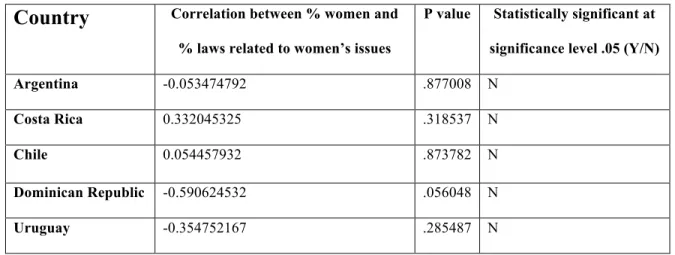
Although plots comparing the percentage of laws related to women’s issues to the percentage of women in the legislature each year for Argentina (graph 2) and Costa Rica (graph 3) appear somewhat correlated, the Pearson correlation coefficients (r) show no statistical significance (see table 1). Therefore, from a quantitative perspective, I fail to reject the null hypothesis H1, which states that increased representation of women in national legislatures will have no effect on the number of legislative bills passed related to women’s issues. Likewise, table 3.2 shows that executive orders are also not correlated at statistically significant levels, and therefore, I also fail to reject null hypothesis H2, which states that increased representation of women in national legislatures will have no effect on the number of executive orders related to women’s issues.
0.00% 2.00% 4.00% 6.00% 8.00% 10.00%
0.00% 5.00% 10.00% 15.00% 20.00% 25.00% 30.00% 35.00% 40.00%
A
ve
ra
ge
%
la
w
s
Average % women Graph 1: Correlation
between % laws related to women's issues and % women in legislature
Table 1: Laws (legislative)
Country
Correlation between % women and% laws related to women’s issues
P value Statistically significant at
significance level .05 (Y/N)
Argentina -0.053474792 .877008 N
Costa Rica 0.332045325 .318537 N
Chile 0.054457932 .873782 N
Dominican Republic -0.590624532 .056048 N
Uruguay -0.354752167 .285487 N
Table 2: Executive Orders
Country
Correlation b/w % women and %exec. orders related to women’s issues
P value Statistically significant at
significance level .05 (Y/N)
Argentina 0.04020341 .906582 N
Costa Rica -0.069028632 .840243 N
Chile 0.172396465 .612437 N
Dominican Republic N/A N/A N/A
r = -0.053474792à No significant relationship
r = 0.332045325à No significant relationship 0.00% 5.00% 10.00% 15.00% 20.00% 25.00% 30.00% 35.00% 40.00% 45.00% 50.00%
2000 2001 2002 2003 2004 2005 2006 2007 2008 2009 2010
P er ce n ta ge Year
Graph 2: % laws pertaining to women's issues compared
to % women in legislature each year — Argentina
%women % laws 0.00% 5.00% 10.00% 15.00% 20.00% 25.00% 30.00% 35.00% 40.00% 45.00% 50.00%
2000 2001 2002 2003 2004 2005 2006 2007 2008 2009 2010
P er ce n ta ge Year
Graph 3: % laws pertaining to women's issues compared
to % women in legislature each year — Costa Rica
% laws
An analysis of the number of meaningful versus marginal laws and executive orders at the country-level yielded unexpected findings. In general, nations with higher average
percentages of women in the legislature passed more “marginal” laws and executive orders. For example, Argentina, the case study nation with the highest average percentage of women in the legislature (33.53%) passed 23 marginal laws during the eleven-year period, constituting 43.4% of all laws related to women’s issues passed during this time period. Meanwhile, Uruguay, the case study nation with the lowest percentage of women in the legislature (12.2%) passed just 3 marginal laws out of 33 total laws related to women’s issues, or 9.09% marginal.
A plot of the percentage of laws that were meaningful versus the average percentage of women during the eleven-year time period shows a strong negative correlation (see graph 4). The relationship has a Pearson correlation coefficient of -.9 and a p-value of .037, making it
r = -.9, p = .037386 à Statistically significant negative relationship
This finding has several possible causal mechanisms. Celis and Childs (2008) explain that representatives who foster substantive representation for women engage in a variety of acts that have different roles. While some of these acts, such as voicing women’s concerns and voting in a manner that substantively represents women’s interests could lead to “meaningful” laws being passed, other activities, such as prioritizing and constructing women’s interests could lead to laws that are considered “marginal,” such as outlining objectives related to women’s
advancement or creating a committee with an organization to focus on the role of women (Celis and Childs 2008). Another explanation is that symbolic victories for women are politically beneficial, and do not incite opposition or require much effort by legislators. Finally, the lack of meaningful legislation could be attributed to backlash from male legislators. This was one theory offered by Childs and Crook to explain how female legislators could be ineffective even as their numbers grow (Childs and Crook 2009). As more women enter the legislature, they likely propose more bills related to women’s issues, including meaningful bills. However, male
0.00% 10.00% 20.00% 30.00% 40.00% 50.00% 60.00% 70.00% 80.00% 90.00% 100.00%
0.00% 5.00% 10.00% 15.00% 20.00% 25.00% 30.00% 35.00% 40.00%
Graph 4: % laws related to women's issues that were
meaningful versus average % of women
33 .5 3 %
legislators fight these women-centric bills or attempt to diminish their impact. Thus, few meaningful proposals are passed, and the bills that do get passed are water down and therefore less meaningful. Although a similar trend appears to hold true for the number of marginal versus meaningful executive orders, I was unable to conclude a statistically significant correlation without data on executive orders for the Dominican Republic, or knowledge of the total number of executive orders passed during this time period in Uruguay.
Chapter Five: Case Study Analysis
In the following sections I will place female representation in the context of each country’s history, political climate, and timeline of women’s advancement. I will also discuss how party politics, women’s movements, gender quota laws, and historic trends of gender equality or inequality may have affected present-day female representation. Additionally, I will analyze how these same mechanisms may subsequently impact the number and importance of laws passed related to women’s issues.
The largest takeaway from individual case study analysis of the effects of female representation is that no cross-country generalization is possible — the number of laws and executive orders related to women’s issues and their importance depends very much on the context of each country during the given year. Moreover, the three other factors that are
1)
The Case of Female Representation in Argentina
Country Background and History:
The first case I will focus on is Argentina, which has the highest level of legislative female representation in Latin America, and was one of the first nations in the world to adopt gender quotas. Following a series of military dictatorships and “The Dirty War,” which ended in 1983, Argentina has consistently held democratic elections and is considered a stable democracy. Argentina is a presidential republic with a multi-party system. The president of Argentina is elected for a 4-year term. During the time period studied for this paper, 2000 to 2010, Christina Fernández de Kirchner became the first female president to be elected in Argentina. However, Isabel Martínez de Perón was technically the first female president of Argentina after she assumed the presidency in 1974 following Juan Perón’s death.
Women, Politics, and Political Parties:
The Argentine Congreso Nacional is bicameral, consisting of a 72 seat Senate and a 257 seat Chamber of Deputies. Senators serve 6-year terms and Deputies serve 4-year terms. Both houses are elected by list proportional representation (PR), which has been shown to favor the election of women (Castels 1981, Darcy et. al. 1994, Duverger 1955, Matland 1997).
collapse of the longstanding Radical Civic Union Party (UCR), a centrist social democratic party. It wasn’t until the 2015 elections that parties reorganized into center-left and center-right coalitions to put up viable opposition to the Justicialists. There are also many smaller parties that frequently win representation in Congress.
Throughout Argentine history, women have crossed party lines to work together on issues of women’s equality. In 1971, representatives from all parties founded the “Group of Women Politicians,” which organized to reform women’s rights in the family and pass a divorce law (Htun 2009). The issue of equality in the family brought together Peronists, Radicals, jurists and even some conservatives (Htun 2009).
The first women were elected to Argentine Congress during the height of the Peronist Women’s Party in 1951. Twenty-four women won seats in the legislature on the Peronist Party ticket, placing Argentina first in the world for female representation (Hinojosa 2009). (In fact, the Peronists party’s unofficial gender quotas would eventually aid the passage of the world’s first national gender quota law (Waylen 2000.))
History of Women’s Advancement and Legislative Victories:
women’s organizations dedicated to political reforms began to appear in the first decade of the twentieth century does the feminist movement appear as a political, as distinct form
revolutionary, phenomenon in Argentina (Hammond 2011).”
Even with the emergence of women’s organizations in the early 1900s, Argentina was slow to reform its civil code, which — like most Latin American nations at the time — was severely restrictive of women. Although proposals for reform of female employment restrictions and married women’s rights were introduced in the legislature as early as 1915, it took a full ten years before any legislation passed the scrutiny of the all-male congress (Lavrin 1998). In 1926, the “law of women’s civil rights” was approved, granting women all the “rights and civil functions” already afforded to men of legal age. These rights included the ability to enter into any career, direct control of earnings, custody of children for unwed or divorced mothers, and the ability to participate in civil and criminal court cases (Lavrin 1998). In a short amount of time, women gained a foothold in the workplace as notaries, stockbrokers and government employees, and made “considerable legal gains” through the court system (Lavrin 1998).
cause another shift in the women’s movement. Perón and his wife, Evita, began a “new” feminist movement, apart from the Radicals and Socialists who did not support his candidacy, to attract women to their movement (Hammond 2011). It was not until September 1947, during the administration of Juan Domingo Perón, that the women’s suffrage law finally passed. Many Argentines attributed the success of the law to Evita Perón’s direct involvement (Hammond 2011). The Peronists were quick to discard the earlier feminists from their Peronist Women’s Party, and Evita held a tight grip on the direction of the women’s movement, removing those who contested Peronist ideals (Hammond 2011).
Although the women’s movement was obviously not idle during the Dirty War period from 1976 to 1983, there is not a great deal of information from this time period, nor were there many significant advances for women. Fast-forwarding to the post-Dirty War period, elite
feminist groups were revitalized with the return to democracy (Htun 2007). Argentina ratified the UN Convention on the Elimination of all Forms of Discrimination Against Women (CEDAW) in July 1985 (United Nations). The same year, the administration of Raúl Alfonsín restored
women’s right to joint custody, which had been repealed by the military dictatorship in 1956 (Htun 2007). This meant that men no longer had the final say in many familial decisions. Just a few years later, Argentina expanded women’s rights in the family sphere even more by
legalizing divorce (Hinojosa 2009).
low until the passage of Argentina’s national gender quota law in 1991 (Hinojosa 2009). The pioneering quota law was enacted in 1991, and was the first law of its kind in Latin America. The law states, “Party electoral lists are required to have a minimum of 30% women among their candidates for all national elections with real chances of being elected (The Quota Project).” The law’s effects were seen almost immediately, with lower house female representation jumping to 12.5 percent in 1993 and 24.9 percent in 1995 (Hinojosa 2009). The passage of the gender quota law has been attributed to a cross-party alliance of women, as well as the support of
nongovernmental organizations, feminist groups, the National Council of Women, and the Menem administration (Waylen 2000, Hinojosa 2009). Likely as a result of the national quota law, all major parties have elected a female representative in modern history. Argentina also has gender quota laws at the regional level and in Buenos Aires City, and the Justicialist Party has adopted a voluntary rule stipulating that the representation of women be respected at all levels within the party (The Quota Project).
Even following the successful reform of the civil code, the suffrage movement, and the advances made immediately following the return to democracy, Argentine women still had hurdles to overcome to achieve true equal rights. According to an index created in 2009 by Universidad Cartólica Uruguay professor Dr. Juan Bogliaccini, Argentina still had one unequal rights provision remaining as of 2009. (The index tallies seven different unequal rights
Selected Legislative Reforms Between 2000 and 2010:
The legislation and executive orders passed in Argentina during this time period were nearly equal parts meaningful and marginal. Many executive orders merely outlined objectives for advancing women’s rights. For example, an order (decreto nacional 1.106/2000) outlined the structure of the Ministry of Health and called for the formulation of programs to reduce infant and maternal mortality, but did not offer specifics. Another symbolic order (decreto nacional 329/2010) declared Eva Perón as the “Woman of the Bicentennial” for her advancement of women’s rights. Numerous laws were also found to be “marginal” because they included generic equality clauses that condemned not only gender discrimination, but also discrimination based on race, ethnicity, etc.
Yet there was no shortage of meaningful laws related to women that also passed during this time period. A 2005 law called the “Law of Integral Protection of the Rights of Girls, Children and Adolescents (ley 26.062)” guaranteed access to health services for children and pregnant women. It also prevented discrimination against teen mothers in both private and public education institutions. In 2008, ley 26.364 declared adherence to the UN protocol to “Prevent, Suppress, and Punish Trafficking Persons,” which in turn led to hundreds of Argentine women being saved from sex slavery and sexual exploitation. The legislature tackled another problem that disproportionately affects women in 2008 with the passage of the “Declaration of National Interest in the Prevention and Control of Food Disorders (ley 26.396).”
Perhaps the most important piece of legislation for women in this era was a law to “eradicate violence against women (ley 26.485),” passed in 2009. The law called for
for women to live a life without violence.” The landmark law recognized that violence against women can be physical, physiological, sexual, economic, and patrimonial. Above all, the law provided victims of gender-based violence with economic and psychological support systems.
Explaining Legislative changes:
A quick look at the percentage of laws and executive order passed each year between 2000 and 2010 offers no rhyme or reason. There are few plausible explanations for why the graph points jump wildly from one year to the next. The Kirchner’s left-leaning Justicialist administrations were in power from 2003 until 2015, offering no explanation for changes during those years. Moreover, the Peronists held Congress by a majority during all the years studied.
0.00% 1.00% 2.00% 3.00% 4.00% 5.00% 6.00% 7.00% 8.00% 9.00% 10.00%
2000 2001 2002 2003 2004 2005 2006 2007 2008 2009 2010
% o f a ll la w s re la te d to w om en 's issu es Year
% of Laws Pertaining to Women's Issues
Each Year — Argentina
0.00% 1.00% 2.00% 3.00% 4.00% 5.00% 6.00% 7.00% 8.00% 9.00% 10.00%
2000 2001 2002 2003 2004 2005 2006 2007 2008 2009 2010
% o f a ll e xe c. o rd er s re la te d to w om en 's issu es Year
Conclusions for Argentina:
Even though Argentina has the highest percentage of female legislators in Latin America, with near gender parity in the Argentine legislature, factors unrelated to descriptive
representation, such as the 2001 economic crisis, could diminish the amount of women-centric legislation. In the wake of the economic downturn, Argentine legislators of all genders likely prioritized economic needs and welfare policies over legislation related to women’s issues. When women-centric legislation was able to pass, it could be attributed to the influence of a strong women’s caucus and women’s movement.
2)
The Case of Female Representation in Costa Rica
Country Background:
The next case I will focus on is Costa Rica, which also has historically high levels of female participation in the legislature. Costa Rica is regarded as one of the most stable
Women, Politics, and Political Parties:
The Costa Rican Asamblea Legislativa is unicameral, with 57 seats. Members are elected to 4-year terms, with elections taking place in February (CIA World Factbook). Legislators are elected through proportional representation. Following the Costa Rican civil war in 1948, a two-party system developed under the National Liberation Party (PLN), a social democratic two-party (Booth 2007). Several conservative parties developed as opposition to the PLN, which eventually merged to become the Christian-Social Unity Party (PUSC). However, in the early 2000s the two-party system gave way to a multi-party system as another social democratic group, The Citizens’ Action Party (PAC), gained a foothold in the legislature (Booth 2007).
Women’s groups in Costa Rica have also traditionally been organized around left-leaning principles. The first modern women’s group, Unión de Mujeres Carmen Lyra, was founded in 1948 and backed by a small left-wing party (the Partido Vanguardia Popular, or PVP). When the PVP collapsed shortly thereafter, the women’s group reorganized into a broader women’s movement called the Asociación de Mujeres Costarricense, which also leaned left-of-center (Saint-Germain 1993). However, there is really no one unified women’s movement in the nation. In fact, by the end of the 80s, there were more than 150 separate women’s groups
(Saint-Germain 1993). In practice, this translates to the women’s movement having limited power due
to dispersion or organization and lack of communication between different groups (Cabrera
1997).
History of Women’s Advancement and Legislative Victories:
five days later was rejected on the grounds that the left-leaning party was using women’s suffrage for political gain during an election year (Fajardo 1997). It would take five more years and another round of protests before women gained the right to vote in the new 1949
Constitution (Fajardo 1997).
The Family Code of Costa Rica, passed in 1973, stood out early on for being one of the first codes in the world to grant parental authority jointly to both parents and to allow for divorce (OECD). However, men are still designated as “bearing the principle expense of the family,” or being the head of the household (OECD). Additionally, women often face economic
discrimination in the wake of divorce and have no legal protections against losses caused by destruction of property or the selling of assets by the male partner (OECD).
In the 1980s, women in Costa Rica began pushing for legal equality in response to low female participation in government and the labor market, income inequality and sexual violence (Montero 1997). Inspired by the UN Convention on the Discrimination of All Forms of
public school textbooks, making credit available to women, creating programs to train female workers, and extending women’s social security coverage (Montero 1997). After extensive debate, the final version of the bill, Law for the Promotion of Women’s Social Equality, was passed in 1990. Although the final law was less progressive and much less extensive than the original proposal, it was still considered a huge victory for women at a time when many other Central American nations were struggling with war and democratization rather than the plight of women (Montero 1997).
Costa Rica established national gender quotas in 2009, which require 50 percent of candidates to be from each gender (The Quota Project). However, the quotas do not appear to have made drastic changes in the gender composition of the legislature following 2009, most likely because the number of female legislators in Costa Rica was already well above average. According to Inter-Parliamentary Union data, the percentage of female lower-house legislators in Costa Rica grew from 19.3 percent to 38.6 percent in the period between 2000 and 2010
("Women in Parliaments”). Costa Rica also has gender quotas at the sub-national level, and several political parties have adopted voluntary gender quotas (The Quota Project).
Selected Legislative Reforms Between 2000 and 2010:
Similar to Argentina, Costa Rica passed large numbers of “marginal” laws and executive orders during the eleven-year period studied. These included multiple executive orders declaring national interest in things such as the International Day of Women, or in national events related to women’s rights issues. Many of the gender-related laws passed by the legislature were
considered marginal because they included generic equality clauses, barring discrimination based on gender but also base don race, ethnicity, etc. Additionally, many laws merely outlined
objectives for advancing women rather than actually creating programs, devoting resources, or developing legal provisions to improve the lives of women.
However, while about a third of all laws related to women’s issues were “marginal,” there were still 23 “meaningful” laws. Arguably the most important law passed during this time period was the 2007 Criminalization of Violence Against Women Act. The law was designed to protect the rights of victims of violence, specifically violence stemming from marriage or gender discrimination. Another landmark piece of legislation was Electoral Law 8765, the Costa Rican gender quota law, which passed in 2009 and required 50 percent of nominated candidates to be women in national and sub-national elections. Similarly, there were many meaningful executive orders passed between 2000 and 2010. For example, a series of orders developed the Law
Against Sexual Harassment to assist the Attorney General’s office with preventing, investigating and punishing crimes of sexual harassment.
Explaining Legislative changes:
administration. The percentage of all laws that were related to women remained high for the duration of his administration and the 2010 electoral season in which another PLN candidate, Laura Chinchilla, won the presidency. Between 2006 and 2010 the PLN also held a majority in the Legislative Assembly (Álvarez-Rivera 2014). This spike is intuitive as the PLN has
historically been the party most favorable to women. The spike in 2001 also coincides with the lead-up to an election year. Although the Christian-Social Unity Party (PUSC) retained power in both the Legislative Assembly and the presidency following the 2002 elections, it is possible that PUSC was attempting to appeal to women and draw female voters away from voting for PLN candidates. The year-to-year change in the number of executive orders was too small to draw any meaningful conclusions 0.00% 1.00% 2.00% 3.00% 4.00% 5.00% 6.00% 7.00% 8.00% 9.00% 10.00%
2000 2001 2002 2003 2004 2005 2006 2007 2008 2009 2010
%
o
f a
ll
la
w
s
re
la
te
d
to
w
om
en
's
issu
es
Year
Conclusions for Costa Rica:
In Costa Rica, leftist parties played the largest role in advancing female-centric
legislation, rather than descriptive representation of women. Although Costa Rica has one of the highest percentages of female legislators in the region, the percentage of all laws that were related to women’s issues each year did not consistently rise along with the number of female legislators. Rather, the percentage rose and fell with the influence of the left-leaning PLN. Additionally, the amount of female-centric legislation rose leading up to election years, likely because members of all parties were trying to attract female voters.
3)
The Case of Female Representation in The Dominican Republic
Country Background and History:
For a case where women’s representation is in the middle of the pack, I will look at the case of the Dominican Republic. Between 2000 and 2001, The Dominican Republic’s percentage
0.00% 1.00% 2.00% 3.00% 4.00% 5.00% 6.00% 7.00% 8.00% 9.00% 10.00%
2000 2001 2002 2003 2004 2005 2006 2007 2008 2009 2010
% o f a ll e xe c. o rd er s re la te d to w om en 's issu es Year
of women in the lower legislature grew from 16.1 to 19.7, which hovers between the regional average for the Americas (which grew from 15.3 to 22.2 percent female) and the world average (which grew from 13.4 and 19.1) during this time period ("Women in Parliaments”). The Dominican Republic is a multi-party presidential system, where presidents are elected to 4-year terms.
Women, Politics, and Political Parties:
The Congreso Nacional is a bicameral legislature. There are 190 members of the House of Representatives, who all serve 4-year terms and are elected through proportional
representation. The upper house consists of 32 Senators elected by simple majority vote for 4-year terms (CIA World Factbook). In modern times, congressional seats are usually divided between the three major parties: the center-left Dominican Liberation Party (PLD), the social-democratic Modern Revolutionary Party (PRM), and the right-wing Social Christian Reformist Party (PRSC).
and women’s issues, and is the party of many prominent women in Dominican Politics. At present, there is no women’s caucus in the Dominican legislature, according to the Inter-Parliamentary Union (Database on Women’s Caucuses).
History of Women’s Advancement and Legislative Victories:
The history of women in the Dominican Republic cannot be separated from its history of occupation and authoritarianism. Early began feminists to come together during the U.S.
occupation lasting from 1916 to 1924 (Mayes 2008). In 1917, Dominican women organized the first National Women’s Congress and founded a national feminist magazine (Mayes 2008). During this time period, U.S. authorities, many of whom believed that hyper-traditional Dominican values were thwarting the nation’s economic and political development, shoved through a series of reforms (Derby 2009). The military government subsequently pushed for legislation that allowed women to manage their own earnings and set up programs to train women for the workforce (Derby 2009). Although changes to the civil and martial codes during this time period helped women to advance, they also placed Dominican women in negative light. Disavowing women’s advancement became synonymous with disavowing Americanization and U.S. imperialism (Derby 2009).
women’s issues and called the AFD his official women’s group, largely because the organization — and the broader Dominican feminist movement — was comprised of white, affluent women (Mayes 2008). According to Mayes, “By 1942, official feminism became a state project that promoted the white supremacist and modernizing vision of Trujillo and elevated the class and color interests of elite white women (Mayes 2008).” Trujillo’s brand of nationalism incorporated elite women, who were viewed as necessary for maintaining a society controlled by the white upper class. Motherhood was venerated, as exemplified by Trujillo’s creation of the National Office to Protect Maternity as well as a prize for women who raised at least eleven children (Mayes 2008). In 1942, the regime granted women the right to vote, which in hindsight can be seen as a strategic political move to bolster domestic support and to make the Trujillo regime appear modern in the eyes of the international community (Mayes 2008). Dominican Congress also reformed the civil code in 1942 to give women equal access to university education, freedom to choose any career, and civil equality for married women (Mayes 2008). However, despite civil and political reform, women had little power in the regime itself or in the eyes of the dictator. Numerous stories exist of Trujillo kidnapping and raping young women, and his
mistresses were well known in Dominican society (Derby 2009).
The influence of the elitist AFD remained strong throughout the Trujillo dictatorship, until his assassination in 1960 and continued into the reign of Trujillista politician Joaquín Balaguer until 1978 (Flora 1984). In her article on Socialist Feminism in the region, Flora explains the eventual rise of a leftist women’s movement in the late 1970s:
Concerned with political change and social justice for the poor, these women suffered the same type of imprisonment that the men did (Flora 1984).”
When leftist opposition parties were allowed to form in 1976, women ironically found
themselves left out of the new political movement, and ramped up grassroots organization (Flora 1984). In the late seventies, numerous women’s groups began to mobilize against male
chauvinism and engage in consciousness-raising among poor Dominican women and the university community (Flora 1984). The strong grassroots movement of women was characterized by “a high degree of organization and social class diversity (Flora 1984).” The period of democratization following the Balaguer regime was an important time for Dominican women, characterized by numerous piecemeal victories. The nineties were the first time that women’s issues were incorporated into the post-Trujillo era political parties, and that national politicians began to use gender-inclusive language on the campaign trail (Morgan 2008). A 1992 modification of the labor code outlawed workplace discrimination based on sex. In 1995, the Dominican Republic ratified the Inter-American Convention on the Prevention, Punishment and Eradication of Violence against Women, and in 1997 the penal code was amended to
criminalize sexual assault and enact longer prison sentences (OECD). The Dominican Republic’s first gender quota law was passed in 1997 and required that candidate lists include at least 25 percent female candidates. In 2000, this was increased to 33 percent. However, the Dominican quota law only applies to the lower house. Furthermore, no political parties have enacted voluntary quota laws (The Quota Project). Another 1997 law established gender quotas for city council elections and national Chamber of Deputies elections (Morgan 2008).