Faith A. Burns The Library as an Intervention in Children’s Health: An Assessment of How Five Public Libraries in North Carolina are Collecting and Circulating Children’s Books that Promote Physical Activity. A Master’s Paper for the M.S. in L.S degree. April, 2015. 63 pages. Advisor: Dr. Mary Grace Flaherty
Childhood obesity is a concern in the United States, with over one-third of children being overweight or obese. Obesity increases children’s risks for chronic conditions, premature disability and death. Bibliotherapy is an intervention that encourages individuals to cope with life and health challenges through reading. It has been used to help children deal with issues and can be guided by a trained professional. Because of their professional skills, and the collection of materials in the library, librarians are at a unique position to use bibliotherapy to help children. With the growing emphasis on fighting obesity, many libraries have implemented initiatives and programs that encourage healthy lifestyle choices. This paper examines the extent to which five public libraries in North Carolina collect and circulate children’s books promoting physical activity. The paper uses the data collected to assert that the studied libraries have a unique opportunity to help fight childhood obesity.
Headings:
Bibliotherapy for children Children’s books
Health promotion in libraries
Collection development in children’s collections Childhood obesity
THE LIBRARY AS AN INTERVENTION IN CHILDREN’S HEALTH: AN ASSESSMENT OF HOW FIVE PUBLIC LIBRARIES IN NORTH CAROLINA ARE
COLLECTING AND CIRCULATING CHILDREN’S BOOKS THAT PROMOTE PHYSICAL ACTIVITY
by Faith A Burns
A Master’s paper submitted to the faculty of the School of Information and Library Science of the University of North Carolina at Chapel Hill
in partial fulfillment of the requirements for the degree of Master of Science in
Library Science.
Chapel Hill, North Carolina April 2015
Approved by
T
ABLE OFC
ONTENTSTable of Contents 1 Introduction 2
Literature Review 4
Obesity in Children 4 What is Bibliotherapy? 6
Bibliotherapy for Children 8
Library as an Intervention for Health 10
Research Question 13 Methodology 13
Defining the Sample 13 Book Selection 15
Definitions 15
Creating an Assessment List 16
Performing the Collection Assessments 17 Gathering Circulation Statistics 19
Methods for Library Comparisons 20 Gathering Additional Data 20
Results 21
Cameron Village Regional Library 21 Chapel Hill Public Library 23
Cumberland County Headquarters Branch Library 24 Durham County Library Main Branch 25
Roanoke Rapids Public Library 26 Combined Data from All Libraries 28 Most Collected Items 28
Least Collected Items 30
All Sample Circulation Statistics 32
Sample-Wide Most Circulated Items 32 Sample-Wide Least Circulated Items 33 Professional Awards and Reviews 34
Reviews and Collection Status 35 Reviews and Circulation Statistics 37
Discussion 39
Trends in Collecting 40 Trends in Circulation 42
I
NTRODUCTIONChildhood obesity is a growing epidemic in the United States, particularly in rural and underserved communities (Rockeymoore, Moscetti, and Fountain, 2014). Almost one-third of children and adolescents in the US are overweight or obese (Rockeymoore, Moscetti, and Fountain, 2014). As a result, more children in the US are developing chronic health conditions that were previously only found in adults (Woodson, Timm, and Jones, 2011). These health conditions include hypertension and type two diabetes (Woodson, Timm, and Jones, 2011).
People who live in underserved and/or rural communities are more likely to be overweight or obese (Woodson, Timm, and Jones, 2011). These young people are also more likely to lack access to nutritious food options, health promotion and disease prevention programs, services, and infrastructure, as well as safe and accessible spaces for physical activity (Rockeymoore, Moscetti, and Fountain, 2014). Research suggests that residence in a poor or rural community may increase an individual’s likelihood to be obese, even more so than traditional risk factors such as age and education level
(Rockeymoore, Moscetti, and Fountain, 2014).
by identifying with the situations, feelings, or actions of the characters in the story. Bibliotherapy has shown to be an effective device in helping children cope with various life challenges, as well as a successful method for helping children understand and display positive behaviors and actions (Pardeck, 1991).
Recently, several initiatives have encouraged the use of the library or story time as a way to promote healthy choices and physical activity in the community (Woodson, Timm, and Jones, 2011; Danforth, 2014; and US Department of Health and Human Services, 2013). These interventions have ranged from video game programs that
encourage movement and exercise, to children’s programs that emphasize reading books that promote wellness and nutrition (Woodson, Timm, and Jones, 2011). These health programs at the library recorded large numbers of attendees who were enthusiastically engaged in the programs and their healthy choices focused content.
The recent initiatives discussed above show how some libraries are using
programs and materials to promote health, nutrition, and physical activity. Initiatives and materials such as these, may be ways to fight the obesity epidemic in children and to promote healthy behaviors. Given the effectiveness of bibliotherapy and the use of books to promote positive behaviors in children, this project explores the extent to which five public libraries in North Carolina are collecting children’s picture books that
L
ITERATURER
EVIEWObesity in Children
Childhood obesity has become an epidemic in the United States, particularly in rural areas (Rockeymoore, Moscetti and Fountain, 2014). The World Health
Organization categorizes childhood obesity as one of the “most serious public health challenges of the twenty-first century”(World Health Organization, 2014a). Because children are rapidly growing and their bodies are changing, childhood obesity can be difficult to judge or diagnose (World Health Organization, 2014b). As a result, the World Health Organization suggests three different obesity gauges: length/height for age; weight for length; and weight for height (2014b). The Oxford English Dictionary describes obesity as being extremely fat or overweight (2014). Canoy and Bundred (2011) take the definition of obesity a bit farther and describe it as a condition of an excess of body fat. Whether or not a person is obese is typically defined by the body mass index, or BMI (Canoy and Bundred, 2011). The BMI is a measurement of the relationship between an individual’s height and weight that is used to determine aspects of health, such as weight status (Oxford English Dictionary, 2014). A BMI greater than 30 or higher than the 84th percentile is generally classified as obese and is the point where weight loss and health interventions are needed (Canoy and Bundred, 2011; Oxford English Dictionary, 2014; O’Connor, Hilmers, Watson,K., Baranowski, and Giardino,2013).
The primary reason childhood obesity is a major health concern in the US is because of the associated long-term health conditions. Children who are obese are more likely to develop chronic non-communicable diseases such as type two diabetes,
conditions (Canoy and Bundred, 2011). Children who are obese are more likely to be obese in adulthood, thus increasing their risk of premature death and the early onset of chronic conditions and disability (World Health Organization, 2014a).
There are many different risk factors for obesity in children. These risk factors include: household income level, where the child lives, parents’education level, parents’ activity level, child’s level of physical activity, and diet, among other factors (Canoy and Bundred, 2011; Rockeymoore, Moscetti, and Fountain, 2014). Furthermore, Laster et al. (2013) found that children with obese parents were more likely to be obese as a result of their parents’unhealthy diet. As detailed in the Rural Childhood Obesity Prevention Toolkit, children in rural or poorer areas have less access to healthy food and safe spaces for physical activity, thus increasing their likelihood of being obese (Rockeymoore, Moscetti, and Fountain, 2014). Many rural and poor areas are food deserts, or areas that do not have immediate access to affordable healthy food (Rockeymoore, Moscetti, and Fountain, 2014). Because the individuals in these areas do not have easy access to a grocery store, they are left with buying food from fast-food restaurants and convenience stores (Rockeymoore, Moscetti, and Fountain, 2014). The foods from these sources are less nutritional and higher in fat, which contributes to a higher risk for obesity
(Rockeymoore, Moscetti, and Fountain, 2014).
Additionally, as explained by Echeverria, Velez-Valle, Janevic, and Prystowsky (2014) being obese or overweight increases a child’s probability of missing eleven or more days of school. This increased likelihood of absence due to obesity was consistent throughout various socio-economic statuses, though it is compounded by poverty
for children that may increase their risk for the early onset of chronic disease and disability, but it can also affect their ability to go to school, interact socially, and their mental health. Because being obese or overweight can affect every aspect of a child’s life, it is important that children are taught about nutrition, physical fitness and healthy lifestyle choices.
What is Bibliotherapy?
When reading through the literature on bibliotherapy, it becomes clear that the definition of bibliotherapy and its uses depends upon the setting and the needs of the individual who is being helped. Lu (2008) describes the range of uses and definitions of bibliotherapy by defining the practice and its uses on a spectrum ranging from the informal use of stories to medical and clinical practice.
On the informal end of the spectrum, Lu describes bibliotherapy as “sharing a book or books with the intent of helping the reader deal with a personal problem”(Lu, 2008, pg. 47). Health, Sheen, Leavy, Young, and Money offer a similar generalized approach in their definition of bibliotherapy, emphasizing the historical importance of story and conceptualizing bibliotherapy as “sharing books or stories with the intent of helping an individual or group gain insight into personal problems”(2005, pg. 564). Lindeman and Kling also assert a less clinical definition of bibliotherapy as “an interaction between the reader and certain literature which is useful in aiding personal adjustment”(1968-1969, pg. 36). In non-clinical use, bibliotherapy is seen as using books to help a person adjust and/or deal with challenges or issues.
interaction between the personality of the reader and literature…it is interaction which may be utilized for personality assessment, adjustment and growth… bibliotherapy is not a strange, esoteric activity, but one that lies within the province of every teacher of literature working with every child in a group”(1950, pg. 212). Pardeck further emphasizes the importance of the teacher in his 1991 article discussing the benefits of using bibliotherapy to help adolescents deal with drug abuse. In the article, Pardeck emphasizes the importance and benefits of skilled practitioners assisting with
bibliotherapeutic interventions (Pardeck, 1991). For Pardeck, bibliotherapy is a useful intervention for any number of problems, and is greatly enhanced by the guidance of a skilled practitioner (Pardeck, 1991). On the clinical side of the spectrum, bibliotherapy can be defined as “a clinical treatment in which a trained facilitator or therapist used selected works of literature to guide discussions…and affect change by affecting feelings”(Lu, 2008, pg. 47).
For the purpose of this study, bibliotherapy will be defined as the use of a book or books to help the reader confront or overcome a personal challenge or obstacle.
Bibliotherapy for Children
Bibliotherapy has a long history within the United States, dating back to at least the mid nineteenth century when librarians were consulted to assist in using books for the treatment of mentally ill patients in institutions (Jack and Ronan, 2008). In their article, Jack and Ronan (2008) provide a comprehensive picture of the history and development of the practice of bibliotherapy in the US and within the larger global context. Similar to Jack and Ronan, Myracle (1998) highlights the long history of bibliotherapy and aspects of its practice being used to instruct and teach children. Books have long been thought of and used as tools to instruct and teach children various lessons (Myracle, 1998).
Bibliotherapy specifically targeted at children became popular in the United States in the 1960s, and experienced the height of academic attention and implementation until the early 1990s (Jack and Ronan, 2008; Lu, 2008). Bibliotherapy for children is an interdisciplinary practice, and has been utilized by a wide variety of practitioners,
including: medical professionals, social workers, educators, psychologists, and librarians (Calhoun, 1987; Hynes 1990).
chemical dependency, and changing family structures (Pardeck and Pardeck 1987; Pardeck, 1991; 1994).
Bibliotherapy can be an effective tool for helping children, because in reading the material, the child can identify with the characters or situations presented in the book (Dialessi and Burns, 1994). According to Howie (1994), children’s books with pictures, stories with animals as main characters, and imaginative stories are useful therapeutic tools because they appeal to children’s natural tendency to make up their own fantasies and stories to explain and understand the world around them. Bibliotherapy uses the interaction between the child and the world of the story to promote healing (Lindeman and Kling, 1968-1969).
Dialessi and Burns (1994) further demonstrate that bibliotherapy allows children struggling with issues such as divorce to feel less alone through identification with book characters. Children relate to the emotions, situations, and challenges of the characters within the story. Many sources agree that identification with the book then leads to self-awareness and self-actualization, which can then promote emotional growth, healing, and coping (Health, et al., 2005; Dialessi and Burns, 1994; Russell and Shrodes 1950;
Calhoun, 1987; Russell and Shrodes, 1950).
encouragement for their situation, rather it should encourage them to come to terms and understand what is going on (Pardeck, 1994). It is also important to remember that a child’s background, experiences and values will have an effect on how they approach the bibliotherapeutic materials (Dialessi and Burns, 1994). As highlighted by Health et al. (2005) materials selected for use in bibliotherapy for children must be culturally sensitive and appropriate, focused on positive characterizations, and, finally, must be engaging and fun to read.
Library as an Intervention for Health
Libraries and librarians have a history of being used in bibliotherapeutic and community interventions, specifically with children (Smith, 1989). In their 1989 article, Smith pointed out that many of the activities librarians already offer to encourage
children to read are also techniques used in bibliotherapy (1989). The activities associated with storytime programs particularly overlap with bibliotherapeutic
techniques, including choosing topics and material appropriate to the audience’s needs, storytelling, using finger plays, and discussion (Smith, 1989). Librarians are also at an advantage for assisting children through bibliotherapy because of the large collection of materials available at their fingertips in the library (Smith, 1989).
Using story times to teach children healthy behaviors is even encouraged by the US Department of Health and Human Services and the National Institutes of Health in
choices through stories at an early age can teach them healthy living habits and to make connections to their lives that will extend throughout their adolescence and adulthood (US Department of Health and Human Services and National Institute of Health, 2013).
In recent years, many libraries have extended the focus of programs to emphasize physical activity and nutrition, with successful participation. One example of the
successful implementation of a storytime program encouraging healthy behaviors
occurred in the Shreve Memorial Library (Woodson, Timm, and Jones, 2011). Through a series of storytime hours, researchers presented books and activities that enforced healthy behaviors and nutrition concepts (Woodson, Timm, and Jones, 2011). There were over 800 participants who signed up for these storytimes, with many being turned away (Woodson, Timm, and Jones, 2011). The researchers found that students were enthusiastic about learning health topics and engaged in the story time interventions (Woodson, Timm, and Jones, 2011).
Liz Danforth (2014) further illustrates how library programming has been used to teach healthy behaviors in her discussion of how libraries have used gaming systems, such as the Kinect for X-Box 360, in programs encouraging physical activity. Danforth (2014) encourages the use of gaming systems in the library for physical activity programs because these programs use materials already in the library and appeal to individuals and youth who would typically spend time sitting while playing the games. Librarians and libraries have a unique opportunity to reach the community because of the collection of books readily available, their familiarity with the community of users, and their
Libraries are successfully implementing programs that teach healthy life choices and emphasize physical activities. Books have long been shown to help children adjust and confront the different emotional and physical challenges they face. Librarians, as a result of their professional skills, already know many of the techniques needed for a successful bibliotherapeutic intervention. And, librarians have access to vast numbers of books that can be used in bibliotherapy right at their fingertips. Moreover, librarians have the advantage of knowing and having a rapport with their community of users. With the prevalence of the obesity epidemic, specifically in poor and undeserved areas, libraries and librarians have a unique opportunity to be places of intervention in obesity issues for their patrons. Using bibliotherapeutic techniques and books promoting physical activity already in their collections, librarians can help teach children the importance of healthy choices and physical activity through programming, books displays, reader’s advisory and book suggestions.
Because libraries have the unique opportunity to help teach children in the community the importance of physical activity to promote health and prevent obesity, this study examines the extent to which five North Carolina public libraries collect and circulate children’s picture books that promote physical activity. If libraries are not collecting the books, then it is likely they cannot be used to help the population. Furthermore, if the library collects the books, but they are not circulating, then there is more that can be done with the books to promote them to the public. This study answers the following question in order to assess libraries’ potential for bibliotherapeutic
R
ESEARCHQ
UESTIONTo what extent are public libraries in North Carolina collecting and circulating children’s books that promote physical activity? How do professional reviews affect these statistics, and how can these books be used to promote physical activity in children?
M
ETHODOLOGYDefining the Sample
This study examines the extent to which five public libraries in North Carolina are collecting and circulating children’s picture books that promote physical activity. Based upon the nature of the research question, a collection assessment was deemed the most appropriate method for evaluating the sample libraries’collections. Collection
assessments are useful tools for librarians and library staff, as they allow them to evaluate the collection and to see if it is meeting “current needs of the community by providing reliable, up to date, and attractive materials”to patrons (Idaho Commission for Libraries, 2011a). Most collection assessments are quantitative assessments (Idaho Commission for Libraries, 2011b). One of the most common methods of quantitative collection
assessment is to examine exactly what is in the collection and how it is being used (Idaho Commission for Libraries, 2011b). This study is a quantitative collection assessment of a convenience sample of libraries.
in the state, and the time frame for conducting the research, this study examines a convenience sample of libraries of five libraries (Saumure and Given, 2008).
The libraries selected for this study were: Roanoke Rapids Public Library, Cumberland County Headquarters Branch Library, Chapel Hill Public Library, Cameron Village Regional Library in the Wake County Public Library System (CAM), and the Main Branch of the Durham County Library (Main). CAM, Main, and Chapel Hill Public Library were chosen because of their geographic proximity, while Roanoke Rapids Public Library and Cumberland County Headquarters Branch Library were chosen as a result of the researcher’s familiarity with the area. Furthermore, Roanoke Rapids Public Library and Cumberland County Headquarter’s Branch Library were also chosen to add some geographic diversity to the sample. All of the libraries in the sample had easily assessable Online Public Access Catalogs (OPACs).
Book Selection
Definitions
The purpose of this study was to determine the extent to which a sample of public libraries in North Carolina were collecting and circulating children’s picture books that promote physical activity. But, what is a children’s picture book? The literature
highlights that the definition of what constitutes a children’s book can vary (Paterson, 1982). A children’s book could be seen as any book that is “published and marketed by that particular division of the company that does children’s books”(Paterson, 1982, p. 325). A book can be classified as a children’s book when it is read and loved by generations of children (Paterson, 1982). Children’s books have also been described as stories that promote morals, entertain children, or teach a particular topic (Meek, 1982). The Encyclopedia Britannica defines children’s picture books as “books and easy-to-read stories written exclusively for children”and these books are intended to “entertain or instruct young people”(Fadiman, 2014). Based upon what has been presented in the literature, this study defines children’s picture books as books featuring pictures that have been designed primarily to instruct or entertain children. These books are typically found in the children’s fiction and non-fiction collections in the public library.
It is also necessary to define the books that promote physical activity and how these books were selected. Based upon the literature above, and the pre-determined list of books discussed below, this study defines a children’s picture book that promotes
directly explain yoga movements, such as Garabedian’s Itsy Bitsy Yoga series. Children’s books may also promote physical activity through energetic, enthusiastic text, and bright and colorful images. The books used in this collection assessment promote physical activity in all of the ways described above.
Creating an Assessment List
In order to assess the collections at the five libraries, the researcher needed to create a list of standard titles that fit the definitions and criteria of children’s books that promoted physical activity. Prior to the development of this study, the researcher was given a list of Children’s Books that Promote Exercise, Yoga, and Movement by Dr. Mary Grace Flaherty for another project, focusing on the creation of resources for children’s librarians. The list was of 82 children’s books that promote physical activity. The list, (Appendix A), was created in April 2014 by Dr. Flaherty and her research assistant. The list was an early research exploration to gather titles and information about books on the topic.
communication, October 10, 2014). The WorldCat Subject Headings used to develop this list were:
- Exercise for children —Juvenile literature. - Hatha yoga for children —Juvenile literature. - Physical fitness —Juvenile literature.
- Exercise—Juvenile literature. - Yoga —Juvenile fiction.
- Physical fitness for children —Juvenile literature - Stretching exercises —Fiction
The list of books was not meant to be a comprehensive total of all the available children’s books that promote physical activity. It is possible that books that fall into this criteria were not cataloged under the selected search headings, and therefore are not on the list. However, because of the size and scope of this study, the list was deemed extensive enough to provide an appropriate snapshot of the selected libraries’catalogs.
Performing the Collection Assessments
Once the libraries were selected, and the collection assessment list was
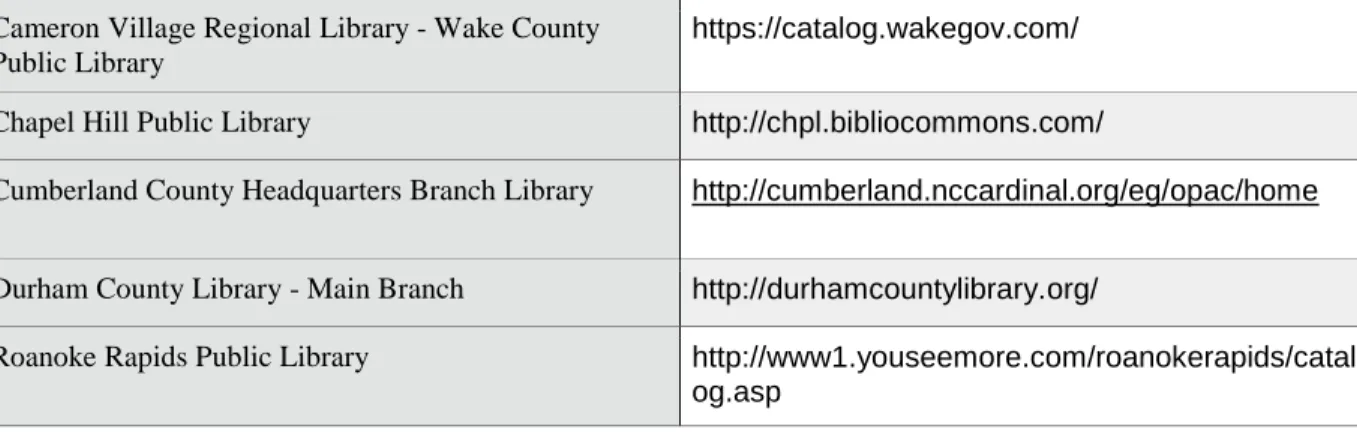
cataloged or typed into the search incorrectly. Table 1 contains the URLs for each library’s OPAC.
TABLE 1: URLS TO SAMPLE LIBRARIES’ ONLINE PUBLIC ACCESS CATALOGS (OPACS)
Cameron Village Regional Library - Wake County Public Library
https://catalog.wakegov.com/
Chapel Hill Public Library http://chpl.bibliocommons.com/
Cumberland County Headquarters Branch Library http://cumberland.nccardinal.org/eg/opac/home
Durham County Library - Main Branch http://durhamcountylibrary.org/
Roanoke Rapids Public Library http://www1.youseemore.com/roanokerapids/catal og.asp
In order to collect the data for each library assessed, the researcher created a spreadsheet of the list of books for each library. The library-specific spreadsheets
included the following categories: Title, Author, Publication year, Associated IBSN, and Library-Specific Barcode (if applicable). In addition to these five general categories, the spreadsheet had two additional categories: Is it in the collection and Circulation Count.
For each title on the assessment list, the researcher included at least the Title, Author, Publication Year, and answered the question of it if was in the collection. This question was recorded on the spreadsheet with a simple yes or no. If the title was in the collection, then the researcher answered the “Is it in the collection?”question as “yes” and recorded the catalog’s corresponding IBSN for the title.
have multiple copies of the same book, or there would be copies of the title available at another library in the system. In order to maintain consistency, and only focus upon the collections at the libraries determined in the convenience sample, copies of a title at other locations as a part of the collection were not included. Rather, the researcher answered “yes”or “no”as to the title’s status in that particular libraries’collection, and then made a note on the spreadsheet if copies were available at another branch in the system.
Similarly, when there were instances of multiple copies of the same title in one library’s collection, barcode of one title was selected to assess in the collection and for the circulation count. The OPACs for Main, CAM, and Cumberland County
Headquarters Library included the barcodes for each specific title in their collections. This barcode was recorded in the appropriate category on each library’s spreadsheet. The specific barcode was used to denote which copy of the title to use for gathering
circulation statistics.
Gathering Circulation Statistics
supplied aggregated circulation data. In other instances the researcher was able to independently access and gather the circulation data.
Methods for Library Comparisons
After looking at each library individually, the researcher created two more spreadsheets combining the collection assessment information and the circulation statistics, respectively, for each title. These spreadsheets allowed for surveying and analysis of the collections for trends, and allowed for answering a number of questions, such as: Which book is circulated the most in the five libraries? Or, which book is circulated the least? The answers to these questions and reporting on additional trends will be discussed later in this document.
Gathering Additional Data
To explore professional reviews and awards for the titles, the researcher searched for the individual book titles in the NoveList database and the UNC Library Catalog. Due to the large number of documents available in the UNC Library Catalog, search terms were carefully constructed with a number of Boolean phrases and limiters. For example, in many searches, the name of the book was placed in quotation marks, in order to search for that particular phrase and searched for the author’s last name and review. A typical search term looked accordingly: “From Head to Toe”and Carle and Review. If advanced search capabilities were provided, results were limited to book reviews and limited the publication years to only those encompassed by the books on the list.
any reviews were listed for it. If a title had no reviews in the UNC Library Catalog and no NoveList page, then it was searched on Amazon, to see if any professional reviews were available. When no professional reviews were found there, the number of customer reviews on Amazon were used to gauge how popular or unpopular the title was.
After it was determined which professional journals contained reviews of a certain book, the journal titles were listed under the “Reviews”column. Similarly, if any awards for the title were found, they were listed in the “Awards”column. If no
professional reviews nor awards were found, the researcher also recorded that
information. This data compiled into a table with all of the combined reviews, awards, circulation, and collection information was then used for analysis and determining trends in the five libraries’collection of picture books that promote physical activity.
R
ESULTSThis section will discuss the results of the collection assessment and the
circulation statistics for each library. After the results from each library are highlighted, the results from the five library comparison will be included. Finally, this section will explore the findings from the search for professional awards and reviews. The results section will move from the individual to the collective, starting with the Cameron Village Regional Library (CAM). The data from all five libraries can be found at the end of the section in Table 2.
Cameron Village Regional Library
is one of the twenty libraries in the Wake County system (Chandler, 2012). As a regional library, Cameron Village is one of the larger libraries in the system. In 2010, there were a total of 900,993 people in Wake County, with approximately 44.83% of that population (403,892) living in the city of Raleigh (US Census Bureau, n.d.d). To serve this
population CAM has extensive children’s and adult programming (McFadden, 2012). It is important to note that Wake County Public Libraries have a shared collection of materials. Therefore, all libraries in the Wake County Public Library System share ownership of and access to the books in the system. While patrons at CAM have access of all materials in the system, information about books in other libraries was not included. Wake County Public Library’s collection is also roving; materials can be returned to any branch location, and are shelved in the location where they are returned. Thus, the books represented on the shelves/collection at Cameron Village are representative of those available in the library on the day the collection was assessed. This assessment took place on Feb. 7, 2015.
Of the 82 total books on the collection assessment list, Cameron Village Regional had 21 books, or 25.6%, from the list in the collection. The most circulated title in
CAM’s collection was Mo Willems’text, Elephants Cannot Dance! There were multiple copies of the book at CAM, with many different copies at other branches within the Wake County Public Library System. The randomly selected copy of Elephants Cannot Dance! assessed for the circulation statistics , and was checked out a total of 75 times.
On the opposite end of the spectrum, the least circulated book from the
different branch libraries. This particular copy of From Head to Toe was checked out once. It should be noted that every title from the list in CAM’s collection either had multiple copies in the library, or at other branches. 13 of the 21 titles had more than one copy on CAM’s shelves, and 19 of the 21 titles were found in other branches.
Chapel Hill Public Library
Located in Chapel Hill, North Carolina, the Chapel Hill Public Library (CHPL) was established in 1958, and has remained a vibrant part of the Chapel Hill Community since it opened (Chapel Hill Public Library, 2015a). CHPL is not a part of a library system, nor a consortium and is open seven days a week (Chapel Hill Public Library, 2015b). CHPL offers a number of programs and services for all ages (Chapel Hill Public Library, 2015c). As of April 2010, there were 57, 233 residents in the town of Chapel Hill, NC (US Census Bureau, n.d.b). Even though Chapel Hill Public Library is in Orange County, it is not a member of the Orange County Public Library System (Orange County, 2015).
Of the five libraries in this convenience survey, Chapel Hill Public Library had the largest number of books in the collection from the Collection Assessment list: 45 of the 82 titles, or 54.9%. The title in the collection with the highest number of check outs was Eric Carle’s “Slowly, Slowly, Slowly’” said the Sloth. There were three copies of the title in the library, and the copy selected for the circulation analysis had a total of 129 check outs. The title with the least amount of check outs was Whitford and Selway’s
Cumberland County Headquarters Branch Library
Located in Fayetteville, NC, Cumberland County Headquarters Branch Library is a part of the Cumberland County Public Library System & Information Center. The Cumberland County Public Library system is made of nine different branches, all within the county. The Headquarters Branch is open seven days a week, and is located in the heart of Fayetteville, the county seat (Cumberland County Public Library & Information Center, n.d.). According to the 2010 census there were 319,431 people living in
Cumberland County, with 200,564 of those persons living in the city of Fayetteville (United States Census Bureau, n.d.a). The library offers a variety of adult, teen, and kids programming (Cumberland County Public Library & Information Center, n.d.). The Cumberland County Public Library system is also a member of a multi-library
consortium within the state called NC Cardinal (NC Cardinal, 2015). Even though the Cumberland County Library system is nine locations and is a part of a multi-county consortium, the collection assessment was limited to books only available at the Headquarters Branch.
was only one copy of the title in the Headquarters Branch library, which was also the only copy of the title in the Cumberland County Library System. There were nine other copies of the title available via NC Cardinal. The copy of Peaceful Piggy Mediation in the Headquarters Branch library had not been checked out of the library.
Durham County Library Main Branch
The Main Branch of the Durham County Library is located in Downtown Durham, North Carolina. It is the central branch of the Durham County Library system that has 8 different branches of varying sizes in different areas in and around Durham County (Durham County Library, n.d.a). The Main Branch of DCL is open seven days a week, and offers a wide variety of programs and services for children, teens, and adults (Durham County Library, n.d.a.; Durham County Library, n.d.b). According to the April 2010 census, 267,587 people lived in Durham County, with 228, 330 of those people living within the city limits (US Census Bureau, n.d.c.). In the year 2014, Main Branch had approximately 84, 543 library card holders, 538 programs attended by 37,012 children, and 220,370 materials in the total collection (Durham County Library, n.d.c.). For the purposes of this assessment, only the collection at the Main Branch of the Durham County Library was assessed for items.
The Main Branch of the Durham County library had 36.7% or 30 of the 82 titles from the Collection Assessment List. The most circulated book from the assessment was R. Walton’s How Can You Dance?, which was checked out 87 times. It should be noted that while the library’s OPAC had classification data for R. Scarry’s The Rooster Struts, the status of the book was on order. So while Main had 30/82 of the books on the
of its on order status, The Rooster Struts had no check out information available. While the circulation total for The Rooster Struts is zero, it has not has the opportunity to be circulated, therefore cannot be counted as the lowest circulating item. With the exception of the status of The Rooster Struts, R. Whitford’s text Sleepy Little Yoga was the least checked out in the collection from the collection assessment list. This copy of Sleepy Little Yoga had only been checked out from the library three times. Of the 30 titles in the Main Branch’s collection, 13 of the titles had more than one copy at Main Branch.
Roanoke Rapids Public Library
The final library in this convenience sample is the Roanoke Rapids Public Library in the city of Roanoke Rapids, North Carolina. The Roanoke Rapids Public Library is a small independent library in Roanoke Rapids, a city of 15, 754 people at the time of the 2010 census (US Census Bureau, n.d.e.). The library was founded in 1933 and is 7,550 square feet with over 41,000 items available (Roanoke Rapids Public Library, n.d.a). Roanoke Rapids Public Library provides community members with a few different programs, including weekly preschool story time and teen book club (Roanoke Rapids Public Library, n.d.b). Of the libraries in this sample, Roanoke Rapids Public Library is the smallest and serves the smallest population.
not necessary. The title with the highest number of check outs at Roanoke Rapids Public Library was Hindley and Bates’s Do Like a Duck Does. The title was checked out 76 times. The lowest number of checkouts was from Calmenson and Degen’s Jazzmatazz!
with a total of nine recoded check-outs. However, the library’s OPAC indicated that the copy of Jazzmatazz! was lost, and there was no date or indication of when the copy went missing. Therefore, the extent to which the book’s lost status effected circulation
numbers is unknown. The next lowest number of check outs was 10 for Mo Willems’s
Elephants Cannot Dance!
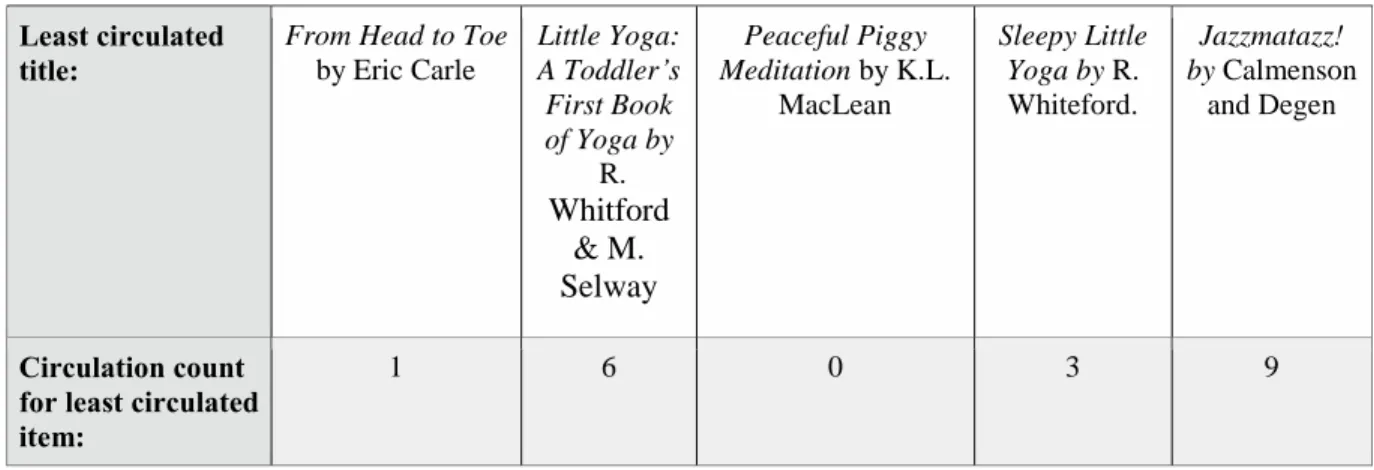
TABLE 2: INDIVIDUAL LIBRARY COMPARISON OF COLLECTION ASSESSMENT AND CIRCULATION DATA Cameron Village Regional Library Chapel Hill Public Library Cumberland County Headquarters Branch Durham County Library Main Branch Roanoke Rapids Public Library
Number of books from the collection assessment list in the collection:
21 45 22 30 5
Percentage of books in collection:
25.6% 54.9% 26.8% 36.6% 6%
Most circulated title:
Elephants Cannot Dance! by Mo
Willems
“Slowly, Slowly, Slowly,”
said the Sloth by Eric Carle
From Head to Toe by Eric Carle
How Can You Dance? by R.
Walton
Do Like a Duck Does by
Hindley and Bates
Circulation count for most
circulated title:
TABLE 2: INDIVIDUAL LIBRARY COMPARISON OF COLLECTION ASSESSMENT AND CIRCULATION DATA
Least circulated title:
From Head to Toe
by Eric Carle
Little Yoga: A Toddler’s First Book of Yoga by
R.
Whitford & M. Selway
Peaceful Piggy Meditation by K.L.
MacLean
Sleepy Little Yoga by R. Whiteford.
Jazzmatazz! by Calmenson
and Degen
Circulation count for least circulated item:
1 6 0 3 9
Combined Data from All Libraries
Once the data from all of the individual libraries in the sample was gathered and analyzed, all library data for the collection assessments and circulation counts was compiled and compared. Of the 82 titles on the Collection Assessment List, a total of 56 of the titles were available in the sample as a total. This information also revealed which titles had the highest and lowest cumulative circulation titles, and which titles all five libraries did or did not have in their collections. This section reports the most circulated items as well as the least circulated items from across the sample, as well as the least and most collected items, respectively.
Most Collected Items
- Let’s Dance, Little Pookie by S. Boynton
- From Head to Toe by Eric Carle
- Bounce by D. Cronin
- Stretch by D.Cronin
- Move! by S. Jenkins
- Ready, set, skip! by J. O’Conner - If You’re Hoppy by A. Sayre
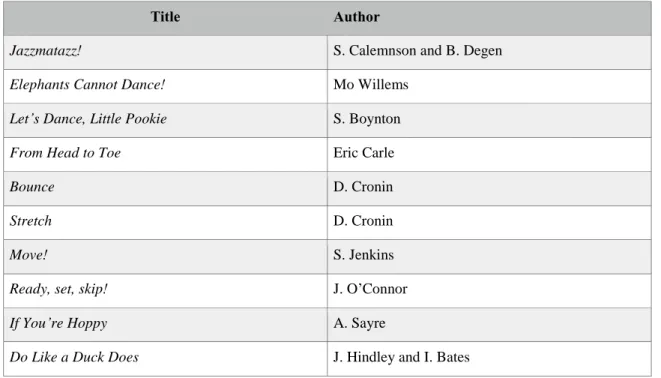
Additionally, there was one title that was available in all libraries except the Durham County Library Main Branch: Hindley and Bates’s Do Like a Duck Does. Of the 82 titles on the collection assessment list, these are the titles that appeared in the largest number of libraries. Table 3 lists the most collected items in the sample.
TABLE 3: MOST COLLECTED TITLES IN THE SAMPLE
Title Author
Jazzmatazz! S. Calemnson and B. Degen
Elephants Cannot Dance! Mo Willems
Let’s Dance, Little Pookie S. Boynton
From Head to Toe Eric Carle
Bounce D. Cronin
Stretch D. Cronin
Move! S. Jenkins
Ready, set, skip! J. O’Connor
If You’re Hoppy A. Sayre
Least Collected Items
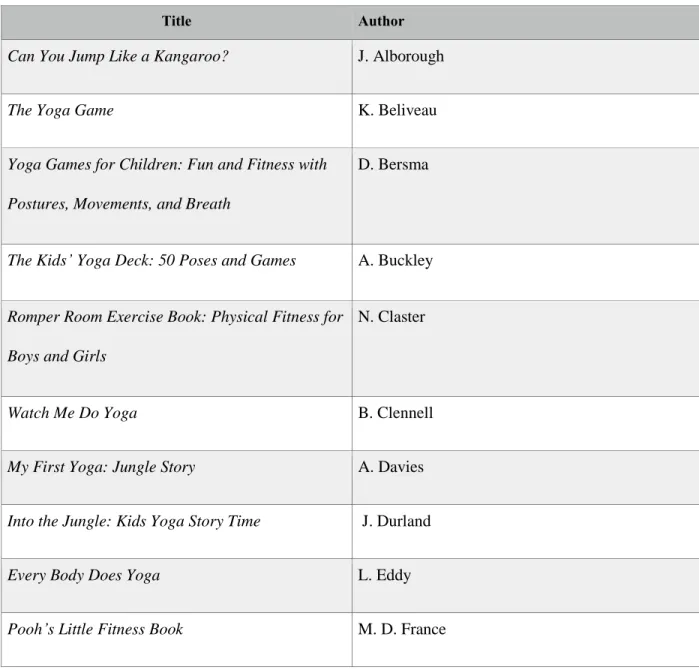
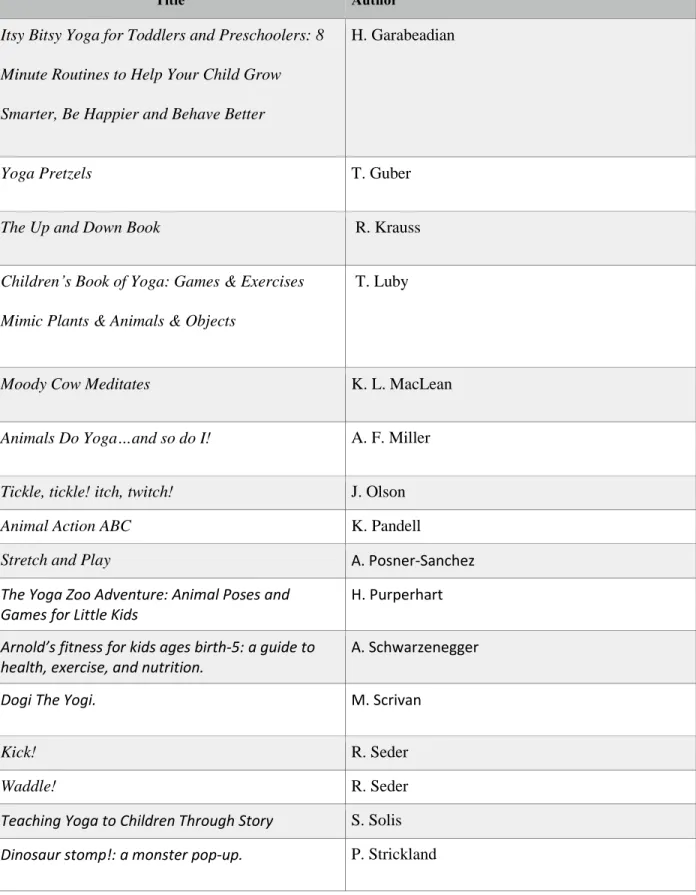
There were also titles that were not in any of the libraries’collections. Out of the 82 titles on the list, 26 were not in any library collections. These items are represented in Table 4, featured below.
TABLE 4: LEAST COLLECTED TITLES IN THE SAMPLE
Title Author
Can You Jump Like a Kangaroo? J. Alborough
The Yoga Game K. Beliveau
Yoga Games for Children: Fun and Fitness with
Postures, Movements, and Breath
D. Bersma
The Kids’ Yoga Deck: 50 Poses and Games A. Buckley
Romper Room Exercise Book: Physical Fitness for
Boys and Girls
N. Claster
Watch Me Do Yoga B. Clennell
My First Yoga: Jungle Story A. Davies
Into the Jungle: Kids Yoga Story Time J. Durland
Every Body Does Yoga L. Eddy
TABLE 4: LEAST COLLECTED TITLES IN THE SAMPLE
Title Author
Itsy Bitsy Yoga for Toddlers and Preschoolers: 8
Minute Routines to Help Your Child Grow
Smarter, Be Happier and Behave Better
H. Garabeadian
Yoga Pretzels T. Guber
The Up and Down Book R. Krauss
Children’s Book of Yoga: Games & Exercises
Mimic Plants & Animals & Objects
T. Luby
Moody Cow Meditates K. L. MacLean
Animals Do Yoga…and so do I! A. F. Miller
Tickle, tickle! itch, twitch! J. Olson
Animal Action ABC K. Pandell
Stretch and Play A. Posner-Sanchez
The Yoga Zoo Adventure: Animal Poses and Games for Little Kids
H. Purperhart
Arnold’s fitness for kids ages birth-5: a guide to health, exercise, and nutrition.
A. Schwarzenegger
Dogi The Yogi. M. Scrivan
Kick! R. Seder
Waddle! R. Seder
Teaching Yoga to Children Through Story S. Solis
All Sample Circulation Statistics
In addition to assessing which titles were collected the most and the least in the sample, all of the per title circulation data was combined in order to see how each title in the Collection Assessment List circulated throughout the entire sample. This section reports the top ten least and most circulated titles, as well as other statistical data.
Sample-Wide Most Circulated Items
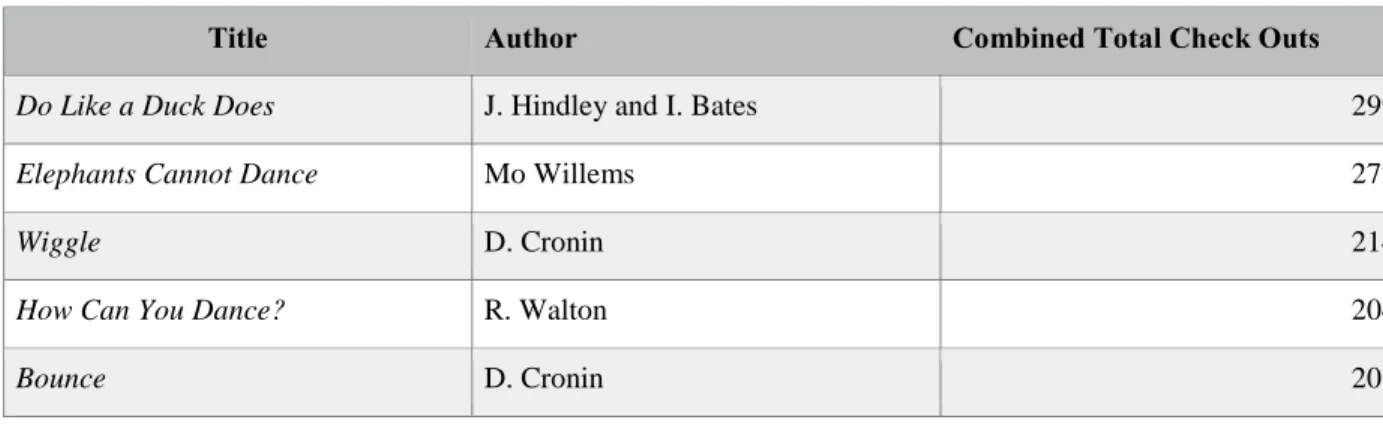
The most checked out book across the sample was Hindley and Bates’s Do Like a Duck Does. Available in Cameron Village Library, Chapel Hill Public Library,
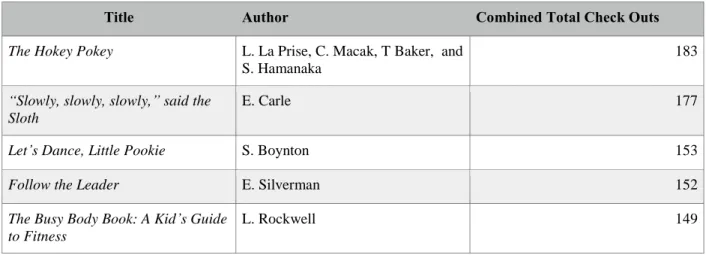
Cumberland County Headquarters Branch Library, and Roanoke Rapids Public Library, the title was checked out a total of 299 times. The second most circulated item was Mo Willems’s Elephants Cannot Dance!, one of the only titles available at every library in the sample. Elephants Cannot Dance! was checked out a total of 272 times. The two titles were followed by Wiggle by D. Cronin, How Can You Dance? by R. Walton, and Bounce, also by Cronin. These titles were checked out 214, 204, and 201 times,
respectively. Of the titles in the sample libraries from the Collection Assessment List, five were checked out over 200 times, and 16 were checked out between 100 and 200 times. Table 5 highlights the most circulated items in the sample.
TABLE 5: SAMPLE-WIDE MOST CIRCULATED ITEMS
Title Author Combined Total Check Outs
Do Like a Duck Does J. Hindley and I. Bates 299
Elephants Cannot Dance Mo Willems 272
Wiggle D. Cronin 214
How Can You Dance? R. Walton 204
TABLE 5: SAMPLE-WIDE MOST CIRCULATED ITEMS
Title Author Combined Total Check Outs
The Hokey Pokey L. La Prise, C. Macak, T Baker, and S. Hamanaka
183
“Slowly, slowly, slowly,” said the Sloth
E. Carle 177
Let’s Dance, Little Pookie S. Boynton 153
Follow the Leader E. Silverman 152
The Busy Body Book: A Kid’s Guide to Fitness
L. Rockwell 149
Sample-Wide Least Circulated Items
In addition to revealing the top 10 most circulated items, the all library
comparison highlighted which titles in the libraries were being checked out the least. Other than the 26 titles that were not in any collections, and therefore not circulated at all, the lowest circulation count was one checkout. This statistic belonged to the one copy of MacLean’s Peaceful Piggy Meditation in the Cumberland County Headquarter’s Branch Library. The next lowest checkout number was four checkouts for R. Reid’s Something Musical Happened at the Library: Adding Song and Dance to Children’s Story
Programs. Table 6 details these titles.
TABLE 6 SAMPLE-WIDE LEAST CIRCULATED ITEMS
Title Author Total Check Outs
Peaceful Piggy Yoga K. L. MacLean 1
Something Musical Happened at the Library: Adding Song and Dance to Children’s Story Programs
R. Reid 4
TABLE 6 SAMPLE-WIDE LEAST CIRCULATED ITEMS
Title Author Total Check Outs
Itsy Bitsy Yoga: Poses to Help Your Baby Sleep Longer, Digest Better, and Grow Stronger
H. Garabedian 13
Move! L. Slegers 15
The ABCs of Yoga for Kids T. Power 16
Tickle, tickle! itch, twitch! J. Olson 18
Gallop! / A scanimation picture book
R. Seder 20
Swing!/ a scanimation picture book R. Seder 26
Little Yoga: A Toddle’s First Book of Yoga
R. Whitford 31
Professional Awards and Reviews
As mentioned in the methods section, each title was searched in NoveList and the UNC Library Catalog in order to see if there were professional reviews and awards for the book. The professional reviews and awards provide supplemental information for analyzing trends in collection development and circulation. Of the 82 titles in the Collection Assessment List, 12 titles were featured in various professional awards lists, including: School Library Journal Best Books, Children’s Picture Book Bestsellers, International Reading Association’s Teachers’Choices, International Reading
Reviews and Collection Status
After awards lists were researched and recorded, the researcher searched for professional awards for the titles. Of the 82 titles on the Collection Assessment List, the researcher was unable to find professional reviews for 21 titles. Of the 21 titles that did not have professional reviews or awards, 18 were not in any of the sample libraries’ collections. The remaining three titles without professional reviews were: Hop, Skip, and Jump, Maisy!; Jump, Wiggle, Twirl & Giggle!; and Peaceful Piggy Yoga. These three titles were each only in the collection of one library.
The other 61 titles were reviewed in at least one professional publication or newspaper. Some titles had only one professional review, while others had more than four. The most common professional publications were Kirkus Reviews, School Library Journal, Publisher’s Weekly, and The Booklist. Thirty-five of the 82 titles had reviews featured in Kirkus Reviews, and 50 titles were reviewed in School Library Journal.
Publisher’s Weekly reviewed 37 titles, and the same number were featured in The Booklist. Other review sources included: Yoga Journal, Bulletin of the Center for Children’s Books, Horn Book Magazine, and Library Media Collection.
TABLE 7: REVIEW JOURNALS OF MOST COLLECTED WORKS
Book title School
Library Journal
Kirkus
Reviews The Booklist Publisher’s Weekly Number of Libraries that own the title
Hop, hop, jump! yes no no yes 3
Little yoga: a toddler’s first book of yoga
yes no yes no 3
You are a lion!: and other fun yoga poses
yes yes yes yes 3
Dancing feet! yes yes yes yes 3
Leap back home to me yes yes yes yes 3
If You’re Hoppy yes no yes no 4
Move! yes yes no no 4
Strech yes yes yes yes 4
From Head to Toe yes no yes no 4
Ready, Set, Skip! yes yes yes yes 4
Hop Jump yes yes yes yes 3
Pretend You’re a Cat yes yes no yes 3
Jazzmatazz! yes yes yes no 5
The Busy Body Book: A Kid’s Guide to Fitness
yes yes yes no 3
Let’s Dance, Little Pookie
no no no no 4
The Hokey Pokey yes yes yes yes 4
Bounce yes yes yes yes 4
How Can You Dance? yes yes yes yes 3
Wiggle yes yes yes no 3
Elephants Cannot Dance!
no no no yes 5
There were 16 titles with reviews in three out of the four journals that were not collected in a majority (3/5) of the libraries in the sample. All of these titles, except Dinosaur Stomp!; A Monster Pop-Up were available in at least one of the sample libraries. While many of these titles were not available in one of the specific sample libraries, they were available within the larger library system.
Reviews and Circulation Statistics
Of the 82 items on the list, 27 titles had a circulation count of zero. 23 of these titles were not in the collections and four titles were only in one out of five collections. The four titles in libraries with circulation counts of zero did not have more than two reviews in the four major journals. The same statistics holds true for most of the ten least circulated titles. Other than Peaceful Piggy Meditation, which was reviewed by
Publisher’s Weekly, The Booklist, and School Library Journal, the lowest circulating books were not reviewed in the major professional journals.
TABLE 8: REVIEW JOURNALS OF MOST AND LEAST CIRCULATED TITLES School Library Journal Kirkus Reviews
The Booklist Publisher’s Weekly
Number of Check Outs for the Title
Most Circulated Titles
Do Like a Duck Does yes yes yes yes 299
Elephants Cannot Dance!
no no no yes 272
Wiggle yes yes yes no 214
How Can You Dance? yes yes yes yes 204
Bounce yes yes yes yes 204
The Hokey Pokey yes yes yes yes 183
“Slowly, Slowly, Slowly,”said the Sloth
yes yes yes yes 177
Let’s Dance Little Pookie
no no no no 153
Follow the Leader yes yes yes no 152
The Busy Body Book: A Kid’s Guide to Fitness
yes yes yes no 149
Least Circulated Titles
Tickle, Tickle! Itch, Twitch!
yes yes no no 18
The ABCs of Yoga for Kids
no no no no 16
Move! no yes no yes 15
Itsy Bitsy Yoga for Toddlers and
Preschoolers: 8-Minute Routines to Help Your Child Grow Smarter, Be Happier and Behave Better
no no no no 13
Hop, Skip, and Jump, Maisy!
TABLE 8: REVIEW JOURNALS OF MOST AND LEAST CIRCULATED TITLES School Library Journal Kirkus Reviews
The Booklist Publisher’s Weekly
Number of Check Outs for the Title
Something musical happened at the library: adding song and dance to children’s story programs
yes no yes no 4
Peaceful Piggy Meditation
yes no yes yes 1
Swing!: a scanimation picture book
no no no yes 0
The Rooster Struts no no no no 0
Itsy Bitsy Yoga: Poses to Help Your Baby Sleep Longer, Digest Better, and Grow Stronger
no no no no 0
D
ISCUSSIONA comparative analysis of the data from the professional reviews and the sample libraries revealed trends in collection and circulation that illustrate how the libraries are collecting children’s books that promote physical activity. In this section, I will discuss trends in collection, then trends in circulation, all within the context of the data gathered from professional reviews. This discussion will: a). demonstrate the need to collect books by well known and loved authors that promote physical activity; b). emphasize the
Trends in Collecting
The library assessments show several collection trends, specifically when compared. First, while the libraries in the sample have books that promote physical activity in their collections, there is no consistency on how they are being collected. Second, books by popular authors are the most likely to be collected. And, finally, professional journals and reviews have the power to affect the collection of children's books that promote physical activity.
Roanoke Rapids Public Library was the smallest library in the sample and had the lowest number of books from the Collection Assessment List. While five titles appears to be low, the small number becomes more understandable when viewed in proportion to the other libraries in the sample. Chapel Hill Public Library, the library with the most titles from the list in the collection is larger in scope, size, and population served than the Roanoke Rapids Public Library. Even then, Chapel Hill Public Library only had 54.9% of the titles from the list in the collection. The collection percentages from the other libraries are discussed above, and highlight a large range and collection emphasis. This shows that there is no consistency in how books that promote physical activity are
collected. The inconsistency along with low percentages of books illuminates the fact that specifically collecting children’s books that promote physical activity is most likely not a criteria considered when selecting children’s books for the sample libraries.
Even with the low percentages, each library in the sample still had children’s books that promote physical activity in all of their collections. Many of those titles were by well-known children’s authors. Mo Willems’s Elephants Cannot Dance! was one of these titles, and was one of the only two titles that were available in all five libraries.
(3/5) of the sample libraries. Eric Carle’s From Head to Toe, S. Boynton’s Let’s Dance Little Pookie, and three titles by Doreen Cronin: Wiggle, Bounce, and Stretch also fit into this category. Carle is a well known children’s author, having penned classics such as The Very Hungry Caterpillar. Cronin is also a popular author who has written a number of children’s books, including the Caldecott award winning Click, Clack, Moo: Cows that Type.
This collection data demonstrates that libraries in the sample are generally collecting books by popular and well-loved authors. Their prevalence in the collection shows a unique opportunity for children’s authors to promote physical activity to the children who are reading their books. If a popular or well-known author writes a text encouraging physical activity, then it is more likely to reach and be read by children because it is being collected by a number of libraries. Well-known authors are also more likely to be known to the audience at the library and therefore read. Books by these authors are also a way to suggest and to introduce new titles promoting physical activity and healthy lifestyles. For example, if a favorite author writes a new book on exercise or yoga, then a child may be more likely to read the title than if the author was previously unknown.
Finally, as Table 7 illustrates, the titles that were in a majority of the sample libraries’collections were generally reviewed in at least two of the major four
professional journals. This connection between collection status and reviews in journals like Publisher’s Weekly, Kirkus Reviews, The Booklist, and School Library Journal,
their materials. The more times a title is reviewed in different journals, the more likely it is that it will be collected by a library in the sample.
For libraries to collect and emphasize children’s books that promote physical activity, then professional reviews will need to highlight a book’s potential to get kids moving. Professional reviews are already using active language to describe some of the most collected books in the sample. Wiggle, by Cronin, is described in as “high energy” in the Horn Book Magazine (Lempke, 2005, pg. 560), and as perfect for “an active storytime about animals in motion”in School Library Journal (Krasniewicz, 2005, pg. 107). In the same manner, How Can You Dance? is described as “just the ticket to get those wiggles out during story time”(Kirkus Reviews, 2001), and as conveying a “wonderful sense of movement”(Ceraldi, 2001, pg. 90). These examples show that children’s book reviews in professional journals are already using language to convey when a book encourages children to actively engage and move with the text. This use of active language paired with the fact that these books are the most collected within the sample, suggests that while librarians may not be actively searching for titles that promote physical activity, they are collecting titles that are being described as full of action. The appropriate vocabulary already exists, and is already influencing how librarians select titles. All that is needed to specifically encourage the collection of children’s books that promote physical activity is awareness and specific descriptors or categories in the professional journals of titles that encourage movement in children.
Trends in Circulation
circulation were similar to those seen in the collection assessment, including the importance and prevalence of well-known authors; and the influence of professional reviews on circulation counts.
Just as the most collected titles in the sample were by popular authors, several of the most circulated titles were written by the same authors or were book adaptions of well-known children’s songs. The second most circulated title in the sample is Willems’s
Elephants Cannot Dance!, which is closely followed by Cronin’s Wiggle and Bounce, as well as Carle’s “Slowly, Slowly, Slowly,”said the Sloth, and Boynton’s Let’s Dance Little Pookie. The fact that well-known authors are the most circulated, highlights that patrons in these libraries may be more likely to check out books about physical activity if they are by authors that they are already familiar with. This again emphasizes well-known authors’unique opportunity to promote physical activity to children. Children’s books that promote physical activity by well-known and loved authors are more likely to be checked out and read by children. If popular authors wrote more books about physical activity, then it is possible that they could promote healthy lifestyle habits to children who would not have been exposed to the topic otherwise.
professionally reviewed, but widely circulated, most likely due to the familiarity and popularity of the author.
The connection between professional reviews and circulation numbers
emphasizes that reviews also affect which books get checked out. There are a number of factors that could cause this connection. First, patrons may see the reviews themselves and seek out the featured titles. Library patrons reading reviews to select their own materials again highlights an opportunity for professional reviews to emphasize
children’s books that are promoting physical activity. For example, reviews highlighting how children’s books promote physical activity may be useful for parents or guardians who are looking for bibliotherapeutic interventions for their own children.
The collection assessment and circulation data collected from this sample, in the context of the professional reviews, highlight that the sample libraries already have books in their libraries that promote physical activity, and that these books are being checked out. The data shows that patrons are checking out books by well-known and loved authors. The data shows the close relationship between professional reviews and
collection and circulation, and that the reviews of the most collected and circulated books are already emphasizing the active nature of the text. The data suggests that there is already a desire in the sample libraries for children’s books that promote physical activity.
L
IMITATIONSThere were some limitations to this study that may affect the outcome. While a convenience sample was the most appropriate for the length and scale of the study, it is important to stress that the results cannot be interpreted and/or generalized to represent libraries and communities beyond those surveyed (Saumure and Given, 2008). The conclusions drawn from this study are only representative of the libraries assessed, and are not representative of nor applicable to libraries outside of the sample size.
C
ONCLUSIONUsing a pre-determined list of titles, this study assessed the collections of five public libraries in North Carolina in order to determine the extent to which the libraries collected and circulated children’s books that promote physical activity. In addition to the collection and circulation data, the study examined the relationship between titles in the sample libraries and reviews in professional journals. The collection data showed that the five libraries do have children’s books that promote physical activity in their
collections and that these titles are being checked out. Focusing primarily on reviews in
School Library Journal, Publisher’s Weekly, Kirkus Reviews, and The Booklist, a comparison of reviews and library data suggest that the titles most collected and most circulated in the sample are those reviewed in a majority of journals. Furthermore, the reviews show that the most collected and circulated texts are described in the review with words that emphasize the active nature of the book. Librarians are collecting and patrons are checking out books that are already described as being active. The study also
demonstrates that children’s books that promote physical activity written by well-known authors such as Eric Carle are more likely to be collected and circulated.
Librarians in these sample libraries are uniquely situated to use books to help children be physically active and to learn about healthy lifestyles because of the books already in their collections. With the implementation of identifiers in journals of books that promote physical activity, and an increased awareness of the uses of texts for
B
IBLIOGRAPHYCalhoun, Jr., G. (1987). Enhancing Self-Perception Through Bibliotherapy. Adolescence
22(88): 939-943
Canoy, Dexter and Bundred, Peter. (2011). Obesity in children. Clin Evid (Online)
2011(2011): 0325
Ceraldi, Genevieve. (2001). How Can You Dance? [Review of the book How can you dance? by Rick Walton]. School Library Journal, 47.7 (Jul 2001): 90.
Chandler, L. (2012). Library Locations. Wake County Government. Retrieved from: http://www.wakegov.com/libraries/locations/Pages/default.aspx
Chapel Hill Public Library. (2015a). History of the Library. Retrieved from: http:// chapelhillpubliclibrary.org/txp/?s=About+CHPL&c=30.+History+of+CHPL Chapel Hill Public Library. (2015b). Library Information. Retrieved from: http://
chapelhillpubliclibrary.org/txp/?s=About%20CHPL&c=01.+Contact+Us
Chapman, J. (2014). The North Carolina Library Edge Initiative: Statewide Assessment Results, 2014. State Library of North Carolina.
Retrieved from: http://plstats.nclive.org/reports/EDGE%20analysis_final.pdf Cumberland County Public Library & Information Center. (n.d.). Locations & Hours.
Retrieved from: http://www.cumberland.lib.nc.us/ccplsite/
Dean, K. S. (2008). Jazzmatazz! [Review of the book Jazzmatazz! by S. Calmenson.]
School Library Journal, 54(3):155
Dialessi, J. and Burns, J. (1994). About Dying and Divorce: How Can a Book Console a Child? The NERA Journal 30(3):17
Durham County Library. (n.d.a.). Locations & Hours. Durham County Library. Retrieved from:http://durhamcountylibrary.org/location/
Durham County Library. (n.d.b.). Main Library. Durham County Library. Retrieved from: http://durhamcountylibrary.org/location/main/
Durham County Library. (n.d.c.). Main Library Renovation: Main Library Facts. Durham County Library. Retrieved from: http://durhamcountylibrary.org/mainrenovation/ Echeverría, S.,Vélez-Valle, E., Janevic, T., and Prystowsky, A. (2014). The Role of
Poverty Status and Obesity on School Attendance in the United States. Journal of Adolescent Health 55(3): 402-407
Fadiman, C. (2014). Children’s literature. Encyclopeadia Britannica. Retrieved from:
http://www.britannica.com/EBchecked/topic/111289/childrens-literature
Health, M., Sheen, D., Leavy., Young, E., Money, K. (2005). Bibliotherapy: A Resource to Facilitate Emotional Healing and Growth. School Psychology International 26(5):563-580
Howie, Mary. (1983). Bibliotherapy in Social Work. The British Journal of Social Work
13(1): 287-319.
Kirkus Reviews. (2001). How can you dance? [Review of the book How can you dance? by Rick Walton]. Kirkus Reviews, 10 (May 15, 2001).
Kirkus Reviews. (2007). Jazzmatazz! [Review of the book Jazzmatazz! by S. Calmenson.]
Kirkus Reviews, 23 (Dec 1, 2007).
Krasniewicz, Kathy. (2005). Wiggle. [Review of the book Wiggle by Doreen Cronin].
School Library Journal, 51.6 (Jun 2005): 107.
Idaho Commission for Libraries. (2011a). The Purpose of Collection Assessment. Retrieved from http://lili.org/forlibs/ce/able/course2/03purpose.htm
Idaho Commission for Libraries. (2011b). Quantitative Measures for Library Collections. Retrieved from http://lili.org/forlibs/ce/able/course2/05measures1.htm
Jack, S., Ronan, K. (2008). Bibliotherapy: Practice and Research. School Psychology International 29(2): 161-182
Laster, L., Lovelady, C., West, D., Wiltheiss, G., Brouwer, R., Stroo, M., Østbye, T (2013). Diet Quality of Overweight and Obese Mothers and Their Preschool Children. Journal of the Academy of Nutrition and Dietetics 113(11): 1476-1483 Lempke, S. D. (2005). Wiggle. [Review of the book Wiggle by Doreen Cronin]. The
Horn Book Magazine, 81.5(Sept/Oct 2005): 560
Lindeman, B., and Kling, M. (1968-1969). Bibliotherapy: Definitions, uses and studies. J. School Psychol. 7(2):36-41