California State University, San Bernardino California State University, San Bernardino
CSUSB ScholarWorks
CSUSB ScholarWorks
Electronic Theses, Projects, and Dissertations Office of Graduate Studies6-2017
THE EFFECT OF MODE OF EDUCATION AND DEGREE LEVEL ON
THE EFFECT OF MODE OF EDUCATION AND DEGREE LEVEL ON
EMPLOYER PERCEPTIONS OF APPLICANTS' HIREABILITY
EMPLOYER PERCEPTIONS OF APPLICANTS' HIREABILITY
Benjamin SafaraCalifornia State University - San Bernardino, [email protected]
Follow this and additional works at: https://scholarworks.lib.csusb.edu/etd
Part of the Industrial and Organizational Psychology Commons, and the Social Psychology Commons Recommended Citation
Recommended Citation
Safara, Benjamin, "THE EFFECT OF MODE OF EDUCATION AND DEGREE LEVEL ON EMPLOYER PERCEPTIONS OF APPLICANTS' HIREABILITY" (2017). Electronic Theses, Projects, and Dissertations. 453.
https://scholarworks.lib.csusb.edu/etd/453
THE EFFECT OF MODE OF EDUCATION AND DEGREE LEVEL ON EMPLOYER PERCEPTIONS OF APPLICANTS’ HIREABILITY
A Thesis Presented to the
Faculty of
California State University, San Bernardino
In Partial Fulfillment
of the Requirements for the Degree Master of Science
in Psychology: Industrial/Organizational
by
Benjamin Nathaniel Safara June 2017
THE EFFECT OF MODE OF EDUCATION AND DEGREE LEVEL ON EMPLOYER PERCEPTIONS OF APPLICANTS’ HIREABILITY
A Thesis Presented to the
Faculty of
California State University, San Bernardino
by
Benjamin Nathaniel Safara June 2017
Approved by:
Kenneth S. Shultz, Committee Chair, Psychology Janet L. Kottke, Committee Member
ABSTRACT
Online education is becoming more prominent, but it has been found that employers are biased against hiring job applicants with online education. The influence of mode of education and degree level on employer perceptions of applicants’ hireability was investigated. It was hypothesized that employer perceptions would decrease as the education of an applicant moved to a category consisting of more online education. It was hypothesized that employers would be less likely to move forward with applicants in the hiring process (viability) as applicants’ education moved to a category consisting of more online education. It was hypothesized that degree level would moderate the relationship of mode of education on employer perceptions of applicants’ hireability and viability. Although it was expected that perceptions of hireability would increase as the applicants’ degree level increased and that perceptions would decrease as applicants’ education moved to a category consisting of more online education, as mode of education moved from hybrid to online, employer perceptions of applicants’ hireability were expected to decrease as applicants’ college degree level advanced. Survey results were collected using Qualtrics Resume Screener service. Results showed employer biases against an applicant’s hireability and viability exist as an applicants’ education moved to a category consisting of more online education, but degree level did not change this relationship. Theories were applied to results to provide possible
explanations for the biases. The limitations of the current study as well as the theoretical and practical implications of the results are discussed.
ACKNOWLEDGEMENTS
I would like to thank my thesis advisor, Dr. Kenneth Shultz, for his guidance in completing this work. I would like to thank my committee members, Dr. Janet Kottke and Dr. Janelle Gilbert, for their contributions in guiding the
TABLE OF CONTENTS
ABSTRACT ... iii
ACKNOWLEDGEMENTS ... v
LIST OF TABLES ... viii
CHAPTER ONE: LITERATURE REVIEW Employer Online Education Bias ... 1
Need for Education ... 2
Online Medium Remedy ... 3
Student Concerns ... 4
Employer Selection Practices ... 6
Employer Perceptions ... 8
The Present Study ... 19
Hypothesis Formation ... 19
CHAPTER TWO: METHODS Participants ... 28
Measures ... 31
Demographics ... 31
Mode of Education ... 31
Degree Level ... 31
Employer Perception of Applicants’ Hireability ... 31
Employer Perception of Applicants’ Viability ... 31
Procedure ... 32
CHAPTER THREE: RESULTS ... 35
Hypothesis 1 ... 38
Hypothesis 2 ... 39
Hypothesis 3 ... 39
Hypothesis 4 ... 44
CHAPTER FOUR: DISCUSSION ... 58
Findings ... 59
Mode of Education ... 59
Degree Level ... 60
Group Comparisons ... 61
Limitations ... 63
CHAPTER FIVE: IMPLICATIONS AND DIRECTIONS FOR FUTURE RESEARCH Theoretical Implications ... 65
Practical Implications ... 70
Discussions for Future Research ... 74
APPENDIX A: SCALES ... 77
APPENDIX B: HYPOTHESES PREDICTIONS ... 90
APPENDIX C: ANALYSES ... 95
APPENDIX D: SAMPLE RECRUITMENT EMAIL ... 102
APPENDIX E: INFORMED CONSENT ... 105
APPENDIX F: INSTITUTIONAL REVIEW BOARD APPROVAL LETTER ... 107
LIST OF TABLES
Table 1. Demographic Variables ... 30 Table 2. Applicant Profiles ... 32 Table 3. Normality Tests... 36 Table 4. Repeated Measures Factorial ANOVA Contrasts of
Original Variables on Hireability ... 41 Table 5. Repeated Measures Factorial ANOVA Contrasts of Log
Transformed Variables on Hireability ... 43 Table 6. Repeated Measures Factorial ANOVA Contrasts of
Original Variables on Viability ... 45 Table 7. Repeated Measures Factorial ANOVA Contrasts of Log
Transformed Variables on Viability ... 46 Table 8. Group Normality ... 49 Table 9. Group Mean Comparisons ... 51
CHAPTER ONE LITERATURE REVIEW
Employer Online Education Bias
Employers have tended to favor applicants with college degrees earned from traditionally instructed (i.e., face-to-face) programs. The preference has been enough to potentially impact hiring decisions. This is because degrees earned from online programs are often stigmatized as less credible, and the bias against them is used as a reflection of the degree holders’ assumed lower job performance ability. Among industries, this has been found particularly in education (Adams & DeFleur, 2005; Adams, Lee, & Cortese, 2012; Connolly & Dippenbrock, 2011; DePriest & Absher, 2013; Flowers & Baltzer, 2006;
Mustafa, 2012; Huss, 2007). Studies in other occupational fields, such as Healthcare and Engineering, have shown similar results (Adams, Defleur, & Heald, 2007; Adams & DeFleur, 2006). Findings in industries other than education though, are limited to a few studies at best. Overall, there is a paucity of research regarding the topic and additional research is needed to generalize findings to industries other than education. Many foci for research are likely to contribute to the body of extant literature on this topic. This study was not specific to one industry; instead, other factors that are likely to
influence employer’s perceptions across industries were considered. Specifically, the factors were the applicants’ degree level and an additional level of the mode of education variable, hybrid. Doing so aimed to add value
both practically, by informing potential students as to what may affect their marketability post-graduation, and theoretically, by investigating other variables that contribute to an understanding of the source of employer’s perceptions of potential job applicant’s.
Need for Education
Many Americans seek education beyond the high school level in hope of acquiring careers with comfortable pay to afford greater standards of living. Over the course of a lifetime’s work, a college education is worth one million dollars more than a high school diploma (Carnevale, Strohl, & Melton, 2011). For positions which high school diplomas have been traditionally sufficient for meeting minimum education requirements, education beyond high school is increasingly required, particularly, in skilled labor and administrative positions (Society for Human Resource Management [SHRM], 2012). For positions that high education requirements have not been increasing, including minimum-wage jobs, competition between first-time job seekers and degree holders is becoming common, mainly since the economic downturn in the United States that began in 2007. Even further, employees may only be eligible for
promotion if they extend their education by earning a degree. By 2020, it is projected that 65% of US jobs will require some form of postsecondary education and the US will have a deficit of 5 million workers with those credentials if postsecondary attainment rates do not increase substantially (Carnevale, Smith, Strohl, 2013). As a result, a high school education or less
is increasingly no longer sufficient for most high earning jobs . Earning a college degree is becoming necessary, simply to remain competitive for work (Bills, 2003).
Traditional colleges are receiving an increasing number of applications and they can only accommodate so many students. Although colleges are increasing their class sizes, they cannot keep up with the demand for enrollment. From 2001 to 2008, average annual increases in the median number of applications at public, four-year institutions increased about 6 percent a year, or 47 percent growth overall. The increase was 8 percent a year at private, not-for-profit institutions, for an overall 70 percent increase over this period (Hossler, Gross, & Beck, 2010). Between the Fall 2014 and Fall 2015 admission cycles, the number of applications from first-time
freshmen increased 6 percent, applications from prospective transfer students increased by 4 percent, and international student applications increased by 23 percent, on average (Clinedinst, Koranteng, & Nicola, 2016)
.
As a result, job seekers are looking for options other than traditional colleges to earn degrees in order to remain competitive for employment.Online Medium Remedy
One solution to the supply and demand issues in higher education seemingly exists in online education, a type of distance learning. With
exponential advancements in technology, educators with limited resources are turning to virtual education to deliver instruction to mass numbers of students
(Johnson, 2003). All types of institutions, including public, private non-profit, and private for-profit, are expanding their educational options to include online instruction. The larger the institution, the more likely it is that it will have a fully online degree program (Allen, Seaman, & Sloan, 2007). Among the top 100 universities as determined by U.S. News and World Report, nearly 75% offered one online degree program in 2014 and the larger the university, the faster online education has been growing (Center of Online Education [COE], 2017). Johnson (2003) stated that the flexibility of distance education is appealing for those that have full-time jobs, families, and therefore, limited discretionary time. Furthermore, Carnevale (2003) reported that online instruction can be much more efficient in terms of expenses. For example, simulated lab experiments save hard science majors money as mistakes do not ruin expensive materials or have serious repercussions when errors are made. Online instruction programs appear beneficial to multiple parties: efficient for educators; accommodating for students; and as will be discussed, lucrative and productive for investors. However, there are drawbacks to online classes as well.
Student Concerns
There are notable concerns for the potential student pursuing online education. In comparison to government-funded colleges, many of the private, for-profit institutions that have been founded over the last few decades, which account for most of the online-based programs, charge exorbitant rates for
tuition. For example, in the 2014-2015 school year, the average tuition and fees for public, four-year institutions was $18,632 and $37,990 for private, nonprofit and for-profit, four-year institutions (U.S. Department of Education, 2016).
Despite the financial concern, the proportion of students taking at least one online course has increased from fewer than 1 in 10 in 2002, to nearly one-third by 2010, with the number of online students growing from 1.6 million to over 6.1 million over the same period – an 18.3 percent compound annual growth rate (Allen, Seaman, Babson Survey Research, & Inside Higher, 2012). The proportion of all students taking at least one online course reached an all-time high of 32%, totaling 6.7 million students in 2012 (Allen, Seaman, Babson Survey Research, & Inside Higher, 2013). With the influx of enrollees and the lack of selectivity of these programs, there is a stigma of lesser quality and a concern exists that potential employers hold the degrees in low regard (Linardopoulos, 2012).
Potential students may seek higher education for a variety of reasons such as fulfilling education requirements for careers, personal growth, or to learn a skill. For those pursuing advanced degrees, it is important to consider whether online coursework will be weighed tantamount to traditional
coursework when evaluated by graduate admissions. The research concerning the perceptions of online education by graduate admissions officers is mixed. Three studies showed academic officers consider traditional
education superior to online education (Adams, 2009; Defleur & Adams, 2004; Mustafa, 2012), but three studies of academic admissions officers showed online education is perceived as equivalent to traditional education (Allen et al., 2007; 2010; Allen et al., 2012). Only the study by Mustafa (2012) found a bias to exist for employment outcomes of the students, too. Overall, these findings do not generalize to the faculty body of the institutions, nor employers. The present study focused on employer perceptions because it is their
perceptions that matter in determining whether graduates are selected for employment. Potential college students then, should be highly concerned with employer perceptions when determining whether they should pursue higher education via online instruction. If employers are indeed negatively biased against online degrees to the extent that a decrease in opportunities for gainful employment follows, students who hold these degrees are likely to regard them as less valuable, and be less likely to enroll in such programs. Employer Selection Practices
In psychology, dual process theory posits that phenomena can occur because of two different processes: one, an automatic and unconscious process; and two, a controlled and conscious process (Marcum, 2012). Forming judgments and making decisions are explained by people’s use of simple and efficient mental shortcuts, or heuristics. These cognitive shortcuts are manifestations of the controlled process variety and reduce intricate issues to simpler ones. Although heuristics can be rather useful, they can also lead to
notions removed from logic and rationalization. These flaws in thinking are known as cognitive biases.
Employer selection processes are designed with the intention of hiring the best applicants, those who will be top performers. Using mode of
education as the basis for determining whether an applicant should be granted further consideration - that is, heuristically (viability) - may not be the soundest method for making these predictions, considering research demonstrated that learning outcomes are comparable for students learning online as in
traditionally based courses (Allen et al., 2010). The equalizing factor is whether the online courses offer instruction from professors. Sitzmann, Kraiger, Stewart, and Wishner (2006) reported no differences in procedural and declarative knowledge from students participating in web-based versus classroom instruction. Bhatti, Jones, Richardson, Forneman, Lund, and Tierney (2011) found medical students participating in e-learning
supplemented with a podcast, outperformed students engaging in a traditional lecture on a multiple-choice and matching questionnaire. A meta-analysis including 71,731 participants demonstrated that distance education students slightly outperformed students of traditional-based instruction in terms of course grades and exam scores (Allen et al., 2004). In the study, distance education denoted the physical absence of an instructor. If employers assume online education means students completed their coursework without the instruction, feedback, and participation of an instructor, they may be basing
their hiring decisions on incorrect information and want to investigate further as to whether instruction by professors was provided for the candidates’ education.
It is likely that using mode of education to screen candidates will result in a higher rate of error, particularly, type I errors. A type I error would result when a traditional candidate is selected over an online candidate solely based on the mode of the candidates’ education, and the traditional candidate
performed lower than the online candidate. This can result the same in favor of the online candidate, where the online candidate is selected over a traditional candidate solely based on the mode of the candidates’ education; though it is likely that the former scenario would occur more often, considering that
research to date, substantiates employer bias for traditional degrees. Employer Perceptions
Employers have expressed specific concerns regarding degrees earned online. For example, Adams and Defleur (2006) noted employers were
particularly worried about the level of in-person interaction experienced by online students. A more recent study by Adams in 2008 confirmed this
concern and introduced the issue with the online, degree-granting campuses’ reputation, as well as the lack of mentored learning experiences afforded to students. Thompson (2009) recognized some of these concerns such as presentation, team building, and communication, as soft or social skills that are vital in the workforce. Columbaro and Monaghan (2009) added employer
concerns with online programs’ academic rigor, risk for cheating, and perceived lack of student commitment (i.e., unwillingness to be physically present on campus). Midlevel student affairs professionals placed a high value on experience and personal contact with faculty, peers, and administrators, throughout the educational experience. They did not consider these qualities available through online education (Connolly & Diepenbrock, 2011).
Again, employer reservations regarding online programs’ academic rigor and reputation have been used heuristically. It has been inferred that these assumptions serve as a basis to judge students and predict their competence and performance as future employees. As far as employers are concerned, earning a degree online is a lower quality education than a degree earned traditionally and it is a reflection of the student’s ability. They inferred that if hired, candidates with online degrees will be less competent and
demonstrate inferior performance compared to those with traditional degrees. A modest amount of research (11 studies) has been conducted
purporting that employers do not perceive the degrees from online colleges as equivalent to degrees earned from in-person educational settings (Adams & DeFleur, 2005; Adams & DeFleur, 2006; Adams, Lee, & Cortese, 2012; Adams et al., 2007; Connolly & Diepenbrock, 2011; Deming et al., 2014; DePriest & Absher, 2013; Flowers & Baltzer, 2006; Mustafa, 2012; Huss, 2007; Rechlin & Kraiger, 2012). Instead, they preferred degrees earned traditionally. Adams, Lee, and Cortese (2012) yielded overwhelming evidence
for bias against online degrees. Further analysis of the survey data from 683 high school principals gathered from the Department of Education website for each of the 50 states, indicated that online degrees were perceived as not presenting sufficient opportunity for students to develop important social skills through interaction with other students and mentors. According to Thompson (2009), some employers only considered applicants with traditional degrees. However, Thompson indicated that differences favoring traditional education existed in industries where a college degree is often required for employment and in industries in which work activities require a high degree of expertise and training. She found that this is true in organizations that had a large
percentage of employees with a Bachelor or graduate degree too. Specifically, online degrees were less accepted when the concentration was in Engineering or Business as compared to Recreation, Entertainment, and Hospitality.
Deming et al. (2014) found employers favored candidates with a bachelor’s degree from a public institution versus from a for-profit, online institution. The outcome variable was candidate’s receiving calls from employers after
submitting resumes to job openings. Though they did not definitively make the decision to hire the student with a traditional education over an online
education, they also did not express interest in the student with the online education, essentially screening the candidate out of the selection process on the basis of the candidates’ mode of education.
Linardopoulos (2012) wrote a qualitative review analyzing studies on the topic and concluded that there was a much greater likelihood that a candidate with an online degree would be viewed less favorably for
employment compared to the candidate with a traditional degree. Mustafa (2012) identified similar results in academia among Arab nations, and Rechlin and Kraigers' (2012) results were consistent in the field of
Industrial-Organizational psychology. In a study by Adams and Defleur (2006),
participants came from many fields of study, ranging from social services and government, and news and entertainment, to research and consulting. Still, bias against online degrees was found.
After controlling for recommendations, publications, and course content, faculty candidates earning Doctoral degrees were found to be at a disadvantage when earning their degree online (Adams & DeFleur, 2005). This finding was consistent with research by Flowers and Baltzer (2006) and although it did not hold in a study by Guendoo (2008), participants in the study specified that they were receptive to hiring faculty with online degrees when the candidate had considerable teaching experience, publications, and
demonstrated professional service. The study by Guendoo (2008) though, did not control for these ancillary variables on applicants’ applications, which muddles the value of the results serving as opposing information to the phenomenon of employer bias against online education. Collectively, the
literature has focused on perceptions in a variety of industries, but has done little in the way of explaining the attributions.
A reasonable characteristic to begin investigating, are differences in the studies’ participants. In Guendoos' (2008) study, the subjects of the study were restricted to community college administrators, which included deans, associate deans, chairpersons and associate chairs, directors of departments, college vice presidents, and senior faculty members serving on hiring
committees at a community college. The attribution may be explained by the in-group bias, a cognitive bias in which there is a tendency for people to give preferential treatment to others they perceive to be members of their own groups (Taylor & Doria, 1981). Administrators may perceive those with online education favorably as they associate applicants with online education as belonging to a group their organization supports. If this is the case, community colleges are likely more open to online education as their school offers
coursework to be completed online.
In the literature comparing perceptions between online and traditional modes of education, three of the eight studies (Allen et al., 2007; 2010; Allen et al., 2012) found online education was perceived as equal to or better than traditional education. Like the study by Guendoo (2008), these studies had administrators as subjects. As a result, the findings cannot be generalized to employer perceptions of applicants’ degrees. Additionally, Allen, Seaman, Babson Survey Research, and Inside Higher (2012), and Allen, Seaman, and
Sloan (2007) noted that although administrators perceived online and traditional modes of education as equal, the faculty at the schools did not. Given the subjects were administrators, the results of these studies too, may be explained by the in-group bias. Two studies showed that the more online coursework that is offered at an institution, the more positive ratings were of learning outcomes (Allen et al., 2012; Allen et al., 2010). No differences in perception were found among subjects with varying degrees of online education experience in one study, (Adams, et al., 2007) but those with experience taking online courses were more likely to recommend a candidate with an online education for hire in one study (Adams et al., 2012) and faculty with direct online teaching experience in the study by Allen et al. (2010) were found to have the most positive views towards online education. Principals were more favorable towards students with online education when the principals’ schools planned to offer credit for online courses. Mustafa (2012) demonstrated employer bias against online degrees, and most of the subjects were not taking online courses and did not study them.
While most departments offered online education for participants in the study by Flowers and Baltzer (2006), the number varied greatly, indicated by a large standard deviation. For those offering less coursework to be completed online, it is likely doing so reflects recent changes in the school’s academic curriculum. Residual bias for online education may hold, and be in a process of adjusting to the idea that online is a suitable mode of education.
In addition to the in-group bias, negative employer perceptions of online education may be explained by the availability heuristic; a type of mental shortcut characterized by the tendency of people to overestimate the frequency of pairings (Chapman, 1967). This cognitive bias has been
explained by the ease with which information comes to one’s mind (Tversky & Kahnerman, 1973). With all the negative media attention surrounding the epidemic of student debt in the United States and its association with high tuition rates - which are characteristic of many on the schools offering exclusively online degrees and programs - employers are likely to attribute online education with the negative stigma. Furthermore, if the general perception of online programs is negative, repeated exposure to this type of negative reference, and ultimately, perception by others, can serve to strengthen the poor image held by the perceiving individual. Whatever the source, employers’ negative perceptions are likely reinforced and more easily retrievable as those negative perceptions reoccur.
Other cognitive biases serve as possible sources of employer
attributions. In addition to administrators at schools, employees who exhibited positive perceptions of applicants with online education who are employed by companies that support online education (offering tuition reimbursement for online programs) and alternatively, employers who negatively perceive online education whose staff mostly hold traditional degrees as in the study by Thompson (2009), the similar-to-me bias may explain their attributions as a
form of self-presentation. Self-presentation is a process in social psychology whereby people attempt to control others’ perceptions of them (Cialdini & Nicholas, 1989). By extension, this may motivate employers to exhibit biases against applicants completing education online as a way to preserve or
maintain a positive reputation or image of their company. Maintaining similarity amongst employees by making hiring decisions based on the type of
education of a candidate, promotes likability of the organization, and in turn, is an attempt at self-preservation.
Allen et al. (2007) noted that small, private four-year colleges have the most negative opinions about online education, as they are the least likely to offer online education. Not only might those making hiring decisions be motivated to preserve the reputation of their organization, but they may be influenced by self-interest as well. Cues such as witnessing preference for traditional hires, and hearing the opinions of those in superior positions within the organization, to curriculums offering online coursework within the
organization offer information to an employee about their company’s culture. Though their personal view may differ, they are likely to side with the collective position of their employer to promote their own likability. This illustrates a clear example of the bandwagon effect, characterized by the probability of individual adoption increasing with respect to the proportion that have already done so regardless of the underlying evidence (Colman, 2003). This tendency occurs because individuals prefer to conform and derive information from others.
Furthermore, social identity theory plays a role in their decision, which is based on an individual’s membership or non-membership in a variety of social groups (Turner & Oaks, 1986). This theory posits that a person’s action
depends on which group membership is most salient at the time of their actions. In this case, their attribution of an applicant’s hireability considering the applicant’s mode of education may directly depend on their employers’ general perception.
Certified public accounting firm recruiters did not differentiate mode of instruction when hiring candidates who earned Masters of accounting degrees (Metrejean & Noland, 2011). However, firms typically hire entry-level
accountants based on their undergraduate coursework and usually do their own training. These points were recognized as limitations of the study that may explain the firms’ indifference towards online Master’s of accounting degrees in hiring decisions. Research by Tabatabaei and Gardiner (2012) did not support the notion that an information systems graduate's education mode was an important consideration to recruiters. They added that other factors such as work experience and academic performance were more salient and important to recruiters. Overall, they proposed that online education is evolving into a viable alternative to traditional education, with other factors dominating perceptions of attractiveness for information systems graduates. All of the subjects from the study were recruiters from one university that recently started offering online courses and did not offer online information systems
degrees. Online degrees may not be much of a concern in the field of information systems considering the high demand and low availability of qualified professionals as well as the nature of the degree (Burning Glass, 2014). It is reasonable to believe the negative stigma of online learning is tempered given the similarity between the field of information technology and the nature of online learning. Furthermore, recruiters may be more concerned with placing candidates and filling positions than they are with applicants’ mode of education, as their job performance is typically evaluated based on their number of placements.
Proponents of online instruction suggest that students who attend college virtually demonstrate exceptional discipline because the increase in independence allows for less procrastination and commands strict adherence to schedules (Adams, 2008). Linardopoulos (2012) found student skills can temper the undermined credibility of online degrees. It is important that skills are highlighted in applications, résumés, and cover letters in order to stand out to employers when employers are reviewing the aforementioned materials. Additionally, advocates proposed that these students often work while
attending school, which speaks in favor of their outstanding motivation, drive, and commitment (Columbaro & Monaghan, 2009). As mentioned, the flexibility afforded by online education is convenient for those with restricted time - such as working professionals, those with families, and caregivers – who are
may be explained by the tendency to overestimate personality or dispositional-based explanations for behavior while undervaluing situational explanations, known as the fundamental attribution error (Ross, 1977). They may attribute students attending online schools to laziness and poor academic performance that prevented students to attend traditionally instructed schools. In turn, employers may use this attribution to predict job performance, instead of recognizing the obligatory circumstances in the student’s life that resulted in online education being the most practical option to advance the students’ education.
Columbaro and Monaghan (2009) also proposed employers may favor online degrees based on the accreditation of the institution. Thompson (2009) discovered too, that perceptions by employers are better for online degrees when they come from accredited institutions. This is an important
consideration for students to note. In making their decision to attend either type of institution, students should be adept at determining if the degree programs under consideration, meet an employer’s requirements for work. Many “diploma mills” offer degrees that are worthless in terms of the
acceptability of the degrees by employers in fulfilling minimum requirements for employment opportunities (Ezell & Bear, 2005). Adams and DeFleur (2005) stated, “Although there are some 678 non-resident degree programs available online, only a handful of these are fully accredited or taught from recognized institutions” (p. 72). It is vital students are aware of the differences between
multiple types of accreditation and take into consideration that several accreditation agencies exist that are not approved by the Council for Higher Education Accreditation or the United States Department of Education. The absence of these accreditations could nullify the degrees granted by some colleges as far as employer perceptions of the degree’s legitimacy is concerned.
The aforementioned studies however, posit reasons various employers may argue for online degree programs but are not conclusions corroborated by the studies. Still, considering these findings, people considering online education may find comfort in knowing that some employers view their education favorably and that taking certain precautions and steps may help improve employer’s perceptions of their online degrees.
The Present Study Hypothesis Formation
The present study considered two outcome variables regarding employer perceptions of applicants’ hireability: one, whether the employer would hire the candidate; and two, whether the employer will advance the candidate in the selection process, or the candidates viability. This distinction is more thorough in capturing employer biases than considering only one of the outcomes. Most of the research to date has only accounted for the former variable. Employer biases may be substantial enough to hire the applicant. If they would not, this does not exclude the possibility of an existing bias.
Employers may not make a selection decision based on their bias, but the bias may be impactful enough that employers do not move the candidate forward in the selection process. Each of the following hypotheses was tested with both outcome variables to investigate whether this distinction is substantial. Of the research on employer perceptions of applicants’ mode of education, only Deming et al. (2014) has investigated perceptions of the applicants’ viability, which found bias for traditional degrees.
In order for a subject to make an informed decision regarding the
hireability or viability of a job applicant, context of the position must be provided. As mentioned, instead of limiting the applicability of the studies’ results to one or a few industries, the present study aimed to generalize the findings among any industry by allowing participants to be employed in any industry. The vacancy for which the applicant was being evaluated was an entry-level, Human Resources Analyst position. It required no experience to prevent subjects from considering experience as a factor in their attributions. Because the study concerned degrees earned online, a Bachelor’s degree was listed as a requirement for the position. Finally, the type of position was chosen in order to maximize the relevance of the job classification to any industry. Due to the nature of the work, Human Resources positions offer broad applicability among organizations, sectors, and industries.
There is some support that although employers generally prefer traditional education, these perceptions of inequality are decreasing. Bailey
and Flegle (2012) recently found minimal, albeit statistically significant support, of managers hiring MBA students with online degrees, to indicate a positive shift in the acceptance of online degrees. As discussed, Metrejean and Noland (2011) and Tabatabaei and Gardiner (2012) found results contrary to much of the literature; that is, no bias against online education. Because this is only the beginning of the transition of employer perception, it was predicted that
employers would still be biased in favor of traditional degrees.
In addition, DePriest and Absher (2013), and Adams, DeFleur, and Heald (2007) found online degrees are better accepted when more units towards one’s degree are earned in a traditional face-to-face format. The finding was true when paralleled to the acceptability of online degrees as criteria for admissions to graduate programs (Defleur & Adams, 2004). Mode of education is not a dichotomous characteristic - either traditional or online. Rather, today’s post-secondary degrees offer students the options to enroll in various delivery modes as captured by the mentioned studies. Using the 2005 Sloan Consortium report, Allen et al. (2007) placed academic programs into three categorizations; traditional, where most instruction is face-to-face permitting up to 29% web-based instruction; hybrid, where occasional
instruction is delivered face-to-face and 30-79% of content is covered online; and online, where at least 80% course content is conducted online. Although several studies have shown preference for traditional degrees compared to online degrees, two showed a preference for degrees obtained from a hybrid
instructional method over degrees earned mostly online (DePriest & Absher, 2013; Adams, DeFleur, & Heald (2007). Although employer perceptions of applicants’ degrees are in a period of transmutation, they have not yet reached equality among modes of education. It was expected that hybrid education will be viewed more favorably than mostly online.
Hypothesis 1: There will be a main effect for mode for education on employer perceptions of applicants’ hireability. As education moves to a category with less traditional instruction, employer perception of applicants’ hireability will decrease. Specifically, employers will perceive the hireability of applicants with hybrid and online degrees lower than the hireability of
applicants with traditional degrees. Employers will perceive the hireability of applicants with online degrees lower than the hireability of applicants with hybrid degrees (See Appendix B).
With exception to the study by Deming et al. (2014), hireability has been the outcome captured in all of the research. That is, employers were asked if they would hire applicants. Because the research has not captured bias to a less extreme extent by asking if employers would move forward with the applicant in the selection process (regardless of the selection instrument used in the process such as phone interviews, written tests, or in-person interviews), accounting for this level of bias, which is coined viability in the present study, was posed as a research question. It was predicted that the
relationship would be the same as the effect of mode of education on employer perceptions of applicants’ hireability.
Hypothesis 2: There will be a main effect for mode for education on employer perceptions of applicants’ viability. As education moves to a category with less traditional instruction, employer perception of applicants’ viability will decrease. Specifically, employers will perceive the viability of applicants with hybrid and online degrees lower than the viability of applicants with traditional degrees. Employers will perceive the viability of applicants with online degrees lower than the viability of applicants with hybrid degrees (See Appendix B).
Beyond industry, further examination reveals that collectively, the literature on the topic of employer perceptions of online education, accounts for other variables. Specifically, the literature accounted for varying levels of college degrees. Four of the five studies investigating degrees at the
Doctorate level, found employers favor applicants with degrees earned traditionally (Adams & DeFleur, 2005; DePriest & Absher, 2013; Flowers & Baltzer, 2006; Rechlin & Kraiger, 2012). The findings are inconclusive for studies conducted at the Master’s degree level; one was in favor for traditional education (Connolly & Diepenbrock, 2011) and two found employer
perceptions were equal for online and traditional degrees (Bailey & Flegle, 2012; Metrejean & Noland, 2011). For studies in which degree level was unspecified, two studies favored traditional education (Adams & DeFleur,
2006; Adams et al., 2007; Mustafa, 2012) and one demonstrated no difference in employer perceptions between online and traditional degrees (Tabatabaei & Gardiner, 2012). Finally, two studies researching employer perceptions for online teaching credentials showed bias for traditional education (Adams et al., 2012; Huss, 2007).
Given the potential for added practical and theoretical value, the degree level of the applicant is one characteristic of applicant profiles that requires further research. Like ensuring a college program is accredited before enrolling in it and highlighting one’s skills, a prospective college student can choose a program that offers the option to complete a specific number of units online depending on the level of degree they are earning. It is reasonable to believe that employers will have higher perceptions for applicants with greater levels of education. Increasing levels of education demonstrate greater
mastery of a particular field of study. As degrees advance, the number of applicants holding them will decrease. According to the U.S. Census (2014), 31.96%, 11.77%, and 1.77% of those age 25 years and older hold Bachelor’s, Master’s, and Doctoral degrees, respectively. Again, education serves as a characteristic of an applicant to be more competitive in the job market. This notion may or may not hold given the mode of education of the degree holder. On one hand, an increasing level of education may serve to decrease or eliminate (moderate) the bias against online degrees because applicants with the degree are more rare. If employers do, they are choosing to resolve the
stress they feel from cognitive dissonance, or the mental discomfort
experienced when they are presented with information inconsistent with their beliefs (Festinger, 1957). While they have a negative perception of online education, the level of the degree outweighs the mode of education in their perception of the candidates’ hireability. This outcome would exhibit a case of accommodation, whereby employers internal model of online education perceptions is adjusted to justify their increasingly positive perception of degrees as they become more advanced (Piaget, 1952). On the other hand, because employers are biased against online education, negative perceptions of online education may increase as the level of the degree increases.
Employer bias against online education may be strengthened (mediated) as the degree under consideration is more advanced because they increasingly value in-person interaction as education advances. This outcome would model a case of assimilation, whereby employers’ negative perceptions of online education are maintained and even strengthened. Assimilation results when information is incorporated to fit pre-existing internal models; in this case, employer’s perceptions of applicants who completed their education online (Piaget, 1952). Employers are biased towards online education and their expectations for degrees are greater as degrees advance, so employers would perceive online education more negatively as the degree level increases. Because four of the five studies demonstrated bias for traditional degrees at the Doctorate level, but are inconclusive for other levels, it was expected that
negative perceptions of education will decrease as the mode of education becomes completely online and the degree level advances, where Doctorate degrees are perceived more favorably than Master’s at the traditional and hybrid levels of mode of education, respectively; and Master’s degrees are perceived more favorably than Bachelor’s degrees at the traditional and hybrid levels of mode of education, respectively, but the relationship will change as the mode of education becomes mostly online. Specifically, employer
perceptions of applicants’ hireability at the online mode of education level in descending order will be: online Bachelor’s degrees, online Master’s degrees, and online Doctorate degrees.
Hypothesis 3: There will be an interaction between mode of education and degree level on employer perceptions of applicant’s hireability.
Specifically, as mode of education moves from being hybrid to online, employer perceptions of applicants’ hireability will decrease for more
advanced degrees. Doctorate degrees will be perceived greater than Master’s degrees at traditional and hybrid mode of education levels, respectively. Master’s degrees will be perceived greater than Bachelor’s degrees at traditional and hybrid mode of education levels, respectively. At the online mode of education level, employer perceptions of online education will be higher for less advanced degrees. Online Bachelor’s degrees will be perceived higher than Master’s degrees, and online Master’s degrees will be perceived higher than online Doctorate degrees (See Appendix B).
Without literature to guide a prediction of the relationship of mode of education and degree level on employer perceptions of applicants’ viability, it was explored as a research question. The expectation was - like the hireability outcome – that there would be an interaction between mode of education and degree level on employer perceptions of applicant’s viability, though the effect will be less pronounced because considering an applicant as viable is less of an extreme consideration than the applicants’ viability.
Hypothesis 4: There will be an interaction between mode of education and degree level on employer perceptions of applicants’ viability. Specifically, as the mode of education moves from hybrid to online, employer perceptions of applicants’ hireability will decrease for more advanced degrees. Doctorate degrees will be perceived greater than Master’s degrees at traditional and hybrid mode of education levels, respectively. Master’s degrees will be perceived greater than Bachelor’s degrees at traditional and hybrid mode of education levels, respectively. At the online mode of education level, employer perceptions of online education will be higher for less advanced degrees. Online Bachelor’s degrees will be perceived higher than Master’s degrees, and online Master’s degrees will be perceived higher than online Doctorate degrees (See Appendix B).
CHAPTER TWO METHODS
Participants
A sample of 111 participants was obtained. Power analyses required 108 subjects to test all four hypotheses (Faul, Erdfelder, Lang, & Buchner, 2007).
Respondents were required to: be 18 years of age, have earned a Bachelor’s degree, be currently employed, and be responsible for screening candidates in the hiring process for their employer. Screening included making decisions to move forward with candidates for hire such as inviting candidates to test and interview.
40.5% of respondents (N = 45) were men and 58.6% (N = 65) were women, while one participant did not disclose their gender. 64.87% (N = 72) were White, 13.51% were Latino/Hispanic (N = 15) and 10% or less self-reported as Black, Asian, or two or more races (N = 23), while one participant did not disclose their ethnicity. 63.1% of respondents (N = 70) highest level of education was a Bachelor’s degree, and 26.1% (N = 29) and 10.81% (N = 12) of respondents highest level of education, was a Master’s and Doctorate degree, respectively. Education, Information Technology, and Healthcare were among the most represented industries for employment, at 12.61% (N = 14) for Education, and 11.7 % (N = 13) for Information Technology and
industry of employment (N = 19). One participant did not disclose his/her industry of employment. A complete list of demographic information is included in Table one.
Table 1. Demographic Variables
Categorical Variable Qualtrics Other Total
N % N % N % Gender Male 43 41.3 2 28.6 45 40.5 Female 60 57.7 5 71.4 65 58.6 Ethnicity White 68 65.4 4 3.6 72 64.9 Black 9 8.1 1 1 10 9.0 Latino/Hispanic 14 12.6 1 1 15 13.5 Asian 10 9 10 9 Two or more 2 1.8 1 1 3 2.7 Highest Education Bachelors 66 59.5 4 3.6 70 63.1 Masters 26 23.4 3 2.7 29 26.1 Doctorate 12 12 12 10.8 Industry Employed Construction 5 4.5 5 4.5 Education 14 12.6 14 12.6 Engineering 5 4.5 5 4.5 Finance/Account 9 8.1 1 1 10 9 Government 4 3.6 2 1.8 6 5.4 13 11.7 13 11.7 Hospitality 5 4.5 5 4.5 Information Technology 13 11.7 1 1 14 12.6 Manufacturing 5 4.5 5 4.5 Media 2 1.8 2 1.8 Real Estate 2 1.8 2 1.8 Science 2 1.8 2 1.8 Transportation 4 3.6 4 3.6 Staffing Agency 3 2.7 1 1 4 3.6 Other 17 15.3 2 1.8 19 17.1
Measures Demographics
Participants were asked information about their Gender, Ethnicity, Highest level of education, and Industry of employment (See Table 1). Mode of Education
Mode of education is a categorical variable that consists of three levels as described by Allen et al. (2007): traditional; where most instruction is face-to-face permitting up to 29% web-based instruction; hybrid, where occasional instruction is delivered face-to-face and 30-79% of content is covered online;
and online, where at least 80% course content is conducted online.
Degree Level
Degree level was measured as a discrete, ordinal variable. It includes three increasing levels: Bachelor’s, Master’s, and Doctorate (PhD).
Employer Perception of Applicants’ Hireability
Employer perception of a candidate’s hireability was measured with a 1-item scale (I would hire this applicant) on a 7-point Likert response scale (1 = strongly agree, 2 = somewhat agree, 3 = agree, 4 = neither agree nor
disagree, 5 = disagree, 6 = somewhat disagree, 7 = strongly disagree). Employer Perception of Applicants’ Viability
Employer perception of a candidate’s viability was measured with a 1-item scale (I would invite this applicant for an interview) on a 7-point Likert response scale (1 = strongly agree, 2 = somewhat agree, 3 = agree, 4 =
neither agree nor disagree, 5 = disagree, 6 = somewhat disagree, 7 = strongly disagree).
A survey consisting of 9 applicant profiles was constructed (See Table 2). It included the questions of hireability, viability, and demographic questions.
Table 2. Applicant Profiles
Profile Mode Degree
1 Traditional Bachelors 2 Hybrid Bachelors 3 Online Bachelors 4 Traditional Masters 5 Hybrid Masters 6 Online Masters 7 Traditional Doctorate 8 Hybrid Doctorate 9 Online Doctorate Procedure
Applicant profiles were randomized.Links to a survey via Qualtrics were advertised via a variety of platforms. The link was posted on the group ‘CSUSB MSIO Student and Alumni group’ and ‘SIOP’ on the website LinkedIn. A message was sent asking permission to send the link out to followers of the following Facebook pages: The American Statistical Association, Personnel Testing Council of Southern California, Personnel Testing Council of Northern California, SHRM SDSU, San Diego SHRM, California Psychological
Organizational Psychology. One response was received from the American Statistical Association indicating that the survey would be sent out to a few people. E-mails were sent to researchers’ contacts at staffing agencies in southern California. None were willing to extend the survey link to their staffs’ recruiters via e-mail. Staffing agencies were visited to recruit participants based on their convenience of location. Approximately 15 firms were visited in-person, where three qualified subjects verbally agreed to participate after work hours. With these participant-recruiting strategies, 14 participants began the study between the day it was launched, August 4th, 2016, and August 12th,
2016.
Because of these poor return rates on the initial participant recruitment strategies, a payment was made to Qualtrics to recruit 99 qualified participants by the companies Resume Screener data collection service. A soft launch of the survey was completed on August 18th, 2016, to collect a sample of
participants. Nine were collected. After review of the data and finding no quality issues, Qualtrics recruited a total of 104 participants (including 4 free of charge). While the survey was still live, 17 additional participants began the survey. The survey was closed on August 29th, 2016 after reaching 135
participants. A total of 24 participants provided unusable data, 16 of which were omitted as a result of completing the survey in less than one-third (2 minutes 24 seconds) the medium time (7 minutes 12 seconds). An additional 7 participants were omitted for not correctly answering the manipulation check,
Question 47, while one participant was omitted for not correctly answering the manipulation check, Question 48.
Ultimately, 111 participants’ data was analyzed. Participants who provided a valid e-mail address were included in a lottery drawing for one $100 gift card to Amazon.com. An informed consent statement was provided for participants to review before beginning the survey (See Appendix E). The survey took an average of 7 minutes and 15 seconds to complete. After completing the survey, results were available to participants on December 1, 2016.
CHAPTER THREE RESULTS
All questions from the survey with the 7-point likert scale as response options were recoded so that higher values would indicate higher values of the given outcome variable. Initially, the coding was as follows: 1 = strongly agree, 2 = somewhat agree, 3 = agree, 4 = neither agree nor disagree, 5 = disagree, 6 = somewhat disagree, 7 = strongly disagree. The coding was reversed, as follows: 7 = strongly agree, 6 = somewhat agree, 5 = agree, 4 = neither agree nor disagree, 3 = disagree, 2 = somewhat disagree, 1= strongly disagree.
Before the testing of hypotheses, screening was conducted to evaluate the completeness of responses, the presence of outliers and normality. The continuous variables for employer perceptions of candidate hireability (9) and viability (9) were examined for evidence of outliers and normality using
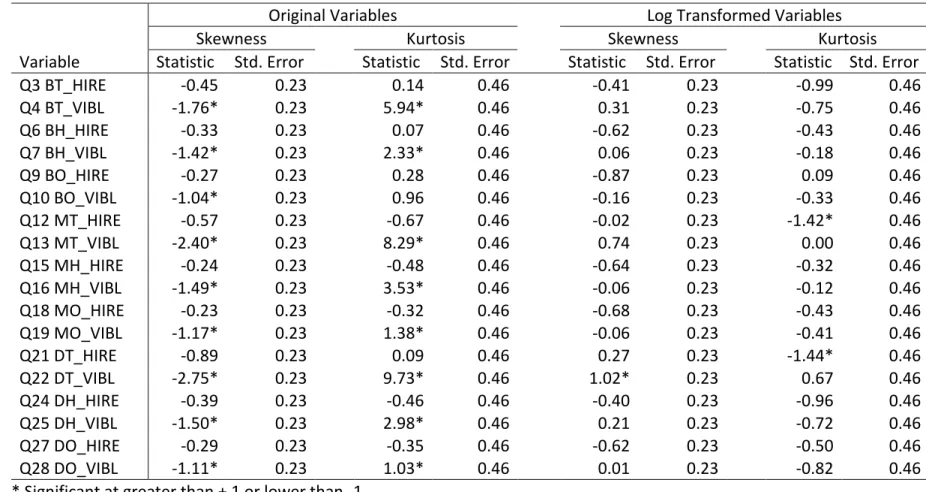
histograms of the standardized distribution of responses and descriptive statistics. Nine of the eighteen variables were negatively skewed, and eight of the eighteen variables showed kurtosis (See Table 3). Using the 3.5 standard deviation units from the mean standard, ten of the variables had outliers (z-scores with an absolute value greater than or equal to +/- 3.5).
36
Table 3. Normality Tests
Original Variables Log Transformed Variables
Skewness Kurtosis Skewness Kurtosis
Variable Statistic Std. Error Statistic Std. Error Statistic Std. Error Statistic Std. Error
Q3 BT_HIRE -0.45 0.23 0.14 0.46 -0.41 0.23 -0.99 0.46 Q4 BT_VIBL -1.76* 0.23 5.94* 0.46 0.31 0.23 -0.75 0.46 Q6 BH_HIRE -0.33 0.23 0.07 0.46 -0.62 0.23 -0.43 0.46 Q7 BH_VIBL -1.42* 0.23 2.33* 0.46 0.06 0.23 -0.18 0.46 Q9 BO_HIRE -0.27 0.23 0.28 0.46 -0.87 0.23 0.09 0.46 Q10 BO_VIBL -1.04* 0.23 0.96 0.46 -0.16 0.23 -0.33 0.46 Q12 MT_HIRE -0.57 0.23 -0.67 0.46 -0.02 0.23 -1.42* 0.46 Q13 MT_VIBL -2.40* 0.23 8.29* 0.46 0.74 0.23 0.00 0.46 Q15 MH_HIRE -0.24 0.23 -0.48 0.46 -0.64 0.23 -0.32 0.46 Q16 MH_VIBL -1.49* 0.23 3.53* 0.46 -0.06 0.23 -0.12 0.46 Q18 MO_HIRE -0.23 0.23 -0.32 0.46 -0.68 0.23 -0.43 0.46 Q19 MO_VIBL -1.17* 0.23 1.38* 0.46 -0.06 0.23 -0.41 0.46 Q21 DT_HIRE -0.89 0.23 0.09 0.46 0.27 0.23 -1.44* 0.46 Q22 DT_VIBL -2.75* 0.23 9.73* 0.46 1.02* 0.23 0.67 0.46 Q24 DH_HIRE -0.39 0.23 -0.46 0.46 -0.40 0.23 -0.96 0.46 Q25 DH_VIBL -1.50* 0.23 2.98* 0.46 0.21 0.23 -0.72 0.46 Q27 DO_HIRE -0.29 0.23 -0.35 0.46 -0.62 0.23 -0.50 0.46 Q28 DO_VIBL -1.11* 0.23 1.03* 0.46 0.01 0.23 -0.82 0.46
* Significant at greater than + 1 or lower than -1.
To correct for the negative skew of the variables, scores were reverse coded and a log transformation was completed. Therefore, interpretation of the variable is reversed for analysis using the log-transformed variables. Big
scores became small and small scores became big. One variable, employer perceptions of hireability for applicants with a Doctorate degree from a traditional mode of education, was still marginally skewed, and two still showed kurtosis.
Completing a log transformation, however, changes the hypothesis being tested and addresses a different construct to the one originally
measured (Field, 2009; Grayson, 2004). Therefore, there is reason to believe that performing the transformation has unwarranted implications as the statistical gain is outweighed by changes that result in interpreting the data. Because the data are not normality distributed, the assumption of normality was not met for a factorial repeated-measures ANOVA. Instead, the non-parametric Friedman ANOVA was conducted to test the main effects of Hypothesis 1 and 2. There is always potential for a loss of power using non-parametric statistics (Field, 2009), though it is a better alternative than
transforming the variables in this case. There is no non-parametric equivalent for the factorial ANOVA to test the interactions of Hypothesis 3 and 4. Factorial repeated-measures ANOVA’s were completed separately using the original and log-transformed variables to test Hypotheses 3 and 4. Results were compared.
Hypothesis Testing
The first and second hypotheses were tested using a Friedman’s ANOVA. The third and fourth hypotheses were tested using a factorial repeated-measures ANOVA.
Hypothesis 1
Hypothesis 1 predicted that there would be a main effect for mode of education on employer perception of applicants’ hireability. As education moved to a category with more traditional instruction, employer perception of applicants’ hireability would decrease. Specifically, employers would perceive the hireability of applicants with hybrid and online degrees lower than the hireability of applicants with traditional degrees. Employers would perceive the hireability of applicants with online degrees lower than the hireability of
applicants with hybrid degrees. To test hypothesis 1, a Friedman’s ANOVA was conducted (See Appendix C). Employer perception of applicants’
hireability changed significantly among the three modes of education, 2(2) = 61.61, p < .001. Wilcoxon tests were used to follow up this finding. A
Bonferroni correction was applied and all effects are reported at a .0167 level of significance. Employer perceptions of hireability changed significantly from traditional to online, T = 94, p < .001, r = -.45, where traditional was higher than hybrid, T = 259, p < .001, r = -.34, and hybrid was higher than online, T = 417, p < .001, r = -.28. The r-values indicate between medium and large, medium, and slightly lower than medium effect sizes, respectively.
Hypothesis 2
Hypothesis 2 predicted that there would be a main effect for mode for education on employer perception of applicants’ viability. As education moved to a category with less traditional instruction, employer perception of
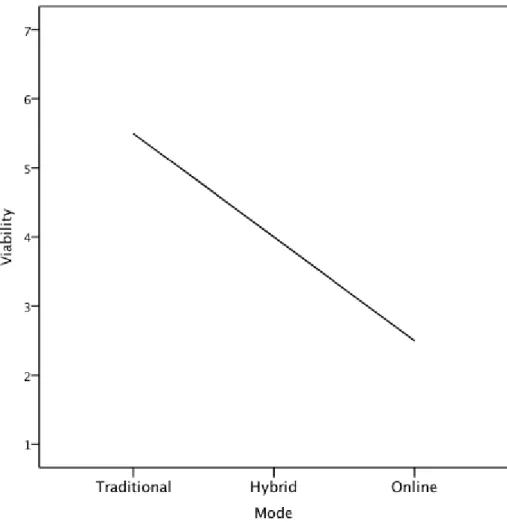
applicants’ viability would decrease. Specifically, employers would perceive the viability of applicants with hybrid and online degrees lower than the viability of applicants with traditional degrees. Employers would perceive the viability of applicants with online degrees lower than the viability of applicants with hybrid degrees. To test hypothesis 2, a Friedman’s ANOVA was conducted (See Appendix C). Employer perception of applicants’ viability changed significantly among the three modes of education, 2(2) = 81.65, p < .001. Wilcoxon tests were used to follow up this finding. A Bonferroni correction was applied and all effects are reported at a .0167 level of significance. Employer perceptions of hireability changed significantly from traditional to online, T = 201, p < .001, r = -.51, where traditional was higher than hybrid, T = 282, p < .001, r = -.43, and hybrid was higher than online, T = 641, p < .001, r = -.29. The r-values indicate large, between medium and large, and medium effect sizes, respectively. Hypothesis 3
Hypothesis 3 predicted that there would be an interaction between mode of education and degree level on employer perceptions of applicant’s hireability. Specifically, as the mode of education moves from being hybrid to online, employer perceptions of applicants’ hireability would decrease for more
advanced degrees. Doctorate degrees would be perceived greater than Master’s degrees at traditional and hybrid mode of education levels,
respectively. Master’s degrees would be perceived greater than Bachelor’s degrees at traditional and hybrid mode of education levels, respectively. At the online mode of education level, employer perceptions of online education would be higher for less advanced degrees. Online Bachelor’s degrees would be perceived higher than online Master’s degrees, and online Master’s
degrees would be perceived higher than online Doctorate degrees. To test hypothesis 3, a factorial repeated-measures ANOVA was conducted (See Appendix C). Mauchly’s test indicated that the assumption of sphericity had been violated for the interaction of mode of education and degree on hireability, 2(2) = 29.4 p < .05. Therefore, degrees of freedom were corrected using Greenhouse-Geisser estimates of sphericity ( = .869). There was no interaction effect between the mode of education and the degree level on hireability, F(3.475, 378.784) = 2.304, p = .067, r = 04. This indicated that mode of education did not have different effects on employer perceptions of applicants hireability depending on the degree level of the candidate. A log transformation was performed to correct the skewed data. Every variable was transformed so that scales were consistent when looking at differences between variables. Mauchly’s test indicated that the assumption of sphericity was violated for the interaction of mode of education and degree on hireability, 2(2) = 34.075 p < .05. Degrees of freedom were corrected
using Greenhouse-Geisser estimates of sphericity ( = .872) and a significant interaction was found, F(3.49, 380.16) = 3.33, p < .05, r = .093. Exploring the data, contrasts were performed comparing all modes of education for both the transformed and untransformed data because as mentioned earlier, the log transformations change the hypotheses being tested.
For the non-transformed data (original variables), contrasts revealed no interaction when comparing traditional to online for Doctorate compared to Bachelor’s, F(1, 109) = .342, p = .56, r = .06, Master’s compared to Bachelor’s F(1, 109) = .483, p= .489, r = .07, or Doctorate compared to Master’s, F(1, 109) = 0, p = 1, r = 0 (See Table 4).
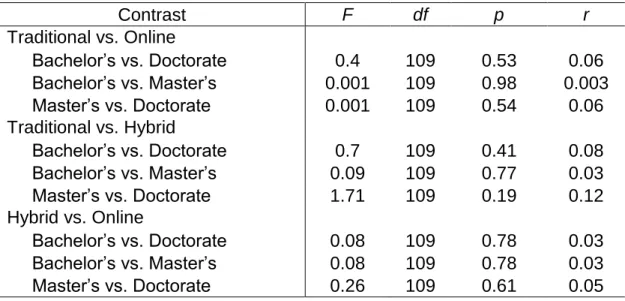
Table 4. Repeated Measures Factorial ANOVA Contrasts of Original Variables on Hireability Contrast F df p r Traditional vs. Online Bachelor’s vs. Doctorate 0.342 109 0.56 0.06 Bachelor’s vs. Master’s 0.483 109 0.49 0.07 Master’s vs. Doctorate 0 109 1 0 Traditional vs. Hybrid Bachelor’s vs. Doctorate 2.33 109 0.13 0.15 Bachelor’s vs. Master’s 11.99 109 0.001* 0.32 Master’s vs. Doctorate 1.61 109 0.21 0.12 Hybrid vs. Online Bachelor’s vs. Doctorate 1.18 109 0.28 0.1 Bachelor’s vs. Master’s 5.41 109 0.02* 0.22 Master’s vs. Doctorate 0.163 109 0.16 0.13
A significant interaction was found when comparing traditional to hybrid for Master’s compared to Bachelor’s F(1, 109) = 11.996,p < .05, r = .315, but not for Doctorate compared to Bachelor’s, F(1, 109) = 2.327, p= .13, r = .15, or for Doctorate compared to Master’s, F(1, 109) = 1.61,p = .208, r = .125. The r-value for Master’s vs. Bachelor’s indicated a medium effect.
A significant interaction was found when comparing hybrid to online for Master’s compared to Bachelor’s, F(1, 109) = 5.41,p < .05, r = .217, but not for Doctorate compared to Bachelor’s, F(1, 109) =1.177, p = .28, r = .103, or Doctorate compared to Master’s, F(1, 109) = 1.974,p = .163, r = .133. The r-value for Master’s compared to Bachelor’s indicated between a small and medium effect.
For the transformed data, there were no significant interactions when comparing traditional to online for Doctorate compared to Bachelor’s, F(1, 109) = 3.46, p = .07, r = .18, Master’s compared Bachelor’s F(1, 109) = 1.43,p =.24, r = .11, or Doctorate compared to Master’s, F(1, 109) = .487,p = .49, r = .07 (See Table. 5).
Table 5. Repeated Measures Factorial ANOVA Contrasts of Log Transformed Variables on Hireability Contrast F df p r Traditional vs. Online Bachelor’s vs. Doctorate 3.46 109 0.07 0.18 Bachelor’s vs. Master’s 1.43 109 0.24 0.11 Master’s vs. Doctorate 0.487 109 0.49 0.07 Traditional vs. Hybrid Bachelor’s vs. Doctorate 4.86 109 0.03* 0.21 Bachelor’s vs. Master’s 12.41 109 0.001* 0.32 Master’s vs. Doctorate 0.754 109 0.39 0.08 Hybrid vs. Online Bachelor’s vs. Doctorate 0.09 109 0.77 0.03 Bachelor’s vs. Master’s 4.3 109 0.04* 0.2 Master’s vs. Doctorate 3.97 109 0.04* 0.19
*Significant at the .05 level
A significant interaction was found when comparing traditional to hybrid for Doctorate compared to Bachelor’s, F(1, 109) = 4.86, p < .05, r = .21, and Master’s compared to Bachelor’s F(1, 109) = 12.41,p < .001, r = .32, but not for Doctorate compared to Master’s, F(1, 109) = .754,p = .387, r = .083. The r-values for the significant interactions indicated between small and medium, and medium effects, respectively.
When comparing hybrid to online, a significant interaction was found for Master’s compared to Bachelor’s, F(1, 109) = 4.3,p < .05, r = .195, and for Doctorate compared to Master’s, F(1, 109) = 3.97,p < .05, r = .19, but not for Doctorate compared to Bachelor’s, F(1, 109) = .09, p = .77, r = .03. The r-
values for the significant interactions both indicated between small and medium effect.
Hypothesis 4
Hypothesis 4 predicted that there would be an interaction between mode of education and degree level on employer perceptions of applicants’ viability. Specifically, as the mode of education moves from hybrid to online, employer perceptions of applicants’ hireability would decrease for more advanced degrees. Doctorate degrees would be perceived greater than Master’s degrees at traditional and hybrid mode of education levels,
respectively. Master’s degrees would be perceived greater than Bachelor’s degrees at traditional and hybrid mode of education levels, respectively. At the online mode of education level, employer perceptions of online education would be higher for less advanced degrees. Online Bachelor’s degrees would be perceived higher than Master’s degrees, and online Master’s degrees would be perceived higher than online Doctorate degrees.
To test hypothesis 4, a factorial repeated-measures ANOVA was conducted (See Appendix C). Mauchly’s test indicated that the assumption of sphericity had been violated for the main effect of mode of education on viability, 2(2) = 58.09, p < .001. Therefore, degrees of freedom were
corrected using Greenhouse-Geisser estimates of sphericity ( = .78). There was no significant interaction between mode of education and degree level on viability, F(3.14, 341.97) = .53, p = .67, r = .04.