1
How Continuous Immunizations Affect B-Cell Immune Response to Influenza through Cross-Reactive Antibody Expression In Normal-Weight, Overweight, and Obese Individuals.
2 1. Abstract
2. Introduction
a. The Modern Obesity Epidemic b. Influenza Virus in Humans
c. Immune Cells and Response to Antigens d. Immunizations and Vaccines
e. Subclasses of Immunoglobulin G and Immunoglobulin M f. Possible Differences Between Age, Ethnicity, and Weight Status 3. Goals and Hypothesis
4. Methods
a. Detailed Influenza-Specific ELISA
b. Specific Details for Antibody Level Analysis Using Enzyme-Linked Immunosorbent Assay
c. Data Analysis 5. Results
a. Study Demographics
b. Differences in Total Antibody Response
c. Percent Increase in Immunoglobulin Response over Time in African-Americans vs. Caucasians
d. Percent Increase in Immunoglobulin Response over Time in Younger and Older Adults
6. Discussion
a. Conclusions
3
Abstract
Introduction: The number of obese individuals has been steadily rising for the last few decades and has reached epidemic proportions. This means that health complications from obesity and being overweight have also increased for all age groups, but specifically for adults who are ages 60 and over. One complication of obesity is the increased risk of mortality from the influenza infection, a deadly illness caused by the influenza virus.
Goal: The goal of this study was to determine whether repeat vaccinations increases immunoglobulin antibody response in normal, overweight, and obese adults. It was also to determine whether or not race and age differences have an effect on antibody levels for each weight category.
Methods: To accomplish this, serum was collected from subjects both pre and post inoculation with that year’s vaccine and an indirect enzyme-linked immunosorbent assay (ELISA) was used
to determine antibody levels.
Results: Total antibody response showed no significance in any immunoglobulin antibody categories based on weight status alone, but IgG1 and IgG total were significant based on the relationship between time and weight status. African Americans showed higher responses for IgG1 in healthy and obese individuals and showed significantly higher responses in IgG2 overweight individuals compared to Caucasians. Adults ages 30 to 60 showed higher responses in IgG1 for healthy and obese categories compared to adults ages 60 to 90 as well. Obese subjects of all races and ages showed decreased antibody response over time.
4
Introduction
1. The Modern Obesity Epidemic
Obesity has reached epidemic proportions recently and levels have been significantly changing for the past decade or more1. Adults in nearly every age category have become more obese, especially adults over 60. Categorically, the number of adults over 60 in the obese BMI category has increased 4.4 percent from 2003-2004 to 2011-2012 while adults as a whole (age ≥20) have gained 2.8 percentage points during the same time period1
. Additionally, Non-Hispanic Blacks have the highest age-adjusted rates of obesity (47.8%) while Non-Hispanics follow with an obesity rate of 42.5%. Non-Hispanic Asians have the lowest with only 10.7% as of 2011-20121,2. Increasingly alarming are the rates of obesity in individuals who are age 19 and below. Although the prevalence of obesity in this age range has remained relatively stable since 2003, it remains high at 17% or 12.7 million people3. Similar to adults, Hispanic children and non-Hispanic Blacks make up the highest two percentage groups with 22.4% and 20.2%
respectively3. While most people hear the term “obese” or “obesity” on a regular basis, it is rarely defined and explained.
Obesity, according to the Centers for Disease Control and Prevention, is defined as having a Body Mass Index (BMI) of 30 or greater. An individual’s BMI is a height and weight based analysis that is used to measure a person’s body fat content. It does not measure body fat
directly, however, and is not used as a diagnostic tool by physicians since it is an approximation. Physicians use other analytical techniques in order to determine difference in visceral fat and abdominal fat, such as skin-fold thickness measurements, diet evaluations, x-ray machines, or hydrodensitometry. BMI is sufficient for Public Health evaluations due to its cost-effectiveness and ease of measurement, but the National Heart, Lung, and Blood Institute recommends additional measurements in order to further improve studies. These two measures include waist circumference, which measures abdominal fat, and risk factors such as high blood pressure, family history, or physical inactivity.
5
and sleep apnea6. The big three diseases that are life-threatening and affect millions of people every day are Heart/Cardiovascular disease, Type II Diabetes, and Cancer. Also, a study conducted by Calle et al in which more than 1 million adults were studied found that not only were obese individuals at risk for many illnesses but were actually at an increased risk of death. Among subjects with the highest BMI, men were 2.58 times more likely to die in the 14 year follow up than men with the lowest BMI while women were 2.00 times as likely5. There are also economic consequences to obesity. Williamson et al estimated in 1998 that the total healthcare costs of obesity were 100 billion dollars, meaning that estimates are now likely to have exceeded this level7. While this number is only an estimate, it indicates how huge of a cost obesity can be on the healthcare system and society.
2. Influenza Virus in Humans
Influenza is a highly infectious disease that is caused by the influenza virus. It is among both the most common forms of human respiratory infections and the most alarming due to its
morbidity and, to a lesser extent, mortality. Influenza viruses are a series of negative sense or negative strand RNA viruses that are a part of the Orthomyxovirus family. Of this family, there are three influenza viruses that affect humans: Influenza A, Influenza B, and Influenza C. Of the three types, Influenza C is the least common and has the ability to infect both humans and pigs. It can cause severe illness and local epidemics, but has been shown to have only mild effects in young children with the average fever lasting approximately 2.88 days8. Influenza B is a slightly more common virus that almost exclusively affects humans, the seal being the only other species it can infect. Due to the fact that it mutates at a slower rate than Influenza A, it has less antigenic diversity and is less of a threat to organisms. This fact makes epidemics and pandemics nearly non-existent for the virus.
The most common, morbid, and mortal Influenza virus is the A virus. It is widespread and has been shown to affect humans, pigs, birds, and horses. This virus is sub-categorized based on two proteins found on the surface of the viral envelope: hemagglutinin and neuraminidase. Hemagglutinin is a protein that causes RBC coagulation and there are 18 known types.
6
There are three main types of influenza virus infections. The first is seasonal influenza that circulates and cause disease on an annual basis. This form of influenza typically infects people of temperate climates during the winter months and the virus itself is contracted on a person-to-person basis10. Because these strains are constantly changing, people can become infected by the flu virus multiple times throughout their lives and vaccines must be constantly altered in order to help halt viral propagation. Pandemic influenza occurs when a viral strain emerges which was not previously circulating among humans and to which humans have little to no pre-existing immunity. These strains cause rapid and severe infection which can lead to millions of new cases in a short period of time. Examples include the 2009 H1N1 infection, which has killed upwards of 18,000 people since its appearance, and the “Spanish Flu” of 1918-1919 which killed 20-50 million people. The third type of influenza virus is the zoonotic or variant influenza which routinely circulate in animals and occasionally infect humans. While these zoological strains may share the name of human viruses, they are distinctly different and are not transmitted between humans easily. Thus, this type of virus is not as highly researched.
Influenza is a very common illness that affects thousands of people every year in the United States. According to the CDC, 16,377 laboratory-confirmed influenza-associated hospitalizations have been reported since October 1, 2014 and this number was last updated on April, 3 201511. In past years, the number of positive laboratory tests ranged anywhere from the tens of thousands to 157, 449 during the 2009-2010 H1N1 pandemic year. The hospitalization rate for the 2014-2015 season is 59.9 out of 100,000 and it is highest for older adults over 65 with a rate of 296.2 out of 100,00011. It is the highest for that age group since data collection began in the 2005-2006.
Influenza is an acute respiratory disease that infects the respiratory system. Early symptoms include sudden fever, cough, sore throat, headache, and inflammation of the upper respiratory system. More serious symptoms, such as extreme fatigue/weakness, can last for upwards of 10 days12. Vomiting and diarrhea can also occur in children, but these symptoms are less common in adults. In addition to common symptoms, people with underlying conditions, such as
cardiovascular disease or diabetes, could experience severe complications if infected.
7
3. Immune Cells and Response to Antigens
As previously noted, Influenza is a highly contagious viral infection of the respiratory system. Most experts agree that it is transmitted from person to person through the formation of liquid droplets from coughing, sneezing, or talking in close proximity. The virus is thought to be spreadable up to 6 feet and the droplets formed by the sick are transmitted into the sinuses or lungs of others thereby infecting them24. Additionally, influenza can be transmitted from touching infected surfaces or persons and subsequently touching one’s own sinus membranes. Once the virus has been contracted, the body’s innate immune system is activated in order to
eradicate the infection.
The innate immune system is the first line of defense for the body, which includes specific components such as mucus and collectin proteins that act to slow viral dissemination. Additionally, various immune cells, all of which originate in the bone marrow, are produced in order to eliminate the virus itself from the body. Infected cells recognize the Influenza A virus with a special kind receptor called Pattern Recognition Receptors (PRR’s). These receptors are
capable of recognizing the main marker of the influenza virus, its viral RNA, and are composed of a mix of toll-like receptors (TLR), retinoic acid inducible gene-I’s (RIG-I), and NOD-like receptor family pryin domain containing 3 (NLRP3) proteins13. Once identified, the virus initiates the release of various pro-inflammatory cytokines and type-1 interferons that have strong antiviral activity and inhibit protein synthesis in virus host cells thereby limiting viral replication. IFN-β is first released, which through a positive feedback mechanism, also
stimulates the release of IFN-α. These type-1 interferons also stimulate dendritic cells (DC’s), which lie underneath the epithelial lumen of airways, to present antigens to CD4+ and CD8+ T cells and instigate the body’s adaptive immune response13
. Additionally, alveolar macrophages and natural killer cells become activated and phagocytose and lyse infected cells in order to prevent the spread of virus to other healthy cells13.
8
specific to the invading antigen. In order to produce the correct antibodies, B cells must rely on antigen-recognition molecules on their cell surfaces. These receptors, called B cell receptors (BCRs), are membrane-bound immunoglobulins that bind antigens and subsequently uptake the antigen molecules by receptor-mediated endocytosis. With the aid of helper T cells and their cytokines, B cells are induced into cells cycles and form plasma cells, which are the forms that secrete the actual antibodies. In this case, the secreted antibodies are of the Immunoglobulin G family. These antibodies then either bind to the pathogen molecules or recruit other phagocytotic cells to the pathogen once other antibodies have bound to it.
T cells work in tandem with B cells but have some distinct differences. Unlike B cells, T cells don’t recognize free floating antigens and their surfaces contain T cell receptors (TCRs)
that recognize antigen fragments15. In most cases, T cells will only recognize antigens if they are bound to the body’s major histocompatibility complexes, or MHC’s. In order for T cells to
differentiate between the body’s own cells and foreign cells, these complexes must present the antigens in “recognizable scaffolding”. Humans have a specific form of MHC’s and they are
called human leukocyte antigens, or HLA15. As alluded to above, there are multiple types of T cells in the adaptive immune system that have different roles. Helper T cells, aka CD4+ cells, help B cells differentiate into antibody-secreting plasma cells, activate phagocytes, and activate other T cells for continued immune response. Cytotoxic T cells, aka CD8+ or killer T cells, bind directly to antigens and secrete molecules that destroy the antigen.
4. Immunizations and Vaccines
According to Vitetta et al, immunologic memory is defined as “the ability to generate a more effective immune response after a second encounter with an antigen”16. Upon secondary
infection, the immune response is “more rapid, of greater magnitude, is longer –lived, and is
9
in that their surface receptors are incredibly quick to recognize antigens and an army of CD8+ cells are generated to eliminate the virus.
Vaccines are intended to elicit an immune response to a specific antigen once it enters the body. In order to generate that response, inactivated or weakened forms of the antigen are injected into the individual’s blood stream so that immune cells can identify and protect against
it without triggering the disease17. Vaccines do this by triggering immune cells that will generate memory cells based on the antigen. If an inoculated person is infected with the antigen, an intense antibody and cellular response occurs. Antibody release is triggered upon viral infection which leads to the neutralization of the microbes before entering bodily cells and also tags microbes for removal by CD8+ T cells18. Thus, vaccines are designed to shield people from contracting dangerous and deadly infectious diseases through the strengthening of the body’s natural immune system.
5. Subclasses of Immunoglobulin G and Immunoglobulin M
The immunoglobulin G antibodies are a major component of the adaptive immune response in humans and are secreted by B cells in order to neutralize various infections. While there are multiple types of immunoglobulins, immunoglobulin G represents approximately 75% of total serum Ig’s21
. Additionally, they are the only types of immunoglobulins that can cross the placental membrane and are used in scientific research due to their high specificity towards antigens21.
The immunoglobulin G antibodies are glycoproteins composed of two heavy or gamma (γ) chains and two light chains that are connected by disulfide bonds. Differences in the subclasses are based on the different amino acid sequences in the heavy chains and the ratio of different light chains, lambda (λ) or kappa (κ) chains. While the primary amino acid sequences are approximately 95% the same for all immunoglobulin subclasses, the main region of variation exists at the “hinge” regions of the Y-shaped antibodies22
. For example, IgG1 has a hinge region of 15 amino acid residues and is highly flexible to allow for antibodies to bind from all
10
Immunoglobulin M is an antibody produced by B cells and is the largest antibody produced. It is the first antibody produced during an immune response to antigens and plays roles in agglutination. IgM is also the third most common antibody produced in immune responses and can exist in two forms, a pentamer and a monomer26. Like IgG antibodies, IgM antibodies are held together via disulfide bonds. It is predominantly found in lymph fluid and blood and, because of its early action, can indicate infection if at elevated levels26.
6. Possible Differences Between Age, Ethnicity, Weight Status
Multiple studies have shown that there are potentially different levels of immune response to influenza vaccinations in those of different ages. Goodwin et al conducted a weighted analysis of vaccine response based on different vaccine components such as H1, H3, and B influenza
antigens20. They determined that vaccine response in older adults over the age of 65 was significantly less than their younger counterparts with a much smaller antibody response. They determined that in the ≥65 age group, the influenza vaccine was only 17-53% effective in
protecting against H1, H3, and B antigens and that young, healthy adults have a much better immune response that reaches 70-90% efficacy20.
There have also been studies conducted that detail the differences in immune response based on ethnicity. Ness et al conducted a study on race-specific differences in allelic variation that lead to the up-regulation of inflammatory cytokines19. They determined that African-American women were significantly more likely to express these variations, which upregulated the inflammatory cytokines IL1A, IL1B, IL6, IL18, and TNFA19. Thus, African-Americans could potentially have genotypes upregulating their inflammatory immune response. Sheridan et al also found that African-Americans had higher immune responses to influenza vaccinations 1 month post vaccination23. This finding supports the findings of Ness et al and this study hypothesized that African Americans would have higher antibody responses than Caucasians.
11
or low BMI. Thus, they determined that obesity could diminish a person’s ability to mount a
12
Goal and Hypothesis
1. Goals
To determine whether repeat vaccinations increases immunoglobulin antibody response in normal, overweight, and obese adults
To determine whether or not race and age differences have an effect on antibody levels for each weight category
2. Hypothesis
Repeat vaccinations will enhance IgG and IgM responses in healthy, overweight, and obese individuals.
13
Methods
1. Detailed Influenza-Specific ELISA
An enzyme-linked immunosorbent assay (ELISA) was used to identify the level of influenza-specific antibodies in subject serum. Antibody levels, attached by antigen-antibody binding, were analyzed on 96-welled plates. Diluted in coating buffer, the vaccine antigen was bound to the surface of the wells. Block buffer made of milk was added to all plates in order to cover all of the binding sites and subject serum was added. Post incubation and one round of plate washing, secondary goat anti-human IgG (IgG1-IgG4, IgG total) and IgM antibodies conjugated with horse radish peroxidase were added. These antibodies bound to the primary antibodies of the participant’s serum. Post washing, enzyme substrate was then added to catalyze a color change
inducing reaction. This color change signal was quantified by optical density readings utilizing an ELISA plate reader set at 450 nm. A higher enzyme activity led to a dark, yellow color (higher optical density), and this was directly correlated with antibody concentration.
The ELISA procedure took three days to complete. Prior to the start of the experiment, optimal dilutions for vaccine antigen, serum, and secondary antibody with horseradish peroxidase were determined. Each subclass of IgG (IgG1-IgG4, IgG total) and IgM was measured, and the optimal vaccine antigen dilution for each antibody was chosen to be 1:160.
IgG 1-3 IgG 4 IgG Total IgM
Vaccine Antigen
1:160 1:160 1:160 1:160
Sample Serum 1:800 (in triplicate) 1:200 (in triplicate) 1:2000 (in triplicate)
1:40,000 (in triplicate)
Conjugate 1:1000 1:500 1:1000 1:1000
Table 1. Standard dilutions used for individual antibodies throughout the experiment
Step Serum Sample
(μL)
Dilution Buffer
(μL)
Diluted
Sample
Final
14
1 10 990 DS1 1:100
2 500of DS1 500 DS2 1:200
3 250 of DS2 750 DS3 1:800
4 300 of DS3 750 DS4 1:2000
5 50 of DS4 950 DS5 1:40,000
Table 2. The dilutions of secondary antibodies and serum dilutions used during ELISA runs for IgG1, IgG2, IgG3, IgG4, IgM, and IgG total.
Antibody Name Antibody
(μL)
PBS/BSA
(mL)
Final
Dilution
Plate
IgG-1, 2, 3, Total, IgM
5.5 5.5 1:1000 A, B, C,
E, F
IgG-4 11.0 5.5 1:500 D
Table 3. The dilutions of goat anti-human IgG conjugated to horseradish peroxidase in dilution buffer
2. Specific Details for Antibody Level Analysis Using Enzyme-Linked Immunosorbent
Assay
Materials used:
Clear 96 well Falcon plates
15
Multi-channel precision pipettes with disposable plastic tips
Plate Reader
Reagents used:
Coating Buffer 0.2 M sodium carbonate/bicarbonate solution in PBS
Wash buffer 330 mL phosphate buffer solution, 3000 mL of distilled H2O,
and 1.6 mL of Tween-20
Block Buffer 2.4 grams of 3% nonfat dry milk in 80 mL of Coating Buffer Dilution Buffer
Detection/Secondary Antibody
Goat anti-human antibody for IgG1, IgG2, IgG3, and IgG4 with horseradish peroxidase conjugate (PBSt)
Vaccine Antigen Diluted in Coating Buffer – 1:160 dilution
Horseradish Peroxidase Attached to detection antibody acting as enzyme conjugate Enzyme Substrate TMB Substrate in peroxide solution
Stop Solution 2M sulfuric Acid
Primary Antibody Antibodies of study participant serum
An enzyme-linked immunosorbent assay was used to identify specific IgG and IgM antibodies in the sample serum. Vaccines were first diluted according to Table 1 in coating buffer. Six different 96-well Falcon Plates were used. Once diluted, the plates were allowed to refrigerate overnight at 4°C.
16
Diluted goat anti-human IgG conjugated to horseradish solution was made according to Table 3 and added to each plate based on IgG subtype. IgG-1, 2, 3, total, and IgM received a 1:1000 diluted solution while IgG-4 received a 1:500 diluted solution. All plates were then washed with PBSt on a plate washer. All plates then immediately received a mixture of TMB solution and peroxide solution. All plates were then incubated at room temperature for 30 minutes under a sheet of aluminum foil. The reaction on the plates was then stopped by adding 100 μL of 2M Sulfuric Acid to each well. Absorbance was then measured with an ELISA plate
reader at 450 nm and data was recorded in Microsoft Excel.
3. Data Analysis
Using Graphpad Prism 6, data for all antibodies was analyzed and graphs were created. T-tests and ANOVA T-tests were conducted for all Immunoglobulins (IgG1-IgG4, IgM, IgG total) and graphs were generated based on raw data. Any subjects missing sera or wells, two in this case, were eliminated from the overall study. All subjects’ data was placed into Microsoft Excel
and separated based on Race, Age, Sex, and Weight Status. Subjects were separated between African-American and Caucasian, years 30-60 and 60-90, male and female, and between healthy, overweight, and obese. Post data separation, percent increase was calculated between Pre- and Post-inoculation for the years 03, 04, and 05. This was calculated by the formula:
𝑃𝑒𝑟𝑐𝑒𝑛𝑡 𝐼𝑛𝑐𝑟𝑒𝑎𝑠𝑒 =𝑃𝑜𝑠𝑡 𝑉𝑎𝑐𝑐𝑖𝑛𝑎𝑡𝑖𝑜𝑛 𝑉𝑎𝑙𝑢𝑒 − 𝑃𝑟𝑒 𝑉𝑎𝑐𝑐𝑖𝑛𝑎𝑡𝑖𝑜𝑛 𝑉𝑎𝑙𝑢𝑒
𝑃𝑟𝑒 𝑉𝑎𝑐𝑐𝑖𝑛𝑎𝑡𝑖𝑜𝑛 𝑉𝑎𝑙𝑢𝑒 𝑥 100
Mean percent increase was then calculated using Microsoft Excel for all subsets of data. Means were then put into graphs based on data subsets. Two-sample t-tests assuming unequal variances were then conducted to determine significance between data subsets.
Results
1. Study Demographics
17
African-Americans and Caucasians, and younger and older individuals. Thus, it was worth separating data based on these subcategories in addition to the primary focus that was healthy vs. obese individuals.
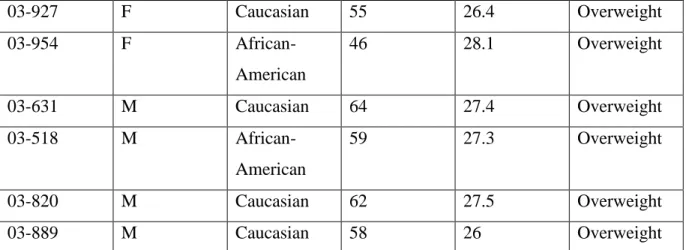
Subject Number
Sex Race Age BMI # BMI
Category
03-982 F Caucasian 31 18.8 Healthy
03-970 F
African-American
46 24.2 Healthy
03-819 F Caucasian 60 21.6 Healthy
03-955 F
African-American
36 22.8 Healthy
03-901 M Caucasian 78 24.8 Healthy
03-588 F Caucasian 69 33.3 Obese
03-971 F
African-American
41 35 Obese
03-895 F
African-American
49 36.2 Obese
03-788 M Caucasian 69 32.5 Obese
03-856 M
African-American
37 37.4 Obese
03-811 F
African-American
71 25.5 Overweight
03-993 F Caucasian 61 27.4 Overweight
03-863 F Caucasian 73 26.6 Overweight
03-579 F Caucasian 85 26.2 Overweight
03-707 F
African-American
49 27.1 Overweight
18
03-927 F Caucasian 55 26.4 Overweight
03-954 F
African-American
46 28.1 Overweight
03-631 M Caucasian 64 27.4 Overweight
03-518 M
African-American
59 27.3 Overweight
03-820 M Caucasian 62 27.5 Overweight
03-889 M Caucasian 58 26 Overweight
Table 4. The available demographics for all study participants.
2. Differences in Total Antibody Response
The null hypothesis was that obese individuals will have an inhibited immune response to the H1N1 virus compared to healthy weight people. Both t-tests and analysis of variance tests
(ANOVA) were conducted for each individual antibody.
19 03 -Pre Ig G1 03 -Po st IgG 1 04 -Pre Ig G1 04 -Po st IgG 1 05 -Pre Ig G1 05 -Po st IgG 1 0 1 2 3 4
Ig G 1
Y e a r
O p ti c a l D e n s it y
H e a lth y O v e rw e ig h t O b e s e
T im e x W e ig h t S ig n ific a n t
Graph 1. IgG1 antibodies for all Healthy, Overweight, and Obese subjects with both pre and post vaccination levels, showing significance between time and weight status
IgG total antibody data was also significant for time, subject, and the interaction between time and weight status. It was also not significant based on weight status alone. For the variable Interaction, the p-value was calculated to be 0.0263, which was enough to be below the
20 03
-Pre Ig
G t ota
l
03 -P
os t Ig
G t ota
l
04 -Pre
Ig G t
ota l
04 -P
os t Ig
G t ota
l
05 -Pre
Ig G t
ota l
05 -P
os t Ig
G t ota l 0 1 2 3 4
Ig G t o t a l
Y e a r
O p ti c a l D e n s it y
H e a lth y O v e rw e ig h t O b e s e
T im e x W e ig h t S ig n ific a n t
Graph 2. IgG total antibodies for all Healthy, Overweight, and Obese subjects with both pre and post vaccination levels, showing significance between time and weight status.
3. Percent Increase in Immunoglobulin Response over Time in African-Americans vs.
Caucasians
The data was further subcategorized in order to study the percent increase in optical density between pre and post vaccination. The formula discussed in the methods section was used in order to generate these calculations and the mean changes for each subcategory were also found.
21
Graph 3. IgG1 antibody levels for healthy African-American and Caucasian subjects indicating a 26.07% increase and 6.49% increase respectively.
For obese African-Americans, IgG1 antibody levels in serum increased at an average rate of 26.50% over three years with a variance of 0.689. The sample size of this group was 3. For obese Caucasians, IgG1 serum antibodies increased at an average rate of 11.88% with a variance of 2.40. The sample size for this group was 2. The p-value between the two groups was found to be 0.245. This p-value was slightly above the 0.05 threshold. The graph for these two groups is displayed below in Graph 4.
-40 -30 -20 -10 0 10 20 30 40 50
3 4 5
Per ce n t In cr e ase Year
IgG1 Healthy
African-American Caucasian -20 -10 0 10 20 30 40 503 4 5
22
Graph 4. IgG1 antibody levels for obese African-American and Caucasian subjects indicating a 26.5% and 11.88% increase respectively.
For overweight African-Americans, IgG2 antibody levels in the serum increased at an average rate of 26.19% with a variance of .613. The sample size of this group was 4. IgG2 serum levels for overweight Caucasians increased at an average rate of 3.68% with a variance of 0.095. The sample size of this group was 8. The p-value for the two groups was found to be 0.0189. This p-value is below the 0.05 threshold and is therefore significant. The graph for the two groups is shown below in Graph 5.
Graph 5. IgG2 antibody levels for overweight African-American and Caucasian subjects indicating a 26.19% increase and a 3.68% increase respectively.
4. Percent Increase in Immunoglobulin Response over Time in Younger and Older
Adults
The data was further subcategorized in order to study the percent increase in optical density between pre and post vaccination. The formula discussed in the methods section was used in order to generate these calculations and the mean changes for each subcategory were also found. There were two subcategories created based on age: a 30-60 years group and a 60-90 years age group.
-5 0 5 10 15 20 25 30 35 40 45
3 4 5
Per
ce
n
t
In
cr
e
ase
Year
IgG2 Overweight
African-American
23
IgG1 serum antibodies increased at an average rate of 25.69% with a variance of 5.10 for healthy individuals ages 30-60. The sample size for the group was 3. For subjects ages 60-90, IgG1 serum antibodies decreased at an average rate of 2.74% with a variance of 2.85. The sample size for this group was 2. The calculated p-value for the two groups was 0.156, which was slightly greater than the 0.05 threshold for significance. The two groups are shown in Graph 6 below.
Graph 6. IgG1 antibody levels for healthy subjects ages 30-60 and 60-90, indicating a 25.69% increase and a 2.74% decrease respectively.
IgG1 Serum antibodies for obese individuals ages 30-60 increased at an average rate of 26.50% with a variance of .686. The sample size for this group was 3. IgG1 serum antibodies increased at an average rate of 11.88% with a variance of 2.40. The sample size for this group was 2. The p-value for the two groups was calculated to be 0.245. This is slightly greater than the significance threshold value of 0.05. A graph of the two groups is shown below in Graph 7.
-30 -20 -10 0 10 20 30 40 50 60
3 4 5
Per
ce
n
t
In
cr
e
ase
Year
IgG1 Healthy
30-60
24
Graph 7. IgG1 antibody levels for obese subjects ages 30-60 and 60-90, indicating a 26.50% increase and a 11.88% increase respectively.
Discussion
1. Conclusions
This study hypothesized that repeat immunizations would enhance the immunoglobulin responses for healthy, overweight, and obese individuals. The total antibody levels for IgG1 and IgG total were found to be significant based on the relationship between time and weight status. This finding is significant because it could mean that continuous immunization could improve antibody responses for the IgG1 and IgG total categories. However, it is also important because the other immunoglobulin categories, IgG2, 3, 4, total, and IgM were not found to be significant. Thus, there is potentially a positive correlation between antibody response and repeat
vaccinations, but only for specific antibodies.
It was also hypothesized that Caucasians would benefit from repeat vaccinations so as to be on par with their African-American counterparts. This was found to be only selectively true. While African-Americans had higher percent increases for nearly every category of IgG, Caucasian healthy people had decent increases in antibody concentrations over time. Graph 3
indicates that while Caucasians actually decreased in antibody response in the first year, they
-20 -10 0 10 20 30 40 50
3 4 5
Per
ce
n
t
In
cr
e
ase
Year
IgG1 Obese
30-60
25
made large gains in the following two years and came close to the antibody concentrations of African-Americans in the 05 year.
However, this trend is not seen in the overweight or obese categories. The IgG1 antibody response in obese individuals was found to be the opposite of healthy individuals and shows a decreasing level of antibody response after repeat vaccinations. Both African-American subjects and Caucasian subjects show this trend with the Caucasian subjects having much less of a response, though not significant. IgG2 antibody levels in overweight subjects were the only subset that showed a significant difference in percent antibody increase. While there was a slightly positive trend for both races, African-Americans showed a significantly higher response to continuous vaccinations than Caucasians. Thus, while repeat vaccinations may help increase antibody response in healthy individuals of both races, they had little effectiveness increasing antibody responses in overweight and obese individuals with African-Americans having significantly higher responses than Caucasians.
For the age subcategory, there were no tests found to be significant. However, there were trends that indicate potential explanations of the data. The IgG1 data in both healthy and obese subjects were higher for younger adults than older adults and was close to being significant. IgG1 healthy individuals also showed increased immune responses over time in both age categories while IgG1 obese individuals showed the opposite trend, showing less of a percent increase in antibody response over time. This data indicates that repeat vaccinations may help older obese adults less over time than older healthy adults. It also shows that younger adults may have a better immune response at all time periods compared to their older counterparts.
2. Improvements for the Future
The best improvement for future studies would be to increase the number of subjects in order to get a better understanding of the population. Because this study only had access to 22
26 Works Cited:
1. Ogden C.L., Carroll M.D., Kit B.K., Flegal K.M. Prevalence of Childhood and Adult Obesity in the United States, 2011-2012. JAMA. 2014; 311(8):806-814.
doi:10.1001/jama.2014.732
2. Adult Obesity Facts. (2014, September 09). Retrieved From http://www.cdc.gov/obesity/data/adult.html
3. Childhood Obesity Facts. (2014, September 03). Retrieved from http://www.cdc.gov/obesity/data/childhood.html
4. Defining Overweight and Obesity. (2012, April 27). Retrieved from http://www.cdc.gov/obesity/adult/defining.html
5. Calle,E. E., Thun, M. J., Petrelli, J. M., Rodriguez, C., Heath, Jr., C. W. Body-Mass Index and Mortality in a Prospective Cohort of U.S. Adults. New England Journal of Medicine. 1999; 341(15):1097-1105 DOI: 10.1056/NEJM199910073411501
6. Overweight and Obesity: Causes and Consequences. (2012, April 27). Retrieved from http://www.cdc.gov/obesity/adult/causes/index.html
7. Williamson, D. F., Narayan, K. M. V., Teutsch, S. M. The Economic Impact of Obesity in the United States: Whither? Obesity Research. 1998; 6(2):173-175.
8. Matsuzaki, Y., Katsushima, N., Nagai, Y., Shoji, M., Itagaki, T., Sakamoto, M., Kitaoka, S., Mizuta, K., Nishimura, H. Clinical Features of Influenza C Virus Infection in
Children. Journal of Infectious Disease. 2006; 193(9):1229-1235. http://jid.oxfordjournals.org/content/193/9/1229
9. Influenza Type A Viruses. (2015, February 09). Retrieved from http://www.cdc.gov/flu/avianflu/influenza-a-virus-subtypes.htm
10. Influenza virus infections in humans. (2014, February). Retrieved from
http://www.who.int/influenza/human_animal_interface/virology_laboratories_and_vaccin
es/influenza_virus_infections_humans_feb14.pdf
11. Situation Update: Summary of Weekly FluView. (2015, April 03). Retrieved from http://www.cdc.gov/flu/weekly/summary.htm
12. Taubenberger, J. K., Morens, D. M. The Pathology of Influenza Virus Infections. Annual Review of Pathology. 2008; 3: 499-522.
27
13. Kreijtz, J. H. C. M., Fouchier, R. A. M., & Fouchier, R. A. M. Immune responses to influenza virus infection. Virus Research. 2011; 162(1-2): 19-30. doi:
10.1016/j.virusres.2011.09.022
14. B Cells. (2012, March 23). Retrieved from
http://www.niaid.nih.gov/topics/immunesystem/immunecells/Pages/bcells.aspx
15. T Cells. (2008, October 02). Retrieved from
http://www.niaid.nih.gov/topics/immunesystem/immunecells/Pages/tcells.aspx
16. Vitetta, E. S. , Berton, M.T., Burger, C., Kepron, M., Lee, W. T., Yin, X. M. Memory B and T Cells. Annual Review of Immunology. 1991; 9: 193-217.
http://www.annualreviews.org/doi/pdf/10.1146/annurev.iy.09.040191.001205
17. How Vaccines Work. Retrieved from
http://www.path.org/vaccineresources/files/How_Vaccines_Work.pdf
18. Understanding How Vaccines Work. (2013, February). Retrieved from
http://www.cdc.gov/vaccines/hcp/patient-ed/conversations/downloads/vacsafe-understand-color-office.pdf
19. Ness, R. B., Haggerty, C.L., Harger, G., Ferrell, R. Differential Distribution of Allelic Variants in Cytokine Genes among African Americans and White Americans. American Journal of Epidemiology. 2004; 160(11): 1033-1038.
http://aje.oxfordjournals.org/content/160/11/1033.full
20. Goodwin, K., Viboud, C., Simonsen, L. Antibody response to influenza vaccination in the elderly: A quantitative review. Vaccine. 2006; 24(8): 1159-1169.
http://www.sciencedirect.com/science/article/pii/S0264410X05009552
21. Antibody Structure and Classes of Immunoglobulins. (2015). Retrieved from
https://www.lifetechnologies.com/us/en/home/life-science/protein-biology/protein-
biology-learning-center/protein-biology-resource-library/pierce-protein-methods/antibody-structure-classes.html
22. Hamilton, R. The Human IgG Subclasses. Calbiochem. (2001). Retrieved from
http://wolfson.huji.ac.il/purification/PDF/affinity/CALBIOCHEM_HumanIgG_Subclasse
s.pdf
28
impaired immune response to influenza vaccination in humans. International Journal of Obesity. 2011; 36: 1072-1077.
http://www.nature.com/ijo/journal/v36/n8/full/ijo2011208a.html
24. How Flu Spreads. (2013, September 12). Retrieved from http://www.cdc.gov/flu/about/disease/spread.htm