ISSN (Online) : 2319 - 8753 ISSN (Print) : 2347 – 6710
International Journal of Innovative Research in Science, Engineering and Technology
An ISO 3297: 2007 Certified Organization Volume 7, Special Issue 5, April 2018
1st International Conference on Recent Innovation in Civil Engineering and Management (ICRICEM '18) 22nd March 2018
Organized by
Department of Civil Engineering & MBA, Loyola Institute of Technology, Chennai, Tamilnadu, India
A Study of Manufacturing and
Experimental Behaviour of Cellular
Lightweight Concrete (CLC) Bricks
J.Thivya 1*, M.Saranya2, J. Vijayaraghavan3
Assistant Professor, Department of Civil Engineering, University College of Engineering Dindigul, Dindigul,
Tamilnadu, India1
P.G Scholar, Department of Structural Engineering, Anna University, Madurai, Tamilnadu, India. 2
Assistant Professor , Department of Civil Engineering, University College of Engineering Ramanathapuram,
Ramanathapuram Tamilnadu, India3.
*Corresponding Author
ABSTRACT: This paper presents an experimental study on the effect in strength of foam concrete using three different filler materials such as river sand, sea sand and quarry dust with cement. Cement and filler mixed in proportions 1:0, 1:1, 1:2 and 1:3 in weight basis.The foaming agent was added with water and mixed thoroughly. Mixed cement and filler added slowly with this and after certain minutes this gel poured in to the mould of size 19 x 9 x 9 cm to get the brick specimen. The specimens were water cured for 28 days. The compressive strength of this light weight foam concrete bricks at an age of 28 days was obtained at normal temperature. Then the specimens after 28 days curing were heated to 100°C in an oven for 24 hours and tested. Also the specimens kept at 100°C for 24 hours were suddenly immersed in water and subjected to thermoshock and tested for compressive strength. The loss of strength due to thermal and thermo shock effect were compared with conventional concrete (River sand as filler). From the results, it is found that sea sand as well as quarry dust can be used as alternate filler material for natural river sand in foam concrete.
Although building techniques and materials have evolved over thousands of years, construction is still along, complex, and expensive process. Construction industry boom can be seen in almost all the developing countries. With the increase in material costs in the construction industry, there is a need to find more cost saving alternatives so as to maintain the cost of constructing houses at prices affordable to people. There is need to develop an alternative system of building component which would impart more benefits and are multifunctional with optimum use of labour and material. Cellular light weight brick wall in Rat-trap bond is an innovative technique for building masonry unit which reduces the construction cost, time and labor considerably. This may not solve all construction problems but they do resolve many issues associated with traditional materials.
KEYW O R D S : Foam concrete, Foaming agent, Cement, Sea sand, River sand, Quarry dust.
I. INTRODUCTION
ISSN (Online) : 2319 - 8753 ISSN (Print) : 2347 – 6710
International Journal of Innovative Research in Science, Engineering and Technology
An ISO 3297: 2007 Certified Organization Volume 7, Special Issue 5, April 2018
1st International Conference on Recent Innovation in Civil Engineering and Management (ICRICEM '18) 22nd March 2018
Organized by
Department of Civil Engineering & MBA, Loyola Institute of Technology, Chennai, Tamilnadu, India
bricks could be met by establishing small units near thermal power stations and to meet the local demand with less transportation costs.
Foam concrete is nowadays largely used in construction industry due to light weight and easy preparation. It occupies the portion to fill better than any other compound. Uniform distribution of air bubbles through the mass of concrete makes 20% of entrapped air, which makes it so light than the conventional concrete. Foam concrete has been successfully used and it has gained popularity due to lower weight. For foam concrete, generally river sand is used as filler material. Due to rapid usage, there is a shortage of conventional construction material river sand and so costly one. In order to minimise this it is necessary to think of alternate materials.It is observed from previous study that the maximum ratio of cement with filler for foam concrete as 1:2.5, so in this study we fixed the trial mixes from
1:0 to 1:3 to confirm the maximum ratio. This is an experimental study on how the strength of foam concrete varied when sand is replaced by sea sand as well as
quarry dust.
1.1 OBJECTIVE
To reduce the weight of the bricks To control the co2 emission Low investment
Quick returns Future products for construction industries Green Product
Less competition market Can earn more percentage of profit Only 10HP power is required to run the plant and can be owned without major engineering expertise.
ISSN (Online) : 2319 - 8753 ISSN (Print) : 2347 – 6710
International Journal of Innovative Research in Science, Engineering and Technology
An ISO 3297: 2007 Certified Organization Volume 7, Special Issue 5, April 2018
1st International Conference on Recent Innovation in Civil Engineering and Management (ICRICEM '18) 22nd March 2018
Organized by
Department of Civil Engineering & MBA, Loyola Institute of Technology, Chennai, Tamilnadu, India
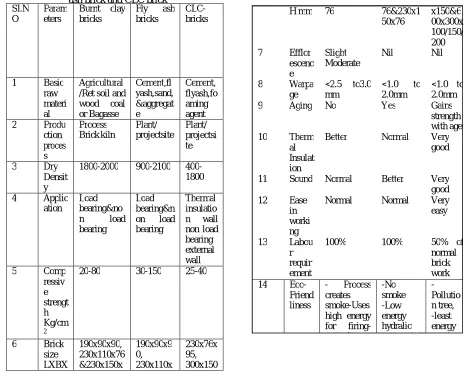
H mm 76 76&230x1 50x76 x150&6 00x300x 100/150/ 200 7 Efflor escenc e Slight Moderate Nil Nil 8 Warpa ge
<2.5 to3.0 mm
<1.0 to 2.0mm
<1.0 to 2.0mm
9 Aging No Yes Gains
strength with age 10 Therm al Insulat ion
Better Normal Very good
11 Sound Normal Better Very good 12 Ease
in worki ng
Normal Normal Very easy
13 Labou r requir ement
100% 100% 50% of normal brick work 14 Eco- Friend liness
- Process creates smoke-Uses high energy for firing- agriculture -No smoke -Low energy hydralic press and
- Pollutio n tree, -least energy requirm SI.N O Param eters
Burnt clay bricks
Fly ash bricks CLC- bricks 1 Basic raw materi al Agricultural /Ret soil and wood coal or Bagasse Cement,fl yash,sand, &aggregat e Cement, flyash,fo aming agent 2 Produ ction proces s Process Brick kiln Plant/ projectsite Plant/ projectsi te 3 Dry Densit y
1800-2000 900-2100 400- 1800
4 Applic ation
Load bearing&no n load bearing
Load bearing&n on load bearing
Thermal insulatio n wall non load bearing external wall 5 Comp ressiv e strengt h Kg/cm 2
20-80 30-150 25-40
6 Brick size LXBX 190x90x90, 230x110x76 &230x150x 190x90x9 0, 230x110x 230x76x 95, 300x150 3.COMPARISON BETWEEN BURNT CLAY BRICK,FLY ASH BRICK AND CLC BRICK
Table 1 Comparison between burnt clay brick, Fly ash brick and CLC brick
ISSN (Online) : 2319 - 8753 ISSN (Print) : 2347 – 6710
International Journal of Innovative Research in Science, Engineering and Technology
An ISO 3297: 2007 Certified Organization Volume 7, Special Issue 5, April 2018
1st International Conference on Recent Innovation in Civil Engineering and Management (ICRICEM '18) 22nd March 2018
Organized by
Department of Civil Engineering & MBA, Loyola Institute of Technology, Chennai, Tamilnadu, India
compared to traditional clay- brick structures. Since the early twentieth century, two ideas were developed to produce lightweight concrete – Aerated Autoclave Concrete (AAC) and Cellular Lightweight Concrete conserve fertile agricultural soil. It has a dramatic impact on emission of Green House Gases created during cement manufacturing.
II. MATERIALS AND THEIR PROPERTIES
2.1 Cement
The cement used for this study is Ordinary Portland cement (OPC) of 53 grade conforming to IS 1226: 1978. The specific gravity of cement was found to be 3.15.
2.2 River Sand
Sand used for this study was collected from river Cauvery, Tiruchirappalli. In this study sand passing through IS sieve of size 600 microns was used. The specific gravity of river sand was found to be 2.61.
2.3 Quarry Dust
Quarry dust is a residue obtained during stone crushing process in crusher units. It is also used as an effective alternative material in normal concrete instead of fine aggregate sand. In this study Quarry dust passing through IS sieve of size 600 microns was used. The specific gravity of quarry dust was found to be 2.84
2.4 Sea Sand
Sea sand is the material which is available in plenty all over the world along the shore. The sea sand was used in the construction field after the removal of salt content from it. An experimental setup with sea sand has been made suitable for construction purpose by reducing the salt content to equalize its properties similar to the river sand. The salt was removed from sea sand by washing with ample water. Hence, it is converted in to inert material free from nature of corrosion. Sea sand passing through IS sieve of size 600 microns was used for this study.The specific gravity of sea sand was found to be
2.38 .
2.5 Water
Potable water with pH value 7 was used for mixing and curing throughout this experiment.
2.6 Foaming Agent
Foaming agent is a material that facilitates formation of foam such as a surfactant or a blowing agent. A surfactant when present in small amounts, reduces surface tension of a liquid (reduces the work needed to create the foam) or increases its colloidal stability by inhibiting coalescence of bubbles. A blowing agent is a gas that forms the gaseous part of the foam. There are two types of foaming agent. They are
Synthetic-suitable for densities of 1000kg/m3 and above.
Protein-suitable for densities from 400kg/m to 1600kg/m3.
ISSN (Online) : 2319 - 8753 ISSN (Print) : 2347 – 6710
International Journal of Innovative Research in Science, Engineering and Technology
An ISO 3297: 2007 Certified Organization Volume 7, Special Issue 5, April 2018
1st International Conference on Recent Innovation in Civil Engineering and Management (ICRICEM '18) 22nd March 2018
Organized by
Department of Civil Engineering & MBA, Loyola Institute of Technology, Chennai, Tamilnadu, India
SI.NO DESCRIPTION MIX RADIO
1 Cement : River sand 1:0, 1:1, 1:2, 1:3
2 Cement : Sea sand 1:0, 1:1, 1:2, 1:3
3 Cement : Quarry dust 1:0, 1:1, 1:2, 1:3
CEMENT:R IVER SAND
COMPRESSIVE STRENGTH(N- MM2)
MEAN COMPRESSI VE
STRENGTH( N/MM2)
2
S1 S2 S3
1:0 1.82 1.69 1.70 1.73 1:1 1.99 1.91 1.96 1.95 1:2 2.82 2.80 2.92 2.84 1:3 3.70 3.77 4.02 3.83
Ratio cement :River sand
cement : Sea sand
cement : Quarry
dust
1:0 607.54 607.53 607.53 1:1 964.91 897.98 1341.78 1:2 1120.89 1026.64 1510.72 1:3 1435.99 1341.78 1767.38
III. MIX PROPORTIONING
In this study four different mix ratios of cement with filler were prepared. Two alternate fillers were used in place of sand. The different mix ratios are tabulated in Table 3.
T able 4: Mix ratios
VI. DENSITY TEST
The specimen were (3 no’s) kept in oven at 100 C for 60 minutes and then weighed. The density of specimen was calculated and is tabulated in Table 4.
Table 5: Density of brick specimen (Kg/m3)
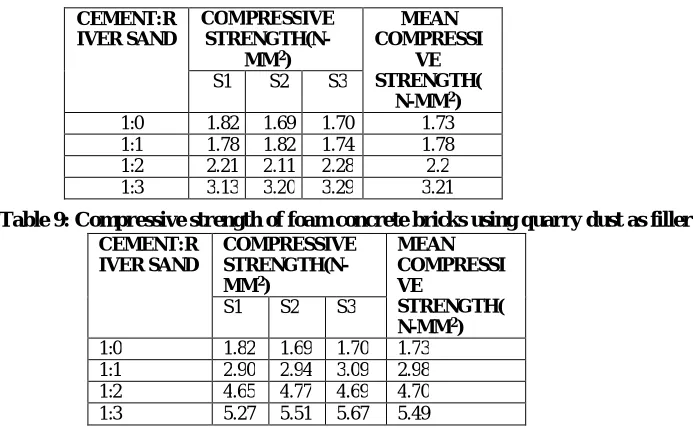
opposite sides or is otherwise compressed, “squashed”, crushed, or flattened. The test sample is generally placed in between two plates that distribute the applied load across the entire surface area of two opposite faces of the test sample and then the plates are pushed together by a universal test machine causing the sample to flatten. A compressed sample is usually shortened in the direction of the applied forces and expands in the direction perpendicular to the force. A compression test is essentially the opposite of the more common tension test. The compressive strength of specimen was calculated and tabulated in Table 6, Table 7 and Table
8.
ISSN (Online) : 2319 - 8753 ISSN (Print) : 2347 – 6710
International Journal of Innovative Research in Science, Engineering and Technology
An ISO 3297: 2007 Certified Organization Volume 7, Special Issue 5, April 2018
1st International Conference on Recent Innovation in Civil Engineering and Management (ICRICEM '18) 22nd March 2018
Organized by
Department of Civil Engineering & MBA, Loyola Institute of Technology, Chennai, Tamilnadu, India
CEMENT:R IVER SAND
COMPRESSIVE STRENGTH(N-
MM2)
MEAN COMPRESSI
VE STRENGTH(
N-MM2)
S1 S2 S3
1:0 1.82 1.69 1.70 1.73 1:1 1.78 1.82 1.74 1.78 1:2 2.21 2.11 2.28 2.2 1:3 3.13 3.20 3.29 3.21
CEMENT:R IVER SAND
COMPRESSIVE STRENGTH(N- MM2)
MEAN COMPRESSI VE
STRENGTH( N-MM2)
S1 S2 S3
1:0 1.82 1.69 1.70 1.73 1:1 2.90 2.94 3.09 2.98 1:2 4.65 4.77 4.69 4.70 1:3 5.27 5.51 5.67 5.49
Table 8: Compressive strength of foam concrete bricks using sea sand as filler
Table 9: Compressive strength of foam concrete bricks using quarry dust as filler
5.1WATER ABSORPTIONTEST
The specimen were (3 no’s) immersed i water for 24 hours and weighed (W1) then they kept in a ventilated oven for one hour and weighed (W2). Percentage of water absorption=W1 – W2 / W2 x 100. The percentage of water absorption was calculated and tabulated in Table 5.
Table 6: Percentage of water absorption
From the Table 6, it is observed that the density of foam concrete bricks increased with increase in mix ratio. Further Quarry dust as filler foam concrete density is higher than sea sand or river sand as filler. The variation in density is presented in Chart - 1.
Ratio cement :River sand
cement : Sea sand
cement : Quarry
1:0 13.43 13.43 13.43
1:1 11.67 11.86 10.58
1:2 9.78 10.26 9.50
ISSN (Online) : 2319 - 8753 ISSN (Print) : 2347 – 6710
International Journal of Innovative Research in Science, Engineering and Technology
An ISO 3297: 2007 Certified Organization Volume 7, Special Issue 5, April 2018
1st International Conference on Recent Innovation in Civil Engineering and Management (ICRICEM '18) 22nd March 2018
Organized by
Department of Civil Engineering & MBA, Loyola Institute of Technology, Chennai, Tamilnadu, India
Ratio cement :River sand
cement : Sea sand
cement : Quarry
dust
1:0 13.43 13.43 13.43 1:1 11.67 11.86 10.58
1:2 9.78 10.26 9.50
1:3 9.37 9.36 8.54
5.2 DENSITY OF FOAM CONCRETE BRICK
.
5.3 COMPRESSION TEST
In a compression test a material experiences opposing forces that push inward upon the specimen from
Chart -3: Compressive Strength of foam concrete bricks at an age of 28 days
V. CONCLUSIONS
From the test results the following conclusions are made
.Foam concrete specimen with quarry dust as filler gained more density and sea sand as filler gained very close density with conventional foam concrete (River sand as filler).
Maximum water absorption of foam concrete brick specimen is well below the allowable limit of 15%.
Compressive strength of specimen using quarry dust as filler gained more and sea sand as filler gained very close results with conventional foam concrete.
Reduction in compressive strength due to thermal effect is in decreasing order for higher mix ratios of all filler materials.
ISSN (Online) : 2319 - 8753 ISSN (Print) : 2347 – 6710
International Journal of Innovative Research in Science, Engineering and Technology
An ISO 3297: 2007 Certified Organization Volume 7, Special Issue 5, April 2018
1st International Conference on Recent Innovation in Civil Engineering and Management (ICRICEM '18) 22nd March 2018
Organized by
Department of Civil Engineering & MBA, Loyola Institute of Technology, Chennai, Tamilnadu, India
From the above conclusions sea sand as well as quarry dust may be used as alternate materials in foam concrete as filler.
REFERENCES
[1] Dr.A.S.Kanagalakshmi, K.Sasikumar and E.Britto Pravin,“An Investigation on Foam Concrete with Quarry Dust Replacement For Filler in Mix Design”, International Journal of Emerging Technology in Computer Science & Electronics, ISSN: 0976-1353, Volume 13, Issue 1, March 2015, pp. 570 – 581.
[2] Mr.S.Yuvaraj, S.Karthik, M.Naveen Raj, S.S.Ridhu Pharan, P.Sargunam, S.Sethunarayanan and C.Vyshnav, “Experimental Research on Foam Concrete with Partial Replacement of Sand by M-Sand”, International Journal of Advanced Technology in Engineering and Science, ISSN: 2348-7550 Vol.No.3, Special Issue No.01, August
2015, pp. 285 -290.
S.Ravi Shankar and Jijo Abraham Joy, “Experiment on Foam Concrete with Quarry Dust as Partial Replacement for Filler”, International Journal of Engineering Research
& Technology, ISSN: 2278-0181, Vol.4 Issue 03, March- 2015, pp. 487 – 493.
[3] Abbas M. Abd and Dunya S. Jarullah, “Producing Lightweight Foam Concrete Building Units Using Local Resources”, Civil And Environmental Research, ISSN
2224 – 5790 (Paper), ISSN 2225-0514 (Online) Vol.8, No.10, 2016, pp. 54 – 63.
[4] Mr.Ashish S.Moon, Dr.Valsson Varghese and Mr.S.S.Waghmare, “Foam Concrete Can be used For Sustainable Construction as a Building Material”, International Journal for Scientific Research & Development, Vol.3, Issue 02, 2015 ISSN (Online):
2321-0613, pp. 1428 - 1431.
[5] Maheshkumar H.Thakrele, “Experimental Study on Foam Concrete”, Environmental and Infrastructure Engineering Research and Development, ISSN (E):
2249-7978, Vol.4, Issue 1 Feb 2014, pp. 145 – 157.
[6] Alonge O. Richard and Mahyuddin Ramli, “Experimental Production of Sustainable Lightweight Foamed Concrete”, British Journal of Applied Science & Technology 3(4): 994-1005, 2013, pp. 994 – 1005.
[7] Chen Bing, Ph.D; Wu Zhen and Liu Ning, Ph.D; “Experimental Research on Properties of High – Strength Foamed Concrete”, Journal of Materials in Civil Engineering, January 2012, 113 -118.
[8] G.Balamurugan and Dr.P.Perumal, “Use of Quarry Dust to Replace Sand in Concrete- An Experimental Study”, International Journal of Scientific and Research Publications, ISSN: 2250-3153, Vol. 3 Issue 12, December 2013, pp. 50 -53.
[9] G.Balamurugan and Dr.P.Perumal, “Behaviour of Concrete on the Use of Quarry Dust to Replace Sand-An Experimental Study”, Engineering Science and Technology: An International Journal, ISSN: 2250-3498, Vol. 3, No.6, December 2013, pp. 776 – 781.
[10] G.Balamurugan and P.Perumal, “Experimental Study on the Thermal and Thermoshock Effects on the Concrete Strength due to the use of Quarry Dust for Replacing Sand”, European Journal of Scientific Research, ISSN: 1450-216X, Vol. 92 No.1, December