Viena G. Covarrubias. A Comparison of the Questions Asked between the Chat
Reference Service and the E-Mail Reference Service in an Academic Library. A Master’s
paper for the M.S. in L.S. degree. March, 2013. 83pages. Advisor: Claudia J. Gollop
Virtual Reference has been provided in libraries since the early 1900s. It started with the E-mail Reference Service, and in the mid-1990s it continued with Chat Reference
Service. However, the Chat Reference Service and the E-mail Reference Service present special characteristics that influence the questions users ask through them.
The present study analyses, categorizes, compares and highlights the differences and similarities of the questions received through these 2 virtual reference services in Walter Royal Davis Library, the main academic library of the University of North Carolina at Chapel Hill. Despite the differences, Policy and Procedural questions are the most common ones in both services, which are distinct from the Reference Transactions traditionally expected.
The results of the study will contribute to the LIS literature regarding virtual reference services. Also, they will be especially helpful to the researcher’s home institution in its implementation of the Chat Reference Service.
Headings:
Academic libraries -- Reference services
Electronic reference services (Libraries)
Instant messaging
Internet in library reference services
Library reference services -- Evaluation
A COMPARISON OF THE QUESTIONS ASKED BETWEEN THE CHAT REFERENCE SERVICE AND THE E-MAIL REFERENCE SERVICE IN AN
ACADEMIC LIBRARY
by
Viena G. Covarrubias
A Master’s paper submitted to the faculty of the School of Information and Library Science of the University of North Carolina at Chapel Hill
in partial fulfillment of the requirements for the degree of Master of Science in
Library Science.
Chapel Hill, North Carolina
March 2013
Approved by
________________________
Table of Contents
Introduction………...3
Literature Review……….…………...….8
Virtual Reference………..………...8
Chat Reference Service………..………..………...10
E-mail Reference Service………..………....12
Evolution of the Chat Reference Service and the E-mail Reference Service …...12
Walter Royal Davis Library…………..………...14
Categories of Questions………..………..……….…17
Reference Transactions………..………..………..20
Methodology………..21
Sample………..……….……….23
Content Analysis of Transcripts………..………….………..24
Defining Categories and their Conceptualization………..……27
Categories and their Conceptualization………..…………...28
Limitations……….40
Results………42
Chat Reference Questions………..………42
E-mail Reference Questions………..………....55
Discussion of Results……….60
Different Number and Percentage of Questions….………..……61
Reference Transactions……….66
Categories of Questions and their Function……….….66
Summary and Conclusions………...………….68
Suggestions for SIBUC………..………71
Introduction
Libraries need to be responsive to actual users’ needs, demands, and expectations.
The analysis of what users are asking and the depth of information needed can help
libraries to take relevant managerial decisions, as well as to create new and better virtual
and on-site services.
Nowadays, librarians handle different types of services at one reference service
point. These services include Reference Transactions, but also other information
requests, such as directional transactions. Literature about this topic has typified the
questions received in the reference environment, and attending to the type of institution
and mean, these present great varieties in length and depth.
Besides the traditional face-to-face reference service, libraries provide reference
services through a combination of means: by telephone, by fax, and also in a virtual way
through their websites.
Regarding “Virtual Reference”, the Reference and User Services Association
(RUSA) of the American Library Association (2010) defines this concept mentioning that
it is a reference service provided by librarians to remote users, through the use of
computers or other technology. The communication channels used for this purpose can
be chat, e-mail, and instant messaging, among many others. Cassell (2010) states that
the basic models for virtual reference for remote users are e-mail, web-based chat, and
as SMS for short message service) and through social networking tools (Facebook,
Twitter, YouTube, MySpace). All these types of virtual reference services complement
each other, and if implemented in a library, they need to be integrated with traditional
reference and also with the rest of other services.
Regarding Chat Reference Service and E-mail Reference Service, both are virtual
reference services intended to satisfy the information needs or questions of remote users.
In comparison with face-to-face reference service, Chat Reference Service and E-mail
Reference Service don’t allow verbal (tone of voice, hesitation, etc.) and nonverbal cues
(body language). However, users can save the response received by the librarian, which
lessen the possibilities of committing transcription errors or misunderstanding the
librarian’s response. Chat Reference Service and E-mail Reference Service have some
special characteristics:
Chat Reference Service is a synchronous online session or a real-time
communication exchange that responds to a sense of immediacy and urgency
from the user. This service gives the opportunity for librarians to conduct the
reference interview, interaction in which users may write several sentences
and formulate different kinds of queries within the same session. However,
librarians may feel more pressure in responding quickly with no delay, and as
a result, the answers provided to the user may be shorter than in an E-mail
service. This communication tool also provides users the privilege of
anonymity and informality (abbreviations and lingo), which may make them
On the other hand, the E-mail Reference Service is asynchronous, or in other
words, not done in “real-time”, which means that the question and the answer
may be formulated, viewed and/or responded at different periods of time by
the librarian and the remote user. So E-mail Reference Service doesn’t
guarantee and immediate or quick answer from the librarian. E-mail
Reference Service doesn’t give a chance for the reference interview and the
questions that users ask without that interaction are usually short and focused
on one particular topic. In contrast, as librarians don’t feel much pressure,
they have more time to elaborate on what they feel may be a more complete
and longer response.
About the history of E-mail Reference Service, most of the authors agree that it
started in the early 1900s. Regarding Chat Reference Service, there is some consensus
that libraries started offering it since the mid-1990s.
So, to find out about the questions asked in virtual reference services, the
hypothesis of the present study is the following: Because of the characteristics of the
different means, the categories of questions asked by users through the Chat Reference
Service and through the E-mail Reference Service are also different, and include more
than Reference Transactions.
The Research Questions are:
1. What categories of questions do users ask through Chat Reference Service?
2. What categories of questions do users ask through E-mail Reference Service?
3. Are the categories of questions that users ask through Chat Reference Service
4. Are the categories of questions asked through both virtual reference services
only Reference Transactions?
To respond to the research questions, a study is done in Walter Royal Davis
Library, the main library of the University of North Carolina at Chapel Hill (UNC-CH),
which provides in its website the two virtual services studied. The Chat Reference
Service is provided through the “Chat with a Librarian” and the “Ask A Librarian -
Instant Messenger (IM)” options. The E-mail Reference Service is mainly provided
through the “E-mail Us” option.
So, the present paper studies the questions asked by users through the Chat
Reference Service and the E-mail Reference Service in Walter Royal Davis Library. The
methodology used is content analysis of the transcripts, a qualitative assessment that adds
dimension to what is already known about these two virtual reference services.
Reference Transactions and other questions that users ask in the physical and
virtual reference desk environment constitute effective feedback from users. But, what
are Reference Transactions? Two well-known organizations have defined this concept:
RUSA of the American Library Association and the Association of Research Libraries
(ARL). Their definitions present some common elements: the presence of information
consultations or information contact in a library setting, the interaction between a
member of the library staff and a user, the presence of particular information needs
expressed by the user, and the assistance provided to the user by the member of the
library staff, which involves the interpretation, evaluation, and instruction in the use of
one or more information resources (Reference and User Services Association (RUSA) of
information services provided by librarians about information sources, and that Reference
Transactions exclude directional transactions.
The results of this study will contribute to the LIS literature regarding virtual
reference services. Also, they will help develop the Chat Reference Service at the
Library System of Pontificia Universidad Catolica de Chile (SIBUC). SIBUC already
has an E-mail Reference Service, which has been placed in its website for 4 years.
Nevertheless, when it was first implemented, reference librarians were afraid of this
service and of the questions they would receive. So, for this second stage, which is the
Chat Reference Service, it will be necessary to sensitize librarians again and break their
fear for change. In order to be able to train librarians on the type of questions they will
receive in the Chat Reference Service, it is necessary to typify these questions, and
compare them with the ones received through E-mail. In this way, librarians will know
the differences between these 2 virtual reference services and will be prepared to respond
to the Chat Reference Service with more information and practical tools. Walter Royal
Davis Library is an academic library that presents some similarities with the libraries at
SIBUC, so, the results of the present study could be extrapolated and applied to it.
In this sense, authors agree that evaluation studies help to take better decisions
and improve the services in an organization. Logan & Lewis (2011) state that
“Assessment not only allows for informed decision making about resource allocation, but
also provides information about ways to improve service.” (p. 218) “Since a good
assessment is designed to answer a question and provide useful information, the loop
should be closed by using the results to make improvements to the service” (Kern, 2009,
Literature Review
Virtual Reference
According to RUSA of the American Library Association (2010):
Virtual reference is reference service initiated electronically where patrons employ computers or other technology to communicate with public
services staff without being physically present. Communication channels used frequently in virtual reference include chat, videoconferencing, Voice-over-IP, co-browsing, e-mail, and instant messaging.” (2.0 Definition of Virtual Reference section, para. 1).
The International Federation of Library Associations and Institutions (IFLA)
(2008) states that virtual reference “must meet the same standards as traditional reference
services.” (The Practice of Digital Reference section, para. 1) and provides useful
guidelines “to promote digital reference best practices on an international basis.”
(Purpose section, para. 1) Many authors have complemented this topic, and among them,
Lipow (2003) wrote a handbook to help libraries in the development of virtual reference
services, and Kovacs (2007) a handbook about the technical, communications, and
reference skills for virtual reference librarians.
Tyckoson (2011) distinguishes 3 kinds of technology: technology that stores
information, that reproduces it, and that communicates. So, virtual reference responds to
this last kind of technology: technology that communicates. Tyckoson (2011) argues
that since the arrival of technology, all that has changed in the reference service over the
years are the tools and the communication channels used for providing the service.
Among them, RUSA of the American Library Association (2010) includes “chat,
videoconferencing, Voice-over-IP, co-browsing, e-mail, and instant messaging.”
RUSA of the American Library Association (2010) also states that virtual
reference must be integrated with traditional reference, or face-to-face reference services,
and be treated as part, and also as “an extension of an institution’s existing reference
services.” (Organization of Service section, para. 1), assigning it the same status and
quality goals.
According to Bridgewater & Cole (2009) “virtual reference can be a very easy,
extremely low-cost way to extend services to previously unserved or underserved patrons
and enhance services to patrons you are already serving well.” (p. 13), or in other words,
it represents an opportunity to reach a new segment of users: remote users. Heise &
Kimmel (2003) complement this idea by commenting that traditional library services are
valuable, but perceived to be less accessible by users, so librarians have to focus on a new
community of online users. Bridgewater & Cole (2009) summarize that other advantages
for implementing virtual reference services are that people are increasingly online and
that virtual reference can be inserted in their online experiences allowing libraries to be
competitive and provide integral reference services.
Finally, Logan & Lewis (2011) affirm that “Today, the library community
recognizes that the ability to communicate with users in a variety of ways is very
important: e-mail, chat, text, phone, and in-person.” (p. 220), and Bridgewater & Cole
(2009) mention that there are three basic models that complement each other for
Chat Reference Service
The creation of this service responds to the increasing number of online services
and resources offered by libraries, as well as to the increasing number of online users.
Chat Reference Services are provided through web-based chat and instant messaging
(Bridgewater & Cole, 2009).
Ronan (2003) says that Chat Reference Service is a real-time or synchronous
reference service for remote users, and that there are some factors that support offering
this kind of service, such as: the increasing number of online users, and better
connectivity and networking technology. Kern (2009) states that a synchronous
transaction may be understood as a computer-mediated communication occurring in real
time. Cassell & Hiremath (2011) state that “The advantage of chat reference is that the
reference interview can be used successfully in this format. There is an opportunity to
communicate back and forth with the user, and an opportunity for providing guidance the
user can use in future queries.” (p. 25). Heise & Kimmel (2003) reaffirm these previous
ideas, but also state that chat programs have special features that make the experience
more enjoyable, and that that it offers the benefits of anonymity to the users, which
alleviates them from the embarrassment of asking for help.
According to Ronan (2003) and Barbier & Ward (2005) the reference interview
online presents many challenges because there is no body language (no visual and audio
clues, such as gestures and vocal intonations). Ronan (2003) suggests some behavioral
guidelines similar to the ones that apply to the face-to-face interview, but with some
reference requires effective communication skills and training because the user is not
present.
Bridgewater & Cole (2009) define IM as “an internet service that allows users to
communicate with one another directly in real time” (p.27), or in other words, systems
such as AIM, Yahoo! Messenger, MSN Messenger, and GoogleTalk that facilitate
connections between known users. Kern (2009) specifies that IM is quite similar to
web-based chat because is text-web-based and computer-facilitated, and that the only difference is
the software used.
On the other hand, Ronan (2003) defines web-based chat as “any program that
creates a chat window on a web page, allowing users to exchange messages with a
librarian without having to install a special piece of software on their computers.” (p. 17)
and Bridgewater & Cole (2009) add that web-based chat can take the form of enterprise
software or widgets embedded in the Website, which can be categorized as “hybrid” and
“prepackaged”.
Regarding the differences between IM and web-based chat, Cassell & Hiremath
(2011) state that IM is faster that web-based chat, but that allows less communication and
shorter messages, and Pomerantz (2005) complements saying that “IM applications are
being used by some libraries as a low-cost means of offering chat-based reference,
because most IM applications are free” (p. 1,289) and that “Another advantage of IM
applications for chat-based reference is that many younger computer users are already
familiar with the technology” (p. 1,289). Lankes (2008) agrees with this last statement,
and adds that IM is perceived more friendly and informal, because itallows case letters,
Regarding web-based chat, Pomerantz (2005) and Lankes (2008) point out that
because theuse applications are designed especially for that kind of service, web-based
chat allows more sophisticated functionality, such as multi-user environment of
anonymous users, queues control, and the possibility to save transcripts automatically and
develop statistics. At this last respect, RUSA of the American Library Association
(2010) affirms that the reviewing of transcripts, and the analysis of statistics are crucial
for evaluating the service.
E-mail Reference Service
E-mail Reference Service is asynchronous, or in other words, not done in
“real-time”. Kern (2009) illustrates the previous statement by saying “E-mail allows users to
send a message any time to a person who may or may not be online at the same time.” (p.
3), and a as consequence, the message received by the librarian can be stored and read
some time after it was received, and the answer to that message can also be delayed, just
as it happens to letters written on paper (but without shipment delays).
Cassell & Hiremath (2011) state that “Although e-mail reference is slower, it has
the advantage of giving the librarian time to do some research and provide a more
thorough response. The e-mail response should also invite the user to return for more
information or to use the service again.” (p. 25)
Evolution of the Chat Reference Service and the E-mail Reference Service
Hudson (2011) states that “Reference librarianship in a virtual or online
starting point for E-mail Reference Service, when the possibilities of utilizing the Internet
for reference service were being explored by pioneer libraries. Hudson (2001) remarks
that since then, libraries started incorporating various online tools that enabled them to
offer in the late 20th century, real-time chat interaction services. Hudson (2001) mentions
that nowadays libraries also offer text-based delivery services for mobile devices.
Most of the authors agree that E-mail Reference Service started in the early
1990s, but there are also some other assumptions. Kern (2009) states that “E-mail is the
most common and oldest of the virtual reference communication tools. Libraries have
been using e-mail for reference service for more than twenty years.” (p. 3) But Cassell &
Hiremath (2011) formulate that libraries started offering E-mail Reference Service since
the mid-1990s. And Coffman & Arrett (2004) comment that to provide traditional library
services in the online environment, libraries have been experimenting with E-mail
Reference Service, Chat Reference Service, and online media since the late 1990s (as
cited in Kortz, Morris, Greene, 2006).
Regarding Chat Reference Service, Pomerantz, Luo, and McClure (2006) state
that libraries have been offering it since the mid-1990s. Heise & Kimmel (2003) agree
with this statement, adding that online chat service was initiated with the introduction of
ICQ (“I seek you”) instant messaging computer program, which was released to the
public in 1996. Hirko (2002) comments about the rapid expansion of real-time reference
and commercial software diversity, saying that in 1999 there were only a few libraries
experimenting with Chat Reference Service, but that the 2000s were the beginning of a
new reference era. On the other hand, and regarding literature about chat-based
(late 1990s) literature on new technologies and its potential was written by early adopters,
and in the second phase (2000s) most of the literature published contains case studies, or
in other words, discussions of new implementations in different environments.
Walter Royal Davis Library
Walter Royal Davis Library is the central library, and the largest and most
comprehensive library for the humanities and social sciences in UNC-CH. It has 2.5
million volumes, 2 million government documents, and 3 million microforms. It
provides access to print and electronic resources, as well as to on-site and virtual services.
The library is constantly improving its services and inviting its users (faculty, students,
and others) to use them and give feedback.
In Walter Royal Davis Library, Chat Reference Service was implemented in
October 2001 (Chad Haefele, personal communication, August 2, 2012), and according
to Andrews (2004), it started using Tutor.com’s (formerly Library Systems and Services,
LLC [LSSI]) Virtual Reference Toolkit. Bridgewater & Cole (2009) wrote that it was in
year 2003 when University of North Carolina (UNC), Duke University, and North
Carolina State University, in a collaborative effort, decided to extend their Chat and
instant message reference services to the late-night hours, forming the Triangle Research
Library Network (TRLN). In February 2004, the UNC University Libraries joined
NCknows(Pomerantz, Luo, & McClure, 2006), a pilot project supported by a grant under
the Federally-funded Library Services and Technology Act (NCknows, About NCknows
page, Who is NCknows? section, para. 1). In 2008 the UNC University Libraries and
these other cooperative institutions started using “Libraryh3lp”, which now combines,
instant messaging and text messaging, and that adds extra features such as the ability to
manage queues with multiple gateways and operators (Bridgewater & Cole, 2009).
The number of chat sessions that Walter Royal Davis Library receives increment
each year, and in 2011 there were 14,357 chat sessions that lasted longer than 30 seconds
(Chad Haefele, personal communication, August 1, 2012).
According to Davis Library website (http://www.lib.unc.edu/davis/), Walter
Royal Davis Library provides the following virtual reference services: “Chat with a
Librarian”, “Ask A Librarian - Instant Messenger (IM)”, “Research Consultation”,
“Subject Specialists”, “Text Us”, and “E-mail Us” services, each one of them with
different characteristics. The UNC University Libraries also offers access to Social
Media (Twitter, Facebook, and Blogs).
Regarding the Chat Reference Service, the website provides the following
options:
Chat with a Librarian: It is a web-based reference service (widget). In this
option, that is also called “Need Help? Ask Us.” the user can choose between
chatting with the Reference or Circulation sections. However, internally,
questions get transferred back and forth between the two sections, depending
on which desk is better suited to handle the questions. There is no easy way
to differentiate the questions between the two sections, but it seems that the
Reference section gets more traffic than the Circulation section (Chad
Ask A Librarian - Instant Messenger (IM): It is an instant messaging
reference service, which allows users to chat via AIM, Yahoo! Messenger,
MSN Messenger, and GoogleTalk.
As mentioned before, these two modalities are fully integrated through the
software “LibraryH3lp”. Due to the collaboration with Duke University, and North
Carolina State University, and also for being part of NCknows, the UNC University
Libraries have extended Chat Reference Service that allows them to operate 24/7. When
the service is offline, or not attended by a UNC Librarian, the queries that users ask
during certain days of the week, after 9:00 p.m. until midnight, go to the Triangle
Research Library Network (TRLN), and when that option is not available, backup chat
services are provided by NCknows librarians.
The E-mail Reference Service was implemented in 1995 through the “E-mail Us”
option, which annually receives a total of 660 queries, or in other words, 55 monthly
queries (Gary Pattillo, personal communication, August 27, 2012):
E-mail Us: This option is a simple Web form that asks the user for: his/her
question, E-mail address, location, whether he/she can visit the UNC
University Libraries in person, and where to send the question (Davis
Reference, or Davis Circulation).
The website also provides other alternatives for more complex and specialized
queries, which will not be considered in this study:
Research Consultation: Through a “Research Consultation Request Form”,
send a research question. The form has many fields to be completed by the
users, including personal information and research related issues.
Subject Specialists: The users are encouraged to contact a specialized
librarian for each school, department, or program. A complete list of library
contacts by subject is provided, which include physical location of the
librarian, telephone and E-mail.
Categories of Questions
The information and library science literature has developed many classifications
of questions received in reference service points, which are illustrated in Table 1.
Table 1
General reference types of questions
Tyckoson (2011) distinguishes 9 different types of questions. Based on their
experience in public libraries, Anderson & Sprenkle (2006) differentiate among
Directional Questions, Reference Questions, and Policy Questions. Katz (2002) talks
about two general types of queries: Known Item, and Information without Knowledge of
a Specific Source. However, he also suggests a more finely drawn categorization:
Direction, Ready Reference, Specific-Search Questions, and Research (Katz, 2002).
Tyckoson (2011) Anderson & Sprenkle (2006) Katz (2002)
Reader’s Advisory, Directional Questions Direction
Ready Reference, Reference Questions Ready Reference
Research Consulting, Policy Questions Specific-Search Questions
Subject Specialists Research
Bibliographic Verification and Citation Interlibrary Loan and Document Delivery Instruction
Literacy Programs Outreach and Marketing
Grogan (1992) De Groote, Hitchcock, & McGowan (2007) Beatty & Cloutier (2012) Administrative and Directional Enquiries Directional Questions Directional
Author/Title Enquiries Ready Reference Questions Reference Fact-Finding Enquiries In-depth Reference Questions, and Technology Material-Finding Enquiries Consultations, Demonstrations Referral
Mutable Enquiries Other
Attending to the nature of the practical response that is expected from the librarian,
Grogan (1992) differentiates 7 groups of enquiries, and Beatty & Cloutier (2012)
distinguishes 5 groups. As a conclusion, it is possible to say that two types of questions
are present in all these categorizations: Directional and Research Queries.
Interesting was the study conducted by De Groote, Hitchcock, & McGowan
(2007), who analyzed the questions asked at the traditional reference desk (in-person or
over the phone) in an academic library. Based on these categories, Beatty & Cloutier
(2012) also studied traditional reference desk activity in an academic library.
On the other hand, some studies have been done specifically for Chat Reference
Service and E-mail Reference Service, which are illustrated in Tables 2 and 3
respectively. The literature found is mostly from the early 2000s, when virtual reference
services were in their initial stage.
The literature regarding Chat Reference Service is illustrated in Table 2. Arnold
& Kaske (2005), Marsteller & Mizzi (2003), and Sears (2001) have studied chat
questions received in academic libraries. Kortz, Morris, & Greene (2006) analyzed
public libraries, which attend a broader segment of users with more diversified interests.
Table 2
Chat reference types of questions
ACADEMIC LIBRARIES PUBLIC LIBRARIES
Arnold & Kaske (2005) Kortz, Morris, & Greene (2006) Directional, Ready Reference, Specific Search, Research, Policy and
Procedural, and Holdings/Do you Own?
Homework and Research, Personal and Recreational Questions, Inappropriate and Prank Questions, and Crisis Questions.
Marsteller & Mizzy (2003) Reference, Facts/Ready Reference, Known Item, and Directional/Policy/Procedure.
Sears (2001)
Reference Questions: Ready-Reference, Specific-Search, and Research Questions.
Policy & Procedural Questions: Database instructions, passwords, etc., and Library policy clarification.
As illustrated in Table 3, and since the E-mail Reference Service has been in
libraries for a longer period of time than the Chat Reference Service has, literature is
more extensive and varied. The categories are also larger, more detailed and adapted to
the particular needs of the organizations, especially in relation to academic libraries.
Schwartz (2004), Diamond & Pease (2001), Powell & Bradigan (2001), and Lederer
(2001) studied E-mail reference questions in academic Libraries; Numminen & Vakkari
(2009) in a consortium of public libraries; and Duff & Johnson (2001) in provincial,
federal, university, city and special archives.
Table 3
E-mail reference types of questions
ACADEMIC LIBRARIES PUBLIC LIBRARIES SPECIAL LIBRARIES (ARCHIVES) Schwartz (2004) Numminen & Vakkari (2009) Duff & Johnson (2001)
By the type of question: Reference, Non-Reference, Known Item, and Mixed.
Reference Questions: Ready Reference (Known-Item Search, Known-(Known-Item Related Search, Fact Finding) and Subject-Based Research Questions (Topical Search, Research Question, Person Related Question).
Limited Help Questions: Administrative / Directional, Material Finding, Specific Form, Known Item, and Service Request.
By the type of answer: Statements, Factual, Provide, Instruct, Advise, and Need.
Policy and Procedural Questions: On Availability and use of E-resources, On Library Policy Clarification and the Availability of a Specific Library Service.
Open-Ended Questions: Consultation and User Education.
By discipline: Humanities, Social sciences, Business, Science, and Interdisciplinary Questions.
Directional Questions: Location within the Physical Library Environment, and Location of Resources on the Library’s Web Site.
Diamond & Pease (2001) Other Questions Catalog Look-Up and Use, Library Policies and
Scope of Collections, Connectivity Questions, Database Mechanics, Questions Answered using Standard Reference Resources, Specific Factual but not Ready Reference, Navigating the Research Station, Information Literacy, Starting Points for Term Papers and Assignments, Non-Library Questions and Referral to Other Departments, and Non-Questions.
Powell & Bradigan (2001)
Access to Online Services, Citation Verification, Consumer Health, Database Searching Advice, Directory Information, Holdings Information, Library Services, Professional Information, and Statistical Information.
Lederer (2001)
Comparing Chat questions with E-mail questions in an Australian academic
library, Lee (2004) concludes that the questions asked in these two modalities are in some
respects similar, and that they receive the same proportion of questions about finding
known items. However, he found out that the Chat Reference Service received a higher
proportion of research and reference enquiries, as well as questions about accessing
databases and electronic resources, and that on the other hand, Email service tended to
receive a higher proportion of questions about administrative issues, referencing and
citation (Lee, 2004). He states that in the Chat Reference Service, the immediacy or
urgency factor may shape the type of questions and that the interaction produced by the
reference interview may alter initial questions and turn them into research and reference
enquiries (Lee, 2004).
Reference Transactions
RUSA of the American Library Association (2008) provides the following
definition for Reference Transactions:
Reference Transactions are information consultations in which library staff recommend, interpret, evaluate, and/or use information resources to help others to meet particular information needs. Reference transactions do not include formal instruction or exchanges that provide assistance with locations, schedules, equipment, supplies, or policy statements. (Reference and User Services Association (RUSA) section, para. 1)
The Association of Research Libraries (ARL) provides a similar definition, which
adds some details regarding information sources:
A reference transaction is an information contact that involves the
databases (including computer-assisted instruction); (c) the library's own catalogs and other holdings records; (d) other libraries and institutions through communication or referral; and (e) persons both inside and outside the library. (Reference and User Services Association (RUSA) of the
American Library Association, 2008,The Association of Research
Libraries (ARL) section, para. 1)
It is important to notice that as RUSA, ARL specifies that Reference Transactions
don’t include directional transactions, which are information contacts for logistical use of
the library (Reference and User Services Association (RUSA) of the American Library
Association, 2008).
Tyckoson (2011) refers to the reference service as “The third and historically
most recent function of libraries” (p. 6) indicating that this concept was born in the mid-
to late-1800s, as a direct result of two 19th century ideals: universal education and free
public libraries. Tyckoson (2011) also indicates that the role of the reference service is
“to provide direct assistance to users in their search and retrieval of information” (p.6).
With the readings, it is possible to infer that despite the arrival of technology in
1876, the main functions of the reference service have remained the same over the years:
to give assistance and instruction to the users, aid the readers in the selection of good
information sources, provide factual information, and promote the library within the
community.
Methodology
According to the Literature Review exposed in the present paper, Chat Reference
Service and E-mail Reference Service have their own particularities. Taking into
is to find out if the questions asked by users through these two services also differ, and if
they include more than Reference Transactions. The research questions are:
1. What categories of questions do users ask through Chat Reference Service?
2. What categories of questions do users ask through E-mail Reference Service?
3. Are the categories of questions that users ask through Chat Reference Service
different from the questions they ask through E-mail Reference Service?
4. Are the categories of questions asked through both virtual reference services
only Reference Transactions?
To compare the questions received through both services, Walter Royal Davis
Library was selected for the study. It is the largest library of the UNC University
Libraries and it offers both services in its website, providing a unique and particular
setting of librarians, collections, services and users.
For the Chat Reference Service the questions received through the “Chat with a
Librarian”, “Need Help? Ask Us.” and the “Ask A Librarian - Instant Messenger (IM)”
options were considered. These options appeared in different pages of the Walter Royal
Davis Library website. Sometimes the user has the option of choosing the “Reference”
or “Circulation” chat box:
Different chat boxes go to different places. We can create a box that goes to any target. So depending on which link you follow, you’ll find
different ones that we thought were most relevant to those pages.
Sometimes we put the box to go straight to circulation (I’d forgotten that one existed, to be honest), and sometimes a more generic one that just goes to the reference desk. (Chad Haefele, personal communication, July 27, 2012)
For the E-mail Reference Service, and to be able to compare similar level of
was considered. As the Chat Reference Service doesn’t provide the users an alternative
for more specialized and complex queries, for analyzing the E-mail Reference Service the
“Research Consultation” and “Subject Specialists” options were not included.
Sample
The period of time selected for both reference services (Chat and E-mail) was the
first semester of year 2012, and for each service, the period with the highest amount of
questions received. To be able to compare the questions received in both services, it was
decided that 150 sessions were going to be analyzed for each one of them.
Even though these virtual services don’t ask the users to give their name, and due
to confidentiality issues, private information such as names, places and E-mails was
previously removed by the librarians in charge of these services.
For the Chat Reference Service, a total of 150 anonymous Chat sessions were
analyzed. The transcripts of these sessions were provided by Mr. Chad M. Haefele, the
librarian in charge of this service in the User Experience Department of the UNC
University Libraries. The second half of February (2/16 – 2/31) was the busiest two
week period for chats in Spring 2012. In those two weeks there were 562 Chat sessions
that lasted longer than 30 seconds, or an average of 35 Chat sessions per day.
From that period, the sample considered an average of 10 Chat sessions per
day, which were randomly selected by Mr. Haefele: If a day had 10 Chat
sessions, he included them all in the sample; if a day had more than 10 Chat
there were fewer than 10 Chat sessions on a given day, he selected others
from another random day to make up the difference.
Only the questions answered by UNC University Libraries were analyzed.
This means that the questions received by the Triangle Research Library
Network (TRLN) and NCknows were not considered.
Chat sessions that were shorter than 30 seconds were excluded from the
sample, because according to Mr. Haefele they are often spam or the person
didn’t wait around for an answer.
For the E-Mail Reference Service, a total of 150 anonymous E-mails (sessions)
were analyzed. The transcripts of the sessions were provided by Mr. Gary N. Pattillo,
reference librarian of the Research and Instructional Services at UNC University
Libraries. The period of time selected was the busiest of Spring and Summer 2012
terms, specifically from February 15 to June 6, and all the questions received during that
time were included in the study.
Content Analysis of Transcripts
Many different categories of reference question have been developed by
researchers along the years, and some of them are described in the Literature Review of
the present paper. Based on those categories, and also on the analysis of the sessions
included in the sample, the present study creates its own categories of questions for the
Chat Reference Service, and for the E-mail Reference Service.
So, to be able to categorize the Chat and E-mail questions, all the questions
the transcripts of the Chat sessions and the transcripts of the E-mails received, which
were the units of analysis of the present study.
At this point, it is important to mention that the analysis of transcripts is a
methodology used in several studies related to virtual reference services, not only to
evaluate the kind of questions that users ask, but to evaluate different aspects of the
service. Ronan (2003) and Pomerantz (2008) state that from the libraries’ perspective,
transcripts of sessions assist in the evaluation of reference services. Arnold & Kaske
(2005) add that “Chat service transcripts provide an excellent way to examine the quality
of reference transactions for any library or group of libraries.” (Introduction section, para.
1) and they describe a quantitative study done in a university chat reference, where
librarians, in order to study the types of questions that were being asked by the users as
well as other issues, analyzed 351 chat transcripts. Pomerantz, Luo, & McClure (2006)
described the experience of a group of librarians, that from a peer reviewed perspective,
reviewed a sample of 429 chat reference transcripts, arriving to significant conclusions
regarding the quality of virtual reference service and the skills and engagement of the
librarians providing it. Barbier & Ward (2005) analyzed the case of a public virtual
reference service, in which a group was formed to evaluate and select the best chat of the
month through the analysis of the transcripts. White, Abels, & Kaske (2003) analyzed
transcripts to evaluate the completeness and accuracy of the answers provided by
librarians and the whole quality of the Chat Reference Service. Radford & Connaway
(2010), from a study that analyzed a sample of 850 chat reference transcripts in an
academic library, reported research results regarding waiting time of users and
Pomerantz, Luo, & McClure (2006) state that the analysis of transcripts is the
perfect method to develop an unobtrusive evaluation in virtual services, because it gives
the opportunity to work with real questions from real users. Babbie (2010) defines
content analysis as “the study of recorded human communications” (p. 333), as an
unobtrusive research method for “studying social behavior without affecting it.” (p. 332).
According to Trochim (2006), in the unobtrusive method researchers don’t interfere in
the research context because they only study it in an indirect way, not being physically
present. Trochim (2006) complements this by saying that “Unobtrusive measurement
presumably reduces the biases that result from the intrusion of the researcher or
measurement instrument.” (Unobtrusive Measures section, para. 2) Finally, as not being
observed, users and librarians are not affected by the Hawthorne effect, and they don’t
alter their natural stream of behaviors.
So, in total for the present study, 300 transcripts of sessions were analyzed. 150
from the Chat Reference Service and 150 from the E-mail Reference Service. The 300
transcripts were read three times. In total, the reading of the transcripts took 3 weeks: 1
week for each time that the transcripts were read.
In order to define specific categories for each service, the transcripts of the Chat
Reference Service were read separately from the transcripts of the E-mail Reference
Service. To provide consistency with the classifications made and the criteria chosen,
each time that the transcripts were read, it was done all at once, in consecutive days.
The first time was to have a general idea of what the questions were about,
The second time was to classify the questions, applying to them the categories
defined and the same criteria.
The third time was to review the classification made for each question, and to
provide consistency among them. At this stage, many changes were made in
the classifications that had already been done.
Defining Categories and their Conceptualization
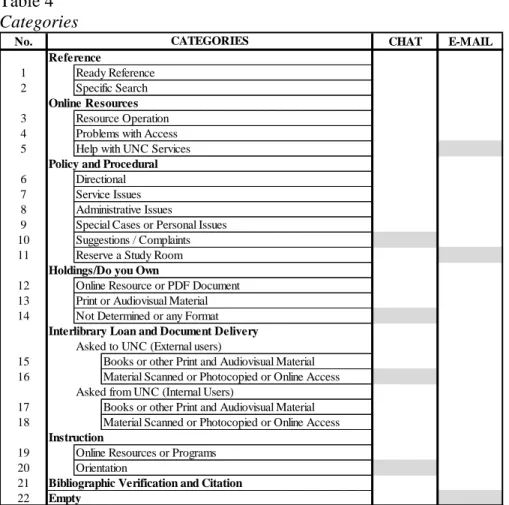
Once the transcripts were carefully read, it was possible to define the categories
illustrated in Table 4.
Table 4
Categories
No. CHAT E-MAIL
Reference
1 Ready Reference 2 Specific Search
Online Resources 3 Resource Operation 4
5
Policy and Procedural 6 7 8 9 10 11
Holdings/Do you Own
12 Online Resource or PDF Document 13 Print or Audiovisual Material 14 Not Determined or any Format
Interlibrary Loan and Document Delivery Asked to UNC (External users)
15 Books or other Print and Audiovisual Material 16 Material Scanned or Photocopied or Online Access
Asked from UNC (Internal Users)
17 Books or other Print and Audiovisual Material 18 Material Scanned or Photocopied or Online Access
Instruction
19 Online Resources or Programs 20
21 Bibliographic Verification and Citation
22 Empty
Note: Color gray in some cells indicates that the category doesn't apply to that particular virtual reference service (Chat or E-mail).
Special Cases or Personal Issues Suggestions / Complaints Reserve a Study Room
Orientation
CATEGORIES
Problems with Access Help with UNC Services Directional
In total, twenty two categories were created for the Chat Reference Service and
for the E-mail Reference Service. Most of the categories are specific categories that form
part of broader categories. Also, some of the categories apply to only one of the
Reference Services: Chat or E-mail.
To define the categories, the following criterion was applied:
If a session had more than one question, each question was counted
separately.
The questions were categorized in major categories, attending to the different
types of questions presented in the Literature Review.
However, it was noticed that some of those major categories defined in the
Literature Review were too broad and didn’t respond to the reality of the
questions included in the sample. So, within some broader categories, more
specific categories were developed.
Categories and Conceptualization
Each category defined for this study has an implied criteria or description
(conceptualization), based in the Literature Review, but also adapted to the particular
questions asked by the users of both services and that were included in the sample:
Reference: These types of question strictly respond to the definition of
“Reference Transaction” stated by RUSA and ARL. They reflect the users’
need of finding specific information resources, related to particular topics.
These questions vary on complexity and represent different levels of difficulty
Marsteller and Mizzy (2003) say that reference “Involves significant
contemplation, knowledge or instruction on the part of the librarian.” (p. 164)
and that reference questions may include guidance with databases or finding
the right access points for a topic.
In the present paper “Reference” questions include “Ready Reference” and
“Specific Search” questions.
Ready Reference: These are specific questions about one single aspect,
and that require a short and factual answer. According to Tyckoson
(2011), examples of these questions are: what is the population of
Washington? How many oranges were grown in California in 2012?
Arnold & Kaske (2005) define these types of questions as:
These are the typical ready-reference or data queries that require only a single, usually uncomplicated, straightforward answer. The requested information is normally found without difficulty in standard reference works, ranging from encyclopedias to almanacs and indexes. . . . Ready-reference queries may be divided and subdivided in many ways . . . Who? What? When? Why? Where? (Methodology section)
Katz (2002) has a similar definition. Marsteller and Mizzy (2003),
Numminen and Vakkari (2009) and De Groote, Hitchcock, and McGowan
(2007) specify that these are short answer type queries. Bopp & Smith
(2011) add that they are specific questions that can be answered in an
accurate or inaccurate way.
Grogan (1992)call them “Fact-Finding Enquiries” and he states that they
provision of specific items of information and statistically they form the
bulk of the enquiries received in libraries of all kinds.” (p. 39)
Specific Search: These are general questions made by users about a
specific topic, and that demand a search from the librarian, who ends up
with a range of information of the topic or a list of citations and materials.
The user will be the one who determines the extent and exhaustively of the
research.
The definition of these types of questions can be taken from Arnold &
Kaske (2005), who say that “Specific Search” answers imply giving the
user a list of citations, or documents, and these types of questions can
easily turn into “Research Questions”, which require detailed information
for a specific question formulated from an adult specialist. Examples of
these questions are: “Where can I find information on sexism in business?
What is the difference between the conservative and the liberal views on
inflation and unemployment?” (Arnold & Kaske, 2005, Methodology
section)
In this study, for the type of media used (Chat and E-mail) the questions
don’t get to be “Research Questions”, and if they do (through the Chat
session), they are referred to “Research Consultation” or “Subject
Specialists” services.
Grogan (1992)calls these questions “Material-Finding Enquiries”, and
demanding kind of queries, the ones that require skillful librarians with
reference and bibliographic knowledge.
These type of questions would correspond to the “Research Consulting”
reference service defined by Bopp & Smith (2011), who state that these
requests are more common in academic libraries and that “In this case, the
librarian may suggest sources, search terms, and pathways that will lead to
material relevant to the research project. These questions do not have
single, factual answers but have many possible results that vary depending
on the researcher’s interests and needs.” (p. 15)
These questions would also correspond to the “Subject-Based Research
Questions” defined by Numminen and Vakkari (2009), who state that they
respond to the request of some kind of materials or clarification on a
specific topic.
Online Resources: It was necessary to create this broad category, because
many of the questions involved the online resources and services available
through the UNC University Libraries website and also in Internet. It seems
that these kinds of questions started to appear in year 2001, with the great
evolution of technology and Internet resources. However, for the present
study, it was also necessary to narrow down this concept to a more specific
categorization:
Resource Operation: Diamond & Pease (2001) name these kinds of
questions “Database Mechanics”, and Lederer (2001) “Access to
such as: “How do I find an article in a certain journal, limit my search to
book chapters, or print only the abstracts of the article?” (Diamond &
Pease, 2001, p. 213)
Problems with Access: This applies for problems accessing databases or
obtaining documents online (E-books, online journals). Diamond & Pease
(2001) call them “Connectivity Questions”, saying that they involve
questions such as: “How do I get access from home? What's the
password? Is the server down?” (p. 213)
Help with UNC Services: These questions are related to the online
services available at the UNC University Libraries website, or to the
automated E-mail notifications that the UNC University Libraries have
implemented to maintain their users informed about the status of their
accounts (overdue notices, recall notices, etc.). These questions were only
asked through the Chat Reference Service.
In her study of Chat Reference Questions, Sears (2001) refers to them as
“Database instructions, password, etc.” questions. An example of these is
"I need to renew books. I cannot get the site to accept my name and
barcode?” (Sears, 2001, Types of Questions section) However, Sears
(2001) classifies them as part of the “Policy & Procedural” questions.
Policy and Procedural: Many authors feel the need of defining questions that
deal with requests not related directly to reference questions or “Reference
Transactions”, but that imply library regulations, policies and procedures
them. According to RUSA of the American Library Association (2008),
these are not reference transactions because they onlyinclude queries related
to policy statements, schedules, locations, equipment, or supplies.
Anderson & Sprenkle (2006) specify that in order to satisfy users, they have to
be answered with full explanations and good arguments, and that the questions
usually begin with “Why does (doesn’t) the library…” . Arnold & Kaske
(2005) believe that they begin with "How do I?". Schwartz (2004) states that
being non-reference questions implies that they apply to the particular
situation of each library, which can only be handled by personnel who know
about the specific institution and its environment.
Grogan (1992) refers to them as “Administrative and Directional Enquiries”:
Enquiries about such elementary and routine matters make no call on the bibliographical expertise of the staff, merely a basic general knowledge of where things are and how things are done in a particular institution. They are scarcely the type of questions that require
professional librarians to answer them, but they are frequently and genuinely asked by users in need of help and any library has an
obligation to make provision for them to be answered in a friendly and helpful manner. Most would agree, however, that in a well-ordered library may such queries could be anticipated by a clear system of signs and notices. (p. 37)
Directional: These types of questions are related to the location of virtual
and on-site collections and services, people, and places. Many authors
include them as part of the Policy and Procedural questions, because they
are non-reference questions that can be answered in an information desk
and that do not require the expertise of a librarian. Examples of these
questions are: “Where is the catalog?, Where are the indexes?” (Arnold &
2001, Types of Questions section) De Groote, Hitchcock, and McGowan
(2007) state that these are “Questions regarding location of services,
policies, collections and materials contained in the building or university.
Example: Where are the restrooms?” (p. 24) Arnold & Kaske (2005)
suggest that these types of question begin with “Where is” or “Where are”,
and that their answer require very little time and only general knowledge
about a particular institution.
Marsteller and Mizzy (2003) are even more updated and specific and state
that these are “Queries that simply ask for directions for where something
is physically or virtually located.” (p. 163) Numminen and Vakkari
(2009) seem to agree with this definition and divide these questions in
two: location within the physical library environment and location of
resources on the library’s website.
Service Issues: This is a subdivision that it was necessary to make
attending to the specific nature of some questions received. It was
believed that having this detail would contribute to the better analysis of
the information. They include general questions related exclusively to
policies, procedures and regulations of the services provided by Walter
Royal Davis Library and the UNC University Libraries, such as loans,
access to the library, opening hours, etc. Examples of these types of
questions are: How much are the fines?, What happens if I lose a book?
Duff & Johnson (2001) typify them as “Administrative / Directional” and
library service, etc. However, in the present study another subdivision
was necessary to make for the administrative questions, which greatly
differ from the service questions already mentioned.
Administrative Issues: To do this subdivision was also necessary in the
present study because of the many questions received about jobs in the
library, procedures about acquisition of materials (donation, purchase and
exchange), information about the personnel or the technology used to
provide services. Examples of these types of questions are: Do you
receive donations?, Which is the name of the software that you use to
provide services in the library?
Special Cases or Personal Issues: These types of questions are not
described in the literature and respond to specific inquiries made by users
regarding their own particular situations, such as state of their loans, or
renewals, missing books, fines and fees, etc. An example is: I would like
to know how many books I have in my library account?
Suggestions / Complaints: The literature doesn’t refer to this type of
questions either, which attend especial cases of users that manifest their
discomfort with some aspects of the library services, such as lack of
materials, limited opening hours, noise in the library, etc. Examples of
these questions can be: Why don’t you open the libraries until midnight?
Reserve a Study Room: These types of requests are not mentioned in the
literature, because they are very specific and apply only to the particular
room were only made through the Chat Reference Service, and not
through the E-mail Reference Service. These questions are like: Can I
reserve a study room for tomorrow?
Holdings/Do you Own: These types of questions refer to inquiries done by
users that are looking for a particular work, either in its physical or online
form. Examples are: Does the library owe the book “Gone with the wind”?,
“Does the library subscribe CLASE / Periodica?
Arnold & Kaske (2005) define them as “Questions about specific holdings of
a library. Normally the customer has the title of a book, journal, video, among
other things and would like to know if the library owns the material.”
(Methodology Section, Holdings/Do You Own? para.)
Grogan (1992)calls them “Author/Title Enquiries”, because the users are
looking for a particular work, which they expect the library to hold. He states
that these kinds of question are very common in academic libraries, and that
they are very easy to answer because they only require from librarians a
detailed knowledge of the collections and searching skills.
Marsteller and Mizzy (2003) call this kind of queries “Known Item” and state
that they deal with the location of a book or journal.
In the present study, this kind of question was broad, and it was necessary to
have the following distinctions:
Online Resource or PDF Document
Print or Audiovisual Material
Interlibrary Loan and Document Delivery: These question are often a result
of the “Holdings/Do you Own” type of questions. In the case of the E-mail
service, both questions can be asked at the same time, but in the case of the
Chat session, they turn into a “Recommendation for Interlibrary Loan and
Document Delivery”, which is usually inferred by the user or suggested by the
librarian. Examples of these types of question may be: Is the book I just
mentioned available for Interlibrary Loan?, Can I get this article online from
another university?
Tyckoson (2011) states that “Interlibrary loan is the process of sharing
material between libraries.” (p. 16) This process allows users to have more
materials. Consortia help these issues, and OCLC is an example of it, because
it has made this function much easier, raising the traffic among lending
libraries.
In these questions the internal and external users want to know more about the
Interlibrary Loan and Document Delivery services that their respective library
or OCLC offers, and sometimes they ask about specific documents, in its print
or online form.
Asked to UNC (External users)
Books or other Print and Audiovisual Material
Material Scanned or Photocopied or Online access
Asked from UNC (Internal Users)
Books or other Print and Audiovisual Material
Instruction: These questions demand guidance from the librarian on how to
use information resources, library services and collections. In this case, users
demonstrate interest in participating in the process of finding information. In
order to develop self-sufficient and knowledgeable users, the main objective
of librarians would be to help users, teaching them step-by-step instructions
and appropriate criteria to search, use, and evaluate information by their own.
An example of this type of questions is: Can you explain to me the steps you
took in the Online Catalog for finding this list of articles?
In the Chat sessions, instruction sometimes is done by default by librarians,
who teach the users at the same time they make the search. In the case of
E-mails, users explicitly formulate a “Request for Instruction”.
Schwartz (2004)refers to them as “Instructquestions”, the ones that are
specifically asked by users that have a conspicuous need of instruction on
solving an information need, meaning that they want to find information, but
also to learn by doing.
These questions correspond to what Tyckoson (2011) defines as direct
instruction, one of the two forms of “Instruction” questions. “Direct
instruction is characterized by the librarian communicating directly to the user
and is delivered through any of a number of channels.” (Tyckoson, 2011, p.
17)
In the present study “Instruction” involves teaching users about the online
some of its services. It can also include advice on issues related to research.
So these types of questions were subdivided in:
Online Resources or Programs
Orientation
Bibliographic Verification and Citation: These questions are asked by users
that want to clarify some aspects about their citation lists, complete their
bibliographic citations, or ask for some advice on how to cite particular
resources. Nowadays this type of questions are very common in academic
libraries and a growing function for reference librarians, especially
considering the different citation styles (MLA, APA, etc.) and formats (print
and online resources), as well as the multiple research projects in which users
are involved. Researchers need to correctly cite the resources that they have
used, so others can also find them. An example of these questions would be:
How do I cite this article using APA?
Tyckoson (2011) states that “Bibliographic verification is the process of
reading, identifying, and interpreting citation to information sources. Those
sources include books, journals, theses, Web pages, manuscripts, or any other
form of publication.” (p. 16)
Empty: This kind of questions occurs in the Chat Reference Service when
there is no question or when the communication is interrupted for no
particular reason. Curiously, Lederer (2001) also recognizesthis type of
Limitations
The first limitation of the present study deals with the period of time the samples
were taken, which could have been a source of internal invalidity due to the history
effect. Even though both samples were taken from the first half of year 2012, as the Chat
Reference Service daily receives more questions than the E-mail Reference Service, the
sample for the first one considered a period of two weeks, and for the second one a period
of almost 4 months. This fact could have influenced the type of questions received,
especially through the E-mail Reference Service that took a longer period of time, while
many academic events were occurring.
Problems of validity would also arise with the different selection of samples and
the resultant comparison of the two reference services. As the Chat Reference Service
was randomly selected from the busiest two week period for chats in Spring 2012, the
sample could have some selection biases, and some types of questions asked may not be
represented by this selection. In the case of the E-mail Reference Service all the E-mails
received from the busiest period of Spring and Summer 2012 terms were included, so the
questions represented the total universe of questions received during that period, which
means that all of them had the chance to be represented.
It was not possible to identify the type of users (internal or external users) for
neither of the two reference services, because the Chat and E-mail reference forms placed
in the library’s website don’t ask for that kind of information. For this reason, it was not
possible to associate particular kinds of questions to particular kinds of users, which