Top-Five Focus Areas for Improving
Sales Effectiveness Initiatives
Introduction
Enterprise growth today is about more than making a sales number. It depends on providing a differentiated and consistent customer experience across sales, marketing and service, as well as taking advantage of all channels and routes to market to interact with customers. But despite significant changes in customer expectations, many companies still operate with a static sales model, which prevents them from responding effectively.
Today’s customers are constantly moving, always connected and more informed than ever before; the purchase experience is now dynamic, accessible and continuous. By the time buyers meet sales representatives for the first time, they are often more than 50 percent through the buying process. To keep pace, companies must move their
marketing, sales and service functions from an analog front-office to a digital one. They also need to understand the myriad of ways in which customers want to interact with their organization. An agile selling approach, which
employs all enterprise assets and channels to the customer, will help differentiate and propel the leaders to the top. Agile selling is fundamentally about three things: 1) using connected customer insights to differentiate the buying process, 2) providing a consistent customer experience across all channels, and 3) taking advantage of social, mobile, analytics and cloud (SMAC) capabilities to reduce time to market and meet customers where they want to transact.
These ideas are brought into sharper focus through data collected directly from sales executives. Accenture, in collaboration with CSO Insights, a
leading research and benchmarking resource for chief sales officers (CSOs), recently completed the 19th
annual study on sales performance optimization. The research surveyed more than 1,200 companies worldwide to assess current sales performance, challenges facing sales teams, the reasons those problems exist, and what organizations are doing to effectively address these issues. As part of Accenture sponsorship of this research, the analysis and insights of this paper focus on companies with at least USD $1 billion in sales revenue. In this year’s study, 177 respondents were from enterprises with more than $1 billion in revenue.
Here is a compilation of the trends and insights we discovered, along with suggestions to incorporate key ideas into your organization to help optimize sales effectiveness.
Globally, enterprises have a more optimistic outlook about business across all industries than they did last year. This positive mood is reflected in CSO attitudes and sales organization behaviors. Data from CSO Insights 2013 indicates 75 percent of CSOs are targeting greater than five percent revenue growth this year. Although the picture seems brighter, nearly half (47%) are concerned about how they will achieve the growth (see Figure 1).
To successfully achieve this growth, Accenture analysis shows that there needs to be an increased focus on selling
Large Gap between Growth Goals and Actual Plans
Figure 1: Revenue targets are up in 2013, but many CSOs are unsure how to achieve this goal.
Concerns 44.0% 11-15% More
18.3%
16-25% More 5.5%
>25% More
11.0% 1-5% More
22.0%
Minimal doubts 41.3% 6-10% More
39.4%
Significant doubts 1.8%
Do not see a way 0.9%
Less than/Same 3.7%
No doubts 11.9%
Revenue target: Year-over-year change Firm’s ability to achieve revenue targets effectiveness, not just within the sales organization, but across the enterprise. In fact, for the first time since Accenture began analyzing the survey, CSOs have reported that they are proactively investing in cross-functional improvements in two key areas. The first is integrating the marketing, sales and service departments around direct selling activities, and the second is improving customer loyalty metrics, which historically have been owned outside of sales.
Within the sales organization specifically, the top three areas slated for increasing
sales effectiveness are related to improving immature sales methodologies and
processes, increasing the ability to attract, retain and grow sales talent, and driving tangible business outcomes from sales technology. As in years past, the CSO Insights data shows companies are making improvements in these areas, yet there is still room to grow.
This point of view focuses first on the cross-functional areas of needed improvement across marketing, sales and service, and then provides snapshots of the sales-specific issues to form one clear plan for boosting sales effectiveness.
Increased focus on sales
effectiveness across the
enterprise—beyond the sales
organization—is needed to
achieve targeted revenue
gains. For the first time,
CSOs reported that they are
proactively investing in
cross-functional improvements in two
key areas outside of sales.
Accenture has routinely asserted that the silos between the sales, marketing and service functions need to be removed to promote sales effectiveness—and we are beginning to see a similar point of view emerge from sales leaders. CSOs indicate they are taking real steps to integrate these functions; however, the data suggests that these efforts so far are failing to produce the expected results.
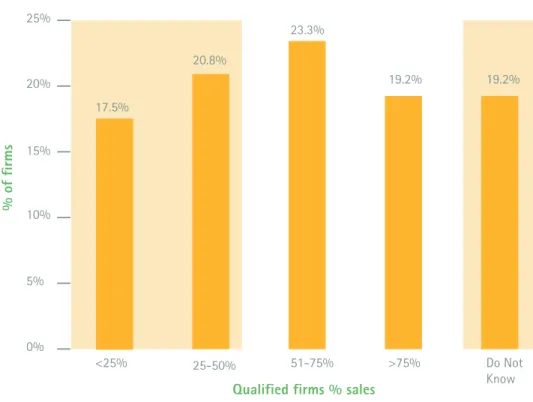
On the front-end of the customer life cycle is the age-old disagreement between marketing and sales on how to develop and manage leads. The data shows that almost 60 percent of companies surveyed still lack a common definition of a qualified lead, and as a result run the risk of a low or misunderstood marketing return on investment (mROI). Not surprisingly, the data also indicates that lead generation is a major challenge. In the majority of firms, fewer than 50 percent of leads result in an initial discussion with a customer (see Figure 2). Another area for improvement between marketing and sales is in how organizations take advantage of their investments in social listening. While many companies now have formal programs to listen to what customers are saying about them, few follow any process to transfer actionable information to sales. At best, this leads to wasted sales opportunities. At worst, it ignores unhappy customers and can actually compromise future sales.
1. Enhance Integration of Marketing, Sales and Service
Figure 2: CSOs cite the number of qualified leads that result in initial discussion as an area for improvement.
0%
<25% Do Not
Know >75%
51-75% 25-50%
17.5%
19.2% 19.2%
23.3% 20.8%
20% 25%
15%
10%
5%
Qualified leads resulting in initial discussion
Qualified firms % sales
% of firms
Sales leaders now recognize that sales and service must be better
integrated. Eighty-two percent are not directing customer service
representatives to take advantage of cross-selling or up-selling
opportunities.
Figure 3: CSOs indicated they need to improve their company’s cross-selling and up-selling capabilities.
Although sales and marketing integration has been an ongoing topic of conversation, the recognition that sales and service must be better integrated is a newer trend among sales leaders. Lack of alignment can inhibit growth and create missed sales opportunities. For example, 47 percent of CSOs believe they need to improve their organization’s performance in cross-selling and up-selling (see Figure 3), and a full 82 percent currently are not directing customer service representatives to take advantage of these opportunities. This is a vital channel to support the CSOs growth objectives, and it appears to be largely untapped.
Lack of alignment between sales and service also contributes to an inconsistent customer experience, which can increase churn. Complementary data from the 2012 Accenture Consumer Pulse research shows that the propensity for customers to switch companies or providers is up this year between three to eight percentage points, depending on the industry.1 Top reasons for
switching include price, value for money and poor customer service experience. This increase in churn is an obstacle for CSOs because they have to grow more than plan to make up for revenue they are losing. Lastly, if service delivers a poor customer experience, the impact can be compounded through social networks, potentially damaging the brand among all of the people that a particular customer influences. With non-stop, digitally savvy customers, any negative customer experience can result in a social media post almost instantly, and depending on the network of followers the individual has, the impact can be significant and often hard to fully measure.
0%
Needs
improvement Meets expectations Exceeds expectations Don’t knowN/A 20%
30% 40%
47%
38.3%
11.3%
3.5% 50%
10%
Actions to Improve Sales Effectiveness
• Improve the interconnection between sales, marketing and service to
provide a customer-centric and unified experience that maintains and
grows the customer base. Integrate internal processes and handoff
points among the three functions.
• Align marketing, sales and customer service leaders around the same
objectives, and use the same metrics to guide behavior and award
bonuses.
• Leverage each touch point to increase consistency across the
customer experience. For example, enable marketing to turn
information collected from social media monitoring into sales
opportunities. If a customer posts negative feedback about the
company on a social media site, alert customer service to proactively
contact the customer. If that same person posts negative feedback
about a competitor, pass along a potential lead for sales.
• Create a chief customer officer role with responsibility for
maintaining a customer-centric point of view across the marketing,
sales and service functions.
Source: CSO Insights 2013
1. Accenture 2012 Global Consumer Pulse Research, www.accenture.com
Accenture’s ongoing research has regularly found that enterprises thrive by revolving around customers versus their internal processes. According to Accenture’s Global Consumer Pulse research, customer needs are changing quickly. The “digital savvies”, constantly connected and in control of the buying process, have unprecedented expectations. This new reality demands a tailored and integrated customer experience—from touch points initiated by marketing, to promises made by sales, to customer service and support consistently delivered after the product is purchased. But experience is not enough. The Pulse research also shows that in the past 12 months, the tendency for consumers to partially switch companies—moving some of their spend to other providers—is also on the rise. These findings tell us that customer loyalty is getting more complex to measure and obtain. Ultimately, it is eroding, despite a customer’s level of satisfaction in the buying process. Ironically, according to the CSO Insights data, sales executives appear more confident in their ability to create customer loyalty than they did last year. But everything else they tell us in the same survey contradicts this notion. For instance, more than 41 percent need improvement in growing current revenue streams (see Figure 4).
2. Improve the Customer Experience at Each Touch Point
Figure 4: CSOs say they need to improve in farming additional opportunities from existing customers.
Needs
improvement Meets expectations Exceeds expectations Don’t knowN/A 41.7%
38.3%
15.7%
4.3% 0%
20% 30% 40% 50%
10%
5%
Source: CSO Insights 2013
This new reality demands a tailored and integrated customer
experience—from touch points initiated by marketing, to promises
made by sales, to customer service and support consistently
delivered after the product is purchased.
0% 20% 30% 40% <1 month 16.5% 6.1% 1-3 months 13.6% 30.7% 7-9 months 16.7% 11% 10-12 months 15.9% 6.3% >1 year 20.5% 3.9% Don’t know 3.8% 2.4% 4-6 months 29.1% 23.5% 10% New customers Existing customers
Perhaps even more telling is the lack of referrals from satisfied and loyal customers, a hallmark metric of customer satisfaction. In this area, CSOs say that less than one-quarter of total leads come from existing customers (see Figure 5). Finally, nearly one-half say they need to improve the ability to sell across the organization with existing customers, yet another indicator that customer referrals among peers within the business are undeniably low (see Figure 6).
Why does it matter? Sales executives routinely tell us that it takes longer to acquire a new customer than to sell to an existing customer (see Figure 7). By driving a consistent customer experience that reduces churn, CSOs can enjoy shorter sales cycles, more productive sales representatives and a faster path to revenue attainment.
Figure 5: Genesis of sales leads shows that less than one-quarter comes from customer referrals.
Figure 6: Nearly one-half of CSOs wish to improve their organization’s ability to sell to other business units within existing customers.
Figure 7: Typical sales cycle close time with new or existing customers. % Customer referrals, other 23.1% % Generated by marketing 24.8% % Self-generated by sales reps 52.1% 0% Needs improvement Meets expectations Exceeds expectations Don’t know N/A 20% 30% 40% 49.6% 34.8% 7.8% 7.8% 50% 10%
Source: CSO Insights 2013
One of the best ways for enterprises to counteract churn is to improve customer loyalty. Given the inefficiency expressed in the sales and after-sales processes, the data shows that approximately 70 percent of firms have yet to develop strong relationships with customers. In fact, only 12 percent of CSOs believe that their customers and prospects view their companies as trusted partners with the majority considering them as only as vendors or suppliers.
2013 Sales Performance Optimization Study level comparison
Level1: 2012 results2
Level 2: 2012 results
Level 3: 2012 results
% reps making quota 55% 62% 67%
% of company plan attainment 85% 90% 93%
% forecast - wins 40% 45% 52%
% forecast - losses 33% 28% 24%
% forecast - no decisions 27% 27% 24%
% sales force turnover Random
process Approved
vendor Preferred supplier Solutions consultant Strategic contributor Trusted partner
Informal
process Formal process Dynamic process 27% 21% 19% Performance Level 3
37% of Firms
Performance Level 1 21% of Firms
Sales Relationship/Process Matrix™−2013 SPO Study Analysis
Performance Level 2 42% of Firms
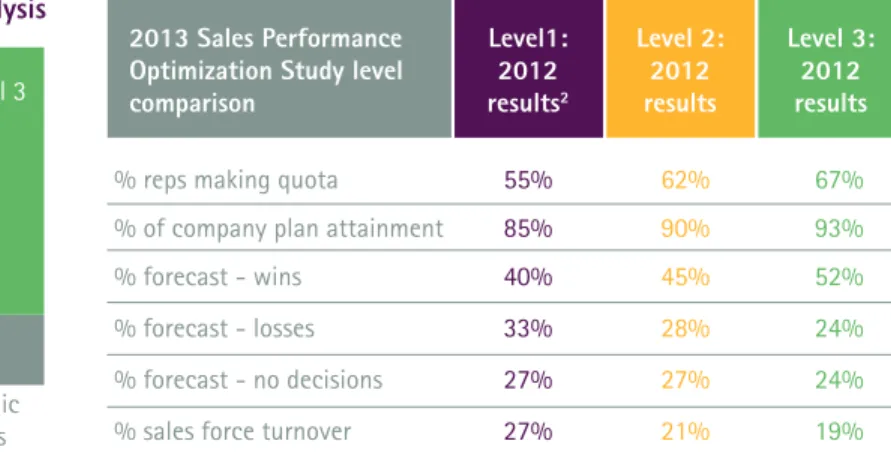
Unless an enterprise is in the coveted 12 percent, there is a significant risk that a larger percentage of customers may switch providers. This disloyalty factor means that sales organization will not be able to take advantage of selling to existing customers. Achieving a true partner relationship, when combined with effective sales processes, is pivotal and can shift the sales performance curve in terms of making quota, plan attainment and sales force turnover (see Figure 8).
Figure 8: Enterprises that build a trusted partner relationship with customers can improve results.
Actions to Improve Sales Effectiveness
• Work to gain a 360-degree understanding of customers by
synthesizing internal data and harvesting external data.
• Ask customers which channel they prefer to interact in, such as
face-to-face or digital, and then develop and apply a customer treatment
model that matches each customer’s preferred buying behaviors.
• Tailor personalized messages to customers across marketing, sales
and service and ensure message consistency across all customer
touchpoints.
• Proactively address customer experience issues that could harm
loyalty at all touch points to help reduce churn.
• Target and solidify customer loyalty to move a larger percent of the
customer base toward trusted partner status.
Source: CSO Insights 2013
Figure 9: CSOs identified areas for improvement in their sales process and methodology. In the survey, CSOs pinpointed areas of their business that require improvement to help drive sales performance. Similar to our findings in previous years, every response is related to process or methodology, further validating that sales organizations remain challenged and immature in this area (see Figure 9). Without consistent and well-adopted processes and methodologies, impacts to sales performance are significant.
3. Strengthen Immature Sales Methodologies and Processes
57.4% 52.2% 51.3% 48.7% 47.0%
40.0% 41.7%
34.8% 27.8%
Ability to incubate promising leads for the future Ability to close deals in timeframe originally forecast
Ability to assess organization's performance in properly qualifying and prioritizing opportunities
Ability to assess organization's performance in selling value, avoiding discounting Ability to assess organization's performance in effectively cross-selling, up-selling
Ability to assess organization's performance in understanding customer's buying process
Ability to assess organization's performance in differentiating versus the competition
Ability to assess organization's performance in creating solution aligned with customer problem(s)
Ability to assess organization's performance in generating an accurate and effective bid/configuration proposal
Percent CSOs rating as needing improvement
Strongly-performing sales organizations find a way to balance the art of selling effectively with the science of structured processes and methodologies. Our experience tells us that representatives who adopt and are managed against a structured sales methodology are the ones who close their deals the quickest— accelerating revenue, and making or exceeding their quotas along the way. Additionally, sales managers within these organizations have better visibility throughout the sales process and are more effective coaches along the way.
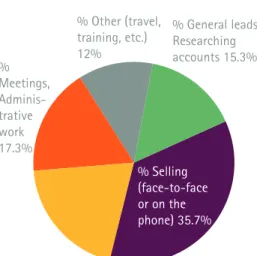
Organizations that lack the balance between art and science are seeing their sales representatives build their own processes, which further complicates their daily activities. At a micro level, the result is a longer sales cycles and is a key contributing factor to the 65 percent of the time representatives are not spending in front of customers (see Figure 10). The macro impact, according to the CSO Insights data, is one-third of sales representatives will not make their quota this year, which will make it difficult for organizations to achieve their sales targets.
Figure 10: Sales representatives spend their time on a variety of non-customer facing activities.
% Selling (face-to-face or on the phone) 35.7%
% General leads, Researching accounts 15.3% % Other (travel,
training, etc.) 12% %
Meetings, Adminis-trative work 17.3%
% Post sales tasks (order processing, account management, etc.) 19.8%
Actions to Improve Sales Effectiveness
• Pick one sales methodology and apply it consistently to maximize
value and drive successful sales behavior.
• Balance the art of selling with the science required to effectively
manage the sales organization.
• Optimize end-to-end sales processes and plan for flexibility as
market conditions change.
• Make sure the methodology and processes add value to sales
representatives and managers. Reevaluate if it is not improving
productivity or sales performance.
• Regularly inspect processes and look for potential failure points, such
as deal handoff or special pricing approval. Create mechanisms to
measure process efficacy and make continuous improvements.
During the past few years, CSOs indicated they were striving to achieve the same quota targets with existing sales representatives. This year, in a more optimistic economic environment, more than one-half of CSOs state they are planning to increase the size of their sales force.
They are all grappling with how to make these hires successfully, though. Approximately 34 percent of CSOs believe that their enterprise’s ability to hire successful representatives needs improvement, and slightly more than 40 percent of firms do not apply aptitude or competency testing to hire the right talent for the job. Unscientific hiring practices can be a bottleneck to creating a robust team structure.
4. Apply More Science to Sales Talent Acquisition,
Development and Retention
Figure 11: Time to proficiency for new sales representatives.
The increase in involuntary turnover rate is another factor here, indicating the potential challenges CSOs face in hiring the right skills. This year, the data indicates that there is an increase in involuntary turnover when a sales representative needs to be counseled out. Competency testing could counteract this trend.
Two other issues compound the resource acquisition problem: the rate at which CSOs need to hire sales representatives to meet resource growth goals and the longer time it takes for new talent to become proficient in selling. Nearly one-half (47.5 percent) of sales representatives take 10 months or longer to become adept enough to contribute to company goals, mostly likely due to the lack of inconsistent sales methodologies and not spending enough time on selling activities (see Figure 11).
10-12 months 24.5%
7-9 months 25.9%
3-6 months 22.3% >1 year 23.0%
<3 months 0.7% Do not know 3.6%
Figure 12: One-third of CSOs are unsure what measurable improvements they seek from training investments.
Accenture analysis also shows that CSOs have increased annual training spend
considerably since 2012, possibly due to the need to ramp-up cross industry hires. Nearly 45 percent are now spending between $2,501-$5,000/year on each sales representative. However, simply spending on training is insufficient. Organizations need to reinforce the training and incorporate it into daily sales activities to yield higher payoffs. Despite the uptick in training spending, CSOs are surprisingly unclear what measureable improvements result from the investment (see Figure 12).
34.9% 30.2% 28.6% 22.2%
22.2% 22.2% 20.6% 20.6% 19% 19% 17.5% 15.9% 7.9%
0% Unsure
Improving prospecting, lead generation Increasing win rates over competition Increasing lead conversion rates
Increasing average deal size (cross/up-sell) Reducing no decisions
Improving forecast accuracy Reducing new rep ramp-up time Shortening sell cycles
Increasing revenues per rep
Increasing customer satisfaction/retention Increasing margins
Decreasing sales rep turnover None
Actions to Improve Sales Effectiveness
• Build talent strategies, competencies, learning models and analytics
capabilities to create agility, speed and stronger integration inside
and outside the organization.
• Know the DNA of high performing sales representatives and then
revise recruiting, retention and training to maintain.
• Reduce time to sales representative proficiency by conducting more
targeted recruiting and more effective onboarding.
• Increase sales representative productivity through more effective
coaching, learning and motivation solutions.
• Improve sales representative retention through more targeted
practices.
Current hiring and training
practices contribute to
suboptimized sales force
effectiveness.
The data shows that organizations continue to invest heavily in technology, such as tablets, mobile and social CRM, and sales intelligence systems. But ROI continues to be disappointing. For instance, although nine out of 10 enterprises have implemented some kind of CRM system to streamline the forecasting process, improve sales organization communications or reduce administrative burden, more than one-third still face low CRM tool adoption rates.
5. Drive Better Outcomes from Sales Technology Enablement
Figure 13: Measurable improvements from sales intelligence service investments
In addition, a large number (61.2 percent) of CSOs are using external sales intelligence service providers, but one-third are unsure about what the investment is bringing to the company (see Figure 13). The majority (70 percent) are also not using sales intelligence systems to mine key customer and prospect information from internal ERP or CRM systems. The best way to increase the value of sales intelligence systems is to base them on accurate and complete data.
38.8% 33.8% 31.3% 27.5% 21.3%
20% 18.8% 17.5% 12.5%
12.5% 7.5%
7.5% Prioritizing which account to sell to
Generating more leads Unsure
Reducing prospect research time
Shortening sell cycles
Increasing win rates over competition
Increasing lead to opportunity conversion rate Increasing average deal size
Reducing no decisions Increasing margins None
Other
Mobile capabilities and tablets continue to be popular as the majority of CSOs (76 percent) perceive that mobile CRM improves the performance of the sales team.
But there is still significant room for improvement. Less than one-half (48.5 percent) of firms are currently providing access to critical sales and customer information on mobile devices, possibly due to the evolving ecosystem for mobile CRM. However, only 30 percent have a formal policy to ensure use of tablets by the sales force (see Figure 14). This inconsistency can reduce sales effectiveness.
Lastly, approximately one-third of CSOs responded that they have some type of social CRM program that is intended to support lead prospecting and generation, build community or gather prospecting intelligence among other things. However, so far the impact of social CRM on sales and marketing effectiveness is marginal with more than one-half of CSOs saying it has only a minor to no noticeable impact.
Figure 14: A number of companies still need to institute a formal policy for tablet device usage by sales teams.
Starting a program
22%
Formal program
30%
No program
20%
Informal program
28%
0% 20% 30%
10%
% of firms
Actions to Increase Sales Effectiveness
• Leverage social, mobility, analytics and cloud to support sales
technology enablement investments. Leverage these technologies to
follow, sense and guide customers; listen, filter and curate content
(via social media), and optimize services and experiences through
context-based cloud services and experience-as-a-service solutions.
• Use descriptive and predictive analytics to gain a full view of
customers and take preemptive steps in the sales, marketing and
service continuum where churn might occur.
• Support greater differentiation in customer interaction through
customer buyer-value analytics, customer value analytics, and
cost-to-serve analytics to focus the marketing, sales and service models
by segment.
• Align costs to serve based on value to the company, and create more
relevant and personalized selling messages for each.
Seventy-six percent of
CSOs perceive that mobile
CRM improves sales team
performance; however,
less than half that number
(30 percent) have a formal
mobile device policy.
Agile selling requires companies to
operate at dramatically different
execution speeds and different
levels of collaboration. When done
strategically, it can help to provide
the flexibility, accountability
and responsiveness necessary to
capitalize on growth opportunities in
today’s economic environment and
in response to changing customer
behaviors.
Conclusion: Sharpen Focus on Goals and Customers through Agile Selling
In this new era, CSOs will be
most effective by taking a holistic
approach to sales effectiveness
across the entire sales organization—
from strategy, processes and
incentives, to talent, enablement
and operations. At the focal point
is delivering a consistent and
superior customer experience that
draws together marketing, sales
and service to inform and sell more
dynamically, and provide service to
meet customers’ ever-expanding
expectations.
About Accenture
Accenture is a global management consulting, technology services and outsourcing company, with approximately 261,000 people serving clients in more than 120 countries. Combining unparalleled experience, comprehensive capabilities across all industries and business functions, and extensive research on the world’s most successful companies, Accenture collaborates with clients to help them become high-performance businesses and governments. The company generated net revenues of US$27.9 billion for the fiscal year ended Aug. 31, 2012. Its home page is www.accenture.com.
About Accenture Sales
& Customer Services
(CRM)
Sales & Customer Services (CRM) helps companies acquire, develop and retain more profitable customer relationships. We offer a broad range of innovative capabilities that address every aspect of the customer experience, including pricing strategy and profitability assessment, customer analytics, direct and indirect sales force execution, customer service, field support, customer contact operations, and retail/branch operations. We use these combinations of skills to help our clients accelerate growth, improve sales productivity and reduce customer-care costs—helping increase the value of their customer relationships and enhancing the economic value of their brands.
Contact Us
To learn more about sales transformation and CRM initiatives to optimize sales effectiveness in your organization, please visit www.accenture.com/ managementconsulting, or contact one of the authors:
Yusuf Tayob
Managing director, Selling Excellence [email protected] Bryan Berumen
Senior manager, Selling Excellence [email protected]
Copyright © 2013 Accenture All rights reserved.