Proceedings of the
Third International Workshop on
Formal Methods for Interactive Systems
(FMIS 2009)
Tightly coupled verification of pervasive systems
Muffy Calder, Phil Gray and Chris Unsworth
16 pages
Guest Editors: Michael Harrison, Mieke Massink
Managing Editors: Tiziana Margaria, Julia Padberg, Gabriele Taentzer
Tightly coupled verification of pervasive systems
Muffy Calder, Phil Gray and Chris Unsworth
Department of Computing Science University of Glasgow Glasgow G12 8RZ, UK
Abstract: We consider the problem of verifying context-aware, pervasive, inter-active systems when the interaction involves both system configuration and system use. Verification of configurable systems is more tightly coupled to design when the verification process involves reasoning about configurable formal models. The ap-proach is illustrated with a case study: using the model checker SPIN [Hol03] and a SAT solver [ES03] to reason about a configurable model of an activity monitor from the MATCH homecare infrastructure [MG09]. Parts of the models are generated automatically from actual log files.
Keywords:formal models, pervasive systems, model checking
1
Introduction
Effective verification of interactive systems has been a significant challenge for both the verifi-cation and user interface communities for at least the last two decades [CH97,CRB07]. More recently, the advent of context-aware, pervasive, interactive systems raises the stakes: can we formulate effective verification techniques and strategies to bring reasoning into the design pro-cesses of these volatile systems? In particular, we are concerned with systems where the interac-tion involves both system configurainterac-tion and system use.
Pervasive systems are characterised by their ability to sense their physical environment and a use of data so gathered both as part of the core application functionality and as a way of mod-ifying system behaviour to reflect changes in the context of use. Amongst the challenges of designing, building and operating such systems is the volatility that this sensor-based context dependency introduces. The set of sensors may themselves come and go and change their be-haviour depending upon environmental conditions. Context changes may be difficult to model and predict. In addition, pervasive applications often operate in situations that require practi-cally unpredictable changes to the application functionality itself. For example, a home care system, providing sensor-based monitoring of the cared person’s activities and state, may have to be reconfigured to take into account changes in the person’s medical condition and their home situation, and consequent changes to the services and sensors needed. For these reasons, system configuration must be treated as an ongoing process throughout the lifetime of a system. It must be modelled and reasoned about in the same way that one would model and reason about normal user interaction with the system.
At a high level of abstraction these context-aware, interactive systems may be regarded as a number of concurrent processes:
where
• Agents are (usually, but not exclusively human) users, there may be several types and (possibly overlapping) instances of user, e.g. patient, carer, social worker, etc.
• SensorsandOut putsquantify physical world data (e.g. thermometer, pressure pad, web-cam), or are outputs devices (e.g. speaker, television screen),
• Monitorsare high level abstractions of a physical state (e.g. encapsulating predicates about who is in a room, whether or not is it cold),
• Con f igurationsare sets of rules, or actual parameters, determining how the system varies according to user preferences and needs,
• theSystemis the underlying computational infrastructure.
While we might traditionally consider the composition (Agents||Sensors||Out puts||Monitors) as the context, i.e. together they reflect a temporal physical context, theCon f iguration is also a context, in that it is also temporal and affects system behaviour.
In this paper we consider the modelling and verification process for configurable, interactive, context-aware systems in general, and a case study of an event driven system. We begin with a general purpose model of functional behaviour and for this we propose that a (concurrent) process based specification language, temporal logics and reasoning by model checking is a good paradigm, especially when context changes are non-deterministic. In the case study here we develop a general purpose model in Promela, for checking with the SPIN model checker [Hol03]. We then refine the verification problem and develop a specialised model for checking redundacies, using a SAT solver [ES03]. A distinctive feature of this work is parts of the models are generated automatically from actual log files.
In the next section we outline our overall vision for the modelling and verification process. The remainder of the paper is an exploration of one iteration of that process, for a case study. Section3introduces the MATCH case study and in section4we give an outline of our Promela model. Properties for verification are given in Section5, where we give an overview of checking for redundant rules in the Promela model. In Section6 we give an outline of the SAT model for redundancy checking and results of online verification. In Section7we consider the more general problem of overlapping left and/or right hand sides of rules, and when these should be interpreted as undesirable. Discussion follows in Section 8 and an overview of related work follows. Conclusions and future work are in Section10.
2
Modelling and verification process
and the system, and indeed the results of the verification. Crucial to the process is the notion of configuration and the extraction from the system of configuration details, often stored as log files.
Our vision is illustrated in Figure1, where ellipses denote agents and rectangles objects. The key feature of our vision is that modelling is tightly coupled with system development and con-figuration. This is not a waterfall model: activities are concurrent and moreover, while four agent roles are indicated, they may be overlapping or conflated. Briefly, activities are as follows. The end users configure the system, and when configured, (possibly different) users interact with the system, as system and users require, according to the context. The configuration is not static, but may be changed repeatedly. Log files are a representation of the configuration process and are generated by a live system. The formal model depends upon what kind of analysis is required (e.g. functional behaviour, security, performance, etc.) and it is also configured, according to the log files. The model is analysed; the verification results may inform understandings of the end user, the configurer, the designer, and the modeller, though in different ways. For example, the user develops a better cognitive model, the configurer understands how to improve his/her rules, the designer develops a better interface, and the modeller gains insight in to how to modify the model so that verification is more efficient. Note, this is just an example. There may be multiple models and a single agent may have multiple roles as configurer/modeller/user/designer. Verifi-cation may be performed off-line or on-line, each of which has its merits. On-line verifiVerifi-cation can inform users in real-time. On the other hand, off-line verification allows more general results e.g. for all configurations with a certain property, a system proprety holds. This kind of veri-fication can then be used by the designer to constrain allowable interactions or configurations. Finally, recall that agents may not be human at all, for example, the system might autonomously configure itself, or the modeller may be another software process.
Properties may support, for example,
• end user configurations, e.g.what will happen if I add this rule?orhow can I notify/detect x in the event of y?
• modalities, e.g.are there multiple speech outputs?orare there multiple speech inputs only when there are multiple users?
• hypotheses about resources, e.g.what happens if a webcam doesn’t work?
In this paper we report on one iteration of the modelling and verification cycle, starting with log files extracted from actual system trials of a prototype system (deployed in the UK and in France).
3
MATCH System
Figure 1: Tightly coupled verification: configurable systems and configurable models
Figure 2: MAM System Architecture
experimental platform designed to explore the challenges of the configuration of activity aware-ness use to support of home-care [MG09].
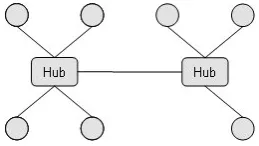
A MAM system consists of one or more hubs (UMPC-based subsystems supporting a rich set of inputs and message types) each of which is connected to a set of satellites (web-based clients offering a limited set of inputs and message types) and other hubs, illustrated via the architecture diagram in Figure2. Typically, a hub will reside in the home of a person requiring care while the satellites are used by carers, clinicians, family and friends.
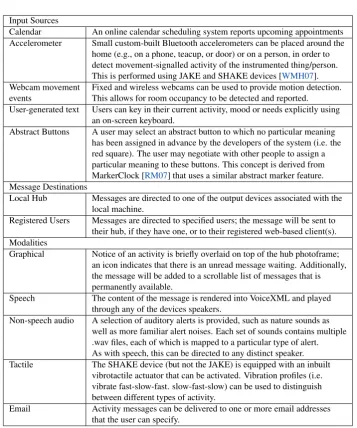
Each hub, placed in the home of a cared person, can communicate with a set of web-based clients and with other hubs. A MAM hub supports a set of up to eight monitoring tasks, each of which involves the generation of messages based on user-generated or sensor-generated input indicating an event or activity. Monitoring tasks are defined by rules that specify an event or activity to be reported plus the destination and form of the reporting message. For example, a rule might state that use of Tony’s coffee cup (captured via an appropriate sensor1) should be reported to me (i.e., the hub in my home) via a speech message. Currently, MAM supports a variety of data sources, message destinations and message modalities (e.g., speech, graphics,
1 MAM uses a JAKE sensor pack for simple movement sensing, while the JAKEs more powerful sibling, the
touch, etc.). A full list is given in Figure3.
Each MAM hub can support up to eight monitoring tasks, each of which is specified explicitly as a monitoring rule2. In addition to simple <input source> <destination, modality> rules, it is also possible to specify combinations of inputs (e.g., a button press or an appointment) or message modalities (e.g., speech and graphics). Rules may also have a guard condition; currently MAM only supports a location condition such that the message is sent if someone is sensed near a specified location.
A user may also choose a system-generated recommendation of the input, destination or modality. The recommendation can be used in an automatic or semi-automatic mode. In the former case, the system will choose the input, destination or modality most commonly associ-ated with the other parameters, based on a history of logged configurations. In the latter case, the system will offer a ranked list of choices, based again on frequency of association, from which the user must select one.
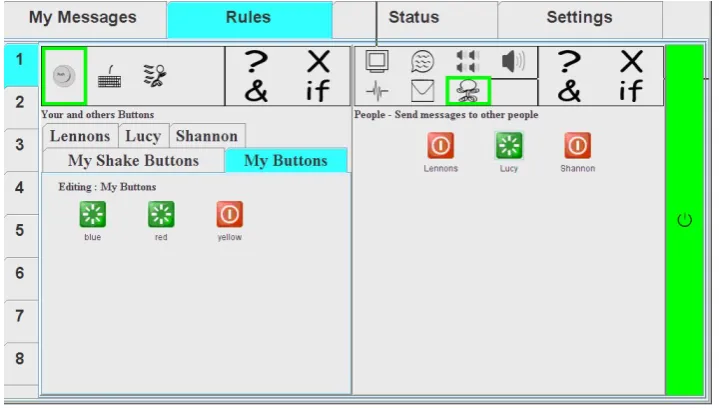
A user interface is supplied for specifying monitoring task rules. If a user is not interacting with the MAM Hub, it operates a digital photo frame application that displays the user’s photos in order to make it a non-intrusive part of the user’s home. To configure the hub, a user touches the screen and the photo application fades away, replaced by the MAM application, from which the configuration screen is accessible. Figure4shows a typical rule configuration. Note the eight tabs to the left, one for each rule; rule 1 is selected. The rule configuration view is divided into a left-hand panel for specifying input and a right-hand panel for destination and modality. In this case the blue and red buttons on my hub (left-hand panel) have been selected to create messages to be sent to Lucy’s machine(s) (right-hand panel). The large vertical green button on the right of the panel is the on-off toggle switch for the rule; when green, the rule is active and when red the rule is inactive.
Even with the rather limited set of inputs, destinations and message types, the configuration space (i.e., number of different possible rules) is rather large (1.07E+301). In addition, not all configurations are desirable. It is possible to create redundant rules, which can be a problem given the restriction on the number of rules allowed. Also, some configurations may cause difficulties for the user: two speech messages delivered at the same time will be impossible to understand. These configuration challenges provide a motivation for verification that can be used both to guide a designer (in exploring the design of the configuration options offered to a user) and to help an end user (in creating a set of rules that both meet their needs and are understandable and maintainable).
4
General model
From a modelling perspective, the MAM system is an event driven rule-based pervasive system. Events include (but are not restricted to) direct user interaction with the hub, such as pushing buttons, and indirect user interaction such as movement captured by a webcam or external actions such as messages received from other users. Rules dictate how the system will react to events. We note that from a modelling perspective, there is no distinction between a user interaction and
2 This limitation, amongst others, is intentional and based on empirical evidence, to limit the complexity of the
Input Sources
Calendar An online calendar scheduling system reports upcoming appointments Accelerometer Small custom-built Bluetooth accelerometers can be placed around the
home (e.g., on a phone, teacup, or door) or on a person, in order to detect movement-signalled activity of the instrumented thing/person. This is performed using JAKE and SHAKE devices [WMH07]. Webcam movement Fixed and wireless webcams can be used to provide motion detection. events This allows for room occupancy to be detected and reported. User-generated text Users can key in their current activity, mood or needs explicitly using
an on-screen keyboard.
Abstract Buttons A user may select an abstract button to which no particular meaning has been assigned in advance by the developers of the system (i.e. the red square). The user may negotiate with other people to assign a particular meaning to these buttons. This concept is derived from MarkerClock [RM07] that uses a similar abstract marker feature. Message Destinations
Local Hub Messages are directed to one of the output devices associated with the local machine.
Registered Users Messages are directed to specified users; the message will be sent to their hub, if they have one, or to their registered web-based client(s). Modalities
Graphical Notice of an activity is briefly overlaid on top of the hub photoframe; an icon indicates that there is an unread message waiting. Additionally, the message will be added to a scrollable list of messages that is permanently available.
Speech The content of the message is rendered into VoiceXML and played through any of the devices speakers.
Non-speech audio A selection of auditory alerts is provided, such as nature sounds as well as more familiar alert noises. Each set of sounds contains multiple .wav files, each of which is mapped to a particular type of alert. As with speech, this can be directed to any distinct speaker. Tactile The SHAKE device (but not the JAKE) is equipped with an inbuilt
vibrotactile actuator that can be activated. Vibration profiles (i.e. vibrate fast-slow-fast. slow-fast-slow) can be used to distinguish between different types of activity.
Email Activity messages can be delivered to one or more email addresses that the user can specify.
Figure 4: Sample task configuration screen
change of context. While there is intent associated with the former, from a modelling point of view both are simply aspects of state that may be captured by propositions (whose validity may be temporal).
Promela [Hol03] is a high-level, state-based, language for modelling communicating, concur-rent processes. It is an imperative, C-like language with additional constructs for non-determinism, asynchronous and rendezvous (synchronizing) communication, dynamic process creation, and mobile connections, i.e. communication channels can be passed along other communication channels. The language is very expressive, and has intuitive Kripke structure semantics.
Our model is centred around a single hub that can take input from one or more satellites or additional hubs. As a result we have a single rule set, which in this case is static. However, it would be a simple matter to extend the model to include multiple hubs and rule sets and dynamic rule sets.
As we are considering a configurable system, the model is designed to reflect this. The system behaviour is separated from the system configuration. System behaviour refers to the actions of the available input and output devices. System configuration refers to the current active rule set.
4.1 System
Each input device is represented by a global variable and a process. For example, a button press is represented by a single bit variable and a process that can arbitrarily assign the values 0 or 1.
processes act as sources of events for the system.
Output devices act as sinks within the system. In the model they are represented as global variables or channels, upon which messages are placed. The associated process for an output device is called when a value is assigned to the variable/posted in the channel. The process then resets the variable or reads the message off the channel.
In future versions of the model it may be useful to include users and/or multiple hubs and rule sets in the system. In this case, the input variables will be directly modified by output processes from other hubs and/or as a direct result of a user action.
4.2 Rules
Rules are taken directly from a MAM system via the log. An excerpt from a log file can be seen in Figure5, included as an illustration of the content of a log file (and not to be read in detail!).
uk.org.match_proj.osgi.EvalFunc.ManualEachComponentInputSelectionEvaluationFunction(selected=["Personal Messages"]){} uk.org.match_proj.osgi.EvalFunc.UnionOutputApprovalEvaluationFunction()
{uk.org.match_proj.osgi.EvalFunc.ManualEachComponentOutputSelectionEvaluationFunction(selected=["GUI","Twitter"]) {}uk.org.match_proj.osgi.EvalFunc.ManualEachPersonSelectionEvaluationFunction(selected=["Doms","Lionel","Anne"]){}} uk.org.match_proj.osgi.EvalFunc.ManualGroupedPersonSelectionEvaluationFunction(selected=["Everyone"]){}
uk.org.match_proj.osgi.EvalFunc.ManualEachComponentOutputSelectionEvaluationFunction(selected=["GUI"]){}
uk.org.match_proj.osgi.EvalFunc.ManualEachPersonSelectionEvaluationFunction(selected=["Caroline","Lionel","Anne"]){} uk.org.match_proj.osgi.EvalFunc.ManualEachComponentOutputSelectionEvaluationFunction(selected=["Speech"]){} uk.org.match_proj.osgi.EvalFunc.ManualEachComponentInputSelectionEvaluationFunction(selected=["Jake Movement"]){} uk.org.match_proj.osgi.EvalFunc.UnionOutputApprovalEvaluationFunction()
{uk.org.match_proj.osgi.EvalFunc.ManualEachPersonSelectionEvaluationFunction(selected=["Caroline","Lionel","Anne"]) {}uk.org.match_proj.osgi.EvalFunc.ManualEachComponentOutputSelectionEvaluationFunction(selected=["GUI","Twitter"]){}} uk.org.match_proj.osgi.EvalFunc.ManualEachComponentInputSelectionEvaluationFunction(selected=["Work Messages"]){} uk.org.match_proj.osgi.EvalFunc.ManualEachPersonSelectionEvaluationFunction(selected=["Caroline","Anne"]){}
Figure 5: Excerpt from a MAM log file.
In the MAM system, rules are defined as evaluation functions that return input or output de-vices. Each rule consists of an input and an output evaluation function. The combination of function name and the list of parameters determine how they are to act. Both input and output functions can be composed. The input composition operator acts as a disjunction, meaning that an event will be triggered if either evaluation function is true. However, the output composition function acts as a conjunction, meaning that if the union output function is triggered then the result of both evaluation functions will be used.
The evaluation function rule set is then expressed as an informal natural language rule set. An example is shown in Figure6. While this step is not strictly necessary, it can be helpful to have the rules expressed in a more readable format.
The rules are then expressed as Promela statements. Each rule is expressed as a conditional statement, consisting of a guard and a compound statement. Therefore, in Promela we represent a rule as a single statementC→A, whereC is a guard statement made up of a disjunction of statements representing the condition of the rule andAis compound statement consisting of a sequence of statements representing the action. For example, the rule “when the red console button is pressed play the doorbell earcon3on the hub speaker” maps to the Promela statement “(this.red>0)→this.speaker!earcon doorbell”. Rules can also be context sensitive. For ex-ample, “If the red button is pressed then, if the webcam has recently detected movement inform
If the red or blue buttons are pressed then play the rocket earcon
If my webcam detects movement then display a pop-up message on my screen and display a message on the screen list If I receive a message from Bill or then inform me using synthesised speech Bill presses his red button
If I receive a message from Bill then send a vibration message via the shake If the red button is pressed then send a message to Bill
and inform me using synthesised speech If the shake senses movement then send a vibration message via the shake If Bill presses his red button then inform me using synthesised speech If the yellow button is pressed then send a vibration message via the shake
Figure 6: Example rule set.
me with synthesised speech else send me an e-mail”. In this case the definition of “recently” is a system parameter.
An example of a Promela representation of a rule set can be seen in Figure7. In this example there are 2 hubs, one that belongs to the user and one that belongs to Bill. In the rule set the user’s hub is referred to asthisand Bill’s hub isBillh. This is because in the model a hub is represented by a bespoke variable type.
proctype rules() {
do
:: (this.red == 1) || (this.blue == 1) -> this.audio_out!ec_rocket; :: (this.webcam > 2) -> this.screen_popup = me; this.screen_list = me; :: (this.text_in == Bill || Billh.red == 1) -> this.audio_out!speech; :: (this.text_in == Bill) -> this.shake_out = 1;
:: (this.red > 0) -> Billh.text_in = me; this.audio_out!speech; :: (this.shake_in_m > 1) -> this.shake_out = 1;
:: (Billh.red > 0) -> this.audio_out = speech; :: (this.yellow > 0) -> this.shake_out = 1; od
}
Figure 7: Promela representation of example rule set.
5
Properties
We now explore a number of issues in the MAM system that may benefit from formal verifica-tion.
5.1 Redundant rule detection
to streamline the system. This could provide feedback to the user and/or allow the system to remove redundant rules from the active rule set.
5.2 Modalities
The input and output devices can be classified by their modalities. For example, earcons and speech are sound, screen pop-ups and text messages are visual and vibration alerts are tactile. The acceptability of a system for a user may depend on the correct use of the different modalities. For example, multiple simultaneous audio outputs may confuse a user and result in the loss of messages. Visual output devices should be avoided for severely visually impaired users, however, it may still be appropriate to use them to notify carers. Overuse of tactile devices may result in the user being unable to differentiate between different types of messages.
5.3 Priorities
Currently MAM does not hold information on the relative priorities of rules/messages. However, a user is likely to be more concerned with certain messages than others. It would therefore be useful to check that the output from a given rule has a greater chance of being received by the appropriate target. For example, high priority messages should be distinct from lower priority messages. If a high priority message uses an earcon, then no other message should use a similar sounding earcon.
5.4 Verification results
We now expand on the redundant rule detection problem using the model checker SPIN, which verifies (or not) properties expressed in the logic LTL (linear temporal logic).
An LTL property can be derived easily from the Promela representation of a rule. In the general form, for a ruler of formC→A, whereCis a guard andAis a sequence of statements, the associated property is informally described by: the action will always eventually occur after the condition becomes true (recall, conditions are disjunctions and actions are conjunctions. More formally, we define the mapping as f(r) = (f(C)→♦f(A)), where f()maps guards and assignments to propositions in the obvious way.
For example, the rule(this.yellow>0)−>this.shake out=1 would map to the LTL property
((this.yellow>0)→♦(this.shake out=1)).
We define f(r) as the property that the action associated with rule r will always eventually occur after the condition ofrbecomes true. A ruler in the rule setRis redundant if for model
M(R|r), which representsRwithoutr, f(r)|=M(R|r). A rule setRcontains no redundant rules if∀r f(r)6|=M(R|r).
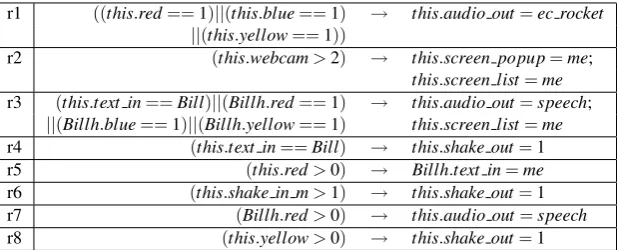
these results do serve as a proof of concept.
r1 ((this.red==1)||(this.blue==1) → this.audio out=ec rocket ||(this.yellow==1))
r2 (this.webcam>2) → this.screen popup=me;
this.screen list=me
r3 (this.text in==Bill)||(Billh.red==1) → this.audio out=speech;
||(Billh.blue==1)||(Billh.yellow==1) this.screen list=me
r4 (this.text in==Bill) → this.shake out=1
r5 (this.red>0) → Billh.text in=me
r6 (this.shake in m>1) → this.shake out=1 r7 (Billh.red>0) → this.audio out=speech
r8 (this.yellow>0) → this.shake out=1
Figure 8: Rule set used in experiments.
6
Specialised model
From Section5.4it can be seen that our current general Promela model of the MAM system is not sufficiently efficient to detect redundancy fast enough to provide feedback to a system configurer in real-time. In this section we show how redundancy can be modelled and solved efficiently with a specialised SAT solver [ES03]. SAT solvers check satisfiability of propositional formulae (usually written in disjunctive normal form). Though in general NP-complete, SAT solvers are highly efficient for many practical applications. The SAT model developed here uses literals to represent input devices, output devices and the rules.
6.1 Literals - inputs and outputs
Each simple input type is represented by a single literal. For example, a literal represents a button press or receiving a message from someone. Similarly, simple output types are also represented as literals. More complex input functions such as movement, which has low, medium and high inputs, can be represented as one literal per input value. A clause then needs to be added to ensure the input values are consistent. For example, if the literal for a movement level high is true, then both medium and low should also be true. To ensure this, the clauses low∨ ¬mediumandmedium∨ ¬highare added, which will need to be done for each movement detection device. However, if only one rule takes input from a movement detection device, then the input can be treated as a simple input device and the clause can be omitted. Classes of output, such as the MAM auditory icon class “nature”, which consists of the auditory icons
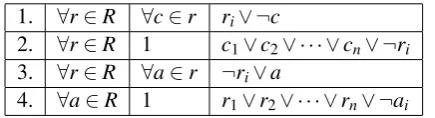
1. ∀r∈R ∀c∈r ri∨ ¬c
2. ∀r∈R 1 c1∨c2∨ · · · ∨cn∨ ¬ri 3. ∀r∈R ∀a∈r ¬ri∨a
4. ∀a∈R 1 r1∨r2∨ · · · ∨rn∨ ¬ai
Figure 9: Clauses required to represent a given rule setR
6.2 Clauses - rules
Each rule is represented by a literalri and a set of clauses as described in Figure9. There are four types of clauses associated with a rule, as follows. The literalri being assigned the value true indicates that ruleihas been triggered. A clauseri∨ ¬cis added for each conditioncthat triggers rulei. To ensureri is not true if none of its conditions are met, the following clause is addedc1∨c2∨ · · · ∨cn∨ ¬ri. If ruleiis triggered then the appropriate outputs must be set to true, thus the clause¬ri∨ais added for each actionaassociated with rulei. Finally, to ensure that actions are only taken if triggered by a rule, the clauser1∨r2∨ · · · ∨rn∨ ¬aiis added, wherer1 tornare all the rules that can trigger actionai.
6.3 Rule redundancy
To use the above model to detect redundant rules, we need to solve the model once for each atomic condition in the rule, to check if atomic conditioncfrom rule ri is redundant. We add a clause for each input literal, setting the literal related to c to true and all the rest to false. All literals that represent the actions from ruleri are set to true. All clauses related to the rule being checked are removed. If the resultant model is satisfiable then conditioncfrom ruleri is redundant, if all conditions associated with ruleriare redundant, thenriis redundant.
6.4 Implementation and complexity
The above model was implemented and solved with the same rule set used in Section5.4. A Java program was written to read the rules from a file in the MAM evaluation function format and generate the SAT model. The SAT model was then solved using the open-source SAT solver miniSAT [ES03]. The problem had 23 literals and around 45 clauses4, each instance of the problem required less than a thousandth of a second to solve. All instances were solved with propagation alone, no search was required.
This model was then used in conjunction with a Java program, which reads a rule set directly from a MAM system log file, generates the models and checks the rule set for redundancy. Using the actual hardware that MAM runs on, reading in and checking a rule set required approximately 5 seconds. The majority of this time was taken to read and parse the log file. Each individual SAT model required approximately 15 thousandths of a second to solve. It is clear that the specialised SAT model offers improvement of 5−6 orders of magnitude for redundancy checking over the general Promela model.
7
Overlapping rules
We have defined a rule to be redundant if it can be removed from a system without affecting how the system operates. However, a rule may also be redundant if it serves nousefulpurpose. For example, a rule set may include the two rules “If I receive a message from Bill then play a bird noise earcon” and “If I receive a message from Bill then play a doorbell earcon”. At a system level these rules are different. However, they both play a sound when a message is received from Bill.
One could interpret this as a lack of confluence, i.e. we have overlapping left hand sides of rules and divergent right hand sides. Rules can also overlap in more subtle ways (e.g. a form of superposition). For example, a rule set may include the two rules “If the red or yellow buttons are pressed play the doorbell earcon and send a text message to Bill” and “If the red or blue buttons are pressed play the doorbell earcon and inform me using synthesised speech”. Both rules cause the doorbell earcon to be played, when one condition is satisfied.
While these are only simple examples, they raise the question of what exactly we should be looking for when detecting redundant rules and what is the underlying theory of modalities? Moreover, to answer these question we need to know why we are interested in this problem. For example, is it a significant issue in practice?
The answer to the latter appears to be positive. While conducting user evaluation studies, the developers of the MAM system have found that many test subjects indicated they have trouble understanding complex rules and only want to define simple rules. This means there is significant scope for overlapping conditions and actions. Therefore, it would be advantageous for the system to offer assistance. This could be in the form of a message informing the user that a rule they entered is redundant, or makes some other rule redundant, or is overlapping with another rule. Alternately, the system may simply detect such rules and only partially implement them. In any case, further study is need to understand user intentions and their relation to modalities and context, and also how best to feedback information from any analysis.
8
Discussion
A distinctive feature of this work is we are trying to more tightly couple design with modelling, closing the loop between design, use, configuration, modelling and verification. Further, we deal with systems as actually deployed, rather than an ideal yet to be implemented.
A long term goal is to automate many of these processes and so in this case study, where possible, we have developed scripts to process inputs automatically e.g. log files.
the verification then became so efficient it could be applied directly within the MAM, running in real time on the same computational hardware.
While we have only investigated one of the properties we mentioned Section5, redundancy, how we detect and resolve redundancy depends also on our understanding of modalities, prior-ities, and more generally, context. For example, a user may not care about overlapping earcons unlessone of them has been generated by a certain condition. For example, delivering messages via the television and the beeper simultaneously may be acceptable, unless one of the messages is considered significantly more urgent than the other, or has arisen because of an unsafe context. The area of semantics and ontologies for modalities/context requires further investigation. Ac-ceptability and usability of modalities may be regarded as an example of crossing the “semantic rubicon”5 [KA02]. A contribution of our formal modelling and analysis to MAM design has been to expose this crossing.
9
Related Work
Much formal analysis of pervasive systems is focussed on techniques for requirements involv-ing location and resources, within a waterfall framework. For example, [CD09] employs the Ambient calculus for requirements and [CE07] employs a constraint-based modelling style and temporal logic properties. Some work has been done on better integration of formal analysis techniques within the context of interactive system interfaces (e.g. [CH08]), but there is little work on more tightly coupled models and analysis. One exception is [RBCB08], where a model of salience and cognitive load is developed and a usability property is considered. The model is expressed in a higher order logic, and the property is expressed in LTL. While our paradigm is different, the authors recognise they are engaged in a cyclic process. In some cases, their veri-fication revealed inconsistencies between experimental behaviour and the formal model, which led them to suggest refinements to the rules and also new studies of behaviour. Finally, there is ongoing work to use policy conflict handling mechanisms embedded in telecommunications systems in homecare applications [WT08]. We believe our approach can provide a more generic framework for such a conflict management service.
10
Conclusions and future work
We have considered the problem of verifying context-aware, pervasive, interactive systems. These kinds of systems present numerous challenges for verification: context-changes may be difficult to model and predict and in addition, such systems often operate in situations that re-quire practically unpredictable changes to the application functionality itself. We have outlined an approach to verification that makes explicit two different types of interaction: system configu-ration and system use. Our long term goal is to more tightly couple reasoning about configurable systems by configuring models, and closing the loop between design, use, configuration, mod-elling and verification. In particular, we are concerned with feeding back results of verification to users, designers, configurers, and modellers.
This paper reports on preliminary results from an example concerning an activity monitor from the MATCH homecare system. We have developed an event based general model in Promela, formulated and checked a number of properties in the model checker SPIN. We have concen-trated on supporting end user configuration by checking for rule redundancy. Results from the general model led us to develop a specialised model for use with a SAT solver, and using that model we were able to verify an example set (taken from an actual log file), on the actual MAM, in real time.
The case study illustrates a number of engineering and foundational challenges for our ap-proach: we have not modelled an idealised system, but one that has been designed and engi-neered in the context of specific practices and personal conventions. This presents non-trivial challenges for any modelling process. The work is still preliminary, but our results demonstrate proof of concept. A distinctive feature of the work is we generate automatically parts of the model from actual log files.
Longer term, our plans for further future work include generating more parts of models au-tomatically from log files, for a class of context aware systems, and incorporating aspects of stochastic behaviour, performance, and real-time in the model and properties. We also plan to further investigate semantic models of modalities and context and the best way to present and use verification results, expecially in the context of human and non-human agents.
Acknowledgements:
This research is supported by the VPS project (Verifying interoperability in pervasive sys-tems), funded by the Engineering and Science Research Council (EPSRC) under grant number EP/F033206/1. We also acknowledge support from the MATCH Project, funded by the Scottish Funding Council under grant HR04016.
We also acknowledge the work of Tony McBryan, the designer and implementer of the MAM System, who kindly provided the log files we used and offered technical assistance.
Bibliography
[CD09] A. Coronato, G. De Pietro. Formal specification of a safety critical pervasive ap-plication for a nuclear medicine department.International Conference on Advanced Information Networking and Applications Workshops, pp. 1043–1048, 2009. doi:10.1109.WAINA.2009.198
[CE07] A. Cerone, N. Elbegbayan. Model-checking Driven Design of Interactive Systems. Electron. Notes Theor. Comput. Sci.183:3–20, 2007.
doi:dx.doi.org/10.1016/j.entcs.2007.01.058
[CH97] J. Campos, M. D. Harrison. Formally verifying interactive systems: a review. In De-sign, Specification and Verification of Interactive Systems 97. Pp. 109–124. Springer, 1997.
Specification of Interactive Systems (DSV-IS 2008). Lecture Notes in Computer Sci-ence 5136, pp. 72–85. Springer-Verlag, July 2008.
[CRB07] P. Curzon, R. R˘uk˙enas, A. Blandford. An approach to formal verification of human-computer interaction.Formal Aspects of Computing, pp. 513–550, 2007.
doi:10.10.1007/s00165-007-0035-6
[ES03] N. E´en, N. S¨orensson. An Extensible SAT-solver. In Giunchiglia and Tacchella (eds.),SAT. Volume 2919, pp. 502–518. Springer, 2003.
[Hol03] G. J. Holzmann.The SPIN model checker: primer and reference manual. Addison Wesley, Boston, 2003.
[HS99] G. Holzmann, M. H. Smith. Software model checking - Extracting verification mod-els from source code. InProc. FORTE/PSTV ’99. Pp. 481–497. Kluwer, 1999.
[JAK] Jake Project.
http://code.google.com/p/jake-drivers/
[KA02] T. Kindberg, F. A. System software for ubiquituous computing.Pervasive comput-ing, pp. 70–81, 2002.
[MG09] T. McBryan, P. Gray. User Configuration of Activity Awareness. Lecture Notes In Computer Science5518:748–751, 2009.
doi:dx.doi.org/10.1007/978-3-642-02481-8 113
[MRM09] P. Markopoulos, B. de Ruyter, W. E. Mackay.Awareness Systems: Advances in The-ory, Methology and Design. Springer, 2009.
doi:10.1007/978-1-84882-477-5
[RBCB08] R. R˘uk˙enas, J. Back, P. Curzon, A. Blandford. Formal modelling of salience and cognitive load.ENTCS, pp. 57–75, 2008.
doi:10.10.1016/j.entcs.2008.03.107
[RM07] Y. Riche, W. Mackay. MarkerClock: A Communicating Augmented Clock for the Elderly. Proc. Interact 07. Part II, Lecture Notes In Computer Science 4663:408– 411, 2007.
[SHA] Shake users group.
http://www.dcs.gla.ac.uk/research/shake/
[WMH07] J. Williamson, R. Murray-Smith, S. Hughes. Shoogle: excitatory multimodal inter-action on mobile devices.Proc. SIGCHI Conference on Human Factors in Comput-ing Systems4663:121–124, 2007.
doi:http://doi.acm.org/10.1145/1240624.1240642