CERRIC AMMONIUM NITRATE (CAN) CATALYSED
SYNTHESIS OF PYRANO[2,3-d]PYRIMIDINE-2,4,7-TRIONES IN
AQUEOUS MEDIUM UNDER SONICATION VIA ONE-POT
THREE COMPONENT REACTON
Anshu Dandia
[a]*, Shyam L. Gupta
[a]and Sumit Bhaskaran
[a]Keywords: Pyrano[2,3-d]pyrimidine, 1,3-dimethyl barbituric acid, ceric ammonium nitrate (CAN), ultrasound irradiation.
A green, environmentally benign, facile and efficient one-pot three-component reaction of benzaldehyde, barbituric acid and meldrum's acid for the synthesis of 5-phenyl-5,6-dihydro-1H-pyrano[2,3-d]pyrimidine-2,4,7(3H)-trione derivatives using cerric ammonium nitrate (CAN) as a catalyst in aqueous medium under ultrasonic irradiation is described. 1,3-dimethyl barbituric acid gives slightly lower yield as compared to barbituric acid and takes longer time to complete the reaction. Excellent yields, no need of base, and simple workup procedure are the prominent features of this protocol.
Corresponding Authors Tel.: +91-9414073436
E-Mail: [email protected]
[a] Centre of Advanced Studies, Department of Chemistry, University of Rajasthan, Jaipur-302004 India
INTRODUCTION
Organic synthesis performed through multicomponent reactions is an attractive area of research in organic chemistry. Multicomponent reactions (MCRs)1–3 can be
defined as convergent chemical processes where three or more reagents are combined in such a way that the final product retains significant portions of all starting materials. They offer a highly atom-economic and efficient way of generating complex molecules in fewer numbers of steps, often with minimal byproducts. One-pot MCRs often shorten reaction periods, giving higher overall chemical yields than multiple-step syntheses, and therefore can reduce the use of energy and manpower.4 The combination of
multicomponent reactions (MCRs) and nonconventional solvents like water has become a new research direction, which enables simultaneous growth of both MCRs and green solvents toward ideal organic synthesis.5-6 The use of
water as a green solvent in organic reactions has improved not only the aspect of the reactions from the viewpoint of green and sustainable properties, but also the synthetic efficiency by stabilizing the catalyst, changing the reaction selectivity or facilitating product isolation.7
The fused pyrimidines are an important class of compounds as chemotherapeutic agents in attracting attention of medicinal chemists for their antibacterial8,
antiviral9 and cytotoxic10 properties. The pyrano-fused
pyrimidines showed a broad range of biological activities, such as antitubercular, antimicrobial,11-12 antiplatelet,13
antifungal,14, antiviral,15 analgesic as well as anticonvulsant
activities and also showed effects against amphetamine induced stereotypy and on potentiation of pentobarbitone sodium hypnosis.16 Moreover, all the compounds which
have a uracil moiety in the skeleton of an organic molecule
showed antitumor, antibacterial, bronchodilator, vasodilator, antihypertensive, cardiotonic, hepatoprotective, and antiallergic activities; some of them also exhibit antimalarial, analgesic, antifungal, and herbicidal properties.17-19 Because
of these biological activities, these compounds have distinguished themselves as heterocycles of profound chemical and biological significance. Thus, the synthesis of these molecules has attracted considerable attention20 but all
these methods suffered from drawbacks such as longer reaction time, use of hazardous organic solvents and reagents, use of conventional conditions etc. Recently Pasha et al.21 reported a methodology for the synthesis of
pyranopyrimidine under microwave irradiation but in this method base is needed for the completion of reaction. Thus, the search for new catalyst and methods is still of growing importance and intrest.
Ultrasound irradiation has been utilized to accelerate a number of synthetically useful reactions during the last few years. Thus, a large number of organic reactions can be carried out under ultrasonic irradiation in high yields, short reaction time and mild conditions.22-23 Cavitation is the
formation, growth and collapse of bubbles in an irradiated liquid. This effect induces very high local pressure and temperature inside the bubbles and enhances mass transfer and turbulent flow in the liquid.24 Sonochemistry shares
sustainable chemistry with aims such as the use of less hazardous chemicals and solvents, reduced energy consumption and increased product selectivity.25
Cerium (IV) ammonium nitrate (CAN) is one of the most interesting oxidants in organic synthesis since it is stable in different solvents and is commercially available.26 Recently,
ceric ammonium nitrate (CAN) received considerable attention as an inexpensive, nontoxic and readily available catalyst for catalyzing various organic transformations not only based on its electron transfer capacity but also with its Lewis acidic property.27 It has many advantages such as
As a part of our ongoing research program on the development of green methodologies in the synthesis of biological important compounds using readily available, inexpensive, and environment friendly catalysts,29 herein,
we report a facile, and rapid one-pot three-component route to the synthesis of 5-aryl-5,6-dihydro-1H -pyrano[2,3-d]pyrimidine-2,4,7-triones by the reaction of aromatic aldehydes 1a-h, barbituric acid 2a-b and meldrum's acid 3 in the presence of CAN as the Lewis catalyst under ultrasonic irradiation in aqueous medium (Scheme 1).
Scheme 1. Synthesis of pyrano[2,3-d]pyrimidine-2,4,7-trione derivatives
RESULTS AND DISCUSSION
Initially, in order to optimize the reaction conditions, we choose the reaction of 4-chlorobenzaldehyde 1a, barbituric acid 2a and meldrum acid 3 in the presence of 10 mol % CAN in different solvents using ultrasonic irradiation (Table 1) but we found that the best conversion was observed when the reaction was performed in water (Table 1, Entry 6). The use of other solvents such as ethanol, methanol, toluene, acetonitrile and CH2Cl2 gave poor to
moderate yields (Table 1, Entry 1-5).
Table 1. Effect of solvent on the synthesis of 5-(4-chlorophenyl)-5,6-dihydro-1H-pyrano[2,3-d]pyrimidine-2,4,7(3H)-trione (4a)a
S. No. Solvents Time, min Yield, %*
1 Acetonitrile 105 58
2 Toluene 135 42
3 Methanol 68 68
4 Ethanol 54 72
5 CH2Cl2 120 58
6 Water 30 94
aReactions are performed on a 2 mmol scale of the reactants and 10
mol% of CAN under ultrasonic irradiation; *Isolated Yield
Further, we focused on systematic evaluation of different catalysts for the model reaction of 4-chlorobenzaldehyde 1a, barbituric acid 2a and meldrum acid 3 in water under ultrasonic irradiation. In order to confirm the effective involvement of catalyst during this transformation, we carried out the model reaction without any catalyst. In the absence of catalyst, the reaction was incomplete even after 4 hr of sonication (Table 2, entry 1) and Knoevenagel adduct was the only product. Further use of K2CO3 as a catalyst
doesn't seems to increase the yield (22%, Table 2, entry 2). Now, a wide range of catalysts were employed including p -TSA, sulfamic acid, L-proline and CAN to improve the
Table 2 which showed that in presence of CAN the desired product was obtained in 94% yield within 30 min. Therefore, this catalyst appears to be superior to any of the other catalysts tested.
Further, in order to optimize the amount of CAN for the synthesis of the target compounds, we started the study by treating a mixture of 4-chlorobenzaldehyde 1a, barbituric acid 2a and meldrum acid 3 in the presence of different amounts of CAN under ultrasonic irradiation (Table 2; entries 6, 7, 8) but we found that 10 mol % of CAN gave the best result in terms of time of completion and the product was obtained in 94% yield (Table 2; entry 7).
Table 2. Influence of various catalysts on the synthesis of 5-(4-chlorophenyl)-5,6-dihydro-1H-pyrano[2,3-d]pyrimidine-2,4,7(3H )-trione (4a)a
S. No. Catalyst Time, min Yield, %*
1 - 240 NR
2 K2CO3 150 22
3 p-TSA 110 58
4 Sulfamic acid 124 62
5 L-proline 80 73
6 CAN (5 mol %) 62 82
7 CAN (10 mol %) 30 94
8 CAN (15 mol %) 30 93
aReactions are performed on a 2 mmol scale of the reactants in
water under ultrasonic irradiation; NR – No reaction; *Isolated Yield
To test the generality of this reaction, a series of aromatic aldehydes with both donating and electron-withdrawing substituents were reacted with meldrum acid and barbituric acid under the optimized reaction conditions, and the results are summarized in Tables 3. Results indicated that a series of aromatic aldehydes were successfully employed to prepare the corresponding product in excellent yields and there is no major effect on the yield of product by electron donating/withdrawing substituents.
Further, we used 1,3-dimethyl barbituric acid in place of barbituric acid and interestingly we found that the reaction proceeds at slower rate as compared to barbituric acid in terms of time and product yield. This was because the acidity of methylene proton of 1,3-dimethylbarbituric acid is lower (pKa=7.1)29 than barbituric acid (pKa=4.01)30 and the
cabanion formation is difficult than barbituric acid and this is the reason why reaction proceeds with slower rate.
The pure products were obtained simply by recrystallization from ethanol without involving any chromatographic purification. All the synthesized compounds are new and were characterized by IR, 1H NMR, 13C NMR and mass analysis.
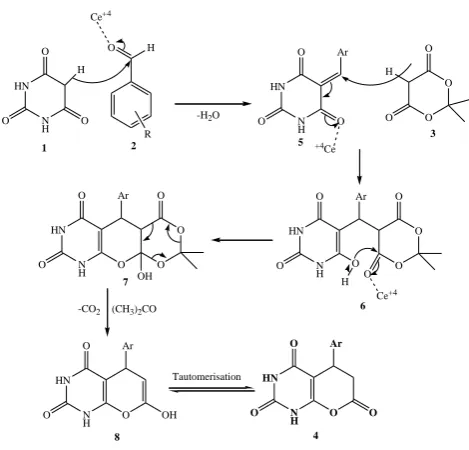
Mechanistically, the formation of the product is expected to involve the formation of a Knoevenagel adduct 5 by the condensation between 1 and 2 and this condensation is facillated by the coordination of Ce+4 ion with carbonyl
oxygen. Further the Michael addition is also facillated by the coordination of Ce+4 between 3 and 5 to give 6, which
cyclise to give tricyclic intermediate 7, which in turn releases acetone and carbon dioxide and gave compound 8
N
N O
O O
O H
R1
O O O
O R
R
N
N O
R1
O
O O
R R
+ +
CAN/H2O
))))
1a-h 2a-b 3
4a-h
R= H, CH3
R1=4-Cl, 4-NO2, 4-F,
Table 3. Synthesis of compounds 4a-h
S.No. R R1 Time, min Yield, %* Mp (oC)
4a H 4-Cl 30 94 284-286
4b H 4-NO2 26 96 250-252
4c H 4-F 31 94 264-266
4d H 2-NO2 27 95 216-218
4e H 2-Cl 29 95 242-244
4f H 2-OH 32 94 290-292
4g CH3 4-Cl 40 83 304-306
4h CH3 4-NO2 37 86 318-320
*Isolated yield
Scheme 2. Plausible Mechanism
EXPERIMENTAL SECTION
Melting points were recorded on a Toshniwal apparatus and are uncorrected. The purity of compounds was checked on thin layers of silica gel in various non-aqueous solvent systems e.g. n-hexane: ethyl acetate (7:3), benzene:ethyl acetate (9:1), benzene:dichloromethane (8:2). IR spectra (KBr) were recorded on Shimadzu FT IR–8400s spectrophotometer and 1H-NMR and 13C-NMR spectra were
recorded on a Bruker DRX-300 instrument at 300 and 75, respectively in DMSO-d6 relative to tetramethylsilane as a
internal reference. Mass spectrum of representative compound was recorded on Waters Xevo Q-Tof spectrometer at 70 eV. Elemental microanalyses were carried out on a Carlo-Erba 1108 CHN analyzer.
Ultrasound irradiation was provided by ultrasonic processor probe (Processor SONOPROS PR-1000MP, OSCAR ULTRASONICS with power input 230V, 50 Hz, 4 Amps and power variac 0-230V and 3Amps) operating at 20 kHz, 750W with 6mm/12 mm tip diameter probes.
HN
N H O
O O
H
O H
HN
N H O
O O
Ar
O O O
O H
HN
N
H O
O Ar O
O O O
O
HN
N
H O
O Ar O
O O
O
OH
HN
N
H OH
Ar O
O O
HN N
H O
Ar O
O O
Ce+4
+4Ce
H Ce+4
(CH3)2CO
Tautomerisation
1 2
R
-H2O
5 3
6 7
8 4
General Procedure for the Synthesis of 5-aryl-5,6-dihydro-1H-pyrano[2,3-d]pyrimidine-2,4,7-triones derivatives (4a-h)
A mixture of benzaldehyde 1a-h (2 mmol), barbituric acid
2a-b (2 mmol), meldrum’s acid 3 (2 mmol), and CAN (10 mol %) in 20 ml water was introduced in a heavy walled pear-shaped two-necked flask with non-standard taper outer joint. The flask was attached to a 12mm tip diameter probe and the reaction mixture was sonicated for the specified period at 50% power of the processor and in a 4 s pulse mode till a solid product separates out. Completion of the reaction was monitored by TLC using n-hexane: ethyl acetate (7:3) as an eluant. All the reactions were invariably completed in 25-40 min. Upon completion, the reaction, the solid product was filtered washed with water, dried and recrystallised from ethanol.
Spectral characterizations
5-(4-Clorophenyl)-5,6-dihydro-1H-pyrano[2,3-d]pyrimidine-2,4,7(3H)-trione (4a)21
Mp 284-286oC; IR (KBr): ν 3388, 3294, 2968, 1738, 1686,
1588, 1174 cm-1; 1H NMR (300 MHz, DMSO-d
6): δ 11.36 (s,
1H, NH), 11.15 (s, 1H, NH), 7.97 (d, J = 8.4 Hz, 2H, Ph), 7.77 (d, J = 8.4 Hz, 2H, Ph), 4.35 (t, J = 6.9 Hz, 1H, CH), 3.38 (d, J = 6.9 Hz, 2H, CH2); 13C NMR (75 MHz,
DMSO-d6): δ 164.1, 161.8, 158.6, 156.2, 143.5, 132.1, 125.8, 123.5,
121.0, 120.4, 92.7, 32.4, 23.1. Anal. Calcd for C13H9ClN2O4:
C, 53.35; H, 3.10; N, 9.57%. Found: C, 53.21; H, 3.19; N, 9.72%; ESI (ms) 293 [M+H]+
5-(4-Nitrophenyl)-5,6-dihydro-1H-pyrano[2,3-d]pyrimidine-2,4,7(3H)-trione (4b)21
Mp 250-252oC; IR (KBr): ν 3384, 3296, 2974, 1742, 1680,
1586, 1170 cm-1; 1H NMR (300 MHz, DMSO-d
6): δ 11.45 (s,
1H, NH), 11.27 (s, 1H, NH), 8.12 (d, J = 8.4 Hz, 2H, Ph), 7.62 (d, J = 8.4 Hz, 2H, Ph), 4.39 (t, J = 7.2 Hz, 1H, CH), 3.40 (d, J = 6.9 Hz, 2H, CH2); 13C NMR (75 MHz,
DMSO-d6): δ 166.5, 163.1, 157.8, 154.9, 147.6, 133.2, 126.7, 124.5,
122.1, 120.7, 92.0, 32.1, 23.4. Anal. Calcd for C13H9N3O6: C,
51.49; H, 2.99; N, 13.86%. Found: C, 51.38; H, 3.15; N, 13.98%; ESI (ms) 304 [M+H]+
5-(4-Fluorophenyl)-5,6-dihydro-1H-pyrano[2,3-d]pyrimidine-2,4,7(3H)-trione (4c)21
Mp 264-266oC; IR (KBr): ν 3402, 3290, 2982, 1735, 1687,
1589, 1176 cm-1; 1H NMR (300 MHz, DMSO-d
6): δ 11.43 (s,
1H, NH), 11.21 (s, 1H, NH), 8.04 (d, J = 8.4 Hz, 2H, Ph), 7.28 (d, J = 8.4 Hz, 2H, Ph), 4.36 (t, J = 7.2 Hz, 1H, CH), 3.38 (d, J = 7.2 Hz, 2H, CH2); 13C NMR (75 MHz,
DMSO-d6): δ 168.7, 163.4, 158.2, 155.4, 146.5, 133.8, 128.5, 127.8,
119.2, 92.3, 31.4, 24.6. Anal. Calcd for C13H9FN2O4: C,
56.53; H, 3.28; N, 10.14%. Found: C, 56.38; H, 3.17; N, 10.28%; ESI (ms) 277 [M+H]+
5-(2-Nitrophenyl)-5,6-dihydro-1H-pyrano[2,3-d]pyrimidine-2,4,7(3H)-trione (4d)21
Mp 216-218oC; IR (KBr): ν 3396, 3284, 2992, 1742, 1692,
1584, 1180 cm-1; 1H NMR (300 MHz, DMSO-d
6): δ 11.37
(s, 1H, NH), 11.18 (s, 1H, NH), 7.84-7.92 (m, 2H, Ph), 7.28-7.36 (m, 2H, Ph), 4.42 (t, J = 7.2 Hz, 1H, CH), 3.36 (d, J = 7.2 Hz, 2H, CH2); 13C NMR (75 MHz, DMSO-d6): δ
165.7, 162.7, 154.4, 152.5, 147.1, 136.7, 129.2, 127.2, 122.7, 121.4, 91.8, 31.7, 23.8. Anal. Calcd for C13H9N3O6: C,
51.49; H, 2.99; N, 13.86%. Found: C, 51.36; H, 3.14; N, 13.70%; ESI (ms) 304 [M+H]+
5-(2-Chlorophenyl)-5,6-dihydro-1H-pyrano[2,3-d]pyrimidine-2,4,7(3H)-trione (4e)21
Mp 242-244oC; IR (KBr): ν 3402, 3286, 2972, 1742, 1692,
1584, 1170 cm-1; 1H NMR (300 MHz, DMSO-d
6): δ 11.34 (s,
1H, NH), 11.21 (s, 1H, NH), 7.72-7.78 (m, 2H, Ph), 7.30-7.35 (m, 2H, Ph), 4.37 (t, J = 7.2 Hz, 1H, CH), 3.35 (d, J = 6.9 Hz, 2H, CH2); 13C NMR (75 MHz, DMSO-d6): δ 164.7,
162.2, 156.1, 154.5, 143.9, 132.4, 126.5, 124.2, 121.7, 119.8, 92.3, 31.8, 23.9. Anal. Calcd for C13H9ClN2O4: C, 53.35; H,
3.10; N, 9.57%. Found: C, 53.51; H, 3.23; N, 9.39%; ESI (ms) 293 [M+H]+
5-(2-Hydroxyphenyl)-5,6-dihydro-1H-pyrano[2,3-d]pyrimidine-2,4,7(3H)-trione (4f)21
Mp 290-292oC; IR (KBr): ν 3592, 3396, 3298, 2974, 1738,
1688, 1586, 1172 cm-1; 1H NMR (300 MHz, DMSO-d
6): δ
11.48 (s, 1H, NH), 10.17 (s, 1H, NH), 7.94-8.02 (m, 2H, Ph), 7.67-7.75 (m, 2H, Ph), 4.34 (t, J = 7.2 Hz, 1H, CH), 4.15 (s, 1H, OH), 3.33 (d, J = 6.9 Hz, 2H, CH2); 13C NMR
(75 MHz, DMSO-d6): δ 170.3, 163.6, 156.8, 153.7, 136.1,
129.7, 127.1, 125.4, 122.4, 118.1, 91.8, 33.2, 24.2. Anal. Calcd for C13H10N2O5: C, 56.94; H, 3.68; N, 10.22%.
Found: C, 57.12; H, 3.56; N, 10.32%; ESI (ms) 275 [M+H]+
5-(4-Chlorophenyl)-1,3-dimethyl-5,6-dihydro-1H-pyrano[2,3-d]pyrimidine-2,4,7(3H)-trione (4g)
Mp 304-306oC; IR (KBr): ν 1742, 1690, 1596, 1182 cm-1; 1H NMR (300 MHz, DMSO-d
6): δ 7.98 (d, J = 8.4 Hz, 2H,
Ph), 7.81 (d, J = 8.4 Hz, 2H, Ph), 4.33 (t, J = 7.2 Hz, 1H, CH), 3.36 (d, J = 6.9 Hz, 2H, CH2), 2.99 (s, 6H, 2xCH3); 13C
NMR (75 MHz, DMSO-d6): δ 164.9, 161.2, 159.3, 157.9,
144.9, 133.8, 126.1, 122.6, 121.5, 121.3, 92.3, 32.0, 27.4, 23.5. Anal. Calcd for C15H13ClN2O4: C, 56.17; H, 4.09; N,
8.73%. Found: C, 56.31; H, 4.3.98; N, 8.85%. ESI (ms) 321 [M+H]+
1,3-Dimethyl-5-(4-nitrophenyl)-5,6-dihydro-1H-pyrano[2,3-d]pyrimidine-2,4,7(3H)-trione (4h)
Mp 318-320oC; IR (KBr): ν 1740, 1694, 1590, 1178 cm-1; 1H NMR (300 MHz, DMSO-d
6): δ 8.12 (d, J = 8.4 Hz,1H,
13C NMR (75 MHz, DMSO-d
6): δ 166.1, 162.5, 157.4, 155.2,
147.3, 132.8, 127.5, 124.2, 121.8, 120.1, 91.6, 32.6, 27.7, 23.2. Anal. Calcd for C15H13N3O6: C, 54.38; H, 3.96; N,
12.68%. Found: C, 54.53; H, 3.83; N, 12.85%. ESI (ms) 332 [M+H]+
CONCLUSION
In conclusion, we have developed an efficient and straightforward procedure for the synthesis of pyrano[2,3-d]pyrimidine-2,4,7-trione derivatives under ultrasonic irradiation in aqueous medium using cerric ammonium nitrate as a mild, readily available, inexpensive, and efficient catalyst. Good functional group tolerance, broad scope of usable substrates, excellent yields and short routine are the prominent features of the present sonocatalyzed methodology. This method provides several advantages such as environmentally benign, excellent yields, no need of base, and simple workup procedure. Slower reaction of 1,3-dimethyl barbituric acid due to its low acidity of methyline proton.
ACKNOWLEDGEMENTS
Financial assistance from the CSIR [02(0143)/13/EMR-II], New Delhi is gratefully acknowledged. We are also thankful to the Central Drug Research Institute (CDRI), Lucknow and IIT Delhi for the spectral analyses.
REFERENCES
1(a) Orru, R. V. A., de Greef, M., Synthesis2003, 1471; (b) Tejedor,
D., Gonza´lez-Cruz, D., Santos-Expósito, A., Marrero-Tellado, J. J., de Armas, P., García-Marrero-Tellado, F., Chem.–Eur. J.
2005, 11, 3502.
2(a) Dömling, A., Chem. Rev.2006, 106, 17; (b) Toure, B. B., Hall,
D. G., Chem. Rev.2009, 109, 4439.
3Verònica, E., Mercedes, V., Menéndez, J. C., Chem. Soc. Rev.
2010, 39, 4402.
4Multicomponent Reactions; Zhu, J., Bienaymé, H., Ed.; Wiley-VCH: Weinheim2005.
5Gu, Y., Green Chem., 2012, 14, 2091
6Andrade, C. K. Z., Alves, L. M., Curr. Org. Chem.2005, 9, 195. 7(a) Simon, M.-O., Li, C.-J., Chem. Soc. Rev. 2012, 41, 1415; (b)
Butler, R. N., Coyne, A. G., Chem. Rev. 2010, 110, 6302; (c) Kobaayshi, S., Pure Appl. Chem. 2007, 79, 235.
8Holla, B. S., Kalluraya, B., Sridhar, K. R., Drake, E., Thomas, L.
M., Bhandary, K. K., Levine, M. J., Eur. J. Med. Chem.1994,
29, 301.
9Molina, P., Aller, E., Lorenzo, Á., López-Cremades, P., Rioja, I.,
Ubeda, A., Terencio, M. C., Alcaraz, M. J., J. Med. Chem.
2001, 44, 1011.
10(a)Chobe, S. S., Dawane, B. S., Tumbi, K. M., Nandekar, P. P.,
Sangamwar, A. T., Bioorg. Med. Chem. Lett. 2012, 22, 7566; (b) Di Parsia, M. T., Suarez, C., Vitolo, M. J., Marquez, V. E., Beyer, B., Urbina, C., Hurtado, I., J. Med. Chem.1981,
24, 117.
11Kamdar, N. R., Haveliwala, D. D., Mistry, P. T., Patel, S. K., Eur. J. Med. Chem.2010, 45, 5056.
12(a) Abdel Fattah, M. E., Atta, A. H., Abdel Gawad, I. I., Mina, S.
M., Orient. J. Chem. 2004, 20, 257; (b) Ghorab, M. M., Hassan, A. Y., Phosphorus, Sulfur Silicon Relat. Elem.1998,
141, 251.
13Bruno, O., Brullo, C., Ranise, A., Schenone, S., Bondavalli, F.,
Barocelli, E., Ballabeni, V., Chiavarini, M., Tognolini, M., Impicciatore, M., Bioorg. Med. Chem. Lett.2001, 11, 1397.
14Akluwalia, V. K., Bala, M., Indian J. Chem., Sect. B1996, 35B,
742.
15Shamroukh, A. H., Zaki, M. E. A., Morsy, E. M. H., Abdel-Motti,
F. M., Abdel-Megeid, F. M. E., Arch. Pharm.2007, 340, 236.
16Joshi, K. C., Jain, R., Sharma, K., J. Indian Chem. Soc.1988, 45,
202.
17(a)The pyrimidines; Fenn, D., Ed.; Wiley: New York 1994; (b)
Heber, D., Heers, C., Ravens, U., Pharmazie1993, 48, 537; (c) Grivasky, E. M., Lee, S., Sigal, C. W., Duch, D. S., Nichol, C. A., J. Med. Chem.1980, 23, 327; (d) Broom, A. D., Shim, J. L., Anderson, G. L., J. Org. Chem. 1976, 41, 1095.
18Ghorab, M. M., Hassan, A. Y., Phosphorus, Sulfur Silicon Relat. Elem.1998, 141, 251; (b) Furuya, S., Ohtaki, T., Eur. Patent
1994, 6,085,65; (c) Coates, W. J., Eur. Patent1990, 3,510,58.
19(a) Kitamura, N., Onishi, A., Eur. Patent 1984, 1,635,99; (b)
Davoll, J., Clarke, J., Elslager, E. F., J. Med. Chem.1972, 15, 837; (c) Levitt, G., U. S. Patent1982, 4,339,267.
20(a)Bo, J., Li-Yuan, X., Xing-Han, W., Man-Su, T., Yin-Ping, L.,
Shu-Jiang, T., Tetrahedron Lett. 2012, 53, 1261; (b) Aly, H. M., Kamal, M. M., Eur. J. Med. Chem. 2012, 47, 18; (c) Kamdar, N. R., Haveliwala, D. D., Mistry, P. T., Patel, S. K.,
Eur. J. Med. Chem. 2010, 45, 5056; (d) Elinson, M. N., Ilovaisky, A. I., Merkulova, V. M., Demchuk, D. V., Belyakov, P. A., Ogibin, Y. N., Nikishin, G. I.,
Electrochimica Acta 2008, 53, 8346; (e) Majumdar, K. C., Chattopadhyay, S. K., Can. J. Chem. 2006, 84, 469; (f) Majumdar, K. C.; Jana, N. K.; Bandyopadhyay, A.; Ghosh, S. K., Synth. Commun.2001, 31, 2979.
21Azzam, S. H. S., Pasha, M. A., Tetrahedron Lett. 2012, 53, 7056.
22(a) Wilkes, J. S., Green Chem. 2002, 4, 73; (b) Cravotto, G.,
Fokin, V. V., Garella, D., Binello, A., Boffa, L., Barge, A., J. Comb. Chem. 2010, 12, 13; (c) Cravotto, G., Cintas, P.,
Chem. Soc. Rev.2006, 35, 180; (d) Pizzuti, L., Martins, P. L. G., Ribeiro, B. A., Quina, F. H., Pinto, E., Flores, A. F. C., Venzke, D., Pereira, C. M. P., Ultrason. Sonochem.2010, 17, 34.
23(a) Singh, B. S., Lobo, H. R., Pinjari, D. V., Jarag, K. J., Pandit,
A. B., Shankarling, G. S., Ultrason. Sonochem. 2013, 20, 633; (b) Jarag, K. J., Pinjari, D. V., Pandit, A. B., Shankarling, G. S., Ultrason. Sonochem.2011, 18, 617; (c) Mason, T. J., Ultrasonic 1992, 30, 192; (d) Cravotto, G., Cintas, P., Angew. Chem. Int. Ed.2007, 46, 5476.
24(a) Mason, T. J., Lorimer, J. P., Chem. Soc. Rev.1987, 16, 239;
(b) Li, J. T., Wang, S. X., Chen, G. F., Li, T. S., Curr. Org. Synth.2005,2, 415; (c) Cravotto, G., Cintas, P., Chem. Soc. Rev.2006, 35, 180.
25(a) Nasir Baig, R. B., Varma, R. S., Chem. Soc. Rev.2012, 41,
1559; (b) Albogami, A. S., Saleh, T. S., Zayed, E. M.,
Ultrason. Sonochem. http://dx.doi.org/10.1016/j.ultsonch. 2013.03.003
26(a) Nair V., Deepthi, A., Chem. Rev. 2007, 107, 1862; (b) Nair,
V., Panicker, S. B., Nair, L. G., George, T. G., Augustine, A.,
Synlett2003, 156.
27(a) Tapaswi, P. K., Mukhopadhyay, C., Arkivoc2011, (x), 287;
(b) Sridharan V., Menendez, J. C., Org. Lett. 2008, 10, 4303; (c) Chang, M.- Y., Wu, T.- C., Lin C.- Y., Hung, C.- Y.,
Tetrahedron Lett. 2006, 47, 8347.
28(a) Sadek, K. U., Alnajjar, A., Mekheimer, R. A., Mohamed, N.
K., Mohamed, H. A., Green and Sustainable Chem.2011, 1, 92; (b) Mekhalifa, A., Mutter, R., Heal, W., Chen, B.,
28(a) Dandia, A., Parewa, V., Gupta, S. L., Rathore, K. S., J. Mol. Catal. A: Chem.2013, 373, 61; (b) Dandia, A., Jain, A. K., Bhati, D. S., Laxkar, A. K., Tetrahedron 2013, 69, 2062; (c) Dandia, A., Parewa, V., Rathore, K. S., Catal. Commun.
2012, 28, 90; (d) Dandia, A., Parewa, V., Jain, A. K., Rathore, K. S., Green Chem.2011, 13, 2135; (e) Dandia, A., Jain, A. K., Sharma, S., Tetrahedron Lett.2012, 53, 5859.
29Washburn, E. W., (Eds.) International Critical Tables; New York,
McGraw-Hill 1929, 6, 261.
30Ballard, B. B., Nelson, E., J. Pharmacol. Exp. Ther.1962, 135,
120.