Available online throug
ISSN 2229 – 5046
MHD COUETTE FLOW AND HEAT TRANSFER OF A DUSTY COUPLE STRESS FLUID
WITH EXPONENTIAL DECAYING PRESSURE GRADIENT
V. P. RATHOD
1, SYEDA RASHEEDA PARVEEN*
11
Department of Studies and Research in Mathematics,
Gulbarga University, Gulbarga-585 106, Karnataka, India.
(Received On: 02-08-15; Revised & Accepted On: 26-08-15)
ABSTRACT
In the present study, the unsteady couette flow with heat transfer of a viscous incompressible electrically conducting
couple stress fluid under the influence of an exponentially decreasing pressure gradient is studied. The parallel plates are assumed to porous and subjected to a uniform suction from above and injection from below while the fluid is acted upon by an external uniform magnetic field applied perpendicular to plates. The equations of motion are solved by using transform technique to get the velocity distributions for the fluid and dust particles. The energy equations for both the fluid and dust particles including the viscous, couple stress parameter Joule dissipation terms are solved by using Mathematica to get temperature distributions.Key – words: coquette flow, magnetohydrodynamics, heat transfer, dusty fluid, couple stress parameter.
INTRODUCTION
The importance and application of solid/fluid flows and heat transfer in petroleum transport waste water treatment, combustion, power piping, corrosive particles in engine oil flow, and many other are well known in the literature [1-5]. Particularly, the flow and heat transfer of electrically conducting fluid in channels and circular pipes under the effect of transverse magnetic field occurs in magnetohydrodynamic (MHD) generators, pumps, accelerators, and flow meters and has possible applications in nuclear reactors filtration, geothermal systems and others.
The flows of couple stress fluids have many practical application in modern technology and industries, led various researchers to attempt diverse flow problems related to several non-Newtonian fluids one such fluid that has attracted the attention of numerous researchers in fluid mechanics during the last five decades in the theory of couple stress fluid proposed by stokes [6]. The concept of couple stress arises due to the way in which the mechanical interactions in the fluid medium are modeled. Singh and Pathak [7] have discussed unsteady flow of a dusty viscous fluid through a uniform pipe with sector of a circle as cross-section, and Pulsatile flow of blood with micro-organism through a uniform pipe with sector of a circle as cross-section, in the presence of transverse magnetic field has been investigated by Rathod and Parveen [8]. Also unsteady flow of a dusty magnetic conducting couple stress fluid through a pipe and the flow of a conducting fluid in a circular pipe has been investigate by many authors Gudiraju et.al, [9]. Dube and Sharma [10] and Ritter and Peddieson [11] have reported solutions for unsteady dusty gas flow in a circular pipe in the absence of a magnetic field and particle phase viscous stress. Rathod et.al, [12] have reported solution for couette flow of a conducting dusty visco-elastic fluid through two flat plate under the influence of transverse magnetic field. Rathod and Rasheeda [13-14] investigated unsteady flow of a dusty magnetic conducting couple stress fluid through a circular pipe, and couette flow with heat transfer of a couple stress fluid under exponential decaying pressure gradient.
The possible presence of solid particles such as ash or soot in combustion MHD generator’s and plasma MHD accelerators and their effect on the performance of such device led to studied of particular suspensions in conducting fluid in the presence of magnetic fields. For example in an MHD generator coal mixed with seed is fed into a combustor the coal and seed mixture is burned in oxygen and the combustion gas expands through a nozzle before it enters the generator section. The gas mixture flouring through the MHD cannel consists of a condensable vapo (slag) and a non-condensable gas mixed with seeded coil combustion products. Both the slag and the non-condensable gas are electrically conducting [1, 2]. The presence of the slag and the seeded particles significantly influence the flow and heat transfer characteristic in the MHD channel. Ignoring the effect of the slag and considering the MHD generator start up condition, the problem reduces to unsteady two-phase flow in an MHD channel [15, 16].
with exponential decaying pressure gradient / IJMA- 6(8), August-2015.
In the present work, the transient couette How with heat transfer of on electrically conducting, viscous, in-compressible, dusty couple stress fluid are studied. The upper plate is moving with a constant velocity while the lower plate is kept stationary. The fluid is acted upon by on exponentially decaying with time pressure gradient. The couple stress fluid is assume to be compressible and electrically conducting and particle phase is assumed to in-compressible, electrically non-conducting dusty and pressure less. The fluid is flowing between two infinite electrically insulating porous plates maintained at two constant but different temperatures while the particle phase is assumed to be electrically non-conducting. The fluid is subjected to a uniform suction from above and a uniform injection from below and mass conservation is assumed. An external uniform magnetic field is applied perpendicular to the plates while no electric field is applied and the induced. Magnetic field is neglected by assuming a very small magnetic Reynolds number. The governing equation for both fluid and dust particles are solved numerically taking the Joule and viscous dissipations in to consideration in the energy equations. The effect of the magnetic field, couple stress parameter. The Hall Current, the ion slip, and the suction velocity on the both the velocity and temperature field are reported.
DESCRIPTION OF THE PROBLEM
The couple stress dusty fluid is assumed to be flowing between two infinite horizontal porous plates located at the y=±h planes. The upper plates is moving with a constant velocity uo while the lower plates is kept stationery. The
plates are subjected to a uniform suction from above and a uniform injection from below. Thus the y-component of the velocity of the fluid is constant and denoted by 𝜈𝜈o. The dust particles are assumed to be electrically non-conducting
spherical in shape and uniformly distributed throughout the fluid. So that they are not pumped out through the porous plates and have no y-component of velocity. The two plates are assumed to be electrically non-conducting and kept at two constant temperature T1 for the lower plate and T2 for the upper plate with T2>T1.
An uniform pressure gradient, which is taken to be exponentially decaying with time, is applied in the 𝑥𝑥-direction. A uniform magnetic field Bo is applied in the y-direction. This is the only magnetic field in the problem as the induced
magnetic field is neglected by assuming a very small magnetic Reynolds number [18]. The fluid motion starts from rest at t=o, and the no-slip condition at the plates implies that the fluid and dust particle velocities have neither a Z nor an 𝑥𝑥 -component at y=±h. The initial temperature of the fluid and dust particle are assumed to be equal to T1. It is required
to obtain the time varying velocity and temperature distributions for both fluid and dust particles. Due to the inclusion Hall Current term, a z-component of the velocities of the fluid and dust particles, is expected to arise. Since the plates
are infinite in the 𝑥𝑥 and z – direction. The physical quantities do not change in these direction that 𝜕𝜕 𝜕𝜕𝑥𝑥 =
𝜕𝜕
𝜕𝜕𝜕𝜕 = 0 and the problem is essentially one – dimensional. The governing equation for this study are based on the conservation law of mass, linear momentum and energy of both phases are treated as two interacting continua. The interaction between the phases is restricted to the inter phase drag force which is modeled by stokes linear drag theory and inter phase heat transfer. The flow of fluid is governed by the momentum equation.
𝛠𝛠𝐷𝐷𝐷𝐷𝐷𝐷𝐷𝐷 = ∇p + 𝝁𝝁∇2v +JxBo - 𝜂𝜂∇2 (∇2v) - KN(v-vp) (1)
Where 𝛠𝛠 is density of the clean fluid, 𝜇𝜇 is the viscosity of the clean fluid, 𝜈𝜈 is the velocity of the fluid,
𝜈𝜈= u(y, t) I + 𝜈𝜈o⥑. 𝜈𝜈p is the velocity of the dust particles 𝜈𝜈p= up(y, t)i, J is the Current density. N is the number of dust
particles per unit volume. K is the stokes constant = 6⊼𝜇𝜇𝜇𝜇, and a is the average radius of the dust particles. the first four terms in the right hand side of e𝓆𝓆n (1) are the pressure gradient, viscosity, Lorent Z force terms couple stress terms respectively.
The last term represents the force due to the relative motion between fluid and dust particles. It is assumed that the Reynolds number of relative velocity is small, In such a case the force between dust and fluid is proportional to the relative velocity [3]. The current density J from the generalized ohm’s law is given by [17]
J = 𝜎𝜎[𝜎𝜎 + 𝜈𝜈 x Bo] (2)
Where б is the electric conductivity of the fluid [17] solving Equation (2) for J and substituting the result in Equation (1), the two components of Equation (1)
𝛠𝛠𝜕𝜕𝜕𝜕𝜕𝜕𝐷𝐷 = ϱ𝜈𝜈𝑜𝑜𝜕𝜕𝜕𝜕 𝜕𝜕𝜕𝜕 = -
𝑑𝑑𝑑𝑑 𝑑𝑑𝑑𝑑 + 𝝁𝝁
𝜕𝜕2𝜕𝜕
𝜕𝜕𝜕𝜕2 - б𝐵𝐵𝑜𝑜2u - 𝜂𝜂∇2 (∇2u) - KN (u-up) (3)
The motion of the dust particle is governed by Newton’s Second law applied in the 𝑥𝑥 and Z direction.
mp𝜕𝜕𝜕𝜕𝑑𝑑𝜕𝜕𝐷𝐷 = KN (u-up) (4)
Where mp is the average mass of dust particles, It is assumed that the pressure gradient is applied at t=o and the fluid
starts its motion from rest. Thus
For t>o, the no-slip condition at the plates implies that
t>o: y = - h, u=up, y=h u= ∪o, up = o. (6)
Heat transfer takes place from the upper hot plate to the lower cold plate by conduction through the fluid. Since the hot plate is above, there is no natural connection, however, there is a force convection due to the suction and injection. In addition to heat transfer, there is a heat generation due to both the Joule and viscous dissipations. The dust particle gain heat from the fluid by conduction through their spherical surface. Since the problem deals with a two – phase flow, two energy equation are required [18]. The energy equations describing the temperature distributions for both the fluid and dust particles read.
𝛠𝛠c 𝜕𝜕𝜕𝜕
𝜕𝜕𝐷𝐷 + ϱ c 𝜈𝜈𝑜𝑜 𝜕𝜕𝜕𝜕 𝜕𝜕𝜕𝜕 = k
𝜕𝜕2𝜕𝜕
𝜕𝜕𝜕𝜕2 + 𝜇𝜇�𝜕𝜕𝜕𝜕𝜕𝜕𝜕𝜕�
2
+ б𝐵𝐵𝑜𝑜2𝜕𝜕2 + 𝜚𝜚𝑑𝑑𝐶𝐶𝑠𝑠
ϒ𝜕𝜕 (Tp – T) (7)
𝜕𝜕𝜕𝜕𝑑𝑑
𝜕𝜕𝐷𝐷 = −1
ϒT (Tp – T) (8)
Where T is the temperature of the fluid, Tp is the temperature of the particles. C is the specific heat capacity of the fluid
at constant volume, k is the thermal conductivity of the fluid, 𝜚𝜚𝑜𝑜 is the mass of dust particles per unit volume of the fluid. 𝛾𝛾𝜕𝜕 is the temperature relaxation time, and Cs is the specific heat capacity of the particles. The last three terms on
the right hand side of equation (7) represent the viscous dissipation, the Joule dissipation, the Joule dissipation (J2/6), and the heat conduction between the fluid and dust particles respectively. The temperature relaxation time depends, in general, on the geometry and since the dust particles are assumed to be spherical in shape, the last term in equation (7) is equal to
4𝜋𝜋a NK(Tp – T). Hence γ𝜕𝜕= (3𝑃𝑃𝑟𝑟 𝛾𝛾𝑑𝑑 𝑐𝑐)/2𝐶𝐶
Where γ𝑑𝑑is the velocity relaxation time = 2𝜚𝜚d2/9𝜇𝜇𝑠𝑠𝑑𝑑𝑟𝑟 is the prandtl number = 𝝁𝝁c/k, and 𝜌𝜌𝑠𝑠is the material density of dust particles 3Pp/4𝜋𝜋a3N.
T and Tp must satisfy the initial and boundary conditions.
t ≤0: T = Tp = o.
t > 0, y = - h, T = Tp = T1
t > 0 y = h: T = Tp = T2 (9)
The problem is simplified by writing the equations in the dimensional form. We define the following non-dimensional quantities. ̭
𝑥𝑥 = 𝑥𝑥 ℎ,
̭
𝜕𝜕 = 𝜕𝜕 ℎ,
̭
𝑍𝑍 = 𝑍𝑍 ℎ,
̭
𝜕𝜕 = 𝜕𝜕 𝜕𝜕𝑜𝑜.
̭
𝑃𝑃 = 𝑃𝑃 𝜚𝜚𝜕𝜕𝑜𝑜2, t =
𝐷𝐷𝜕𝜕𝑜𝑜
ℎ ,
̭
𝜕𝜕𝑑𝑑 = 𝜕𝜕𝑑𝑑
𝜕𝜕𝑜𝑜,
̭
T = 𝜕𝜕−𝜕𝜕1 𝜕𝜕2−𝜕𝜕1,
̭
Tp =
𝜕𝜕𝑑𝑑−𝜕𝜕1
𝜕𝜕2−𝜕𝜕1,
Re = ϱhuo/𝝁𝝁, is the Reynolds number.
S = 𝛾𝛾𝑜𝑜/uo is the suction parameter.
Pr = 𝝁𝝁c/k is the prandtl number.
H𝜇𝜇2= бB𝑜𝑜2h2/𝝁𝝁 where Ha is the Hartmann number.
G = mp𝝁𝝁/ϱh 2
k is the particle mass parameter.
R = 𝐾𝐾𝐾𝐾ℎ2
𝜇𝜇 is the particle concentration parameter. Ec = 𝜕𝜕𝑜𝑜2/c (T2-T1) is the Eckert number.
Lo = ϱh2/𝜇𝜇𝜕𝜕 is the temperature relaxation time parameter.
In terms of the above non-dimensional quantities the velocity and energy equations read. 𝜕𝜕𝜕𝜕
𝜕𝜕𝐷𝐷 + s 𝜕𝜕𝜕𝜕 𝜕𝜕𝜕𝜕 = -
𝜕𝜕𝑑𝑑 𝜕𝜕𝑥𝑥 +
1
𝑅𝑅𝑅𝑅 𝜕𝜕2𝜕𝜕
𝜕𝜕𝜕𝜕2 - 𝛼𝛼�12 𝑅𝑅𝑅𝑅1 𝜕𝜕 4𝜕𝜕
𝜕𝜕𝜕𝜕4 - 𝑅𝑅𝑅𝑅1 𝐻𝐻𝜇𝜇2u – 𝑅𝑅𝑅𝑅𝑅𝑅 (u-up) (10)
G 𝜕𝜕𝜕𝜕𝑑𝑑
𝜕𝜕𝐷𝐷 = u – up (11)
𝜕𝜕𝜕𝜕 𝜕𝜕𝐷𝐷 + s
𝜕𝜕𝜕𝜕 𝜕𝜕𝜕𝜕 =
1
𝑃𝑃𝑟𝑟
𝜕𝜕2𝜕𝜕
𝜕𝜕𝜕𝜕2 + Ec �
𝜕𝜕𝜕𝜕 𝜕𝜕𝜕𝜕�
2
+ 𝐻𝐻𝜇𝜇2 Ec u2 + 2𝑅𝑅
3𝑃𝑃𝑟𝑟 (Tp – T) (12)
𝜕𝜕𝜕𝜕𝑑𝑑
𝜕𝜕𝐷𝐷 = - Lo (Tp – T) (13)
With the initial and boundary condition,
t ≤ o : u = up = o, t > o; y = -1, u = up = o, y = 1, u = 1, up = o. (14)
t ≤ o, T = Tp = o, t > o, Tp = o, y = - 1,
T = Tp = o, y = 1, T = Tp = 1 (15)
Where the pressure gradient is assumed in the form 𝑑𝑑𝑑𝑑
with exponential decaying pressure gradient / IJMA- 6(8), August-2015.
Equation (10), (11), (12) and (13) represent a system of coupled and nonlinear partial differential equation which are solved by using transformation method (cosine and Hankle transformation).
u = 4 ∝�
ca Re ∞
𝑚𝑚=𝑜𝑜 �1−
1
𝐺𝐺�
(−1)𝑑𝑑
�2𝑚𝑚+12∝ �
1
𝜇𝜇2−𝜇𝜇𝑥𝑥1+𝑥𝑥2 �𝑅𝑅−𝜇𝜇𝐷𝐷 + �𝑥𝑥 1 12−4𝑥𝑥2�½
�(∝2+𝜇𝜇)𝑅𝑅∝1𝐷𝐷− (∝1+𝜇𝜇)𝑅𝑅2𝐷𝐷�
� � ℇ1 i
Jo(yℇi)
J1(ℇi) −
∞
𝑖𝑖=1 cos (2𝑚𝑚+1)⊼𝜕𝜕
2∝ (16)
up = 4∝� Reca ∞
𝑚𝑚=𝑜𝑜 �1−
1
𝐺𝐺�
(−1)𝑑𝑑
�2𝑚𝑚+12∝ ��1− 𝑅𝑅
−𝐺𝐺1𝐷𝐷� 1
𝜇𝜇2−𝜇𝜇𝑥𝑥1+𝑥𝑥2
� 1
1−𝜇𝜇𝐺𝐺�𝑅𝑅−𝜇𝜇𝐷𝐷 − 𝑅𝑅
−1𝐺𝐺𝐷𝐷�+ 1 (𝑥𝑥12−4𝑥𝑥2)½ �
(∝2+𝜇𝜇)(𝑅𝑅∝1𝐷𝐷−𝑅𝑅 −1
𝐺𝐺 𝐷𝐷) (1+∝1𝐺𝐺) −
(∝1+𝜇𝜇)(𝑅𝑅∝2𝐷𝐷− 𝑅𝑅 −1
𝐺𝐺 𝐷𝐷)
(1+∝2𝐺𝐺) ���
1
ℇi
Jo(yℇi)
Jo(ℇi) −
∞
𝑖𝑖=1 cos (2𝑚𝑚+1)⊼𝜕𝜕
2∝ (17)
T = 𝛽𝛽 �𝜕𝜕12−4𝜕𝜕2�½
(−2𝜇𝜇+𝐿𝐿𝑜𝑜)�(−2𝜇𝜇−𝑍𝑍2)𝑅𝑅𝑍𝑍1𝐷𝐷−(−2𝜇𝜇−𝑍𝑍1)𝑅𝑅𝑍𝑍2𝐷𝐷+𝑅𝑅−𝑍𝑍𝜇𝜇𝐷𝐷�
4𝜇𝜇2+𝜇𝜇𝜕𝜕1+𝜕𝜕2 + 1
�𝑥𝑥12−4𝑥𝑥2�
(∝2+𝜇𝜇)2(2∝1+𝐿𝐿𝑜𝑜)�(2∝1−𝑍𝑍2)𝑅𝑅𝑍𝑍1𝐷𝐷−(2𝜇𝜇2−𝑍𝑍1)𝑅𝑅𝑍𝑍2𝐷𝐷+𝑅𝑅−2∝1𝐷𝐷�
4∝12−2𝑥𝑥1𝜕𝜕1+𝜕𝜕2
+ (∝1+𝜇𝜇)2(2∝2+𝐿𝐿𝑜𝑜)
4∝22−2∝2𝜕𝜕1+𝜕𝜕2
�(2∝2−𝑍𝑍2)𝑅𝑅𝑍𝑍1𝐷𝐷−(2∝2−𝑍𝑍1)𝑅𝑅𝑍𝑍2𝐷𝐷+𝑅𝑅2∝2𝐷𝐷�
−2(∝1+𝜇𝜇) (∝2+𝜇𝜇)(∝1+∝2+𝐿𝐿𝑜𝑜)
(∝1+∝2)2−(∝1+∝2)𝜕𝜕1+𝜕𝜕2
�(∝1+∝2𝑍𝑍2)𝑅𝑅𝑍𝑍1𝐷𝐷−(∝1+∝2−𝑍𝑍1)𝑅𝑅𝑍𝑍2𝐷𝐷+𝑅𝑅(∝1+∝2)𝐷𝐷�
+ 2
�𝑥𝑥12−4𝑥𝑥2�½ �
(∝2+𝜇𝜇) (∝1−𝜇𝜇+𝐿𝐿𝑜𝑜)�(∝1−𝜇𝜇−𝑍𝑍2)𝑅𝑅𝑍𝑍1𝐷𝐷−(∝1−𝜇𝜇−𝑍𝑍1)𝑅𝑅𝑍𝑍2𝐷𝐷+𝑅𝑅(∝1−𝜇𝜇)𝐷𝐷�
(∝1−𝜇𝜇)2−(∝1−𝜇𝜇)+𝜕𝜕2 �
− (∝1+𝜇𝜇) (∝2−𝜇𝜇+𝐿𝐿0)
(∝2−𝜇𝜇)2−(∝2−𝜇𝜇)𝜕𝜕1+𝜕𝜕2
�(∝1−𝜇𝜇−𝑍𝑍2)𝑅𝑅𝑍𝑍1𝐷𝐷−(∝1−𝜇𝜇−𝑍𝑍1)𝑅𝑅𝑍𝑍2𝐷𝐷+𝑅𝑅(∝2−𝜇𝜇)𝐷𝐷�
(18)
Tp = 𝛽𝛽
�𝜕𝜕12−4𝜕𝜕2�½
(−2𝜇𝜇+𝐿𝐿𝑜𝑜)
4𝜇𝜇2+2𝜇𝜇𝜕𝜕1+𝜕𝜕1 �
(−2𝜇𝜇+𝑍𝑍2)(𝑅𝑅𝑍𝑍1𝐷𝐷−𝑅𝑅−𝐿𝐿𝑜𝑜𝐷𝐷)
(𝑍𝑍1+𝐿𝐿𝑜𝑜) −
(−2𝜇𝜇−𝑍𝑍1)(𝑅𝑅𝑍𝑍2𝐷𝐷−𝑅𝑅−𝐿𝐿𝑜𝑜𝐷𝐷)
(𝑍𝑍2+𝐿𝐿𝑜𝑜) �
+ 1
�𝑥𝑥12−4𝑥𝑥2�
(∝2+𝜇𝜇)2(2∝1+𝐿𝐿𝑜𝑜)
4∝12−2𝑥𝑥1𝜕𝜕1+𝜕𝜕2
(2∝1−𝑍𝑍2)�𝑅𝑅𝑍𝑍1𝐷𝐷−𝑅𝑅−𝐿𝐿𝑜𝑜𝐷𝐷�
(𝑍𝑍1+𝐿𝐿𝑜𝑜) −
(2∝2−𝑍𝑍1)(𝑅𝑅𝑍𝑍2𝐷𝐷−𝑅𝑅−𝐿𝐿𝑜𝑜𝐷𝐷)
(𝑍𝑍2+𝐿𝐿𝑜𝑜) +
[𝑅𝑅−2∝1𝐷𝐷−𝑅𝑅−𝐿𝐿𝑜𝑜𝐷𝐷] (2∝1+𝐿𝐿𝑜𝑜)
+ (∝1+𝜇𝜇)2(2∝2+𝐿𝐿0)
(4∝12−2∝2𝜕𝜕1+𝜕𝜕2) �
[(2∝2+𝑍𝑍2)𝑅𝑅𝑍𝑍1𝐷𝐷−𝑅𝑅−𝐿𝐿𝑜𝑜𝐷𝐷]
(𝑍𝑍1+𝐿𝐿𝑜𝑜) −
(2∝2−𝑍𝑍1)(𝑅𝑅𝑍𝑍2𝐷𝐷−𝑅𝑅−𝐿𝐿𝑜𝑜𝐷𝐷)
(𝑍𝑍2+𝐿𝐿𝑜𝑜) +
�𝑅𝑅2∝2𝐷𝐷−𝑅𝑅−𝐿𝐿𝑜𝑜𝐷𝐷�
2∝2+𝐿𝐿𝑜𝑜 �
− 2(∝1+𝜇𝜇)(∝2+𝜇𝜇)(∝1+∝2+𝐿𝐿𝑜𝑜)
(∝1+∝2)2−(∝1+∝2)𝜕𝜕1+𝜕𝜕2 �(∝1+∝2− 𝑍𝑍2)
�𝑅𝑅𝑍𝑍1𝐷𝐷−𝑅𝑅−𝐿𝐿𝑜𝑜𝐷𝐷�
(𝑍𝑍1+𝐿𝐿𝑜𝑜) − (∝1+∝2− 𝑍𝑍1)
�𝑅𝑅𝑍𝑍2𝐷𝐷−𝑅𝑅−𝐿𝐿𝑜𝑜𝐷𝐷�
(𝑍𝑍2+𝐿𝐿𝑜𝑜) �
+ 𝑅𝑅(∝(∝1+∝2−𝑅𝑅−𝐿𝐿𝑜𝑜𝐷𝐷 1+∝2)+𝐿𝐿𝑜𝑜 +
2
�𝑥𝑥12−4𝑥𝑥2�½ �
(∝2+𝜇𝜇) (∝1−𝜇𝜇+𝐿𝐿𝑜𝑜)
(∝1−𝜇𝜇)2−(∝1−𝜇𝜇)𝜕𝜕1+𝜕𝜕2
(∝1−𝜇𝜇−𝑍𝑍2)�𝑅𝑅𝑍𝑍1𝐷𝐷−𝑅𝑅−𝐿𝐿𝑜𝑜𝐷𝐷�
(𝑍𝑍1+𝐿𝐿𝑜𝑜) �
−(∝1−𝜇𝜇−𝑍𝑍1)�𝑅𝑅𝑍𝑍2𝐷𝐷−𝑅𝑅−𝐿𝐿𝑜𝑜𝐷𝐷�
(𝑍𝑍2+𝐿𝐿𝑜𝑜) +
𝑅𝑅(∝1+𝜇𝜇)𝐷𝐷−𝑅𝑅−𝐿𝐿𝑜𝑜𝐷𝐷
(∝1−𝜇𝜇) +𝐿𝐿𝑜𝑜 -
(∝1+𝜇𝜇) (∝2−𝜇𝜇−𝐿𝐿𝑜𝑜)
(∝2−𝜇𝜇)2−(∝2−𝜇𝜇)𝜕𝜕1+𝜕𝜕2
[(∝1−𝜇𝜇−𝑍𝑍2) ]
−�𝑅𝑅𝑍𝑍(1𝑍𝑍𝐷𝐷−𝑅𝑅−𝐿𝐿𝑜𝑜𝐷𝐷� 1+𝐿𝐿𝑜𝑜) -
(∝1−𝜇𝜇−𝑍𝑍1) �𝑅𝑅𝑍𝑍2𝐷𝐷−𝑅𝑅−𝐿𝐿𝑜𝑜𝐷𝐷�
𝑍𝑍2+𝐿𝐿𝑜𝑜 +
�𝑅𝑅∝2−𝜇𝜇)𝐷𝐷−𝑅𝑅−𝐿𝐿𝑜𝑜𝐷𝐷�
(∝2−𝜇𝜇)𝐿𝐿𝑜𝑜 (19)
Where B= (1+𝐻𝐻𝜇𝜇2) �∝4 � Reca ∝
𝑚𝑚=𝑜𝑜 �1−
1
𝐺𝐺�
(−1)𝑚𝑚
�2𝑚𝑚+12∝ �
1
𝜇𝜇2−𝜇𝜇𝑥𝑥1+𝑥𝑥2 �
2
� � ℇ1 i
Jo(yℇi)
Jo(ℇi) −
∝
𝑖𝑖=1 cos
(2𝑚𝑚+1)⊼𝜕𝜕
2∝ �
2
Y1 = S-Lo-𝑃𝑃1 𝑟𝑟 - Lo
2𝑅𝑅
3𝑃𝑃𝑟𝑟, 𝑥𝑥1= S+
1
𝑅𝑅𝑅𝑅+
1
𝛼𝛼�2𝑅𝑅𝑅𝑅2 Y2 = LoS - 𝐿𝐿𝑃𝑃𝑜𝑜
𝑟𝑟 , 𝑥𝑥2=
1
𝑅𝑅𝑅𝑅 �𝐻𝐻𝜇𝜇
2− 1
𝐺𝐺+ 𝑅𝑅+
1
𝑅𝑅𝑅𝑅𝐺𝐺+
𝑆𝑆 𝐺𝐺−
1
𝛼𝛼�2𝑅𝑅𝑅𝑅�, 𝑥𝑥3=𝐶𝐶𝜇𝜇𝑅𝑅𝑅𝑅�1−𝐺𝐺1� (−1) 𝑚𝑚 (2𝑚𝑚+1)
2∝ .
∝1 =12�−𝑥𝑥1+�𝑥𝑥12−4𝜕𝜕2� ,
∝2 =12�−𝑥𝑥1− �𝑥𝑥12−4𝜕𝜕2� ,
Z1= 𝜕𝜕1+(𝜕𝜕1 2−4𝜕𝜕
2)
2 ½
, Z2=
𝜕𝜕1−�𝜕𝜕13−4𝜕𝜕2
2 ,
Computations have been made for c = - 5, ∝ = 1, Re = 1, Pr = 1, R = 0.5, Lo = 0.7, G = 0.8, and Ec=0.2. Ha=h ,���𝛼𝛼2=
u up
t t
(a) (b)
T Tp
t t (c) (d)
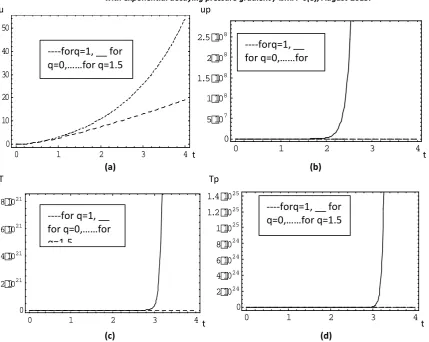
Fig. 1: Effect of q on time variation of (a) u ,(B) up, (c)T , (d) Tp {y=0, h=0.5, s=0.5}
U up
t t
(a) (b)
T Tp
t t
(c) (d)
Fig. 2: Effect of h on time variation of (a) u, (B) up, (c)T, (d) Tp {y=0, q=0. 1, s=1}
0 1 2 3 4
0 10 20 30 40 50
0 1 2 3 4
0 5107 1108 1.5108 2108 2.5108
0 1 2 3 4
0 21021 41021
61021 81021
0 1 2 3 4
0 21024 41024 61024 81024 11025 1.21025 1.41025
0 0.2 0.4 0.6 0.8 1
0 1 2 3 4 5
0 1 2 3 4
0 21012 41012 61012 81012
0 1 2 3 4
0 2.51026 51026 7.51026 11027 1.251027 1.51027
0 1 2 3 4
0 21028 41028 61028 81028
----forq=1, __ for
q=0,……for q=1.5
----for h=0, __
for h=1,……for
h 3
----for h=0, __
for h=1,……for
----forq=1, __
for q=0,……for
----for q=1, __
for q=0,……for
q=1 5
----for h=0, __ for
h=1,……for h=3
----forq=1, __ for
q=0,……for q=1.5
with exponential decaying pressure gradient / IJMA- 6(8), August-2015.
© 2015, IJMA. All Rights Reserved 157
u up
t t
(a) (b)
T Tp
t t
(c) (d)
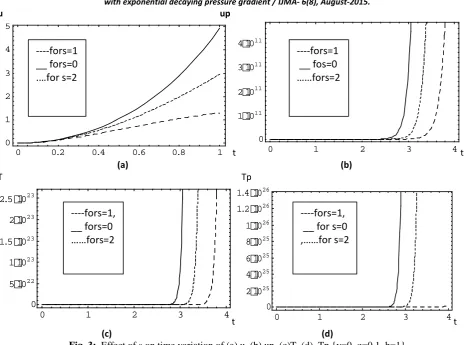
Fig. 3: Effect of s on time variation of (a) u, (b) up, (c)T, (d) Tp {y=0, q=0.1, h=1}
u up
u y. y
(a) (b) T Tp
y y
(a) (d)
Fig. 4: Time variation of the profile of (a) u, (b) up, (c) T, (d) Tp {h=1, s=1, y=0}
0 0.2 0.4 0.6 0.8 1 0
1 2 3 4 5
0 1 2 3 4
0 11011 21011 31011 41011
0 1 2 3 4
0 51022 11023 1.51023 21023 2.51023
0 1 2 3 4
0 21025 41025 61025 81025 11026 1.21026 1.41026
-1 -0.5 0 0.5 1
0 1 2 3 4 5 6
-1 -0.5 0 0.5 1
0 0.5 1 1.5
-1 -0.5 0 0.5 1
-15 -10 -5 0 5 10
-1 -0.5 0 0.5 1
-1500 -1250 -1000 -750 -500 -250 0
----fors=1
__ fors=0
.…for s=2
__t=0.2,
-- ---t=1
……t=2
----fors=1,
__ fors=0
……fors=2
__t=.2
----t=1
…..t=2
----fors=1
__ fos=0
……fors=2
t=0___
t=0.2----t=0.4…
.t=0.6_.
----fors=1,
__ for s=0
,……for s=2
__t=.2
----t=1
RESULT AND DISCUSSION
Figure 1 presents, respectively, the profiles of the velocity components and temperature of the fluid u and T and particles up and Tp for various values of couple stress parameter. The figures are plotted for Ha = 0.5 and S=0.5. As
shown in figures 1a and 1b the profile of u and up are asymmetric about the plane y=o because of the suction. It is clue from figures increasing couple stress parameter decrease. u and up for all values of t, In figures 1c and 1d the shows that increasing couple stress parameter decreases T and Tp for all values of t.
Figure 2 shows the time evolution of the velocity components and temperature at the centre of the channel y = o, respectively, for the fluid and particle phases for various values of the Hartmann number Ha and s = o, q = o.1. In figures 2a and 2b indicate that increasing Ha decreases u and up for all t as a result of increasing the clamping force on u and up increase T and Tp due to increasing the Joule dissipation. But for large t increasing Ha decreases + as a result
of decreasing the velocity u and up and consequently decreases the viscous and Joule dissipations.
Figure 3 presents the time evolution of the velocity components and temperature at the centre of the channel y = o, respectively for the fluid and particle phases for various values of the suction parameter S and Ha= o. q=o.1. It is shows
that Figures 3 a and b that increasing the suction parameter decreases both u and up due to the conversion of the fluid from regions in the lower half to the centre which has higher fluid speed. Figures 3c and d shows that increasing S decreases the temperature at the centre of the channel. This is due to the influence of convection in pumping the fluid from the cold lower half towards the centre of the channel. It is observed from Figure 2 and 3 that suction has a more pronounced effect on the particles than that of the magnetic field.
Figure 4 presents, respectively the profiles of the velocity component and temperature of the fluid u and T and particles up and Tp for various values of time t. The figures are plotted for Ha=1, S=1, q=o.1. It is observed that the velocity
component and temperature of the fluid reach the steady state faster than that of the particle phase. This a because the fluid velocity is the source for the dust particles velocity. It is shown that the velocity components and temperatures of the fluid and dust particles do not reach the steady state monotonically due to the effect of the pressure gradient.
CONCLUSION
The unsteady flow with head transfer of a dusty couple stress conducting fluid under the influence of an applied uniform magnetic field has been studied in the presence of uniform suction and injection and an exponential decaying pressure gradient. An analytic solution for the equation of the motion has been obtained while the energy equation has solved using transform technique. The effect of the magnetic field, couple stress parameter and the suction and injection velocity on the velocity and temperature distributions for both the fluid and particles phases has been investigated. It is of interest to see that the effect the magnetic field on the temperature of the fluid and particles depends on time. Also, It is observed that the suction velocity has more apparent effect than the magnetic field and couple stress parameter on the steady state time of the velocity and temperature of the dust particles.
REFERENCE
1. Lohrabi, J., Ph.D. thesis Tennessee Technological University P.I. (1980).
2. Chamkha, A.J., International J. of Heat and fluid and fluid flow, Vol, 21, PP. 740-746 2000. 3. Saffman P.G., Journal of fluid Mechanics, Vol. 13, PP. 120 (1962).
4. Gupta, R.K. and Gupta, Sc., J. of applied Mathematics and Physics., Vol. 27, PP. 119 (1978). 5. Prasad, VR and Ramacharyulu, N.C.P., Def. Sci. Journal. Vol. 30, PP 125 6] (1979).
6. Stokes, V.K., the physics of fluid 3(9) PP 1709-1775. (1966).
7. Singh and Pathak, Ind. J. of pure and Appl. Math 8(6) PP. 695-701. 1977 8. Rathod V.P. and Parveen S.R, Math Edn 3. PP 121-133, (1997).
9. Gudiraju, M., Peddieson, J. and Munukutle. S. Mechanic Research Communication 19, PP 7-13. (1992). 10. Dube. S.N. and Sharma, C.L., Phy. Soc. Japan 38. PP. 298-310 (1975).
11. Ritter J.M. and peddieson, J. Proceeding of the 6th Canadian Congress of Applied Mechanics (1977). 12. Rathod, V.P., Patel G.S. and Haq K.A., Sci. and Tech. Res GUG (1990).
13. Rathod, V.P., and Syeda Rasheeda Parveen, Int. J. Mathematical Science and Engineering Application Vol. 8 No.11, 149-160, (2014).
14. Rathod V.P. and Syeda Rasheeda Parveen, IJMA Vol. 6. No. 3, PP 11-18. (2015). 15. Singh,k. k., Indain J. of pure and applied mathematics, Vol .8 P.1124(1981). 16. Aboul-Hassan, A.L. Sharef El-Dn.H, FICEMP, Cairo, p723 (1991).
17. G.W. Sutton and A. Sherman, Engineering Magnetohydrodyanamics, Mc Graw-Hill, New York, (1965). 18. Schlichting, H., McGraw-Hill (1968).