Volume 2013, Article ID ama0108, 7 pages ISSN 2307-7743
http://scienceasia.asia
CHARACTERIZATIONS OF SOME ALTERNATING AND
SYMMETRIC GROUPS
LINGLI WANG
Abstract. We suppose thatp= 2α5β+1, whereα≥1, β≥0, andp≥11 is a prime number. Then we prove that the simple groupAn, wheren=p, p+1, or p+ 2 and the finite groupSn, wheren=p, p+ 1, are also uniquely determined by their order components. As corollaries, the validity of a conjecture of J. G. Thompson, a conjecture of AAM (ref. [1]) and a conjecture of Shi(ref. [36]) both onAn, wheren=p, p+ 1, orp+ 2 are obtained. Also we generalized these conjectures for the groupsSn, wheren=p, p+ 1.
1.
Introduction
Let
G
be a finite group. We denote by
π
(
G
) the set of all prime divisors
of
|G|
. We construct the prime graph of
G
as follows. The prime graph Γ(
G
) of
a group
G
is the graph whose vertex set is
π
(
G
), and two distinct primes
p
and
q
, considered as vertices of Γ(
G
), are adjacent by an edge(we write
p
∼
q
) if and
only if
G
contains an element of order
pq
. Let
t
(
G
) be the number of connected
components of Γ(
G
) and let
π
1(
G
)
, π
2(
G
)
, . . . , πt
(
G
) be the connected components
of Γ(
G
). Sometimes we use the notation
πi
instead of
πi
(
G
). If 2
∈
π
(
G
) then we
always suppose that 2
∈
π
1(ref. [38]).
Now
|G|
can be expressed as a product of coprime positive integers
mi, i
=
1
,
2
, . . . , t
(
G
), where
π
(
mi
) =
πi
. These integers are called order components of
G
. The set of order components of
G
will be denoted by
OC
(
G
). Also we call
m
2, . . . , m
t(G)the odd-order components of
G
.
A finite group
G
is called a 2-Frobenius group if
G
has a normal series 1
E
H
E
K
E
G
, where
K
and
G/H
are Frobenius groups with kernels
H
and
K/H
,
respectively. A group
G
is called a
C
ppgroup if the centralizers of its elements
of order
p
in
G
are
p
-groups. The non-commuting graph
∇
(
G
) associated with a
finite group
G
defined by Paul Erd¨
o
s in 1975 is as follows: the vertex set of
∇
(
G
)
is
G\Z
(
G
) with two vertices
x
and
y
joined by an edge whenever the commutator
of
x
and
y
is not the identity(ref. [29]).
Professor Chen first introduced the definition of order components in studying
Thompson’s Conjecture. It is an interesting topic to characterize finite (simple)
groups by their order components. Up to now, there are many results about it. We
summarize them in the following theorem([3]-[5], [7]-[12], [14]-[26], [30]).
2010Mathematics Subject Classification. 20D05, 20D06, 20D08.
Key words and phrases. finite group, order components, non-commuting graph.
Project supported by NNSF of China (Grant No. 11201133,11171364,11111120022) and Youth Sci-ence Foundation of Shanxi Province(Grant No. 2012021001-1).
1
c
Theorem 1.1.
Let
G
be a finite group,
p
and
r
are primes,
q
=
p
m, and
M
be one
of the following groups:
(1)
finite simple groups with
t
(
G
)
>
2
;
(2)
Sporadic simple groups, Suzuki-Ree groups,
3D
4
(
q
)
,
2D
4(
q
)
, E
6(
q
)
,
2E
6(
q
)
, E
8(
q
)
;
(3)
G
2(
q
)
,
q
≡
0(3)
;
(4)
P SL
2(
q
)
, P SL
3(
q
)
, P SL
5(
q
)
, where
q >
5
;
(5)
F
4(
q
)
, where
q
is even;
(6)
C
2(
q
)
,
q >
5
;
(7)
P SUr
(
q
)
,
r
≥
3
,
q >
5
;
(8)
2Dr
+1
(2)
, where
5
≤
r
6
= 2
m−
1
;
Cr
(2)
;
2Dn
(3)
where
9
≤
n
= 2
m+ 1
6
=
r
)
;
Dr
+1(3)
;
Dr
(3)
,
Dr
(5)
,
r >
5
;
(9)
Alternating groups
Ar, where
r
and
r
−
2
are primes;
An
where
n
=
r, r
+ 1
, r
+ 2
and
r
= 2
a3
b+ 1
.
Then
G
∼
=
M
if and only if
OC
(
G
) =
OC
(
M
)
.
In this short paper, we prove the following theorems.
Theorem A
Let
p
= 2
α5
β+ 1, where
α
≥
1
, β
≥
0, and
p
≥
11 is a prime
number. Let
M
be
An
, where
n
=
p, p
+ 1, or
p
+ 2. Then
OC
(
G
) =
OC
(
M
) if and
only if
G
∼
=
M
.
Theorem B
Let
p
= 2
α5
β+ 1, where
α
≥
1
, β
≥
0, and
p
≥
11 is a prime
number. Let
M
be
S
n, where
n
=
p, p
+ 1. Then
OC
(
G
) =
OC
(
M
) if and only if
G
∼
=
M
.
In this paper, all groups are finite and by simple groups we mean non-abelian
simple groups. All further unexplained notations are standard and we refer the
reader to [38].
2.
Preliminaries
Remark 2.1. Let
N
be a normal subgroup of
G
and
p
∼
q
in Γ(
G/N
). Then
p
∼
q
in Γ(
G
). In fact if
xN
∈
G/N
has order
pq
then there is a power of
x
of
order
pq
.
Lemma 2.1.
(
[38]
)
If
G
is a finite group with prime graph having at least two
components then
G
is one of the following groups:
(a) a Frobenius or
2
-Frobenius group;
(b) a simple group;
(c) an extension of a
π
1-group by a simple group;
(d) an extension of a simple group by a
π
1-group;
(e) an extension of a
π
1-group by a simple group by a
π
1-group.
Lemma 2.2.
(
[38]
) If
G
is a finite group with more than one prime graph
compo-nent and has a normal series
1
E
H
E
K
E
G, such that
H
and
G/K
are
π
1-groups
and
K/H
is a simple group, then
H
is a nilpotent group.
The next lemma follows from [6].
Lemma 2.3.
Let
G
be a Frobenius group of even order and let
H, K
be Frobenius
complement and Frobenius kernel of
G, respectively. Then
t
(Γ(
G
)) = 2
,
and the
prime graph components of
G
are
π
(
H
)
,
π
(
K
)
and
G
has one of the following
structures:
(b)
2
∈
π
(
H
)
,
K
is an abelian group,
H
is a solvable group, the Sylow subgroups
of odd order of
H
are cyclic groups, and the 2-Sylow subgroups of
H
are cyclic or
generalized quaternion groups;
(c)
2
∈
π
(
H
)
,
K
is an abelian group, and there exists
H
0≤
H
such that
|H
:
H
0| ≤
2
,
H
0=
Z
×
SL
(2
,
5)
,
(
|Z|,
2
.
3
.
5) = 1
, and the Sylow subgroups of
Z
are
cyclic.
The next lemma follows from [6] and Lemma 2.3.
Lemma 2.4.
Let
G
be a 2-Frobenius group of even order. Then
t
(Γ(
G
)) = 2
and
G
has a normal series
1
E
H
E
K
E
G
such that
(a)
π
1=
π
(
G/K
)
∪
π
(
H
)
and
π
(
K/H
) =
π
2;
(b)
G/K
and
K/H
are cyclic,
|G/K|
divides
|
Aut (
K/H
)
|,
(
|G/K|,
|K/H|
) = 1
,
and
|G/K|
<
|K/H|;
(c)
H
is nilpotent and
G
is a solvable group.
The next two lemmas follow from [7].
Lemma 2.5.
Suppose that
G
and
M
are two finite groups satisfying
t
(Γ(
G
))
≥
2
,
N
(
G
) =
N
(
M
)
, where
N
(
G
) =
{n|G has a conjugacy class of size n}, and
Z
(
G
) = 1
. Then
|G|
=
|M
|.
Lemma 2.6.
Let
G
1and
G
2be finite groups satisfying
|G
1|
=
|G
2|
and
N
(
G
1) =
N
(
G
2)
. Then
t
(
G
1) =
t
(
G
2)
and
OC
(
G
1) =
OC
(
G
2)
.
Lemma 2.7.
(
[23]
)
Let
G
be a finite group and let
M
be a non-abelian finite
group with
t
(
M
) = 2
satisfying
OC
(
G
) =
OC
(
M
)
. Let
|M
|
=
m
1m
2,
OC
(
M
) =
{m
1, m
2}, and
π
(
mi
) =
πi
for
i
= 1
,
2
. Then
|G|
=
m
1m
2and one of the following
holds:
(a)
G
is a Frobenius or 2-Frobenius group;
(b)
G
has a normal series
1
E
H
E
K
E
G
such that
G/K
is a
π
1-group,
H
is a nilpotent
π
1-group, and
K/H
is a non-abelian simple group. Moreover,
OC
(
K/H
) =
{m
01
, m
02,
· · ·
, m
0s, m
2},
|K/H|
=
m
01m
02· · ·
m
0sm
2, and
m
01, m
02,
· · ·
, m
0s, m
2m
1,
where
π
(
m
0j) =
π
j0,
1
≤
j
≤
s
and
|G/K|
|Out
(
K/H
)
|.
Lemma 2.8.
(
[28]
) Let
S
=
An
(
n
≥
4)
or
Sn
(
n
≥
3)
, if
H
is a group such that
∇
(
H
)
∼
=
∇
(
S
)
then
|
H
|
=
|
S
|.
Lemma 2.9.
(
[37]
) Let
G
and
H
be finite groups. If
∇
(
H
)
∼
=
∇
(
G
)
, then
|
CH
(
x
)
\Z
(
H
)
|
=
|
CG
(
φ
(
x
))
\Z
(
G
)
|
for all
x
∈
H
\
Z
(
H
)
, where
φ
is an isomorphism from
∇
(
H
)
to
∇
(
G
)
.
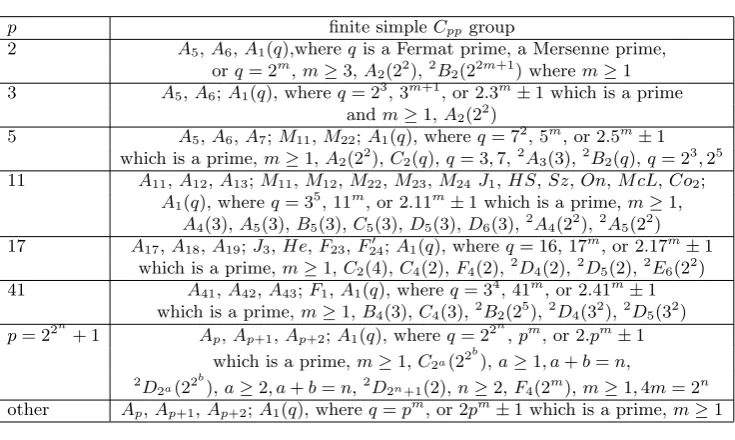
Table 1 finite simple
C
ppgroup
p
finite simple
C
ppgroup
2
A
5, A
6, A
1(
q
),where
q
is a Fermat prime, a Mersenne prime,
or
q
= 2
m,
m
≥
3,
A
2
(2
2),
2B
2(2
2m+1) where
m
≥
1
3
A
5,
A
6;
A
1(
q
), where
q
= 2
3, 3
m+1, or 2
.
3
m±
1 which is a prime
and
m
≥
1,
A
2(2
2)
5
A
5,
A
6,
A
7;
M
11,
M
22;
A
1(
q
), where
q
= 7
2, 5
m, or 2
.
5
m±
1
which is a prime,
m
≥
1,
A
2(2
2),
C
2(
q
),
q
= 3
,
7
,
2A
3(3),
2B
2(
q
),
q
= 2
3,
2
511
A
11,
A
12,
A
13;
M
11,
M
12,
M
22,
M
23,
M
24J
1,
HS
,
Sz
,
On
,
M cL
,
Co
2;
A
1(
q
), where
q
= 3
5, 11
m, or 2
.
11
m±
1 which is a prime,
m
≥
1,
A
4(3),
A
5(3),
B
5(3),
C
5(3),
D
5(3),
D
6(3),
2A
4(2
2),
2A
5(2
2)
17
A
17,
A
18,
A
19;
J
3,
He
,
F
23,
F
240;
A
1(
q
), where
q
= 16, 17
m, or 2
.
17
m±
1
which is a prime,
m
≥
1,
C
2(4),
C
4(2),
F
4(2),
2D
4(2),
2D
5(2),
2E
6(2
2)
41
A
41,
A
42,
A
43;
F
1,
A
1(
q
), where
q
= 3
4, 41
m, or 2
.
41
m±
1
which is a prime,
m
≥
1,
B
4(3),
C
4(3),
2B
2(2
5),
2D
4(3
2),
2D
5(3
2)
p
= 2
2n+ 1
A
p,
A
p+1,
A
p+2;
A
1(
q
), where
q
= 2
2 n,
p
m, or 2
.p
m±
1
which is a prime,
m
≥
1,
C
2a(2
2b
),
a
≥
1
, a
+
b
=
n
,
2D
2a(2
2 b),
a
≥
2
, a
+
b
=
n
,
2D
2n+1(2),
n
≥
2,
F
4(2
m),
m
≥
1
,
4
m
= 2
nother
A
p,
A
p+1,
A
p+2;
A
1(
q
), where
q
=
p
m, or 2
p
m±
1 which is a prime,
m
≥
1
3.
Characterization of some alternating and symmetric groups
In the sequel, we suppose that
p
= 2
α5
β+ 1, where
α
≥
1
, β
≥
0, and
p
≥
11 is a prime
number.
Lemma 3.1.
Let
G
be a finite group and let
M
be
A
n, wheren
=
p, p
+ 1
, or
p
+ 2
, or
S
n, wheren
=
p, p
+ 1
. If
OC
(
G
) =
OC
(
M
)
, then
G
is neither a Frobenius group nor a
2
-Frobenius group.
Proof
If
G
is a Frobenius group, then by Lemma 2.3,
OC
(
G
) =
{|H
|,
|K|}
, where
K
and
H
are Frobenius kernel and Frobenius complement of G, respectively. Since
|H|
(
|K| −
1),
we have
|H|
<
|K|
. Therefore 2
-
|H
|
, and hence 2
|K|
. So,
|H|
=
p
,
|K|
=
|G|/p
. We
claim that there exists a prime
p
0such that 3
n/
4
< p
0< p
. Note that
p
≤
n
, and hence
p
2-
|A
n|
. Let
β
(
n
) be the number of prime numbers less than or equal to
n
. In fact, by
[22, Theorem 2] we have
n
logn
−
12
< β
(
n
)
<
n
logn
−
32
(3
.
1)
where
n
≥
67. Thus
β
(
n
)
−
β
(
3
n
4
)
>
n
logn
−
12
−
3n 4
log
(
3n4)
−
3 2(3
.
2)
When
n
≥
405, we get
β
(
n
)
−
β
(3
n/
4)
>
1, and for
n <
405, we can immediately obtain
the result by checking the table of prime numbers. Now let
P
0be the
p
0- Sylow subgroup
of
K
. Since
K
is nilpotent,
P
0E
G
. Thus
P
0H
is a Frobenius group, and
p
p
0−
1. Which
is a contradiction since
p
0< p
. Therefore, G is not a Frobenius group.
Now let
G
be a 2-Frobenius group. By Lemma 2.4, there is a normal series 1
E
H
E
K
E
G
such that
|K/H|
=
p
and
|G/K|
< p
. Let
p
0be as above, then
p
0∈
π
(
H
) since
|G|
=
|G/K||K/H||H|
. Let
P
0be the
p
0- Sylow subgroup of
H
and
P
the
p
- Sylow subgroup of
G
. Then [
P
0]
P
is a Frobenius subgroups of order
p
0p
. Thus
p|p
0−
1, which is impossible.
Hence,
G
is not a 2-Frobenius group.
Theorem A
Let
p
= 2
α5
β+ 1, where
α
≥
1
, β
≥
0, and
p
≥
11 is a prime number. let
Proof
By Lemma 2.7 and Lemma 3.1,
G
has a normal series 1
E
H
E
K
E
G
such that
H
and
G/K
are
π
1-groups and
K/H
is a simple group. Moreover, the odd-order component
of
M
is equal to an odd-order component of
K/H
. Therefore,
K/H
is a finite simple
C
ppgroup. Now using Table 1, we consider each possibility of
K/H
separately.
Case
I
p
= 11.
(1.1) Let
K/H
∼
=
M
11, M
12, M
22, HS, M cl, M
23, M
24, J
1, Suz, O
0N
, or
CO
2.
If
K/H
∼
=
M
11or
M
12, then
|G|/|K/H|
=
|H||G/K| 6
= 1. Since
|G/K
|
|Out
(
K/H
)
| ≤
2
by Lemma 2.7, 7
∈
π
(
H
). Let
P
be the 7-Sylow subgroup of
H
. Since
H
is nilpotent,
P
E
G
. Hence, 11
(
|P| −
1), which is a contradiction.
If
K/H
∼
=
M
22, then 5
∈
π
(
H
) since 5
k |M
22|
, 5
2k |G|
and
|Out
(
M
22)
|
= 2. Let
P
be
the 5-Sylow subgroup of
H
. But since
H
is nilpotent,
P
E
G
. Hence, 11
(
|P| −
1), which
is a contradiction.
If
K/H
∼
=
HS
or
M cl
. It is a contradiction since 5
3|K/H|
, but 5
2k |G|
.
If
K/H
∼
=
M
23, M
24, J
1, O
0N,
or
CO
2. It is a contradiction since there exists a prime
in
π
(
K/H
) which is not in
π
(
G
).
If
K/H
∼
=
Suz
. It is a contradiction since 2
13|Suz|
, but
|G|
2≤
2
9.
(1.2)
If
K/H
∼
=
L
2(11
m) or
L
2(2
·
11
m±
1), where 2
·
11
m±
1 is a prime and
m
≥
1.
Note 11
2-
|G|
, hence
m
= 1. So
K/H
∼
=
L
2(11) or
L
2(23). If
K/H
∼
=
L
2(11), we can
proceed similar to (1.1). If
K/H
∼
=
L
2(23), It is obvious contradictory since 23
∈
π
(
K/H
)
but 23
∈
/
π
(
G
).
(1.3)
If
K/H
∼
=
L
2(3
5)
, L
5(3)
, L
6(3)
, B
5(3)
, C
5(3)
, D
5(3)
, D
6(3)
,
2A
4(2
2)
,
or
2A
5(2
2).
It is a contradiction since
|K/H
|
-
|G|
by [2].
(1.4)
If
K/H
ia an alternating group, namely
A
11,
A
12, or
A
13. First suppose that
n
= 11. Since
|K/H| ≤ |A
11|
,
K/H
∼
=
A
11. But
|G|
=
|A
11|
, and hence
H
= 1 and
K
=
G
∼
=
A
11. If
n
= 12, then
K/H
∼
=
A
11or
A
12. But if
r
6
= 6, then Aut (
A
r) =
S
r, and
hence
|Out
(
A
r)
|
= 2. If
K/H
∼
=
A
11, then
|G/K|
2, and hence 3
∈
π
(
H
). Let
P
be the
3- Sylow subgroup of
H
. Then
|P
|
= 3. Since
H
is nilpotent,
P
E
G
. Hence, 11
(
|P
| −
1),
which is a contradiction. Therefore,
K/H
∼
=
A
12, and hence
G
∼
=
A
12. If
n
= 13, we do
similarly.
Case
II
p
= 41.
(2.1) If
K/H
∼
=
F
1,
2D
4(3
2)
,
or
2D
5(3
2)
.
It is a contradiction since
|K/H|
-
|G|
by
calculating their orders.
(2.2) If
K/H
∼
=
B
4(3)
2B
2(2
5) or
A
1(3
4). Then 37
∈
π
(
H
) since 37
∈
/
π
(
H/K
) and
|Out
(
K/H
)
| ≤
10. Let
P
be the 37- Sylow subgroup of
H
. Since
H
is nilpotent,
P
E
G
.
Hence, 41
(
|P| −
1), which is a contradiction.
(2.3) If
K/H
∼
=
L
2(41
m) or
L
2(2
·
41
m±
1), where 2
·
41
m±
1 is a prime and
m
≥
1.
Note 41
2-
|G|
, hence
m
= 1. So
K/H
∼
=
L
2(41) or
L
2(83). If
K/H
∼
=
L
2(41), we can
proceed similar to (2.2). If
K/H
∼
=
L
2(83), It is obvious contradictory since 83
∈
π
(
K/H
)
but 83
∈
/
π
(
G
).
(2.4) If
K/H
ia an alternating group, namely
A
41,
A
42, or
A
43. Then we have
G
∼
=
A
nby the same method to (1.4).
Case III
p
= 17 or other cases.
In fact the proof of this step is the same to that in [23] and we omit it.
Theorem B
Let
p
= 2
α5
β+ 1, where
α
≥
1
, β
≥
0, and
p
≥
11 is a prime number. let
M
be
S
n, where
n
=
p, p
+ 1. Then
OC
(
G
) =
OC
(
M
) if and only if
G
∼
=
M
.
Proof
Using Lemma 2.7 and Lemma 3.1, we have
G
has a normal series 1
E
H
E
K
E
G
such that
G/K
is a
π
1-group,
H
is a nilpotent
π
1-group, and
K/H
is a
C
ppsimple group.
Similar to the proof of Theorem A, we have
K/H
∼
=
A
n. Thus
A
n≤
G/H
≤
Aut (
A
n) =
S
n. Therefore,
G/H
∼
=
A
nor Aut (
A
n) =
S
n. If
G/H
∼
=
A
n, then
|H
|
= 2 and
H
E
G
.
Hence,
H
⊆
Z
(
G
) = 1, which is a contradiction.
Therefore,
G/H
∼
=
S
n, and since
4.
some related results
In 1987, Professor J. G. Thompson gave the following conjecture.
Thompson’s Conjecture
If
G
is a finite group with
Z
(
G
) = 1 and
M
is a non-abelian
simple group satisfying
N
(
G
) =
N
(
M
), then
G
∼
=
M
, where
N
(
G
) :=
{n
∈
N
|
G
has a
conjugacy class of size
n}
.
We can generalize this conjecture for the groups under discussion by our
characteriza-tion of these groups.
Corollary 4.1.
Let
G
be a finite group with
Z
(
G
) = 1
and
M
be
A
p,A
p+1,A
p+2,S
por
S
p+1. IfN
(
G
) =
N
(
M
)
, then
G
∼
=
M
.
Proof
By Lemma 2.5 and 2.6, if
G
and
M
are two finite groups satisfying the condition
of Corollary 4.1, then
OC
(
G
) =
OC
(
M
). So Theorem A and B imply this Corollary.
In 2006, A. Abdollahi, S. Akbari, and H.R. Maimani put forward a conjecture in [1] as
follows.
AAM’s Conjecture
Let
M
be a finite non-abelian simple group and
G
a group such
that
∇
(
G
)
∼
=
∇
(
M
). Then
G
∼
=
M
.
Corollary 4.2.
Let
G
be a finite group and
M
be
A
p,A
p+1,A
p+2,S
por
S
p+1. Then∇
(
G
) =
∇
(
M
)
if and only if
G
∼
=
M
.
Proof
By lemma 2.8 and lemma 2.9, we have
|G|
=
|M
|
and
N
(
G
) =
N
(
M
). Hence
OC
(
G
) =
OC
(
M
) by Lemma 2.6. Thus
G
∼
=
M
by Theorem A and B.
In 1987, Professor Shi put forward the following conjecture(ref.[36]).
Shi’s Conjecture
Let
G
be a finite group and
M
a finite nonabelian simple group.
Then
G
∼
=
M
if and only if (1)
π
e(
G
) =
π
e(
M
), (2)
|G|
=
|M
|
.
This conjecture is valid for all finite simple groups except symplectic group and
or-thogonal group of odd dimension with order larger than 10
8(ref. [13], [31]-[36]). As a
consequence of Theorems A and B, we prove a generalization of this conjecture for the
groups under discussion.
Corollary 4.3.
Let
G
be a finite group and let
M
be
A
p,A
p+1,A
p+2,S
por
S
p+1. If|G|
=
|M
|
and
π
e(
G
) =
π
e(
M
)
, then
G
∼
=
M
.
Proof
By assumption, we must have
OC
(
G
) =
OC
(
M
). Thus the corollary follows by
Theorems A and B.
References
[1] Abdollahi A., Akbari S. and Maimani H. R.,Non-commuting graph of a group, Journal of Algebra,298(2006), 468-492.
[2] Conway J. H., Curtis R. T., Norton S. P., et al., Atlas of finite groups, Clarendon Press, Oxford (1985).
[3] Chen G. Y.,On Thompson0s conjecture–for sporadic groups(in Chinese), Proc. China Assoc. Sci. and Tech. First Academic Meeting of Youths, Chinese Sci. and Tech. Press, Beijing, (1992),1-6.
[4] Chen G. Y.,On Thompson’s conjecture, Ph. D. Thesis of Sichuan Univ., Chengdu, July 1994. [5] Chen G. Y.,A new characterization ofE8(q), Journal of Southwest China Normal University,
21(3), (1995), 215-217.
[6] Chen G. Y.,On structure of Frobenius groups and 2-Frobenius groups, J. Southwest China Normal Univ.,20(5), (1995), 485-487.
[7] Chen G. Y.,On Thompson0s conjecture, Journal of Algebra,185, (1996), 184-193.
[8] Chen G. Y.,A new characterization of sporadic simple groups, Algebra Colloquium,3(1), (1996), 49-58.
[9] Chen G. Y., A new characterization of Suzuki-Ree groups, Sci. in China, 27(5), (1997), 430-433.
[10] Chen G. Y., A new characterization ofP SL2(q), Southeast Asian Bulletin Mathematics,
[11] Chen G. Y.,Further reflections on Thompson0s conjecture, Journal of Algebra,218, (1999), 276-285.
[12] Chen G. Y.,Characterization of Lie type groupG2(q)by its order components, J. Southwest China Normal Univ.,26(5), (2001), 503-509.
[13] Cao H. P. and Shi W. J.,Pure quantitative characterization of finite projective special unitary groups,Sci. in China(A),45(6)(2002),761-772.
[14] Iranmanesh A. and Alavi S. H.,A new characterization ofApwherepandp−2are primes, Korean J. Comput. and Appl. Mathematics,8(3), (2001), 665-673.
[15] Iranmanesh A. and Alavi S. H.,A characterization of simple groupsP SL(5, q), Bull. Austral Math. Soc.,65, (2002), 211-222.
[16] Iranmanesh A., Alavi S. H. and Khosravi B.,A characterization ofP SL(3, q)whereqis an odd prime power, Journal of Pure and Applied Algebra,170(2-3), (2002), 243-254. [17] Iranmanesh A., Alavi S. H. and Khosravi B.,A characterization ofP SL(3, q)forq= 2m,
Acta Math. Sin.(Engl. Ser.),18(3), (2002), 463-472.
[18] Iranmanesh A. and Khosravi B.,A characterization ofF4(q)whereqis even, Far East J. Math. Sci.,2(6), (2000), 853-859.
[19] Iranmanesh A. and Khosravi B.,A characterization ofC2(q)whereq >5, Comment Math. Univ. Carolinae.,43(1), (2002), 9-21.
[20] Iranmanesh A. and Khosravi B.,A characterization ofP SU(5, q), Int. Math. J.,3, (2003), 129-141.
[21] Iranmanesh A., Khosravi B. and Alavi S. H., A characterization ofP SU(3, q)for q >5, Southeast Asian Bulletin Math.,26(1), (2002), 33-44.
[22] Khosravi A. and Khosravi B.,A new characterization of almost sporadic simple groups,J. Algebra and its Applications,1(3), (2002), 267-279.
[23] Khosravi A. and Khosravi B.,A new characterization of some alternating and symmetric groups, Int. J. Math. Sci.,45, (2003), 2863-2872.
[24] Khosravi B.,A characterization of2D
4(q), Pure Math. Appl.,12(4), (2001), 415- 424. [25] Khosravi Behrooz and Khosravi Bahman,A characterization ofE6(q), Algebra Groups and
Geometries,19(2), (2002), 225-243.
[26] Khosravi Behrooz and Khosravi Bahman,A characterization of2E
6(q), Kumamoto J. Math.,
16, (2003), 1-11.
[27] Li M. H.,All theCppsimple groups on certain conditions,Master Thesis of Southwest Univ. Chongqing, July, 2008.
[28] Moghaddamfar A. R., Shi W. J., Zhou W. and Zokayi A. R.,On the noncommuting graph associated with a finite group, Siberian Math. J.,46(2), (2005), 325-332.
[29] Neumann B. H.,A problem of Paul Erd¨os on group, J. Aust. Math. Soc.(Ser. A),21, (1976), 467-472.
[30] Shi H. G.,Characterization of finite simple groups by their order components,Master Thesis of Southwest Univ. Chongqing, July, 2005.
[31] Shi W. J., A new characterization of the sporadic simple groups, Group Theory - Porc. Singapore Group Theory Conf. 1987, Walter de Gruyter Berlin-New York, 1989, 531-540. [32] Shi W. J.,A new characterization of some simple groups of Lie type,Contemporary Math.,
82, (1989), 171-180.
[33] Shi W. J.,pure quantitative characterization of finite simple groups (I),Progress in Natural Science,4(3),(1994), 316-326.
[34] Shi W. J. and Bi J. X., A characteristic property for each finite projective special linear group, Lecture Notes in Math.,1456, (1990), 171-180.
[35] Shi W. J. and Bi J. X.,A characterization of Suzuki-Ree groups,Science in China (Ser. A),
34(1), (1991), 14-19.
[36] Shi W. J. and Bi J. X.,A characterization of the alternating groups,Southeast Asian Bulletin of Mathematics,16(1), (1992), 81-90.
[37] Wang L. L. and Shi W. J., A new characterization of A10 by its noncommuting graph, Communications in Algebra,36(02), (2008), 523 - 528.
[38] Williams J. S., Prime graph components of finite groups, Journal of Algebra, 69, (1981), 487-513.