Available online throug
ISSN 2229 – 5046
A STUDY ON (3, (c1, c2)) - REGULAR BIPOLAR FUZZY GRAPH
M. ANDAL*, S. MEENA DEVI
Assistant Professor,
Department of Mathematics,
Sri Kaliswari College (Autonomous), Sivakasi. Tamil Nadu -626123, India.
(Received On: 13-11-17; Revised & Accepted On: 14-12-17)
ABSTRACT
I
n this paper, we defined d3-degree of a vertex in bipolar fuzzy graphs, total d3 -degree of a vertex in bipolar fuzzygraphs, (3, (c1, c2))-regular bipolar fuzzy graphs and totally (3, (c1, c2)) - regular bipolar fuzzy graphs. (3, (c1, c2
))-regular bipolar fuzzy graphs and totally (3, (c1, c2))-regular bipolar fuzzy graphs are compared through various
examples. A necessary and sufficient condition under which they are equivalent is provided. Also, (3, (c1, c2
))-regularity on some bipolar fuzzy graphs whose underlying crisp graphs are a path on six vertices P6, a Corona graph
Cn ͦ K1 (n≥5), a Wagner graph and a cycle Cn (n≥5) is studied with some membership function. Some properties of
(3, (c1, c2))-regular bipolar fuzzy graphs studied and they are examined for totally (3, (c1, c2))-regular bipolar fuzzy
graphs.
Keywords: d3- degree of a vertex in bipolar fuzzy graphs, total d3- degree of a vertex in bipolar fuzzy graphs,
(3, (c1, c2))-regular bipolar fuzzy graphs, totally (3, (c1, c2))-regular bipolar fuzzy graphs.
1. INTRODUCTION
In 1965, Lofti A. Zadeh introduced the concept of fuzzy subset of a set as method of representing the phenomena of uncertainty in real life situation. In 1975, Azriel Rosenfeld introduced the concept of fuzzy graphs. It has been growing fast and has numerous applications in various fields. Nagoor Gani and Radha introduced regular fuzzy graphs, total degree and totally regular fuzzy graphs, In 1994 W.R.Zhang initiated the concept of bipolar fuzzy sets as generalisation of fuzzy sets. S. Meena Devi and M. Andal introduced d3 -degree of a vertex in fuzzy graphs and discussed some
properties of d3-degree of a vertex in fuzzy graphs. Bipolar fuzzy sets are extension of fuzzy sets with membership
values in [−1, 1]. Throughout this paper, the vertices take the membership values (𝑚1+, 𝑚1−) and edges take the membership values (𝑚2+, 𝑚2−) where 𝑚1+,𝑚2+∈ [0, 1] and 𝑚1−,𝑚2− ∈ [−1, 0].
2. PRELIMINARIES
Definition 2.1: For a given graph G, the d3-degree of a vertex v in G, denoted by d3(v) means numberof vertices at a
distance three away from v.
Definition 2.2: A graph G is said to be (3, k)-regular (d3–regular) if d3(v) = k, for all v in G. We observe that (3,
k)-regular and d3-regular graphs are same.
Definition 2.3: A fuzzy graph G is a pair of functions G: (σ, µ) where σ: V → [0, 1] is a fuzzy subset of a non empty set V and µ:V x V → [0,1] is symmetric fuzzy relation on σ such that for all u, v in V the relation µ(uv) ≤ σ(u) Λ σ(v) is satisfied.
A fuzzy graph G is complete if µ(uv) = σ(u) Λ σ(u) for all u, v ϵ V where uv denotes the edge between u and v.
Definition 2.4: LetG: (σ, µ) be fuzzy graph. The degree of a vertex u is dG(u) = ∑u≠vμ(uv)for uv ∈E and µ(uv) = 0
for uv not in E, this equivalent to dG (u) = ∑uv∈Eμ(uv)
Corresponding Author: M. Andal*,
Assistant Professor, Department of Mathematics,
© 2018, IJMA. All Rights Reserved 136
The minimum degree of G is δ (G) = Λ {d (v): v∈V}.
The maximum degree of G is ∆(G) = ˅ {d (v): v∈V}.
The order of a fuzzy graph is O (G) =∑ σ(u).
Definition 2.5: The strength of connectedness between two vertices u and v is µ∞(uv)=sup{µk(uv) / k = 1,2,…..} where (uv) = sup{µ(uu1)Λµ(u1u2)Λ……Λµ(uk-1v)|u1,u2,……uk-1ϵ V}.
Definition 2.6: The Wagner graph is a 3-regular with 8 vertices and 12 edges.
Definition 2.7: The Corona of two graphs G1 and G2 is the graph G = G1 o G2 formed from one copy of G1 and |v(G1)|
copies of G2 where i th
vertex of G1 is adjacent to every vertex in the i th
copy of G2.
[Note that G1 is a cycle of length ≥ 5 and G2 is K1].
Example 2.8:
Figure-1
Definition 2.9: A bipolar fuzzy graph with an underlying set V is defined to be the pair G = (A, B) where A = (𝑚1+, 𝑚1−) is a bipolar fuzzy set on V and B = (𝑚2+, 𝑚2−) is a bipolar fuzzy set on E such that 𝑚2+(x, y) ≤ min {(𝑚1+
(x), 𝑚1+ (y)} and𝑚2− (x, y) ≥ max {𝑚1− (x), 𝑚1− (y)} for all (x, y) ∈ E. Here A is called a bipolar fuzzy vertex set of V and B is called a bipolar fuzzy edge set of E.
Definition 2.10: The positive degree of a vertexu∈Gisd+(u) = 𝑚2+(u, v). The negativedegree of a vertex u ∈ G is d−(u) = 𝑚2− (u, v). The degree of the vertex u is defined as d(u)= (d+(u), d−(u)).
Definition 2.11: LetG= (A, B) be a bipolar fuzzy graph whereA= (𝑚1+, 𝑚1−) andB =(𝑚2+, 𝑚2−) are two bipolar fuzzy sets on a non-empty finite set V . Then G is said to be regular bipolar fuzzy graph if all the vertices have same positive and negative membership values.
Definition 2.12: LetG= (A, B) be a bipolar fuzzy graph whereA= (𝑚1+, 𝑚−1) andB=(𝑚2+, 𝑚2−) be two bipolar fuzzy sets on a non-empty finite set V . G is said to be a totally regular bipolar fuzzy graph if all the vertices of G has same total degree (k1, k2). It is denoted by (k1, k2) - totally regular bipolar fuzzy graph.
3. d3-DEGREE AND TOTAL D3-DEGREE OF A VERTEX IN BIPOLAR FUZZY GRAPHS
Definition 3.1: Let G= (A, B) be a bipolar fuzzy graph. The positive d3- degree of a vertex u ∈ G is defined as
d3+(u) = m2(3,+)(u, v) where m2(3,+)(u, v) = sup {m2+(u, u1) ∧m2+ (u1, u2)∧ m2+(u2, v) : u,u1,u2,v }is the shortest path
connecting u and v of length 3. The negative d3- degree of a vertexu ∈ G is defined as d−3(u) = m2(3,−)(u, v) where
m2(3,−)(u, v) = inf {m2−(u, u1) ˅ m2− (u1, u2) ˅ m2−(u2, v) : u,u1,u2,v }is the shortest path connecting u and v of length 3.
Also μ(uv)=0, for uv not in E.
The minimum d3degree of G is δ3(G) = Λ {d3 (v): v∈V}.
The maximum d3degree of G is Δ3 (G) = V {d3 (v): v∈V}.
Example3.2: Let G = (A, B) be a bipolar fuzzy graph, where A= (𝑚1+, 𝑚1−) andB=(𝑚2+, 𝑚2−) are two bipolar fuzzy sets on a non-empty finite set V and E ⊆ V×V. Where V = {v1, v2, v3, v4, v5}.
Figure-2
Here, d3(v1) = (0.3 ∧ 0.2 ∧ 0.1, -0.4˅-0.3˅ -0.3) + (0.3 ∧ 0.4 ∧ 0.1, -0.3˅-0.5˅-0.3) = (0.1, -0.3) + (0.1, -0.3)
= (0.2, -0.6).
d3(v2) = (0.3 ∧ 0.3 ∧ 0.2, -0.3˅-0.4˅-0.3) + (0.4 ∧ 0.1 ∧ 0.2, -0.5˅-0.3˅-0.3) = (0.2, -0.3) + (0.1, -0.3)
= (0.3, -0.6)
d3(v3) = (0.4 ∧ 0.3 ∧ 0.3, -0.5˅-0.3˅-0.4) + (0.1 ∧ 0.2 ∧ 0.3, -0.3˅-0.3˅-0.4) = (0.3, -0.3) + (0.1, -0.3)
= (0.4, -0.6).
d3(v4) = (0.1 ∧ 0.4 ∧ 0.3, -0.3˅-0.5˅-0.3 + (0.2 ∧ 0.3 ∧ 0.3, -0.3˅-0.4˅-0.3) = (0.1, -0.3) + (0.2, -0.3)
= (0.3, -0.6).
d3(v5) = (0.2 ∧ 0.1 ∧ 0.4, -0.3˅-0.3˅-0.5) + (0.3 ∧ 0.3 ∧ 0.4 , -0.4˅-0.3˅-0.5) = (0.1, -0.3) + (0.3, -0.3)
= (0.4, -0.6).
Example 3.3: Let G = (A, B) be a bipolar fuzzy graph, where A= (𝑚1+, 𝑚1−) andB=(𝑚2+, 𝑚2−) are two bipolar fuzzy sets on a non-empty finite set V and E ⊆ V×V. Where V = {v1, v2, v3, v4, v5, v6}.
Figure-3
Here, d3(v1) = (0.3 ∧ 0.2 ∧ 0.2, -0.2˅-0.1˅-0.1) + (0.3 ∧ 0.4 ∧ 0.4, -0.3˅-0.4˅-0.2) = (0.2, -0.1) + (0.3, -0.2)
= (0.5, -0.3).
d3(v2) = (0.3 ∧ 0.3 ∧ 0.2, -0.3˅-0.2˅-0.1} + (0.4 ∧ 0.4 ∧ 0.2, -0.4˅-0.2˅-0.1) = (0.2, -0.1) + (0.2, -0.1)
= (0.4, -0.2).
d3(v3) = (0.4 ∧ 0.3 ∧ 0.3, -0.4˅-0.3˅-0.2) + (0.4 ∧ 0.2 ∧ 0.2, -0.2˅-0.1˅-0.1) = (0.3, -0.2) + (0.2, -0.1)
= (0.5, -0.3).
d3(v4) = (0.4 ∧ 0.4 ∧ 0.3, -0.2˅-0.4˅-0.3) + (0.2 ∧ 0.2∧ 0.3, -0.1˅-0.1˅-0.2) = (0.3, -0.2) + (0.2, -0.1)
© 2018, IJMA. All Rights Reserved 138
d3(v5) = (0.2 ∧ 0.4 ∧ 0.4, -0.1˅-0.2˅-0.4) + (0.2 ∧ 0.3 ∧ 0.3, -0.1˅-0.2˅-0.3) = (0.2, -0.1) + (0.2, -0.1)
= (0.4, -0.2).
d3(v6) = (0.2 ∧ 0.2 ∧ 0.4, -0.1˅-0.1˅-0.2) + (0.3 ∧ 0.3 ∧ 0.4, -0.2˅-0.3˅-0.4) = (0.2, -0.1) + (0.3, -0.2)
= (0.5, -0.3).
Definition 3.4: The total degree of a vertexu ∈ Vis denoted bytd(u) and defined as td(u)= (td+(u), td−(u)) where td+(u) = m2+ (u, v) + m1+( (u) and td−(u) = m2− (u, v) +m1− (u).
The minimum td3-degree of G is tδ3(G) = ∧{td3(v) : v ∈ V}.
The maximum td3-degree of G is tΔ3(G) = ∨{td3(v) : v ∈ V}.
Example 3.5: Let G = (A, B) be a bipolar fuzzy graph, where A= (𝑚1+, 𝑚1−) andB=(𝑚2+, 𝑚2−) are two bipolar fuzzy sets on a non-empty finite set V and E ⊆ V×V. Where V = {v1, v2, v3, v4, v5, v6}.
Figure-4
Here, d3(v1) = (0.2 ∧ 0.3 ∧ 0.4, -0.3˅-0.4˅-0.2) = (0.2, -0.2) .
d3(v2) = (0.3 ∧ 0.4 ∧ 0.5, -0.4˅-0.2˅-0.2) = (0.3, -0.2) .
d3(v3) = (0.4 ∧ 0.5 ∧ 0.6, -0.2˅-0.2˅-0.2) = (0.4, -0.2) .
d3(v4) = (0.4 ∧ 0.3 ∧ 0.2, -0.2˅-0.4˅-0.3) = (0.2, -0.2) .
d3(v5) = (0.5 ∧ 0.4 ∧ 0.3, -0.2˅-0.2˅-0.4) = (0.3, -0.2) .
d3(v6) = (0.6 ∧ 0.5 ∧ 0.4, -0.2˅-0.2˅-0.2) = (0.4, -0.2) .
td3(v1) = (0.2, -0.2) + (0.3, -0.3) = (0.5, -0.5).
td3(v2) = (0.3, -0.2) + (0.4, -0.5) = (0.7, -0.7).
td3(v3) = (0.4, -0.2) + (0.5, -0.4) = (0.9, -0.6).
td3(v4) = (0.2, -0.2) + (0.6, -0.2) = (0.8, -0.4).
td3(v5) = (0.3, -0.2) + (0.7, -0.3) = (1.0, -0.5).
td3(v6) = (0.4, -0.2) + (0.8, -0.5) = (1.2, -0.7).
4. (3, (c1, c2))-REGULAR AND TOTALLY (3, (c1, c2))-REGULAR BIPOLAR FUZZY GRAPHS
Definition 4.1: LetG= (A, B) be a bipolar fuzzy graph. Ifd3(u) = (c1, c2) for allu∈V,then G is said to be a (3, (c1,c2))
- regular bipolar fuzzy graph.
Example 4.2: LetG= (A,B)be a bipolar fuzzy graph whereA= (𝑚1+, 𝑚1−) and B = (m2+, m2− ) be two bipolar fuzzy
sets on a non-empty finite set V and E ⊆ V×V, where V = {v1, v2 , v3 , v4, v5, v6.
Figure-5
Here d3(v1) = (0.3, -0.4), d3(v2) = (0.3, -0.4), d3(v3) = (0.3, -0.4), d3(v4) = (0.3, -0.4), d3(v5) = (0.3, -0.4), d3(v6) = (0.3,
-0.4). So, G is (3, (0.3, -0.4))- regular bipolar fuzzy graph.
Example 4.3: LetG= (A,B)be a bipolar fuzzy graph whereA= (𝑚1+, 𝑚1−) and B = (𝑚2+, 𝑚2−) be two bipolar fuzzy sets on a non-empty finite set V and E ⊆ V×V, where V = {v1, v2 , v3 , v4, v5}.
Here, d3(v1) = (0.6, -0.4), d3(v2) = (0.6, -0.4), d3(v3) = (0.6, -0.4), d3(v4) = (0.6, -0.4), d3(v5) = (0.6, -0.4). So G is
(3, (0.6, -0.4))- regular bipolar fuzzy graph.
Example 4.4: LetG= (A,B)be a bipolar fuzzy graph whereA= (𝑚1+, 𝑚1−) and B = (𝑚2+, 𝑚2−) be two bipolar fuzzy sets on a non-empty finite set V and E ⊆ V×V, where V = {v1, v2 , v3, v4, v5, v6, v7, v8}.
Figure-7
Here, d3(v1) = (0.2˄0.2˄0.3, -0.1-0.1˅-0.2) + ( 0.2˄0.2˄0.2, -0.1˅-0.1˅-0.1) + (0.2˄0.3˄0.2, -0.1˅-0.2˅-0.1)
+ (0.2 ˄ 0.3 ˄ 0.3, -0.1˅-0.2˅-0.2) + (0.2 ˄ 0.2 ˄ 0.3, -0.1˅-0.1˅-0.2) = (0.2, -0.1) + (0.2, -0.1) + (0.2, -0.1) + (0.2, -0.1) + (0.2, -0.1) = (1.0, -0.5)
d3(v2) = (0.2 ˄ 0.2 ˄ 0.2, -0.1˅-0.1˅-0.1) + (0.2 ˄ 0.2 ˄ 0.3, -0.1˅-0.1˅-0.2) + (0.3˄0.2˄0.3, -0.2˅-0.1˅-0.2}
+ (0.3 ˄ 0.2 ˄ 0.2, -0.2˅-0.1˅-0.1) + (0.3 ˄ 0.2 ˄ 0.3, -0.2˅-0.1˅-0.2) = (1.0, -0.5)
d3(v3) = (0.3 ˄ 0.2 ˄ 0.2, -0.2˅-0.1˅-0.1) + (0.3 ˄ 0.3 ˄ 0.2, -0.2˅-0.2˅-0.1) + (0.2 ˄ 0.3 ˄ 0.2, -0.1˅-0.2˅-0.1)
+ (0.2 ˄ 0.3 ˄ 0.3, -0.1˅-0.2˅-0.2) + (0.2 ˄ 0.2 ˄ 0.3, -0.1˅-0.1˅-0.2) = (1.0, -0.5)
d3(v4) = (0.2 ˄ 0.3 ˄ 0.2, -0.1˅-0.2˅-0.1) + (0.2 ˄ 0.2 ˄ 0.2, -0.1˅-0.1˅-0.1) + (0.3 ˄ 0.2 ˄ 0.2, -0.2˅-0.1˅-0.1)
+ (0.3 ˄ 0.3 ˄ 0.2, -0.2˅-0.2˅-0.1) + (0.3 ˄ 0.2 ˄ 0.2, -0.2˅-0.1˅-0.1) = (1.0, -0.5)
d3(v5) = (0.3 ˄ 0.2 ˄ 0.2, -0.2˅-0.1˅-0.1) + (0.3 ˄ 0.3 ˄ 0.2, -0.2˅-0.2˅-0.1) + (0.2 ˄ 0.3˄ 0.2, -0.1˅-0.2˅-0.1)
+ (0.2 ˄ 0.2 ˄ 0.2, -0.1˅-0.1˅-0.1) + (0.3 ˄ 0.2 ˄ 0.2, -0.2˅-0.1˅-0.1) = (1.0, -0.5)
d3(v6) = (0.2 ˄ 0.3 ˄ 0.2, -0.1˅-0.2˅-0.1) + (0.2 ˄ 0.3 ˄ 0.3, -0.1˅-0.2˅-0.2) + (0.3 ˄ 0.2 ˄0.2, -0.2˅-0.1˅-0.1)
+ (0.3 ˄ 0.3 ˄ 0.2, -0.2˅-0.2˅-0.1) + (0.2 ˄ 0.2 ˄ 0.3, -0.1˅-0.1˅-0.2) = (1.0, -0.5)
d3(v7) = (0.3 ˄ 0.2 ˄ 0.3, -0.2˅-0.1˅-0.2) + (0.3 ˄ 0.2 ˄ 0.2, -0.2˅-0.1˅-0.1) + (0.2 ˄ 0.2 ˄0.2, -0.1˅-0.1˅-0.1)
+ (0.2 ˄ 0.2 ˄ 0.3, -0.1˅-0.1˅-0.2) + (0.3 ˄ 0.2 ˄ 0.3, -0.2˅-0.1˅-0.2) = 0.2 + 0.2 + 0.2 + 0.2 + 0.2 = 1.0
d3(v8) = (0.2 ˄ 0.3 ˄ 0.2, -0.1˅-0.2˅-0.1) + (0.2 ˄ 0.3 ˄ 0.3, -0.1˅-0.2˅-0.2) + (0.2 ˄ 0.2 ˄0.3, -0.2˅-0.2˅-0.2)
+ (0.2 ˄ 0.2 ˄ 0.2, -0.1˅-0.1˅-0.1) + (0.2 ˄ 0.2 ˄ 0.3, -0.1˅-0.1˅-0.2) = (1.0, -0.5)
So G is (3, (1.0, -0.5))- regular bipolar fuzzy graph.
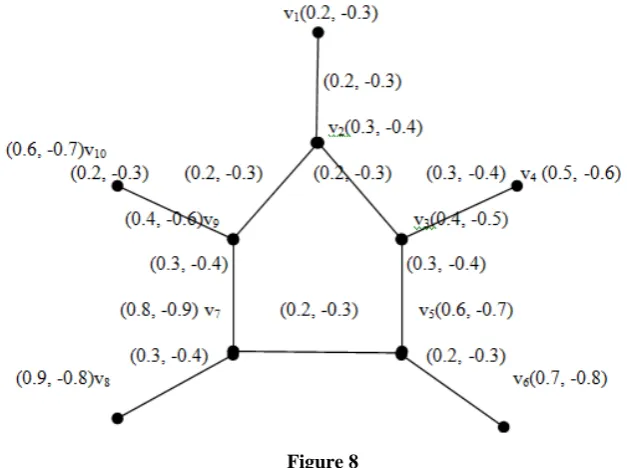
© 2018, IJMA. All Rights Reserved 140 Figure 8
Here, d3(v1) = (0.2∧0.2∧0.3, -0.3˅-0.3˅-0.4) + (0.2∧0.2∧0.3, -0.3˅-0.3˅-0.4) + (0.2∧0.2∧0.3, -0.3˅-0.3˅-0.4)
+ (0.2∧0.2∧0.2, -0.3˅-0.3˅-0.3) = (0.8, -1.2) .
d3(v2) = (0.2∧0.3∧0.2, -0.3˅-0.4˅-0.3 ) + (0.2∧0.3∧0.2, -0.3˅-0.4˅-0.3) + (0.2∧0.3∧ 0.2, -0.3˅-0.4˅-0.3)
+ (0.2 ∧0.3∧0.3, -0.3˅-0.4˅-0.4) = (0.8, -1.2).
d3(v3) = (0.3∧0.2∧0.3, -0.4˅-0.3˅-0.4) + (0.3∧0.2∧0.3, -0.4˅-0.3˅-0.4) + (0.2∧0.2∧0.2, -0.3˅-0.3˅-0.3)
+ (0.2∧0.2 ∧0.3, -0.3˅-0.3˅-0.4) = (0.8, -1.2).
d3(v4) = (0.3 ∧0.2∧0.2, -0.4˅-0.3˅-0.3) + (0.3∧0.2∧0.2, -0.4˅-0.3˅-0.3) + (0.3∧0.3 ∧ 0.2, -0.4˅-0.4˅-0.3)
+ (0.3 ∧ 0.3 ∧ 0.2, -0.4˅-0.4˅-0.3) = (0.8, -1.2).
d3(v5) = (0.3 ∧0.2∧0.2, -0.4˅-0.3˅-0.3) + (0.3∧0.2∧0.2, -0.4˅-0.3˅-0.3) + (0.2∧0.3∧ 0.2, -0.3˅-0.4˅-0.3)
+ (0.2 ∧ 0.3 ∧ 0.2, -0.3˅-0.4˅-0.3) = (0.8, -1.2).
d3(v6) = (0.2∧0.3∧0.2, -0.3˅-0.4˅-0.3) + (0.2∧0.3∧0.3, -0.3˅-0.4˅-0.4) + (0.2∧0.2 ∧ 0.3, -0.3˅-0.3˅-0.4)
+ (0.2 ∧ 0.2 ∧ 0.3, -0.3˅-0.3˅-0.4) = (0.8, -1.2).
d3(v7) = (0.3∧0.2∧0.2, -0.4˅-0.3˅-0.3) + (0.3∧0.2∧0.2, -0.4˅-0.3˅-0.3) + (0.2∧0.3∧ 0.2, -0.3˅-0.4˅-0.3)
+ (0.2 ∧ 0.3 ∧ 0.3, -0.3˅-0.4˅-0.4) = (0.8, -1.2).
d3(v8) = (0.3∧0.3∧0.2, -0.4˅-0.4˅-0.3) + (0.3∧0.2∧0.3, -0.4˅-0.3˅-0.4) + (0.3∧0.2∧ 0.2, -0.4˅-0.3˅-0.3)
+ (0.3∧0.3∧0.2, -0.4˅-0.4˅-0.3) = (0.8, -1.2).
d3(v9) = (0.2∧0.2∧0.3, -0.3˅-0.3˅-0.4) + (0.3∧0.2∧0.3, -0.4˅-0.3˅-0.4) + (0.2∧ 0.2∧0.3, -0.3˅-0.3˅-0.4)
+ (0.3 ∧ 0.2 ∧ 0.2, -0.4˅-0.3˅-0.3) = (0.8, -1.2).
d3(v10) = (0.2∧0.2∧0.2, -0.3˅-0.3˅-0.3) + (0.2∧0.3∧0.2, -0.3˅-0.4˅-0.3) + (0.2∧0.3∧ 0.3, -0.3˅-0.4˅-0.4)
+ (0.2 ∧ 0.2 ∧ 0.2, -0.3˅-0.3˅-0.3) = (0.8, -1.2).
So G is (3, (0.8, -1.2))- regular bipolar fuzzy graph.
Definition 4.6: LetG= (A, B) be a bipolar fuzzy graph. If each vertex ofGhas same totald3 - degree, then G is said to
be totally (3, (c1, c2)) - regular bipolar fuzzy graph.
Figure-9
Here, d3(v1) = (0.4, -0.4), d3(v2) = (0.4, -0.4), d3(v3) = (0.4, -0.4), d3(v4) = (0.4, -0.4), d3(v5) = (0.4, -0.4) and td3(v1) =
(0.9, -0.9), td3(v2) = (0.9,-0.9), td3(v3) = (0.9, -0.9), td3(v4) = (0.9, -0.9),td3(v5) = (0.9, -0.9). Each vertex has same total
d3-degree (0.9, -0.9). Hence G is totally (3, (0.9, -0.9))-regular bipolar fuzzy graph.
Example 4.8: A totally (3, (c1, c2))-regular bipolar fuzzy graph need not be a (3, (c1, c2))-regular bipolar fuzzy graph.
LetG= (A,B)be a bipolar fuzzy graph whereA= (𝑚1+, 𝑚1−) and B = (𝑚2+, 𝑚2−) be two bipolar fuzzy sets on a non-empty finite set V and E ⊆ V×V, where V = {v1, v2, v3, v4, v5}.
Figure-10
Here, d3(v1) = (0.5, -0.2), d3(v2) = (0.4, -0.3), d3(v3) = (0.5, -0.3), d3(v4) = (0.4, -0.3), d3(v5) = (0.4, -0.3) and
td3(v1) = (1.0, -0.6), td3(v2) = (1.0, -0.6), td3(v3) = (1.0, -0.6), td3(v4) = (1.0, -0.6), td3(v5) = (1.0, -0.6). Each vertex has
same total d3-degree (1.0, -0.6). Hence G is totally (3, (1.0, -0.6))-regular bipolar fuzzy graph. But G is not (3, (c1, c2
))-regular bipolar fuzzy graph.
Example 4.9: A (3, (c1, c2))-regular bipolar fuzzy graph need not be a totally (3, (c1, c2))-regular bipolar fuzzy graph.
LetG= (A,B)be a bipolar fuzzy graph whereA= (𝑚1+, 𝑚1−) and B = (𝑚2+, 𝑚2−) be two bipolar fuzzy sets on a non-empty finite set V and E ⊆ V×V, where V = {v1, v2, v3, v4, v5, v6}.
© 2018, IJMA. All Rights Reserved 142
Here, d3(v1) = (0.4, -0.4), d3(v2) = (0.4, -0.4), d3(v3) = (0.4, -0.4), d3(v4) = (0.4, -0.4), d3(v5) = (0.4, -0.4), d3(v6) = (0.4,
-0.4) and td3(v1) = (0.7, -0.8), td3(v2) = (0.8, -0.9), td3(v3) = (0.9, -1.0), td3(v4) = (1.0, -1.1), td3(v5) = (0.8, -0.9),
td3(v6) = (0.9, -0.8). Each vertex has same d3-degree (0.4, -0.4). So, G is (3, (0.4, -0.4))-regular bipolar fuzzy graph.
But G is not a totally (3, (c1, c2))-regular bipolar fuzzy graph.
Example 4.10: A (3, (c1, c2))-regular fuzzy graph which is totally (3, (c1, c2))-regular fuzzy graph.
LetG= (A,B)be a bipolar fuzzy graph whereA= (𝑚1+, 𝑚1−) and B = (𝑚2+, 𝑚2−) be two bipolar fuzzy sets on a non-empty finite set V and E ⊆ V×V, where V = {v1, v2, v3, v4, v5, v6}.
Figure-12
Here, d3(v1) = (0.8, -0.8), d3(v2) = (0.8, -0.8), d3(v3) = (0.8, -0.8), d3(v4) = (0.8, -0.8), d3(v5) = (0.8, -0.8),
d3(v6) = (0.8, -0.8) and td3(v1) =(1.3, -1.3), td3(v2) = (1.3, -1.3), td3(v3) = 1.3, td3(v4) = (1.3, -1.3), td3(v5) = (1.3, -1.3)
td3(v6) = (1.3, -1.3). Each vertex has the same d3-degree (0.8, -0.8). So, G is a (3, (0.8, -0.8))-regular bipolar fuzzy
graph. Each vertex has the same total d3-degree (1.3, -1.3). Hence G is a totally(3, (1.3, -1.3))-regular bipolar fuzzy
graph.
Theorem 4.11: LetG= (A, B) be a bipolar fuzzy graph onG∗(V, E). ThenA(u) = (k1, k2)for all u ∈ V if and only if
the following conditions are equivalent.
i). G = (A, B) is a (3, (c1, c2)) - regular bipolar fuzzy graph.
ii). G = (A, B) is a totally (3, (c1 + k1, c2 + k2)) - regular bipolar fuzzy graph.
Proof: SupposeA(u) = (k1, k2) for allu∈V.
Assume that G is a (3, (c1, c2)) - regular bipolar fuzzy graph, then d3(u) = (c1, c2) for all u ∈ V .
So td3(u) = d3(u) + A(u) = (c1, c2) + (k1, k2) = (c1 + k1, c2 + k2).
Hence G is a totally (3, (c1 + k1, c2 + k2)) - regular bipolar fuzzy graph.
Thus (i) ⇒ (ii) is proved.
Suppose G is a totally (3, (c1 + k1, c2 + k2)) - regular bipolar fuzzy graph.
⇒ td3(u) = (c1 + k1, c2 + k2) for all u ∈ V
⇒ d3(u) + A(u) = (c1 + k1, c2 + k2) for all u ∈ V
⇒ d3(u) + (k1, k2) = (c1, c2) + (k1, k2) for all u ∈ V
⇒ d3(u) = (c1, c2) for all u ∈ V
Hence G is a (3, (c1,c2)) - regular bipolar fuzzy graph.
Thus (i) and (ii) are equivalent.
Conversely assume that (i) and (ii) are equivalent.
Let G be a (3, (c1, c2)) - regular bipolar fuzzy graph and totally (3, (c1 + k1, c2 + k2)) - regular bipolar fuzzy graph.
⇒ td3(u) = (c1 + k1, c2 + k2) and d3(u) = (c1, c2) for all u ∈ V
⇒ d3(u) + A(u) = (c1 + k1, c2 + k2) and d3(u) = (c1, c2) for all u ∈ V
⇒ d3(u) + A(u) = (c1, c2) + (k1, k2) and d3(u) = (c1, c2) for all u ∈ V
Hence A(u) = (k1, k2) for all u ∈ V .
Theorem 4.12: If a bipolar fuzzy graph G is both (3, (c1, c2))-regular and totally (3, (c1, c2))-regular then A(u) is
constant function.
Proof: Let G be (3, (c1, c2)) -regular and totally (3, (c1, c2)) –regular bipolar fuzzy graph.
Then d3(u) = (k1, k2) and td3 (u) = (k3, k4) for all u ∈ V.
Now td3(u) = (k3, k4) for all u ∈ V.
⇒ d3(u)+ A(u) = (k3, k4) for all u ∈ V .
⇒ (k1, k2) + A(u) = (k3, k4) for all u ∈ V.
⇒ A(u) = (k3, k4) – (k1, k2) for all u ∈ V.
Hence A(u) is a constant function.
Remark 4.13: The converse of theorem 4.12 is not true.
LetG= (A,B)be a bipolar fuzzy graph whereA= (𝑚1+, 𝑚1−) and B = (𝑚2+, 𝑚2−) be two bipolar fuzzy sets on a non-empty finite set V and E ⊆ V×V, where V = {v1, v2 , v3 , v4, v5}.
Figure-13
Here, d3(v1) = (0.4, -0.4), d3(v2) = (0.4, -0.5), d3(v3) = (0.4, -0.5), d3(v4) = (0.4, -0.5), d3(v5) = (0.4, -0.5) and
td3(v1) = (0.9, -0.9), td3(v2) = (0.9,-1.0), td3(v3) = (0.9, -1.0), td3(v4) = (0.9, -1.0),td3(v5) = (0.9, -1.0). Here, A(u) is a
constant function. But G is neither (3, k)-regular bipolar fuzzy graph nor totally (3, k)-regular bipolar fuzzy graph.
5. (3, (c1, c2))–REGULAR BIPOLAR FUZZY GRAPHS ON A PATH ON 6 VERTICES WITH SOME
SPECIFIC MEMBERSHIP FUNCTIONS
In this section (3, (c1, c2))-regularity and totally (3, (c1, c2))-regularity on bipolar fuzzy graph whose underlying crisp
graph is a path on 6 vertices is studied with some specific membership functions.
Theorem 5.1: LetG= (A, B) be a bipolar fuzzy graph such thatG∗(V, E) is a path on sixvertices. If B is a constant function then G is a (3, (k1, k2)) - regular bipolar fuzzy graph.
Proof: Suppose that B is a constant function, sayB (uv) = (k1, k2), for alluv∈E. Thend3(u) = (k1, k2). Hence G is
(3, (k1, k2)) - regular bipolar fuzzy graph.
Remark 5.2: The converse of Theorem 5.1 need not be true. For example considerG= (A, B)be bipolar fuzzy graph such that G∗(V, E) is a path on six vertices.
Figure-14
Here, d3(v1) = (0.3, -0.2), d3(v2) = (0.3, -0.2), d3(v3) = (0.3, -0.2), d3(v4) = (0.3, -0.2), d3(v5) = (0.3, -0.2),
d3(v6) = (0.3, -0.2). Hence G is (3, (0.3, -0.2)) - regular bipolar fuzzy graph. But B is not a constant function.
Theorem 5.3: LetG= (A, B) be a bipolar fuzzy graph such thatG∗(V, E) is a path on six vertices. If alternate edges
have the same membership values then G is a (3, (k1, k2)) - regular bipolar fuzzy graph where
© 2018, IJMA. All Rights Reserved 144 Proof: If alternate edges have same membership values, then µ(ei) =�
(𝑐1,,𝑐2 )𝑖𝑓𝑖𝑖𝑠𝑜𝑑𝑑 (𝑐3,,𝑐4 ) 𝑖𝑓𝑖𝑖𝑠𝑒𝑣𝑒𝑛�.
If (𝑐1,,𝑐2)= (𝑐3,,𝑐4), then B is constant function. So G is (3, (𝑐1,,𝑐2 )) -regular bipolar fuzzy graph.
If (𝑐1,,𝑐2) <(𝑐3,,𝑐4 ), then d3(v) = (𝑐1,,𝑐2 ), for all v∈ V. So G is (3, (𝑐1,,𝑐2 ))-regular bipolar fuzzy graph.
If (𝑐1,,𝑐2) >(𝑐3,,𝑐4 ), then d3(v) = (𝑐3,,𝑐4 ), for all v∈ V. So G is (3, (𝑐3,,𝑐4 ))-regular bipolar fuzzy graph.
Theorem 5.4: LetG= (A, B) be a bipolar fuzzy graph such thatG∗(V, E) is a path on six vertices. If the middle edge has positive membership value less than positive membership values of the remaining edges and negative membership value greater than the negative membership value of remaining edges, then G is a (3, (c1, c2)) - regular bipolar fuzzy
graph where c1 and c2 are membership values of the middle edge.
For example, considerG= (A, B)be bipolar fuzzy graph such that G∗(V, E) is a path on six vertices.
Figure-15
Here, d3(v1) = (0.2, -0.1), d3(v2) = (0.2, -0.1), d3(v3) = (0.2, -0.1), d3(v4) = (0.2, -0.1), d3(v5) = (0.2, -0.1),
d3(v6) = (0.2, -0.1). Hence G is (3, (0.2, -0.1)) – regular bipolar fuzzy graph.
Remark 5.5: IfA is a constant function, then Theorems 5.1, 5.3 and 5.4 hold good for totally(3, (c1,c2)) - regular
bipolar fuzzy graphs.
6. (3, (c1, c2))–REGULAR BIPOLAR FUZZY GRAPHS ON WAGNER GRAPH WITH SOME SPECIFIC
MEMBERSHIP FUNCTION
In this section (3, (c1, c2))-regularity and totally (3, (c1, c2))-regularity on bipolar fuzzy graph whose underlying crisp
graph is a Wagner graph is studied with some specific membership function.
Theorem 6.1: Let G: (A, B) be a bipolar fuzzy graph such that G*: (V, E) is Wagner graph.If B is constant function, then G is (3, (5c1, 5c2)) - regular bipolar fuzzy graph.
Proof: Suppose that, B is constant function say B(uv) = c for u v∈E. Then d3(v) = (5c1, 5c2) for all v∈V.
Hence G isa(3, (5c1, 5c2)) – regular bipolar fuzzy graph.
Remark 6.2: Converse of the theorem 6.1 need not be true.
For example, Consider G: (A, B) be a bipolar fuzzy graph such that G*:(V, E) is Wagner graph.
Figure-16
Here, d3(v1) = (1.0, -0.5), d3(v2) = (1.0, -0.5), d3(v3) = (1.0, -0.5), d3(v4) = (1.0, -0.5), d3(v5) = (1.0, -0.5),
d3(v6) = (1.0, -0.5), d3(v7) = (1.0, -0.5), d3(v8) = (1.0, -0.5). So, G is (3, (1.0, -0.5))-regular bipolar fuzzy graph. But B
Remark 6.3: The theorem 6.1 does not hold for totally (3, (c1, c2)) – regular bipolar fuzzy graphs.
Figure-17
Here, d3(v1) = (1.0, -0.5), d3(v2) = (1.0, -0.5), d3(v3) = (1.0, -0.5), d3(v4) = (1.0, -0.5), d3(v5) = (1.0, -0.5),
d3(v6) = (1.0, -0.5), d3(v7) = (1.0, -0.5), d3(v8) = (1.0, -0.5) and td3(v1) = (1.2, -0.6), td3(v2) = (1.3, -0.7),
td3(v3) = (1.4, -0.8), td3(v4) = (1.5, -0.9), td3(v5) = (1.6, -1.0), td3(v6) = (1.7, -1.1), td3(v7) = (1.8, -1.2),
td3(v8) = (1.9, -1.3). Hence G is (3, (1.0, -0.5)) - regular bipolar fuzzy graph but not totally (3, (c1, c2))-regular bipolar
fuzzy graph. But B is a constant function.
7. (3, (c1, c2))–REGULAR BIPOLAR FUZZY GRAPHS ON CORONA GRAPH WITH SOME SPECIFIC
MEMBERSHIP FUNCTION
In this section (3, (c1, c2))-regularity and totally (3, c1, c2))-regularity on bipolar fuzzy graph whose underlying crisp
graph is a Corona graph is studied with some specific membership function.
Theorem 7.1: Let G: (A, B) be a bipolar fuzzy graph such that G*: (V, E) is Corona graph Cn ͦ K1 where n ≥ 5.If B is a
constant function, then G is (3, (4c1, 4c2)) - regular bipolar fuzzy graph.
Proof: Suppose that, B is a constant function say B(uv) = (c1, c2) for all u v∈E , then d3(v) = (4c1, 4c2) for all v∈V.
Hence G is(3, (4c1, 4c2)) – regular bipolar fuzzy graph.
Remark 7.2: Converse of the theorem 7.1 need not be true.
For example, Consider G: (A, B) be a bipolar fuzzy graph such that G*: (V, E) is Corona graph.
© 2018, IJMA. All Rights Reserved 146
Here, d3(v1) = (0.8, -1.2), d3(v2) = (0.8, -1.2), d3(v3) = (0.8, -1.2), d3(v4) = (0.8, -1.2), d3(v5) = (0.8, -1.2),
d3(v6) = (0.8, -1.2), d3(v7) = (0.8, -1.2), d3(v9) = (0.8, -1.2), d3(v10) = (0.8, -1.2), d3(v11) = (0.8, -1.2),
d3(v12) = (0.8, -1.2). So G is (3, (0.8, -1.2)) - regular bipolar fuzzy graph. But B is not a constant function.
Remark 7.3: The theorem 7.1 does not hold for totally (3, (c1, c2))-regular bipolar fuzzy graph.
Figure-19
Here, d3(v1) = (0.8, -1.2), d3(v2) = (0.8, -1.2), d3(v3) = (0.8, -1.2), d3(v4) = (0.8, -1.2), d3(v5) = (0.8, -1.2), d3(v6) = (0.8,
-1.2), d3(v7) = (0.8, -1.2), d3(v9) = (0.8, -1.2), d3(v10) = (0.8, -1.2), d3(v11) = (0.8, -1.2), d3(v12) = (0.8, -1.2). and
td3(v1) = (1.0, -1.5), td3(v2) = (1.1, -1.6), td3(v3) = (1.2, -1.7), td3(v4) = (1.3, -1.8), td3(v5) = (1.4, -1.9),
td3(v6) = (1.5, -2.0), td3(v7) = (1.6, -2.1), td3(v8) = (1.7, -2.0), td3(v9) = (1.2, -1.8), td3(v10) = (1.4, -1.9). Hence G is
(3, (0.8, -1.2)) - regular bipolar fuzzy graph but not totally (3, (c1, c2))-regular bipolar fuzzy graph. But B is a constant
function.
8. (3, (C1, C2))-REGULAR BIPOLAR FUZZY GRAPHS ON A CYCLE OF LENGTH ≥ 5 WITH SOME
SPECIFIC MEMBERSHIP FUNCTION
In this section (3, (c1, c2))-regularity and totally (3, (c1, c2))-regularity on bipolar fuzzy graph whose underlying crisp
graph is a Cycle of length ≥ 5 is studied with some specific membership function.
Theorem 8.1: Let G=(A, B) be bipolar fuzzy graph such that G*= (V, E) is cycle of length ≥ 5. If B is constant function, then G is (3, (2c1, 2c2)) - regular bipolar fuzzy graph.
Proof: Suppose that, B is constant function say B(uv) = (c1, c2) for all uv∈E , then d3(v) = (2c1, 2c2), for all v∈V.
Hence G is (3, (2c1, 2c2)) – regular bipolar fuzzy graph.
Remark 8.2: Converse of the theorem 8.1 need not be true.
For example, Consider G = (A, B) be fuzzy graph such that G*:(V, E) is odd cycle of length seven.
Here, d3(v1) = (0.6,- 0.6), d3(v2) = (0.6,- 0.6), d3(v3) =(0.6,- 0.6), d3(v4) = (0.6,- 0.6), d3(v5) =(0.6,- 0.6),
d3(v6) = (0.6,- 0.6), d3(v7) =(0.6,- 0.6). So G is (3, (0.6, - 0.6)) – regular bipolar fuzzy graph. But µ is not a constant
function.
Remark 8.3: The theorem 8.1 does not hold for totally (3, (c1, c2))-regular bipolar fuzzy graphs.
Figure-21
Here, d3(v1) = (0.6,- 0.6), d3(v2) = (0.6,- 0.6), d3(v3) =(0.6,- 0.6), d3(v4) = (0.6,- 0.6), d3(v5) = (0.6,- 0.6),
d3(v6) = (0.6,- 0.6), d3(v7) =(0.6,- 0.6). and td3(v1) = (0.9, -0.8), td3(v2) = (1.0, -0.9), td3(v3) = (1.1, -1.0), td3(v4) = (1.2,
-1.1), td3(v5) = (1.3, -1.2), td3(v6) = (1.4, -1.3), td3(v7) =(1.5, -1.4).So G is (3, (0.6,- 0.6))-regular fuzzy graph, but not
totally(3, (c1, c2))-regular bipolar fuzzy graph. But B is a constant function.
Theorem 8.4: Let G= (A, B) be bipolar fuzzy graph such that G*: (V, E) is even cycle of length ≥ 5. If alternate edges have same membership values, then G is (3, (c1, c2))-regular bipolar fuzzy graph.
Proof: If alternate edges have same membership values, then B(ei) =�
(𝑐1,,𝑐2 )𝑖𝑓𝑖𝑖𝑠𝑜𝑑𝑑 (𝑐3,,𝑐4 ) 𝑖𝑓𝑖𝑖𝑠𝑒𝑣𝑒𝑛�.
If (𝑐1,,𝑐2 ) =(𝑐3,,𝑐4), then B is constant function. So G is (3, (2c1, 2c2))-regular bipolar fuzzy graph.
If (𝑐1,,𝑐2 )< (𝑐3,,𝑐4), then d3(v) = (2c1, 2c2), for all v∈ V. So G is (3, (2c1, 2c2))-regular bipolar fuzzy graph.
If (𝑐1,,𝑐2 )> (𝑐3,,𝑐4), then d3(v) = (2𝑐3,, 2𝑐4), for all v∈ V. So G is (3, (2𝑐3,, 2𝑐4)-regular bipolar fuzzy graph.
Remark 8.5: The theorem 8.4 does not hold for totally (3, (𝑐1,,𝑐2))-regular bipolar fuzzy graphs
For example, Consider G= (A, B) be fuzzy graph such that G*: (V, E) is even cycle of length ≥ 5.
Figure-22
Here, d3(v1) = (0.6,-0.8), d3(v2) =(0.6,-0.8), d3(v3) = (0.6,-0.8), d3(v4) = (0.6,-0.8), d3(v5) = (0.6,-0.8), d3(v6) = (0.6,-0.8)
and td3(v1) = (0.9, -1.2), td3(v2) = (1.0, -1.3), td3(v3) = (1.1, -1.4), td3(v4) = (1.2, -1.5), td3(v5) = (1.3, -1.6), td3(v6) =
© 2018, IJMA. All Rights Reserved 148 Remark 8.6: Let G= (A, B) be bipolar fuzzy graph such that G*:(V, E) is odd cycle of length ≥ 5. If alternate edges have same membership values, then G is (3, (c1, c2))-regular bipolar fuzzy graph.
For example, Consider G:(A, B) be bipolar fuzzy graph such that G*:(V, E) is odd cycle of length 5.
Figure-23
Here d3(v1) = (0.4, -0.6), d3(v2) = (0.4, -0.6), d3(v3) = (0.4, -0.6), d3(v4) = (0.4, -0.6), d3(v5) = (0.4, -0.6). G is
(3, (0.4, -0.6))-regular bipolar fuzzy graph.
Remark 8.7: The remark 8.6 does not hold for totally (3, (c1, c2))-regular bipolar fuzzy graphs. For example, Consider
G= (A, B) be bipolar fuzzy graph such that G*: (V, E) is odd cycle of length 5.
Figure-24
Here d3(v1) = (0.4, -0.4), d3(v2) =(0.4, -0.4), d3(v3) = (0.4, -0.4), d3(v4) = (0.4, -0.4), d3(v5) =(0.4, -0.4) and td3(v1) = (0.7,
-0.8), td3(v2) = (0.8,-0.9), td3(v3) = (0.9, 1.0), td3(v4) = (1.0, 1.1), td3(v5) = (1.1, 1.2). Hence G is not totally (3, (c1, c2))
– regular bipolar fuzzy graph.
Theorem 8.8: Let G= (A, B) be bipolar fuzzy graph such that G*: (V, E) is any odd cycle of length ≥ 5.
Let B(ei) = �
(𝑐1,,𝑐2), 𝑖𝑓𝑖𝑖𝑠𝑜𝑑𝑑.
(𝑐1,,𝑐2 )≥(𝑐3,,𝑐4), 𝑖𝑓𝑖𝑖𝑠𝑒𝑣𝑒𝑛�, then G is (3, (2c1, 2c2)))-regular bipolar fuzzy graph.
Proof: Let B(ei) = �
(𝑐1,,𝑐2), 𝑖𝑓𝑖𝑖𝑠𝑜𝑑𝑑. (𝑐1,,𝑐2 )≥(𝑐3,,𝑐4), 𝑖𝑓𝑖𝑖𝑠𝑒𝑣𝑒𝑛�
Case-1: Let G= (A, B) be bipolar fuzzy graph such that G*:(V,E) is even cycle of length ≥ 5.
d3(vi)= (c1 ˄ c3 ˄ c1, c2˅c4˅c2) + (c3 ˄ c1 ˄ c3, c4˅c2˅c4) = (𝑐1,,𝑐2) + (𝑐1,,𝑐2)= (2𝑐1,, 2𝑐2), for all v∈V. So, G is
(3, (2𝑐1,, 2𝑐2))-regular bipolar fuzzy graph.
Case-2: Let G= (A, B) be fuzzy graph such that G*:(V, E) is an odd cycle of length ≥ 5. Let e1, e2, e3…..e2n+1 be the
edges of the odd cycle of G* in that order.
d3 (v1) = (𝑚2+(e2n+1)Λ𝑚2+ (e2n)Λ𝑚2+ (e2n-1), 𝑚2− (e2n+1)˅𝑚2−(e2n) ˅𝑚2−(e2n-1)) +(𝑚2+ (e1)Λ𝑚2+ (e2)Λ𝑚2+ (e3),
𝑚2− (e1) ˅𝑚2− (e2 ) ˅𝑚2− (e3))
= (c1Λ c3Λ c1, c2˅ c4˅c2 )+{c1Λ c3Λ c1, c2˅ c4˅c2} = (𝑐1,,𝑐2)+ (𝑐1,,𝑐2)= (2𝑐1,, 2𝑐2).
d3(v2) ={𝑚2+ (e1)Λ𝑚2+ (e2n+1)Λ𝑚2+ (e2n), 𝑚2− (e1) ˅𝑚2− (e2n+1) ˅𝑚2− (e2n)}+{𝑚2+ (e2)Λ 𝑚2+ (e3)Λ 𝑚2+e4, 𝑚2−
(e2) ˅ 𝑚2−(e3 ) ˅ 𝑚2−e4)}
={c1Λ c1Λ c3, c2˅ c2˅ c4 }+ {c3Λ c1Λ c3, c4˅c2˅ c4 } = (𝑐1,,𝑐2)+ (𝑐1,,𝑐2)= (2𝑐1,, 2𝑐2).
d3(v3) ={𝑚2+ (e2)Λ 𝑚2+ (e1)Λ 𝑚2+ (e2n+1), 𝑚2− (e2) ˅𝑚2− (e1) ˅ 𝑚2− (e2n+1}+{𝑚2+ (e3) Λ 𝑚2+ (e4) Λ 𝑚2+ (e5), 𝑚2− (e3)
˅𝑚2− (e4) ˅𝑚2− (e5)}
For i= 4, 5, 6,….,2n.
d3 (vi) = {𝑚2+ (ei-1)Λ𝑚2+ (ei-2)Λ𝑚2+ (ei-3), 𝑚2− (ei-1) ˅𝑚2− (ei-2) ˅𝑚2− (ei-3)} + {𝑚2+ (ei)Λ 𝑚2+ (ei+1) 𝑚2+ (ei+2), 𝑚2−
(ei) ˅ 𝑚2− (ei+1) ˅ 𝑚2− (ei+2)}
= {c1Λc3Λc1, c2˅c˅˅c2}+{c3Λc1Λc3, c4˅c2˅c4} = (𝑐1,,𝑐2)+ (𝑐1,,𝑐2)= (2𝑐1,, 2𝑐2).
d3(v2n+1) ={𝑚2+ (e2n+1)Λ𝑚2+ (e1)Λ𝑚2+ (e2) , 𝑚2− (e2n+1)˅𝑚2− (e1) ˅𝑚2− (e2)}+{𝑚2+ (e2n)Λ𝑚2+ (e2n-1)Λ 𝑚2+ (e2n-2),
𝑚2− (e2n) ˅𝑚−2 (e2n-1) ˅ 𝑚2− (e2n-2}
= {c1Λ c3Λ c1, c2˅c4˅c2}+{c3Λ c1Λc3, c4˅c2˅c4}= (𝑐1,,𝑐2)+ (𝑐1,,𝑐2)= (2𝑐1,, 2𝑐2).
Hence, d3(vi) = (2𝑐1,, 2𝑐2), for all v ϵ V.
So G is (3, (2c1, 2c2))) - regular bipolar fuzzy graph.
Remark 8.9: The theorem 8.8 does not hold for totally (3, (c1, c2)) - regular bipolar fuzzy graph.
1. Consider G= (A, B) be bipolar fuzzy graph such that G*:(V, E) is even cycle of length six.
Figure-25
Here, d3(v1) = (0.4, -0.6), d3(v2) = (0.4, -0.6), d3(v3) = (0.4, -0.6), d3(v4) = (0.4, -0.6), d3(v5) = (0.4, -0.6), d3(v6) =
(0.4, -0.6). So G is (3, k)-regular fuzzy graph. But td3(v1) = (0.7, -1.0) td3(v2) = (0.8, -1.1), td3(v3) = (0.9, -1.2), td3(v4) =
(1.0, -1.3), td3(v5) = (1.1, -1.4), td3(v6) = (1.2, -1.5). So G is not totally (3, (c1, c2)))-regular bipolar fuzzy graph.
2. Consider G= (A, B) be bipolar fuzzy graph such that G*:(V, E) is an odd cycle of length five.
Figure-26
Here, d3(v1) = (0.4, -0.6), d3(v2) = (0.4, -0.6), d3(v3) = (0.4, -0.6), d3(v4) = (0.4, -0.6), d3(v5) = (0.4, -0.6). So G is
(3, (0.4, -0.6))-regular bipolar fuzzy graph. But td3(v1) = (0.6, -0.9), td3(v2) = (0.8, -1.1), td3(v3) = (0.7, -1.0), td3(v4) =
(0.9, -1.2), td3(v5) = (0.7, -1.0). So G is not totally (3, (c1, c2))-regular bipolar fuzzy graph.
9. CONCLUSION AND FUTURE STUDIES
In this paper (3, (c1, c2)) - regular bipolar fuzzy graphs and totally (3, (c1, c2))-regular bipolar fuzzy graphs are compared
through various examples. A necessary and sufficient condition under which they are equivalent is provided. Also we provide (3, (c1, c2))-regular bipolar fuzzy graphs and totally (3, (c1, c2))-regular bipolar fuzzy graphs in which
underlying crisp graphs are a path on six vertices, a corona graph, a Wagner graph and a cycle of length ≥ 5 is studied with some specific membership function. Some properties of (3, (c1, c2))-regular bipolar fuzzy graphs studied and they
are examined for totally (3, k)-regular bipolar fuzzy graphs. The results discussed may be used to study about various fuzzy graphs invariants. For further investigation, the following open problem is suggested.
“(r, (c1, c2))-regular bipolar fuzzy graph and totally (r, (c1, c2))-regular bipolar fuzzy graph for r > 3 may be
© 2018, IJMA. All Rights Reserved 150
REFERENCES
1. Akram and W. Dudek, Regular bipolar fuzzy graphs, Neural Computing and Application, 1007/s00521-011-0772-6.
2. G.S. Bloom, J.K. Kennedy and L.V. Quintas, Distance degree regular graphs, The Theory and Applications of Graphs, Wiley, New York, (1981), 95-108.
3. J. A. Bondy and U.S.R. Murty, Graph Theory with Application, MacMillan, London (1979). 4. P. Bhattacharya, Some remarks on Fuzzy Graphs, Pattern Recognition Lett, 6(1987), 297-302.
5. G. Chartrand, P. Erdos and O. R. Oellermann, How to define an irregular graph, College Math. J., 19 (1988), 36-42.
6. F. Harary, Graph Theory, Addison - Wesley, (1969).
7. S.Meena Devi and M.Andal, On (3, k) - regular fuzzy graph and totally (3, k) - regular fuzzy graph
International Journal of Science and Research.
8. John N.Moderson and Premchand S. Nair, Fuzzy graphs and Fuzzy hypergraphs Physica verlag, eidelberg(2000).
9. A.Nagoor Gani and K. Radha, On Regular Fuzzy Graphs, Journal of Physical Sciences, Volume 12(2008), 33-44.
10. N.R.Santhi Maheswari and C.Sekar, On (2, k) - regular fuzzy graph and totally (2, k)- regular fuzzy graph
International Journal of Mathematics and Soft computing 4(2)(2014)59-69.
11. N. R. Santhi Maheswari and C. Sekar (r, 2, r (r-1))- regular graphs, International Journal of Mathematics and Soft Computing, Vol. 2. No.2 (2012), 25-33.
12. N.R. Santhi Maheswari and C.Sekar On d2 of a vertex in Product of Graphs. (ICODIMA 2013) December 3rd,
2013.Periyar Maniammai University, Thanjavur.
13. S. Ravi Narayanan and N.R. Santhi Maheswari, On (2,(c1, c2))- regular bipolar fuzzy graph International
Journal of Mathematics and Soft computing 5(2015), 91-103.
14. A.Rosenfeld, Fuzzy graphs, in: Fuzzy sets and their applications to Cognetive and Deci-sion Processes
(L.A. Zadeh, K.S. Fu, Tanaka and M. Shimura, EDs), Academic Press,Newyork (1975), 77-95.
Source of support: Nil, Conflict of interest: None Declared.