ISSN: 2347-7474
International Journal Advances in Social Science and Humanities
Available online at: www.ijassh.com
RESEARCH ARTICLE
Meena HK | April 2016 | Vol.4 | Issue 04 |41-48 41
British Industrial Policy and Decline of Handicrafts in 19
th& 20
thCentury
Meena HK
Department of History, Indira Gandhi National Tribal University Amarkantak, Madhya Pradesh, India.
Abstract
The British rule was a long story of systematic exploitation by an imperialistic government. The policies of the British government were agriculture-oriented rather than industry-oriented. During their rule, much emphasis was laid on improving the quality of agricultural products and encouraging the exports of Indian raw materials which were essential for the progress of the industries in England like raw cotton, raw silk, oilseeds, hides, jute, dye-stuffs, etc. The principal drive of the colonial government behind this policy of systematically de-industrializing India was double folded. The intention was, firstly, to lessen India to the status of a mere exporter of industrial raw materials for the growing industries in Britain and, secondly, to turn India into a sprawling market for the manufactured industrial products of Britain. As such the colonial rule ensured the maximum advantage of their home country. The rapid development of railway and roads, development of steamer service and the opening of the Suez Canal enabled the English manufacturers to reach the interior parts of India. As a result, Indian industries faced severe competition. The disappearance of the courts of Nawabs and regional rajas that extended patronage to Indian artisan class was another important factor for the destruction of the handicraft industries of India.
Keywords: Capitalism, Colony, Commercialization of Agriculture, De-industrialization, Industrial Revolution, Railway, Raw-material.
Introduction
During Mughal rule, India was considered to be the chief workshop of the world. She was the main supplier of textile fabric and other industrial goods [1,2]. Indian handicrafts produced excellent quality of textile products and as per estimates nearly two hundred varieties of cotton and silk fabrics were exported from India.1 But this glory of the
Indian industry was completely vanished after the establishment of British rule in India. By the middle of the 19th century the
Indian handicrafts met with their complete destruction. The European traders who had earlier given an immense fillip to the Indian
1From the beginning of 17th century to 1757, the East India Company’s role in India was that of a trading corporation. It brought goods or precious metals into India and exchanged them for Indian goods like textiles and spices which it sold abroad. Its profits came primarily from the sale of India goods abroad. This led to the opening of new markets for Indian goods in Britain and other countries. This in turn increased the export of Indian manufactures and thus encouraged their production.
industry and trade by providing it with new markets proved to be responsible for its decay as well. The splendid period of indigenous handicraft industries came to an end as the political influence of the East India Company spread over various parts of the country [3,4]. Being principally interested in the industrial development of England, the East India Company’s avowed policy was not in the favour of Indian industry. The ruinous effect of this policy was very soon reflected in the foreign trade of the county.2 R. C. Dutt mentions that,
“India in the eighteenth century was a great manufacturing as well as a great agricultural country, and the products of the Indian loom supplied the markets of Asia and Europe. But, this situation was
2With the decline of the manufacture of silk and cotton goods
Available online at: www.ijassh.com
Meena HK | April 2016 | Vol.4 | Issue 04 |41-48 42 completely changed by the British rule.
Their fixed policy, pursued during the last decades of the eighteenth century and the first decades of the nineteenth, was to make India subservient to the industries of Great Britain, and to make the Indian people grow raw produce only, in order to supply material for the looms and manufactories of Great Britain.”
The British Industrial policy in the 19th
century ruined the Indian handicrafts. Their self-motivated interests destroyed the handicrafts and the cottage Industries of India which were the primary sources of its foreign trade and wealth, as drawn in figure 1 & 2 [5]. This was particularly true for the cotton textile industry which served as the main vehicle of the Industrial Revolution in Britain.
To quote Karl Marx, “It was the British intruder who broke up the Indian handloom and destroyed the spinning wheel. England began with driving the Indian cottons from the European market; it then introduced twist into Hindustan, and in the end inundated the very mother country of cotton with cottons.” Britain had already evolved the colonial pattern of trade which helped the Industrial Revolution and which in turn strengthened this pattern; the colonies exported agricultural and mineral raw materials to Britain while the latter sold them the manufactured goods [6]. Consequently, there was a sudden and quick collapse of the urban handicrafts industry. Indian goods made with primitive techniques could not compete with industrial goods made in England. Moreover, the railways enabled British manufacturers to reach and uproot the traditional industries in the remotest villages of the country. The cotton-weaving and spinning were the worst hit. Silk and woollen textiles fared no better. A similar fate overtook the iron, pottery, glass, paper, metals, guns, tanning and dyeing industries. It began from Bengal after 1757.3
3 Bengal was famous for indigenous cotton textiles and silk
textiles. The servants of the company after assuming political influence in Bengal exploited the craftsmen in Bengal mercilessly. They gave them raw products on high prices and asked them to manufacture a fixed quantity and quality of goods and paid them arbitrarily so that handicraft profession no more remained profitable. Consequently, thousands of craftsmen left their ancestral profession.
Fig: 1- British Cotton Imports (1814-35) (In '000 yards)
Source: Roy T [5]. The Economic History of India 1857-1947. New Delhi: Oxford University Press.
Fig: 2- Difference between Exports and Imports (1815-32) (In '000 Pounds)Source: See figure 1.
In 1813, East India Company’s monopoly of trade with India was abolished.4 All trading
companies of Europe therefore were left free to trade with India. The British also pursued the policy of protective tariffs in Britain as well as in India much against the trading interests of India [7,8]. While in Britain, heavy duties were charged on Indian goods, however, at the same time the English goods entering India were charged only nominal duties.
The trade discrimination went on increasing till the Indians failed in competing with the machine-made goods of England. When Industrial Revolution took place in England, Britain needed raw materials from India and a wide market for its machine-made goods.5 The Industrial Revolution in Britain
4The abolition of East India Company’s monopoly of Indian
trade by the Character of 1813 led to the onrush of private European enterprise into India, which immensely affected the course of India’s industrial development. New entrepreneurs entered with greater aggressiveness than the East Indian Company. This new class of merchants, unlike their predecessors, did not come to India to buy goods produced here but came to secure a market for the goods manufactured in the factories of England.
5 The Industrial Revolution in British completely transformed
Britain’s economy and its economic relations with India. During the second half of the 18th century and the first few
decades of the 19th century, Britain underwent profound
social and economic transformation and British industry developed and expanded rapidly. In 1769, the British industrialists compelled the company by law to export
raw-0 1000 2000 3000 4000 5000 6000
1814 1821 1828 1835
1300
100 26.3
400
0 200 400 600 800 1000 1200 1400
1815 1832
Exports
Meena HK | April 2016 | Vol.4 | Issue 04 |41-48 43 led to the rise f a powerful class of
manufacturers. This had directly affected the Indian administration and policies. As this class grew in strength and political influence it began to attack the trade monopoly of the Company. Since the profits of this class came from trading, it wanted to encourage exports of its own products to India as well as imports of raw materials from India. Not satisfied with this, the British manufacturers launched a campaign against the Company’s commercial privileges and succeeded in abolishing its monopoly of Indian trade in 1813. Therefore, in 1833, Indian government virtually accepted the policy of free trade with a view to provided cheap raw materials to Britain and cheap manufactured goods in the Indian market [9, 10]. In this reference, R. C. Dutt aptly wrote that, “The East India Company and the British Parliament following the selfish commercial policy of a hundred years ago discouraged Indian manufacturers in the early years of British rule in order to encourage the rising manufacturers of England. Their policy was to make India subservient to the industries of Great Britain and to make the Indian producer grow raw material for the industries of England.” Thus, the policies of the government, on the one hand, handicapped Indian trade and thereby its manufactures; on the other hand provided a vast market for the manufactured goods of Britain. It is quite mention-worthy that the construction of the railways in India further helped this process. The British goods reached even the rural markets of India.
Was De-industrialization a Myth?
Three different sets of views have emerged debating the process of de-industrialization following the evidence suggested by western scholars, early economists and modern researchers. One school of thought represented by Daniel Thorner tends to argue that de-industrialization might have appeared in the early 19th century but the
evidence of industrialization was clearly visible in the last decade of the 19th century
and the early 20th century (Johannes, 1996;
Chandra, 1979). Secondly, to the U.S. scholar Morris D. Morris the stage of
material every year British manufactures amounting to over £ 380,000 even though it suffered a loss on the transaction. In 1793, they forced the company to grant t hem the use of 3,000 tons of its shipping every year to carry their goods.
industrialization in India was highly difficult to find out. Well known economists of early national movement, however, had no doubt about de-industrialization and they have view that self-motivated interests of British rule proved havoc for industries of India. In support of their assertion, nationalists like R. C. Dutt, M. M. Malabya relied on external trade statistics which indicated a rapid growth of imports of broadcloth in conjunction with a decline in textiles import. The value of imports showed a remarkable uptrend during 1860 and 1900 when it rose from 9.6 million pounds to 270 million pounds [11]. Fall in exports is tantamount to loss of foreign market of indigenous products while rise in imports means destruction of home made goods in the home market. However, this trade data do not clearly explain de-industrialization since this data do not give any definite inkling about the decline in productions.
Firstly, we will discuss the western view-point of de-industrialization. The U. S. scholar Morris D. Morris opined that de-industrialization was a myth since it did not take place even in the early 19th century.
Morris argued that nationalists index of de-industrialization (external trade data) could not stand as a fair index. Unfortunately, his arguments are more conjectural and dubious. Village handicraft industries survived mainly as an only occupation left to the artisans. Above all, artisans were forced to put themselves into the clutches of moneylenders. In colonial economy, this merchant capital or the question of exploitation played a dominant role in the survival of these industries. In terms of output and employment, handloom and a variety of traditional industries suffered a catastrophic decline. The purpose of Daniel Thorner’s study was to evaluate the notion of de-industrialization in India under British Rule during the last phase of the 19th
century [12]. His presentation of the issue is a threefold proposition to the effect that decline of handicrafts continued into the 20th
Available online at: www.ijassh.com
Meena HK | April 2016 | Vol.4 | Issue 04 |41-48 44 (MWF) and reached the conclusion that the
census data for males do not support the case either for absolute de-industrialization or even for relative de-industrialization. He suggested that if indeed a major shift from industry to agriculture ever occurred during the British Rule in India, it might have happened sometime between 1815 and 1880.
If the view of Morris D. Morris, W. H. Moreland, or European travelers or British factory records is accepted that India was underdeveloped when the British gradually conquered it, then the implication is that the British conquest of India was beneficial for the economy, society and polity of this country. In history whenever two societies interact, the advanced and well organized society succeeds in establishing its control over the less advanced society and at the same time the less advanced society gains from the technology and organization of the advanced society [13]. The western writers view the British colonial rule as a rule of advanced society over an underdeveloped one. In this process, the underdeveloped society like India achieved benefits from the British rule and they are enumerated by the western scholars as, “The British provided political unity and stability to India. The British developed a system of roads and rail transport which had a positive impact on the economic development of India. The British developed irrigation and other public works which facilitated the growth of agriculture, commerce and manufacturing activities in India.” To sum up, the Western writers have made two points regarding the impact of British rule over India. First, on the eve of colonial expansion, the British found a highly underdeveloped India with low productivity in agriculture, very low per capita income and absence of any developed technology or tools for manufacturing. Second, the benevolent policies of the British helped in the establishment of political unity, a system of governance and it laid the foundations of economic development in India.
Now we will come to the nationalists view-point of de-industrialization. The nationalists argued that British rule led to the de-industrialization of India. India was an exporter of cotton manufacture and this was how the Company started its trade but gradually India became an importer of
cotton manufactured goods and thus Indian artisans, craftsmen and important trading centers collapsed and whatever manufacturing activity existed was destroyed under the impact of imports of cotton manufactured products exclusively from Britain [14,15]. Amiya Bagchi observed, “India remained the major importer of cotton goods from Britain, often taking more than forty per cent of the British exports.”
Objectives of the Study
The paper focuses on the economic outlook of British imperial rule in India. This study shows that how India was treated as a dependency of the East India Company and its successor, the rule of Crown; where every move towards the extension of British political authority was accompanied by a simultaneous step towards the disruption of the indigenous economic system. At the same time, the British followed free trade policy in Indian affecting Indian interests.
Methodology
An elaborative research methodology was used to investigate and interpret the impact of British rule on Indian industrial sector from the second half of eighteenth century. The researcher has relied both on primary sources as well as secondary sources for collection of data. Primary data has been gathered from archival records; whereas secondary data is based on analysis and discussions.
Discussion
Meena HK | April 2016 | Vol.4 | Issue 04 |41-48 45 industry fall a prey to their ruinous policies.6
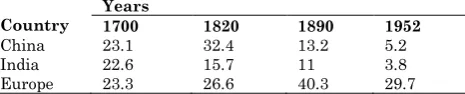
By 1895, the decline of the Indian industry had reached such a stage that Indian industry was already a mere tradition a memory of the past. It is ironical that the British rule weakened the organisation of guilds which supervised the quality of products and workmanship. The British government prohibited the export of tools, machinery, etc. as also the migration of trained workmen employed in printing calicos, cottons, muslins and linens from whom Indian could receive apprenticeship in large-scale production [17,18]. Evaluating the prosperous economic past of India, M. Davis concludes, “If the history of British rule in India were to be condensed to a single fact, it is this: there was no increase in India’s per-capita income from 1757 to 1947.” In fact, incomes may have declined by 50 percent in the last half of the 19th
century, as portrayed in table1:
Table 1: World-wide per-capita income
Country Years 1700 1820 1890 1952
China 23.1 32.4 13.2 5.2
India 22.6 15.7 11 3.8
Europe 23.3 26.6 40.3 29.7
Source: Davis, M [19]. Famines and the making of the Third World. London: Verso Books
Right from the foundation of British rule in India, the doctrine of free trade was implemented, however, it remained one-sided throughout their rule. The British Government showed a marked antipathy and neglect towards Indian industries. It resulted in the demise of India’s world fame cottage and small scale industries as these could not stand in the competition of British industries [20]. Tierney had explained Britain’s economic policy vis-a-vis India in the following words, “The general principle of our economic policy should be, to sell in Indian markets the goods manufactured in England and in return, to buy raw material from India.” While the doors of India were thrown wide open to foreign goods, at the same time Indian products which could still complete with British products were subjected to heavy import duties on entry into Britain [21]. The British had not taken Indian goods on fair and equal terms even at this stage when their industries had
6 The industrial and commercial policies of the British in
India aimed at developing India as a market for British manufactured goods in return for India’s goods and raw materials.
achieved technological superiority over Indian handicrafts. Duties in Britain on several categories on Indian goods continued to be high till their export to Britain virtually ceased. For example, Indian sugar had to pay on entry into Britain a duty that was over three times its cost process. In some cases duties in England went up as high as 400 per cent [22,23]. As a result of such prohibitive import duties and development of machine industries, Indian exports to foreign countries fall rapidly.
The decline of the native handicraft industries created not only gigantic unemployment in India but also a new demand of foreign goods emerged in the Indian consumer market. With the virtual elimination of demand for the indigenous industry following the disappearance of noble courts, there appeared a new source of demand from the European officials and tourists and from the Indian baboos and sahibs [24]. The consumption habits of the newly educated Indians, a product of English education, also gave a crippling blow to handicraft industries. This newly created Indian bourgeoisie class not only disdained the products of indigenous industries but also tried to copy everything European which was considered to be the hallmark of enlightenment.7 This demand was profitably
met by the increasing imports of cheap manufactured goods from Britain.
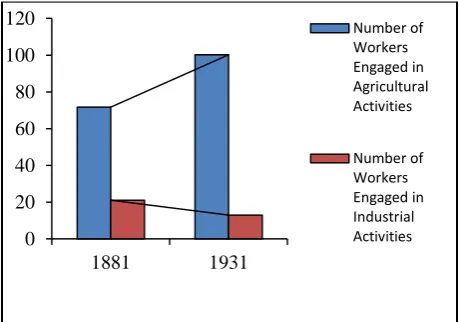
The British policies caused imbalance in the occupational structure leading to rural unemployment and under-employment. Empirical studies show that in 1881, the number of workers engaged in agricultural activities stood at 71.7 million which swelled to 100.2 million by the end of 1931, as against this, people engaged in industrial activities declined from 21.1 million to 12.9 million between 1881 and 1931 (See fig. 3). Amiya Bagchi used employment statistics of the period 1809 to 1901 as evidence of de-industrialization when the proportion of cotton spinning and weaving population to total industrial population declined from 62.3 per cent 0 to 15.1 per cent. People
7 The demand for the wares which the handicraftsmen
Available online at: www.ijassh.com
Meena HK | April 2016 | Vol.4 | Issue 04 |41-48 46 released from industry of various kinds
found agriculture as the only alternative means of livelihood. Consequently, agricultural sector became overburdened with surplus population consequently a new proletariat class of landless labourers emerged in the countryside [25,26].
Fig 3: Workers Engaged in Agricultural & Industrial Activities (1881-1931) (In millions)
Development of Industries in India During the latter half of the 19th century,
modern industry began to establish in India, however, the pace of its growth remained very sluggish.8 Initially, this development
was confined to the setting up of cotton and jute textile mills. The cotton textile mills were located in the western parts of the countr (Maharashtra and Gujarat) while the jute mills were mainly concentrated in Bengal [24].
The cotton mills were mostly owned and dominated by the Indian enterprises, whereas the jute mills were mainly owned by the British capitalists. Subsequently, iron and steel industries began rooted in the Indian soil in the beginning of the 20th
century. The Tata Iron and Steel Company (TISCO) was incorporated in 1907. After the First World War, an Industry Commission and Indian Ammunition Board was appointed in 1916 and 1917 respectively to evaluate industrial prospects in India. The
8 It is quite an interesting fact that whenever India's colonial
economic links, in terms of foreign trade and inflow of foreign capital, were disrupted one can easily trace that Indian economy made strides in industrial development (Sen, 1998; Bose, 1993). During the 20th century, the colonial
economic links were interrupted thrice: first, during the First World War (1914-18), second, at the time of the Great Economic Depression (1929-32), and third during the Second World War (1939-45). In other words, free flow of foreign trade and capital meant economic stagnation in India, while their absence provided a chance for Indian capital to open up avenues of industrial growth.
Ammunition Board made some efforts towards industrial growth. In 1919, the industry was made a state subject. The Tariff Commission was set up in 1921. On the recommendations of this Commission, differential policy of protection was adopted for Indian industries. It was decided to provide protection to some selected industries keeping in view pre-decided principles [27]. A few other industries of sugar, cement and paper came up after the Second World War. However, the growth rate of the new industrial sector and its contribution to the Gross Domestic Product (GDP) remained very small. This sector remained confined only to the railways, power generation, communications, ports and some other departmental undertakings [28-42].
Conclusion
The economic policies followed by the British rule led to the rapid transformation of India’s economy into a colonial economy whose nature and structure were determined by the needs of the economy of Britain. The economic policies pursued by the colonial government in India were concerned more with the protection and promotion of the economic interests of Britain rather than with the development of the Indian economy. Such policies brought about a fundamental change in the structure of the Indian economy and transformed India into mere supplier of raw materials and consumer of finished industrial products from Britain. With the consolidation and extension of British rule in India, agricultural India was to be an economic colony of industrial Britain. Henceforth, the government of India followed a policy of free trade As a result, the Indian handicrafts were exposed to the fierce and unequal competition of the machine-made products of Britain and faced extinction. The free trade imposed on India was however one-sided. Indian goods were subjected to heavy import duties on entry into Britain.
As a result, Indian exports to Britain fall rapidly. Instead of exporting manufactures, India was now forced to export raw materials which Britain industries needed urgently or plantation products like indigo or food grains which were in short supply in Britain. The skill of mass production of industrial goods helped Britain to flood the
0 20 40 60 80 100 120
1881 1931
Number of Workers Engaged in Agricultural Activities
Meena HK | April 2016 | Vol.4 | Issue 04 |41-48 47 Indian markets. The railways facilitated the
reach of these goods to remotest parts in India and the procurement of raw materials from these parts.
References
1.Moreland WH (1968) The Agrarian System of Moslem India. Oriental Books Corporation. 200-12.
2.Gandhi MK (1956) Rebuilding Our Villages. Ahmedabad: Navjivan Publishing House. 11. 3.Naoroji D (1901) Poverty and Un-British Rule
in India. London: Swan Sonnenschein & Co. Ltd. 214-16.
4.Keay J (1993) The Honourable Company: A History of the English East India Company. Harper Collins. 48-54.
5.Roy T (2013) The Economic History of India 1857-1947. New Delhi: Oxford University Press. Third edition. 277-81.
6.Bardhan PK (1984) Land, Labor and Rural Poverty: Essays in Development Economics. Delhi: Oxford University Press. 354-59.
7.Kumar D (1982) The Cambridge Economic History of India (c.1757-c.1970). Cambridge University Press, Vol. II. 104.
8.Alavi HA (1972) The state in post-colonial societies: Pakistan and Bangladesh’, New Left Review (Old Series), 74:59-81.
9.Dutt RC (1906) Economic History of India in the Victorian Age 1837-1901. Kegan Paul, 77-93.
10. Dutt RC (1950) The Economic History of India under Early British Rule. Trubner’s Oriental Series, Reprint 2000, 253-55. 11. Bagchi AK (2000) Private Investment in
India 1900-1939. Cambridge: Cambridge University Press. 96-112.
12. Thorner D (1980) The Shaping of Modern India. Bombay: Allied Publishers, 114-29. 13. Stokes E (1959) The English Utilitarians and
India. Clarendon Press. 196-207.
14. Misra BR (1942) Land Revenue Policy in the United Provinces under British Rule. Nand Kishore & Brothers. 89-107.
15. Cohn BS (1996) Colonialism and Its Forms of Knowledge: The British in India. Princeton: Princeton University Press, 33-46.
16. Amin S (1990) Maldevelopment. London: Zed Press. 248-53.
17. Stein B (1989) ‘Eighteenth Century India: Another View’, Studies in History (New Series), 5(1):1-26.
18. Frankel R (1978) India's Political Economy 1947-77: The Gradual Revolution. Princeton: Princeton University Press, 38-43.
19. Davis K (1951) The Population of India and Pakistan. Princeton: Princeton University Press, 196-205.
20. Kenneth AR (1985) Trade, Plunder and Settlement: Maritime Enterprise and the Genesis of the British Empire 1480-1630. Cambridge University Press. 272-83.
21. Bowen H, Rigby N (2002) The Worlds of the East India Company. Suffolk (UK): Boydell Press, 97.
22. Bardhan PK (1996) The Political Economy of Development in India. Delhi: Oxford University Press. 226-30.
23. Datta KK (1964) Dawn of Renascent India. Bombay: Allied Publisher, 112-17.
24. Ray I (2011) Bengal Industries and the British Industrial Revolution (1757-1857) Routledge. 162-63.
25. Chakravarty S (1987) Development Planning: The Indian Experience. Delhi: Oxford University Press, 137-44.
26. Patel SJ (1952) Agricultural Labourers in Modern India and Pakistan. Delhi: Current Book House. 22.
27. Ahmad A (1991) ‘Between orientalism and historicism: Anthropological knowledge of India’, Studies in History, 7(1):135-63.
28. Alavi HA (1980) India: Transition from feudalism to colonial capitalism, Journal of Contemporary Asia, 10(4):359-99.
29. Alavi HA (1990) India and the Colonial Mode of Production, in Utsa Patnaik. (ed.). Agrarian Relations and Accumulation: The 'Mode of Production' Debate in India. Delhi: Oxford University Press, pp. 132-55.
30. Altekar AS (1927) A History of Village Communities in Western India. Madras: Oxford University Press. 94-103.
31. Avineri S (1969) Karl Marx on Colonialism and Modernization. New York: Anchor Books. 167-69.
32. Chandra B (1979) Nationalism and Colonialism in Modern India. Delhi: Orient Longman, 212-23.
Available online at: www.ijassh.com
Meena HK | April 2016 | Vol.4 | Issue 04 |41-48 48 34. Feuer LS (1959) Marx and Engels: Basic
Writings on Politics and Philosophy. Garden City: Double Day Anchor Books, 194-212. 35. Inden R (1986) Orientalist Constructions of
India, Modern Asian Studies, 20(3):401-46. 36. Johannes HV (1996) British Policy towards
Indian Historical Research and Writing 1870-1930. Indian Economic & Social History Review (3):137-49.
37. Klein I (1988) Plague, Policy and Popular Unrest in British India. Cambridge University Press: Modern Asian Studies 22(4):723-55.
38. Mill JS (1840) The History of British India. London: James Maden. 321-33.
39. Sen S (1998) Empire of Free Trade: The East India Company and the Making of the Colonial Marketplace. University of Pennsylvania Press. 138-45.
40. Steensgard N (1975) The Asian Trade Revolution of the Seventeenth Century: The East India Companies and the Decline of the Caravan Trade. University of Chicago Press. 112-15.
41. Stokes E (1978) The Peasant and the Raj: Studies in Agrarian Society and Peasant Rebellion in Colonial India. Cambridge University Press. 253-69.