Available online throug
ISSN 2229 – 5046
THE EDGE VERSION OF INVERSE SUM INDEG INDEX OF CONNECTED GRAPH
M. BHANUMATHI
Associate professor, Department of Mathematics,
Govt. Arts College for women, Pudukkottai, India.
K. EASU JULIA RANI
Assistant professor, Department of Mathematics,
T. R. P Engineering College, Trichirappalli, India.
S. BALACHANDRAN
Assistant professor-II, School of humanities & sciences,
Sastra University, Tanjore, India.
(Received On: 25-12-15; Revised & Accepted On: 25-01-16)
ABSTRACT
T
he inverse sum indeg index is defined as 𝐼𝐼𝐼𝐼𝐼𝐼(𝐺𝐺) =∑ 11𝑑𝑑𝑢𝑢+𝑑𝑑𝑣𝑣1
𝑢𝑢𝑣𝑣∈𝐸𝐸(𝐺𝐺) =∑𝑢𝑢𝑣𝑣 ∈𝐸𝐸(𝐺𝐺) 𝑑𝑑𝑑𝑑𝑢𝑢𝑢𝑢×+𝑑𝑑𝑑𝑑𝑣𝑣𝑣𝑣 in which degree of vertex v
is denoted by 𝑑𝑑𝑣𝑣. Now we define a new version of ISI index as 𝐼𝐼𝐼𝐼𝐼𝐼𝑒𝑒 (𝐺𝐺) =∑ 𝑑𝑑𝑒𝑒×𝑑𝑑𝑓𝑓 𝑑𝑑𝑒𝑒+𝑑𝑑𝑓𝑓
𝑒𝑒𝑓𝑓∈𝐸𝐸(𝐿𝐿(𝐺𝐺)) , where𝑑𝑑𝑒𝑒denotes the degree of an edge e in G. The goal of this paper is to the study of the𝐼𝐼𝐼𝐼𝐼𝐼𝑒𝑒 index of graphs.
Key words: sum indeg index, Edge version, circumcronone series, Benzenoid.
2000 Mathematics subject classification: 05C12, 05C75.
1. INTRODUCTION
A graph is a collection of points and lines connecting them. The points and lines of a graph are also called vertices and edges respectively. If e is an edge of G, connecting the vertices u and v, then we write𝑒𝑒=𝑢𝑢𝑣𝑣 and say "u and v are adjacent". A connected graph is a graph such that there is a path between all pairs of vertices. The distance 𝑑𝑑(𝑢𝑢,𝑣𝑣) between two vertices u and v is the length of the shortest path between u and v in G. A simple graph is an unweighted, undirected graph without loops or multiple edges. A single number that can be used to characterize some property of the graph is called a Topological Index for that graph. Obviously, the number of vertices and the number of edges are topological indices. The Wiener index is the first graph invariant reported (distance based) topological index and is defined as a half sum of the distances between all the pairs of vertices in a graph [1]. Also, the edge version of Wiener index which were based on distance between edges introduced by A. Iranmanesh et al. in 2008 [2]. These topological indices are formulated as follows:
𝑊𝑊𝑣𝑣(𝐺𝐺) =∑{𝑢𝑢,𝑣𝑣}⊂𝑉𝑉(𝐺𝐺)𝑑𝑑(𝑢𝑢,𝑣𝑣) (1)
𝑊𝑊𝑒𝑒(𝐺𝐺) =∑{𝑒𝑒,𝑓𝑓}⊂𝐸𝐸(𝐺𝐺)𝑑𝑑(𝑒𝑒,𝑓𝑓) (2)
in which degree of vertex v and edge e are denoted by 𝑑𝑑𝑣𝑣𝑎𝑎𝑎𝑎𝑑𝑑𝑑𝑑𝑒𝑒. The degree of a vertex v is the number of vertices joining to v. Also, the degree of an edge 𝑒𝑒 ∈ 𝐸𝐸(𝐺𝐺) is the number of its adjacent vertices in 𝐿𝐿(𝐺𝐺), where the line graph L(G) of a graph G is defined to be the graph whose vertices are the edges of G, with two vertices being adjacent if the corresponding edges share a vertex in G.
𝐼𝐼𝐼𝐼𝐼𝐼 (𝐺𝐺) =∑ 𝑑𝑑𝑢𝑢×𝑑𝑑𝑣𝑣
𝑑𝑑𝑢𝑢+𝑑𝑑𝑣𝑣
𝑢𝑢𝑣𝑣 ∈𝐸𝐸(𝐺𝐺) (3)
Corresponding Author: K. Easu Julia Rani*, Associate Professor,
Here, we define the new member (edge version of inverse sum indeg index) of this class on the ground of the end-vertex degree 𝑑𝑑𝑒𝑒 and 𝑑𝑑𝑓𝑓 of edges e and f in a line graph of G as follows:
𝐼𝐼𝐼𝐼𝐼𝐼𝑒𝑒 (𝐺𝐺) =∑𝑒𝑒𝑓𝑓∈𝐸𝐸(𝐿𝐿(𝐺𝐺))𝑑𝑑𝑑𝑑𝑒𝑒𝑒𝑒+×𝑑𝑑𝑑𝑑𝑓𝑓𝑓𝑓 (4)
where 𝑑𝑑𝑒𝑒denotes the degree of the edge e in G. The aim of this paper is to study the 𝐼𝐼𝐼𝐼𝐼𝐼𝑒𝑒 index for some families of graphs.
2. MAIN RESULT
The goal of this section is to study and computing the 𝐼𝐼𝐼𝐼𝐼𝐼𝑒𝑒 index of the complete graph 𝐾𝐾𝑎𝑎 , path𝑃𝑃𝑎𝑎, cycle 𝐶𝐶𝑎𝑎 and and star graph 𝐼𝐼𝑎𝑎.
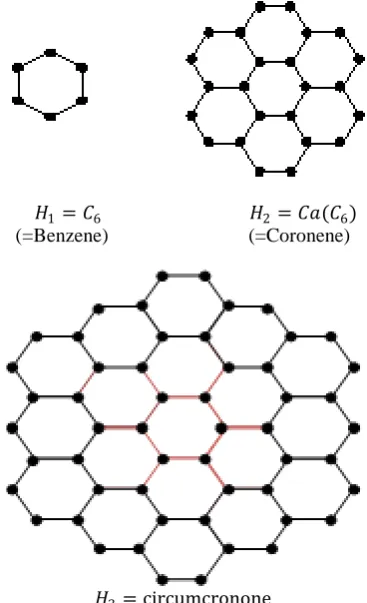
Also we obtain a closed formula of this index for a famous molecular graph that is Circumcoronene Series of Benzenoid 𝐻𝐻𝑘𝑘. The circumcoronene homologous series of benzenoid is family of molecular graph, which consist several copy of benzene𝐶𝐶6 on circumference. The first terms of this series are 𝐻𝐻1= benzene, 𝐻𝐻2= coronene,
𝐻𝐻3= circumcoronene 𝐻𝐻4= circumcircumcoronene, see Figure 1 and Figure 2, where they are shown.
𝐻𝐻1=𝐶𝐶6 𝐻𝐻2=𝐶𝐶𝑎𝑎(𝐶𝐶6)
(=Benzene) (=Coronene)
𝐻𝐻3= circumcronone
Figure-1: The first 3 graphs 𝐻𝐻1,𝐻𝐻2𝑎𝑎𝑎𝑎𝑑𝑑𝐻𝐻3 from the circumcronone series.
These molecular graphs are presented in many papers, (see the paper series [18-21]). For every positive integer number k, the general form of circum- coronene series of benzenoid𝐻𝐻𝑘𝑘 is shown in Figure 1. Also, its line graph is shown in Figure 3. For more information of this family, see the paper series [3, 6, 9-15].
Lemma 1: Let 𝐾𝐾𝑎𝑎 be the complete graph on n vertices. Then𝐿𝐿(𝐾𝐾𝑎𝑎) will be a 2(𝑎𝑎 −1) regular graph and for every
𝑒𝑒 ∈ 𝐸𝐸(𝐾𝐾𝑎𝑎) (𝑒𝑒 ∈ 𝑉𝑉(𝐿𝐿(𝐾𝐾𝑎𝑎))) 𝑑𝑑𝑣𝑣= 2(𝑎𝑎 −1).So |𝐸𝐸(𝐿𝐿(𝐾𝐾𝑎𝑎)| =12|𝐸𝐸(𝐾𝐾𝑎𝑎)|2(𝑎𝑎 −1) =12𝑎𝑎(𝑎𝑎 −1)2 . This implies that
𝐼𝐼𝐼𝐼𝐼𝐼𝑒𝑒 (𝐾𝐾𝑎𝑎) =∑𝑒𝑒𝑓𝑓∈𝐸𝐸(𝐿𝐿(𝐾𝐾𝑎𝑎))𝑑𝑑𝑑𝑑𝑒𝑒𝑒𝑒+×𝑑𝑑𝑑𝑑𝑓𝑓𝑓𝑓 = |𝐸𝐸(𝐿𝐿(𝐾𝐾𝑎𝑎)|
2(𝑎𝑎−1)×2(𝑎𝑎−1) 2(𝑎𝑎−1)+2(𝑎𝑎−1)=
𝑎𝑎(𝑎𝑎−1)3
2 . (5)
Lemma 2: Let 𝐶𝐶𝑎𝑎be the cycle of length n: Then one can see that 𝐿𝐿(𝐶𝐶𝑎𝑎) =𝐶𝐶𝑎𝑎 and for every 𝑣𝑣 ∈ 𝑉𝑉(𝑐𝑐𝑎𝑎) and
Figure-2: The Circumcoronene Series of Benzenoid 𝐻𝐻𝑘𝑘(𝑘𝑘 ≥1) with dges
Lemma 3: Let 𝑃𝑃𝑎𝑎 be a path of length n.Then 𝐿𝐿(𝑃𝑃𝑎𝑎) =𝑃𝑃𝑎𝑎−1and for all vertices of 𝐿𝐿(𝑃𝑃𝑎𝑎): 𝑑𝑑𝑒𝑒 = 2, (except first and end
vertices on path, that are as degree one), thus
ISIe (Pn) = (n−3) ×�2 × 22 + 2�+ 2 ×�2 × 12 + 1�
=3n−5
3 . (7)
Lemma 4: Let𝐼𝐼𝑎𝑎 be a star graph with 𝑎𝑎+ 1 vertices. Then 𝐿𝐿(𝐼𝐼𝑎𝑎) will be a(𝑎𝑎 −1) regular graph (or a complete
graph on n vertices) and for every 𝑒𝑒 ∈ 𝐸𝐸(𝐼𝐼𝑎𝑎) or (𝑒𝑒 ∈ 𝑉𝑉(𝐿𝐿(𝐼𝐼𝑎𝑎)))𝑑𝑑𝑣𝑣= (𝑎𝑎 −1). So |𝐸𝐸(𝐿𝐿(𝐼𝐼𝑎𝑎))| = |𝐸𝐸(𝐾𝐾𝑎𝑎)| =12𝑎𝑎(𝑎𝑎 −1). This implies that
𝐼𝐼𝐼𝐼𝐼𝐼𝑒𝑒 (𝐼𝐼𝑎𝑎) = |𝐸𝐸(𝐿𝐿(𝐼𝐼𝑎𝑎)| ((𝑎𝑎−𝑎𝑎−1)+(1)×(𝑎𝑎−𝑎𝑎−1)1)=𝑎𝑎(𝑎𝑎−1)
2
4 (8)
In addition, to achieve our aims we need the following definition.
Definition 1[16]: Let G be the molecular graph and 𝑑𝑑𝑣𝑣 is degree of vertex 𝑣𝑣 ∈ 𝑉𝑉(𝐺𝐺) (Obviously 1≤ 𝛿𝛿 ≤ 𝑑𝑑𝑣𝑣≤ ∆≤ 𝑎𝑎 −1, where
𝛿𝛿=𝑚𝑚𝑚𝑚𝑎𝑎{𝑑𝑑𝑣𝑣/𝑣𝑣 ∈ 𝑉𝑉(𝐺𝐺)} and
∆=𝑚𝑚𝑎𝑎𝑚𝑚{𝑑𝑑𝑣𝑣|𝑣𝑣 ∈ 𝑉𝑉(𝐺𝐺)}.
Let 𝐺𝐺=𝐻𝐻𝑘𝑘, we divide edge set 𝐸𝐸(𝐺𝐺) and vertex set 𝑉𝑉(𝐺𝐺) of graph G to several partitions, as follow: 𝑓𝑓𝑓𝑓𝑓𝑓𝑚𝑚 ∈[2𝛿𝛿, 2∆ ] ,𝑑𝑑𝑒𝑒𝑓𝑓𝑚𝑚𝑎𝑎𝑒𝑒𝐸𝐸𝑚𝑚 = {𝑒𝑒=𝑢𝑢𝑣𝑣 ∈| 𝑑𝑑𝑢𝑢+𝑑𝑑𝑣𝑣=𝑚𝑚},𝑓𝑓𝑓𝑓𝑓𝑓𝑗𝑗 ∈ [𝛿𝛿2,∆2 ] ,𝑑𝑑𝑒𝑒𝑓𝑓𝑚𝑚𝑎𝑎𝑒𝑒
𝐸𝐸𝑗𝑗 = {𝑒𝑒=𝑢𝑢𝑣𝑣 ∈| 𝑑𝑑𝑢𝑢×𝑑𝑑𝑣𝑣=𝑗𝑗},𝑓𝑓𝑓𝑓𝑓𝑓𝑘𝑘 ∈ [𝛿𝛿,∆ ] ,𝑑𝑑𝑒𝑒𝑓𝑓𝑚𝑚𝑎𝑎𝑒𝑒𝑉𝑉𝑘𝑘 = {𝑣𝑣 ∈ 𝑉𝑉(𝐺𝐺)| 𝑑𝑑𝑣𝑣=𝑘𝑘}.
Theorem 4: Consider the graph 𝐺𝐺 =𝐻𝐻𝑘𝑘(𝑘𝑘 ≥2) is circumcoronene series. Then the Inverse sum indeg index of 𝐻𝐻𝑘𝑘
given by
𝐼𝐼𝐼𝐼𝐼𝐼(𝐻𝐻𝑘𝑘) =101(135𝑘𝑘2−81𝑘𝑘 −54). (9)
Proof: Let 𝐺𝐺 =𝐻𝐻𝑘𝑘(𝑘𝑘 ≥2) be the circumcoronene series of benzenoid. Thus, this graph has 6𝑘𝑘2 vertices and
3×6𝑘𝑘(𝑘𝑘−1)+2×6𝑘𝑘
2 = 9𝑘𝑘2 -3k edges. From the structure of 𝐻𝐻𝑘𝑘 .0ne can see that there are two partitions
𝑉𝑉3= {𝑣𝑣 ∈ 𝑉𝑉(𝐻𝐻𝑘𝑘)| 𝑑𝑑𝑣𝑣= 3} and 𝑉𝑉2= {𝑣𝑣 ∈ 𝑉𝑉(𝐻𝐻𝑘𝑘)| 𝑑𝑑𝑣𝑣= 2} with size 6𝑘𝑘(𝑘𝑘 −1)and 6𝑘𝑘, respectively. The edge set of
graph 𝐻𝐻𝑘𝑘 can be divide in to three partitions 𝐸𝐸4,𝐸𝐸5𝑎𝑎𝑎𝑎𝑑𝑑𝐸𝐸6 . In other words, For every 𝑒𝑒=𝑢𝑢𝑣𝑣 belong to 𝐸𝐸6,𝑑𝑑𝑢𝑢 =𝑑𝑑𝑣𝑣= 3. Similarly, for every 𝑒𝑒 =𝑢𝑢𝑣𝑣 belong to 𝐸𝐸4,𝑑𝑑𝑢𝑢 =𝑑𝑑𝑣𝑣= 2 Finally, if𝑒𝑒=𝑢𝑢𝑣𝑣 be an edge of 𝐸𝐸5 then
𝑑𝑑𝑢𝑢 = 2 𝑎𝑎𝑎𝑎𝑑𝑑𝑑𝑑𝑣𝑣= 3. We mark the members of 𝐸𝐸4 by red color, the members of 𝐸𝐸5 by green color and the members of
𝐸𝐸6 by black color, in Figure 2. Thus, we have following computations:
Clearly |𝐸𝐸4| = 4, |𝐸𝐸5| = 12(𝑘𝑘 −1) 𝑎𝑎𝑎𝑎𝑑𝑑 |𝐸𝐸6| = 9𝑘𝑘2−15𝑘𝑘+ 6. Hence we have
𝐼𝐼𝐼𝐼𝐼𝐼(𝐻𝐻𝑘𝑘) = � 𝑑𝑑𝑑𝑑𝑢𝑢×𝑑𝑑𝑣𝑣 𝑢𝑢+𝑑𝑑𝑣𝑣 𝑒𝑒=𝑢𝑢𝑣𝑣∈𝐸𝐸(𝐻𝐻𝑘𝑘)
= � 𝑑𝑑𝑑𝑑𝑢𝑢 ×𝑑𝑑𝑣𝑣
𝑢𝑢+𝑑𝑑𝑣𝑣 𝑒𝑒=𝑢𝑢𝑣𝑣 ∈𝐸𝐸9
+ � 𝑑𝑑𝑑𝑑𝑢𝑢×𝑑𝑑𝑣𝑣
𝑢𝑢+𝑑𝑑𝑣𝑣 𝑒𝑒=𝑢𝑢𝑣𝑣 ∈𝐸𝐸6
+ � 𝑑𝑑𝑑𝑑𝑢𝑢×𝑑𝑑𝑣𝑣
=9 6|𝐸𝐸9| +
6 5|𝐸𝐸6| +
4 4|𝐸𝐸4| =32[9𝑘𝑘2−15𝑘𝑘+ 6] +6
5[12(𝑘𝑘 −1)] + 1(6)
𝐼𝐼𝐼𝐼𝐼𝐼(𝐻𝐻𝑘𝑘) =135𝑘𝑘
2−81𝑘𝑘 −54
10
Theorem 5: Let G be the graphs from the circumcoronene series of benzenoid 𝐻𝐻𝑘𝑘 ∀𝑘𝑘 ≥1 with 6𝑘𝑘2 vertices and
9𝑘𝑘2-3k edges then
𝐼𝐼𝐼𝐼𝐼𝐼𝑒𝑒 (𝐻𝐻𝑘𝑘) =�1260𝑘𝑘
2−1170𝑘𝑘+99�
35 (10)
Figure-3: The general representation of line graph of circumcoronene series of Benzenoid 𝐻𝐻𝑘𝑘(𝑘𝑘 ≥1)
with edges marking [11]
Proof: Consider the circumcoronene series of benzenoid 𝐻𝐻𝑘𝑘 for all positive integer number k. By theorem 4 the edge
version of Inverse sum indeg index of 𝐻𝐻𝑘𝑘 is equivalent with Inverse sum indeg index of its line graph. At first, we partition the vertex set and edge set of 𝐻𝐻𝑘𝑘 as follow:
𝑉𝑉3= {𝑣𝑣 ∈ 𝑉𝑉(𝐻𝐻𝑘𝑘)| 𝑑𝑑𝑣𝑣= 3} ⇒|𝑉𝑉3| = 6𝑘𝑘(𝑘𝑘 −1)
𝑉𝑉2= {𝑣𝑣 ∈ 𝑉𝑉(𝐻𝐻𝑘𝑘)| 𝑑𝑑𝑣𝑣= 2} ⇒|𝑉𝑉2| = 6𝑘𝑘
𝐸𝐸4= {𝑒𝑒=𝑢𝑢𝑣𝑣 ∈ 𝐸𝐸(𝐻𝐻𝑘𝑘)|𝑑𝑑𝑢𝑢 =𝑑𝑑𝑣𝑣 = 2} ⇒|𝐸𝐸4| = 6
𝐸𝐸5= {𝑒𝑒=𝑢𝑢𝑣𝑣 ∈ 𝐸𝐸(𝐻𝐻𝑘𝑘)|𝑑𝑑𝑢𝑢 = 3 & 𝑑𝑑𝑣𝑣= 2} ⇒|𝐸𝐸5| = 12(𝑘𝑘 −1)
𝐸𝐸6= {𝑒𝑒=𝑢𝑢𝑣𝑣 ∈ 𝐸𝐸(𝐻𝐻𝑘𝑘)|𝑑𝑑𝑢𝑢 =𝑑𝑑𝑣𝑣 = 3} ⇒|𝐸𝐸6| = 9𝑘𝑘2−15𝑘𝑘+ 6
In Figure 1, all edges belong to 𝐸𝐸4,𝐸𝐸5𝑎𝑎𝑎𝑎𝑑𝑑𝐸𝐸6marked by red, green and black colors, respectively. It is very clear that number of vertices in 𝐿𝐿(𝐻𝐻𝑘𝑘) = number of edges in 𝐻𝐻𝑘𝑘 = 9𝑘𝑘2−15𝑘𝑘+ 6 + 12𝑘𝑘 −12 + 6 = 9𝑘𝑘2−3 and number of edges in 𝐿𝐿(𝐻𝐻𝑘𝑘) = sum of the degrees of the edges of 𝐻𝐻𝑘𝑘 =4�9𝑘𝑘
2−15𝑘𝑘+6 �+3×12(𝑘𝑘−1)+2×6
2
= 18𝑘𝑘2−12𝑘𝑘. Alternatively, we can partition the vertex set and edge set of 𝐿𝐿(𝐻𝐻
𝑘𝑘) by using the results of [11] as
follow:
𝑉𝑉𝐿𝐿2= {𝑒𝑒 ∈ 𝐸𝐸(𝐻𝐻𝑘𝑘)| 𝑑𝑑𝑒𝑒= 2}⇒|𝑉𝑉𝐿𝐿2| = |𝐸𝐸4| = 6
𝑉𝑉𝐿𝐿3= {𝑒𝑒 ∈ 𝐸𝐸(𝐻𝐻𝑘𝑘)| 𝑑𝑑𝑒𝑒= 3}⇒|𝑉𝑉𝐿𝐿3| = |𝐸𝐸5| = 12(𝑘𝑘 −1)
𝑉𝑉𝐿𝐿4= {𝑒𝑒 ∈ 𝑉𝑉(𝐿𝐿(𝐻𝐻𝑘𝑘)) 𝑓𝑓𝑓𝑓𝑒𝑒 ∈ 𝐸𝐸(𝐻𝐻𝑘𝑘)| 𝑑𝑑𝑒𝑒 = 4}⇒|𝑉𝑉𝐿𝐿4| = |𝐸𝐸6| = 9𝑘𝑘2−15𝑘𝑘+ 6
𝐸𝐸𝐿𝐿5=�𝜇𝜇=𝑒𝑒𝑓𝑓𝑒𝑒𝐸𝐸(𝐿𝐿(𝐻𝐻𝑘𝑘))|𝑑𝑑𝑒𝑒 = 2 ,𝑑𝑑𝑓𝑓 = 3� ⇒|𝐸𝐸𝐿𝐿5| = 2|𝑉𝑉𝐿𝐿2| = 12
𝐸𝐸𝐿𝐿6=�𝜇𝜇=𝑒𝑒𝑓𝑓𝑒𝑒𝐸𝐸�𝐿𝐿(𝐻𝐻𝑘𝑘)�|𝑑𝑑𝑒𝑒 = 𝑑𝑑𝑓𝑓= 3� ⇒|𝐸𝐸𝐿𝐿6| = |𝑉𝑉𝐿𝐿3|−|𝑉𝑉𝐿𝐿2| = 6(2𝑘𝑘 −3)
𝐸𝐸𝐿𝐿7=�𝜇𝜇=𝑒𝑒𝑓𝑓𝑒𝑒𝐸𝐸(𝐿𝐿(𝐻𝐻𝑘𝑘))|𝑑𝑑𝑒𝑒 = 3 ,𝑑𝑑𝑓𝑓 = 3� ⇒|𝐸𝐸𝐿𝐿7| = |𝑉𝑉𝐿𝐿3|−|𝑉𝑉𝐿𝐿2| = 12(𝑘𝑘 −1)
𝐸𝐸𝐿𝐿8=�𝜇𝜇=𝑒𝑒𝑓𝑓𝑒𝑒𝐸𝐸(𝐿𝐿(𝐻𝐻𝑘𝑘))|𝑑𝑑𝑒𝑒 = 𝑑𝑑𝑓𝑓= 4� ⇒|𝐸𝐸𝐿𝐿8| =𝐸𝐸�𝐿𝐿(𝐻𝐻𝑘𝑘)� − |𝐸𝐸𝐿𝐿7|−|𝐸𝐸𝐿𝐿6|−|𝐸𝐸𝐿𝐿5| = 18𝑘𝑘2−36k + 18
= 18(k−1)2
In Figure 3 all edges belong to 𝐸𝐸𝐿𝐿5,𝐸𝐸𝐿𝐿6,𝐸𝐸𝐿𝐿7𝑎𝑎𝑎𝑎𝑑𝑑𝐸𝐸𝐿𝐿8𝑎𝑎𝑓𝑓𝑒𝑒 marked by red, green, and blue black colors, respectively.
Hence
𝐼𝐼𝐼𝐼𝐼𝐼𝑒𝑒 (𝐻𝐻𝑘𝑘) =∑𝑒𝑒=𝑢𝑢𝑣𝑣 ∈𝐸𝐸�𝐿𝐿(𝐻𝐻𝑘𝑘)� 𝑑𝑑𝑑𝑑𝑢𝑢𝑢𝑢+×𝑑𝑑𝑑𝑑𝑣𝑣𝑣𝑣
= ∑ 2×3
2+3
𝑒𝑒𝑓𝑓∈𝐸𝐸𝐿𝐿5 +∑
3×3 3+3
𝑒𝑒𝑓𝑓∈𝐸𝐸𝐿𝐿6 +∑
3×4 3+4
𝑒𝑒𝑓𝑓∈𝐸𝐸𝐿𝐿7 +∑
4×4 4+4
=65|𝐸𝐸𝐿𝐿5| +69|𝐸𝐸𝐿𝐿6| +127 |𝐸𝐸𝐿𝐿7| +168|𝐸𝐸𝐿𝐿8|
=65(12) +32(12𝑘𝑘 −18) +127 (12𝑘𝑘 −12) + 2(18𝑘𝑘2−36𝑘𝑘+ 18)
𝐼𝐼𝐼𝐼𝐼𝐼𝑒𝑒 (𝐻𝐻𝑘𝑘) =�1260𝑘𝑘
2−1170𝑘𝑘+99�
35
Example 1: Let 𝐻𝐻3be the Circumcoronene. Then the number of edges 𝑒𝑒5,𝑒𝑒6,𝑒𝑒7𝑎𝑎𝑎𝑎𝑑𝑑𝑒𝑒8 in line graph 𝐻𝐻3 are equal to 12,
18, 24 and 72, respectively (see Figure 4). So 𝐼𝐼𝐼𝐼𝐼𝐼𝑒𝑒 index of𝐻𝐻3 is equal to 𝐼𝐼𝐼𝐼𝐼𝐼𝑒𝑒 (𝐻𝐻𝑘𝑘) =𝐼𝐼𝐼𝐼𝐼𝐼(𝐿𝐿(𝐻𝐻3 ) ) = 226.5428
REFERENCES
1. H. Wiener, Structural determination of paraffin boiling points, J. Amer. Chem. Soc, (1947), 69, 7-20.
2. A. Iranmanesh, I. Gutman, O. Khormali, A. Mahmiani, MATCH Commun. Math. Comput. Chem. 61(3), (2009), 663.
3. M.R. Farahani, Eccentricity Version of Atom-Bond Connectivity Index of Ben- zenoid Family ABC5 (Hk), World Applied Sciences Journal, (2013), 21(9), 1260-1265.
4. B. Furtula, A. Graovac, D. Vukicevic, Disc. Appl. Math. 157, (2009). 2828
5. D. Vukicevic, B. Furtula, Topological index based on the ratios of geometrical and arithmetical means of end-vertex degrees of edges, J. Mathematical Chemistry. 46, (2009). 1369.
6. M.R. Farahani A New Version of Atom-Bond Connectivity Index of Circum- coronene Series of Benzenoid, J. Math. Nano Science. 2(1), (2012), 15-20.
7. J. Asadpour Some topological polynomial indices of nanostructures, Optoelec- tron. Adv. Mater. - Rapid Commun. 5(7), 2011, 769 - 772.
8. A. Madanshekaf, M. Ghaneeei, Computing two topological indices of nanostars dendrimer, Optoelectron. Adv. Mater.-Rapid Commun. 4(12), (2010), 2200-2202.
9. V. Chepoi S. Klavzar, Distances in benzenoid systems: Further developments, Discrete Math. 192, (1998) 27-39.
10. M.V. Diudea, Studia Univ. Babes-Bolyai, 4, (2003) 3-21.
11. M.R. Farahani, The Edge Version of Geometric-Arithmetic Index of Benzenoid Graph, Romanian Academy Seri B. 15(2). (2013). .
12. S. Klavzar, I. Gutman, B. Mohar, Labeling of Benzenoid Systems which Reects the Vertex-Distance Relations, J. Chem. Int Comput. Sci. 35, (1995) 590-593.
13. S. Klavzar, A Bird's Eye View of The Cut Method And A Survey of Its Appli- cations In Chemical Graph Theory, MATCH Commun. Math. Comput. Chem. 60, (2008), 255-274.
14. A. Soncini, E. Steiner, P.W. Fowler, R.W.A. Havenith, L.W. Jenneskens. Perimeter E_ects on Ring Currents in Polycyclic Aromatic Hydrocarbons: Circum- coronene and Two Hexa benzocoronenes, Chem. Eur. J. 9, (2003) 2974-2981.
15. P. Zigert, S. Klavzar, I. Gutman. Calculating the hyper-Wiener index of ben- zenoid hydrocarbons, ACH Models Chem. 137, (2000) 83-94.
16. M.R. Farahani, Computing Randic, Geometric-Arithmetic and Atom-Bond Connectivity indices of Circumcoronene Series of Benzenoid, Int. J. Chem. Model. 5(5), (2013).
17. M.R. Farahani,The edge version of atom-bond connectivity index of connected graphs, Int. J. Chem. Model., (36/2013), 277-284.
18. M.R. Farahani and M.P. Vlad. On the Schultz, Modified Schultz and Hosoya polynomials and Derived Indices of Capra-designed planar Benzenoids. Studia Univ. Babes-Bolyai. 57(4) In press, (2012).
19. M.R. Farahani, On the Schultz polynomial, Modified Schultz polynomial, Hosoya polynomial and Wiener index of circumcoronene series of benzenoid, J. Applied Mathe.& Informatics. 31(3) in press, (2013).
20. Gutman and S. Klavžar, M. Petkovsek and P. Zigert. On Hosoya polynomials of benzenoid. graphs, MATCH Commun. Math. Comput. Chem. 43, 49–66 (2001).
21. Gutman and S. Klavžar. A method for calculationg Wiener numbers of benzenoid hydrocarbons and phenylenes. ACH Models Chem. 133, 389-399. (1996).
Source of support: Nil, Conflict of interest: None Declared