Effectiveness of Employing Holistic Approach
Strategy on Teaching English Reading
Comprehension Skills for Seventh Graders in
Jordan
Mohammad Dayij Al.qomoul Tafilat Technical University, Jordan
Abstract—The study aimed at investigating the effect of using holistic approach strategy on teaching English reading comprehension skills for seventh graders in Jordan in comparison with conventional methods. The sample of the study consists of 120 male and female students. The sample distributed into two groups: experimental and control. The former is taught by holistic approach strategy and the later is taught according to traditional methods. A comprehension reading test was constructed by the researcher and administered before and after the experiment. The data was collected and analyzed using analysis of covariance (ANCOVA). The findings of the study showed significant differences (0α 05) between the two groups in favor of the experimental group. There is also a significant difference (0α 05) between the male and female students’ performances in favor of females.
Index Terms—holistic approach, strategy, reading comprehension, seventh graders
I. BACKGROUND OF THE STUDY
Reading comprehension is recently considered to be an efficient process done by an efficient reader. As soon as the reader starts practicing reading, he or she actually, should have various cultural and experimental branches about the text he or she reads. Comprehension is gained by the reader based on the cognitive structure used in the process. The low cognitive experiments lead to low comprehension and vice versa. So, not being able to achieve the correct meaning or not being able to construct it means that the reader is not involving himself in the reading process (Ammar, 2002, Al-Meri, 1994, Smith, 1985).
To utilize the new concept of reading comprehension skills, skillful readers create a type of fictional conversation with writers and they always attempt to probe believes and aims of text authors. They try to make a kind of elaboration between their own thoughts and thoughts of others. Sometimes, readers analyze and evaluate the contents of what they read and interact emotionally with it. Even after finishing the reading process, some efficient readers still commenting on what they have read, focuses mainly on its meanings and objectives (Harste, Burke and Woodward, 1994).
A reader is not only a passive dealer to what he or she reads, but also a reproducer to what has been read. A reader, any reader, is actually participating in building up a text meaning. This means that, understanding the external meanings of a text is not the main object of teaching reading skills. Some authors, such as (Roe, Stoodt and Burns, 1998) call for adopting synonyms or antonyms for reading comprehension concepts. However, reading skills in its recent meaning requires teaching it as a daily-life habit that should be practiced happily by all readers. Good performance, participation and priority are all targeted objectives sought by all educators especially, for linguistic education. Such objectives couldn’t be achieved without employing instructional strategies which allow and sustain students’ freedom to construct their own meanings through reading processes. This could be achieved easily if we apply instructional strategies based on holistic approach. This approach focuses on what teachers and students do through the frame work of the language totality regarding relating the four language skills altogether, which leads finally, to achieving the targeted language advancement for the students (Tueima Manna, 2000, and Nasr, 2003). This attachment could be implemented in one single setting for all the four language skills instead of many repetitive classes.
The holistic approach is based on teaching a language to students the same way as it was taught to them when they were kids, totally and precisely. So, it is advisable to follow this approach in teaching language skills, totally not partially (Goodman, 1986).
Schindler, 2006). This, however, adopted by the language holistic approach which, in turn, creates a system of cognitive imaginations that direct and lead the education decision making (Weaver and Henke, 1992).
One of the main bases of the language holistic approach is that a learner constructs his own understanding of the text he interacts with and converses with others according his understanding. A reader should be aware that the text he reads must be of a great interest to his own life. When he does so, a learner feels safe through learning process, not fearing blame or sarcasm, and building up his own meanings depending on his own past knowledge to understand a reading text (Harste, Burke and Woodward, 1994). The language holistic approach is not only restricted to language teaching, it could be also applied to all other subjects, or improved other rich activities since it calls for a new modern view for teachers and teaching, encouraging them to interact effectively with the students. Educators are, also, attempting to improve language curricula which encourage learners to involve themselves in the language teaching atmosphere. This new method of teaching urges students to revise their roles in the teaching-learning process, from spontaneous learners to effective participants (Weaver, 1994, Richards and Rodgers, 2001, O’sullivan, 2004). In this way, learners become active members in the society and play stronger role in social communication. According to this new trend, learners, usually, practice brain storming, problem solving and other strategies which support meaning construction. However, this could be supported by an efficient teacher who believes in the outcomes of this new trend. When accepting this new view of teaching, teachers, surely, will operate it in all class settings. They may urge students to participate actively in the class discussions, concentrate more on the learners as the core of the teaching-learning process, helping them to create knowledge, improving their responsibility towards learning, forgiving the students’ mistakes, helping them to be self-reliant, employing group work activities and fulfilling the students’ needs (Richards and Rodgers, 2001, Latha, 2005, Cara, 2007).
Learners need to be motivated to practice higher level of thinking. They should recognize not only the apparent level of meanings but also the implemented meanings that help them to conclude, analyze and criticize. This could be easily done with the help of teachers who work as models for the students inside the classroom. Teachers may rise high level of probing questions in front of their students and then promote them to do the same (Klien, 2005). If learners do so, they will become efficient thinkers and will meet and solve all problems that may face them in real life (Angier, 2009). The language use and employment in the real life situations leads to cognitive awareness of that language. Written passages could be comprehended by continuous repetition, analysis and investigation (Croft and Crose, 2004, Spoolsky, 2009).
The efficiency of learning a language is concluded on the centrality of that language in curriculum construction and the centrality of the students in the teaching- learning process. In this sense, the concentration should be directed to the learners not to the content. Therefore, teachers have to find an impressive teaching learning atmosphere for the students, the same as that of their actual life outside the school. This will eventually, urge them to participate and work actively during the teaching-learning process (Goodman, 1989).
Problem and Questions of the Study
The problem of the study is emerged from the feeling of the researcher of existing relative deficient of seventh graders in reading comprehension.This point of view was assured by a study conducted in this respect (Ashrouf, 2002, Abdullatif, and Hadad, 2004). These two studies point out that the relative weakness of students in reading comprehension is contributed to the type of teaching strategies used in teaching reading skills. This is, actually, a strong reason for finding new teaching techniques that may help in improving reading comprehension for the students. However, the problem of the study could be restricted to the following questions:
- Does the degree of reading comprehension of seventh graders differ according to the difference of teaching strategies; either ‘new or traditional’?
- Does the degree of reading comprehension of seventh graders differ according to sex?
- Does the degree of reading comprehension of seventh graders differ according to the interaction between teaching strategy and sex?
Objectives of the study
The study aimed at recognizing the impact of implementing a teaching strategy based on holistic approach to improve reading comprehension skills for the seventh graders in Jordan. To achieve the objective of this study, the researcher built a new strategy based on language holistic approach and constructed a suitable test to measure students’ skills in reading comprehension.
Importance of the Study
The importance of this study is laid behind investigating the effect of using a strategy based on the language holistic approach on the reading comprehension skills of seventh grade students. The study may be of great benefit for the basic stage students, especially, seventh graders. Teachers of languages could utilize this strategy as a new technique when teaching reading comprehension to students. It may provide the teachers with a new trend to teach languages in general and particularly, reading comprehension. The study may be beneficial for the designers of school curricula and syllabuses. It may help them plan chapters of textbooks according to holistic approach strategy.
Limitations of the Study
- The sample of the study is chosen randomly from four basic state schools in Tafila Directorate of Education in Jordan.
- The study is restricted to reading compression texts chosen from seventh graders English textbooks “Student’s Book 7”.
- The study instrument is a “Comprehension Test” constructed by the researcher.
- The study is, actually, tackled only three levels of reading comprehension: literal, applicable and productive. - The sample of the study was taught only, twenty periods (45 minutes for each).
Definition of Terms
• Language holistic approach strategy: a group of systematic activities which carried out by both teachers and students to practice reading comprehension texts.
• Reading comprehension: a way of reading by which a reader builds up his own meanings when reading a text. The mode is represented in three levels of reading: literal, applicable and productive.
• Improvement of reading comprehension: this is measured according to the difference between means of experimental group and means of control group collected after demonstrating the test which is constructed for this target.
• Seventh graders: students who finish seven years at the basic stage education in Jordan. Variables of the Study
• Independent variable: teaching strategy: language holistic approach and conventional method. • Dependant variable: reading comprehension skills of seventh graders.
• Gender variable: male and female students.
II. LITERATURE REVIEW
The researcher attempts to revise some of the previous studies and views which could be related to the findings of the present study.
Alashhab (2000) conducted a study which aimed at measuring the effect of teaching language grammar using holistic approach strategy on the achievement of ninth grade students in Jordan. The sample of the study was 211 male and female students distributed into two groups: experimental and control. The findings of the study were in favor of the experimental group.
Abu-sheikh (2002) conducted another study which aimed at measuring the impact of teaching morphology from Arabic grammar textbook of tenth graders in Jordan applying holistic approach strategy and comparing it with conventional method. The sample of study was 160 male and female students distributed into experimental and control groups. The results of the study indicated superiority of experimental group over control group.
Albatayneh (2004) presented a study aimed at constructing a holistic program for teaching literature, criticism and fluency and investigating its impact on the achievement and appreciation of aesthetics in literal texts for the first secondary students in Jordan. The sample of the study included 135 male and female students distributed into two groups: experimental and control. The findings of the study showed superiority of experimental group over control group.
Azzitawi (2005) studied the effect of using holistic approach strategy on teaching reading comprehension texts for improving higher level of thinking for seventh graders in Ramtha Directorate of Education in Jordan. A sample of (29) male and female students were chosen randomly and distributed into two groups-experimental and control. The findings of the study were in favor of the experimental group over that of control group.
Nimr (2008) conducted a study to investigate the effect of instructional program based on holistic approach strategy to improve listening comprehension skill for eighth grade female students. To achieve the objectives of the study, the researcher chose a sample comprised of (87) female students from United Nations Relief and Works Agency (UNRWA). The sample was distributed into two groups: experimental and control and administered a test to measure listening comprehension skill. The findings of the study showed statistical differences in favor of experimental group over control group.
Commentary on the Previous Studies
It is apparently clear from the previous studies that there are three of them aimed at measuring achievements of the students on subjects related to language constituents such as: grammar and literature. Where as, (Azzitawi, 2005) study aimed at developing higher level of thinking for seven grade students, and (Nimr, 2008) study explored the effect of instructional program on listening comprehension skill of eighth grade students. However, when revising all the previous studies, it is clear that none of them deals with the reading comprehension skills. That is why the present study focused on the reading comprehension skills and the effect of using holistic approach on teaching reading in its three levels: literal, productive and applicable.
III. METHODOLOGY AND PROCEDURES
accomplish this study. The four sections of the students were chosen randomly so as to represents the subject of the study: (60) for the experimental group and (60) for the control group. Table (1) below shows the distribution of the sample of the study according to variables of group and sex.
TABLE (1)
DISTRIBUTION OF THE SAMPLE OF THE STUDY
Group Males Females Total
Experimental 30 30 60
Control 30 30 60
Total 60 60 120
Instrument of the Study
The instrument of the study was a reading comprehension test constructed by the researcher. A reading text has been chosen out of the school textbook to measure reading comprehension skill for seventh grade students. Smith and Harris model (1972) has been adopted to develop the test which aimed at measuring the level of reading comprehension skills for the sample of the study. The model included twenty items of multiple choice test type; four distracters one of them is correct. The items were equally distributed on the targeted three levels of reading comprehension skills, according to prescriptive table built purposefully for this task. The items were distributed in the table as follows: seven items for literal level, seven items for productive level and nine items for applicable level. The three main skills were determined as follows:
- Literal level: deals with recognizing new vocabulary items, main and minor ideas included in the text.
- Productive level: tackles interpreting phrases mentioned in the text, showing the relation between cause and effect and understanding metaphorical language.
- Applicable level: includes the ability to make decision about the reading text, distinguishing between truth and point of view, predicting results, suggesting new solutions and the ability to behave wisely in real life sitations.
The test was constructed after reviewing some of the educational literature in this regard (Smith and Harris, 1972, Habibuallah, 2000, Abdullatif and Hadad, 2004, Al-otoum, Aljerrah and Bshara, 2009).
Instrument Validity
The instrument was revised by ten university referees specialized in curricula and instruction. Then, it was reviewed by some of experienced supervisors and teachers of English language to be sure of its validity for the task of the study. All referees accepted the suggested text which has been chosen to evaluate the performance of seventh grade students. Theysuggested some changes, modifications and omission to some of the test items. All remarks and suggestions of referees were taken into consideration. However, the items were decreased to twenty instead of twenty three under the request of referees.
Test Reliability
To be sure of the test reliability, it was first applied on an explorative sample consisted of 120 male and female seventh grade students. KR-20 assimilation was employed to calculate the test coefficient reliability. It was found to be 80% which is suitable for the purpose of the present study. Difficulty indexes were found to be 35-88% and recognition items were 36-85%. These calculations are all accepted for educational studies (Odeh, 2010).
Procedures of the Application
To teach the experimental group, three reading comprehension texts were chosen from the textbook of seventh grade students to be the material for evaluating students’ performance. Workshop papers were also prepared for the selected reading texts. Each paper included a set of questions which encourage students to improve their comprehension abilities. Cooperative male and female teachers were trained to make use of the holistic approach strategy in teaching the selected passages to the students. The researcher presented active models for each step of language holistic approach in front of the cooperative teachers. The experimental group was taught according to the language holistic approach strategy which was represented by the following points:
- Stimulating the students’ past experiences regarding the selected passages, such as: What does the title of the passage mean to you? Do you have any previous information about the title? What new information do you expect to gain by reading the passage?
- Encouraging the students to build their own meanings by referring to previous knowledge they obtain without fear or shy of others.
- Calling the students to read the selected passages silently, by giving them the opportunity to read the texts according to their individual abilities.
- Adopting direct instruction and cooperative peer work which based on discussion and dialogue as new effective teaching methods. After silent and functional aloud readings, students should negotiate the implemented ideas with each other.
- Composing a writing dialogue based on the reading passage between the teacher and the students. This step may encourage and help the students to utilize the presented written ideas. The written commentary is actually, better than oral views, since the students exchange their written views which in turn, develop their comprehension.
- Giving the students the opportunity to participate actively in the discussions with their teachers and answer the raised questions.
- Teachers should allocate two periods, weekly, for the students to use language holistic approach strategy. Simultaneously, they should present at least, one lesson in front of the students as a model.
Regarding training of the control group, teachers should present the material according to conventional methods, as follows:
- Starting the lesson with a suitable preface. - Asking the students to read the text silently.
- After silent reading, teachers should raise questions and receive answers from the students.
- Teachers read the text loudly while the students listen carefully. Then, students individually, read loudly. - Teachers explain some of the vague vocabulary items appeared in the passage.
- Students are bound to answer the questions provided at the end of the passage. Procedures of the Study
The present study is conducted according to the following points:
• Constructing a reading comprehension test to measure the dependent variable of the study.
• The objective of the study has been explained to the cooperative teachers to be aware of the needed steps. • The test was first, applied on an exploratory sample to allocate the needed time.
• The students were given one period (45 minutes) to answer all the twenty items of the test. • The researcher corrected the pre and post papers of the exam.
• One mark was given to each correct answer and zero for each wrong answer. • The total mark for each examinee was registered at the top of the first page.
• The collected data was statistically analyzed, findings discussed and suggestions presented. Statistical Processing
The following statistics were all used to process the data of the study: statistical means, standard deviations and analysis of covariance (ANCOVA), to remove the effect of any difference between the two groups before conducting the study.
IV. FINDINGS OF THE STUDY
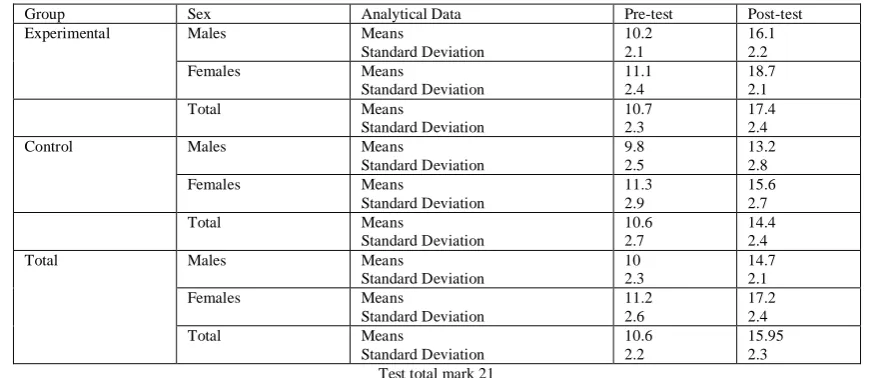
Findings related to the fist question: to answer the first question, means and standard deviation of the marks of the students were calculated for the two groups (experimental and control) before and after the experiment. Table 2 below shows the means and standard deviation of the marks of the students on the pre and post test according to group and sex.
TABLE (2)
DISTRIBUTES THE MEANS AND STANDARD DEVIATION OF THE MARKS OF THE STUDENTS ON THE PRE AND POST TEST ACCORDING TO GROUP AND SEX
Group Sex Analytical Data Pre-test Post-test
Experimental Males Means
Standard Deviation
10.2 2.1
16.1 2.2
Females Means
Standard Deviation
11.1 2.4
18.7 2.1
Total Means
Standard Deviation
10.7 2.3
17.4 2.4
Control Males Means
Standard Deviation
9.8 2.5
13.2 2.8
Females Means
Standard Deviation
11.3 2.9
15.6 2.7
Total Means
Standard Deviation
10.6 2.7
14.4 2.4
Total Males Means
Standard Deviation
10 2.3
14.7 2.1
Females Means
Standard Deviation
11.2 2.6
17.2 2.4
Total Means
Standard Deviation
10.6 2.2
15.95 2.3 Test total mark 21
TABLE (3)
EXPLAINS STATISTICAL DIFFERENCES BETWEEN THE MEANS OF THE TWO GROUPS ON THE POST-TEST
Difference Source Total of Squires Freedom Degree Means of Squires F-ratio Significance level
Pre-test 4.55 1 4.55 1.53 0.51
Teaching Strategy 45.62 1 45.62 15.41 0.03
Sex 171.54 1 171.54 57.95 0.02
Strategy-Sex Interaction 3.25 1 3.25 1.09 0.38
Deviation 348.71 118 2.96
Total 573.67 122
Table 3 shows statistical significances (α=0. 03) between the means of students in the experimental group and the means of their colleagues in the control group. This means that teaching strategy which adopted language holistic approach strategy gained higher marks than that of traditional method.
Findings related to the second question: to answer the second question, means and standard deviations were calculated for the groups on the post test according to students’ sex. Table 2 shows that the means of the male students is 14.7 and the means of the female students is 17.2. ANCOVA was employed to calculate the differences as shown in Table 3. A statistical significances (α=0. 02) was clearly shown between the two means in favor of female students.
Findings related to the third question: to answer the question ANCOVA was used to analyze the results. Table 3 shows that there are no statistical differences (α=0. 05) attributed to the interaction between the teaching strategy and sex.
Discussion of Findings
As shown on table 3, there are statistical significances (α=0. 03) between the means of performances of the experimental group over that of control group. This could be attributed to the teaching strategy (language holistic approach) which used to teach the students in the experimental group. Language holistic approach is definitely, improved the comprehension of the experimental group. Students who adopt this approach are characterized as active, participant and positive learners. When reading any text, they can build their own meanings, not only the superficial but also the implied meanings. Students, who embrace this approach, practice their reading skills in a happy manner, freely and in a full dignity, since they have the freedom to compose their own meanings depending on their past experiences. This strategy deals with the language as a whole which helps the reader to benefit from his reading lessons in his own real life. The learner of this approach could be able to discuss ideas in various reading texts not only using receptive skills but also productive skills as well. Holistic approach strategy can find real settings where a student can learn freely and positively. The providing of more opportunities to the students to build meanings such as: active negotiations, composing and improving their responsibilities toward learning make them creative learners and good decision makers. Teachers should be tolerant with their students all the time, and support them to become self-reliant. In this sense, students could be true learners, who can compose real language meanings depending on themselves not on their teachers. Holistic approach is actually a student centered strategy rather than a teacher centered one. When comparing it with conventional methods, it could be characterized as distinguishable. Traditional methods are normally based on recitation and memorization, the only role of the students is to recite and then answer the test questions accurately. When adopting traditional methods, students are passive, they only memorize and recall the given knowledge without understanding.
The finding of the present study is consistent with the findings of (Al-Ashhab, 2000, and Azzitawi, 2005). In these two studies, the results of the statistical analysis were in favor of the experimental groups over their colleagues in the control groups. In the present study, Table 3 shows Statistical differences (α=0. 02) between male and female students in favor of females. This could be attributed to the fact that females are socially more active than males. Language holistic approach as mentioned before needs a positive, participant and a socially active learner. Such a learner should be cooperative with his colleagues to figure out real meanings using all language skills, either receptive skills or productive skills. As proved in some recent studies, the female learners are better in language skills than their male colleagues. This also, could be attributed to the fact that females use left-side sphere of brain which is responsible for language abilities.
The results on Table 3 shows no statistical differences (α=0. 05) due to the interaction between sex and teaching strategy. However, the results of the present study indicate that the performance of the female is much better than males regardless the group. Even if the females adopt the holistic approach strategy or not, their results in reading comprehension test are higher than that of males.
V. RECOMMENDATIONS
In the light of the results of the present study, the researcher recommends the following:
• Training teachers of languages in general and teachers of English in particular to adopt language holistic approach strategy when teaching reading comprehension.
• Language holistic approach strategy should be implemented in the basic stage’s language syllabuses to improve the students’ reading comprehension.
REFERENCES
[1] Abdullatif, J. and Hadad, A. (2004). The effect of past experiences on Arabic reading comprehension for female tenth graders, Muta Researches and Studies, 19(1), 95-132.
[2] Abu-Ashiekh, A. (2002). Impact of Holistic Comprehension Strategy on the Achievement of Tenth graders in a Conjugation Subject. Unpublished M.A. Thesis, University of Jordan, Amman, Jordan.
[3] Alashhab, W. (2000). Effect of Holistic Comprehension Strategy on the Achievement of Ninth Graders in Arabic Syntax in Public Schools. Unpublished M. A. Thesis, Algods University, Palastine.
[4] Al-batayneh, Z. (2004). The Effect of Holistic Program to Teach Fluency, Literature and Criticism on the Achievement and Aesthetic Appreciation in Literal Comprehension Texts for the First Secondary Class. Unpublished PhD. Thesis, Amman Arab University for Graduate Studies, Amman, Jordan.
[5] Al-Hashemi, A. and AL-Azzawi, F. (2005). Teaching Listening Skill under Visual Practice (1st. ed.). Dar El-manahej for Publication and Distribution: Amman, Jordan.
[6] Al-Meri, F. (1994). Relation between creativity, text and receptive. Alam El-fikr, 23(1,2), 335-360.
[7] Al-otoum, A. Al-jarrah, A. and Bshra, M. (2009). Improvement of Thinking Skills – Theoretical Models and Practical Activities (2nd. ed.). Dar Al-maseerah, for Publishing and Distribution: Amman, Jordan.
[8] Ammar, S. (2002). Recent Trends in Arabic Teaching. Arrisaleh for Typing, Publication and Distribution: Beirut, Lebanon [9] Angier, M. (2009). Positive thinking: have a big why to win big. Personal Excellence, 14(11), 10-11.
[10] Ashrouf, Z. (2002). Effect of Using Metaphysical Knowledge Strategy on Reading Comprehension for Female Tenth Graders in Ramtha Directorate of Education. Unpublished PhD. Thesis, Yarmouk University, Irbid Jordan.
[11] Assayed, M. (1998). Arabic Teaching Methods (3rd. ed.). Publication of Damascus University, Damascus, Syria.
[12] Azzitawi, S. (2005). Impact of Using Holistic Approach on Teaching Reading Comprehension Passages to Improve Higher Thinking Skills for Seventh Graders in Ramtha Governorate. Unpublished M. A. Thesis, Yarmouk University, Irbid, Jordan. [13] Cara, C. (2007). The power of one with many revisited: creativity inclusive, accessible, collaborative education for all. The
International Journal of Learning, 14(8), 221-233.
[14] Croft, W. and Cruse, D. (2004). Cognitive Linguistics. Cambridge: Cambridge University Press.
[15] Freppon, P. (1991). Children Concepts of the nature and purpose of reading in different instructional sittings. Journal of Reading Behavior, 23(8), 139-163.
[16] Goodman, K. (1986). What’s whole in Whole language? NH: Heinemann.
[17] Goodman, K. (1989). Whole language research: foundation and development. Elementary School Journal, 2(90), 208-221. [18] Habibullah, M. (2000). Reading Functions and Understanding: Theory and Practice – Introduction to Improve Learning
Thinking and Understanding Skills (1st. ed.). Dar Ammar: Amman, Jordan.
[19] Harris, L. Smith, C. (1972). Reading Instruction through Diagnostic Teaching, New York: Holt Richard and Winston.
[20] Harste, J. Burke, C. and Woodward, V. (1994). Children Language and World: Initial Encounters with Print. In R.B. Rudde1, M. R. Rudde11, and H. Singer (Eds.), Theoretical Models and Processes of Reading (4th. ed.). Newark, DE: International Reading Association.
[21] Klein, K. (2005). Teaching young learners. English Teaching Forum, 43(1), 12-17.
[22] Latha, R. (2005). A reading program for elementary schools, English Teaching Forum, 43(1), 18-23.
[23] Nasr, H. (2003). English Teachers’ attitudes towards sing holistic approach and its relations with related variables in Sultanate of Oman. Journal of Faculty of Education, 19(1), 71-117. Assut University.
[24] Nimr, A. (2008). Effect of an Instructional Program Based on Holistic Approach on Improving Listening Comprehension Skills for Female Eighth Grade Students. Unpublished M. A. Thesis, University of Jordan, Amman, Jordan.
[25] Odeh, A. (2010). Evaluation and Measurement in the Teaching Process (4th. Ed.). Dar El-amal for Publication and Distribution: Irbid, Jordan.
[26] O’sullivan, M. (2004). The re-conceptualization of learner-centered approaches: A Namibian case study. International Journal of Educational Development, 24(6), 585-602.
[27] Richards, J. and Rodgers, T. (2001). Approaches and Methods in Language Teaching (2nd. ed.). Cambridge: Cambridge University Press.
[28] Roe, B., Stoodt B. and Burns, P. (1988). Secondary School Literary Instruction: The Content Areas. Boston: Houghton Mifflin Company.
[29] Schindler, A. (2006). Channeling children’s energy through vocabulary activities. English Teaching Forum, 44(2), 8-13. [30] Smith, F. (1985). Reading without Nonsense (2nd. Ed.). New York: Teacher College Press.
[31] Spoolsky, B. (2009). Language Management. Cambridge: Cambridge University Press.
[32] Tueima, R. and Manna, M. (2000). Teaching Arabic in Public Sector – Theory and Practice. Dar El-fikr Al-Arabi: Cairo, Egypt. [33] Weaver, C. (1994). Reading Process and Practice (2nd. ed.), NH: Heinemann.
[34] Weaver, C. and Henke, L. (1992). Supporting Whole Language: Stories of Teacher and Instructional Change. NH: Heinemann.
Mohammad Dayij Al.qomoul was born in Tafila-Jordan in 1957. He received his PH D. degree in TEFL from Amman Arab University for Graduate Studies in 2005.
He is currently an associate professor in curricula and instruction - Tafila Technical University-Jordan. His research interests include language and curricula.