INFLUENCE OF RICE HUSK ASH (RHA) ON THE DRYING
SHRINKING OF MORTAR
Benyamin Rasoul
[a]*Keywords: Physical properties; chemical composition; fineness; drying shrinkage, crystalline silica; rice husk ash.
The possibility of using of rice husk ash (RHA) in the mortar has been studied. The impact of physical properties and chemical composition of RHA on dry-shrinkage of mortar is a potential problem, especially in the context of the increased use of new generation solutions and the development of new materials to ensure sustainability. In this study, the effects of RHA content, RHA particles size (fineness) and silica structure have been evaluated. Comparisons are made over the full test period and at specific periods ranging from 3 days to 180 days. Incorporation of RHA provided lower dry shrinkage, where the amount of decrease in dry shrinkage increased with increase crystalline silica content and coarse particles size when compared to the control Ordinary Portland Cement (OPC) mixture, with finer RHA giving better improvement. Fine RHA exhibited the highest shrinkage value due to the effect of microfine particles which increases its shrinkage values considerably.
* Corresponding Authors Fax:
E-Mail: [email protected] [a] University of Brighton [b] 7 Manton road, Brighton/UK
Introduction
Cracking in the concrete bridge decks is a well-documented problem. The problem is particularly severe for a large structure, such as a large concrete floor. Cracking contributes to the deterioration of the structures and allows the ingress of water to the reinforcement, which may lead to corrosion. Cracking increases the maintenance costs, reduces the service life and may result in disruptive and costly repairs. Experience shows that a combination of shrinkage and thermal stresses causes most structure cracking. Efforts have been made to reduce the cracking by designing concrete mixes for minimal shrinkage and improving methods of construction, placement, and finishing. Various admixtures such as silica fume,1 and carbon fibres2 have been used to
reduce the drying shrinkage. Moreover, to conserve raw materials involved in the production process, eliminate wastes that impact the environment, and to improve the technical properties of concrete, previous studies have demonstrated the feasibility of replacing cement with agro-industrial sub-products. One such example is the ash obtained from burning rice husks, as rice is one of the most cultivated grains in the world. Research has shown that rice husks can improve concrete’s mechanical properties3 and durability.4
However, few studies have focused on the influence of the rice husk ash content on dry mortar shrinkage.
Experimental
Materials
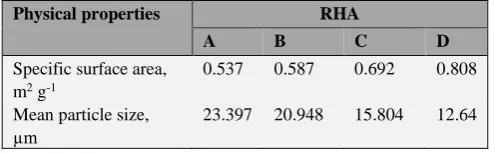
Three types of RHA (A, B and C) were used in the experimental research are brought from India, While RHA-D obtained by re-burned RHA-C at relatively high temperatures (550 ºC) for 6 h. Properties of rice husk ash, the typical physical properties and chemical composition are given in Tables 1 and 2.
Table 1. Physical properties of RHA samples.
Physical properties RHA
A B C D
Specific surface area, m2 g-1
0.537 0.587 0.692 0.808
Mean particle size, µm
23.397 20.948 15.804 12.64
Test procedures
The dry-shrinkage of RHA mortar mixtures were measured according to the recommendations made by ASTM standards ASTM C 490 standard.5 For each mix under investigation,
four specimens with dimensions of 400 mm × 50 mm × 50 mm were studied for each composition. After preparing and mixing, each mixture was carefully filled into two prisms moulds. The moulds kept for 24 h then de-moulded and the first reading, which is the initial reading, was recorded by using the apparatus of measurement of dry-shrinkage. The values of dry shrinkage represent the average of two specimens for each batch. The samples were stored in a room at 23 ± 2 °C at a relative humidity of 50 ± 10 % for air drying. Shrinkage readings were performed at 7, 14, 21, 28, 35, 56, 91, and 180 days. These readings were performed in an expandable comparator with a digital marker accurate to 0.001 mm.
Measurement of length change of specimens
To calculate the length change in OPC and RHA mortars, the ASTM C 490 formula was used (eqn. 1), where L = % change in length at x age, Lx = comparator reading of
specimen at x age minus comparator reading of reference bar at x age in mm, Li= Initial comparator reading of specimen
minus comparator reading of reference bar at that same time in mm and G = nominal gage length 250.
(1)
x
−
i100
=
L
L
Table 2. Chemical composition of RHA samples.
Table 3. The mix proportion of RHA mortar dry-shrinkage test.
Batch No. Cement, kg m-3 RHA, kg m-3 Water, kg m-3 SP*, kg m-3 SP (% wt. of binder)
OPC 587 0 292 1.47 0.25
5 558 29 292 1.47 0.25
10 528 59 292 1.47 0.25
15 499 88 292 1.47 0.25
20 470 117 292 1.47 0.25
30 411 176 290.56 2.94 0.50
40 352 235 287.63 5.87 1.00
50 293.5 293.5 281.76 11.74 2.00
60 235 352 270.02 23.48 4.00
Mix proportion and Curing
The mix proportions of the batches are given in table 3. Where the water binder ratio (w/b) was constant at 0.50 and the fine aggregate (silica sand) used was 1320 kg m-3.
Results and Discussion
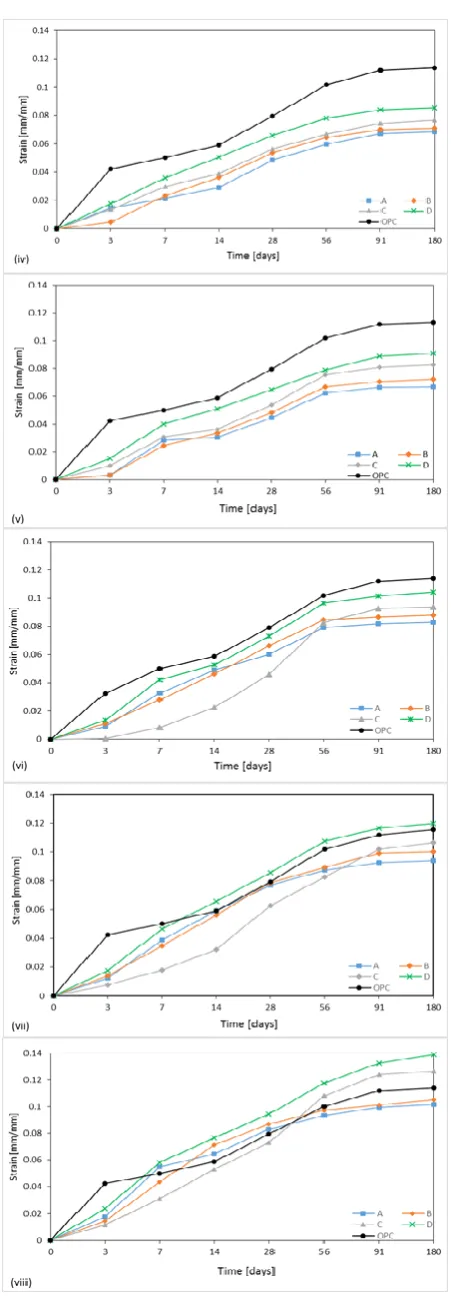
The dry shrinkage results for the RHA mortars mixes under investigation are presented in Figure 1 and Table 4. These results correspond to the average micro deformations (mm mm-1) of two specimens tested for each replacement ratio. In
general, the dry shrinkage of all the mixes ranged from 32 to 1016 10-4 mm mm-1 (RHA-A), 18 to 105210-4 mm mm-1
(RHA-B), 8 to 1242 10-4 mm mm-1 (RHA-C), 134 to 1391
10-4 mm mm-1 (RHA-D), compare to 424 to 1143 10-4 mm
mm-1 for OPC mortar, over 180 days. The mixes containing
RHA-A and RHA-B had values ranging from 18 to1052 10 -4 mm/mm, which is considered low for OPC mortar even at
60 % replacement ratio. The RHA-D displayed the highest values of dry shrinkage among all RHA mixes including the OPC mortar reference, at all replacement ratio and curing time.
Table 4. Dry shrinkage strain (mm/mm) of RHA mortars at different replacement ratio compare to OPC mortar at different ages.
Days 5 % RHA mortar OPC
mortar
A B C D
3 0.0118 0.004 0.0388 0.0462 0.0424 7 0.0246 0.0224 0.0476 0.0644 0.0500 14 0.0386 0.0482 0.0580 0.0770 0.0590 28 0.0554 0.0714 0.0766 0.0990 0.0794 56 0.0758 0.0912 0.0996 0.1154 0.1004 91 0.0776 0.0980 0.1054 0.1264 0.1120 180 0.0796 0.0995 0.1068 0.1298 0.1143
Days 10 % RHA mortar
A B C D
3 0.0112 0.0034 0.0172 0.0254 7 0.0328 0.0214 0.0370 0.0408 14 0.0414 0.0458 0.0502 0.0532 28 0.0576 0.0612 0.0636 0.0742 56 0.0646 0.0776 0.0832 0.0890 91 0.0678 0.0816 0.0882 0.0882 180 0.0689 0.0823 0.0891 0.1024
Days 15 % RHA mortar
A B C D
3 0.0056 0.0018 0.0158 0.0300 7 0.0270 0.0158 0.0336 0.0396 14 0.0396 0.0390 0.0438 0.0530 28 0.0502 0.0550 0.0598 0.0680 56 0.0568 0.0662 0.0694 0.0794 91 0.0646 0.0762 0.0806 0.0862 180 0.0659 0.0785 0.0819 0.0881
Days 20 % RHA mortar
A B C D
3 0.0148 0.0046 0.0138 0.0178 7 0.0216 0.0232 0.0298 0.0358 14 0.0290 0.0362 0.0390 0.0506 28 0.0484 0.0536 0.0564 0.0660 56 0.0596 0.0646 0.0670 0.0780 91 0.0672 0.0700 0.0744 0.0840 180 0.0685 0.0711 0.0768 0.0852
Days 30 % RHA mortar
A B C D
3 0.0034 0.0032 0.0100 0.0152 7 0.0284 0.0246 0.0306 0.0400 14 0.0304 0.0334 0.0362 0.0512 28 0.0444 0.0484 0.0538 0.0648 56 0.0624 0.0670 0.0754 0.0788 91 0.0664 0.0706 0.0808 0.0890 180 0.0670 0.0723 0.0827 0.0910
RHA sample Chemical composition (% wt. of ash)
SiO2 Al2O3 Fe2O3 CaO K2O P2O5 SO3 MnO
RHA-A 92.10 1.066 0.241 0.719 1.366 0.403 0.076 0.109
RHA-B 89.31 1.389 0.391 0.987 1.813 0.747 1.104 0.166
RHA-C 84.30 1.066 0.175 0.729 1.522 0.675 0.083 0.144
Days 40 % RHA mortar
A B C D
3 0.0092 0.0110 0.0008 0.0134 7 0.0330 0.0282 0.0084 0.0406 14 0.0490 0.0464 0.0228 0.0529 28 0.0604 0.0664 0.0462 0.0730 56 0.0794 0.0848 0.0826 0.0966 91 0.0818 0.0868 0.0928 0.1016 180 0.0829 0.0881 0.0937 0.1043
Days 50 % RHA mortar
A B C D
3 0.0122 0.014 0.0076 0.0176 7 0.0388 0.035 0.018 0.0406 14 0.0590 0.056 0.0322 0.0656 28 0.0770 0.0786 0.0626 0.0856 56 0.0874 0.0892 0.0826 0.1076 91 0.0926 0.0994 0.1018 0.1164 180 0.0939 0.1002 0.1065 0.1198
Days 60 % RHA mortar
A B C D
3 0.0176 0.0144 0.0116 0.0234 7 0.055 0.0436 0.0312 0.0582 14 0.0644 0.0712 0.053 0.0768 28 0.0832 0.0872 0.0732 0.0944 56 0.0934 0.0972 0.108 0.1176 91 0.0994 0.1014 0.1242 0.1326 180 0.1016 0.1052 0.1267 0.1391
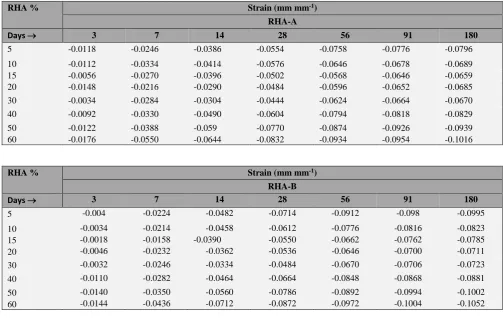
Table 5. Effect of RHA on the dry-shrinkage of mortar at different ages.
Effect the fineness of RHA particles
Based on the experimental results the RHA mean particles size, amorphous silica percentage are particularly effective on
the dry shrinkage of RHA mortars performance. Generally, there is a linear correlation between the particle size distributions to the development of dry shrinkage of RHA mortars which is presented in Table 5 (Figure 1).
RHA % Strain (mm mm-1)
RHA-A
Days → 3 7 14 28 56 91 180
5 -0.0118 -0.0246 -0.0386 -0.0554 -0.0758 -0.0776 -0.0796
10 -0.0112 -0.0334 -0.0414 -0.0576 -0.0646 -0.0678 -0.0689
15 -0.0056 -0.0270 -0.0396 -0.0502 -0.0568 -0.0646 -0.0659
20 -0.0148 -0.0216 -0.0290 -0.0484 -0.0596 -0.0652 -0.0685
30 -0.0034 -0.0284 -0.0304 -0.0444 -0.0624 -0.0664 -0.0670
40 -0.0092 -0.0330 -0.0490 -0.0604 -0.0794 -0.0818 -0.0829
50 -0.0122 -0.0388 -0.059 -0.0770 -0.0874 -0.0926 -0.0939
60 -0.0176 -0.0550 -0.0644 -0.0832 -0.0934 -0.0954 -0.1016
RHA % Strain (mm mm-1)
RHA-B
Days → 3 7 14 28 56 91 180
5 -0.004 -0.0224 -0.0482 -0.0714 -0.0912 -0.098 -0.0995
10 -0.0034 -0.0214 -0.0458 -0.0612 -0.0776 -0.0816 -0.0823
15 -0.0018 -0.0158 -0.0390 -0.0550 -0.0662 -0.0762 -0.0785
20 -0.0046 -0.0232 -0.0362 -0.0536 -0.0646 -0.0700 -0.0711
30 -0.0032 -0.0246 -0.0334 -0.0484 -0.0670 -0.0706 -0.0723
40 -0.0110 -0.0282 -0.0464 -0.0664 -0.0848 -0.0868 -0.0881
50 -0.0140 -0.0350 -0.0560 -0.0786 -0.0892 -0.0994 -0.1002
60 -0.0144 -0.0436 -0.0712 -0.0872 -0.0972 -0.1004 -0.1052
RHA % Strain (mm mm-1)
RHA-C
Days → 3 7 14 28 56 91 180
5 -0.0388 -0.0476 -0.0580 -0.0766 -0.0996 -0.1054 -0.1068
10 -0.0172 -0.0370 -0.0502 -0.0636 -0.0832 -0.0882 -0.0891
15 -0.0158 -0.0336 -0.0438 -0.0598 -0.0694 -0.0806 -0.0819
20 -0.0138 -0.0298 -0.0390 -0.0564 -0.0670 -0.0744 -0.0768
30 -0.0100 -0.0306 -0.0362 -0.0538 -0.0754 -0.0806 -0.0827
40 -0.0008 -0.0086 -0.0228 -0.0462 -0.0806 -0.0928 -0.0937
50 -0.0076 -0.0180 -0.0322 -0.0626 -0.1064 -0.1018 -0.1065
60 -0.0116 -0.0312 -0.0530 -0.0732 -0.1120 -0.1242 -0.1267
RHA % Strain (mm mm-1)
RHA-D
Days → 3 7 14 28 56 91 180
5 -0.0462 -0.0644 -0.0770 -0.0990 -0.1154 -0.1264 -0.1298
10 -0.0254 -0.0408 -0.0532 -0.0742 -0.0890 -0.0996 -0.1024
15 -0.0300 -0.0396 -0.0530 -0.0680 -0.0794 -0.0862 -0.0881
20 -0.0178 -0.0358 -0.0506 -0.0660 -0.0780 -0.0840 -0.0852
30 -0.0152 -0.0400 -0.0512 -0.0648 -0.0788 -0.0890 -0.0910
40 -0.0134 -0.0406 -0.0592 -0.0730 -0.0966 -0.1016 -0.1043
50 -0.0176 -0.0424 -0.0656 -0.0856 -0.1076 -0.1164 -0.1198
Effect of RHA properties on the dry shrinkage of mortar
As shown in Figure 1, there is a general trend on dry shrinkage decreasing with increasing replacement ratio up to 20 %. This can be justified by the pozzolanic and the filler effects.6 This fact has been reported by other researchers
also.7,8 These results correspond to the average micro
deformations (10-6 mm/mm) of the two specimens tested for
each mix. From data presented in Table 2, it can be noted that RHA-D at 5 % replacement ratio exhibited higher dry shrinkage than that of reference mortar by about 12.25 %. The increases in dry shrinkage strain of RHA-D at 5 %, can be justified by the pozzolanic and the filler effects.6 Even though,
RHA-C consists of entirely amorphous silica, it exhibited lower dry-shrinkage compare to OPC mortar at 5 % replacement ratio. This behaviour of RHA-C specimens can be attributed to the high residual carbon content. On the other hand, the dry shrinkage of RHA mortar specimens was noticeably reduced by the addition of RHA-A and B. Specimens at 180 days showed a reduction in dry shrinkage strain by 30.11 % and 12.64 % compared to OPC. Partial replacement crystalline silica with coarse particles of RHA provides a positive effect on the dry shrinkage of mortar, which is attributed to the filler effect. This correlation was determined for 20% RHA; however, it’s same for other RHA replacement ratio. Where, mortar specimens containing RHA-C and D with a particles size of 15.804 and 12.64 µm, exhibited higher dry-shrinkage compare to RHA-A and B with 23.397 and 20.948 μm, respectively. According to Habeeb and Fayyadh6 RHA with fine particles significantly
affected on the dry shrinkage of concrete mixtures containing 20 % RHA, Thus, it can be concluded that the addition of RHA content higher amount of microfine particles to mortar would increase the drying shrinkage.
Conclusions
The drying shrinkage was significantly affected by RHA silica structure and fineness of particles. RHA-D recorded the higher shrinkage value, while RHA-A exhibited lower values than the control, this could be due to the effect of the microfine particles.
The use of the RHA for application in mortar showed excellent performance in drying shrinkage at 60 % RHA-A and B compare to control mortar. Strains due to drying shrinkage are ranged from 1016 to 1391 ×10-6 (mm/mm) at
180 days.
The parameters affecting the dry shrinkage strain are RHA silica structure, size of RHA grain particles and replacement ratio. The effective mean particle size of RHA on mitigating dry shrinkage of RHA mixtures was suggested to be over 20.0 µm, where with coarser particles size less dry shrinkage reported.
Maximum dry shrinkage development registered was in between 3 to 7 days for all RHA mortars mixtures.
The behaviour of RHA dry shrinkage strain is linear concerning the composition of RHA. Where, with a high amount of crystalline silica content and coarser particles size, lower dry shrinkage was obtained as shown with results of RHA-B to A.
As the proportion of replacement ratio increases the dry shrinkage of the mortar decreased up to 15% RHA-A, and 20% RHA-B, C and D, beyond this limitation increased.
A linear relationship is established between compressive strength and dry shrinkage, this correlation is more significant for the dry shrinkage, and it will be more adequate if the shrinkage is measured starting from the setting time. It is shown that there is a strength value for each type of RHA mortar mixtures from which the shrinkage behaviour between blended cement and ordinary cement changes.
According to the literature, there is some debate among the researchers, about the advantageous use of RHA in mortar and concrete in respect of dry shrinkage. However, this study proves the point view of the majority of the researchers about the positive impact of RHA on the decrease of mortar dry shrinkage at the extended period.
References
1Xu, Y., Chung, D. D. L., Reducing the drying shrinkage of cement
paste by admixture surface treatments, Cement, Concrete Res., 2000, 30 (2), 241-245. https://doi.org/10.1016/S0008-8846(99)00239-2
2Park, S. B., Lee, B. I., echanical properties of
carbon-®ber-reinforced polymer-impregnated cement composites, Cement Concrete Compos., 1993, 15 (3), 153–163.
https://doi.org/10.1016/0958-9465(93)90004-S
3De Sensale, G. R., Strength development of concrete with rice-husk
ash, Cement, Concrete Compos., 2006, 28(2), pp.158-160.
https://doi.org/10.1016/j.cemconcomp.2005.09.005
4Cezar D. S., Characteristics of durability of concrete with fly ash
and rice husk ash with and without processing, Master’s thesis. Santa Maria: College of Civil Engineering, Federal University of Santa Maria, 2011, 143.
5ASTM, C., 490/C 490 M-09. Standard Practice for Use of
Apparatus for the Determination of Length Change of Hardened Cement Paste, Mortar, and Concrete, 2009.
6Habeeb, G., Fayyadh, M., Rice Husk Ash Concrete: the Effect of
RHA Average Particle Size on Mechanical Properties and Drying Shrinkage, Aust. J. Basic Appl. Sci., 2009, 3(3), 1616-1622.
7Zhang, M. H. and Malhotra, M. V., High-performance concrete
incorporating rice husk ash as supplementary cementing material, ACI Mater. J., 1996, 93(6), 629-636.
8Chatveera, B., Lertwattanaruk, P., Durability of conventional
concretes containing black rice husk ash, J. Environ. Manage., 2011, 92(1), 59-66. doi: 10.1016/j.jenvman.2010.08.007.