ASSESSMENTS OF PLANTS FOR PHYTOREMEDIATION OF
ARSENIC-CONTAMINATED WATER AND SOIL
María T. Alarcón-Herrera
[a]*, Mario A. Olmos-Márquez
[a], Cecilia Valles-
Aragon
[a], Esther Llorens
[a], Ignacio R. Martin Domínguez
[a]Paper was presented at the 4th International Symposium on Trace Elements in the Food Chain, Friends or Foes, 15-17 November, 2012,
Visegrád, Hungary
Keywords: phytoremediation; arsenic removal; arsenic contaminated soil and water; Shoenoplectus americanus; Eleocharis
macrostachya; Baccharis salicifolia
Phytoremediation is an innovative technology that uses plants in order to remediate polluted water and soil. A 10 week study in flower pots was performed in order to determine the arsenic (As) removal potential of Shoenoplectus americanus, Eleocharis macrostachya and
Baccharis salicifolia and also to evaluate their tolerance capacity to increasing doses of As. The experiment involved five different treatments with distinct As concentrations (1, 2, 3, 4 and 5 mg L-1 ) and a control (tap water) to determine the acclimatization capacity of
the species to the different concentrations. The number of plants and their height were determined during the experiment. The values for the factors of translocation, accumulation and enrichment were obtained at the end of the experiment; the maximum values for these factors were, respectively, 1.86, 92.13 and 1.63 for E. macrostachya, 1.73, 59.74 and 0.56 for S. americanus and 8.96, 27.94 and 6.72 for B. salicifolia. The maximum growth value belonged to the S americanus. The maximum concentration of As in water tolerated by E. macrostachya and B. salicifolia were 2 and 3 mg L-1 respectively. B. Salicifolia, has no tolerance for environments with high
concentrations of arsenic. S. americanus showed the highest As accumulation capacity and the greatest tolerance in the tested concentrations. E. macrostachya proved to be translocator plants and S. americanus was confirmed to be a stabilizer plant with a high potential for phytostabilization and rhizofiltration techniques.
* Corresponding Author
Maria Teresa Alarcón-Herrera E-Mail: [email protected]
[a] Miguel de Cervantes 120, Complejo Industrial Chihuahua 31109 Chihuahua, Chih. Mexico
INTRODUCTION
As removal of water sources for human consumption is one of the great challenges in the world. Millions of people have been or are being exposed to excessive levels of As through drinking water1,-3. The health effects attributed to
the consumption of water with high concentrations of As
include: skin diseases, cardiovascular, neurological,
hematological, renal and respiratory and liver cancer, kidney
and prostate 4 . Therefore minimizing the metalloid
concentrations in soils and water contaminated through various physical, chemical and biological, processes is one of the current challenges. Phytoremediation has been proposed as an alternative technology eco-friendly and
cost-effective to remediate soils contaminated with As.5,6 This
technique has been applied to the removal of different contaminants (including metals and metalloids) of soil, surface water, ground water and municipal and industrial wastewaters.7 In Mexico there are several areas affected by
high concentrations of As in groundwater. In recent decades, studies conducted at different sources of drinking water in the state of Chihuahua, have shown the presence of arsenic in concentrations exceeding the maximum permissible limits
of NOM-127-SSA1-1994,8 for human consumption, with an
average concentration of 0.152 mg L-1 and a maximum
concentration of 0,517 mg L-1 . In addition, the population
growth and overexploitation of the different aquifers have
caused an increase in the concentrations of this metalloid, which is found naturally in subsurface geological formations.
E. macrostachya, S. americanus and B. salicifolia are three
species of native plants from the state of Chihuahua that have been reported as As tolerant with potential application in phytoremediation techniques 9,10). Thus, the aim of this
study was to determine the translocation, accumulation, enrichment and tolerance factors of these plants species, for potential use in the phytoremediation of arsenic in water and soil.
EXPERIMENTAL
The experiment was performed in pots, for a period of 10
weeks, with 3 suspected As tolerant species: E.
macrostachya, S. americanus (Cyperaceaes family) and B.
salicifolia (Asteraceae family). The plants were subjected to
increasing doses of As prepared with sodium arsenite (1, 2, 3, 4 and 5 mg L-1 ) using tap water as a control. The
experiment was performed by duplicate in two different media: one with soil (loamy sand) composed of 91% sand and 9% of fine particles. The other was a hydroponic medium prepared with tap water and Arsenic.
Collection and acclimation of plants
E. macrostachya, S. americanus, and Bacharis salicifolia
silty sand. Plants were kept under flooded conditions with tap water, adding nutrients once a week for an acclimatization period of three months prior to the start of the experiment. Before placing the plants in pots, their size were measured, the wet weights determined, and the number of plants per pot was counted. These data were considered as the initial values of the experiment. The plants in hydroponic medium were placed in plastic bottles (2 L).
Plant monitoring
Throughout the period of experiment, the number of plants per pot were counted weekly, thereby determining the reproduction of plants subjected to various doses of As. To determine the growth, three individuals per pot were randomly selected, and their growth was measured weekly. At the end of the experiment, all plants were weighed to determine the biomass produced by each species.
Chemical analysis of plants
At the end of the experiment all the plants were extracted from their pots, washed with water, separated in different sections (roots, stems and leaf) and placed in plastic bags previously identified. The samples were dried at 60 ° C for 24h in an oven, and subsequently digested in a CEM microwave equipment Model MarsX. A certificated standard of tomato leafs was used as an analytical control.
The determination of As was carried out by atomic absorption spectrophotometry with hydride generator, GBC brand, model Avanta Σ, and an inductively coupled plasma (ICP-OES) Thermo Jarrell Ash brand, model AP-Duo Iris. To ensure the quality of analyzes, duplicate samples and controls were considered, as well as the measuring of certified standards.
Determination of translocation, accumulation and
enrichment coefficient
The translocation factor (TF) was calculated according to
the criteria established by Fitz and Wenzel11, by dividing the
concentration of As in shoot biomass (mg kg-1) by the
concentration of As in the root biomass (mg kg-1). The
accumulation factor (AF) was calculated by the ratio of As in the stem of the plant and the concentration of As in the stalk. Finally the enrichment coefficient (EC) was calculated by the ratio of As concentration in the treated plants, and the concentration of arsenic in soil12).
RESULTS AND DISCUSSION
The highest concentration of As was found in the roots of
the analyzed plants. E. macrostachya and S. americanus had
the highest accumulation of arsenic in the hydroponic
medium (Table 1), while B. salicifolia in soil (Table 2).
E.macrostachya presents a proportional accumulation of
As with the concentration increase of arsenic in the feed water. At lower As concentrations (>2 mg L-1 ), the plant
behaves as a tolerant, absorbing and holding As in the root.
Whereas at higher As concentrations (≤4 mg L-1 ) the plant
allows to accumulate greater amounts of As in the shoot also.
S. americanus tolerated arsenic concentrations up to 4 mg
L-1 in hydroponic medium for a period of 10 weeks. At
concentrations of 5 mg L-1 , the plant decreased its capacity
of arsenic accumulation; this may be due to a blocking defense or to prevent damage from the element in their
tissues13). The plant accumulated 30 times more arsenic
from soil, than from the hydroponic media, behaving as a tolerant during all tests.
B. salicifolia behaves poorly under high arsenic
concentrations in the media. Showing a possible saturation or activation in defense mechanisms to inhibit the toxic effects of arsenic. The plant behaves as traslocator in hydroponic media.
The biomass of E. macrostachya as S. americanus, had
increased proportionally with the increase of As
concentration in water. In contrast B. salicifolia produced
more biomass at low As concentrations in water. At the end
of the experiment it was observed that E. macrostachya and
S. americanus, roots developed rapidly at high As
concentrations, while the size of stem decreased.
S. americanus showed positive reproduction at all As
concentrations in both media (soil, hydroponic). The
maximum increase was of 73 new plants. E. macrostachya
plants showed an increase in the number of plants under concentrations of As in the range of 1-3 mg L-1 . Under
these concentrations, reproduction was the largest (76 new
plants). B. salicifolia reproduction didn’t occur in any of the
As concentrations.
With regard to size, all plants showed positive values in both mediums, but the plants developed better in flooded
soil. E. macrostachya showed the higher size with a
maximum value of 40 cm in hydroponic media and 104 cm. in soil.
Plant growth is a major parameter used to assess survival and adaptation of a given species to the environment. Plants responded to the excess of As supply in water and soil mediums by developing visible symptoms of toxicity,
besides decreasing stem biomass14.
B. salicifolia accumulated Arsenic in the root (11 to 329
mg kg-1) and in the stem from 29 to 141 mg kg-1, in the
loamy sand media (soil), irrigated with arsenic
concentrations between 0.02 and 4 mg L-1 . Although the
plant could accumulate arsenic, its reproductive capacity was inhibited, and the plant damage was evident for all arsenic concentrations tested in this study. Therefore, the plant is not suitable for phytoremediation purposes. The translocation factor was 4.79, which is about six times higher than the value reported for plants belonging to the same family as B. sarothroides (TF = 0.80) (Haque et al., 200815). High translocation of arsenic by B. salicifolia may
be the cause of its damage.
E. macrostachya showed a severe clorosis damage in the
stem by the forth week of experimentation, for arsenic concentrations greater than 2 mg L-1 in the hydroponic
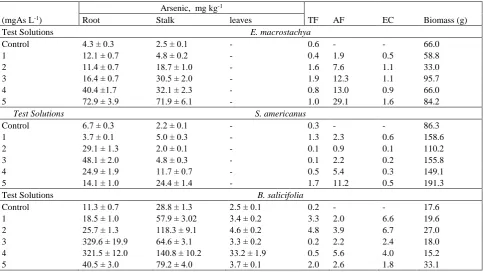
Table 1. Biosorption of arsenic by plants (mean ± standard deviation), tran slocation, and biomass accumulation using a hydroponic medium.
Arsenic, mg kg-1
(mgAs L-1) Root Stalk leaves TF AF Biomass (g)
Test Solutions E. macrostachya
Control 42.4 ± 2.2 1.8 ± 0.4 - 0.0 - 20.0 1 93.9 ± 4.1 35.6 ± 1.2 - 0.4 18.9 51.2 2 54.9 ± 3.4 73.4 ± 3.7 - 1.3 38.9 29.0 3 91.9 ± 6.0 156.1 ± 6.5 - 1.7 82.6 34.8 4 124.7 ± 6.3 162.7 ± 10.9 - 1.3 86.1 33.8 5 183.6 ± 8.3 174.1 ± 10.2 - 1.0 92.1 71.8 Test Solutions S. americanus
Control 39.2 ± 2.2 2.9 ± 0.1 - 0.1 - 60.6 1 62.8 ± 3.8 31.4 ± 1.2 - 0.5 10.5 125.5 2 239.4 ± 9.8 34.1 ± 2.2 - 0.1 11.4 108.2 3 357.7 ± 22.7 52.7 ± 3.9 - 0.1 17.6 101.3 4 616.5 ± 26.6 178.6 ± 11.4 - 0.3 59.7 149.6 5 419.5 ± 24.9 130.6 ± 6.8 - 0.3 43.7 166.6
Hydroponic media
Control 1.0 ± 0.1 2.6 ± 0.1 3.2 ± 0.2 5.5 - 12.4 1 1.4 ± 0.1 4.5 ± 0.2 8.0 ± 0.5 9.0 2.1 8.3 2 26.3 ± 1.4 32.5 ± 2.0 20.7 ± 1.2 2.0 9.1 2.7 3 51.8 ± 3.3 74.0 ± 5.7 60.5 ± 4.7 2.6 22.9 7.9 4 56.9 ± 3.2 65.0 ± 3.9 5.7 ± 0.4 1.2 12.0 9.3 5 94.1 ± 8.2 57.6 ± 3.4 109.2 ± 6.9 1.8 28.4 6.5
Table 2. Biosorption of As by plants (mean ± SD), translocation factors, accumulation and enrichment coefficient, using soil medium (silty sand).
Arsenic, mg kg-1
(mgAs L-1) Root Stalk leaves TF AF EC Biomass (g)
Test Solutions E. macrostachya
Control 4.3 ± 0.3 2.5 ± 0.1 - 0.6 - - 66.0 1 12.1 ± 0.7 4.8 ± 0.2 - 0.4 1.9 0.5 58.8 2 11.4 ± 0.7 18.7 ± 1.0 - 1.6 7.6 1.1 33.0 3 16.4 ± 0.7 30.5 ± 2.0 - 1.9 12.3 1.1 95.7 4 40.4 ±1.7 32.1 ± 2.3 - 0.8 13.0 0.9 66.0 5 72.9 ± 3.9 71.9 ± 6.1 - 1.0 29.1 1.6 84.2
Test Solutions S. americanus
Control 6.7 ± 0.3 2.2 ± 0.1 - 0.3 - - 86.3 1 3.7 ± 0.1 5.0 ± 0.3 - 1.3 2.3 0.6 158.6 2 29.1 ± 1.3 2.0 ± 0.1 - 0.1 0.9 0.1 110.2 3 48.1 ± 2.0 4.8 ± 0.3 - 0.1 2.2 0.2 155.8 4 24.9 ± 1.9 11.7 ± 0.7 - 0.5 5.4 0.3 149.1 5 14.1 ± 1.0 24.4 ± 1.4 - 1.7 11.2 0.5 191.3 Test Solutions B. salicifolia
These physical changes were consistent with the high translocation factors (TF) obtained by the chemical analysis of the plants at the end of the experimentation (1.3, 1.7, 1.3
and 1) for As concentrations of 2, 3, 4 and 5 mg L-1
respectively. Indicating that, when the plant is under high As concentrations, the metaloid is translocated to the shoot, causing damage to the cell membrane. This can be attributed to the possible interaction of arsenic with sulfhydryl groups
of proteins in the plant 16). For As concentrations lower than
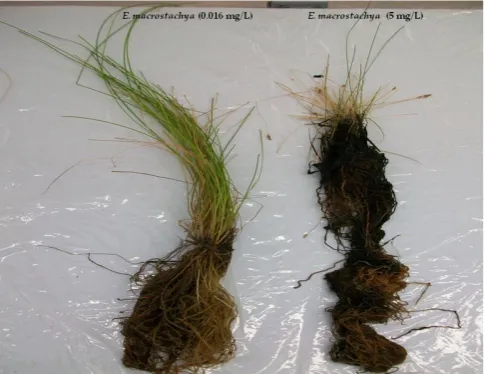
3. The root of the plant suffered no apparent damage, but its size increased proportionally to the increase in As concentration in water (Figure 1)
Figure 1. Root and stem size in E. macrostachya, after undergoing As concentrations of 0,016 mg L-1 and 5 mg L-1 for a period of
10 weeks.
Accumulation factors (AF) calculated for E. macrostachya
in soil (Table 2) shown that at higher concentrations of arsenic in the irrigated water, the plant also accumulated more arsenic in root and stem. The higher values correspond to the higher As concentration of 5 mg L-1 . These values
are approximately 7 times higher than those reported in previous studies of the plant when it was subjected to arsenic concentrations in irrigation water, between 3 and 9 mg L-1 , for a period of four months (Nuñez et al., 2007).
However, translocation factors obtained in both the studies are a coincident, confirming that the plant is tolerant to
arsenic concentrations lower than 2 mg L-1 whereas above
this value, the damage is visible, ceasing to be tolerant when
the As concentration increased to 3 mg L-1 in the irrigated
water.
S. americanus in soil, irrigated with 3 mg L-1 of arsenic,
was able to accumulate 48 mg/kg of arsenic in their roots and 4.8 mg/kg in their stems (Table 2). In previous studies (Flores et al., 2003) reported that for soils irrigated with
concentrations of 9 mg L-1 of arsenic in water, the arsenic
accumulation in the plant roots was approximately 6 times less than the results obtained in the present study (7.6 mg kg-1). However, the amounts of arsenic in the stalk are a
coincident (4.7 mg kg-1). This behaviour is attributable to
the fact that the plant decreases arsenic absorption at concentrations greater than 3 mg L-1 and it behaves as
exception to arsenic, possibly to restrict the adverse effects
on the vegetal structure (Castillo-Michel et al., 200917).
Studies with plants associated with desert environments
shows that other plants like Prosopis sp. and Chilopsis
linearis accumulate As up to 445 mg kg-1 in their roots18,15)
S. americanus accumulated As up to 616 mg kg-1 in
hydroponic medium (Table 1). Due to this characteristic feature researchers are suggesting its potential use in
phytoremediation of contaminated water and soil. E.
macrostachya can also be considered in phytoestabilization
techniques for sites with concentrations up to 2 mg L-1 .
Considering that the characteristic of extracting metals from
water is known as ‘rhizofiltration’, E. macrostachya and S.
americanus could, therefore, also be considered as
rhizofilterers of As, due to its capability of grow in flooded
environments19.
This research shows that, B. Salicifolia, has least tolerance
for environments with high concentrations of arsenic. E.
macrostachya and S. americanus are tolerant to high
concentrations of arsenic in soil and water. The higher concentrations of As, the greater the As accumulated in the roots of plants. The maximum tolerated concentration of
arsenic in hydroponic medium for E. macrostachya was 2
mg L-1, and for soil (silty sand) it was 4 mg L-1.
S. americanus showed the highest As accumulation
capacity and greater tolerance for As concentrations up to 3
mg L-1 , showing no evidence of physical damage to the cell
or tissue limitation in their reproduction and growth. Both
species E. macrostachya and S. americanus behave as
tolerating and excluding with a high potential for use in phytoremediation strategies.
ACKNOWLEDGEMENTS
This research has been supported by the Spanish Agency for International Development Cooperation (AECID) through the two projects 10-CAP1-0631 and 11-CAP2-1583.
REFERENCES
1 Wickramasinghe, S. R., Han, B., Zimbron, J., Shen Z., Karim, M.
N., Desalination, 2004, 169, 231-244.
2Caceres, D. D., Pino, P., Montesinos, N., Atalah, E., Amigo, H.,
and Loomis, D., Environ. Res., 2005, 98(2), 151-159.
3Agusa. T., Kunito, T., Fujijara, J., Kubota, R., Minh. T. B., Trang.
P. T. K., Iwata. H., Subramanian A., Viet. P. H., and Tanabe. S. Environ. Pollut., 2006, 139(1), 95-106.
4Morton, W. E., Dunette, D.A. Health effect of environmental
arsenic. In: Nriagu, J. O., Editor. Arsenic in the environment, Part II: Human and ecosystem effects. New York: Wiley and sons; 1994, 17-34.
5Lasat, M. M., J. Environ. Qual. 2002, 31, 109-120.
6Mc Grath, S. P., Zhao, F. J., Lombi, E. Adv. Agron. 2002, 75,
1-56.
7USEPA (United States Environmental Protection Agency). Arsenic treatment technologies for soil, waste and water.
Office of Solid Waste and Emergency Response. EPA 542-R-02-004. 2002.
8Secretaria de Salud, Modificación a la Norma Oficial Mexicana
tratamientos a que debe someterse el agua para su potabilización. 2000.
9Flores-Tavizòn, E., Alarcón-Herrera, M. T., Gonzàlez-Elizondo,
S., Olguín, E. J., Arsenic tolerating plants from mine sites and hot sprongs in the semi-arid región of Chihuahua, Mexico, Acta Biotechnol.,2003 113-119.
10Nuñez Montoya, O. G., Alarcón Herrera, M.T., Melgoza Castillo,
A., Rodríguez Almeida, F.A. y Royo-Márquez, M.H. Evaluation of three native species from Chihuahua desert for use in phytoremediation, Terra Latino., 200725(1) 35-41.
11Fitz, W. J. Y Wenzel, W. W. Arsenic transformations in the
soil-rhizosphere-plant system: fundamentals and potential application to phytoremediation. Biotechnol., 2002 99, 259-278.
12 Zu, Y.Q., LI, Y., Chen, H,Y., Qin, L., Schvartz, C.
Hyperaccumulation of Pb, Zn and Cd in herbaceous grown on lead-zinc mining area in Yunnan, China. Environ. Int.
2005, 31, 755-762.
13 Gonzalez-Mendoza, D., Zapata-Perez, O. Mecanismos de
tolerancia a elementos potencialmente tóxicos en plantas. Boletín de la Sociedad Botánica de México, Distrito Federal, México. 2008, 82, 53-61.
14Shanker, A.K., Cevantes, C., Loza-Tavera, H., Avudainayagam,
S. Chromium toxicity in plants. Environ. Int., 2005, 31, 739-753.
14Haque N., Peralta-Videa, J. R., Jones, J. L., Gill, T. E.,
Gardea-Torresdey J. L. Screening the phytoremediation potential of desert broom (Baccharis sarothroides gray) growing on mine tailing in Arizona, USA. Environ. Pollut., 2008,153, 362-368.
15Haque N., Peralta-Videa, J. R., Jones, J. L., Gill, T. E.,
Gardea-Torresdey J. L. Screening the phytoremediation potential of desert broom (Baccharis sarothroides gray) growing on mine tailing in Arizona, USA. Environ. Pollut., 2008,153, 362-368.
16Wauchope, R.D. Uptake, translocation and phytotoxicity of
arsenic in plants. In: Arsenic: Industrial, Biomedical, Environmental Perspectives (Lederer y Fensterheim (ed.)). Arsenic Symposium, Gaithersburg, Maryland. Van Nostrand Reinhold Company. New York, N.Y. 1983, 348-374.
17Castillo-Michel H. A., Zuverza-Mena N., Parsons J. G., Dokken
K.M., Duarte-Gardea M., Peralta-Videa J. R., Gardea-Torresdey J.L. Accumulation, spatiation and coordination of arsenic in an inbred line and a wild type cultivar of the desert plant species Chilopsis linearis (desert willow), Phytochem.,
2009, 70, 540-545.
18Haque N., Peralta-Videla, J. R., Duarte-Gardea M.,
Gardea-Torresdey J. L. Different effect of metals/metalloids on the growth and element uptake of mesquite plants obtained from plants grown at a Cooper mine tailing, Biores.,2009,100, 6177-6182.
19Mielke, M.S., Almeida, A.-A.F., Gomes, F.P., Aguilar, M.A.G.,
Mangabeira,P.A.O., 2003. Leaf gas exchange, chlorophyll fluorescence and growthresponses of Genipa americana seedlings to soil flooding. Environ. Exp.Bot., 2003, 50, 221-231.