Volume 77 (2019)
Interactive Workshop on the Industrial Application of
Verification and Testing,
ETAPS 2019 Workshop
(InterAVT 2019)
AskTheCode: Interactive Call Graph Exploration
for Error Fixing and Prevention
Robert Hus´ak, Jan Kofroˇn and Filip Zavoral
6 pages
AskTheCode: Interactive Call Graph Exploration
for Error Fixing and Prevention
Robert Hus´ak1, Jan Kofro ˇn2and Filip Zavoral3
1[email protected] 2[email protected]
Charles University
Faculty of Mathematics and Physics, Prague, Czech Republic
Abstract: In order to prevent and fix errors in program code, developers need to understand its semantics to a significant extent. For this purpose, they use various approaches, such as manual call graph exploration or dynamic analysis with a de-bugger. However, these techniques tend to be cumbersome in a larger codebase, because they provide either underapproximate or overapproximate results and it is often hard to combine them. Therefore, we present AskTheCode, a Microsoft Vi-sual Studio extension enabling to interactively explore a call graph, ensuring that only feasible execution traces are taken into consideration. AskTheCode is based on control flow analysis and backward symbolic execution. We show its potential to significantly improve developers’ experience on a complex code example.
Keywords: control flow analysis, symbolic execution, call graph, interactive, de-bugging
1
Introduction
When developers want to fix and prevent errors by understanding the semantics of the source code, they usually use manual call graph exploration and debugging. However, call graphs are often complicated and the calls can be constrained by various conditions. Debugging, on the other hand, might be misleading and incapable of capturing all the possible situations. Therefore, finding the exact context under which a bug can occur is tedious and error-prone [LM10].
2
Design
The primary purpose of AskTheCode is to reason about the context under which a certain situ-ation in a program can occur. Therefore, an efficient way to formulate what problem we need to address is writing an assertiona0 specifying the expected semantics and check in which
sit-uations it can be violated. Notice that this approach is suitable not only for bug fixing, but also for their prevention, because developers can use the tool to confirm their possibly incorrect ideas about the program semantics.
To verify an assertion, a natural approach is to inspect the code against the control flow and look for any input that eventually violates it. Because AskTheCode is a Microsoft Visual Studio extension aimed at C# code analysis, it can access the Roslyn .NET compiler [NH14]. We use it to construct control flow graphs and the call graph of the methods related to the problem being solved. Next, we utilize backward symbolic execution [BCD+18, CFS09] to perform the assertion verification itself, employing the Z3 SMT solver [DB08]. Depending on the user configuration, anentry pointis either a non-private method in the same class as wherea0occurs, or a public method in a public class within the project. To tackle path explosion and other symbolic execution problems, users can also adjust loop unwinding, recursion limit, and timeout. All the execution traces fromentry pointsto violatinga0are continuously gathered during the run of backward symbolic execution. We provide users with a panel allowing them to interac-tively explore those traces as if they were a program under execution. They can step forward and backward throughout the particular methods and statements and see their intermediate values. Furthermore, they can also inspect the relevant heap structure and its changes.
There is also a high-level overview in the form of an annotated call graph, rendered using the Microsoft Automatic Graph Layout library [NNB+16]. The graph is continuously updated as backward symbolic execution runs on background. At the beginning, it consists only of the method m0 containing a0, but then it expands as the explored states extend to the callers and
callees ofm0. Whenever an execution trace is discovered, all the methods it traverses are empha-sized in red to draw the user’s attention. On the other hand, if there are not any states capable of extending to a methodmu, we markmuas unreachable by making its background green. The
user can also explicitly ignore certain methods, letting the analysis focus on less complicated ones.
3
Example
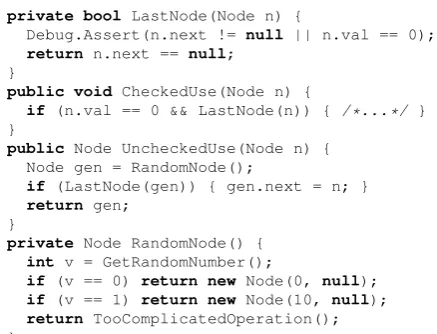
To demonstrate how can AskTheCode help developers, let us inspect the code example in Fig-ure1. It presents an excerpt from a library working with singly linked lists. They are represented by theNodeclass containing an integer fieldvaland a reference to the following node called
next. Due to a certain implementation issue, it is demanded that whenever aNodeis last in a list, itsvaluemust be zero. InLastNode, we check this property using an assertion. Imagine that we have received a bug report stating that this property is sometimes violated, but we were not given any exact context under which it can happen.
private bool LastNode(Node n) {
Debug.Assert(n.next != null || n.val == 0); return n.next == null;
}
public void CheckedUse(Node n) {
if (n.val == 0 && LastNode(n)) { /*...*/ } }
public Node UncheckedUse(Node n) { Node gen = RandomNode();
if (LastNode(gen)) { gen.next = n; } return gen;
}
private Node RandomNode() { int v = GetRandomNumber();
if (v == 0) return new Node(0, null); if (v == 1) return new Node(10, null); return TooComplicatedOperation(); }
Figure 1: Example C# code with an assertion inLastNodeto be verified
requires us to inspect the logic of each affected method to ensure the situation is handled in there. In our example, we need to inspectCheckedUse, although it never allows the error to happen. Debugging, on the other hand, reveals only the situations which can indeed cause the error being inspected. However, it might be often difficult to reproduce the error and we cannot be sure that we have discovered all the contexts under which it can occur. Furthermore, the information provided by the debugger is limited. Considering our example, after reproducing the error and pausing the program execution on the violated assertion, we can seeUncheckedUsein the call stack. However, we cannot see what exactly happened in the call ofRandomNode, because we no longer know the indeterministic valuevand hence the executed branch.
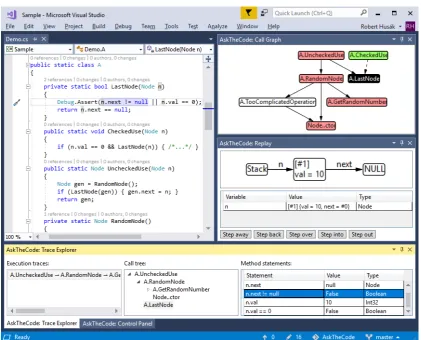
The mentioned problems can be solved using AskTheCode, as we can see in Figure2. The call graph displayed in the top right panel shows thatLastNodeis called both byCheckedUse
andUncheckedUse. CheckedUseis displayed with a green background and dashed arrow, as it is proven not to cause the error. On the other hand, UncheckedUseis emphasized in red together with its calleesRandomNode,GetRandomNumberand theNodeconstructor, as there was found an assertion violating program trace going through them. RandomNode can also potentially call another method, TooComplicatedOperation, whose definition we have intentionally skipped. As we can tell from its name, it was too complicated for backward symbolic execution to handle automatically. Therefore, as it is shown in the call graph, we at least know that it is worth to be inspected manually, unlikeCheckedUse.
Regarding the found trace, we can explore it in the bottom panel by inspecting its call tree and the particular statements. Whenever we select a statement in the table, the appropriate piece of code is selected in the opened code editor in the top left part. Furthermore, there is a replay panel on the right in which we can see the contents of the heap and of all the local variables at the given step of the trace. On its bottom, there are buttons to navigate through the trace in a debugger-like fashion, with the added capability of stepping backward in the history. From the trace, we can now easily discover that at least one of the problematic situations happens whenv
Figure 2: AskTheCode in Microsoft Visual Studio 2017
4
Related Work
In the field of human interface design, there are numerous tools helping developers to understand the semantics of the code [SBM17,DR10]. Probably the closest one to our approach is Reacher [LM11], a tool to interactively and intuitively explore complex call graphs. However, these tools do not reason about reachable paths as soundly as symbolic execution. Furthermore, they are not directly aimed at verifying assertions, hence no production of error traces.
5
Conclusion
On a complex example which models situations known from practice, we demonstrate that Ask-TheCode can help developers understand causes of errors. Utilizing interactive approach, certain limitation of used backward symbolic execution can be alleviated, e.g. by voluntarily omitting certain problematic places or controlling loop unwinding. In the future, we plan to extend the in-teractivity even more, and implement more advanced features such as state merging [KKBC12] or directed call graph construction [CFS09], ultimately making AskTheCode production-ready.
Acknowledgements: This work was supported by the project PROGRESS Q48, the Czech Science Foundation project 18-17403S and the grant SVV-2017-260451.
Bibliography
[BCD+18] R. Baldoni, E. Coppa, D. C. D’elia, C. Demetrescu, I. Finocchi. A survey of sym-bolic execution techniques.ACM Computing Surveys (CSUR)51(3):50, 2018.
doi:10.1145/3182657
[CFS09] S. Chandra, S. J. Fink, M. Sridharan. Snugglebug: A Powerful Approach to Weakest Preconditions.SIGPLAN Not.44(6):363–374, June 2009.
doi:10.1145/1543135.1542517
[DA14] P. Dinges, G. Agha. Targeted Test Input Generation Using Symbolic-Concrete Back-ward Execution. In29th IEEE/ACM International Conference on Automated Soft-ware Engineering (ASE). ACM, V¨aster˚as, Sweden, September 15-19 2014.
doi:10.1145/2642937.2642951
[DB08] L. De Moura, N. Bjørner. Z3: An Efficient SMT Solver. In Proceedings of the Theory and Practice of Software, 14th International Conference on Tools and Algorithms for the Construction and Analysis of Systems. TACAS’08/ETAPS’08, pp. 337–340. Springer-Verlag, Berlin, Heidelberg, 2008.
doi:10.1007/978-3-540-78800-3 24
[DR10] R. Deline, K. Rowan. Code canvas: Zooming towards better development environ-ments. InProceedings of the 32nd ACM/IEEE International Conference on Software Engineering - Volume 2. Volume 2, pp. 207–210. 05 2010.
doi:10.1145/1810295.1810331
[KKBC12] V. Kuznetsov, J. Kinder, S. Bucur, G. Candea. Efficient State Merging in Symbolic Execution. InProceedings of the 33rd ACM SIGPLAN Conference on Programming Language Design and Implementation. PLDI ’12, pp. 193–204. ACM, New York, NY, USA, 2012.
[LM10] T. D. LaToza, B. A. Myers. Developers Ask Reachability Questions. InProceedings of the 32Nd ACM/IEEE International Conference on Software Engineering - Volume 1. ICSE ’10, pp. 185–194. ACM, New York, NY, USA, 2010.
doi:10.1145/1806799.1806829
[LM11] T. D. LaToza, B. A. Myers. Visualizing call graphs. In2011 IEEE Symposium on Visual Languages and Human-Centric Computing (VL/HCC). Pp. 117–124. Sep. 2011.
doi:10.1109/VLHCC.2011.6070388
[MYFH11] K. Ma, K. Yit Phang, J. S. Foster, M. Hicks. Directed Symbolic Execution. InStatic Analysis. Pp. 95–111. Springer Berlin Heidelberg, Berlin, Heidelberg, 2011.
doi:10.1007/978-3-642-23702-7 11
[NH14] T. Neward, J. Hummel. Rise of Roslyn.MSDN29(11):70, 2014.
https://msdn.microsoft.com/en-us/magazine/dn818501.aspx
[NNB+16] L. Nachmanson, A. Nocaj, S. Bereg, L. Zhang, A. Holroyd. Node Overlap Re-moval by Growing a Tree. InGraph Drawing and Network Visualization. Pp. 33– 43. Springer International Publishing, Cham, 2016.
doi:10.1007/978-3-319-50106-2 3
[SBM17] J. Smith, C. Brown, E. Murphy-Hill. Flower: Navigating program flow in the IDE. In 2017 IEEE Symposium on Visual Languages and Human-Centric Computing (VL/HCC). Pp. 19–23. 10 2017.