A Cognitive Linguistics Approach to Chinese
Classifier Teaching: An Experimental Study
Liulin Zhang
Department of East Asian Languages and Literatures, The University of Hawaiʻi at Mānoa, Honolulu, USA
Song Jiang
Department of East Asian Languages and Literatures, The University of Hawaiʻi at Mānoa, Honolulu, USA
Abstract—Chinese is commonly recognized as a classifier language with an obligatory classifier for any noun with numeral. Based on the fact that in almost all Chinese textbooks the usage of classifiers is introduced by a set of mechanical rules combining a few isolated examples, most students without classifier language background need to learn by rote memorization. This traditional approach overlooks the polysemous properties of Chinese classifiers that the functions of an individual classifier are normally related to a central sense, and the extension of meanings and functions is usually highly motivated. According to the cognitive linguistics approach (CL approach) to language instruction, presenting students with the central sense as well as the motivation underlying meaning extension facilitates students’ initial learning, long-term retention, as well as identification of unfamiliar uses of polysemy. Taking the Chinese classifier 道dao as an example, the present study focuses on the effect of CL approach in the Chinese classifier learning of advanced level Chinese learners with English as their first language. Participants were assigned to two groups and received different instructions. The result shows a statistically significant effect, but the benefit of CL approach lies mainly in the ability to identify uninstructed extended uses.
Index Terms—Chinese classifier, cognitive linguistics, polysemy, experimental method
I. INTRODUCTION
Recognized as a classifier language, Mandarin Chinese presents an extensive inventory of ‘classifiers’ that must be used in combining a numeral with any noun (Jiang, 2012, p. 1).
(1) san *(ge) ren 三个人 three Cl person ‘three persons’ (Jiang, 2012, p. 2)
There are over 900 classifiers in the language (Zhang, 2007). The most frequently used classifier in Mandarin is 个 ge, but many nouns still require special classifiers. Generally, the classifier is determined by the inherent property of the objects and is restricted to a certain type of object (Jiang, 2009, p. 293).
Based on the essential difference between classifier languages and non-classifier languages, Li & Thompson (1981) claimed that ‘to a speaker of English, one of the most striking features of the Mandarin noun phrase is the classifier’ (p. 104), and ‘by and large, which nouns occur with which classifier must be memorized’ (p. 112).
Consistent with Li & Thomson’s claim, Jiang (2009) investigated Chinese textbooks and found that the usage of classifiers is typically introduced by a set of mechanical rules combining a few isolated examples, such as 条 (tiao “branch”) is for long things as in a line or a road, 张 (zhang “to stretch”) is for flat things, as in a piece of paper or a poster (p. 307). Therefore, rules concerning the same classifier appear to be arbitrary and unrelated for learners, making rote memorization the only practical way for students to learn Chinese classifiers.
However, it has been repeatedly demonstrated that the functions of individual Chinese classifiers are not as arbitrary as the way they are presented in textbooks. Rather, there is always a semantic relation between a classifier and the associated nouns referenced by the classifier, and the functions of an individual classifier are normally related to a central sense.
Tai & Wang (1990) argued that classifiers in Chinese to a great extent reflect human categorization in Chinese culture.
(2) A classifier categorizes a class of nouns by picking out some salient perceptual properties, either physically or functionally based, which are permanently associated with the entities named by the class of nouns.
(Tai & Wang, 1990)
type of human categorization based on an imputed salient perceptual property of ‘extension in length’, which actually stems from the original meaning of the character 条 “branch”.
In addition, there is normally a certain kind of association between the multiple functions of a classifier. In other words, a semantic network can be captured and individual classifiers can thus be viewed as polysemies in most cases. Cognitive linguistic research on polysemy has suggested that the various meanings of a polysemous item constitute a ‘category of senses’, which center on a ‘prototypical’ or ‘more representative’ sense, from which the others may be derived (Lakoff, 1987, p. 416-419). In support of Lakoff’s claim and applied to Chinese classifiers, Jiang (2009) argued that each individual extension of the uses of a classifier has its own historical cognitive basis that can result in a very complicated network structure (p. 294).
Therefore, a conjecture has been ventured that by explaining the meaningful systematicity of the semantic networks of Chinese classifiers, the cognitive linguistics (CL) approach in language teaching potentially lessens Chinese learner’s memory load, and thus offers a more teachable and more learnable account of the Chinese classifier system in the second language classroom (Hou, 2006; Jiang, 2009, p. 297-298). However, this conjecture is yet to be supported by empirical evidence. To fill in the gap between theory and practice, the present study focuses on whether the CL approach can facilitate English native speakers’ learning of Chinese classifiers, compared to the traditional textbook approach.
II. VOCABULARY TEACHING AND COGNITIVE LINGUISTICS
In fact, the potential pedagogical implications of a CL approach have already received researchers’ attention and are dramatically gaining momentum. Langacker (2008) expressed optimism that language teaching would fare better when guided by notions from cognitive linguistics. He explained, ‘compared to other approaches, cognitive linguistics offers an account of language structure that —just from the linguistic standpoint— is arguably more comprehensive, revealing, and descriptively adequate’. Tyler (2012) argues that the CL approach has the potential to provide rich insights into the relatedness of, organization of, and motivation for the core and many “exceptional” uses associated with aspects of lexis and grammar and ultimately, these insights offer language learners a more coherent and explanatory description of the language (p. 18).
Quite a few experiments have been carried out to illustrate the effect of the CL approach to second language learning, especially for English (ESL) and German (GSL). In Huong’s (2005) and Verspoor’s (2009) studies aiming at instruction of English articles, learners receiving instruction based on the CL approach showed significant gains on an immediate posttest and/or delayed posttest in comparison to learners receiving traditional instruction. In an effect of instruction experiment focusing on English aspect, Niemeier (2008) found that exposing students to the link between English aspect and the notion of boundedness resulted in significant gains in their ability to use the progressive aspect. Boers and Lindstromberg’s (2008) edited volume presents numerous recent studies on the applications of the CL approach in learning general vocabulary, idioms and phrasal verbs. As for polysemies and the semantic networks of individual words, Verspoor and Lowie (2003) found that teaching the central meaning of a word first facilitated more accurate interpretation of unfamiliar extended meanings. In their experiment with Dutch-English learners, the cognitive group presented with the core sense of the tested words outperformed the traditional group in both initial learning of meaning extensions and long-term memory of the extended uses. Csábi, S., (2004), Beréndi, Csábi & Kövecses (2008) undertook experiments teaching the meanings of hold and keep to L1 Hungarian learners. The cognitive group that received a teacher’s explanation of the polysemy networks and the motivations for the targeted extensions outscored the traditional group in immediate and delayed posttests.
All these experiments provide evidence that systematically alerting students to the central sense and/or the motivation of meaning extension of a polysemy can help promote more appropriate use and long-term retention of L2 lexical items. However, to our knowledge, in the field of Chinese pedagogy, the same type of empirical study is yet to be conducted despite the considerable body of literature theoretically arguing the value of the CL approach in teaching Chinese classifiers (see section 1). Therefore, in accordance with studies in ESL and GSL, the present study aims to fill this gap by testing whether presenting polysemy networks and motivations for extensions can facilitate English speaking learners’ initial learning, long-term memory as well as extended use of Chinese classifiers. The hypothesized result is a positive effect of the CL approach exists not only in initial learning and long-term retention, but also in learners’ identification of new uses.
III. METHOD
A. Participants
32 native English speakers were recruited from 300 or 400 level Chinese classes in Institution XX (16 males, 16 females, mean age 27.03)1. The reason why we did not include beginning level learners is to guarantee that all participants already had a general idea of classifiers in Chinese and have enough Chinese vocabulary so as not to be
1
distracted by the nouns in the tests. Participants were randomly assigned to a cognitive group and a traditional group, 16 in each group. There are 9 males and 7 females in the cognitive group, mean age 27.94 (there is one 57-year-old participant), mean years of Chinese study 3.88, and the lengths of exposure in Chinese speaking areas vary from none to 6 years (median 1.5 months). There are 7 males and 9 females in the traditional group, mean age 26.13, mean years of Chinese study 3.97, and the lengths of exposure in Chinese speaking areas range from none to 2 years (median 1 month).
B. Procedures
Each participant completed two sessions. A brief language background survey, together with a pretest was given in the first session, followed by an instructional video of 5 minutes and an immediate posttest. The second session was one week later in which participants were asked to complete a delayed posttest. In the immediate posttest as well as the delayed posttest, half of the test items are instructed and half are unfamiliar new ones. The only difference between the cognitive group and the traditional group is how the instructional videos were organized.
C. Instrumentation 1. The classifier 道Dao
Since the purpose of the present study is concerned with the acquisition of polysemous Chinese classifiers, a classifier with a relatively complicated polysemy network, ideally across different domains, is needed for the measurement. If the usage of the tested classifier is too simple, the CL approach may not be necessary for learners to grasp its meanings and functions. Nevertheless, complexity of usage alone may not be enough; for practical reasons there are some other factors that we need to take into consideration.
In the first place, generic classifiers need to be avoided. Though Chinese classifiers 个ge and 只zhi historically featured specific categorical prototypes, they have become so productive that basically all animals but human beings can be classified by只zhi and all other entities can co-occur with个ge. Students are free to apply them in different situations without much constraint.
Secondly, frequency is also a concern, not only the frequency of the classifier itself, but also the frequency of the nouns categorized by the classifier. In most cases, for classifiers with complicated networks, there are always some unfamiliar nouns involved.
Last but not least, it is better to have a classifier whose extension is not highly predictable on the surface. In literature, many classifiers other than道 dao, like 条 tiao and 张 zhang, were also claimed to display complicated polysemy networks (Tai & Wang, 1990; Tai, 1994), but essentially almost all nouns referenced by条tiao can be profiled by a length-extending shape, while 张zhang is for flat-faced objects. The meaning extensions of条tiao and 张zhang are pretty transparent in this sense, which cannot raise any real challenge for learning. For this reason, the association between different meanings of the tested classifier should not be too obvious. An ideal classifier for this test should have undergone extension in different directions and have functions in multiple semantic domains.
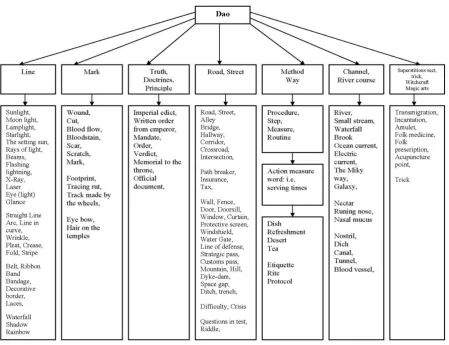
Figure 1. Semantic network of the Chinese classifier 道dao
The classifier use of道dao is fairly complicated and extends to different domains ranging from tangible objects to geometric figures as well as abstract concepts, which provide us with a rich pool of test items.
2. Instruction materials
Based on the HSK (Hanyu Shuiping Kaoshi ‘Chinese Proficiency Test’, designed by Hanban) Level 1-6 vocabulary guideline2, which is widely adopted in teaching Chinese as a second language, as a reference for frequency, the present study narrowed test items down to 24 nouns referenced by the classifier 道dao, listed in Table 1.
TABLE I. TEST ITEMS
No. Pinyin Characters English Translation No. Pinyin Characters English Translation
1 yí dào bùzhòu 一道步骤 a step (in a work) 13 yí dào shǎndiàn 一道闪电 a lightning
2 yí dào cǎihónɡ 一道彩虹 a rainbow 14 yí dào shānɡbā 一道伤疤 a blood vessel
3 yí dào cài 一道菜 a course (in a meal) 15 yí dào wéiqiánɡ 一道围墙 an enclosing wall
4 yí dào chénɡxù 一道程序 a procedure 16 yí dào yánɡɡuānɡ 一道阳光 a ray of sunlight
5 yí dào ɡuānqiǎ 一道关卡 a check point 17 yí dào xuèɡuǎn 一道血管 a blood vessel
6 yí dào hēixiàn 一道黑线 a black line 18 yí dào pùbù 一道瀑布 a waterfall
7 yí dào hénjì 一道痕迹 a mark 19 yí dào ménfènɡ 一道门缝 a crack between a
door and its frame
8 yí dào méimɑo 一道眉毛 an eyebrow 20 yí dào kǒuzi 一道口子 a cut
9 yí dào míyǔ 一道谜语 a riddle 21 yí dào shǒuxù 一道手续 a formality
10 yí dào mìnɡlìnɡ 一道命令 an order 22 yí dào chá 一道茶 a tea course
11 yí dào nántí 一道难题 a difficult problem 23 yí dào ménkǎn 一道门槛 a doorsill
12 yí dào shānmài 一道山脉 a range of mountain 24 yí dào nánɡuān 一道难关 A crisis
For the first 16 of these 24 test items, two instructional videos of 5 minutes were edited using Powerpoint, one for the cognitive group and the other for the traditional group. Both videos contain slides of the test items, combined with pictures and an audio recording as shown in Figure 2, and all slides are played twice. The only difference between the two videos is the way in which slides are organized.
2
Figure 2: A sample slide of the instructional video
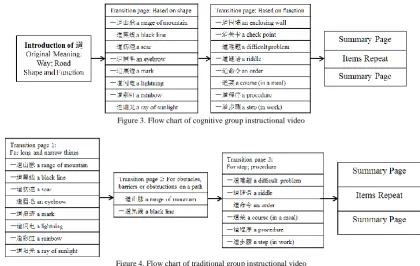
Jiang’s simplified polysemy network (2004) was adopted in the organization of the cognitive group instructional video, thus the sixteen instructional items were categorized into classification based on shape and classification based on function. In order to design the traditional group instructional video, we studied 4 widely used series of textbooks with the expectation of finding some textbook treatments3. Much to our disappointment, the classifier use of 道dao is just mentioned once, in the case of 一道菜yi dao cai ‘a course (in a meal)’, in one textbook, which forces us to rely on dictionary definitions. Xiandai Hanyu Cidian [The Contemporary Chinese Dictionary] listed 4 senses of the classifier 道dao.
(3) ① FOR LONG AND NARROW THINGS;
② FOR OBSTACLES, BARRIERS, OR OBSTRUCTIONS ON A PATH; ③ FOR EVENTS/THINGS CONSISTING OF SEQUENTIAL ITEMS; ④ FOR A STEP IN A PROCEDURE.
The first three senses are related with our test items, and were adopted in the design of the traditional group instructional video. Therefore, the flow charts of the instructional videos are as follows:
Figure 3. Flow chart of cognitive group instructional video
Figure 4. Flow chart of traditional group instructional video
3 The four series of studied textbooks are: Integrated Chinese(Level I, Part I - Level II, Part II), Tao-chung Yao & Yuehua Liu. Boston: Cheng &
The summary pages of both videos are shown in Figure 5 and Figure 6 respectively:4
Figure 5. Summary page of cognitive group video Figure 6. Summary page of traditional group video
In the summary page of the cognitive group instructional video, in order to highlight the original meaning of 道dao and the motivation for its meaning extension, items disappear and the instructional video ends with the original meaning: “path, way, road”.
3. Test materials
A pretest, an immediate posttest and a delayed posttest were designed, all with fill-in-the-blank questions with the pattern ‘Number (Classifier) Noun’. The pretest covers test items No.1-16 in Table 1, the same as the instructional videos. Whereas the immediate posttest covers items No.1-8 and No.17-24, and delayed posttest covers items No.9-24, so that each test has 16 test items and there are 8 instructed items together with 8 new ones in the two posttests. The 16 test items are mixed with 24 different fillers in all three tests. Pinyin, Chinese characters, as well as English translations were given, as shown in (4), and participants were instructed to fill in the blank with either the Chinese character or Pinyin, avoiding 个ge or 只zhi (the two generic classifiers mentioned above) if possible.
(4)
yī( )zuǐ 一( )嘴 a mouth
IV. RESULTS
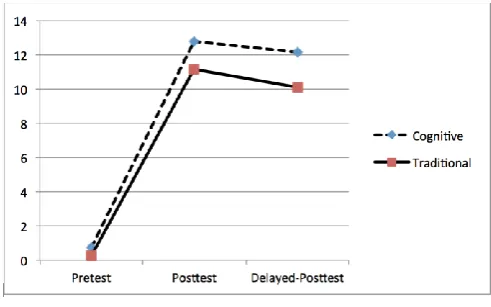
Subject means for the pretest, immediate posttest, and delayed posttest are graphed in Figure 7.
It can be observed that participants basically had no knowledge of the classifier 道dao before instruction. The means for the cognitive group and the traditional group in the pretest are 0.75 and 0.25 respectively. A two-tailed
4
Whitney U test (assumptions for t-test not met) shows there is no significant difference between these two groups. U = 82, p = .08726. The critical value of U at p ≤ 0.05 is 75.
For the immediate posttest and delayed posttest, independent group t-tests were carried out and revealed the cognitive group scored significantly higher than the traditional group at p < .05 on the immediate posttest, as well as on the delayed posttest. For the immediate posttest, t (30) = 2.31, p = .0279, while for the delayed posttest, t (30) = 2.59, p = .0148. Cohen’s ds are also calculated to estimate the effect sizes, precisely d = 0.8168 in the immediate posttest and d = 0.9142 in the delayed posttest, both of which can be considered fairly large.
However, when we look only at the instructed items in the two posttests, surprisingly, there is no significant difference between the two groups, as shown in Table 2.
Therefore, it is possible to claim that the difference between the two groups lies in the identification of extended uses, but not in the memorization of instructed items, which is exactly the condition as shown in Figure 8. The cognitive group performed noticeably better than the traditional group on the uninstructed items both times, but the advantage is not seen for instructed items.
V. CONCLUSION AND DISCUSSION
The present study supports our hypothesis that the CL approach, specifically presenting polysemy network and the underlying motivations, can facilitate Chinese classifier learning. However, by contrast to our hypothesis, the benefit can only be observed in the ability to guess unfamiliar new uses, not in retention of instructed items. This finding is also different from previous studies (Huong, 2005; Verspoor, 2009; Beréndi, Csábi & Kövecses, 2008). A possible explanation is that the number of test items and/or participants is too limited to produce a difference, which is a limitation of the present study.
It is also noteworthy that there is no measurement of general cognitive ability such as working memory in the present study, but working memory seems to be an important factor affecting the results, especially the memorization of instructional items in the immediate posttest. So a working memory test such as a reading span task may be a remedy for this limitation.
figurative senses may not be so clear. So providing the core meaning and the motivation for meaning extension equips learners with the big picture of a radial category instead of a few unrelated mechanical rules. When learners encounter uninstructed new items, identifying items within a category seems to be easier than judging whether unrelated mechanical rules apply. In this sense, the uninstructed items are not totally ‘new’ to learners who have received instruction based on the CL approach.
Last but not least, there is an additional benefit of the CL approach involving Chinese character teaching and learning. In most cases, the central sense of a Chinese classifier bears some relationship to its character form, whose complexity is argued to be the biggest challenge for learners with an alphabetic first language (Allen, 2008; Bell, 1995; DeFrancis, 1984; Everson, 1988; Guder, 2005; McGinnis, 1999). With the CL approach, the central sense and meaning extension of Chinese classifiers are normally introduced through the characters, making the character an indispensable medium instead of an extra burden. Instruction of individual characters can be rendered more coherent and explanatory at the same time.
REFERENCES
[1] Allen, J. R. (2008). Why learning to write Chinese is a waste of time: A modest proposal. Foreign Language Annals, 41, 237– 251.
[2] Bell, J. S. (1995). Relationship between L1 and L2 literacy: Some complicating factors. TESOL Quarterly, 29, 687–704. [3] Beréndi, M., Csábi, S., & Kövecses, Z. (2008). Using conceptual metaphors and metonymies in vocabulary teaching. In F.
Boers & S. Lindstromberg (Eds.), Cognitive linguistic approaches to teaching vocabulary and phraseology (pp. 65-100). Berlin: Mouton de Gruyter.
[4] Boers, F. & Lindstromberg, S. (2008). Cognitive linguistic approaches to teaching vocabulary and phraseology. Berlin: Mouton de Gruyter.
[5] Boroditsky, L. (2011). How language shapes thought. Scientific American, 2, 62-65.
[6] Csábi, S. (2004). A cognitive linguistic view of polysemy in English and its implications for teaching. In M. Archard, & S. Niemeier (Eds.), Cognitive linguistics, second language acquisition, and foreign language teaching (pp. 233- 256). Berlin: Mouton de Gruyter.
[7] DeFrancis, J. (1984). The Chinese language: Fact and fantasy. Honolulu: University of Hawaii Press.
[8] Ellis, N. C., & Robinson, P. (2008). An introduction to cognitive linguistics, second language acquisition, and language instruction. In P. Robinson, & N. C. Ellis (Eds.), Handbook of cognitive linguistics and second language acquisition (pp.372-406). London: Routledge.
[9] Everson, M. E. (1988). Speed and comprehension in reading Chinese: Romanization vs. characters revisited. Journal of the Chinese Language Teachers Association, 23, 1–15.
[10] Guder, A. (2005, August).Struggling with Chinese: New dimensions in foreign language teaching. Paper presented at the International and Interdisciplinary Conference, University of Mainz, Germersheim, Germany.
[11] Hou, R. (2006).Renzhi fenxi yu duiwaihanyu shixingliangci jiaoxue [A Cognitive analysis of Chinese shape-measure words in TCFL]. Journal of Yunnan Normal University: Teaching and Research of Chinese as A Foreign Language, 03, 14-18.
[12] Huong, N. T. (2005). Vietnamese learners mastering English articles. Unpublished doctoral dissertation. University of Groningen, Groninggen, Netherlands.
[13] Jiang, L. (2012). Nominal arguments and language variation. Unpublished doctoral dissertation, Department of Linguistics, Harvard University, Cambridge, Massachusetts.
[14] Jiang, S. (2004). A semantic study of the classifier dao. In M. Archard & S. Kemmer (Eds.), Language, culture, and mind (pp.429-443). Stanford, Calif.: Center for the Study of Language and Information (CSLI) Publications.
[15] Jiang, S. (2009). The semantic structure of Chinese classifiers and its implications for linguistic relativity.Unpublished doctoral dissertation, Department of East Asian Languages & Literatures, University of Hawaii at Manoa, Hawaii.
[16] Lakoff, G. (1990). The invariance hypothesis: Is abstract reason based on image schemas? Cognitive Linguistics, 1, 39-74. [17] Lakoff, G. (1987). Women, fire, and dangerous things. Chicago: University of Chicago Press.
[18] Langacker, R. W. (2008). Cognitive grammar as a basis for language instruction. In P. Robinson, & N. C. Ellis (Eds.), Handbook of cognitive linguistics and second language acquisition (pp.66-88). London: Routledge.
[19] Li, C., & Thompson, S. A. (1981). Mandarin Chinese: A functional reference grammar. Berkeley: University of California Press.
[20] McGinnis, S. (1999). Students’ goals and approaches. In M. Chu (Eds.), Chinese Language Teachers Association monograph series: Vol. III. Mapping the course of the Chinese language field (pp. 151-188). Kalamazoo, MI: Chinese Language Teachers Association.
[21] Niemeier, S. (2008). The notion of boundedness/ unboundedness in the foreign language classroom. In F. Boers, & S. Lindstromberg (Eds.), Cognitive linguistic approaches to teaching vocabulary and phraseology (pp. 309-327). Berlin: Mouton de Gruyter.
[22] Tai, J. H.-Y. (1994). Chinese classifier systems and human categorization. In M. Chen, & O. Tseng (Eds.), Honor of Professor William S-Y. Wang: Interdisciplinary studies on language and language change (pp.479-494). Zenda: Pyramid Publishing Company.
[23] Tai, J. H.-Y., & Wang, L. Q. (1990). A semantic study of the classifier Tiao. Journal of the Chinese Language Teachers Association,XXVI (1), 35-56.
[24] Tyler, A. (2012). Cognitive linguistics and second language learning-theoretical basics and experimental evidence. New York and London: Taylor & Francis Group.
[27] Zhang, H. (2007). Numeral classifiers in Mandarin Chinese. Journal of East Asian Linguistics, 16,43-59.
[28] Zhang, J., Xie, N., Wang, S., Li, Y., & Zhang, T. (2010). Hanyu shuiping kaoshi yanzhi baogao [Report of Chinese Proficiency Test designing]. Zhongguo Kaoshi [China Examinations], 9, 38-44.
Liulin Zhang is a Ph.D. student in Chinese linguistics and pedagogy at the University of Hawaiʻi at Mānoa, USA. She received her B.A. and M.A. in Wuhan University, China. She taught Chinese at different levels in Wuhan University, the University at Pittsburgh at Bradford, and the University of Hawaiʻi at Mānoa. Her research interests include cognitive linguistics, construction grammar, psycholinguistics, and usage-based approach to language acquisition.