Quick Guide—Make good obligations
September 2013
Prepared by: Energy Regulation and Implementation, Department of Environment and Heritage Protection
© State of Queensland, 2013.
The Queensland Government supports and encourages the dissemination and exchange of its information. The copyright in this publication is licensed under a Creative Commons Attribution 3.0 Australia (CC BY) licence.
Under this licence you are free, without having to seek our permission, to use this publication in accordance with the licence terms.
You must keep intact the copyright notice and attribute the State of Queensland as the source of the publication. For more information on this licence, visit http://creativecommons.org/licenses/by/3.0/au/deed.en
Disclaimer
This document has been prepared with all due diligence and care, based on the best available information at the time of publication. The department holds no responsibility for any errors or omissions within this document. Any decisions made by other parties based on this document are solely the responsibility of those parties. Information contained in this document is from a number of sources and, as such, does not necessarily represent government or departmental policy.
If you need to access this document in a language other than English, please call the Translating and Interpreting Service (TIS National) on 131 450 and ask them to telephone Library Services on +61 7 3170 5470.
This publication can be made available in an alternative format (e.g. large print or audiotape) on request for people with vision impairment; phone +61 7 3170 5470 or email <[email protected]>.
September 2013
Quick Guide—Make good obligations
Summary of make good obligations
When water is extracted from a coal seam, groundwater levels decline in the area surrounding the well. In some situations this may affect private landholder bores. The purpose of this guide is to explain how impacts on landholder bores are identified and addressed.
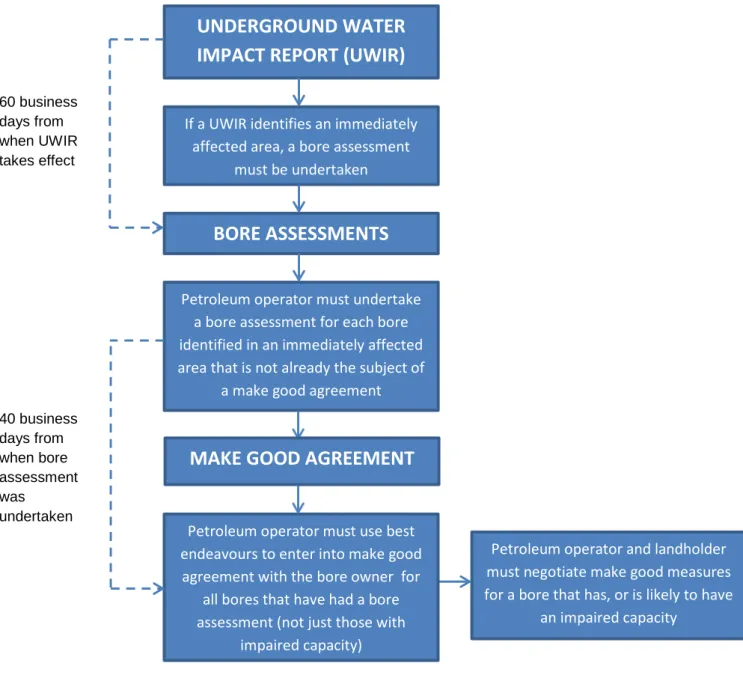
The framework for monitoring, modelling and making good impacts that result from petroleum operations is under Chapter 3 of the Water Act 2000. Figure 1 summarises the process for ensuring that a bore is properly monitored, and where necessary, that any impacts caused by a petroleum activity, are 'made good'.
This framework ensures that a bore owner is not disadvantaged by a petroleum operation.
Figure 1: Framework for monitoring, modelling and make good impacts
UNDERGROUND WATER
IMPACT REPORT (UWIR)
If a UWIR identifies an immediately
affected area, a bore assessment
must be undertaken
BORE ASSESSMENTS
Petroleum operator must undertake
a bore assessment for each bore
identified in an immediately affected
area that is not already the subject of
a make good agreement
MAKE GOOD AGREEMENT
Petroleum operator must use best
endeavours to enter into make good
agreement with the bore owner for
all bores that have had a bore
assessment (not just those with
impaired capacity)
Petroleum operator and landholder
must negotiate make good measures
for a bore that has, or is likely to have
an impaired capacity
60 businessdays from when UWIR takes effect
40 business days from when bore assessment was
undertaken
Underground water impact report
A key part of the framework for managing impacts on groundwater associated with petroleum activities is the requirement for the preparation of an underground water impact report. An underground water impact report is prepared to model, make predictions, and set out future monitoring obligations in the petroleum tenure. If there are multiple petroleum tenures adjacent to each other, the impacts of water extraction on groundwater levels may overlap. In these situations, a cumulative approach is required for the assessment and management of groundwater level impacts and the government may declare a broader cumulative management area.
The Office of Groundwater Impact Assessment is a statutory body responsible for preparing underground water impact reports for cumulative management areas. The Surat cumulative management area underground water impact report is an example of this cumulative approach.
Predicting impacts from a petroleum operation
A key role of an underground water impact report is to predict groundwater impacts that are likely to occur in both the immediate and long-term. The purpose of this is to ensure that make good agreements can be entered into before any impacts occur.
Petroleum operators must review their underground water impact report each year, and submit a summary of this review to the department. The summary must include any details about substantial changes to the underground water impact report. Petroleum operators are also required to submit a new underground water impact report every three years.
Unforseen impacts
The underground water management framework is specifically designed to proactively identify impacts so that compensation arrangements can be determined ahead of any impacts. However, if you are concerned that your bore is experiencing an impact that has not been predicted, you should contact the CSG Compliance Unit in the Department of Natural Resources and Mines on either:
Phone: 07 4529 1500
Email [email protected].
The CSG Compliance Unit can direct that a petroleum operator carry out a bore assessment and enter into a make good agreement, even where an impact has not been predicted.
Bore assessment and make good agreement
A bore assessment, make good agreement and make good measures are collectively known as 'make good obligations' (Figure 2). These obligations ensure that a bore is properly monitored, and where necessary, that any impacts caused by a petroleum activity, are 'made good'.
A make good agreement is only required to include make good measures where a bore has, or is likely to have an impaired capacity because of a petroleum activity. Sometimes a bore assessment will show that a bore will not be impacted by a petroleum activity. In these circumstances, the make good agreement is only required to state the findings of the bore assessment.
Figure 2: Make good obligations
Step 1—Bore assessments
A bore assessment is undertaken by (or on behalf of) the petroleum operator and is the first step in the make good obligations. This assessment is used to establish whether a bore has an impaired capacity or is likely to start having an impaired capacity as a result of a petroleum activity. A bore assessment must be conducted for bores identified in the immediately affected area 60 business days after the underground water impact report takes effect. In certain circumstances, a longer period to conduct the bore assessment can be agreed to.
All bore assessments must be carried out in accordance with the 'Bore Assessment Guideline'. A bore assessment can include:
• historical records
• observations from the bore owner
• pumping tests or flow/pressure tests
• measurement of flow rate (only where pumping is not possible e.g. because of immovable head works which prevent access).
It is important that a bore owner facilitates access to the bore, and provides any available information about the bore, for example, drill logs, pump records and a description of how the bore is used. The more information provided, the more accurate the assessment will be.
After a bore assessment has been completed, the petroleum operator is required to provide a copy of the assessment to the bore owner within 30 business days. If you have concerns about the assessment you should discuss this first with the petroleum operator. If your concerns are not adequately addressed, you should contact the CSG Compliance Unit.
Sometimes there will be sufficient information for a petroleum operator to acknowledge that a bore will have an impaired capacity without having to carry out a full bore assessment. If the bore owner agrees with the
recommended make good measures, a full bore assessment is not required. This is regarded as a preliminary bore assessment.
Figure 3 outlines the key obligations for petroleum operators and bore owners during the bore assessment stage of the make good process.
Step 1.
Bore
assessment
Step 2.
Make good
agreement
Step 2a.
Make good
measures
Make good
obligations
Only required where a bore is impaired, or is likely to be impaired because of a petroleum operation
Figure 3: Summary of bore assessment obligations and responsibilities
Step 2—Make good agreement
A make good agreement is the second step in the make good obligations, and is an agreement entered into by a petroleum operator and a bore owner about a water bore. A make good agreement is required for all bores that have had a bore assessment (not just those with an impaired capacity or likely to have an impaired capacity). Make good agreements are separate to conduct and compensation agreements required under petroleum legislation. A make good agreement is a legally binding agreement between a petroleum operator and a bore owner. If the bore assessment has shown that a bore has, or will likely have an impaired capacity because of a petroleum operation, the agreement must include make good measures arrived at by negotiation between the petroleum operator and the landholder (see Step 2a—Make good measures).
As make good agreements are legally binding, it is important that appropriate professional advice is sought when making this agreement. A petroleum operator is required to compensate the bore owner for any reasonable accounting, legal or valuation costs incurred during the negotiation process, other than the costs of a person facilitating alternative dispute resolution if requested by the bore owner.
Figure 4 outlines the key obligations for petroleum operators and bore owners during the make good agreement stage of the make good process.
Figure 4: Summary of make good agreement obligations and responsibilities
Step 2a—Make good measures
Make good measures form part of a make good agreement and are only required where a bore has, or is likely to have an impaired capacity. The two key factors in determining appropriate make good measures are:
• the level of impairment caused by a petroleum activity
• whether this impairment is impacting on the authorised use or purpose of the bore (e.g. a specific entitlement, or stock and domestic).
These above requirements are designed to ensure that a bore owner is not disadvantaged by a petroleum
Petroleum operator
•
Give notice to bore owner 10 business days
before assessment
•
Conduct bore assessment
•
Determine if capacity impaired or will likely to
be impaired
•
Provide a copy of bore assessment to bore
owners 30 business days after the assessment
•
Explain outcome of bore assessment
Bore owner
•
Give access to bore
•
Provide information about bore
•
Understand bore assessment and its
implications
Petroleum operator
•
Seek agreement on bore assessment
•
Compensate for reasonable professional
costs
•
Negotiate make good measures if bore
impaired, or is likely to be impaired
Bore owner
•
Seek appropriate professional advice
•
Seek agreement on bore assessment
•
Negotiate make good measures if bore
impaired, or is likely to be impaired
operation. As part of the negotiation process, a bore owner is free to seek make good measures other than those proposed by the petroleum operator during the negotiation process. Potential make good measures may include:
• enhancing a bore by deepening
the bore
• constructing a new bore
• providing a supply of an equivalent amount of water
• undertaking periodic bore assessments and ongoing monitoring
• compensating with money.
If monetary compensation is accepted as a measure instead of a new water supply, bore owners are encouraged to fully consider how this will affect long-term viability of the land use, and the impact that this might have on land value. Monetary compensation could also be used to improve other water infrastructure on the land.
While the requirement to enter into make good measures is designed to ensure that a bore owner is not disadvantaged, petroleum operators are not responsible for making good impairment that results from the poor maintenance of a bore (e.g. a bore with a collapsed or rusted casing).
There may be some circumstances where a bore may have multiple factors that limit its ability to supply water. For example, a bore might be collapsed or rusted in, but if fixed, the authorised use or purpose would still be impacted by a petroleum operation. Where this is the case, the petroleum operator is responsible to the extent that the impairment can be attributed to the petroleum operation.
In these circumstances, a bore owner and a petroleum operator may negotiate to either:
• share the costs associated with accessing a new water supply (e.g. the petroleum operator would pay for the costs of drilling a new bore, minus what it would cost for the bore owner to fix the existing problem)
• agree that the petroleum tenure holder will carry out a bore assessment and provide appropriate make good measures at the point at which the bore owner fixes the problem with the existing bore.
Make good measures should not be influenced by the degree to which bore owners utilise the supply. The key issue is the authorised capacity of the bore, and the level to which this capacity is impaired, or likely to be impaired. For example, a functioning bore used at times of short water supply is still entitled to the same reasonable quality and quantity of water for its authorised purpose as if it was required for frequent use.
As the make good measures form part of the make good agreement, it is important that appropriate legal advice is sought before entering into an agreement.
Figure 5 outlines the key obligations for petroleum operators and bore owners when negotiating make good measures.
Figure 5: Summary of make good measure obligations
Circumstances where an agreement can be changed
The level of impact on a bore caused by a petroleum operation may change. This change could result from a petroleum operator changing production plans, or because a new underground water impact report detailing new impacts, has been released. There may also be situations where a previously agreed to make good measure is ineffective for the bore owner.
Because of the potential for circumstances to change, a bore owner or a petroleum operator can seek to vary a make good agreement, in three circumstances:
Petroleum operator
•
Negotiate make good measures
•
Provide alternative solutions
•
Consider alternative solutions
•
Compensate for reasonable professional
costs
Bore owner
•
Negotiate make good measures
•
Provide alternative solutions
•
Seeks appropriate professional advice
•
Consider the long term implications
•
there is a material change in circumstances•
the make good measures are ineffective•
another effective and more efficient measure is available.In any of these situations, both the petroleum operator and bore owner must enter negotiations using their best endeavours to vary the agreement.
Complaints and disputes
Resolving disputesConcerns regarding the undertaking of bore assessments, entering into make good agreements, or negotiating a change to a make good agreement can be referred to the CSG Compliance Unit in the Department of Natural Resources and Mines on:
Phone 07 4529 1500
Email [email protected].
Additionally, if there is a disagreement about a make good agreement, either party may seek a conference or independent alternative dispute resolution (ADR) to negotiate a resolution of the dispute. To seek a conference or ADR, the requesting party must complete an election notice and provide a copy to the CSG Compliance Unit and the other party. If a conference is sought, officers from the CSG Compliance Unit will conduct a conference to try and negotiate resolution of the dispute.
Further information and resources
Visit www.ehp.qld.gov.au to access other resources linked to bore assessments and make good agreements including:
• Frequently asked questions
• Dispute resolution election notice
• Underground water impact report guideline
•
Copies of approved underground water impact reports
• Bore assessment guideline