U.S. Department Of Transportation
National Highway
Traffic Safety Administration
PRELIMINARY
REGULATORY
IMPACT
ANALYSIS
FMVSS No. 136
Electronic Stability Control Systems
On
Heavy Vehicles
Office of Regulatory Analysis and Evaluation
National Center for Statistics and Analysis
May 2012
TABLE OF CONTENTS
EXECUTIVE SUMMARY--- E-1 I. INTRODUCTION --- I-1 II. PROPOSED REQUIREMENTS --- II-1
A. Definition of ESC --- II-3 B. Performance Requirements ---II-4 1. Slowly Increasing Steer Maneuver --- II-5 2. Sine With Dwell Maneuver --- II-6 C. ESC Malfunction Telltale and Symbol --- II-13 D. ESC Off Switch, Telltale and Symbol --- II-14 III. HOW ESC WORKS --- III-1
A. ESC Systems --- III-1 B. How ESC Prevents Rollovers --- III-1 C. How ESC Prevents Loss of Control --- III-3 IV. BENEFITS --- IV-1 A. Effectiveness of ESC and RSC --- IV-3 B. Initial Target Population --- IV-7 C. Projected Target Population --- IV-13 D. Benefits --- IV-21 E. Travel Delay and Property Damage Savings --- IV-24 F. Summary --- IV-33 V. COSTS and LEADTIME --- V-1
A. Technology Costs --- V-1 B. Leadtime --- V-13 VI. COST EFFECTIVENESS AND BENEFIT-COST --- VI-1
A. Discounting Factors --- VI-3 B. Fatal Equivalents --- VI-6 C. Net Costs --- VI-8 D. Cost-Effectiveness --- VI-9
E. Net Benefits --- VI-9 F. Summary --- VI-10
VII. ALTERNATIVES --- VII-1 A. Alternative 1 – RSC for All Applicable Vehicles --- VII-2 B. Alternative 2 – Trailer-RSC for All New Trailers --- VII-4
VIII. REGULATORY FLEXIBILITY ACT, UNFUNDED --- VIII-1 MANDATES REFORM ACT
A. Regulatory Flexibility Act --- VIII-1 B. Unfunded Mandates Reform Act --- VIII-6 APPENDIX A. RETROFITTING --- A-1 APPENDIX B. REVISED COMPREHENSIVE COSTS --- B-1
E-1
EXECUTIVE SUMMARY
This Preliminary Regulatory Impact Analysis examines the impact of the proposal to establish Federal Motor Vehicle Safety Standard (FMVSS) No. 136, Electronic Stability Control Systems (ESC) on Heavy Vehicles. At this time, the proposal would apply to only truck tractors and buses with a GVWR greater than 11,793 kilograms (26,000 pounds). Specifically, the applicable buses (large buses) are those that have 16 or more designated seating positions (including the driver), and at least 2 rows of passenger seats, rearward of the driver’s seating position, that are forward-facing or can convert to forward-facing without the use of tools. This proposal does not apply to school buses and urban transit buses sold for operation as a common carrier in urban transportation along a fixed route with frequent stops.
ESC is one of two types of stability control systems that have been developed for heavy vehicles. The other one is roll stability control (RSC) which is designed primarily to mitigate on-road, un-tripped rollovers. ESC, on the other hand, not only includes the RSC functions but also is designed to mitigate loss-of-control (LOC) crashes that are caused by yaw instability. The National Highway Traffic Safety Administration (NHTSA, the agency) is proposing ESC for addressing both first-event rollover and LOC crashes.
The proposal is based on a thorough examination of three Alternatives including the proposal. Based on this analysis, the proposal is highly cost-effective measured against a comprehensive
E-2
baseline of $6.4 million1 per life value (2010 economics). The proposal would also generate a positive net benefit.
Note that RSC can be implemented on truck tractors and trailers. Therefore, for clarification, hereafter, RSC and ESC are used exclusively as tractor-based or bus-based systems. Trailer-RSC as implied by the name is a trailer-based system. No tractor-trailer combination systems2 are discussed in the analysis since the tractor-based systems are found to be the dominant systems.
Requirements
The proposal would require that truck tractors and buses with a gross vehicle weight rating (GVWR) greater than 11,793 kilograms (kg; 26,000 pounds) be equipped with an ESC system that meets the equipment, functional, and performance requirements specified in the proposed FMVSS No. 136. The proposal requires ESC to comply with two compliance tests and four performance criteria. The proposed compliance tests are 1) Slowly Increasing Steer
Characterization test and 2) Sine with Dwell test. The proposed performance criteria are 1) Engine Torque Reduction, 2) Lateral Acceleration Ratio, 3) Yaw Rate Ratio, and 4) Lateral Displacement. These proposed performance requirements complemented by the equipment and functional requirements would ensure that ESC would mitigate the on-road untripped rollover and LOC crashes but not at the expense of vehicle steering responsiveness when it was activated. The truck tractors and large buses covered by the proposal are called applicable vehicles in this analysis. On-road untripped first event rollovers are called target rollovers.
1
Contains both economic costs and values for intangible consequences such as lost quality of life
E-3
In addition, the proposal would require manufacturers to install an ESC malfunction telltale (warning lamp) using specific symbols and/or text for the malfunction telltale. An On/Off switch to turn off ESC would not be allowed.
Technical Feasibility/Baseline
ESC is increasingly being offered as standard or optional equipment in new model year truck tractors and large buses. Based on manufacturers’ product plans submitted to the agency in late 2009, the agency estimated that 14 percent of model year (MY) 2009 truck tractors and an extremely small percent of buses were equipped with ESC. By 2012, ESC installation rates are expected to increase to 26 percent for truck tractors and 80 percent for large buses. The agency believes that these ESC systems, some of which may need slight modifications, would otherwise already comply with the proposed “ESC” performance requirements.
For this analysis, the projected MY 2012 installation rates serve as the baseline compliance rates. As described earlier, with slight modifications, current ESC systems would pass the proposed compliance tests. Therefore, this analysis assumes that the 2012 model year ESC-equipped vehicles would all comply with the proposed test. Benefits and costs of the proposal thus reflect increasing ESC installation rates from 26 percent in truck tractors and 80 percent in large buses to 100 percent in both vehicle types.
E-4
Benefits3
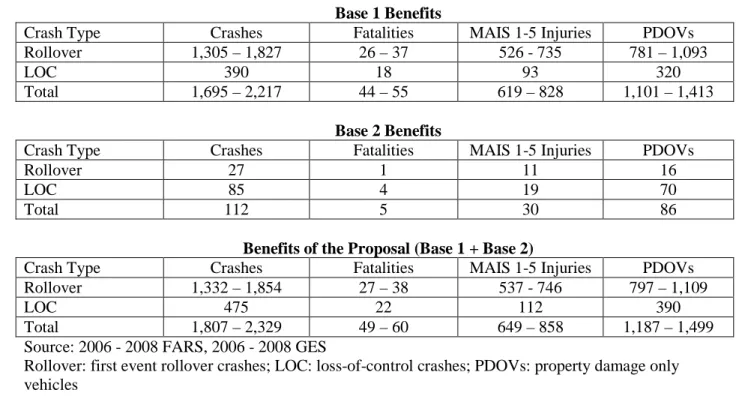
ESC is estimated to reduce the target rollover and LOC crashes by 28 to 36 percent. Therefore, the proposal would eliminate 1,807 – 2,329 crashes annually including 1,332 – 1,854 rollover crashes and 475 LOC crashes once all truck tractors and large buses have ESC. As a result, annually, the proposal would save (undiscounted) 49 – 60 lives, reduce 649 – 858 MAIS 1-5 injuries4, and eliminate 1,187 – 1,499 property damage only (PDOVs) vehicles. Of these benefits, 27 – 38 lives and 537 – 746 MAIS 1-5 injuries were from rollover crashes and 22 lives and 112 MAIS 1-5 injuries were from LOC crashes. For PDOVs, 797 – 1,109 vehicles were from target rollover crashes and 390 were from LOC crashes. Table E-1 lists these benefits.
Note that benefits for target rollover crashes are presented as a range in this analysis. This is the result of using a range of ESC effectiveness against the target rollover crashes. By contrast, at the time of publication, there is only one available effectiveness estimate for LOC. Therefore, the benefits for LOC are presented as a single point estimate. Also note that the estimated benefits were basically all from truck tractors. This is due to the small 2012-based large bus target crash population and a high ESC installation rate for large buses.
3 Benefits of the rule are measured from a baseline of 26% ESC installation to 100% installation for truck tractors
and 80% to 100% for large buses. However, the overall benefits of ESC could be measured from “no ESC” to 100% penetration rate with 0% RSC penetration rate. Overall, ESC would prevent 2,876 – 3,758 crashes, save a total of 74 – 92 lives, and eliminate 1,047 – 1,401 MAIS 1-5 injuries and 1,870 – 2,397 PDOVs annually.
4 MAIS (Maximum Abbreviated Injury Scale) represents the maximum injury severity of an occupant at an
Abbreviated Injury Scale (AIS) level. AIS ranks individual injuries by body region on a scale of 1 to 6: 1=minor, 2=moderate, 3=serious, 4=severe, 5=critical, and 6=maximum (untreatable).
E-5
Table E-1 Summary of Benefits
(Undiscounted)
Low Range of Benefits High Range of Benefits Rollover
Crashes
Loss-of-Control
Crashes Total
Rollover Crashes
Loss-of-Control
Crashes Total
Crashes 1,332 475 1,807 1,854 475 2,329
Fatalities 27 22 49 38 22 60
Injuries
(AIS 1-5) 537 112 649 746 112 858
PDOVs 797 390 1,187 1,109 390 1,499
PDOVs: property damage only vehicles
Vehicle Technology Costs
The ESC system cost is estimated to be $1,160 (in 2010 dollars) per vehicle which includes all the components for ESC and the ESC malfunction telltale. The total incremental cost of the proposal (over the MY 2012 installation rates and assuming 150,000 unit truck tractors and 2,200 large buses sold per year) is estimated to be $113.6 million to install ESC and malfunction
indicator lamps. The average incremental cost is estimated to be $746 per vehicle. Separately by vehicle type, the estimated average incremental cost is $754 per truck tractor and $232 per bus. These figures reflect the fact that 26 percent of the baseline MY 2012 truck tractors and 80 percent of MY 2012 large buses are projected to already come equipped with ESC. The costs also take into account that 16.0 percent of MY 2012 truck tractors, in addition to the 26 percent mentioned above, would already have RSC. Table E-2 summarizes the vehicle costs.
E-6
Table E-2
Summary of Vehicle Technology Costs
(2010 dollars)
Average Vehicle Costs Total Costs
Truck Tractors $754 $113.1 M
Large Buses $232 $0.5 M
Combined $746 $113.6 M
M: million
Other Impacts
Property Damage and Travel Delay
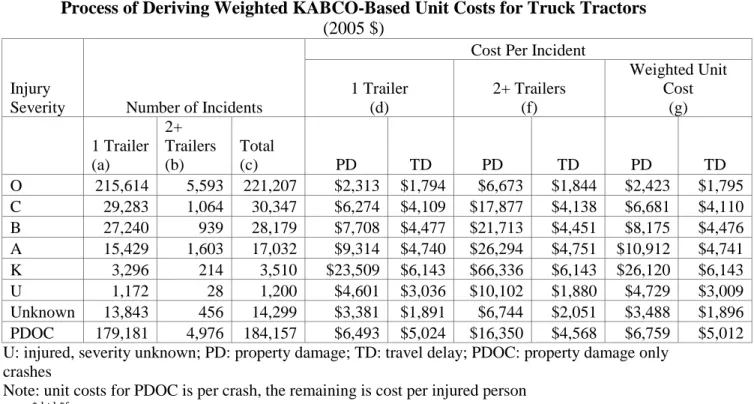
The proposal would prevent crashes and thus would reduce property damage costs and travel delay associated with those crashes avoided. Overall, the rule would save $13.9 to $17.8 million at a 3 percent discount rate or $11.0 to $14.1 million at a 7 percent discount rate in property damage and travel delay.
Fuel Economy
The added weight from ESC, which consists primarily of just electronic sensors and wiring, is insignificant relative to the 11,793 kg (26,000 pounds) plus weight of the truck tractors and large buses. Consequently, the increase in their lifetime use of fuel is considered to be negligible.
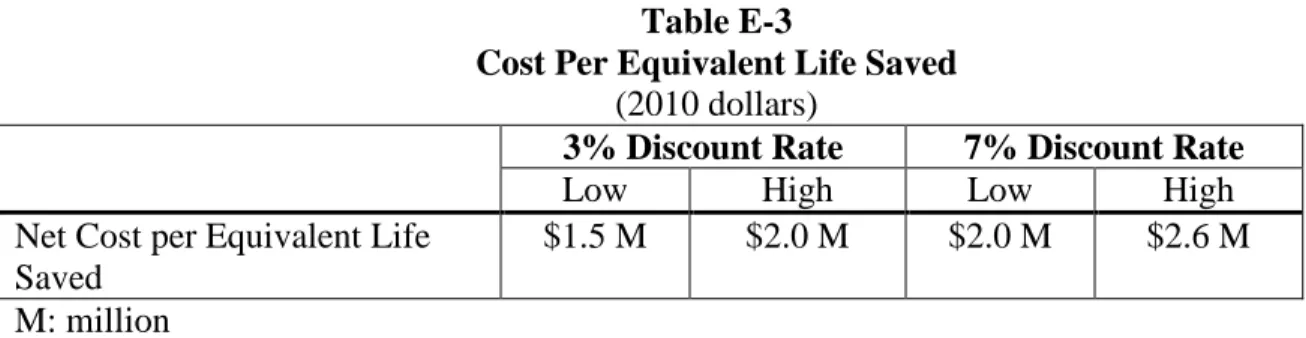
Net Cost Per Equivalent Life Saved
As shown in Table E-3, the net cost per equivalent life saved, discounted at a 3 percent and 7 percent discount rate will range between $1.5 million and $2.6 million.
E-7
Table E-3
Cost Per Equivalent Life Saved
(2010 dollars)
3% Discount Rate 7% Discount Rate
Low High Low High
Net Cost per Equivalent Life Saved
$1.5 M $2.0 M $2.0 M $2.6 M
M: million
Net Benefits
A net benefit analysis differs from a cost effectiveness analysis in that it requires that benefits be assigned a monetary value. This value is compared to the monetary value of costs to derive a net benefit. The proposal would accrue $155 to $310 million in net benefits as shown in Table E-4. The high net benefit of $310 million was based on a 3 percent discount rate and the low end of $155 million was based on a 7 percent discount rate. Both of these are based on a $6.4 million comprehensive value for preventing a fatality.
Table E-4 Net Benefits
With $6.4 M Cost Per Life
(2010 dollars)
At 3% Discount At 7% Discount
Low High Low High
Net Benefits $228 M $310 M $155 M $222 M
M: million
Alternatives
In addition to the proposal requiring ESC, the agency also examined two less stringent alternatives that would require RSC and trailer-RSC:
E-8
• Alternative 1 would require all new applicable vehicles (i.e.., truck tractors and large buses) to be equipped with RSC,
• Alternative 2 would require trailer-RSC for all new trailers
Alternative 1 is slightly more cost-effective and lower in total costs than the proposal. However, this Alternative would save fewer lives and accrue less net benefits than the proposal.
Furthermore, Alternative 1 would have significantly less impact on LOC crashes, a sizeable safety population that the agency intends to address. Therefore, Alternative 1 was not proposed.
Alternative 2 would save even fewer lives than Alternative 1. Moreover, Alternative 2 is significantly less cost-effective than both the proposal and Alternative 1 and would produce negative net benefits. Table E-5 lists the costs, equivalent lives saved, cost per equivalent life saved, and net benefits of these two Alternatives by discount rate. Therefore, Alternative 2 was not selected.
Table E-5
Cost-Benefit Measures for Alternatives 1 and 2 by Discount Rate (2010 dollars)
Cost-Benefit Measures
Alternative 1 Alternative 2
At 3% Discount At 7% Discount At 3% Discount At 7% Discount Equivalent Lives
Saved 31 - 43 24 – 34 5 – 7 3 – 5
Vehicle Cost* $55.8 M $55.8 M $81.2 M $81.2 M
Cost per
Equivalent Life Saved
$1.0 - $1.5 M $1.3 - $2.0 M $11.2 - $15.9 M $16.0 - $26.7 M Net Benefits $153 - $235 M $106 - $174 M -$35 to -$49 M** -$50 to -$60 M** * Not discounted since the costs occur when the vehicle is purchased
** Negative benefits indicate that costs are greater than the dollar value of benefits M: million
E-9
Retrofitting
The analysis also examines the practicability of extending applicable vehicles to include in-service vehicles. Retrofitting ESC or RSC does not appear to be feasible because of the
complexity of integration which involves the calibration of these technologies with the vehicles’ engine, braking, local communication, and electronic control unit systems. Moreover, no ESC or RSC retrofitting tools are currently available. In contrast, retrofitting trailer-RSC systems are commercially available. However, retrofitting in-service trailers is extremely costly ($3.3 - $4.2 billion) and not cost effective ($0.5 - $1.7 billion per equivalent life saved). Therefore, the agency has determined that retrofitting ESC or RSC is not practical, and that retrofitting trailer-RSC is not cost beneficial.
Leadtime
The agency proposes a two-year leadtime for typical 4x2 and 6x4 truck tractors5 and large buses. For severe service tractors, which typically have a GVWR greater than 27,000 kg (59,600
pounds), and other specialty truck tractors with three axles or more, the agency proposes a leadtime of four years.
The agency believes that the proposed leadtime would ensure that the only two current suppliers of heavy vehicle stability control systems, Bendix and Meritor WABCO, would have enough time to produce sufficient units of stability control systems to meet the demand of truck tractor
5 The 6x4 description for a tractor represents the total number of wheel positions (six) and the total number of wheel
positions that are driven (four), which means that the vehicle has three axles with two of them being drive axles. Similarly, a 4x2 tractor has four wheel positions, two of which are driven, meaning that the vehicle has two axles, one of which is a drive axle.
E-10
and bus manufacturers. It also should enable truck/bus manufacturers to make necessary design changes to their vehicles’ instrumentation, brake, and electronic systems as to accommodate the new ESC systems. Consequently, this would minimize the compliance costs to manufacturers.
Summary of Annual Costs and Benefits
Table E-6 summaries the total annual costs, injury benefits, property damage and travel delay savings, cost per equivalent life saved, and net benefits of the proposal by two discount rates.
Table E-6
Estimated Annual Cost, Benefits, and Net Benefits of the Proposal (in million of 2010 dollars)
Costs
Injury Benefits
Property Damage and Travel Delay
Savings
Cost Per Equivalent Live
Saved
Net Benefits At 3%
Discount
$113.6 $328 – $405 $13.9 - $17.8 $1.5 - $2.0 $228 - $310 At 7%
Discount
I-1
CHAPTER
I.
INTRODUCTION
This Preliminary Regulatory Impact Analysis (PRIA) accompanies NHTSA’s Notice for Proposed Rulemaking (NPRM) to establish Federal Motor Vehicle Safety Standard (FMVSS) No. 136, Electronic Stability Control Systems (ESC) for Heavy Vehicles. At this time, the proposal would require truck tractors and buses that have a gross vehicle weight rating (GVWR) greater than 11,793 kilograms (kg, 26,000 pounds) be equipped with ESC. This proposal would apply to these buses that have 16 or more designated seating positions (including the driver), and at least 2 rows of passenger seats, rearward of the driver’s seating position, that are forward-facing or can convert to forward-forward-facing without the use of tools. The applicable bus does not include a school bus, multifunction school activity bus, or urban transit bus sold for operation as a common carrier in urban transportation along a fixed route with frequent stops (i.e., transit bus designed for an “urban area” as defined in 49 U.S.C. Section 5301(16). These applicable buses are referred as “large buses”, hereafter.
ESC and Roll Stability Control (RSC) are two types of stability control systems that have been developed for heavy vehicles. RSC is designed to mitigate on-road, un-tripped truck rollovers by automatically decelerating the vehicle by applying the foundation brakes and reducing engine torque output. ESC includes the RSC function described previously. In addition, ESC has added capability for mitigating severe oversteer or understeer conditions that can lead to vehicle loss-of-control (LOC), by automatically applying selective brakes to generate a yawing moment that helps the driver maintain directional control of the vehicle. Thus, ESC for truck tractors and large buses are designed to mitigate both untripped rollover and LOC crashes, which is different
I-2
from that specified in Federal Motor Vehicle Safety Standard No. 126 (FMVSS No. 126) for light vehicles with a GVWR of 4,536 kg (10,000 pounds) or less. Note that manufacturers also developed based roll stability control technology. This technology is specified as trailer-RSC in this analysis. Therefore, ESC and trailer-RSC in this analysis represent specifically the truck tractor- or bus-based systems.
Rollover and LOC crashes comprised a significant portion of truck tractor and bus crashes. Based on 2006-2008 General Estimates System (GES) and Fatality Analysis Reporting System (FARS), annually, truck tractors and large buses were involved in 201,600 crashes (198,800 non-fatal and 2,800 non-fatal crashes). There crashes caused 3,721 non-fatalities and 60,400 non-non-fatal police-reported injuries. Of these truck tractor and large bus crashes, 13,200 crashes (5,700 first event rollover and 7,500 LOC crashes) would be impacted by the proposal. Consequently, the
proposal would potentially further reduce the 415 fatalities and 5,400, non-fatal police-reported injuries that were associated with these rollover and LOC crashes.
Since the early 1990’s, the agency has been actively addressing the heavy vehicle rollover and LOC safety problems. In 1995, the agency published a final rule mandating antilock braking systems (ABS) on truck tractors manufactured on or after March 1, 1997 and for other air-braked heavy vehicles, including single unit trucks, buses, and trailers manufactured on or after March 1, 1998. ABS, an advanced braking technology, has helped to reduce jackknife crashes and other directional loss-of-control crashes that were caused by wheel lockup during braking. However, many rollovers and LOC crashes are not caused by wheel lockup but by steering maneuvers. To specifically address these types of crashes, in the mid-1990s, the agency
I-3
sponsored the development of a prototype roll stability advisor (RSA) system - a precursor of an RSC system. RSA relays stability related information such as the truck’s roll stability threshold and the peak lateral acceleration achieved during cornering maneuvers to the driver.
In 2006, with the further advancement of avoidance technologies and the agency’s experience with ESC on light vehicles6, the agency initiated a test program at the Vehicle Research and Test Center (VRTC) to evaluate the performance of heavy vehicle stability control systems and to develop objective test procedures and performance measures. Researchers tested three tractors, each equipped with either RSC or ESC systems, one semi-trailer equipped with a trailer-based RSC system, and three buses equipped with an ESC system. Additionally, the agency tested five baseline semi-trailers not equipped with a stability control system, including an unbraked control trailer that is used to conduct tractor braking tests as prescribed by FMVSS No. 121, Air brake systems. These research efforts form the basis of this proposal. Research results are summarized in one paper and two technical reports:
a. NHTSA’s Class 8 Truck-Tractor Stability Control Test Track Effectiveness, 2009 ESV paper, No. 09-05527,
b. Tractor-Semitrailer Stability Objective Performance Test Research – Roll Stability, May 2011, DOT HS 811 467, and
c. Tractor-Semitrailer Stability Objective Performance Test Research – Yaw Stability (to be published)
6
On April 6, 2007, the agency issued a final rule (72 FR 17236) that established Federal Motor Vehicle Standard (FMVSS) No. 126, Electronic Stability Control Systems, which requires passenger cars, multipurpose passenger vehicles, trucks and buses with a gross vehicle weight rating of 4,536 kg (10,000 lb) or less to be equipped with an electronic stability control system beginning model year 2012.
7
I-4
Furthermore, NHTSA has sponsored several research programs with stability control system developers and manufactures and universities to study the effectiveness of the RSC and ESC on truck tractors against untripped first-event rollovers (i.e., target rollovers) and LOC crashes. These studies include:
• A study with Meritor WABCO and the University of Michigan Transportation Research Institute (UMTRI) to examine the potential safety effectiveness of RSC and ESC systems for five-axle tractor-trailer combination vehicles (UMTRI study)8,
• A study with the University of Iowa using the National Advanced Driving Simulator (NADS)9 to determine the effectiveness of RSC and ESC for scenarios that were most likely to induce rollover and jackknife crashes, and
• An ongoing project started in February 2009 with Virginia Tech Transportation Institute (VTTI) to assess the real-world safety benefits of the Bendix stability system. The project is focused on RSC and the project report is still underway at the publication of the analysis.
After the completion of the UMTRI’s study, the agency published a Research Note10 which describes the process of deriving the effectiveness rates of ESC and RSC in truck tractors. The Research Note was built upon the UMTRI study and revised the effectiveness of RSC and ESC. The Research Note concluded that ESC would prevent 28 to 36 percent of target rollovers and LOC crashes. RSC would prevent 21 to 30 percent of these crashes.
8 Safety Benefits of Stability Control Systems for Tractor-Semitrailers, DOT HS 811 205, October 2009, available
from www.regulations.gov; see Docket No. NHTSA-2010-0034-0006
9 Heavy Truck ESC Effectiveness Study Using NADS, DOT HS 811 233, November 2009, The final report is
available from www.regulations.gov, Docket No. NHTSA-2010-0034-0007
10
Wang, Jing-Shiarn, Research Note “Effectiveness of Stability Systems for Truck Tractors” , DOT HS 811 437, January 2011
I-5
As for large buses, in October 2009, NHTSA issued a Vehicle Safety Priority Plan, which describes the agency plans for rulemaking and research for calendar years 2009 to 2011. The Priority Plan includes stability control on Heavy Vehicles, and states that the agency plans to develop test procedures for a Federal motor vehicle safety standard on stability control for truck tractors, with the countermeasures of roll stability control and electronic stability control, which are aimed at addressing rollover and loss-of-control crashes. In addition, the Department of Transportation Motorcoach Safety Action Plan11, issued in November 2009, includes an action item for NHTSA to assess the safety benefits for stability control on motorcoaches and develop objective performance standards for these systems.
Following the Motorcoach Safety Priority Plan, NHTSA’s VRTC has evaluated the performance of ESC on three motorcoaches using the test maneuvers and performance criteria developed for truck tractors. The three motorcoaches were two 2007 MCI D4500 with the Meritor WABCO ESC system and a 2009 Prevost H3 with the Bendix ESC system. Overall this research
concluded that an identical set of test maneuvers and similar performance criteria can be applied to both motorcoaches and truck tractors to discern ESC performance in preventing target
rollovers and LOC crashes.
The National Transportation Safety Board (NTSB) has issued several safety recommendations relevant to ESC systems on heavy and other vehicles. Recommendation H-08-15 addresses ESC systems on commercial vehicles. Recommendations H-10-05 and H-10-06 address stability control systems on buses with a GVWR above 10,000 pounds. Two other safety
recommendations, H-01-06 and H-01-07, on adaptive cruise control and collision warning
I-6
systems on commercial vehicles are indirectly related to ESC on heavy vehicles because the addressed technologies and ESC all require active braking without driver input12.
The trucking industry has implemented the stability control technologies to mitigate rollover and LOC crashes. The industry first introduced RSC in the U.S. for truck tractors in 2002 and later ESC in 2005. Based on the trucking industry’s input and product plans submitted to the agency, the agency estimates that about 7.4 percent of truck tractors sold in 2007 were already equipped with ESC and additional 10.5 percent were equipped with RSC only systems. The ESC
installation rate is expected to increase to 26.2 percent and RSC to 16.0 percent for model year (MY) 2012 truck tractors. The stability control systems were introduced for large buses much later. The agency estimates that the ESC and RSC installations were extremely low for those sold in 2007. However, ESC installation is expected to rapidly rise to 80.0 percent for MY 2012 large buses.
Given that the agency’s research has developed feasible and repeatable test maneuvers and viable performance criteria, that ESC is found to be effective in reducing rollover and LOC crashes, and that the ESC technologies are mature, the agency has decided to propose requiring ESC on truck tractors and buses with a GVWR greater than 11,793 kg (26,000 pounds) to reduce the occurrence of rollovers and LOC crashes in these new heavy vehicles.
I-7
Organization of the Remaining Analysis
This PRIA estimates the benefits, cost, cost-effectiveness, and net benefits of the rule. The following discussion outlines the remaining structure of this document. Chapter II describes the requirements of the proposed Standard No. 136. Chapter III discusses current ESC systems and their functional capabilities. This Chapter also summarizes the test results performed by the agency. Chapter IV estimates the benefits. Chapter V discusses the costs and leadtime. Chapter VI provides cost-effectiveness and net benefits analysis. Chapter VII discusses alternatives. Finally, Chapter VIII examines the impacts of the proposal on small business entities. In addition, Appendix A examines the practicability of retrofitting. Appendix B revises comprehensive costs to reflect the value of a statistical life (VSL) of $6.0 million that was specified in a 2009 DOT guideline on value of life.
II-1
CHAPTER
II.
PROPOSED
REQUIREMENTS
The proposal would establish Federal Motor Vehicle Safety Standard (FMVSS) No. 136, Electronic Stability Control Systems (ESC) for Heavy Vehicles, which requires truck tractors and buses having a gross vehicle weight rating (GVWR) greater than 11,793 kilograms (26,000 pounds) to be equipped with an ESC system that meets the requirements of the standard. This proposal would apply to these buses with 16 or more designated seating positions (including the driver), and at least 2 rows of passenger seats, rearward of the driver’s seating position, that are forward-facing or can convert to forward-facing without the use of tools. 13 Applicable buses include those that were sold for intercity, tour, and commuter bus service, but do not include school buses, or urban transit buses sold for operation in urban transportation along a fixed route with frequent stops..
Note that the agency is not proposing to include single unit trucks with a GVWR greater than 4,536 kg (10,000 pounds) and buses with a GVWR 11,793 kg (26,000 pounds) or less at this time, primarily because stability control systems are not yet available for a broad segment of these vehicles. Substantial variations in brake type, vehicle weight, wheelbase, number of axles, center of gravity height, and cargo type, exist among single unit trucks. Furthermore, the
development of stability control system for heavy vehicles has been focused on air-braked vehicles which include truck tractors and large buses that were covered by the proposed rule. These factors have made it challenging for the agency to devise test procedures and conduct vehicle testing to evaluate stability control system performance on single unit trucks.
II-2
The agency also is not proposing to apply this standard to in-service vehicles due to the lack of feasibility of retrofitting ESC. The integration of the systems into in-service vehicles involves the vehicle’s chassis, engine, braking, and other stability related systems (e.g., traction control), vehicle local network communication systems, and electronic control units, which would place a tremendous financial burden especially on bus operators, of which 80 percent operate with a bus fleet size of less than 10 vehicles14. Moreover, the agency is not aware of any available ESC retrofitting service, most likely due to integration complexity. See Appendix A for a more detailed analysis of retrofitting issues.
In addition to retrofitting ESC, the agency also studied the impacts of retrofitting trailer-RSC since this retrofitting tool is commercially available. Based on the available cost information and the agency’s test data on trailer-RSC, the agency determined that retrofitting trailer-RSC is not cost-effective. Thus, it is also not practical to require retrofitting trailer-RSC. Appendix A provides the agency’s analysis on retrofitting issues.
The proposal specifies (a) the Definition of ESC, (b) the Equipment and Functional
Requirements of ESC, (c) the Performance Requirements of ESC, and (d) ESC Activation, Malfunction, Telltale, and Symbol Requirements. The following sections summarize these requirements. Interested parties should consult the preamble of the NPRM for the details. In addition, comprehensive technical background information for deriving the requirements can be found in the agency research reports listed in Chapter I.
II-3
A. DEFINITION OF ESC
The definition of ESC compliments the performance-based criteria to ensure the ESC is operational at a full range of rollover and vehicle stability conditions without the burden of requiring a battery of tests to cover a wide array of possible loading configurations and operating ranges for heavy vehicles. ESC is defined as a system that has all of the following attributes:
1) Augments vehicle directional stability by applying and adjusting vehicle brake torques individually at each wheel position on at least one front and at least one rear axle of the vehicle to induce correcting yaw moment to limit vehicle oversteer and to limit vehicle understeer.
2) Enhances rollover stability by applying and adjusting the vehicle brake torques
individually at each wheel position on at least one front and at least one rear axle of the vehicle to reduce lateral acceleration of a vehicle.
3) Computer-controlled with the computer using a closed-loop algorithm to induce correcting yaw moment and enhance rollover stability.
4) Has a means to determine the vehicle’s lateral acceleration.
5) Has a means to determine the vehicle’s yaw rate and to estimate its side slip or side slip derivative with respect to time.
6) Has a means to estimate vehicle mass or, if applicable, combination vehicle mass. 7) Has a means to monitor driver steering input.
8) Has a means to modify engine torque, as necessary, to assist the driver in maintaining control of the vehicle.
9) When installed on a truck tractor, has the means to provide brake pressure to automatically apply and modulate the brake torques of a towed semi-trailer.
II-4
To ensure that a vehicle is equipped with an ESC system that meets the proposed definition and to allow the agency to verify that the ESC system meets operational requirements that may not necessarily be validated under the proposed performance tests, the agency is proposing that vehicle manufacturers make the following information available to the agency:
(1) A system diagram that identifies all ESC system hardware,
(2) A written explanation describing the ESC system’s basic operational characteristics, (3) A discussion of the pertinent inputs to the computer and how its algorithm uses that
information to mitigate rollover and limit oversteer and understeer, and
(4) For truck tractors, information that shows how the tractor provides brake pressure to a towed trailer.
The requested information would enable the agency to ascertain that an ESC system includes the proposed components and attributes. This information also would aid the test engineers with execution and completion of the proposed compliance tests.
B.PERFORMANCE REQUIREMENTS
An ESC-equipped vehicle must satisfy performance test criteria to ensure sufficient rollover stability and oversteer or understeer intervention (i.e., mitigating the tendency for the vehicle to spinout or plow out in a curve). The agency is proposing the two compliance tests and four performance criteria:
(1) Slowly Increasing Steer Maneuver (SIS)
• Engine Torque Output Criterion (2) Sine with Dwell Maneuver (SWD)
II-5
• Yaw Rate Ratio (YRR)
• Lateral Displacement (LD)
Slowly Increasing Steer Maneuver (SIS)
The SIS maneuver is used to determine a steering wheel angle which then is used to normalize the severity of the subsequent SWD maneuver. SIS is also used to evaluate the engine torque reducing capability of ESC to demonstrate that it mitigates both rollover and understeer.
Test Maneuver
The SIS maneuver is conducted at a constant speed of 48.3 kilometer per hour (km/h) with 1.6 km/h acceptable speed variation (i.e., 30 mph + 1mph). A steering controller gradually increases the steering wheel angle from 0 to 270 degrees at continuous rate of 13.5 degrees per second. The 270 degrees is held constant for one second and the maneuver concludes. Each vehicle is subjected to two series of runs, with three tests performed for each series (i.e., a total of 6 runs). One series uses counterclockwise steering and the other uses clockwise steering. During each test run, ESC system activation must be confirmed. If ESC system activation does not occur during the maneuver, then the steering wheel angle is increased in 270-degree increments until the vehicle’s maximum allowable steering wheel angle is reached or until ESC activation is confirmed.
The steering wheel angle determined by SIS would be used to program the automated steering machine for subsequent SWD test. The steering wheel angle is that which would produce 0.5 g of lateral acceleration in the test vehicle at a constant speed of 30 mph. This angle is determined by extrapolating the linear regression results of the steering wheel angle and lateral acceleration
II-6
from the SIS test data. The 0.5 g lateral acceleration at 30mph is a level at which a loaded heavy vehicle is highly likely to experience roll instability. As we understand, the relationship
between the steering wheel angle and lateral acceleration varies with vehicles due to differences in steering gear ratios, suspension systems, wheelbase, and other vehicle characteristics. Using the established steering wheel angle in the subsequent SWD tests is to ensure that each vehicle is subjected to the same test severity and is likely to experience the same instability condition.
Engine Torque Reduction Criterion
ESC would be required to reduce the engine torque output by a minimum of 10 percent from the torque output requested by the driver at 1.5 seconds after it is activated. For the confirmation of ESC activation and evaluating the engine torque reduction capability by ESC, engine torque output and driver requested torque are collected from the vehicle’s J1939 communication data link and compared. During the initial stages of an SIS test, the rate of change over a period of time for engine torque output and driver requested torque will be consistent. If ESC is activated, engine torque will be reduced and the rate of change for engine torque output and driver
requested torque will diverge over time. The agency believes that 1.5 seconds after the ESC is activated, appreciable engine torque reduction can be measured.
Sine With Dwell Maneuver (SWD)
The proposed SWD maneuver subjects a vehicle to both roll and yaw instabilities and thus allows the agency to verify the performance of ESC in mitigating those instabilities. ESC would be required to comply with the proposed lateral stability, yaw stability, and responsiveness criteria.
II-7
Test Maneuver
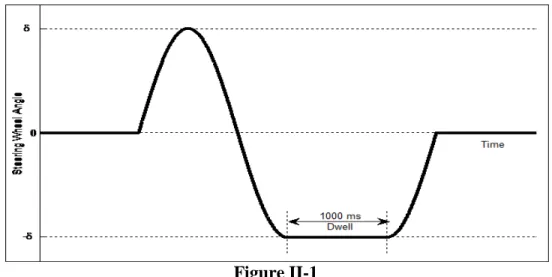
SWD is a maneuver based on a 0.5 Hz (half cycle per second) sinusoidal steering input with a pause (i.e., dwell) of 1.0 second after completion of the third quarter-cycle of the sinusoid. Hence, the total time for the steering maneuver is three seconds. Figure II-1 depicts the SWD maneuver. To ensure accurate, repeatable, and reproducible results, the performance test uses a steering machine to deliver the maneuver to the steering wheel. Steering is initiated at 72 km/h (45 mph) with an allowable variation in initial speed of 1.6 km/h (i.e., 45 mph + 1.0 mph). One series uses counterclockwise steering for the first half cycle. The other series uses clockwise steering for the first half cycle. The steering amplitude for the initial run of each series is 0.3A, where A is the steering wheel angle determined from the SIS maneuvers. In each of the
successive test runs, the steering amplitude would be increased by increments of 0.1A until a steering amplitude of 1.3A, or 400 degrees maximum is achieved.
Figure II-1
Sine with Dwell by Steering Wheel Angle Inputs
For a truck tractor, the SWD test would be conducted with the tractor coupled to a test trailer and loaded to 80 percent of the tractor’s GVWR. The trailer is equipped with outriggers in case the
II-8
ESC system does not function properly to prevent the tractor-trailer combination from rolling over. The trailer loaded with ballast that has a low center-of-gravity (CG) height which
minimizes the likelihood of trailer rollover. This load and test configuration enables the tractor’s ESC mass estimation program to sense that the tractor is heavily loaded and thus provide full tractor braking intervention during the SWD maneuver.
For a bus, the vehicle is loaded with a 68 kg (150 pounds) water dummy in each of the vehicle’s designated seating positions, which would bring the bus’ weight to less than its GVWR. No additional ballast is required to maintain the desired CG height of the test load.
Initially, the agency examined six maneuvers for roll stability and six maneuvers for yaw stability performance. Maneuvers for roll stability included: SIS, SWD, Constant Radius Increasing Velocity, 150-foot Radius J-turns, Double-Lane-Change, and Ramp Steer Maneuver (RSM). Maneuvers for testing roll stability performance included SIS, SWD, Half Sine with Dwell, RSM, Ramp with Dwell, and 150-foot Radius Braking-in-a-Curve. In addition, the agency also reviewed test maneuvers suggested by the industry and suppliers of stability control systems. These maneuvers include: a 500-foot Wet Jennite Curve Drive-Through from the Truck & Engine Manufacturers Association (EMA)15 for yaw stability, a sinusoidal steering maneuver and a ramp with dwell maneuver from Bendix, and a lane change maneuver (on a large diameter circle) from Volvo.
After completing this research, SIS and SWD maneuvers were selected. Specifically, SWD was selected over other maneuvers due to its objectivity, practicability, repeatability, and
II-9
representativeness. SWD is highly objective because it will initiate roll, oversteer, and understeer intervention for every tested ESC system and because it will discriminate strongly between many vehicles with and without ESC (or with ESC disabled). The maneuver is practicable because it can easily be programmed into the steering machine and because it simplifies the test instrumentation due to its lack of closed-loop feedback control (e.g., yaw acceleration). It is repeatable due to the use of a steering machine thereby minimizing driver effects. In addition, the maneuver, similar to the test maneuver specified in the FMVSS No. 126, is representative of steering inputs produced by human drivers in an emergency obstacle
avoidance situation such as performing severe lane change maneuver. Furthermore, SWD is able to address rollover, lateral stability, and responsiveness while other maneuvers are required to be paired in order to achieve the similar test condition. Finally, the SWD maneuver can be applied to both truck tractors and large buses for evaluating ESC performance while other tests may not be able to. Thus, proposing SWD reduces the number of required performance tests for ESC. Readers interested in the detailed test maneuvers and test results can consult the NHTSA research reports that were listed in Chapter I.
Performance Criteria
Lateral Acceleration Ratio (LAR)
LAR is developed to evaluate the ability of ESC in mitigating rollovers, i.e., to evaluate the RSC function of the ESC system. LAR is the ratio of lateral acceleration corrected for the vehicle’s roll angle at a specific time to the maximum lateral acceleration measured between 4.5 seconds after the beginning of steering and the time when steering is completed. The beginning of steering is the point at which the maneuver begins and the steering wheel angle begins to change
II-10
from 0 degree. The completion of steering is the point at which the maneuver ends and the steering wheel angle returns to 0 degree. ESC would be required to meet two LAR performance limits (i.e., the maximum allowable value of the ratio):
(1) 0.75 second after completion of the steering input for the 0.5 Hz, 72 km/h Sine with Dwell maneuver, LAR has to be less than or equal to 30 percent.
(2) 1.50 second after completion of the steering input for the 0.5 Hz, 72 km/h Sine with Dwell maneuver, LAR has to be less than or equal to 10 percent.
LAR can be represented in mathematical notations as follows:
% 30 100 max ) 75 . 0 (0 <= × + imum t A A and % 10 100 max ) 75 . 1 (0 <= × + imum t A A Where, input steering of completion to Time t t and input sterring of 1.0 between on accelerati lateral Maximum A seconds) (in t at time on accelerati Lateral A 0 0 maximum t = = =
LAR is considered as the normalized lateral acceleration measure which is found to be a more robust measurement than simply the lateral acceleration for assessing roll stability performance. Based on the agency’s test experience, LAR adequately differentiated vehicles equipped with RSC (i.e., the RSC function of the ESC) and without RSC under the roll stability test conditions.
II-11
Other than LAR and lateral acceleration, the agency also examined a wheel lift measurement for roll stability performance. Although wheel lift is the most straightforward measure among all the measurements that were evaluated by the agency, its indication of an imminent rollover is less certain than LAR and the lateral acceleration. Certain vehicle suspensions are designed to permit wheel lift during severe cornering maneuvers. Non-uniform road surfaces also can cause brief wheel lift events. These wheel lifted conditions do not necessarily imply that rollover is imminent. Thus, wheel lift is not considered as a performance measure in the agency’s proposal.
Yaw Rate Ratio (YRR)
YRR is developed to evaluate the ability of ESC in mitigating LOC crashes. YRR is the ratio of vehicle yaw rate at a specified time to the first local peak yaw rate generated by the 0.5 Hz Sine with Dwell steering reversal. The performance limits (i.e., the two maximum allowable values of the ratio) establish a five percent spinout threshold when ESC intervenes. In other words, an ESC-equipped vehicle has a less than five percent probability of not satisfying NHTSA’s spinout definition if the vehicle meets the required lateral criteria. More specifically, YRR measures how quickly the vehicle stops turning or rotating about its vertical axis, after the steering wheel is returned to the straight-ahead position. A vehicle that continues to turn or rotate about its vertical axis for an extended period after the steering wheel has been returned to a straight-ahead position is most likely experiencing loss of control. ESC is required to meet the following two YRR performance limits:
(1) 0.75 seconds after completion of the steering input for the 0.5 Hz Sine with Dwell maneuver, the yaw rate of the vehicle has to be less than or equal to 40 percent of the first local peak yaw rate produced by the steering reversal.
II-12
(2) 1.50 seconds after completion of the steering input, the yaw rate of the vehicle has to be less than or equal to 15 percent of the first local peak yaw rate produced by the steering reversal.
The YRR criteria can be noted as:
% 40 100 ) 75 . 0
(0+ × <=
Peak t ψ ψ , and % 15 100 ) 50 . 1 (0 <= × + Peak t ψ ψ Where, input steering of completion to Time t input sterring Dwell with Sine Hz 0.5 by the generated rate yaw peak local First ψ seconds) (in t time at rate Yaw ψ 0 Peak t = = =
Based on the agency’s analysis, we anticipate that an ESC system meeting these lateral stability criteria would significantly prevent the probability of a spinout during the conduct of the SWD maneuvers.
Lateral Displacement (LD)
LD will be used to measure the ability of a vehicle to respond to the driver’s inputs during an ESC intervention. The criterion is defined as the lateral displacement of the vehicle’s center of gravity with respect to its initial straight path during the initial stage of the sine with dwell maneuver. The criterion performance limit establishes the displacement threshold to ensure that the ESC intervention used to achieve acceptable lateral stability does not compromise the ability of the vehicle to respond to the driver’s input. The proposal requires that an ESC-equipped
II-13
vehicle would have a lateral displacement of at least 2.13 meters (7 feet) at 1.50 seconds after the initiation of steering for truck tractors, and 1.52 meters (5 feet) for large buses. The lateral displacement at 1.50 seconds after initiation of the steering input (the 1.50-seconds-lateral-displacement) can be calculated using the following double integration formula:
Where,
t0 = Steering wheel input starting time
AC.G = Lateral acceleration, corrected for the effects of roll angle and sensor offset from the vehicle C.G. position.
The double integration technique for calculating the lateral displacement was presented by the Alliance on September 7, 2005.16 The technique was adapted by the agency and is incorporated in FMVSS No. 126.
C. ESC Malfunction Telltale and Symbol
The proposal would require a yellow ESC malfunction telltale identified by either the acronym “ESC” or the following symbol:
16 Docket Number NHTSA-2005-19951
≥ ≥ =
∫
+∫
+ es motorcoach for meters, 1.52 tractors for truck meters, 2.13 (t)dt Ay ent DisplacemLateral t 1.50
t 1.50 t t C.G. 0 0 0 0
II-14
This symbol and the alternative text are included in Table 1 of FMVSS No. 101, Controls and Displays. The malfunction telltale is required to be mounted inside the occupant compartment in front of and in clear view of the driver. The malfunction telltale is required to illuminate after the occurrence of one or more ESC malfunctions that affect the generation or transmission of control or response signals in the vehicle’s ESC system. Such telltale is required to remain continuously illuminated for as long as the malfunction exists, whenever the ignition locking system is in the “On” (“Run”) position. The ESC malfunction telltale must extinguish at the initiation of the next ignition cycle after any malfunctions have been corrected.
D. ESC Off Switch, Telltale and Symbol
The proposal would not allow an ESC on/off switch in truck tractors or large buses. Based on our observation on light vehicle ESC systems, although ESC on/off switches are permitted in FMVSS No. 126, disabling the ESC system reduces the potential safety benefits of the system. The agency believes that heavy vehicles handling and control characteristics differ substantially compared to light vehicles and as a result the agency does not believe there is a needs for allowing an ESC on/off switch in heavy vehicles. The agency believes that all truck tractors currently sold with ESC systems are also equipped with traction control systems. Therefore, there would be no need to turn off the ESC when starting to move the vehicle on a slippery or loosely-packed road surface.
III-1
CHAPTER III. HOW ESC WORKS
A. ESCSYSTEMS
Meritor WABCO pioneered the ESC system for commercial vehicles in 2001 when the company offered the system as an option on the company's electronic braking system (EBS). The company is one of the leading providers of electronic braking, stability, suspension and transmission control systems for the commercial vehicle industry. Currently, ESC for heavy trucks and large buses primarily are produced by two companies17: Meritor WABCO and Bendix.
An ESC system utilizes computers to control individual wheel brake torque and assists the driver in maintaining control of the vehicle by keeping the vehicle headed in the direction the driver is steering even when the vehicle nears or reaches the limits of road traction. For example, during sudden lane changes or while cornering at excessive speed, ESC can help prevent truck-trailer combinations from rolling-over, skidding, or jack-knifing. Stabilization of the vehicle is achieved by selective braking on each wheel, or simultaneous application the brakes on several wheels, concurrent with automatic reductions in engine power.
A. How ESC Prevents Rollovers
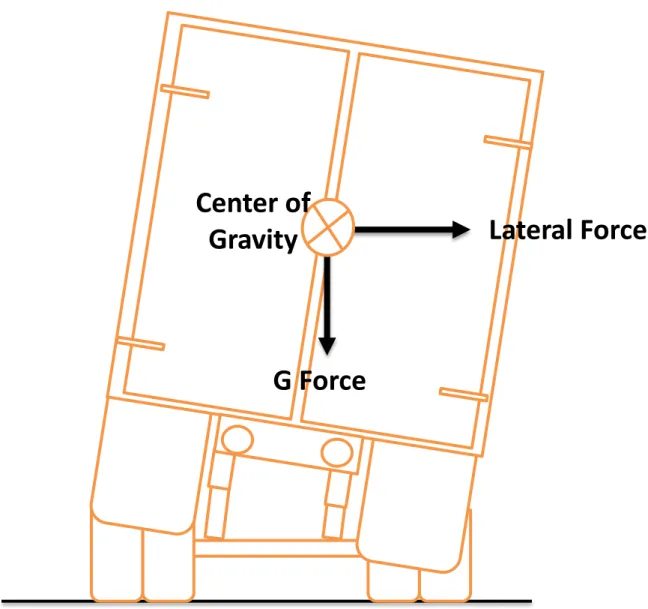
Lateral acceleration is the primary cause of rollovers. Figure III-1 depicts a simplified rollover condition. As shown, when the lateral force (i.e., lateral acceleration) is sufficient large and
III-2
exceeds the roll stability threshold of the tractor-trailer combination vehicle, the vehicle will roll over. Many factors related to the drivers’ maneuvers, heavy vehicle loading conditions, vehicle handling characteristics, roadway design, and road surface properties would result in various lateral accelerations and influences on the rollover propensity of a vehicle. For example, given other factors are equal, a vehicle entering a curve at a higher speed is more likely to roll than a vehicle entering the curve at a lower speed. Transporting a high center of gravity (CG) load would increase the rollover probability more than transporting a relatively lower CG load. Contributing factors in truck rollover crashes include: the driver making an abrupt steering input during a lane-change maneuver, or attempting to recover from a run-off-road event; driving with improperly secured cargo that can shift in transit; other shifting or sloshing loads ((such as transporting cattle or partial loads of liquids in tanker trailers), ); vehicle in-service defects such as worn or broken suspension components or underinflated or worn (low tread depth) tires; improper superelevation design or construction of curved roadways; driving on roadway shoulders that may have the wrong superelevation direction for a given curve; and improper or missing curve speed warning signs. These operational issues can all lead to an increased likelihood of a truck rollover.
III-3
Figure III-1 Rollover Condition
The RSC function within an ESC system uses a lateral accelerometer to measure lateral
acceleration. When RSC detects the acceleration reaching the estimated roll stability threshold of the truck, it intervenes and decelerates the vehicle by reducing engine throttle and engaging the tractor drive axle and trailer brakes to reduce the lateral acceleration of the vehicle and prevent a rollover from occurring.
Lateral Force
G Force
Center of
III-4
B. How ESC Prevents Loss of Control
In addition to a lateral acceleration sensor, ESC uses two additional sensors to monitor the vehicle for yaw instability (oversteer) or for loss of directional control (understeer). One is a steering wheel angle sensor which senses the intended direction of a vehicle. The other one is a yaw rate sensor which measures the actual turning movement of the vehicle. When imbalance between these two measures occurs, the vehicle is either in an understeering (plowing out) or oversteering (spinning out) condition. When ESC detects an imbalance, it automatically intervenes by using selective braking of individual wheels on the tractor. ESC is further differentiated from RSC in that it has the ability to selectively apply the front steer axle brakes whereas the RSC system does not incorporate this feature.
Figure III-2 illustrates the oversteering and understeering conditions18. While Figure III-1 may suggest that a particular vehicle lose control due to either oversteer or understeer, it is quite possible that a vehicle could require both understeering and oversteering interventions during progressive phases of a complex crash avoidance maneuver such as a double lane change.
Oversteering. Figure III-2, the right side shows that the truck tractor entered a right curve that is too sharp for the speed that the tractor is traveling. The rear of the vehicle begins to slide which would lead to a non-ESC vehicle spinning out. If the tractor is towing a trailer, this is also called a jackknife crash; the tractor spins around and may make physical contact with the side of the trailer. An oversteering vehicle is considered to be yaw-unstable because the tractor rotation
18
Adopted from the report “Concept of Operation and Voluntary Operational Requirements for Vehicle Stability Systems (VSS) On-Board Commercial Motor Vehicles”, Federal Motor Carrier Safety Administration, July 2005, FMCSA-MCRR-05-006
III-5
occurs without a corresponding increase in steering wheel angle by the driver, and the driver has also lost directional control of the vehicle (i.e., loss-of-control or LOC).
Understeering. Figure III-2, the left side shows a similar situation faced by a truck tractor whose response as it exceeds the limits of road traction is first sliding at the front (“plowing out” ). Such a vehicle is considered to be yaw-stable because no increase in tractor rotation occurs when the driver increases the steering wheel angle. However, the driver has lost directional control of the tractor.
An ESC system maintains what is known as “yaw” (or heading) control by determining the driver’s intended heading via steering wheel angle sensors, measuring the vehicle’s actual response, and automatically adjusting the turning behavior of the vehicle if its response does not match the driver’s intention. However, with ESC, turning is accomplished by unbalanced forces at the tire-road interface from the brake torque being applied at a particular corner of the vehicle, from the brake torque rather than from steering input. Speed and steering angle measurements are used to determine the driver’s intended heading. The vehicle response is measured in terms of lateral acceleration and yaw rate by onboard sensors. If the vehicle is responding properly to the driver, the vehicle is considered to be yaw-stable and the driver has full directional control of the vehicle.
The concept of “yaw rate” can be illustrated by imagining the view from above of a truck following a large circle painted on a parking lot. One is looking at the top of the roof of the
III-6
vehicle and seeing the circle. If the truck starts in a heading pointed north and drives half way around circle, its new heading is south. Its yaw angle has changed 180 degrees. If it takes 10 seconds to go half way around the circle, the “yaw rate” is 180 degrees per 10 seconds (deg/sec) or 18 deg/sec. If the speed stays the same, the truck is constantly rotating at a rate of 18 deg/sec around a vertical axis that passes through the vehicle’s center of gravity. If the speed is doubled, the yaw rate increases to 36 deg/sec.
As depicted in Figure III-2, for example, while driving in a circle, the driver notices that he must hold the steering wheel tightly to avoid sliding toward the passenger seat. The bracing force is necessary to overcome the lateral acceleration that is caused by the truck tractor following the curve. When the speed is doubled, the lateral acceleration increases by a factor of four if the truck follows the same circle. There is a fixed physical relationship between the truck’s speed, the radius of its circular path, and its lateral acceleration. Since the ESC system measures the truck’s speed and its lateral acceleration, it can compute the radius of the circle and subsequently the correct yaw rate for a vehicle following the path. The ESC system then compares the actual measured yaw rate acquired from the onboard yaw rate sensor to that computed for the path the truck is following. When the computed and measured yaw rates begin to diverge as the vehicle’s speed is increased to the point where the driver is beginning to lose control, A vehicle unassisted by ESC soon would have a heading significantly different from the desired path and would be out-of-control either by spinning out or plowing out. An ESC system has the ability to detect the imbalance and attempts to correct it by automatically applying brake torque (typically at one corner of the vehicle, but sometimes at more than one corner of the vehicle) - rather than by
III-7
redirecting the vehicle’s steer tires. The intervention of ESC will cause the vehicle’s heading to change thus allow the driver to regain control of the vehicle.
Figure III-2 Loss-of-Control Conditions
Oversteering (“Spinning
Understeering (“Plowing
IV-1
CHAPTER
IV.
BENEFITS
ESC is a crash avoidance countermeasure that would prevent crashes from occurring. Preventing crashes not only saves lives and reduces injuries. ESC also alleviates crash-related travel delays and property damage. Therefore, the estimated benefits include both injury and non-injury components. The “injury benefits” discussed in this chapter are the estimated fatalities and injuries that would be prevented by the proposal. The non-injury benefits include the travel delay and property damage savings from crashes that would be avoided by ESC.
Basically, the size of the benefits depends on two elements: (1) the target crash population (P) and (2) the ESC effectiveness (e) against that population. The overall injury reduction benefit of the proposal is equal to the product of these two elements and can be expressed mathematically by the following generic formula:
B = P * e
Where, B = Benefit of the rule,
P = Target crash population, and
e = Effectiveness of ESC.
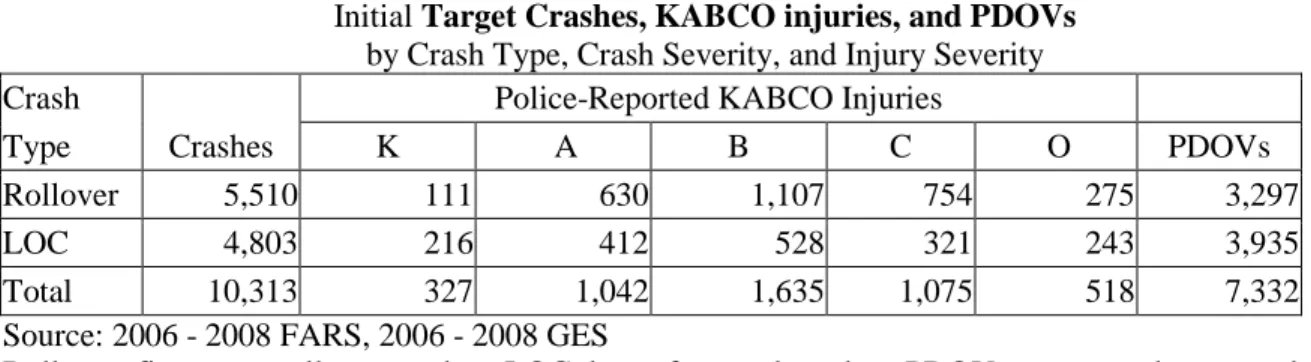
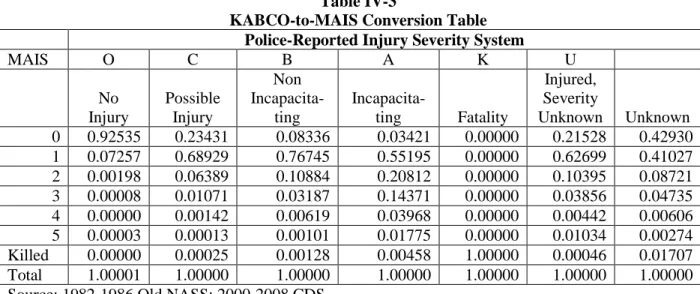
The target population includes fatalities, non-fatal injuries measured by the maximum
abbreviated injury scale (MAIS), and property damage only vehicles (PDOVs). Fatalities and MAIS injuries are used for estimating injury reduction benefits. They also combined with
IV-2
PDOVs for for calculating non-injury benefits, i.e., property damage and travel delay savings. The estimated injury benefits are then translated into fatal equivalents to derive
cost-effectiveness and net benefit estimates of the proposal. The estimated property damage and travel delay savings are included in the cost to derive the “net cost” of the proposal.
Annual benefits and costs are expressed for a future time when all new vehicles must comply with the standard and the full on-road vehicle fleet has been converted to comply with the standard. Under these circumstances, assuming a constant rate of sales over time, the lifetime impacts on a single model year’s fleet will equal the full on-road fleet impacts in any given calendar year. The target population was initially derived from the most current available real-world crash data. The initial target population was then projected to the 2012 level through a series of adjustments in order to correspond to the cost estimates for ESC which are based on the 2012 model year applicable vehicles. The projection takes into account the impacts of ESC and RSC that are estimated to be increasingly voluntarily implemented in the future fleet (i.e., 2012 model year vehicles). The impact of stability control system technology not only depends upon its installation rate on vehicles but also on its effectiveness in preventing crashes. Therefore, the technology effectiveness is discussed first. Initial target crashes, projected target crashes, and benefits are discussed in the subsequent sections.
IV-3
A. Effectiveness of ESC and RSC
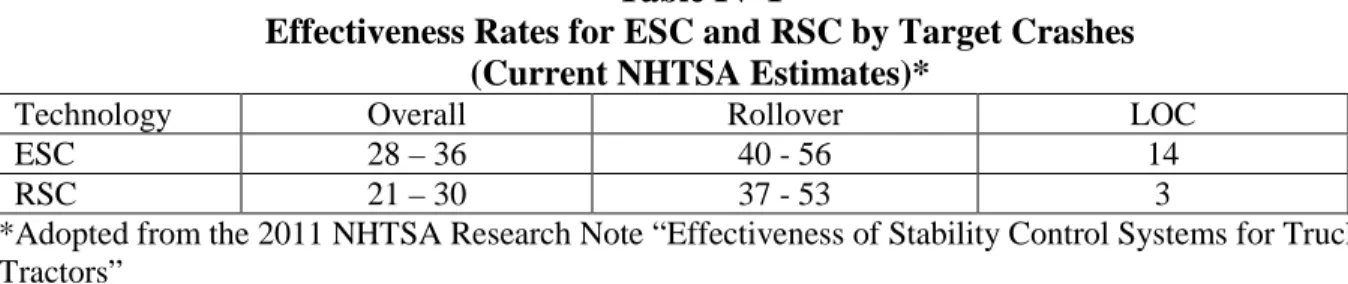
As stated previously, the agency’s 2011 Research Note on the effectiveness of stability control systems for truck tractors found overall that ESC is 28 – 36 percent effective in reducing untripped rollover (i.e., target rollovers) and LOC crashes19. When segregated by crash type, ESC would reduce 40 – 56 percent of target rollover crashes and 14 percent of LOC crashes. By comparison, RSC is 21 – 30 percent effective against the same target rollover and LOC crashes. Separately, RSC is 37 – 53 effective against target rollovers and 3 percent effective against LOC crashes20. Table IV-1 lists these effectiveness rates which are used in the PRIA for the benefit analysis.
Table IV-1
Effectiveness Rates for ESC and RSC by Target Crashes (Current NHTSA Estimates)*
Technology Overall Rollover LOC
ESC 28 – 36 40 - 56 14
RSC 21 – 30 37 - 53 3
*Adopted from the 2011 NHTSA Research Note “Effectiveness of Stability Control Systems for Truck Tractors”
These effectiveness rates were built upon two earlier studies: (1) a 2008 study on RSC that was conducted by American Transportation Research Institute and sponsored by the Federal Motor Carrier Safety Administration (FMCSA)21 and (2) a 2009 study that was conducted by the University of Michigan Transportation Research Institute (UMTRI) and Meritor WABCO and
19 Effectiveness of Stability Control for Truck Tractor, Research Note, DOT HS 811 437, January 2011 20 these LOC were followed by rollovers
21
Murray, D., Shackelford S., House, A., Analysis of Benefits and Costs of Roll Stability Control Systems, FMCSA-PRT-08-007 October 2008
IV-4
sponsored by NHTSA22. The effectiveness rates from both studies were based on computer simulation results, expert panel assessments of available crash data, input from trucking fleets that had adopted the technology, and research experiments. A statistical analysis of vehicles with and without the technology using real-world crash data was not feasible (even now) since ESC and RSC penetration in the national in truck tractors is still small since these are relatively new technologies that have only been installed on a small percentage of new tractors over the past few years.
The 2008 FMCSA study examined only the effectiveness of RSC and was limited to rollover crashes. The study estimated that RSC is 37 - 53 percent effective against rollover crashes. The high end of the effectiveness was based on simulation results for rollovers on curved roadways due to excessive speed (i.e., untripped rollovers). The low end of the effectiveness was based on motor carriers’ feedback on 106 rollover cases, of which 39 were considered to have been preventable by RSC.
The 2009 NHTSA study examined both the effectiveness of RSC and ESC. The study found that ESC would reduce rollovers by 0 to 75 percent and LOC crashes by18 to 40 percent. The
magnitude of the effect varies depending on roadway alignment (straight, curved) and roadway surface conditions (dry, wet). These effectiveness estimates were aggregated from the initial effectiveness rates of these technologies for 159 cases that were identified from FMCSA’s large truck crash causation study (LTCCS) as candidate target crashes. Eventually, the effectiveness rates of ESC and RSC against untripped rollover and LOC crashes were aggregated by roadway
22
Woodroffe, J., Blower, D., and Green, P., Safety Benefits of Stability Control Systems for Tractor-Semitrailers, DOT HS 811 205, October 2009
IV-5
alignment (straight versus curved) and roadway condition (dry versus wet). Four sets of aggregated effectiveness estimates were established for ESC and for RSC. However, these aggregated effectiveness rates did not take into account the probability of occurrence for individual cases. Furthermore, in 2010 NHTSA revised the effectiveness of ESC and RSC downwards for six LTCCS cases and re-categorized the crash type for another two other cases. After these case revisions, the range of estimated ESC effectiveness against rollovers is 0 percent on straight, not dry roadways to 75 percent on curved, dry roadways. The ESC effectiveness against LOC crashes ranged from 7 percent on straight, dry roadways to 19 percent on curved, dry roadways. For RSC, the corresponding range was 0 to 72 percent against rollovers and 0 to 7 percent against LOC crashes. The effectiveness rates estimated in the 2011 Research Note were modified by considering the probability of occurrence of each of the 159 LTCCS cases and by incorporating the mentioned changes for 8 cases. The revised estimated effectiveness for ESC is a 47 percent reduction of first-event rollovers and a 14 percent reduction of LOC crashes. The corresponding revised effectiveness for RSC is 44 and 3 percent for rollover and LOC crashes, respectively.
The revised RSC effectiveness of 44 percent is close to the mid-point between the 37 and 53 percent that were estimated by the 2008 FMCSA study. For the consideration of uncertainty inherent in the study methodologies, the 2011 Research Note adopted the range of 37 to 53 percent as the effectiveness of RSC for rollover crashes. The effectiveness of ESC against rollover crashes ranged from 40 to 56 percent, 3 percent higher than those of RSC. The 3 percent is the difference between the RSC and ESC effects that were derived from the 2009 NHTSA study. Due to only one available study that examined the LOC crashes, a point
IV-6
effectiveness estimate is used for LOC crashes. ESC and RSC would reduce LOC crashes by 14 and 3 percent, respectively.
As described previously, only ESC has the ability to apply individual brakes at the corners of a vehicle to generate re-stabilizing yaw moments about the vehicle’s center of gravity, to prevent a vehicle from going into a severe understeer or oversteer event. RSC on the other hand typically applies all of the tractor drive axle brakes using a uniform braking air pressure at all of the drive axle brakes. As the lateral acceleration of a vehicle increases during a hard cornering event, the RSC is able to detect this condition and apply the brakes to slow the vehicle down, thus
preventing the vehicle from exceeding the limits of lateral tire traction. This is how RSC is able to mitigate loss of control. However, when the vehicle is on a slippery road surface and begins to lose control23, only an ESC system can intervene to maintain vehicle control, since the lateral acceleration at the limit of lateral tire traction may be low enough not to activate an RSC system (provided that the vehicle is, for example, in a lightly-loaded condition such that RSC would allow up to 0.6 g of lateral acceleration before activating). This is why the effectiveness rate for preventing LOC crashes is higher for ESC than for RSC.
Note that due to limited large bus crash data, it is not feasible to conduct a statistical analysis of RSC/ESC performance for large buses. Therefore, the RSC/ESC effectiveness developed for truck tractors is also applied to large buses.
23 For example, LTCCS cases 821005770 and 808006121 are examples of LOC on a slippery road surface.
However, these cases were not included in the agency’s effectiveness estimates, since one involved a bobtail tractor and the other involved double trailers. The agency’s effectiveness estimates only included tractor-semitrailer crash-involved vehicles.