More Generality in Efficient Multiple Kernel Learning
Manik Varma [email protected]
Microsoft Research India, Second Main Road, Sadashiv Nagar, Bangalore 560 080, India
Bodla Rakesh Babu [email protected]
CVIT, International Institute of Information Technology Hyderabad, Gachibowli, Hyderabad 500 032, India
Abstract
Recent advances in Multiple Kernel Learn-ing (MKL) have positioned it as an attrac-tive tool for tackling many supervised learn-ing tasks. The development of efficient gra-dient descent based optimization schemes has made it possible to tackle large scale problems. Simultaneously, MKL based al-gorithms have achieved very good results on challenging real world applications. Yet, de-spite their successes, MKL approaches are limited in that they focus on learning a linear combination of given base kernels.
In this paper, we observe that existing MKL formulations can be extended to learn gen-eral kernel combinations subject to gengen-eral regularization. This can be achieved while retaining all the efficiency of existing large scale optimization algorithms. To highlight the advantages of generalized kernel learn-ing, we tackle feature selection problems on benchmark vision and UCI databases. It is demonstrated that the proposed formulation can lead to better results not only as pared to traditional MKL but also as com-pared to state-of-the-art wrapper and filter methods for feature selection.
1. Introduction
Support Vector Machines are basic tools in machine learning that are used for tasks such as classification, regression, etc. They find application in diverse ar-eas ranging from vision to bioinformatics to natural-language processing. The success of SVMs in these fields is often dependent on the choice of a good kernel and features – ones that are typically hand-crafted and
Appearing inProceedings of the 26thInternational Confer-ence on Machine Learning, Montreal, Canada, 2009. Copy-right 2009 by the author(s)/owner(s).
fixed in advance. However, hand-tuning kernel para-meters can be difficult as can selecting and combining appropriate sets of features.
Multiple Kernel Learning (MKL) seeks to address this issue by learning the kernel from training data. In particular, it focuses on how the kernel can be learnt as a linear combination of given base kernels. Many MKL formulations have been proposed in the liter-ature. In (Sonnenburg et al., 2006), it was shown that the MKL Block l1 formulation of (Bach et al., 2004) could be expressed as a Semi-infinite Linear Pro-gram. Column generation methods and existing SVM solvers could then be used for efficient optimization and to tackle large scale problems involving as many as a million data points. Gradient descent can be more efficient than solving a series of linear programs and (Rakotomamonjy et al., 2008) demonstrated that training time could be further reduced by nearly an order of magnitude on some standard UCI datasets when the number of kernels was large. Simultane-ously, MKL based algorithms have achieved very good results on bioinformatics and computer vision applica-tions. These methods established the viability of MKL as a tool for tackling challenging real world problems. Nevertheless, MKL approaches are limited in that they focus on learning linear combinations of base kernels – corresponding to the concatenation of individual ker-nel feature spaces. Far richer representations can be achieved by combining kernels in other fashions. For example, taking products of kernels corresponds to taking a tensor product of their feature spaces. This leads to a much higher dimensional feature represen-tation as compared to feature concatenation. Fur-thermore, by focusing mainly on feature concatena-tion, MKL approaches do not consider the fundamen-tal question of what are appropriate feature represen-tations for a given task.
Some attempts have been made at addressing this is-sue. Most recently, (Bach, 2008) develop an innovative way of learning linear combinations of an exponential number of kernels of a certain type. The method can
therefore be leveraged in situations where the desired kernel combination can be approximated as a linear combination of appropriately chosen base kernels. In this paper, we observe that it is fairly straight forward to extend traditional MKL formulations to handle generic kernel combinations. Furthermore, the gradient descent optimization developed and used in (Bach, 2008; Chapelle et al., 2002; Rakotomamonjy et al., 2008; Varma & Ray, 2007) can still be applied out of the box. It is therefore possible to learn rich feature representations without having to sacrifice any of the advantages of a well developed, large scale op-timization toolkit. In addition to the kernel function, it is also possible to generalize the regularization on the kernel parameters. This can be used to incorpo-rate prior knowledge about the kernel parameters if available. However, the price that one has to pay for such generality, is that the new MKL formulation is no longer convex. Nevertheless, we feel that the ability to explore appropriate feature representation is probably more important than being able to converge to the global optimum (of an inappropriate representation). This is borne out by our experimental results. We highlight the advantages of generalized kernel learning by tackling feature selection problems on benchmark computer vision tasks, such as gender iden-tification, as well as on some UCI datasets. We show that for a fixed number of selected features, standard MKL can lag behind our formulation by as much as 10% in some cases. Stated in another way, our for-mulation is capable of reaching the same classification accuracy as MKL with only a sixth of the features. We also present comparative results with AdaBoost, OWL-QN (Andrew & Gao, 2007), LP-SVM (Fung & Mangasarian, 2002), Sparse SVM (Chan et al., 2007) and BAHSIC (Song et al., 2007).
The rest of the paper is organized as follows: In Sec-tion 2 we review the development of MKL from ini-tial work to current state-of-the-art. We then present our formulation in Section 3. The formulation is quite general and can be used for kernel combination, ker-nel parameter tuning, non-linear feature selection and dimensionality reduction. Since our empirical focus is on feature selection we review other feature selection methods in Section 4 and present comparative results to them in Section 5. We conclude in Section 6.
2. Related Work
Some of the earliest work on MKL was developed in (Crammer et al., 2002; Cristianini et al., 2001). Their focus was on optimizing loss functions such as
kernel target alignment rather than the specific clas-sification or regression problem at hand. This was addressed in the influential work of (Lanckriet et al., 2004) which showed how MKL could be formulated ap-propriately for a given task and optimized as an SDP or QCQP (for non-negative kernel weights). Never-theless, QCQPs do not scale well to large problems and one of the first practical MKL algorithms was presented in (Bach et al., 2004). The blockl1 formu-lation, in conjunction with M-Y regularization, was developed so that efficient gradient descent could be performed using the SMO algorithm while still gener-ating a sparse solution.
As already mentioned in the introduction, (Sonnen-burg et al., 2006) retained the block l1 regularization but reformulated the problem as a SILP. This made it applicable to large scale problems and the authors were impressively able to train their algorithm on a million splice data set. Further efficiency was obtained in (Rakotomamonjy et al., 2008; Varma & Ray, 2007) via gradient descent optimization and (Bach, 2008) opened up the possibility of training on an exponen-tially large number of kernels. Other interesting ap-proaches have been proposed in (Argyriou et al., 2005; Ong et al., 2005; Zien & Ong, 2007) and include Hy-perkernels and multi-class MKL.
Note that these methods essentially learn linear com-binations of base kernels subject to l1, or sometimes
l2(Cristianini et al., 2001; Kloft et al., 2008), regular-ization of the kernel parameters. Most formulations are convex or can be made so by a change of variables.
3. Generalized MKL
Our objective is to learn a function of the form
f(x) = wtφ
d(x) +b with the kernel kd(xi,xj) =
φtd(xi)φd(xj) representing the dot product in feature spaceφparameterized byd. The function can be used directly for regression or the sign of the function can be used for classification. The goal in SVM learning is to learn the globally optimal values of w and b from training data {(xi, yi)}. In addition, MKL also esti-mates the kernel parameters d. We extend the MKL formulation of (Varma & Ray, 2007) to
min w,b,d
1 2wtw+
X
i
l(yi, f(xi)) +r(d) (1) subject to d≥0 (2) where both the regularizerrand the kernel can be any general differentiable functions of d with continuous derivative andlcould be one of various loss functions such as l=C max(0,1−yif(xi)) for classification or
Three things are worth noting about the primal. First, we choose to use a non-convex formulation, as opposed to the convex P
kwtkwk/dk (Rakotomamonjy et al., 2008), since for general kernel combinations, wt
kwk need not tend to zero whendk tends to zero. Second, we placer(d) in the objective and incorporate a scale parameter within it rather than having it as an equal-ity constraint (typically P
kdk = 1 or Pkd2k = 1). Third, the constraint d≥0 can often be relaxed to a more general one which simply requires the learnt ker-nel to be positive definite. Conversely, the constraints can also be strengthened if prior knowledge is avail-able. In either case, if ∇dr exists then the gradient descent based optimization is still applicable. How-ever, the projection back into the feasible set can get more expensive.
In order to leverage existing large scale optimizers, we follow the standard procedure (Chapelle et al., 2002) of reformulating the primal as a nested two step op-timization. In the outer loop, the kernel is learnt by optimizing over dwhile, in the inner loop, the kernel is held fixed and the SVM parameters are learnt. This can be achieved by rewriting the primal as follows
Min
d T(d) subject to d≥0 (3)
where T(d) = Min w,b
1 2w
tw+X
i
l(yi, f(xi)) +r(d)
We now need to prove that∇dT exists, and calculate it efficiently, if we are to utilize gradient descent in the outer loop. This can be achieved by moving to the dual formulation of T given by (for classification and regression respectively)
WC(d) = max α
1tα−1 2α
tYKdYα+r(d) (4) subject to 1tYα= 0, 0≤α≤C (5) and
WR(d) = max α
1tYα−1 2α
tK dα
+r(d)−ǫ1t|α| (6) subject to 1tα= 0, 0≤ |α| ≤C (7) whereKdis the kernel matrix for a given dand Yis a diagonal matrix with the labels on the diagonal. Note that we can writeT =r+PandW =r+Dwith strong duality holding between P and D. Therefore,
T(d) =W(d) for any given value ofd, and it is suffi-cient for us to show that W is differentiable and cal-culate∇dW. Proof of the differentiability ofWC and
WR comes from Danskin’s Theorem (Danskin, 1967). Since the feasible set is compact, the gradient can be
shown to exist if k, r, ∇dk and ∇dr are smoothly varying functions of dand if α∗, the value of α that
optimizes W, is unique. Furthermore, a straight for-ward extension of Lemma 2 in (Chapelle et al., 2002) can be used to show thatWC andWR(as well as oth-ers obtained from loss functions for novelty detection, ranking,etc.) have derivatives given by
∂T ∂dk
= ∂W
∂dk = ∂r
∂dk
−12α∗t∂H
∂dk
α∗ (8)
whereH=YKYfor classification andH=Kfor re-gression. Thus, in order to take a gradient step, all we need to do is obtainα∗. Note that sinceW
CorWRare equivalent to their corresponding single kernel SVM duals with kernel matrix Kd, α∗ can be obtained by any SVM optimization package. The final algorithm is given in Algorithm 1 and we refer to it as Generalized MKL (GMKL). The step size sn is chosen based on the Armijo rule to guarantee convergence and the pro-jection step, for the constraintsd≥0, is as simple as d← max(0,d). Note that the algorithm is virtually unchanged from (Varma & Ray, 2007) apart from the more general form of the kernelkand regularizerr. If a faster rate of convergence was required, our assump-tions could be suitably modified so as to take second order steps rather than perform gradient descent. Only very mild restrictions have been placed on the form of the learnt kernel k and regularizer r. As regards k, the only constraints that have been im-posed are that K be strictly positive definite for all validdand that∇dkexists and be continuous. Many kernels can be constructed that satisfy these proper-ties. One can, of course, learn the standard sum of base kernels. More generally, products of base ker-nels, and other combinations which yield positive def-inite kernels, can also be learnt now. In addition, one can also tune kernel parameters in general ker-nels such as kd(xi,xj) = (d0+P
mdmxtiAmxj)n or
Algorithm 1 Generalized MKL.
1: n←0
2: Initialized0 randomly.
3: repeat
4: K←k(dn)
5: Use an SVM solver of choice to solve the single kernel problem with kernelKand obtainα∗.
6: dnk+1←dn k−sn
∂r ∂dk−
1 2α∗t ∂
H ∂dkα
∗
7: Project dn+1 onto the feasible set if any con-straints are violated.
8: n←n+ 1
kd(xi,xj) =e−
P mdm
xt
iAmxj. Combined with a
spar-sity promoting regularizer on d, this can be used for non-linear dimensionality reduction and feature selec-tion for appropriate choices ofA. Note, however, that such kernels do not lead to convex formulations. As regardsr, we only require that its derivative should exist and be continuous. Since d can be restricted to the non-negative orthant, various forms of p-norm regularisers withp≥1 fall in this category. In partic-ular, l1 regularization with r(d) = σtdor variations of (Chan et al., 2007) could be used for learning sparse solutions. Alternatively, l2 regularization of the form
r(d) = (d−µ)tΣ−1(d−µ) can be used when only a
small number of relevant kernels are present or if prior knowledge in the form ofµandΣis available (for in-stance, from transfer learning). Finally, for regression, one could incorporate the term log|Kd|intorso as to obtain a MAP estimate of a probabilistic formulation. The na¨ıve substitutionα=K−1y would then render
our formulation near identical to a marginal likelihood approach in Gaussian Processes.
4. Feature Selection Methods
We compare our formulation to traditional MKL as well as the following feature selection methods Boosting : The LPBoost formulation of (Bi et al., 2004) is similar to that of standard MKL and boosting generalizes standard MKL’s decision function. Boost-ing can therefore be used to learn linear combinations of base kernels. Individual “weak classifier” SVMs are pre-learnt from each of the given base kernels and com-bined using AdaBoost. This can be attractive when there are a large number of kernels or when kernels are made available incrementally. While the computa-tional costs are low, the empirical results were found to be poor as the learnt kernel weights could not influ-ence the pre-learnt weak classifiers. Of course, in tra-ditional boosting, the weak classifiers and the weights are learnt together and we present comparative results to (Baluja & Rowley, 2007) which represents a state-of-the-art boosting method for gender identification. OWL-QN (Andrew & Gao, 2007) : This is a large scale implementation of l1 logistic regression. The method learns a function of the form f(x) =wtxby minimizing (1/C)||w||1+Pil(yi, f(xi)) wherelis the log loss. Despite being linear, the method can some-times outperform boosting. Nevertheless, the overall performance is poor as compared to the other linear methods since OWL-QN does not have an explicit bias term. One could simulate a bias by adding a constant feature but the corresponding weight could be set to
zero due to the l1 regularization. When this doesn’t happen, OWL-QN’s performance is comparable to LP-SVM and Sparse-LP-SVM.
LP-SVM (Fung & Mangasarian, 2002) : This is the standard SVM formulation but with the l2 reg-ularization on w replaced by l1 regularization. We consider the linear formulation which learns a func-tion of the form f(x) = wtx + b by minimizing
||w||1+CPil(yi, f(xi)) wherelis the hinge loss. See-ing that the hSee-inge loss is very similar to the log loss, the formulation appears to be very similar to OWL-QN. However, due to the explicit bias termb which is not included in thel1 regularization, LP-SVM can some-times perform much better than OWL-QN. Somewhat surprisingly, the performance of the linear LP-SVM could even be better than that of non-linear MKL (though not GMKL).
Sparse-SVM (Chan et al., 2007) : This method does not use explicitl1 regularization to enforce spar-sity. Instead, it places a direct cardinality constraint on the hyperplane normal. It learns a function of the form f(x) = wtx + b by minimizing ||w||
2 +
CP
il(yi, f(xi)) subject to ||w||0 ≤ r, where l is the hinge loss. We take the convex QCQP relaxation (QCQP-SSVM) proposed by the authors. Empirically, we found the performance of Sparse-SVM to be very similar to that of LP-SVM though, being a QCQP, it took much longer to optimize.
BAHSIC (Song et al., 2007) : This is a leading fil-ter method which runs a backward selection algorithm discarding features based on their label dependence as measured by the Hilbert-Schmidt independence crite-rion. We use an RBF kernel for the data (the same as used by boosting, MKL and GMKL) and a linear kernel for the labels. BAHSIC outputs a ranked list of features from which a subset of the desired size can be selected. An SVM with an RBF kernel is then trained using the selected features. In our experiments, we found backward selection to be computationally very expensive without offering any advantages in terms of classification accuracy. Given identical kernels, BAH-SIC performed substantially worse than GMKL,
5. Experiments
In this section we evaluate generalized kernel learn-ing on various feature selection problems. We inves-tigate gender identification from frontal facial images using as few pixels as possible. It is demonstrated that, on the benchmark database of (Moghaddam & Yang, 2002), GMKL can outperform MKL by as much as 10% for a given number of features. Similarly, on the
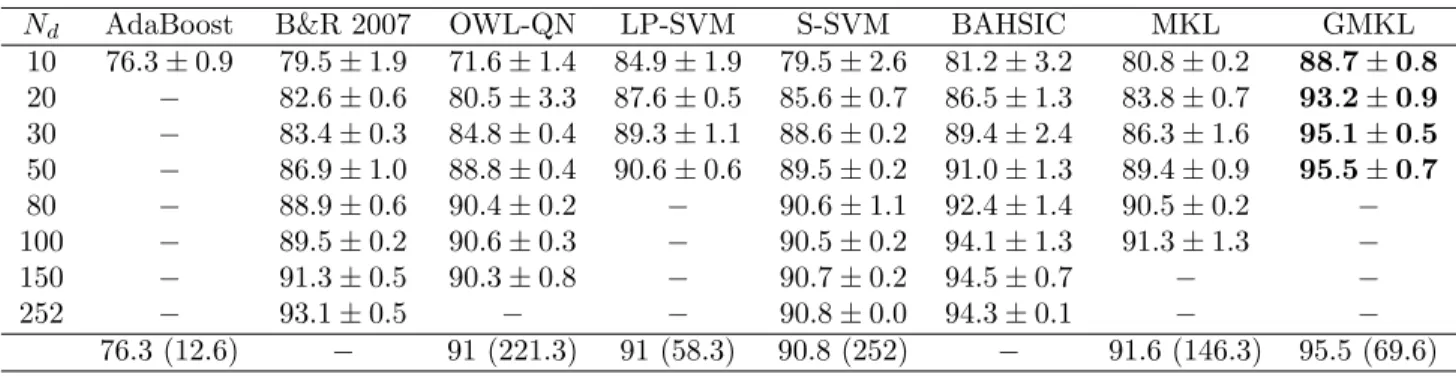
Table 1: Gender identification results. The final row summarizes the average number of features selected (in brackets) by each wrapper method and the resultant classification accuracy. See text for details.
Nd AdaBoost B&R 2007 OWL-QN LP-SVM S-SVM BAHSIC MKL GMKL 10 76.3±0.9 79.5±1.9 71.6±1.4 84.9±1.9 79.5±2.6 81.2±3.2 80.8±0.2 88.7±0.8 20 − 82.6±0.6 80.5±3.3 87.6±0.5 85.6±0.7 86.5±1.3 83.8±0.7 93.2±0.9 30 − 83.4±0.3 84.8±0.4 89.3±1.1 88.6±0.2 89.4±2.4 86.3±1.6 95.1±0.5 50 − 86.9±1.0 88.8±0.4 90.6±0.6 89.5±0.2 91.0±1.3 89.4±0.9 95.5±0.7 80 − 88.9±0.6 90.4±0.2 − 90.6±1.1 92.4±1.4 90.5±0.2 −
100 − 89.5±0.2 90.6±0.3 − 90.5±0.2 94.1±1.3 91.3±1.3 −
150 − 91.3±0.5 90.3±0.8 − 90.7±0.2 94.5±0.7 − −
252 − 93.1±0.5 − − 90.8±0.0 94.3±0.1 − −
76.3 (12.6) − 91 (221.3) 91 (58.3) 90.8 (252) − 91.6 (146.3) 95.5 (69.6)
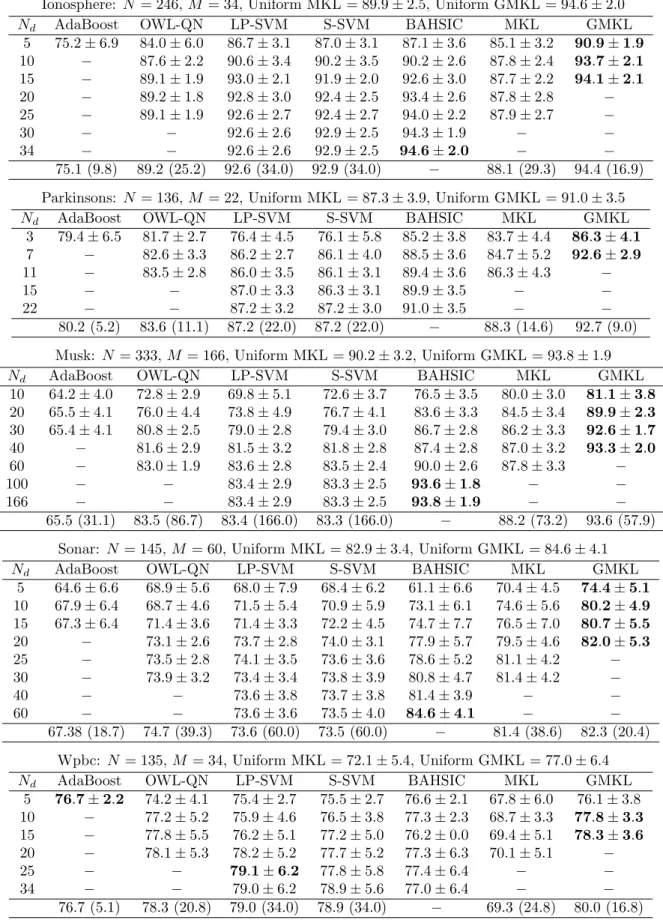
UCI datasets, there can be as much as a 6% to 10% difference in performance between GMKL and MKL. We also demonstrate that GMKL performs better than the other methods considered.
To generate feature selection results, we can vary the hyper-parameter C in the wrapper methods to select a desired number of features. However, this strategy does not yield good classification results even though globally optimal solutions are obtained. Low values of
Cencouraged greater sparsity but also permitted more classification errors. We obtained much better results by the theoretically suboptimal strategy of fixingCto a large value (chosen via cross-validation so as to mini-mize classification error), learning the classifier, taking the top ranked components ofw(ord) and relearning the classifier using only the selected features.
This technique was used to generate the results in Ta-bles 1 and 2. For each dataset, the very last row sum-marizes the number of features selected (Ns) by each wrapper method and the resultant classification accu-racy. When the number of desired features (Nd) is less thanNs, the classification accuracy is determined using the Nd top ranked features. Otherwise, when
Nd> Ns, the table entry is left blank as the classifica-tion accuracy either plateaus or decreases as subopti-mal features are added. In such a situation, it is better to choose only Nsfeatures and maintain accuracy. 5.1. Gender Identification
We tackle the binary gender identification problem on the benchmark database of (Moghaddam & Yang, 2002). The database has images of 1044 male and 711 female faces giving a total of 1755 images in all. We follow the standard experimental setup and use 1053 images for training and 702 for testing. Results are averaged over 3 random splits of the data.
Each image in the database has been pre-processed
by (Moghaddam & Yang, 2002) to be aligned and has been scaled down to have dimensions 21×12. Thus, each image has 252 pixels and we associate an RBF kernel with each pixel based on its grey scale inten-sity directly. For Generalized MKL, the 252 base kernels are combined by taking their product to get
kd(xi,xj) = Q252m=1e−dm(xim−xjm)
2
where xim and
xjm represent the intensity of the mth pixel in im-ageiandj respectively. For standard MKL, the same 252 base kernels are combined using the sum represen-tation to get kd(xi,xj) = P252
m=1dme−γm(xim−xjm)
2
. Both methods are subject tol1regularization ondso that only a few kernels are selected. AdaBoost can also be used to combine the 252 weak classifiers de-rived from the individual base kernels. The method of (Baluja & Rowley, 2007) can be considered as a state-of-the-art boosting variant for this problem and operates on pairs of pixels. We use RBF kernels for BAHSIC as well while the other methods are linear. Table 1 lists the feature selection results. AdaBoost tended to perform the worst and selected only 12.6 features on average. The poor performance was due to the fact that each of the 252 SVMs was learnt inde-pendently. The weak classifier coefficients (i.e. kernel weights) did not influence the individual SVM para-meters. By contrast, there is a very tight coupling between the two in MKL and GMKL and this ensures better performance. Of course, other forms of boost-ing do not have this limitation and the state-of-the-art boosting method of (Baluja & Rowley, 2007) performs better but is still significantly inferior to GMKL. The performance of the linear feature selection meth-ods is quite variable. Logistic regression performs poorly as the implicit bias weight got set to zero due to the l1 regularization. On the other hand, LP-SVM and Sparse-LP-SVM perform even better than stan-dard MKL (though not better than GMKL). BAHSIC, which is a non-linear filter method, follows the same
Table 2: UCI results with datasets havingN training points andM features. See text for details. Ionosphere: N = 246,M = 34, Uniform MKL = 89.9±2.5, Uniform GMKL = 94.6±2.0
Nd AdaBoost OWL-QN LP-SVM S-SVM BAHSIC MKL GMKL 5 75.2±6.9 84.0±6.0 86.7±3.1 87.0±3.1 87.1±3.6 85.1±3.2 90.9±1.9 10 − 87.6±2.2 90.6±3.4 90.2±3.5 90.2±2.6 87.8±2.4 93.7±2.1 15 − 89.1±1.9 93.0±2.1 91.9±2.0 92.6±3.0 87.7±2.2 94.1±2.1 20 − 89.2±1.8 92.8±3.0 92.4±2.5 93.4±2.6 87.8±2.8 −
25 − 89.1±1.9 92.6±2.7 92.4±2.7 94.0±2.2 87.9±2.7 −
30 − − 92.6±2.6 92.9±2.5 94.3±1.9 − −
34 − − 92.6±2.6 92.9±2.5 94.6±2.0 − −
75.1 (9.8) 89.2 (25.2) 92.6 (34.0) 92.9 (34.0) − 88.1 (29.3) 94.4 (16.9) Parkinsons: N = 136,M = 22, Uniform MKL = 87.3±3.9, Uniform GMKL = 91.0±3.5
Nd AdaBoost OWL-QN LP-SVM S-SVM BAHSIC MKL GMKL 3 79.4±6.5 81.7±2.7 76.4±4.5 76.1±5.8 85.2±3.8 83.7±4.4 86.3±4.1 7 − 82.6±3.3 86.2±2.7 86.1±4.0 88.5±3.6 84.7±5.2 92.6±2.9 11 − 83.5±2.8 86.0±3.5 86.1±3.1 89.4±3.6 86.3±4.3 −
15 − − 87.0±3.3 86.3±3.1 89.9±3.5 − −
22 − − 87.2±3.2 87.2±3.0 91.0±3.5 − −
80.2 (5.2) 83.6 (11.1) 87.2 (22.0) 87.2 (22.0) − 88.3 (14.6) 92.7 (9.0) Musk: N = 333,M = 166, Uniform MKL = 90.2±3.2, Uniform GMKL = 93.8±1.9
Nd AdaBoost OWL-QN LP-SVM S-SVM BAHSIC MKL GMKL 10 64.2±4.0 72.8±2.9 69.8±5.1 72.6±3.7 76.5±3.5 80.0±3.0 81.1±3.8 20 65.5±4.1 76.0±4.4 73.8±4.9 76.7±4.1 83.6±3.3 84.5±3.4 89.9±2.3 30 65.4±4.1 80.8±2.5 79.0±2.8 79.4±3.0 86.7±2.8 86.2±3.3 92.6±1.7 40 − 81.6±2.9 81.5±3.2 81.8±2.8 87.4±2.8 87.0±3.2 93.3±2.0 60 − 83.0±1.9 83.6±2.8 83.5±2.4 90.0±2.6 87.8±3.3 −
100 − − 83.4±2.9 83.3±2.5 93.6±1.8 − −
166 − − 83.4±2.9 83.3±2.5 93.8±1.9 − −
65.5 (31.1) 83.5 (86.7) 83.4 (166.0) 83.3 (166.0) − 88.2 (73.2) 93.6 (57.9) Sonar: N = 145,M = 60, Uniform MKL = 82.9±3.4, Uniform GMKL = 84.6±4.1
Nd AdaBoost OWL-QN LP-SVM S-SVM BAHSIC MKL GMKL 5 64.6±6.6 68.9±5.6 68.0±7.9 68.4±6.2 61.1±6.6 70.4±4.5 74.4±5.1 10 67.9±6.4 68.7±4.6 71.5±5.4 70.9±5.9 73.1±6.1 74.6±5.6 80.2±4.9 15 67.3±6.4 71.4±3.6 71.4±3.3 72.2±4.5 74.7±7.7 76.5±7.0 80.7±5.5 20 − 73.1±2.6 73.7±2.8 74.0±3.1 77.9±5.7 79.5±4.6 82.0±5.3 25 − 73.5±2.8 74.1±3.5 73.6±3.6 78.6±5.2 81.1±4.2 −
30 − 73.9±3.2 73.4±3.4 73.8±3.9 80.8±4.7 81.4±4.2 −
40 − − 73.6±3.8 73.7±3.8 81.4±3.9 − −
60 − − 73.6±3.6 73.5±4.0 84.6±4.1 − −
67.38 (18.7) 74.7 (39.3) 73.6 (60.0) 73.5 (60.0) − 81.4 (38.6) 82.3 (20.4) Wpbc: N = 135,M = 34, Uniform MKL = 72.1±5.4, Uniform GMKL = 77.0±6.4
Nd AdaBoost OWL-QN LP-SVM S-SVM BAHSIC MKL GMKL 5 76.7±2.2 74.2±4.1 75.4±2.7 75.5±2.7 76.6±2.1 67.8±6.0 76.1±3.8 10 − 77.2±5.2 75.9±4.6 76.5±3.8 77.3±2.3 68.7±3.3 77.8±3.3 15 − 77.8±5.5 76.2±5.1 77.2±5.0 76.2±0.0 69.4±5.1 78.3±3.6 20 − 78.1±5.3 78.2±5.2 77.7±5.2 77.3±6.3 70.1±5.1 −
25 − − 79.1±6.2 77.8±5.8 77.4±6.4 − −
34 − − 79.0±6.2 78.9±5.6 77.0±6.4 − −
trend and its performance is significantly worse than GMKL with identical kernels. This would suggest that wrapper methods based on the right feature represen-tation should be preferable to filter methods which do not directly optimize for classification accuracy. The comparison between MKL and GMKL is even starker. GMKL achieves a classification accuracy of 93.2% using as few as 20 features and 95.1% using only 30 features. In comparison, standard MKL achieves just 83.8% and 86.3% respectively. This reinforces the observation that choosing the right kernel repre-sentation is much more important than converging to the globally optimal solution. Finally, the MKL and GMKL results for fixed uniform weights chosen via cross-validation are 92.6±0.9 and 94.3±0.1 respec-tively. Note that these results are obtained using all 252 features. GMKL can obtain a similar classification accuracy using as few as 25 features.
In summary, there can be a difference of almost 10% between standard MKL and GMKL for a fixed small number of features. GMKL also does significantly bet-ter than BAHSIC and achieves nearly a 10x compres-sion factor as compared to taking uniform weights. 5.2. UCI Datasets
We also present comparative results on UCI datasets. We follow the standard experimental methodol-ogy (Rakotomamonjy et al., 2008) where 70% of the points are used for training and the remaining 30% for testing. Results are reported over 20 random splits of the data. All datasets are preprocessed to have zero mean and unit variance.
An RBF kernel is assigned to each of theM features in a given dataset. The M RBF kernels are then combined linearly for standard MKL and by taking their product for GMKL. The learnt kernels are of the form kd(xi,xj) = PMm=1dme−γm(xim−xjm)
2
and
kd(xi,xj) =QM
m=1e−dm(xim−xjm)
2
respectively. Table 2 lists the feature selection results. The analysis
Table 3: Comparison with the results in (Rakotoma-monjy et al., 2008). GMKL achieves slightly better results but takes far fewer kernels as input.
Database SimpleMKL GMKL Sonar 80.6±5.1 (793) 82.3±4.8(60) Wpbc 76.7±1.2 (442) 79.0±3.5(34) Ionosphere 91.5±2.5 (442) 93.0±2.1(34) Liver 65.9±2.3 (091) 72.7±4.0(06) Pima 76.5±2.6 (117) 77.2±2.1(08)
is similar to that of gender identification except that OWL-QN performs better as the implicit bias is not al-ways being set to zero. For a fixed number of features, GMKL has the best classification results even as com-pared to MKL or BAHSIC (though the variance can be high for all the methods). Furthermore, a kernel with fixed uniform weights yields ballpark classifica-tion accuracies though GMKL can achieve the same results using far fewer features.
5.3. Comparison to SimpleMKL and HMKL The classification performance of standard MKL can be improved by adding extra base kernels which are either more informative or help better approximate a desired kernel function. However, this can lead to a more complex and costlier learning task. We there-fore leave aside feature selection for the moment and compare our results to those reported in (Rakotoma-monjy et al., 2008). Table 3 lists classification per-formance on the 5 datasets of (Rakotomamonjy et al., 2008). The number of kernels input to each method are reported in brackets. As can be seen, GMKL can achieve slightly better performance than SimpleMKL while training on far fewer kernels. Of course, one can reduce the number of kernels input to SimpleMKL but this will result in reduced accuracy. In the limit that only a single kernel is used per feature, we will get back the results of Table 2 where GMKL does much better than standard MKL.
The results for Liver were obtained usingl2 regulariza-tion. This lead to a 7% improvement in performance over SimpleMKL as a sparse representation is not suit-able for this database (there are only 6 features). Pima also has very few features butl1andl2regularization give comparable results.
Finally, we also compare results to Hierarchical MKL (Bach, 2008). We use a quadratic kernel of the form kd(xi,xj) = (1 +Pmdmximxjm)2 as compared to the more powerful kd(xi,xj) =Qm(1 +ximxjm)4 of (Bach, 2008) which decomposes to a linear combina-tion of 5M kernels. Nevertheless, as shown in Table 4, we achieve slightly better results with less computa-tional cost.
Table 4: Comparison between HKL and GMKL. Database N M HKL GMKL Magic04 1024 10 84.4±0.8 86.2±1.2 Spambase 1024 57 91.9±0.7 93.2±0.8 Mushroom 1024 22 99.9±0.2 100±0.0
6. Conclusions
In this paper, we have shown how traditional MKL formulations can be easily extended to learn general kernel combinations subject to general regularization on the kernel parameters. While our focus was on binary classification our approach can be applied to other loss functions and even other formulations such as Local MKL, multi-class and multi-label MKL. Gen-eralized kernel learning can be achieved very efficiently based on gradient descent optimization and existing large scale SVM solvers. As such, it is now possible to learn much richer feature representations as compared to standard MKL without sacrificing any efficiency in terms of speed of optimization.
Our GMKL formulation based on products of kernels was shown to give good results for various feature se-lection problems – not only as compared to traditional MKL but also as compared to leading wrapper and fil-ter feature selection methods. Of course, taking prod-ucts of kernels might not always be the right approach to every problem. In such cases, our formulation can be used to learn other appropriate representation in-cluding sums of kernels. Finally, it should be noted that the classification accuracy of GMKL with learnt weights tends to be much the same as that obtained using uniform weights chosen through cross-validation. The advantage in learning would therefore seem to lie in the fact that GMKL can learn to achieve the same classification accuracy but using far fewer features.
Acknowledgements
We are grateful to P. Anandan, Andrew Zisserman and our reviewers for providing helpful feedback.
References
Andrew, G., & Gao, J. (2007). Scalable training ofL1 -regularized log-linear models. ICML (pp. 33–40). Argyriou, A., Micchelli, C. A., & Pontil, M. (2005).
Learning convex combinations of continuously pa-rameterized basic kernels. COLT(pp. 338–352). Bach, F. R. (2008). Exploring large feature spaces
with hierarchical multiple kernel learning.NIPS(pp. 105–112).
Bach, F. R., Lanckriet, G. R. G., & Jordan, M. I. (2004). Multiple kernel learning, conic duality, and the SMO algorithm. ICML (pp. 6–13).
Baluja, S., & Rowley, H. (2007). Boosting sex identi-fication performance. IJCV,71, 111–119.
Bi, J., Zhang, T., & Bennet, K. P. (2004). Column-generation boosting methods for mixture of kernels. Proc. SIGKDD(pp. 521–526).
Chan, A. B., Vasconcelos, N., & Lanckriet, G. (2007). Direct convex relaxations of sparse SVM.ICML(pp. 145–153).
Chapelle, O., Vapnik, V., Bousquet, O., & Mukherjee, S. (2002). Choosing multiple parameters for Support Vector Machines. Machine Learning,46, 131–159. Crammer, K., Keshet, J., & Singer, Y. (2002). Kernel
design using boosting. NIPS (pp. 537–544). Cristianini, N., Shawe-Taylor, J., Elisseeff, A., &
Kan-dola, J. (2001). On kernel-target alignment. NIPS (pp. 367–373).
Danskin, J. M. (1967). The theorey of max-min and its applications to weapons allocation problems. Fung, G., & Mangasarian, O. L. (2002). A feature
se-lection newton method for support vector machine classification (Technical Report 02-03). Univ. of Wisconsin.
Kloft, M., Brefeld, U., Laskov, P., & Sonnenburg, S. (2008). Non-sparse Multiple Kernel Learning. NIPS Workshop on Kernel Learning.
Lanckriet, G. R. G., Cristianini, N., Bartlett, P., El Ghaoui, L., & Jordan, M. I. (2004). Learning the kernel matrix with semidefinite programming. JMLR,5, 27–72.
Moghaddam, B., & Yang, M. H. (2002). Learning gen-der with support faces. IEEE PAMI,24, 707–711. Ong, C. S., Smola, A. J., & Williamson, R. C. (2005).
Learning the kernel with hyperkernels. JMLR, 6, 1043–1071.
Rakotomamonjy, A., Bach, F., Grandvalet, Y., & Canu, S. (2008). Simplemkl. JMLR,9, 2491–2521. Song, L., Smola, A., Gretton, A., Borgwardt, K., &
Bedo, J. (2007). Supervised feature selection via dependence estimation. ICML(pp. 823–830). Sonnenburg, S., Raetsch, G., Schaefer, C., &
Schoelkopf, B. (2006). Large scale multiple kernel learning. JMLR,7, 1531–1565.
Varma, M., & Ray, D. (2007). Learning the discrimi-native power-invariance trade-off. ICCV.
Zien, A., & Ong, C. S. (2007). Multiclass multiple kernel learning. ICML(pp. 1191–1198).