Sean Rhea, Chris Wells, Patrick Eaton,
Dennis Geels, Ben Zhao, Hakim Weatherspoon, and John Kubiatowicz
University of California, Berkeley
Maintenance-Free
Global Data Storage
OceanStore, a global storage infrastructure, automatically
recovers from server and network failures, incorporates new
resources, and adjusts to usage patterns.
T
he computing world isexperienc-ing a transition from desktop PCs to connected information appli-ances, which — like the earlier transition from mainframes to PCs — will profound-ly change the way information is used. The variety of devices capable of con-necting to the Internet is astounding. Per-sonal Data Assistants (PDAs), cellular phones, and even cars have Internet nectivity. Given the proliferation of con-nected devices, it’s natural to address their common need for persistent storage by means of an Internet-based, distributed storage system. Such a system would let devices transparently share data and pre-serve information even when devices are lost or damaged (for a discussion of appli-cations that will benefit from such a stor-age infrastructure, see the “Applications for Global Storage Systems” sidebar on p. 44). To handle all of the world’s client devices, such a storage system must even-tually consist of thousands or millions of Internet-connected servers. Consequently, the greatest obstacle to building and deploying such a system is manageabili-ty. Already, single-site data storage
sys-tems require carefully orchestrated server configurations, an art understood only by highly paid experts. In a global-scale, dis-tributed storage system, the difficulties increase by many orders of magnitude.
Two distinct types of management are readily identified. Storage-level manage-mentis the set of operations required to maintain the integrity and access perfor-mance of raw data, without reference to the semantics of the information that data represents. Proper storage-level manage-ment yields a stable set of bits (or stable store) that can be utilized by applications in a variety of ways. Information-level management,on the other hand, is the set of operations involved in sorting, classi-fying, and organizing raw data. Conse-quently, error correction codes are an aspect of storage-level management, while sophisticated indexing is an aspect of information-level management.
This article explores mechanisms for storage-level management in OceanStore,1
a global-scale utility infrastructure, de-signed to scale to billions of users and exabytes of data. A prototype of the OceanStore system is currently under
struction at the University of California at Berkeley. OceanStore combines erasure codes for data dura-bility with a Byzantine agreement protocol for con-sistent update serialization, even when malicious servers are present. Its routing layer effectively divorces information from location, and includes an integrated set of tools for introspective adapta-tion. Each component is sufficiently fault-tolerant to survive a severe network partition, and each component can repair itself following unexpected or malicious failures. Such mechanisms support the automatic integration and removal of servers, per-haps the greatest advance over conventional dis-tributed storage systems.
System Overview
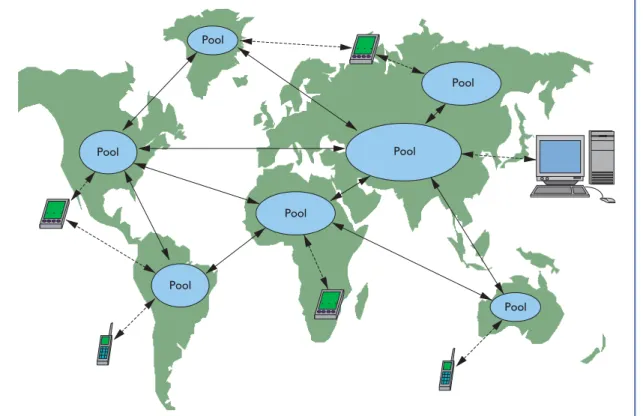
As Figure 1 shows, OceanStore consists of millions of individual servers, each cooperating to provide service. A group of such servers is a pool. Data flows freely between these pools, allowing repli-cas of a data object to exist anywhere, at any time. Because OceanStore is composed of untrusted servers, it utilizes redundancy and client-side cryptographic techniques to protect data. Although many servers may be corrupted or compromised at a given time, the complete system’s aggregate behavior assures users of stable storage. Moreover,
because client data is encrypted, servers are never able to read it. Users are assumed to pay for vice from one of many possible OceanStore ser-vice providers (OSPs), each of which own some of the OceanStore servers.
OceanStore attacks the problem of storage-level maintenance with four mechanisms:
■ a self-organizing routing infrastructure,
■ m-of-ndata coding with repair,
■ Byzantine update commitment, and
■ introspective replica management.
Together, these elements form a highly available, maintenance-free data storage substrate. This sub-strate recovers from server and network failures, efficiently incorporates new resources, and adjusts to changing usage patterns, all without manual intervention.
OceanStore is designed to support 1010users, each
having approximately 104data files of 104 bytes
each. Thus, the system must store approximately one exabyte (1018bytes) of data, a size that is consistent
with recent data growth projections.2
At the lowest level, OceanStore uses erasure codes
for data durability.3 Erasure coding transforms a
block of input data into fragments, which are spread Pool
Pool
Pool
Pool
Pool Pool
Pool
Figure 1. The OceanStore system.The core is composed of potentially thousands or millions of highly connected “pools” or storage domains, among which data freely flows. Clients connect to one or more pools, perhaps intermittently.
over many servers; only a fraction of the fragments are needed to reconstruct the original block. This coding technique introduces several concerns. One such issue is data integrity: The system must ensure that a reconstructed object is an exact copy of the original, despite failures or malicious corruption of fragments. OceanStore addresses this issue by nam-ing each object and its associated fragments by the result of a secure hash function over the object’s contents. This value is the object’s globally unique identifier(GUID). The security of the hash justifies this terminology — our prototype uses a 160-bit SHA-1 hash for which the probability that two out of 1014different objects hash to the
same value is approximately 1 in 1020. Because changing an object’s
content changes its hash value and name, objects named by GUIDs are read-only. OceanStore’s archival subsystem manages these read-only objects, as we discuss later. Because the servers can regenerate and check hashes at any time, fragments are unforgeable and self-verifying.
Another issue introduced by erasure coding is location: When reconstructing an object, the sys-tem must locate enough servers storing fragments for that object. OceanStore addresses this problem with Tapestry, an overlay routing and location layer on top of TCP/IP that maps GUIDs to individual servers. A server can advertise many GUIDs, and any GUID can be advertised by multiple servers. Utilizing Tapestry, OceanStore can easily locate the servers containing fragments for a given GUID.
As specified above, durable elements of OceanStore are read-only. OceanStore overcomes this deficiency through versioning,4the concept
that every update creates a new version of a data object. To support versioning, each OceanStore object has a special name called an active GUID. The system then provides a fault-tolerant mapping from an object’s active GUID to the GUID of the most recent read-only version of that object. This mapping is accomplished by the inner ring, a group of servers working on behalf of that object. Each object has its own inner ring, although phys-ical servers may participate in many different inner rings. The system builds a mapping from human-readable names to active GUIDs with a hierarchy of OceanStore objects, similar to the SDSI framework.5Clients locate servers of an inner
ring through Tapestry.
An inner ring’s servers are kept consistent
through a Byzantine agreement protocol that lets a group of 3f+ 1 servers reach agreement whenever no more than fof them are faulty. Consequently, the mapping from active GUID to most recent read-only GUID tolerates server failure and cor-ruption. The system ensures that no more than fof those servers are faulty via the responsible party, a group of servers owned by a user’s OSP, that pro-vide a crucial, but low-bandwidth, level of over-sight to the system.
The inner ring also verifies a data object’s legitimate writers, orders updates, and maintains an update history. This history allows for time travel as in the original Postgres database.4Time travel facilitates information management by providing a universal undo mechanism. Further, storing old versions of objects allows true refer-ential integrity. These are information-level man-agement properties, however, which are outside the scope of this article.
Finally, because reconstructing an object from archival fragments is computationally intensive, it should be performed only when necessary. OceanStore servers that have already reconstruct-ed objects from the archive can advertise them through Tapestry. These objects are secondary replicas of the data, distinct from the primary replicasstored on the inner ring. An OceanStore client can retrieve an object either by locating a replica from a nearby server or reconstructing it from the archive.
To make object retrieval less costly and minimize total work, an introspective replica management sub-system automatically creates, replaces, and removes replicas in response to object usage patterns.
Mechanisms for Self-Maintenance
A self-maintaining system requires two funda-mental properties: fault tolerance and automatic repair. When a system begins to fail or misbehave, the most important system property is its capabil-ity to continue operating correctly, though possi-bly at reduced performance. Such fault tolerance, however, is not sufficient for self-maintenance, because further failures might render correct oper-ation impossible. Instead, a system must, with high probability, detect and repair a failure before fur-ther failures cause a catastrophic error or disrupt service. This section describes self-maintenance in four pieces of the OceanStore architecture.
Routing Infrastructure
OceanStore’s Tapestry, a self-organizing routing and object location subsystem, provides object
Self-maintenance
requires fault
tolerance and
automatic repair.
location and node-to-node communication under failure conditions, while transparently handling the automatic insertion and removal of nodes.6 Basic routing and location.Tapestry functions as an overlay on top of IP, using a distributed, fault-tolerant data structure to explicitly track the loca-tion of all objects. This data structure resembles the hashed-suffix routing structure presented by Plax-ton, Rajaraman, and Richa.7Each network node
can act as a server that stores objects, a client that initiates requests, or a router that forwards mes-sages, or as all of these. Like objects, nodes are assigned unique identifiers called NodeIDs that are location- and semantics-independent.
Tapestry uses local-neighbor maps to incremen-tally route messages to their destination NodeID, digit by digit. Figure 2 shows an example of such routing. Because the only routing constraint is that each hop match some growing suffix, each routing step in any path can often be satisfied by several destinations. Tapestry keeps pointers to the three closest candidates (in network latency) for each routing entry and, where possible, routes to the neighbor with lowest latency. Nodes early in a path, in particular, generally have many candi-dates, making early routing hops very fast.
Location through Tapestry works as follows: When an OceanStore server inserts a replica into the system, Tapestry publishes its location by depositing a pointer to the replica’s location at each hop between the new replica and the object’s
root node, whose name (NodeID) is a deterministic function of the object’s GUID. To locate an object, a client routes a request to the object’s root until it encounters a replica pointer, at which point it routes directly to that replica.
Fault tolerance.Tapestry uses its redundant neigh-bor pointers when it detects a primary route failure while routing a message. Figure 3, which shows the effectiveness of these alternate routing paths, derives from a simulation of a 5,000-node TIERS artificial topology,8of which 4,096 nodes
partici-pate in the Tapestry protocols. In this simulation, we repeatedly routed packets from randomly cho-sen nodes in the Tapestry network to 256 destina-tion nodes, while increasing the number of failed links in the physical network. Because IP routing via border gateway protocol (BGP) tables cannot detect failures and find alternate routes in time to redirect packets, we consider packets sent along failed links dropped. Tapestry, on the other hand, uses periodic user datagram protocol (UDP) probes to gauge link conditions, and can immediately deploy backup routes when a failure is detected.
The most striking result in Figure 3 is that Regions B and D are almost invisible, meaning only L4
L2 L1
L3
L4
L4 L3
L2
L3 L2
L1 D598
1598
2118 4598
0098 3E98
7598
87CA 9098
B4F8
0325
2BB8
Figure 2. Tapestry routing example. A potential path for a message originating at node 0325 destined for node 4598.Tapestry routes the message through nodes **** → ***8 → **98 → *598 →4598, where asterisks represent wildcards.The role each hop plays in the path is marked with a level number.
0 0.05 0.10 0.15 0.20 0.25 0.30 0.35 0.40 0.45 0.50 0.0
0.1 0.2 0.3 0.4 0.5 0.6 0.7 0.8 0.9 1.0
Fraction of failed links
Fraction of routing conditions A, B, C, D, E
<Base 4; namespace size 4,096; group size 256; TIERS 5,000> A B C D E
Figure 3. Fault-tolerant routing in Tapestry.This figure shows the benefits of fault-tolerant routing by plotting a reachability measure (fraction of routes available) against the fraction of failed physical links. Regions A through D: physical route exists; Region E: no physical route exists. Region A: both IP and Tapestry successfully route to destination. Region B (barely visible between A and C): IP succeeds, Tapestry fails. Region C: IP fails,Tapestry succeeds. Region D (barely visible between C and E): both protocols fail.
in rare circumstances does Tapestry fail to route to a physically reachable node. As failures increase in frequency, Tapestry greatly increases the probabili-ty of successful routing. Even when half the physi-cal links are broken, Tapestry has a 10 percent chance of reaching any destination node.
Besides storing multiple destinations per hop, Tapestry deterministically chooses multiple inde-pendent root nodes for each object to provide additional redundancy in the location protocol. The result trades off reliability and bandwidth, because location queries are sent to each root in parallel. In a network with sroots, and assuming a large-scale network partition that divides the network fairly evenly, it is likely (P ≈1 – (1/2)s)
that the data is available via one of the roots.
Automatic repair.Tapestry provides distributed
algorithms to adapt to node insertions and removals, fluctuating network conditions and changing user access patterns. To join an existing network, a node chooses a random NodeID by
which to identify itself. It then chooses a Tapestry node close in network distance to itself. These nearby Tapestry nodes can be specified by a sys-tem administrator or publicized by an external index such as a lightweight, directory access pro-tocol (LDAP) server. Routing to the newly chosen NodeID through this existing node lets the new node find other existing nodes that share incre-mentally longer suffixes. By copying and optimiz-ing their routoptimiz-ing tables at each level, the new node can generate a full routing table. The new node then notifies nearby nodes of its existence so that they can consider it as a more optimal neighbor.
To handle exiting nodes, Tapestry includes two separate mechanisms. A node can simply disap-pear from the network, in which case its neighbors detect its absence and update routing tables accordingly. Alternatively, a node can use back-pointers to inform nodes that rely on it for rout-ing to redirect pointers and to notify object servers for which it stores location information.
The above mechanisms let us dynamically add and remove nodes without manual configuration. Similarly, background processes monitor network conditions to detect suboptimal routes and update routing maps where appropriate.6
M-of-NEncoding
Erasure codes and self-verifying fragments are the cornerstones of the archival layer’s fault tolerance and automatic repair. An erasure code treats input data as a series of mfragments, which it trans-forms into nfragments, where n>m. The result-ing code’s essential property is that any mof the coded fragments are sufficient to reconstruct the original data. The rateof encoding is r=m/n. The storage overhead is 1/r. The system can adjust the durability of information by selecting the rate (and hence overhead).
Fault tolerance.OceanStore divides objects into
blocks, producing an erasure-encoded form of each block. An object’s inner ring encodes blocks during the update process, sending encoded frag-ments for each new block to a set of independent storage servers. The inner ring chooses storage servers in a way that minimizes the impact of cor-related failures, such as can occur if the storage servers have similar geographic locations or administrative domains. To accomplish this, the inner ring builds models of the independence of storage servers based on historical measurement and information exchanged with other inner rings. Further, correlated failures pose less of a difficulty
A distributed, fault-tolerant, secure storage infrastructure benefits both very large and small datasets. For example, NASA’s Earth Observing Sys-tem (http://eospso.gsfc.nasa.gov/) is organizing a collection of satellites and data centers to manage scientific data about Earth’s climate.The sys-tem daily produces more than one terabyte of data, used by more than 10,000 researchers worldwide.
Currently, the data is partitioned across many data centers, each responsible for its own data administration and distribution. A global stor-age infrastructure would better serve such an unwieldy manstor-agement scheme, relieving administration and distribution burdens.The infrastruc-ture would ensure that data remain uncorrupted and widely available, and the system would replicate the data, rendering manual backup unneces-sary. If part of the infrastructure were compromised or retired, the sys-tem would restore replication levels automatically.The syssys-tem would find requested data regardless of its physical location and create a copy near the user. Researchers could check the data’s integrity to ensure that it was not altered during storage or transmission. Furthermore, if users lost their local copy due to administration or hardware failure, the infrastructure could immediately supply a new copy.
At the other end of the spectrum, virtually all PC owners have lost per-sonal data, despite the fact that many own suitable backup devices like tape drives or large removable disks. But such devices must be used on a reg-ular basis and do not protect data from threats such as fire and theft. As the volume and value of data stored on PCs increases, so does the poten-tial loss.This backup problem could be eliminated by a maintenance-free, global-scale storage infrastructure. Data would be replicated and geo-graphically distributed to protect it from hardware failure, configuration errors, and natural catastrophe. Moreover, the data would be stored securely to protect against theft or corruption.
to an archival system using a lower rate of encod-ing (higher overhead). For example, it is extreme-ly unlikeextreme-ly that 24 of 32 randomextreme-ly placed frag-ments would all be placed on the West Coast.
Erasure codes allow several servers storing fragments for a particular object to be unreach-able at any given time without making the object itself unavailable. With good fragment placement, an encoded block becomes unavailable only in the event of a network partition near the user or a complete partition of the Internet. The archival layer’s high tolerance for fragment failures must be supplemented, however, by a good repair mechanism.
Automatic repair. Once fragments have been
stored, they must be maintained despite failure. OceanStore offers four maintenance techniques: predicting disk failure, local server sweeps, distrib-uted detection and repair, and global sweep. The first two techniques increase local storage durabil-ity; the latter two ensure archive durability.
First, since disks begin to show signs of impending failure before they actually fail,9a
serv-er can improve the durability of local information by copying it to a new disk before it is lost. Sec-ond, a server can periodically verify the fragments it stores. Each fragment contains sufficient addi-tional information such that its contents can by verified by re-hashing the data and comparing the result to the fragment’s name. If an error is detect-ed, the server can request the failed fragment’s block from the archive, reconstruct the block, and fragment it to recreate the lost fragment.
Third, OceanStore replaces lost information with a distributed detection-and-repair scheme, which is useful because we cannot fully trust servers to maintain the integrity of their own data. A given server could crash, losing all fragments stored on its disk. Or, a server could maliciously delete data. Tapestry contains the location of every fragment; further, this information is self-repair-ing. Consequently, it’s possible to notice — such as at Tapestry root nodes — when the redundancy level for a given object has dropped below a crit-ical level and trigger the recreation and redissem-ination of lost fragments.
Finally, as a last line of defense, the responsible party periodically sweeps through data under its control, attempting to reconstruct each block. It then regenerates and redisseminates the block’s fragments. This process restores lost redundancy to the archive and compensates for malicious or faulty servers.
Extreme durability.An effective detection and
repair scheme can yield data durability unmatched by conventional archiving techniques. A simplified model of OceanStore illustrates the benefits of fragmentation and repair. First, we assume that the archive is a collection of inde-pendently failing disks and that failed disks are immediately replaced by new, blank ones. During dissemination, each archival fragment for a given block is placed on a unique, randomly selected disk. Finally, a global sweep-and-repair process scans the system, attempting to restore redun-dancy by reconstructing each block and redis-tributing its fragments over a new set of disks. The time period between sweeps of the same block is an epoch.
Figure 4 shows a block’s resulting mean time to failure (MTTF) for various epoch lengths and num-bers of fragments. The probability that a fragment will survive until the next epoch was computed from the distribution of disk lifetimes,9
supple-mented by the assumption that five-year-old disks are at the end of their lifetime, using a method similar to computing the residual average lifetime of a randomly selected disk. The probability that a block can be reconstructed is the sum of all cases in which at least mfragments survive. The MTTF is the mean of the geometric distribution produced from the block survival probability.
The MTTF axis in Figure 4 is logarithmic, indi-cating that the MTTF of objects scales superlin-early with the inverse of the repair epoch. Although perhaps less clear from the graph, the
1 1e + 10 1e + 20 1e + 30 1e + 40 1e + 50 1e + 60 1e + 70 1e + 80 1e + 90 1e + 100 1e + 110
0 1 2 3 4 5 6
MTTF (years)
Repair time (months)
Mean time to failure of an erasure-coded block (rate = 1/4) Number of fragments = 64 Number of fragments = 32 Number of fragments = 16 Number of fragments = 8 Number of fragments = 4
Figure 4. MTTF for a block encoded with a rate-1/4 erasure code. Increasing the number of fragments drastically increases a block’s durability while keeping the total storage cost constant.The four-frag-ment case is equivalent to simple replication on four servers.
MTTF also scales exponentially with the number of fragments. In our simple failure model, given 64 fragments and a repair time of six months, an object has an MTTF of more than 1035years.
Sim-ple replication, on the other hand, produces an MTTF of less than 35 years with the same storage cost and repair epoch.
This model analyzes only the sweep-and-repair process and does not include the other mecha-nisms, specifically the distributed detection and repair mechanism. These more-efficient repair techniques greatly increase the archive’s durabili-ty and, further, reduce the required frequency of global sweep and repair.
Byzantine Update Commitment
An object’s inner ring is responsible for generating new versions of the object from client updates and
consistently mapping the object’s active GUID to the GUID of its latest version. Each inner ring makes its decisions through a Byzantine agreement protocol.
Fault tolerance.Byzantine agreement guarantees
fault tolerance even in the presence of malicious replicas; specifically, ffaulty machines can be tol-erated by an inner ring of size n= 3f+ 1. However, Byzantine protocols require O(n2) messages to be
exchanged for every modification of data and were previously believed to be too inefficient for practi-cal use. This is no longer so for several reasons.
First, recent improvements in Byzantine proto-cols have greatly reduced both the number and size of messages sent during the agreement process. Our protocol is derived from one present-ed by Castro and Liskov.10 Their protocol
com-monly uses only a constant number of phases, rather than a number of phases linear in the size of the ring that characterized earlier protocols. Moreover, for a reasonably large write — say, exceeding four kilobytes — the total bandwidth these messages consume is less than that con-sumed by sending the write to the replicas. As a result, these algorithms are within a factor of two of the theoretical lower bound for bandwidth use in a replicated system.1In fact, Castro and Liskov
showed that their protocol was practical for file system use by favorably comparing an imple-mentation of their protocol to a commercial net-work file system (NFS) server.
Second, the inner ring consists of a few replicas, typicallyn< 10. Because secondary replicas are merely data caches, they don’t participate in the Byzantine protocol, but receive consistency infor-mation through an application-level multicast tree rooted at the inner ring. Their number does not contribute to the Byzantine protocol’s communi-cation costs. This two-tiered architecture is similar to that first presented by Gray and colleagues.11
Castro and Liskov’s system did not include pro-visions for caching data, so to ensure that cached data is valid, we extend their system as follows: Replicas in the inner ring use a threshold signature scheme to collectively sign the results of their deci-sions. Such a scheme allows a signature to be pro-duced as long as f+ 1 parties agree to cooperate, while preventing any smaller group from generat-ing a signature. Incorporatgenerat-ing such a scheme allows for any party in our system to verify that a data object’s content was valid at some time, since by assumption no more than fprimary replicas are faulty. Moreover, the inner ring members time stamp each decision, allowing any party to verify
Intermemory1is a large-scale, distributed, fault-tolerant archival system
that encrypts and erasure-encodes data. It stores fragments on untrust-ed machines and locates them via an enhancuntrust-ed-DNS lookup scheme. Far-Site2is an organization-scale distributed file system built from untrusted
components. Its goals include Byzantine fault tolerance and high availabil-ity. PAST3intends to produce a global-scale storage system of read-only
data using replication for durability. It includes Pastry, a location compo-nent that shares many of Tapestry’s properties, described in the main text. CAN4and Chord5are also examining wide-area location systems.
Other systems have more limited goals. Free Haven (http://www. freehaven.net/) and Freenet (http://freenet.sourceforge.net/) are publish-ing systems to support free expression; they focus on publisher anonymi-ty and object authentication. Systems such as i-drive (http://www.idrive. com/) and Xdrive (http://www.xdrive.com/) provide available Web-based storage and file-sharing solutions. Finally, systems like Scale Eight (http://www.s8.com/) and Mojo Nation (http://www.mojonation.net/) dis-tribute proprietary content and consequently focus heavily on security, authenticity of data, and access control. Mojo Nation uses Swarm, a peer-to-peer distribution model, while Scale Eight relies on a proprietary glob-al infrastructure for distribution.
REFERENCES
1. A. Goldberg and P.Yianilos, “Towards an Archival Intermemory,” Proc. IEEE Int’l Conf. Advances in Digital Libraries (ADL 98), IEEE Computer Soc. Press, Los Alamitos, Calif., 1998, pp. 147-156.
2. W. Bolosky et al.,“Feasibility of a Serverless Distributed File System Deployed on an Exist-ing Set of Desktop PCs,” Proc. Sigmetrics,ACM Press, New York, 2000.
3. P. Druschel and A. Rowstron,“PAST:A Large-Scale, Persistent Peer-to-Peer Storage Utili-ty,” Proc. HotOS Conf., IEEE Computer Soc. Press, Los Alamitos, Calif., 2001.
4. S. Ratnasamy et al.,“A Scalable Content-Addressable Network,” Proc. SIGCOMM Conf., ACM Press, New York, 2001.
5. I. Stoica et al.,“Chord:A Scalable Peer-to-Peer Lookup Service for Internet Applications,” Proc. SIGCOMM Conf.,ACM Press, New York, 2001.
that a data object is both valid and current. Par-ties can verify that an object is current only as pre-cisely as the system clocks are synchronized. Alternatively, they can determine an object’s freshness with certainty by requesting the current sequence number directly from the inner ring.
Automatic repair.Automatic repair of the inner
ring means maintaining the Byzantine assumption by ensuring that less than a third of the servers in a ring are compromised or faulty at any time.
Aproactive threshold signature12allows the
par-ties who participate in signing objects to be changed over time without changing the key used to verify a signature. This technique allows the responsible party (mentioned earlier) to replace faulty or corrupted replicas without changing the inner ring’s public key, and only this key is neces-sary to verify an object’s data. Because the rest of OceanStore communicates with the inner ring through Tapestry, changing the ring’s composition like this will not affect other servers’ ability to communicate with it. This information-hiding makes it possible to change the set of servers con-stituting the inner ring without affecting the rest of the system. Because there could be many sec-ondary replicas for a given object, this property is essential for efficient automatic repair.
We maintain the Byzantine assumption by con-tinuously altering the set of servers that participate in an inner ring. We assume that the fraction of faulty or corrupted servers in the world is much less than one third. Given this assumption, replac-ing any server in the inner rreplac-ing with a random server from the pool of all servers will likely reduce the number of faulty servers in the inner ring. This replacement can be initiated by the responsible party discussed earlier, and so long as such replace-ments occur slightly faster than the average rate at which servers within the ring fail, the Byzantine assumption remains valid. Further model exten-sions, the subject of ongoing research, let the inner ring safely manage its own membership with min-imal outside assistance.
Introspective Replica Management
OceanStore allows data caching at any network location. Clearly, the service time of user requests depends on the network distance to the nearest replica, as well as its load. More subtly, replica locality affects service availability when network connectivity is intermittent.
The cost and complexity of manually adminis-tering 1014objects to ensure locality and
accept-able levels of replication is prohibitive. Instead, we delegate this task to the introspective replica man-agement subsystem.
Introspectionis an architectural paradigm that mimics biological adaptation. The introspection layer in OceanStore contains the tools for event monitoring, event analysis, and self-adaptation. It also provides tools for automatic collaboration among introspective modules on different servers. Introspective modules on servers observe net-work traffic, measuring access traffic generated by nodes within a few hops. When a server detects heavy demand for an object, it creates a new local replica to handle those accesses. Alternately, clients can request replicas on
nearby servers if their perceived quality of service drops below acceptable levels. Additionally, Tapestry root nodes can detect requests that travel a great dis-tance and suggest locations for new replicas. When a replica falls into disuse, a server can remove it from the network and reclaim its resources.
If a replica suddenly becomes
unavailable, the nearby clients will continue to receive service from a more distant replica, due to the fault-tolerant properties of the routing and location mechanism. This failover produces addi-tional load on distant replicas, which the intro-spective mechanisms detect. OceanStore then cre-ates new replicas to stabilize the system. These activities satisfy the requirements for both fault tol-erance and automatic repair.
Bringing It All Together
Against the backdrop of these mechanisms, we can trace the life of a typical server from its integra-tion into OceanStore to its eventual removal.
Integration.To place itself in OceanStore, a new
server needs only the address of at least one known Tapestry node; it then weaves itself into the routing and location layer. Next, the server begins advertising its services and the roles it can assume to the world. For example, a server with extra pro-cessing cycles and spare storage could advertise its willingness to become an inner ring member or to store new archival fragments. These roles are either specified by administrative parameters or follow recommendations made by its introspective component. For example, a node is unlikely to accept new archival fragments when its available
OceanStore
allows data
caching at any
network location.
storage falls under acceptable limits. Additionally, for a node to perform certain roles, it must estab-lish a level of trust with the remainder of the sys-tem. For example, to become a member of an inner ring, a node must be recommended by some user’s OceanStore service provider. This recommendation would be based on the belief that the given node would fail independently of the other members of the given inner ring.
Removal.A server can be removed from OceanStore
if it becomes obsolete, needs scheduled mainte-nance, or experiences component failures. When possible, the server runs a shutdown script to inform the system of its imminent removal. Even in the absence of this announcement, OceanStore will detect and correct for the server’s absence. Tapestry nodes that depend on the server for rout-ing will promote secondary routers and find new backups. Servers in primary rings will elect replace-ments from the global pool of available servers. The roots for archived objects for which the server was storing fragments will cause server pointers to time out, notifying the objects’ responsible parties, and introspective mechanisms will ensure regeneration and redissemination of fragments if redundancy falls under an acceptable level.
Prototype Architecture
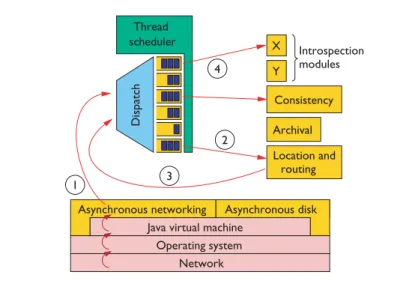
Figure 5 depicts the event-driven server
architec-ture of the OceanStore prototype under construc-tion at UC Berkeley. This prototype is layered on SEDA (http://www.cs.berkeley.edu/~mdw/proj/ seda/) and implemented in Java. Although a com-plete system is not yet operational, many compo-nents are already functioning in isolation. The Tapestry routing infrastructure is in small-scale test, including a multicast facility. A prototype NFS communicates with the Byzantine inner ring and can run the Andrew file system benchmark. Fur-ther, a stand-alone version of the archival system is operational as a backup system. We are present-ly integrating these components. Several clients are currently under construction, including an NTFS file system, a full-function backup manage-ment facility, and an HTML gateway.
Conclusion
OceanStore provides a global-scale, distributed storage platform through adaptation, fault toler-ance, and repair. The only role of human admin-istrators in our system is to physically attach or remove server hardware. Of course, an open ques-tion is how to scale a research prototype in such a way to demonstrate the basic thesis of this article — that OceanStore is self-maintaining. In the com-ing months, we will demonstrate this premise in a number of ways, including large-scale simulations with fault injection and wide-area deployment of functional OceanStore server components. The allure of connecting millions or billions of com-ponents together is a hope that aggregate systems can provide scalability and predictable behavior under a wide variety of failures. The OceanStore architecture is a step toward this goal.
References
1. J. Kubiatowicz et al., “OceanStore: An Architecture for Global-Scale Persistent Storage,” Proc. Conf. Architectural Support for Programming Languages and Operating
Sys-tems (ASPLOS-IX), ACM Press, New York, 2000.
2. W. Bolosky et al., “Feasibility of a Serverless Distributed File System Deployed on an Existing Set of Desktop PCs,”
Proc. Sigmetrics, ACM Press, New York, 2000.
3. J. Bloemer et al., “An XOR-Based Erasure-Resilient Coding Scheme,” tech. report TR-95-048, The Int’l Computer Sci-ence Inst., Berkeley, Calif., 1995.
4. M. Stonebraker, “The Design of the Postgres Storage Sys-tem,”Proc. 13th Int’l Conf. Very Large Databases, Morgan Kaufmann, San Francisco, 1987.
5. R. Rivest and B. Lampson, “SDSI — A Simple Distributed Security Infrastructure,” manuscript presented at CRYPTO 96 Rump session, 1996; details available at http://theory. lcs.mit.edu/~cis/sdsi.html.
2 3
4
Asynchronous disk Java virtual machine
Network Operating system Asynchronous networking 1
Archival Consistency Y
X
modules Introspection
Dispatch
Thread scheduler
routing Location and
Figure 5. OceanStore server architecture. Numbered arrows show the sample path of one message through the system: (1) Message passes from the network through the OS and JVM to the asynchro-nous I/O layer; (2) Routing module verifies that message has reached its final destination; (3) Same module then extracts and dis-patches message contents; (4) Consistency module receives and processes event; meanwhile, event is sent to an introspective module.
6. B.Y. Zhao, J.D. Kubiatowicz, and A.D. Joseph, “Tapestry: An Infrastructure for Fault-Tolerant Wide-Area Location and Routing,” tech. report UCB/CSD-01-1141, Apr. 2001, Univ. of California at Berkeley.
7. C. Plaxton, R. Rajaraman, and A. Richa, “Accessing Near-by Copies of Replicated Objects in a Distributed Environ-ment,”Proc. ACM Symp. Parallel Algorithms and
Archi-tectures,(SPAA 97), ACM Press, New York, 1997.
8. M. Doar, “A Better Model for Generating Test Networks,”
Proc. IEEE Globecom, IEEE Press, Piscataway, N.J., 1996.
9. D. Patterson and J. Hennessy, Computer Architecture: A
Quantitative Approach,3rd ed., to be published Mar. 2002,
Morgan Kaufmann, San Francisco.
10. M. Castro and B. Liskov, “Practical Byzantine Fault Tol-erance,”Proc. Usenix Symp. Operating Systems Design
and Implementation (OSDI 99), Usenix Assoc., Berkeley,
Calif., 1999.
11. J. Gray et al., “The Dangers of Replication and a Solution,”
Proc. ACM SIGMOD Conf., ACM Press, New York, 1996.
12. B. Barak et al., “The Proactive Security Toolkit and Appli-cations,”Proc. ACM Conf. Comm. and Computer Security, ACM Press, New York, Nov. 1999.
Sean Rhea is a PhD student at the University of California, Berkeley, and is the principal architect of OceanStore’s inner ring design. His research interests include wide-area location and routing algorithms and the use of Byzantine agreement protocols in fault-tolerant file systems. He received a BS in computer engineering from the Universi-ty of Texas, Austin.
Chris Wells, although currently unaffiliated, is one of the prin-cipal architects of the archival generation and repair mech-anisms of OceanStore. He received a BS in computer sci-ence from the University of Kentucky and an MS from the University of California, Berkeley.
Patrick Eaton is a PhD student at the University of California, Berkeley, where he is responsible for OceanStore’s second-tier object servers design. His research interests include mechanisms for global-scale data coherence and APIs for multiversioned objects. He received a BS in computer engi-neering from the University of Illinois, Urbana-Champaign.
Dennis Geels is a PhD student at the University of California, Berkeley, where he is developing efficient learning models for distributed introspection in OceanStore. His research interests include operating systems, computer architecture, and statistical learning theory. He received two BA degrees from Rice University, one in computer science and one in mathematics.
Ben Zhao is a PhD student at the University of California, Berkeley, where he is the principal architect of the Tapestry
network infrastructure. His interests include global-scale, fault-tolerant, and location-independent routing, as well as service discovery services and in-memory XML databases. He received a BS in computer science from Yale University and an MS from the University of California, Berkeley.
Hakim Weatherspoon is a PhD student at the University of California, Berkeley, where he is one of the principal archi-tects of OceanStore’s archival generation and dissemina-tion mechanisms. His research interests include global-scale, fault-tolerant archival storage and maintenance. He received a BS in computer engineering from the Universi-ty of Washington.
John D. Kubiatowicz is an assistant professor at the Universi-ty of California, Berkeley, where he is the technical lead and principal investigator for OceanStore. In addition to global-scale storage systems, his interests include computer architecture, multiprocessor design, quantum computing, and continuous dynamic optimization. He received two BS degrees from the Massachusetts Institute of Technology, one in electrical engineering and one in physics. He also received an MS and a PhD from MIT in electrical engi-neering and computer science.
Additional information about OceanStore, including author con-tact information, is available at http://oceanstore.cs.berkeley.edu/.
computer.org/publications/ computer.org/publications/ Transactions on
■ Computers
■ Knowledge and Data Engineering ■ Multimedia
■ Networking
■ Parallel and Distributed Systems
■ Pattern Analysis and Machine Intelligence ■ Software Engineering
■ Very Large Scale Integration Systems ■ Visualization and
Computer Graphics