Office of Assessment and Curriculum Arkansas Department of Workforce Education
Disseminated by
BUSINESS COMMUNICATIONS
Curriculum Content Frameworks
Career and Technical Education Arkansas Department of Workforce Education
Edited by
Linda Shock, Program Manager Jim Brock, Program Advisor Ted Dean, Program Advisor Brenda Buerkle, Program Advisor Office of Business/Marketing Technology Arkansas Department of Workforce Education Please note: All assessment questions will be taken from the knowledge portion of these
frameworks.
Prepared by
Pattie Lovins, Rivercrest High School Shanda Wood, Southside-Batesville High School
Facilitated by
Karen Chisholm, Program Manager Office of Assessment and Curriculum
Page
Unit 1: Communications 1
Unit 2: Writing 3
Unit 3: Technology 4
Unit 4: Speaking 5
Unit 5: Career 7
Glossary 8
Prerequisite: Keyboarding Computer Technology: Introduction Grade Levels: 10, 11, 12
Course Code: 492060
Curriculum Content Frameworks
BUSINESS COMMUNICATIONS
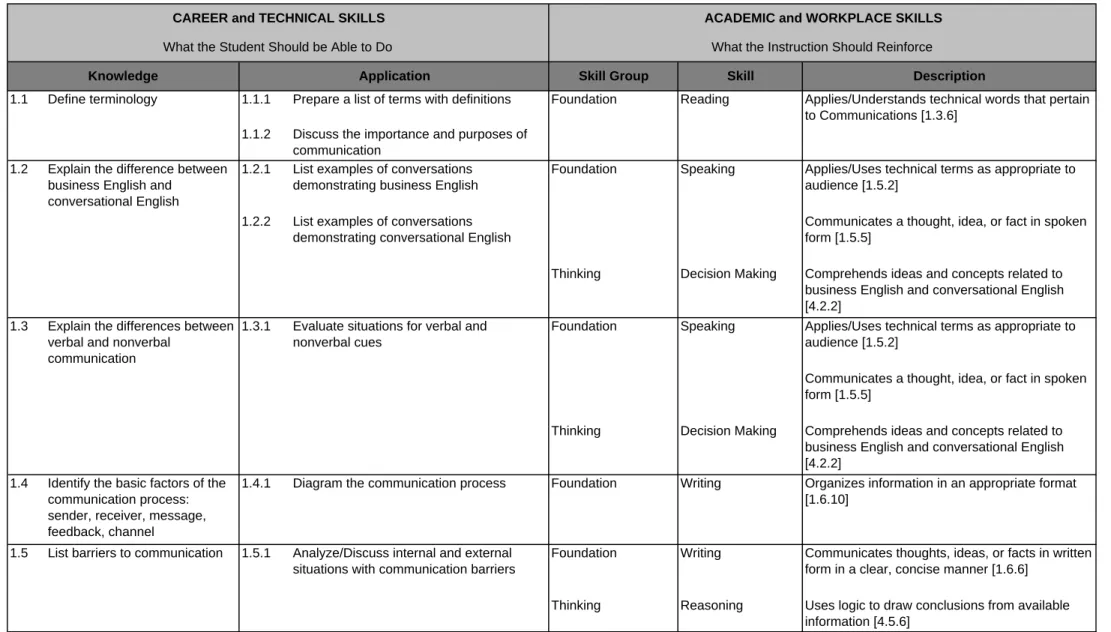
Course Description: Business Communications is a one-semester course designed to provide students with the communication skills needed in business careers. The course includes both written and oral communications relating to business activities and is directed toward understanding the language of nonverbal communication and improved listening skills, reading, voice usage, and writing skills. Emphasis is given to developing competencies in fundamentals, such as spelling, punctuation, grammar, vocabulary, sentence and paragraph structure, English usage, and proofreading. Applications in writing all types of business documents are valuable components of the course. Students gain competencies in writing, thinking logically, organizing ideas, writing clearly and concisely, and displaying tact and courtesy in writing. Technological advancements relating to information, communication, and telecommunications are given emphasis.
Table of Contents
1.1 1.1.1 Reading 1.1.2
1.2 1.2.1 Speaking
1.2.2
Thinking
1.3 1.3.1 Speaking
Thinking
1.4 1.4.1 Writing
1.5 1.5.1 Writing
Thinking
CAREER and TECHNICAL SKILLS
What the Student Should be Able to Do
Skill Group Skill
ACADEMIC and WORKPLACE SKILLS
What the Instruction Should Reinforce
Application
Knowledge Description
Decision Making Comprehends ideas and concepts related to business English and conversational English [4.2.2]
List examples of conversations demonstrating conversational English
Communicates a thought, idea, or fact in spoken form [1.5.5]
Comprehends ideas and concepts related to business English and conversational English [4.2.2]
Decision Making
Organizes information in an appropriate format [1.6.10]
List barriers to communication Analyze/Discuss internal and external situations with communication barriers
Foundation Communicates thoughts, ideas, or facts in written form in a clear, concise manner [1.6.6]
Identify the basic factors of the communication process: sender, receiver, message, feedback, channel
Diagram the communication process Foundation Evaluate situations for verbal and
nonverbal cues
Uses logic to draw conclusions from available information [4.5.6]
Reasoning Explain the differences between
verbal and nonverbal communication
Communicates a thought, idea, or fact in spoken form [1.5.5]
Terminology: Business English, Channel, Clear, Communication, Communication barrier, Complete, Concise, Conversational English, Correct, Courteous, External barrier, Feedback, Internal barrier, Listening, Message, Nonverbal communication, Receiver, Sender, Verbal communication
Define terminology
Applies/Uses technical terms as appropriate to audience [1.5.2]
Prepare a list of terms with definitions Foundation Applies/Understands technical words that pertain to Communications [1.3.6]
Foundation Discuss the importance and purposes of
communication Explain the difference between
business English and conversational English
List examples of conversations demonstrating business English
Unit 1: Communications
Hours: 15
Foundation Applies/Uses technical terms as appropriate to audience [1.5.2]
1.6 1.6.1 Reading
Thinking
1.7 1.7.1 Thinking Decision Making Comprehends ideas and concepts related to
business English and conversational English [4.2.2]
Identify the five C's of communication: clear, concise, complete, correct, courteous
Apply the five C's to a form of communication (i.e., written, oral, etc.)
Knowing how to Learn
Discuss effective listening List ways to improve listening skills
Foundation Applies/Understands technical words that pertain to the five C's of communication [1.3.6]
Applies new knowledge and skills to communication [4.3.1]
CAREER and TECHNICAL SKILLS ACADEMIC and WORKPLACE SKILLS
What the Student Should be Able to Do What the Instruction Should Reinforce
Description
Knowledge Application Skill Group Skill
Business Communications 2
2.1 2.1.1 Reading
2.2 2.2.1 Writing
2.3 2.3.1 Writing
2.4 2.4.1 Writing
2.5 2.5.1 Writing
2.6 2.6.1 Writing
2.7 2.7.1 Writing
ACADEMIC and WORKPLACE SKILLS
What the Instruction Should Reinforce
Skill Group Skill Description CAREER and TECHNICAL SKILLS
What the Student Should be Able to Do
Knowledge Application
Identify various types of common written communications used in business
Format, compose, and produce various types of written communications used in business -- reports, resumes, memos, letters, e-mail, etc.
Composes and creates documents -- letters, manuals, reports, proposals, graphics, flow charts, etc. [1.6.8]
Identify commonly used proofreader's marks
Proofread written communications with errors, using proofreader's marks
Checks, edits, and revises document for correct information, appropriate emphasis, form, grammar, spelling, and punctuation [1.6.5]
Foundation
Foundation
Applies rules of grammar, punctuation, capitalization, and spelling [1.6.3]
Uses language, style, organization, and format appropriate to subject matter, purpose, and audience [1.6.19]
Uses language, style, organization, and format appropriate to subject matter, purpose, and audience [1.6.19]
Composes and creates documents -- letters, manuals, reports, proposals, graphics, flow charts, etc. [1.6.8]
Unit 2: Writing
Hours: 30
Terminology: Drafting/writing, Prewriting/planning, Proofreader's marks, Proofreading, Publishing, Revising/editing, Tone, "You" attitude
Identify mechanics (periods, semi-colons, etc.) and parts of speech (plurals, adjectives, sentence fragments, etc.)
Apply the rules of mechanics and the rules of speech
Foundation
Define terminology Prepare a list of terms with definitions Foundation Applies/Understands technical words that pertain to writing [1.3.6]
Evaluate written
correspondence for "you" attitude
Compose written communications, applying the "you" attitude
Identify the stages of the writing process: prewriting/planning, drafting/writing, revising/editing, proofreading, publishing
Foundation
Foundation Compose written communications, applying
tone Evaluate written
correspondence for tone
Foundation Compose written communications, applying
the stages of the writing process
3.1 3.1.1 Reading
3.2 3.2.1 Speaking
Thinking
3.3 3.3.1 Reading
Writing
ACADEMIC and WORKPLACE SKILLS
What the Instruction Should Reinforce
Skill Group Skill Description
Hours: 10
Terminology: Communications technology
Applies/Understands technical words that pertain to technology [1.3.6]
Describe the various types of communications technology used in business
Analyze the best type of technology to be used in a communications scenario
Foundation
CAREER and TECHNICAL SKILLS
What the Student Should be Able to Do
Knowledge Application
Foundation
Communicates a thought, idea, or fact in spoken form [1.5.5]
Uses logic to draw conclusions from available information [4.5.6]
Reasoning
Uses graphs, charts, tables to obtain factual information [1.3.21]
Organizes information in an appropriate format [1.6.10]
Unit 3: Technology
Define communications technology
Foundation List/Discuss examples of communications
technology (i.e., voice mail, e-mail, fax, Internet)
Demonstrate the ability to execute a successful search for data accurately
Conduct research using the five basic steps: planning the search, locating sources of information, organizing the information, evaluating the sources, and using the information to prepare a short report on a business topic
Identifies relevant details, facts, and specifications [1.3.16]
Determines what information is needed [1.3.10]
Business Communications 4
Skill Group Skill Description
4.1 4.1.1 Reading
Writing
4.2 4.2.1 Reading
4.3 4.3.1 Speaking
4.3.2
4.4 4.4.1 Reading
4.5 4.5.1 Reading
Thinking
CAREER and TECHNICAL SKILLS
What the Student Should be Able to Do
Application
ACADEMIC and WORKPLACE SKILLS
What the Instruction Should Reinforce
Unit 4: Speaking
Hours: 20
Terminology: Oral communication
Compose a short speech on a business-related topic
Comprehends written information for main ideas [1.3.7]
Present a short speech on a business-related topic
Foundation
Uses words appropriately [1.6.21]
Applies/Understands technical words that pertain to speaking [1.3.6]
Foundation
Comprehends written information for main ideas [1.3.7]
Speaks effectively, using appropriate eye contact, gestures, and posture [1.5.11] Give a presentation using visual aids (i.e.,
flow charts, slide show, posters)
Pronounces words correctly [1.5.9]
Speaks in a clear, concise manner [1.5.12]
Foundation Uses verbal language and other cues, such as
body language, appropriate in style, tone, and level of complexity to the audience and the occasion [1.5.14]
Foundation Identify proper telephone
communication
Demonstrate an appropriate telephone conversation in a business setting
Knowledge
Define terminology
Identify the importance of oral communication in business
Give examples of situations in which oral communication is appropriate in a business setting
Prepare a list of terms with definitions
Identify the importance of good oral communication in a job interview
Participate in a job interview
Foundation Adapts presentation to audience [1.5.1]
Communicates a thought, idea, or fact in spoken form [1.5.5]
Uses verbal language and other cues, such as body language, appropriate in style, tone, and level of complexity to the audience and the occasion [1.5.14]
Applies rules and principles to a new situation [4.5.1]
Skill Group Skill Description
4.6 Identify appropriate 4.6.1 Speaking
communication in a given setting
Demonstrate effective communication in various situations (i.e., face-to-face, small group, large group)
Foundation Participates in conversation, discussion, and group presentations [1.5.8]
Knowledge Application
CAREER and TECHNICAL SKILLS ACADEMIC and WORKPLACE SKILLS
What the Student Should be Able to Do What the Instruction Should Reinforce
Business Communications 6
5.1 5.1.1 Reading
5.2 5.2.1 Speaking
5.2.2
Writing 5.2.3
5.2.4 5.2.5
Unit 5: Career
Comprehends written specifications, and applies them to a task [1.3.9]
Discuss the job application process
CAREER and TECHNICAL SKILLS
What the Student Should be Able to Do
Knowledge Application
ACADEMIC and WORKPLACE SKILLS
Describe the appropriate aspects of a job search
Hours: 20
Speaks effectively, using appropriate eye contact, gestures, and posture [1.5.11] What the Instruction Should Reinforce
Skill Group Skill
Terminology: None
Foundation
Checks, edits, and revises document for correct information, appropriate emphasis, form, grammar, spelling, and punctuation [1.6.5] Demonstrate and apply the job
application process
Compose a job-specific cover letter
Description
Identifies education and training needed to achieve goals [3.1.8]
Develops skills to locate, evaluate, and interpret career information [3.1.4]
Compose a follow-up/thank you letter
Personal Management
Create a personal résumé
Foundation
Explores career opportunities [3.1.6] Career Awareness,
Development, and Mobility
Complete a sample job application Conduct a mock job interview
Career Awareness, Development, and Mobility
Personal Management
Establishes and implements a plan of action [3.1.5]
Completes form accurately [1.6.7]
Organizes information in an appropriate format [1.6.10]
Analyzes impact of work on individual and family life [3.1.1]
1. Business English – the language used in a business environment 2. Channel – the mode a sender uses to send a message
3. Clear – easily heard, seen, or understood
4. Communication – the process used to send and interpret messages 5. Communication barrier – an obstacle to communication
6. Complete – provides all the information necessary for the message to be understood 7. Concise – brief, to the point, short
8. Conversational English – the language used in an informal, nonbusiness setting 9. Correct – means that the information in a document is accurate and up-to-date 10. Courteous – positive, considerate, bias-free
11. External barrier – an obstacle to communication that lies outside the receiver or sender (i.e., temperature, lighting, noise, and comfort) 12. Feedback – the response of a receiver to a message
13. Internal barrier – an obstacle to communication that lies within the receiver or sender (i.e., personalities, backgrounds, cultures, status, and biases) 14. Listening – the process of hearing and focusing attention to understand and remember an oral message
15. Message – a set of symbols selected to represent a thought or an idea 16. Nonverbal communication – messages sent without or in addition to words 17. Receiver – a person or thing to whom a message is sent; the audience
18. Sender – a person or thing that originates an idea or initiates the communication process 19. Verbal communication – messages sent using spoken or written symbols
Glossary
Unit 1: Communications
Business Communications 8
1.
2. Prewriting/planning – the stage of the writing process during which writers plan their message
3. Proofreader's marks – symbols or codes that indicate what kind of changes need to be made to writing and where
4. Proofreading – the stage of the writing process during which the writer reviews and corrects the final draft of a written message
5. Publishing – the stage of the writing process during which the writer delivers a message to the receiver or makes a message available to the public 6. Revising/editing – the stage of the writing process during which writers make changes to a written message
7. Tone – the general effect a message creates
8. "You" attitude – focuses on the needs, interests, and concerns of the receiver
Drafting/writing – the stage of the writing process during which writers use prewritten/planning notes or organizational tools as they write their message into sentences and paragraphs
1. Communications technology – the use of electronic/digital devices to communicate
Unit 3: Technology
Business Communications 10
1. Oral communication – spoken communication
No terminology for this unit
Unit 5: Career
Business Communications 12