Pearson EnglishStage 4 Teaching Program
This teaching program can be used to correlate the outcomes of the NSW Stage 4 English syllabus with the content of the Pearson English 7 & 8 Student and Activity Books.
Outcome EN4–1A*
•
responds
to
and
composes
texts
for
understanding,
interpretation,
critical
analysis,
imaginative
expression
and
pleasure*
This outcome, in many ways, covers the essentials of the teaching of English. Any of the chapters will assist students in exploring and achieving this outcome. The chapters indicated below offer a more explicit approach to teaching for this outcome. To further assist your programming, specific content points that may require a more direct approach have been correlated with the particular modules in which they are covered.
Processes/Content* Year 7 Student Book Year 8 Student Book Year 7 Activity Book Year 8 Activity Book Engage personally with texts
• recognise, reflect on, interpret and explain the connections between their own experiences and the world in texts
• consider and analyse the ways their own experience affects their responses to texts • explore and appreciate the
aesthetic qualities in their own and other texts and the power of language to communicate information, ideas, feelings and viewpoints
• experiment with language forms and features to compose texts for pleasure and enjoyment
• Diaries, biographies and life writing
• Fantastic Worlds
• Media
• Visual Literacy: Comics and graphic novels
• Poetry
Rich and diverse classroom discussion will encourage students to engage personally with a range of texts and begin their exploration of the connections between their own experiences and their responses to texts.
The chapters listed above offer a range of different texts for examination as well as activities designed to assist students in creating their own texts and appreciating the power and beauty of language.
• Life: Cultural Contexts
• The Creative World: Animation
• Visual Worlds
• Appreciating Fiction
• Print Media
• Literature: The Outsiders
• Horror
• Craft of Writing
• Poetry
Rich and diverse classroom discussion will encourage students to engage personally with a range of texts and begin their exploration of the connections between their own experiences and their responses to texts.
The chapters listed above offer a range of different texts for examination as well as activities designed to assist students in creating their own texts and appreciating the power and beauty of language.
• Unit 1, 4, 7, 8, 9, 10, 11, 12, 13, 14, 15, 16, 17, 18, 21, 24, 26, 27
The units listed above all contain extracts in which the grammar, punctuation or vocabulary element in focus is contextualised. In this way, students are able to explore the aesthetic qualities of the texts and the power of particular elements of language in order to communicate information, ideas, feelings and viewpoints.
• Unit 1, 6, 8, 9, 10, 12, 14, 16, 17, 18, 19, 20, 21, 23, 24, 25, 27, 28
The units listed above all contain extracts in which the grammar, punctuation or vocabulary element in focus is contextualised. In this way, students are able to explore the aesthetic qualities of the texts and the power of particular elements of language in order to communicate information, ideas, feelings and viewpoints.
Units 6, 10, 19, 20 and 25 also contain activities that direct students to experiment with the language feature in focus in compositions of their own.
Develop and apply contextual knowledge
• interpret the stated and implied meanings in spoken texts, and use evidence to support or challenge different perspectives (ACELY1730)
• Out in Front
• Media
Spoken texts are explored thoroughly in Out in Front.
Module3: Performance
poetryfocuses particularly on this skill.
Spoken texts found in the media are covered in Media, Module 2: What is news?
Not directly applicable to this Student Book.
Not directly applicable to this Activity Book.
Not directly applicable to this Activity Book.
Understand and apply knowledge of language forms and features
• apply increasing knowledge of vocabulary, text structures and language features to understand the content of texts
(ACELY1733)
• recognise that vocabulary choices contribute to the specificity, abstraction and style of texts
(ACELA1547)
• analyse how the text structures and language features of persuasive texts, including media texts, vary according to the medium and mode of communication
(ACELA1543)
• understand and explain how the text structures and language features of texts become more complex in informative and persuasive texts and identify underlying structures such as taxonomies, cause and effect, and extended metaphors (ACELA1531)
• Diaries, biographies and life writing.
• Fantastic Worlds
• Media
• Visual Literacy: Comics and graphic novels
• Poetry
• Research, revising and editing
(7 or 8 custom chapter only) The chapters listed above offer a variety of ways to develop students’ understanding of language forms and features, as well as activities to foster analytical skills and the application of this knowledge in their own compositions.
Media,Module2: What is news?
specifically explores how text structures and language features vary according to the medium and mode of communication.
Focus on Language,Module3: Making your writing
interestingexplicitly teaches increasingly sophisticated writing techniques that can be applied contextually to the writing activities throughout the other chapters.
• Life: Cultural Contexts
• The Creative World: Animation
• Visual Worlds
• Appreciating Fiction
• Print Media
• Horror
• Craft of Writing
• Poetry
• Focus on Language
• Research, revising and editing
(7 or 8 custom chapter only) The chapters listed above offer a variety of ways to develop students’ understanding of language forms and features, as well as activities to foster analytical skills and the application of this knowledge in their own compositions.
The text structures and language features of persuasive texts are a specific focus of Craft of Writing, Module 3: Writing to persuade and instruct.
Devices that create tone are explored in Poetry, Module 1:
• Units 1, 2, 3, 4, 5, 6, 8, 9, 10, 11, 12, 13, 14, 17, 21, 24, 27
These units consolidate and extend students’ knowledge of vocabulary and language features in order to understand the content of texts.
Units 1, 3, 4, 5, 8, 9, 10, 11, 12, 13, 14, 21 and 27 will assist students in recognising that vocabulary choices contribute to the style of texts.
Unit 10: Personal Pronouns will assist students with skill acquisition in recognising personal pronouns so that they may apply it to their understanding of the subjectivity or objectivity of texts.
• Units 1, 3, 4, 5, 6, 7, 8, 9, 10, 12, 13, 14, 16, 17, 18, 19, 20, 21, 23, 24, 25
These units consolidate and extend students’ knowledge of vocabulary and language features in order to understand the content of texts.
Units 1, 6, 7, 10, 11, 14, 16, 17, 21, 22, 23, 24 and 25 will assist students in recognising that
vocabulary choices contribute to the style of texts.
Unit 7: Personal Pronouns will assist students with skill acquisition in recognising personal pronouns so that they may apply it to their understanding of the subjectivity or objectivity of texts.
Units 19, 20, 21, 22, and 23 cover figures of speech and other writing techniques.
• use increasingly sophisticated verbal, aural, visual and/or written techniques, such as imagery, figures of speech, selective choice of vocabulary, rhythm, sound effects, colour and design, to compose imaginative texts for pleasure • recognise when information is
presented objectively and subjectively by examining the language of opinion, including modality, bias, personal pronouns and other semantic cues
• identify and evaluate devices that create tone, for example humour, wordplay, innuendo and parody in poetry, humorous prose, drama or visual texts (ACELT1630)
Increasingly sophisticated writing techniques that can be applied contextually to the writing activities throughout the chapters are
included in:
• Focus on Language, Module 3: Vocabulary: making it more interesting
• Appreciating Fiction, Module 1: Focus on novels
• Poetry, Module 1: Understanding poetry.
Respond to and compose texts
• respond to and compose imaginative, informative and persuasive texts for different audiences, purposes and contexts for understanding, interpretation, critical analysis, imaginative expression and pleasure
• explore and explain the ways authors combine different modes and media in creating texts, and the impact of these choices on the viewer/listener (ACELY1735)
• identify and discuss main ideas, concepts and points of view in spoken texts to evaluate qualities, for example the strength of an argument or the
• Out in Front
• Fantastic Worlds
• Literature
• Media
• Visual Literacy: Comics and graphic novels
• Research, revising and editing
(7 or 8 custom chapter only) The chapters listed above explore a variety of texts for student response and composition.
Out in Front and Media both examine spoken texts, while
Fantastic Worlds, Literature and
Visual Literacy all examine character, event and setting in different narrative forms.
Visual Literacy, Module 1: Words, images and
• Life: Cultural Contexts
• The Creative World: Animation
• Visual Worlds
• Appreciating Fiction
• Literature: The Outsiders
• Horror
• Craft of Writing
• Poetry
• Research, revising and editing
(7 or 8 custom chapter only) The chapters listed above explore a variety of texts for student response and composition.
The Creative World,
Appreciating Fiction, Literature
and Horror all examine character, event and setting in different
• Units 1, 4, 5, 7, 8, 9, 10, 11, 12, 13, 14, 15, 16, 17, 18, 19, 21, 22, 23, 24, 26, 27
These units all contain texts that students respond to in terms of understanding and critical analysis in particular.
• Units 1, 2, 6, 8, 9, 10, 12, 14, 16, 17, 18, 19, 20, 21, 23, 25, 27, 28
These units all contain texts that students respond to in terms of understanding and critical analysis in particular.
lyrical power of a poetic rendition
(ACELY1719)
• compare the ways that language and images are used to create a character, and to influence emotions and opinions in different types of texts (ACELT1621)
• recognise and analyse the ways that characterisation, events and settings are combined in narratives, and discuss the purposes and appeal of different approaches
(ACELT1622)
• understand how language is used to evaluate texts and how evaluations about a text can be substantiated by reference to the text and other sources
(ACELA1782)
• understand, interpret and discuss how language is compressed to produce a dramatic effect in film or drama, and to create layers of meaning in poetry, for example haiku, tankas, couplets, free verse and verse novels (ACELT1623)
communicationcould be a focus for exploring the ways authors combine modes and media.
Literature, Module 3: Interrogating texts could be a specific focus for teaching the evaluation of texts through language.
Out in Front, Module 3: Performance poetry could be a focus for the compression of language to produce dramatic effect in drama.
narrative forms.
Foci for exploring the ways authors combine modes and media could include:
• The Creative World, Modules 2 and 3
• Visual Worlds, Modules 3 and 4
• Appreciating Fiction, Modules 3 and 4
Poetry, Modules 1 and 2 could be a focus for the compression of language to create layers of meaning.
Outcome EN4–2A*
•
effectively
uses
a
widening
range
of
processes,
skills,
strategies
and
knowledge
for
responding
to
and
composing
texts
in
different
media
and
technologies*
This outcome supports Outcome 1 in focusing on the processes, skills, strategies and knowledge required for students to effectively respond to and compose texts.The Breakaway Tasks and
Writer’s Toolbox features throughout the chapters are designed to assist students in achieving this outcome. The chapters indicated below offer an explicit approach to teaching for this outcome. To further assist your programming, specific content points that may require a more direct approach have been correlated with the particular modules in which they are covered.
Processes/Content* Year 7 Student Book Year 8 Student Book Year 7 Activity Book Year 8 Activity Book Engage personally with texts
• discuss and explain the processes of responding and composing, identifying the personal satisfaction and difficulties experienced
• recognise the different processes required for responding and composing in a range of forms and media
• reflect on ideas and opinions about characters, settings and events in literary texts, identifying areas of agreement and difference with others and justifying a point of view
(ACELT1620)
• Out in Front
• Literature
• Media
In these chapters, students are exposed to various processes for responding to and composing different types of texts, and to activities requiring them to reflect on and articulate their experiences. Specific foci could include:
Literature, Module 1: The novel,which explores various reading strategies and processes for responding to written texts;
Module 2: Love, Aubrey, which directs students to apply these strategies and processes in the context of a specific novel study.
Literature, Module 3:
Interrogating textsguides students through the process of forming opinions about aspects of literary texts and justifying those opinions effectively in written modes.
Out in Front, Module 1: Speaking out and Module 3: Performance poetry examine the processes involved in constructing and performing spoken texts.
• Life: Cultural Contexts
• Appreciating Fiction
• Literature: The Outsiders
In these chapters, students are exposed to various processes for responding to and composing different types of texts, and to activities requiring them to reflect on and articulate their experiences.
Appreciating Fiction, Module 1: Focus on novels and Module 3: Focus on film guide students through a detailed explanation of how novels and films are constructed, and prompt them to experiment with these processes.
Module 2: The novel: case studiesleads students through the process of writing a text response. Both Modules in Literature: The Outsiders explore reading processes and strategies for responding effectively to literature.
Not directly applicable to this Activity Book.
Not directly applicable to this Activity Book.
Develop and apply contextual knowledge
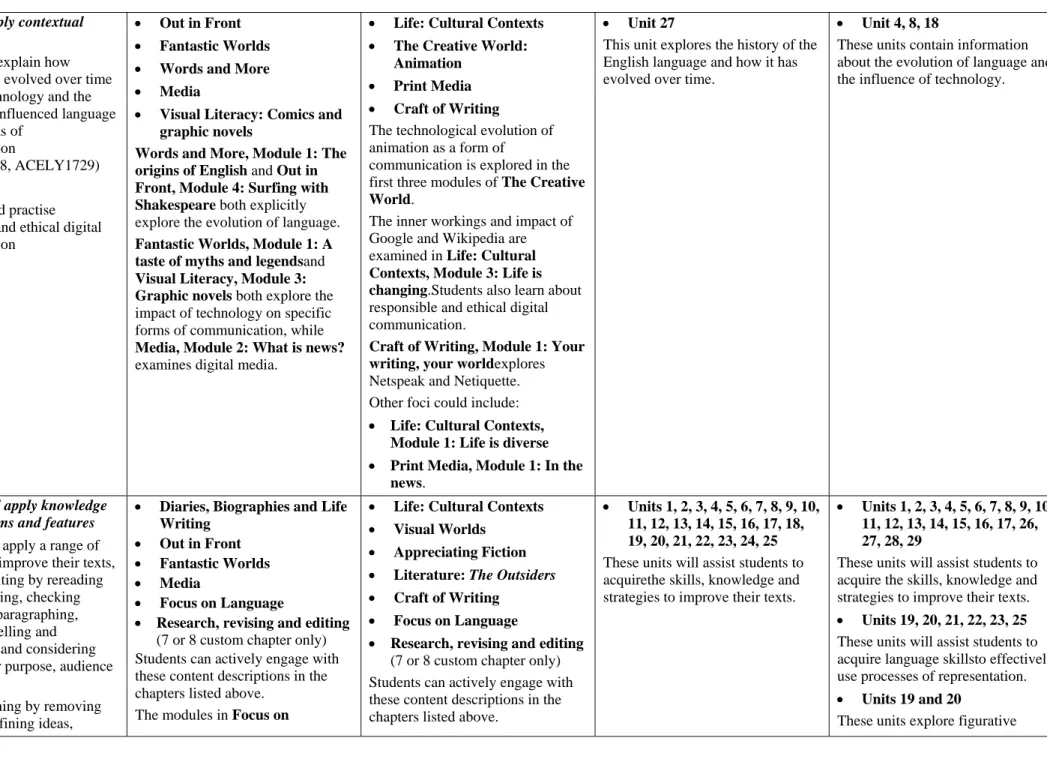
• analyse and explain how language has evolved over time and how technology and the media have influenced language use and forms of
communication
(ACELA1528, ACELY1729)
• recognise and practise responsible and ethical digital communication
• Out in Front
• Fantastic Worlds
• Words and More
• Media
• Visual Literacy: Comics and graphic novels
Words and More, Module 1: The origins of English and Out in Front, Module 4: Surfing with Shakespeare both explicitly explore the evolution of language.
Fantastic Worlds, Module 1: A taste of myths and legendsand
Visual Literacy, Module 3: Graphic novels both explore the impact of technology on specific forms of communication, while
Media, Module 2: What is news?
examines digital media.
• Life: Cultural Contexts
• The Creative World: Animation
• Print Media
• Craft of Writing
The technological evolution of animation as a form of
communication is explored in the first three modules of The Creative World.
The inner workings and impact of Google and Wikipedia are examined in Life: Cultural Contexts, Module 3: Life is changing.Students also learn about responsible and ethical digital communication.
Craft of Writing, Module 1: Your writing, your worldexplores Netspeak and Netiquette. Other foci could include: • Life: Cultural Contexts,
Module 1: Life is diverse
• Print Media, Module 1: In the news.
• Unit 27
This unit explores the history of the English language and how it has evolved over time.
• Unit 4, 8, 18
These units contain information about the evolution of language and the influence of technology.
Understand and apply knowledge of language forms and features
• consider and apply a range of strategies to improve their texts, including editing by rereading and peer editing, checking accuracy of paragraphing, grammar, spelling and punctuation, and considering relevance for purpose, audience and context
• edit for meaning by removing repetition, refining ideas,
• Diaries, Biographies and Life Writing
• Out in Front
• Fantastic Worlds
• Media
• Focus on Language
• Research, revising and editing
(7 or 8 custom chapter only) Students can actively engage with these content descriptions in the chapters listed above.
The modules in Focus on
• Life: Cultural Contexts
• Visual Worlds
• Appreciating Fiction
• Literature: The Outsiders
• Craft of Writing
• Focus on Language
• Research, revising and editing
(7 or 8 custom chapter only) Students can actively engage with these content descriptions in the chapters listed above.
• Units 1, 2, 3, 4, 5, 6, 7, 8, 9, 10, 11, 12, 13, 14, 15, 16, 17, 18, 19, 20, 21, 22, 23, 24, 25
These units will assist students to acquirethe skills, knowledge and strategies to improve their texts.
• Units 1, 2, 3, 4, 5, 6, 7, 8, 9, 10, 11, 12, 13, 14, 15, 16, 17, 26, 27, 28, 29
These units will assist students to acquire the skills, knowledge and strategies to improve their texts. • Units 19, 20, 21, 22, 23, 25
These units will assist students to acquire language skillsto effectively use processes of representation. • Units 19 and 20
reordering sentences and adding or substituting words for impact
(ACELY1726)
• use processes of representation, including the creative use of symbols, images, icons, clichés, stereotypes, connotations and particular aural, visual and/or digital techniques
• understand and use bibliographies, citations (including web citations) to acknowledge sources and avoid plagiarism
• understand and use the terminology associated with responding to and composing digital texts
• use a range of software, including word processing programs, to create, edit and publish texts imaginatively
(ACELY1728, ACELY1738)
Language will assist students to acquire language skills to
effectively apply a range of editing strategies.
Media, Module 2: What is news?
contains a section on referencing websites, incorporating quotes and avoiding plagiarism.
The modules in Focus on Language will assist students to acquire language skills to enable them to effectively apply a range of editing strategies.
Life: Cultural Contexts, Module 3
contains a specific section on referencing websites and using bibliographies.
language to enable students to effectively apply ‘editing for meaning’ skills.
Respond to and compose texts
• use comprehension strategies to interpret and evaluate texts by reflecting on the validity of content and the credibility of sources, including finding evidence in the text for the author’s point of view
(ACELY1723, ACELY1734)
• analyse and explain the effect of technological innovations on texts, particularly media texts
(ACELY1765)
• Diaries, Biographies and Life Writing
• Out in Front
• Literature
• Media
• Visual Literacy: Comics and graphic novels
• Research, revising and editing
(7 or 8 custom chapter only) Students can actively engage with these content descriptions in the chapters listed above.
• Life: Cultural Contexts
• The Creative World: Animation
• Visual Worlds
• Appreciating Fiction
• Literature: The Outsiders
• Research, revising and editing
(7 or 8 custom chapter only) Students can actively engage with these content descriptions in the chapters listed above.
• Units 1, 2, 3, 4, 5, 6, 7, 8, 9, 10, 11, 12, 13, 14, 15, 16, 17, 18, 19, 20, 21, 22, 23, 24, 25
These units will assist students toacquire skills to use editing processes for composing and publishing texts.
Units 9, 21, 22 ask students to handwrite texts, facilitating the development of a personal handwriting style.
• Units 1, 2, 3, 4, 5, 6, 7, 8, 9, 10, 11, 12, 13, 14, 15, 16, 17, 25, 26, 27, 28, 29
These units will assist students to acquire skills to use editing processes for composing and publishing texts.
Units 6, 10, 20, 25 ask students to handwrite texts, facilitating the development of a personal handwriting style.
• use prior knowledge and text processing strategies to interpret a range of types of texts
(ACELY1722)
• use a widening range of processes of composing and publishing sustained texts, including planning, drafting, rehearsing and editing • use a range of effective
strategies for organising information, ideas and arguments, e.g. clustering, listing, compare and contrast, semantic chains, graphic and diagram outlines, and mind maps
• use collaborative processes, e.g. playbuilding, performances and digital compositions to construct texts
• consolidate a personal
handwriting style that is legible, fluent and automatic and supports writing for extended periods
(ACELY1727)
Visual Literacy and Media both explicitly document the effect of technological innovations on texts.
The Creative World explicitly documents the effect of
Outcome EN4–3B*
•
uses
and
describes
language
forms,
features
and
structures
of
texts
appropriate
to
a
range
of
purposes,
audiences
and
contexts*
This outcome examines how texts are constructed. The texts offered in the various chapters model language forms, features and structures, many with explanations and annotations.
Metalanguage is used deliberately throughout, and the Writer’s Toolbox features have been specifically designed to assist students in achieving this outcome. The chapters indicated below offer an explicit approach to teaching for this outcome. To further assist your programming, specific content points that may require a more direct approach have been correlated with the particular modules in which they are covered.
Processes/Content* Year 7 Student Book Year 8 Student Book Year 7 Activity Book Year 8 Activity Book Engage personally with texts
• engage with the language and structures of texts in
meaningful, contextualised and authentic ways
• identify, discuss and reflect on the ideas and information in a range of texts
• develop a sense of personal style and taste in composition and response
• Diaries, Biographies and Life Writing
• Out in Front
• Fantastic Worlds
• Literature
• Words and More
• Media
• Visual Literacy: Comics and graphic novels
• Poetry
Students can actively engage with these content descriptions by responding to the texts featured in the chapters listed above.
• Life: Cultural Contexts
• The Creative World: Animation
• Visual Worlds
• Appreciating Fiction
• Literature: The Outsiders
• Horror
• Poetry
Students can actively engage with these content descriptions by responding to the texts featured in the chapters listed above.
• Units 1, 4, 5, 7, 8, 9, 10, 11, 12, 13, 14, 17, 21, 24, 26, 27
These units contain texts and corresponding activities that allow students to engage with the language of the texts in meaningful and contextualised ways.
• Units 1, 7, 8, 9, 11, 13, 14, 17, 21, 24, 26
These units also engage students with the ideas and information in the texts.
• Units 1, 2, 6, 8, 9, 10, 12, 14, 16, 17, 18, 20, 21, 23, 27, 28
These units contain texts and corresponding activities that allow students to engage with the language of the texts in meaningful and contextualised ways.
• Units 8, 9, 14, 16, 17, 18, 20, 21, 23, 27, 28
These units also engage students with the ideas and information in the texts.
Develop and apply contextual knowledge
• describe and analyse the purpose, audience and context of texts
• use interaction skills for identified purposes, using voice and language conventions to suit different situations, selecting vocabulary, modulating voice and using elements such as music, images and sound for specific effects
(ACELY1804, ACELY1808)
• Out in Front
• Fantastic Worlds
• Words and More
• Media
• Visual Literacy: Comics and graphic novels
• Poetry
• Focus on Language
• Research, revising and editing
(7 or 8 custom chapter only) Students can actively engage with these content descriptions in the chapters listed above. Teachers can
• Life: Cultural Contexts
• Visual Worlds
• Appreciating Fiction
• Print Media
• Horror
• Craft of Writing
• Poetry
• Focus on Language
• Research, revising and editing
(7 or 8 custom chapter only) Students can actively engage with these content descriptions in the chapters listed above. Teachers can
• All units
Students can actively engage with these content descriptions, particularly the use of appropriate metalanguage, in the various units of this Activity Book.
• All units
Students can actively engage with these content descriptions, particularly the use of appropriate metalanguage, in the various units of this Activity Book.
The text in Unit 8 contains elements of Aboriginal English.
Units 14 and 16 examine clause structures.
• explore texts that include both Standard Australian English and elements of other languages, including Aboriginal English • recognise and use appropriate
metalanguage in discussing a range of language forms, features and structures • analyse and examine how
effective authors control and use a variety of clause structures, including clauses embedded within the structure of a noun group/phrase or clause
(ACELA1534, ACELA1545)
• understand the effect of nominalisation in the writing of informative and persuasive texts
(ACELA1546)
• understand how to apply learned knowledge consistently in order to spell accurately and to learn new words including
nominalisations
(ACELA1549)
• identify Standard Australian English, its variations and different levels of usage across a range of different types of texts to enhance own writing • understand how rhetorical
devices are used to persuade and how different layers of meaning are developed through the use of metaphor, irony and parody
(ACELA1542)
refer to the diverse range of texts provided for a thorough
examination of audience, purpose and context, while the explicit teaching and contextualised use of appropriate metalanguage is a strong feature throughout the series. Many of the chapters contain spoken activities requiring students to use interaction skills. Out in Front consolidates these skills more explicitly.
Out in Front, Module 3: Performance poetry and Words and More, Module 3: Word playboth explore texts that contain elements of other languages.
Media, Module 3: The feature article covers clause structures with a clear explanation of embedded clauses and also a contextualised look at nominalisation.
refer to the diverse range of texts provided for a thorough
examination of audience, purpose and context, while the explicit teaching and contextualised use of appropriate metalanguage is a strong feature throughout the series.
Life: Cultural Contexts, Module 1: Life is diverse, Visual Worlds, Module 1: What are visual texts?
and Poetry, Module 2: Poems with purpose explore texts that contain elements of other languages.
Horror and Focus on Language, Module 2: Grammar: sentence structuresboth cover clause structures.
Understand and apply knowledge of language forms and features
• understand the ways etymology can clarify choice of vocabulary • interpret and analyse language
choices, including sentence patterns, dialogue, imagery and other language features, in short stories, literary essays and plays
(ACELT1767)
• investigate vocabulary typical of extended and more academic texts and the role of abstract nouns, classification, description and generalisation in building specialised knowledge through language
(ACELA1537)
• understand how modality is achieved through discriminating choices in modal verbs, adverbs, adjectives and nouns
(ACELA1536)
• understand how coherence is created in complex texts through devices like lexical cohesion, ellipsis, grammatical theme and text connectives
(ACELA1809)
• understand that the coherence of more complex texts relies on devices that signal text structure and guide readers, for example overviews, initial and
concluding paragraphs and topic sentences, indexes or site maps or breadcrumb trails for online texts
(ACELA1763)
• Fantastic Worlds
• Literature
• Words and More
• Media
• Focus on Language
• Research, revising and editing
(7 or 8 custom chapter only) Students can actively engage with these content descriptions in the chapters listed above.
A thorough investigation of punctuation is covered in Focus on Language, Module 1:
Punctuation.
The internal cohesion of paragraphs is explored explicitly in Literature, Module 3: Interrogating texts.
Media, Module 2: What is news?
includes annotated text models allowing for an examination of textual cohesion.
Words and More, Module 1: The origins of English details word origins as a foundation for a study of etymology and spelling.
• Life: Cultural Contexts
• Appreciating Fiction
• Craft of Writing
• Focus on Language
• Research, revising and editing
(7 or 8 custom chapter only) Students can actively engage with these content descriptions in the chapters listed above.
Spelling rules are covered in detail in Focus on Language, Module 1: Spelling rules.
The internal cohesion of paragraphs is explored explicitly in
Appreciating Fiction, Module 2: The novel: case studiesand Craft of Writing, Module 4: Aim to analyse and expect to explain. Modality and textual cohesion are explored in Craft of Writing, Modules 3 and 4.
• Units 15, 16, 17, 18, 19, 20, 21, 22, 23
These units assist students to understand the use of punctuation conventions.
• Units 3, 25, 26, 29
These units cover spelling rules and word origins.
• Units 26, 27
These units examine etymology. • Unit 13
This unit examines conjunctions (text connectives).
• Unit 17
This unit assists students to understand the use of punctuation conventions.
• Units 6, 8, 10, 14, 16, 26, 27, 28, 29
These units cover spelling rules and word origins.
• Units 4, 8, 16, 18
These units examine etymology. • Unit 16
This unit assists students in understanding sentence patterns.
• understand how cohesion in texts is improved by strengthening the internal structure of paragraphs through the use of examples, quotations and substantiation of claims
(ACELA1766)
• understand the use of punctuation conventions, including colons, semicolons, dashes and brackets in formal and informal texts
(ACELA1532, ACELA1544)
• understand how to use spelling rules and word origins, for example Greek and Latin roots, base words, suffixes, prefixes, spelling patterns and
generalisations to learn new words and how to spell them
(ACELA1539)
Respond to and compose texts
• analyse and evaluate the ways that text structures and language features vary according to the purpose of the text and the ways that referenced sources add authority to a text
(ACELY1721, ACELY1732)
Teachers can refer to any of the texts offered throughout the chapters and engage students in a discussion of the influence of purpose on text.
Specific foci could include: • Media
Teachers can refer to any of the texts offered throughout the chapters and engage students in a discussion of the influence of purpose on text.
Specific foci could include: • Visual Worlds
• Print Media
• Craft of Writing
Not directly applicable to this Activity Book.
Not directly applicable to this Activity Book.
Outcome EN4–4B*
•
makes
effective
language
choices
to
creatively
shape
meaning
with
accuracy,
clarity
and
coherence*
Rich and detailed classroom discussion surrounding the diverse texts used throughout this series will enable students to engage with effective language, complemented by Breakaway Tasks
designed to encourage students to make effective language choices, using the texts as models. The Writer’s Toolbox features are invaluable here.The chapters indicated below offer an explicit approach to teaching for this outcome. To further assist your programming, specific content points that may require a more direct approach have been correlated with the particular modules in which they are covered.
Processes/Content* Year 7 Student Book Year 8 Student Book Year 7 Activity Book Year 8 Activity Book Engage personally with texts
• recognise and appreciate the ways a wide range of texts communicate by using effective language choices
• Diaries, Biographies and Life Writing
• Fantastic Worlds
• Media
• Poetry
Students can actively engage with this content description in the chapters listed above.
• Life: Cultural Contexts
• The Creative World: Animation
• Visual Worlds
• Appreciating Fiction
• Print Media
• Horror
• Poetry
Students can actively engage with this content description in the chapters listed above.
• Units 1, 4, 7, 8, 9, 10, 11, 12, 13, 14, 15, 16, 17, 18, 21, 24, 27
The wide range of texts included in these units will assist students to appreciate how texts communicate by using effective language choices.
• Units 1, 6, 8, 9, 10, 12, 14, 16, 17, 18, 20, 21, 23, 27, 28
The wide range of texts included in these units will assist students to appreciate how texts communicate by using effective language choices.
Develop and apply contextual knowledge
• explore and analyse the ways purpose, audience and context affect a composer’s choices of content, language forms and features and structures of texts to creatively shape meaning • understand the influence and
impact that the English language has had on other languages or dialects and how English has been influenced in return
(ACELA1540)
• Out in Front
• Fantastic Worlds
• Visual Literacy: Comics and graphic novels
• Poetry
• Research, revising and editing
(7 or 8 custom chapter only) The activities related to the texts offered in the chapters listed above will engage students in an
exploration of the effect of purpose, audience and context on a text.
Words and More, Module 1: The origins of English has a specific focus on the interrelationship
• Life: Cultural Contexts
• Visual Worlds
• Print Media
• Horror
• Craft of Writing
• Research, revising and editing
(7 or 8 custom chapter only) The activities related to the texts offered in the chapters listed above will engage students in an
exploration of the effect of purpose, audience and context on a text. Purpose, audience and context are explicitly examined in Craft of Writing.
• Units 26, 27
These units explore how the English language has been influenced.
• Units 8, 16, 18
These units explore how the English language has been influenced.
between English and other languages.
Life: Cultural Contexts, Module 1: Life is diverse looks at the influence and dominance of the English language.
Understand and apply knowledge of language forms and features
• combine visual and digital elements to create layers of meaning for serious, playful and humorous purposes
• experiment with particular language features drawn from different types of texts, including combinations of language and visual choices to create new texts
(ACELT1768, ACELT1805)
• experiment with text structures and language features to refine and clarify ideas to improve the effectiveness of students’ own texts
(ACELY1810)
• analyse how point of view is generated in visual texts by means of choices, for example gaze, angle and social distance
(ACELA1764)
• Diaries, Biographies and Life Writing
• Fantastic Worlds
• Words and More
• Media
• Visual Literacy: Comics and graphic novels
• Poetry
Teachers can refer to Breakaway Tasks and Strands in Action tasks in the chapters listed above for activities that require or encourage students to experiment with language features and visual or digital elements to create and improve their own texts. Point of view in visual texts is covered through an examination of media photographs in Media, Module 1: Newspaper terms.
• Life: Cultural Contexts
• The Creative World: Animation
• Visual Worlds
• Appreciating Fiction
• Print Media
• Poetry
Teachers can refer to Breakaway Tasks and Strands in Action tasks in the chapters listed above for activities that require or encourage students to experiment with language features and visual or digital elements to create and improve their own texts.
Visual texts are examined in detail in Visual Worlds.
• Units 9, 14, 21, 22
These units contain opportunities for students to experiment with language features to improve the effectiveness of their own texts.
• Units 6, 10, 20, 25
These units contain opportunities for students to experiment with language features to improve the effectiveness of their own texts.
Respond to and compose texts
• create imaginative, informative and persuasive texts that raise issues, report events and advance opinions, using deliberate language and textual choices, and including digital elements as appropriate
(ACELY1736)
• Diaries, Biographies and Life Writing
• Fantastic Worlds
• Media
• Visual Literacy
• Poetry
• Research, revising and editing
(7 or 8 custom chapter only)
• Life: Cultural Contexts
• The Creative World: Animation • Visual Worlds
• Appreciating Fiction
• Literature: The Outsiders
• Horror
• Craft of Writing
Not directly applicable to this Activity Book.
• Units 6, 10, 20, 25
These units contain activities that direct students to create texts using particular language features.
persuasive texts, selecting aspects of subject matter and particular language, visual, and audio features to convey information and ideas
(ACELY1725)
• plan, rehearse and deliver presentations, selecting and sequencing appropriate content, including multimodal elements, to reflect a diversity of
viewpoints
(ACELY1720, ACELY1731)
• create literary texts that draw upon text structures and language features of other texts for particular purposes and effects
(ACELT1632)
• creatively adapt and transform their own or familiar texts into different forms, structures, modes and media for a range of different purposes and
audiences
• respond to and compose new print and multimodal texts, experimenting with appropriations and intertextuality
of texts, including literary texts, to raise issues, report events, advance opinions and convey information and ideas.
Out in Frontprovides numerous opportunities for students to plan, rehearse and deliver presentations. Specific focus could include
Module 1: Speaking out. Specific foci for adaptations and transformations could include: • Diaries, Biographies and Life
Writing, Module 3: Biographies and Module 4: Personal writing
• Fantastic Worlds, Module 1: A taste of myths and legends. Specific focus for experimenting with appropriations and
intertextuality could include: • Fantastic Worlds, Module 2:
Fables, fairytales and twisted tales.
(7 or 8 custom chapter only) The chapters listed above engage students in creating different types of texts, including literary texts, to raise issues, report events, advance opinions and convey information and ideas.
There are also numerous
opportunities for students to plan, rehearse and deliver presentations. Specific foci for adaptations and transformations could include: • Literature, Module 2:
Literature circles
• Horror
• Poetry, Modules 1 and 2
Specific foci for experimenting with appropriations and intertextuality could include: • Visual Worlds, Modules 1 and
2
• Appreciating Fiction, Module 4: Case study: Son of Rambow
• Horror
• Poetry, Module 2: Poems with purpose.
Outcome EN4–5C*
•
thinks
imaginatively,
creatively,
interpretively
and
critically
about
information,
ideas
and
arguments
to
respond
to
and
compose
texts*
Using the Breakaway Tasks, combined with rich classroom discussion, any of the chapters will assist students in exploring and achieving this outcome. The chapters indicated below offer a more explicit approach to teaching for this outcome. To further assist your programming, specific content points that may require a more direct approach have been correlated with the particular modules in which they are covered.
Processes/Content* Year 7 Student Book Year 8 Student Book Year 7 Activity Book Year 8 Activity Book Engage personally with texts
• describe and explain qualities of language in their own and others’ texts that contribute to the enjoyment that can be experienced in responding to and composing texts
• engage in wide reading of self-selected texts for enjoyment and share responses individually, in pairs and/or in small groups in a variety of relevant contexts, including digital and face-to-face contexts
• share, reflect on, clarify and evaluate opinions and arguments about aspects of literary texts
(ACELT1627)
• Diaries, Biographies and Life Writing
• Fantastic Worlds
• Literature
• Poetry
Students can actively engage with these content descriptions in the chapters listed above.
Fantastic Worlds and Poetry are particularly relevant to this process.
Literature, Module 3: Interrogating texts contains a focus on clarifying and evaluating opinions about aspects of literary texts.
• Life: Cultural Contexts
• Appreciating Fiction
• Literature: The Outsiders
• Horror
Students can actively engage with these content descriptions in the chapters listed above.
Appreciating Fiction and
Literature are particularly relevant to this process.
Appreciating Fiction, Module 2: The novel: case studies and
Literature, Module 1: The Outsiderscontain a focus on clarifying and evaluating opinions about aspects of literary texts.
• Units 1, 4, 8, 9, 10, 11, 12, 13, 14, 17, 21
These units provide opportunities for students to describe and explain qualities of language in texts.
• Units 1, 6, 9, 14, 16, 17, 19, 20, 21, 23, 27, 28
These units provide opportunities for students to describe and explain qualities of language in texts.
Develop and apply contextual knowledge
• explore the ways individual interpretations of texts are influenced by students’ own knowledge, values and cultural assumptions
• critically consider the ways in which meaning is shaped by context, purpose, form,
• Literature
• Visual Literacy: Comics and graphic novels
• Poetry
Both content descriptions are engaged within these chapters.
• Life: Cultural Contexts
• The Creative World: Animation
• Visual Worlds
• Appreciating Fiction
• Print Media
• Literature: The Outsiders
• Poetry
Not directly applicable to this Activity Book.
• Units 1, 6, 9, 10, 17, 21, 23, 27
These units contain texts with activities that guide students to an understanding of the ways meaning is shaped by language choices.
language choices and their own personal perspective
Both content descriptions are engaged within these chapters.
Understand and apply knowledge of language forms and features
• investigate and understand the ways web and digital
technologies influence language use and shape meaning
• understand and use conventions of storytelling in a range of modes and media, e.g. digital storytelling
• use imaginative texts as models to replicate or subvert textual conventions to create new texts
• Diaries, Biographies and Life Writing
• Out in Front
• Fantastic Worlds
• Media
• Visual Literacy: Comics and graphic novels
• Poetry
The conventions of storytelling are examined in the chapters listed above.Some chapters include activities that guide students to use imaginative texts as models to replicate or subvert textual conventions.
Specific foci could include: • Out in Front, Module 4:
Surfing with Shakespeare
• Fantastic Worlds, Module 1: A taste of myths and legends
• Fantastic Worlds, Module 2: Fables, fairytales and twisted tales
• Visual Literacy, Module 2: Manga
Media, Module 2: What is news?
explores the influence of web and digital technologies on language and meaning.
• The Creative World: Animation
• Visual Worlds
• Appreciating Fiction
• Horror
• Craft of Writing
• Poetry
The conventions of storytelling are examined in the chapters listed above. Some chapters include activities that guide students to use imaginative texts as models to replicate or subvert textual conventions.
Appreciating Fiction, Module 1: Focus on novels is particularly relevant.
Other foci could include:
• The Creative World, Modules 2 and 3
• Visual Worlds, Module 1: What are visual texts?
• Horror
• Craft of Writing, Module 2: Being creative
• Poetry, Module 1: Understanding poetry Life: Cultural Contexts, Module 3: Life is changing and Visual Worlds, Module 1: What are visual texts? explore the influence of web and digital technologies on language and meaning.
Not directly applicable to this Activity Book.
Not directly applicable to this Activity Book.
Respond to and compose texts
• compose texts using alternative, creative and imaginative ways of expressing ideas, recognising, valuing and celebrating
originality and inventiveness • express considered points of
view and arguments on areas such as sustainability and the environment accurately and coherently in speech or writing with confidence and fluency • compose a range of visual and
multimodal texts using a variety of visual conventions, including composition, vectors, framing and reading pathway
• critically analyse the ways experience, knowledge, values and perspectives can be represented through characters, situations and concerns in texts and how these affect responses to texts
• discuss aspects of texts, for example their aesthetic and social value, using relevant and appropriate metalanguage
(ACELT1803)
• Diaries, Biographies and Life Writing
• Fantastic Worlds
• Literature
• Words and More
• Media
• Visual Literacy: Comics and graphic novels
• Poetry
Students can actively engage with these content descriptions in the chapters listed above.
Teachers can refer to Breakaway Tasks and Strands in Action Tasks for activities directing students to compose visual and multimodal texts.
For expressing considered points of view on areas such as sustainability, specific foci could include:
• Media, Module 1: Newspaper terms
• Media, Module 2: What is news?
• Life: Cultural Contexts
• The Creative World: Animation
• Visual Worlds
• Appreciating Fiction
• Print Media
• Horror
• Poetry
Students can actively engage with these content descriptions in the chapters listed above.
Teachers can refer to Breakaway Tasks and Strands in Action Tasks for activities directing students to compose visual and multimodal texts.
For expressing considered points of view on areas such as sustainability, specific foci could include:
• Life: Cultural Contexts, Module 1: Life is diverse
• Life: Cultural Contexts, Module 4: Life is meaningful
• Print Media, allmodules
• Poetry, Module 2: Poems with purpose
• Units 9, 21, 22
These units contain activities that direct students to compose texts in alternative, creative and
imaginative ways.
• Units 6, 10, 20, 25
These units contain activities that direct students to compose texts in alternative, creative and
Outcome EN4–6C*
•
identifies
and
explains
connections
between
and
among
texts*
With reference to the diverse range of texts offered throughout the chapters, and rich classroom discussion, any of the chapters will assist students in exploring and achieving this outcome. The chapters indicated below offer a more explicit approach to teaching for this outcome. To further assist your programming, specific content points that may require a more direct approach have been correlated with the particular modules in which they are covered.
Processes/Content* Year 7 Student Book Year 8 Student Book Year 7 Activity Book Year 8 Activity Book Engage personally with texts
• recognise, explain and analyse the ways literary texts draw on readers’ knowledge of othertexts and enable new understanding and appreciation of aesthetic qualities
(ACELT1629)
• Diaries, Biographies and Life Writing
• Fantastic Worlds
Students can engage with this content description in the chapters listed above.
• Life: Cultural Contexts
• Appreciating Fiction
• Horror
• Poetry
Students can engage with this content description in the chapters listed above.
Not directly applicable to this Activity Book.
Not directly applicable to this Activity Book.
Develop and apply contextual knowledge
• explain the similarities and differences in meaning and language between texts created for different purposes or audiences
• investigate and explain
appropriations into English from a range of other cultures and times
• Diaries, Biographies and Life Writing
• Fantastic Worlds
• Visual Literacy: Comics and graphic novels
• Poetry
Specific foci could include: • Fantastic Worlds, Module 2:
Fables, fairytales and twisted tales
• Visual Literacy, Module 2: Manga
• Poetry, Module 2: Types of poetry
• The Creative World: Animation
• Visual Worlds
• Horror
• Craft of Writing
• Poetry
Horror and Poetry are particularly relevant.
Not directly applicable to this Activity Book.
Not directly applicable to this Activity Book.
Understand and apply knowledge of language forms and features
• compare the text structures and language features of multimodal texts, explaining how they combine to influence audiences
(ACELY1724)
• categorise texts by content, composer and genre considering language forms, features and structures of texts
• understand and explain the ways in which use of detail,
perspective and choice of vocabulary connect texts • investigate how visual and
multimodal texts allude to or draw on other texts or images to enhance and layer meaning
(ACELA1548)
• Diaries, Biographies and Life Writing
• Fantastic Worlds
• Media
• Visual Literacy: Comics and graphic novels
• Poetry
The chapters listed above explore these content descriptions.
The modules in Visual Literacy are particularly relevant.
• The Creative World: Animation
• Visual Worlds
• Appreciating Fiction
The chapters listed above explore these content descriptions.
Not directly applicable to this Activity Book.
Not directly applicable to this Activity Book.
Respond to and compose texts
• create literary texts that adapt stylistic features encountered in other texts, for example, narrative viewpoint, structure of stanzas, contrast and
juxtaposition
(ACELT1625)
• identify and explain the links between the ideas, information, perspectives and points of view presented in a range of different texts
• identify, compare and describe the connection between texts with similar subject matter, such as a book and its film adaptation • compose texts that make
• Diaries, Biographies and Life Writing
• Fantastic Worlds
• Media
• Poetry
Students can actively engage with these content descriptions in the chapters listed above.
The depth and variety of texts explored across the chapters provide a diverse foundation for exploring the links between texts and for composing texts that make creative connections with or adapt texts. Teachers can refer to
Breakaway Tasks to further support the teaching of this outcome.
• The Creative World: Animation
• Appreciating Fiction
• Literature: The Outsiders
• Horror
• Poetry
Students can actively engage with these content descriptions in the chapters listed above.
The depth and variety of texts explored across the chapters provide a diverse foundation for exploring the links between texts and for
composing texts that make creative connections with or adapt texts. Teachers can refer to Breakaway Tasks to further support the teaching
• Units 1, 21
These units direct students to compose texts that adapt other texts.
Not directly applicable to this Activity Book.
the preparation of promotional material for a film or book or a narration for a documentary • use an increasingly wide range
of strategies to present information, opinions and perspectives across a range of different types of texts
Outcome EN4–7D*
•
demonstrates
understanding
of
how
texts
can
express
aspects
of
their
broadening
world
and
their
relationships
within
it*
With reference to the diverse range of texts offered throughout the chapters, and rich classroom discussion, any of the chapters will assist students in exploring and achieving this outcome. The chapters indicated below offer a more explicit approach to teaching for this outcome. To further assist your programming, specific content points that may require a more direct approach have been correlated with particular the modules in which they are covered.
Processes/Content* Year 7 Student Book Year 8 Student Book Year 7 Activity Book Year 8 Activity Book Engage personally with texts
• explore and analyse the ways in which personal experiences and perspectives shape their responses to texts
• draw on experience to consider the ways the ‘real world’ is represented in the imaginary worlds of texts, including imaginative literature, film, media and multimedia texts
• Fantastic Worlds
• Literature
• Visual Literacy: Comics and graphic novels
• Poetry
Both content descriptions are engaged within these chapters. Specific foci could include: • Fantastic Worlds, Module 1:
A taste of myths and legends
• Fantastic Worlds, Module 4: Modern fantasy
• Literature, Module 2: Love, Aubrey
• Visual Literacy, Module 1 Words, images and communication
• Visual Literacy, Module 2: Manga
• Life: Cultural Contexts
• The Creative World: Animation
• Visual Worlds
• Appreciating Fiction
• Literature: The Outsiders
• Horror
• Poetry
Both content descriptions are engaged within these chapters.
Not directly applicable to this Activity Book.
Not directly applicable to this Activity Book.
Develop and apply contextual knowledge
• compare and contrast texts that present alternative views of their own world
• explain and justify personal empathy, sympathy and antipathy towards characters, situations and concerns depicted
• Fantastic Worlds
• Literature
• Media
• Visual Literacy: Comics and graphic novels
• Poetry
These content descriptions are engaged within the chapters listed
• Life: Cultural Contexts
• The Creative World: Animation
• Appreciating Fiction
• Literature: The Outsiders
• Horror
• Poetry
These content descriptions are
Not directly applicable to this Activity Book.
Not directly applicable to this Activity Book.
explored across the chapters provide a diverse foundation for comparing and contrasting texts that present alternative views of students’ world.
The depth and variety of texts explored across the chapters provide a diverse foundation for comparing and contrasting texts that present alternative views of students’ world.
Specific foci could include: • Horror,all modules
• Poetry, Module 2: Poems with purpose
Understand and apply knowledge of language forms and features
• analyse the ways that language features such as modality are used to represent individual, shared or disparate views of the world
• analyse how combinations of words, sound and images can create particular perspectives of the same event or issue such as environmental sustainability • analyse and understand the ways
techniques of representation in multimodal texts are used to present alternative views of the world, people, places and events
• Media
• Visual Literacy: Comics and graphic novels
Students can actively engage with these content descriptions in the chapters listed above.
• Life: Cultural Contexts
• The Creative World: Animation
• Visual Worlds
• Print Media
Students can actively engage with these content descriptions in the chapters listed above.
Not directly applicable to this Activity Book.
Not directly applicable to this Activity Book.
Respond to and compose texts
• respond to and compose sustained texts in an increasingly wide range of forms that reflect their broadening world and their relationships within it
• Diaries, Biographies and Life Writing
• Fantastic Worlds
• Media
• Visual Literacy: Comics and graphic novels
• Poetry
• The Creative World: Animation
• Visual Worlds
• Appreciating Fiction
• Literature: The Outsiders
• Horror
• Poetry
•
Not directly applicable to this Activity Book.
Not directly applicable to this Activity Book.
• explore the ways ‘story’ shapes their experience of and
responses to a range of texts, including film and multimedia
Both content descriptions are explored in these chapters. Specific foci could include: • Fantastic Worlds, Module 1:
A taste of myths and legends
• Fantastic Worlds, Module 2: Fables, fairytales and twisted tales
• Visual Literacy, all modules
• Poetry, Module 2: Types of poetry
Both content descriptions are explored in these chapters. Specific foci could include: • Visual Worlds, Modules 1 and
2
• Literature, Module 1: The Outsiders
• Horror, all modules
• Poetry, Module 1: Understanding poetry