BEST LAID PLANS: THE IMPACT OF POWER SHARING AND EXTERNAL SUPPORT ON SEPARATIST VIOLENCE
Lucia Bird
A thesis submitted to the faculty of the University of North Carolina at Chapel Hill in partial fulfillment of the requirements for the degree of Master of Arts in the Department of Political Science, Concentration International Relations.
Chapel Hill 2015
ABSTRACT
LUCIA BIRD: Best Laid Plans: The Impact of Power Sharing and External Support on Separatist Violence
(Under the direction of Navin Bapat.)
TABLE OF CONTENTS
LIST OF TABLES . . . v
LIST OF FIGURES . . . vi
Introduction . . . 1
Power Sharing Options for the State . . . 2
External Support for Separatist Groups . . . 6
A Theory of External Support . . . 9
Data and Methods . . . 14
Methods . . . 21
Analysis . . . 23
Discussion . . . 30
APPENDIX . . . 34
LIST OF TABLES
Table
1 Major Variables of Interest in Dataset . . . 15
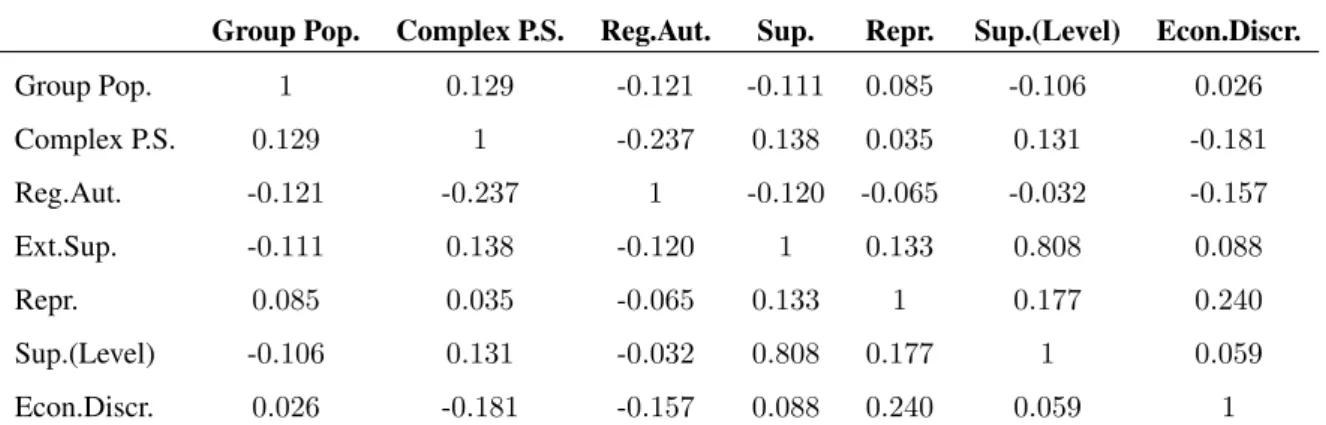
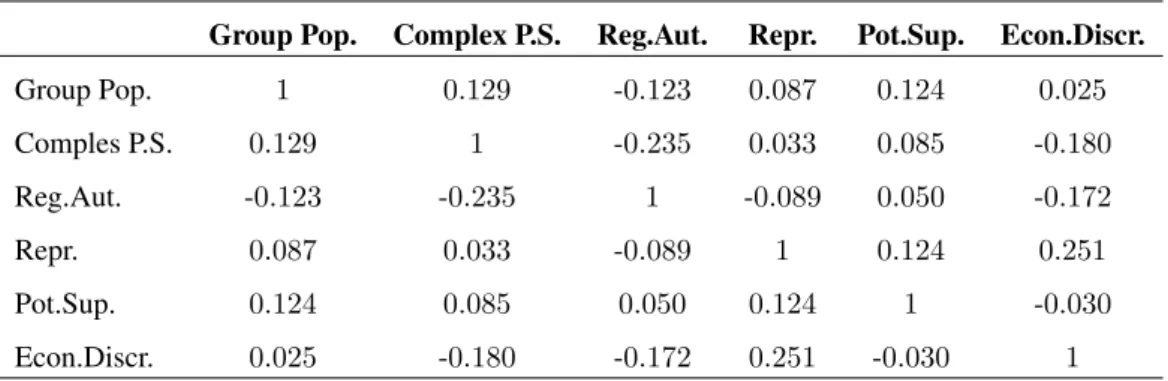
2 Correlation between Independent and Control Variables in Models 1 and 2 15 3 Correlation between Independent and Control Variables in Model 3 . . . . 16
4 Summary Statistics of the Dependent Variable . . . 16
5 Summary Statistics of Dichotomous Independent Variable: Potential Out-side Support . . . 18
6 Summary Statistics of Dichotomous Independent Variables: Political Insti-tutions . . . 19
7 Summary Statistics of Continuous Control Variable . . . 20
8 Summary Statistics of Dichotomous Control Variable: Repression . . . 20
9 Marginal Effects of External Support under Two Separate Institutional Conditions . . . 25
10 Variance Inflation Factors for Models 1, 2, and 3 . . . 29
11 Expected Percent Correctly Predicted for Models 1, 2, and 3 . . . 30
12 Logistic Regression Results of Models 1, 2, and 3 . . . 34
13 Predicted Probabilities of Violent Rebellion by External Support and Polit-ical Institutions . . . 35
LIST OF FIGURES
Figure
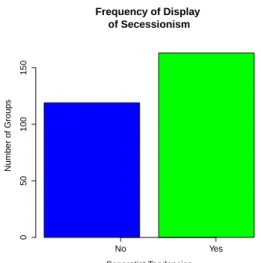
1 Frequency of Groups Interested in Secession, 2004-2006 . . . 10 2 Independent Variables: Outside Support as Dichotomous and Ordinal
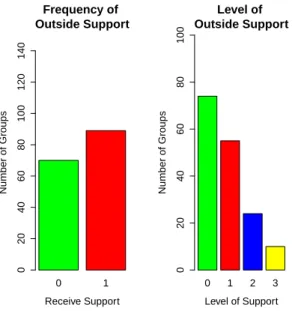
Vari-ables . . . 17 3 Control Variable: Economic Discrimination . . . 21 4 Predicted Probabilities of Political Institutions and External Support (Model
1) . . . 26 5 Predicted Probability of Rebellion Given Regional Autonomy and External
Support (Model 2) . . . 28 6 Predicted Probabilities of Political Institutions and Potential External
Sup-port (Model 3) . . . 29 7 Predicted Probability of Rebellion Given Complex Power Sharing and
Introduction
In early 2015, Crimean residents of eastern Ukraine overwhelmingly voted in favor of a referendum to secede and join Russia. Demonstrations eventually culminated in Crimean separatists’ declaration of independence from Ukraine and armed conflict between pro-Russian separatist groups and the Ukrainian military (BBC 2014). After the fall of the So-viet Union and Ukrainian independence, the central government of Ukraine granted Crimea significant measures of autonomy in 1991 (Taylor 2014). Additionally, although schol-arly and policy debate regarding the relationship between Crimean rebels and the Russian state continues, allegations of outside support from Russia to Ukrainian rebels operating in Crimea remain. This recent episode, which includes (likely) externally supported sepa-ratists operating under a particular political institution designed to alleviate problems within divided societies, illustrates the puzzle motivating this paper.
Theoretically, states have unchallenged sovereignty within their territory. Borrowing from Weber, this suggests that, at a minimum, the government controls the use of armed force within the legal boundaries of the state (1919). In reality, however, such sovereignty is not always respected or maintained. Specifically, internal threats to sovereignty arise from violent non-state actors that aim to reshape traditional national boundaries and shift some amount of territory away from the central government and to the group itself or some other state.
separatists opt to violently rebel.
Two power sharing institutional models that governments may enact to face the threat of secession include regional autonomy and complex power sharing. Past scholars in this vein have considered the relationship between secession and power sharing arrangements, but not specifically the impact of outside support and power sharing on outbreak of violence. For example, Horowitz considers federalism in the Swiss context and finds that this form of government is effective at reducing ethnic conflict (1985). Lijphart argues that India under consociationalism was less violent, and conflict between societal groups increased as the mechanisms to share power were undermined (1996). Conversely, Wilkinson directly con-tradicts this claim by arguing that when violence levels were lower, India’s governmental structure was not consociational (2000). As India has become increasingly a consociational government, violence levels have actually increased (Wilkison 2000). Thus, in addition to failing to agree on which type of power sharing arrangement incites or depresses intrastate violence, scholars have failed to take into account the role of international actors in spark-ing violent rebellion by separatists involved in such political institutions. So, this paper is motivated by an academically interesting and policy relevant question: when can outside support disrupt the societal equilibrium created by state institutions and trigger intrastate conflict?
Power Sharing Options for the State
Complex power sharing refers to a political arrangement that allows some autonomy for the substate group but is generally institutionally engineered to conciliate minority groups in fragmented societies and thus may include elements ranging from consociationalism to integration (Wolff 2009). McGarry observes that scholarship on complex power sharing is closely connected to work on consociationalism (2008). Lijphart, the scholar perhaps most linked with this institutional design, describes this form of power sharing as including one or more of the following characteristics: representation in the government that integrates the various groups in the state, some degree of autonomy for different societal groups, pro-portional representation and financial allocations to the multiple groups in the state, and the veto that protects groups’ basic interests and is to be used sparingly (1977). The con-fessional democratic system in Lebanon that allows power sharing between Christians and Muslims displays this type of institutional design (Dekmejian 1978). Specifically, complex power sharing consists of a carefully designed distribution of power that prevents establish-ment of political supremacy by certain religious, ethno-national, or other types of substate groups (O’Leary 2008). This institutional design incentivizes collaboration among group elites that have to work together after elections because they are forced to have a stake in the central government. Conversely, other scholars argue that complex power sharing pro-duces challenges regarding distribution of political benefits between ethnic groups because elites bring their groups’ conflicts to a high level in the government and keep inflammatory issues on the agenda (Roeder and Rothchild 2005). Wolff asserts that complex power shar-ing arrangements rely on the good will and capacity of elites, as well as their constituents in respective societal groups, to properly function(2008). This suggests that the success of complex power sharing can be undermined if group members hold extreme views. This design also establishes some inflexibility in the central government because it institution-alizes a normal, structured state of affairs that makes adapting to demographic or political changes difficult (Roeder and Rothchild 2005).
control over issues that are important to both the state as a whole and the individual group (2000). This may be an effective strategy because it reduces the feelings of insecurity expe-rienced by both members and elites of minority groups. Thus, devolving some authority to the regional level will make these groups feel more secure by minimizing the possibilities for risks associated with belonging to a minority (Posen 1993). Alternatively, Brancati cau-tions that, while decentralization may decrease ethnic conflict and secessionism by giving groups control over their own administrative affairs, this may also increase ethnic conflict and secessionism unintentionally by incentivizing the rise of regional parties (2006). Re-gional parties contribute to outbreak of ethnic conflict and secessionism by emphasizing sectarian identities. Such regional parties may advocate for public policies that show pref-erence for certain ethnic groups and rally these groups into conflict and secession (Brancati 2006). The devolution of power to Scotland from the central government in the United Kingdom exemplifies this power sharing structure (Sorens 2004).
The aforementioned strategies have strengths and weaknesses according to their struc-turing of power and consequences of their implementation. Ideally, complex power sharing allows for, or at least does not undermine, the legitimacy of the central government. This institutional arrangement also incentivizes cross-group cooperation so that the government can continue to function. For example, Norris notes that consociationalism, an aspect of complex power sharing, leads to elite cooperation that is helpful in achieving stability and democracy in divided societies (2005). Theoretically, this should be beneficial for states trying to integrate separatist groups because it forces them to buy into the idea of the state as a whole. Regional autonomy, conversely, weakens the strength of the central government because power is devolved to groups in certain areas. This provides groups the opportunity to prepare for violent secession by allowing space to mobilize resources and people for the potential ensuing conflict with the central government.
are more likely to identify with their group rather than the nation as a whole, the authority of the central government is undermined.
Furthermore, these power sharing structures essentially compel elites to associate with their primary group of identification. Politically, the elites must win the approval and vote of their constituents, who are the members of their groups. Complex power sharing may unintentionally create moral hazard because the generation of political elites after those that created the power sharing arrangement may compete among one another to rise above ri-vals within their own group (Roeder and Rothchild 2005). Such outbidding strategies may include lip service for violent rebellion. For groups with regional autonomy, elites may be forced to the extremes, such as support of violent behavior, to maintain support. Re-gionally autonomous groups may also face fewer difficulties to mobilize for armed conflict because they are already geographically concentrated and administratively independent, making outbreak of violence likely.
External Support for Separatist Groups
While societal peace may be established through institutional design choices made by the state, the resulting nonviolent interactions between domestic actors may be disrupted by outside forces. Specifically, inflows of foreign support for separatist groups can encourage rebellious behavior. Foreign support is aid, which may vary in nature and intensity, from state actors to groups interested in seceding from the state (Byman 2013). Byman et al. assert that the timing of such support is particularly important; for example, providing aid to nascent rebel groups is likely to be significantly more influential than providing aid to mature groups (2001a).
Since the end of the Cold War, 75% of violent conflicts have involved monetary and administrative aid from states not directly engaged in the conflict (Harbom and Wallensteen 2005). During the Cold War, the bipolar nature of the international system encouraged ex-tensive support to rebel groups from the United States and the Soviet Union. After the Cold War, however, outside support from the superpowers to violent substate groups decreased significantly, leading to a parallel reduction in such groups’ capabilities generally (Kalyvas and Balcells 2010). Regardless of the recent decrease in aid, Byman et al. suggest that support from states, including those that are not superpowers, continues to be the most sig-nificant type of aid that violent substate actors can receive (2013). Such foreign support is likely to significantly increase the capacity of separatist groups, leading to increased vi-olence and duration of the intrastate conflict (Regan 2000, 2002). Similarly, Libicki and Connable observe that insurgents that receive state support are successful in over 50% of conflicts, as opposed to those groups that lack such support and have only won 16.7% of conflicts (2010).
are more likely to receive support from other states due to the rivalry that characterizes the interstate relationship (2002). Similarly, Maoz and San-Akca find that the existence of an inter-state rivalry makes collaboration between violent substate actors and (rival) states more likely (2012). Furthermore, states may benefit from separatists’ local demographic and geographic knowledge, as well as lend credibility to the outside state sponsor’s in-volvement in the intrastate conflict by providing an familiar and easily identifiable front to the state’s activities (Gleditsch, Salehyan and Schultz 2008). Additionally, neighboring states are likely to sponsor separatist groups if the host state (of the rebels) has supported neighbors’ rebels in the past (Harbom and Wallensteen 2005).
strategy to garner domestic support (Byman et al. 2001a). Similarly, the likelihood of interstate violence increases with the presence of politically active minority groups in states considering sponsoring foreign rebels (Davis and Moore 1997).
Separatist groups may receive military and nonmilitary benefits, which is likely to influ-ence their turn to violent activity, from state support. I will first consider previous work on military aid from states to nonstate armed groups. States that sponsor rebels are often will-ing to train fighters, which may consist of teachwill-ing groups to use bombs or light weaponry, or cooperate with rebels to execute attacks (Byman 2005). States may also directly provide violent nonstate groups weapons or valuable intelligence that informs operations (Jenkins 1986). Another option to enhance the military capabilities of separatist groups is to provide technical or logistical expertise that improves the quality of arms and administration of the group (Byman 2013).
on the ability to organize for military action (Salehyan 2007). Salehyan contends that this is particularly beneficial to rebels as they are able to increase their bargaining leverage by raising information asymmetries and accruing credibility as a result of outside sources of support (2007).
Of course, separatists that accept support from states also face certain costs in the form of constraints on their range of choices and behavior. Horowitz notes that secessionist groups may have less agency over their members and actions since state sponsors often have their own limited, and possibly divergent, objectives in the conflict (1985). Additionally, such support may weaken secessionist groups by dividing the movement into ideological factions, lowering the incentives to forge alliances with other nonstate armed groups against the state, and undermining loyalty to the rebels’ local leaders (Byman 2013). Weinstein suggests another potential pitfall of state support: when state support is available, rebel groups may be less dependent on the population and eventually alienate and possibly abuse the civilians supposedly under their jurisdiction (2006). Finally, Carter argues that state sponsors are actually less beneficial to nonstate armed groups than conventionally held by scholars (2012). States, although they may be amenable to providing a safe haven or resources, are ultimately unwilling to incur any of the consequences associated with this aid and so be willing to give up information about such groups located in their territory (Carter 2012).
A Theory of External Support
Frequency of Display of Secessionism
Separatist Tendencies
Number of Groups
0
50
100
150
No Yes
Fig. 1: Frequency of Groups Interested in Secession, 2004-2006
Walter asserts that separatist disputes are the type of conflict most likely to intensify to the point of violence and the most difficult to resolve via negotiation between parties (2009). Bargaining difficulties arise because states engage in reputation building to appear resolute against potential future opposition and separatists hope that violence will force the government to concede (Walter 2009). When the secessionist group believes the benefits outweigh the costs of violence in this bargaining dynamic, separatists will engage in violent activity against the state. For separatist groups, this choice to engage in violence is likely to occur as the allocation of strength changes to favor the separatists instead of the state (Morrow 1989). Such an increase in separatists’ capacity is likely when the groups receive support from external actors.
Support from outside actors that enhances the capabilities of separatists is likely to influ-ence the demand for secession. Horowitz asserts that the capacity of such a group to engage in rebellious activity is contingent upon international actors’ choices (1985). The power sharing framework in the state is likely to mediate the impact of such external support, which is particularly useful to separatists because this aid may help balance the traditional power asymmetries that exist between the government and nonstate actors. This support from states may be material, political, or military in nature. Regardless of the different types or goals of groups in conflict with the central state government, separatist groups that enjoy external support are better off than groups without state sponsorship (Heraclides 1990). So, building on a large body of theoretical research, I contend that such external sup-port is beneficial for separatist groups in terms of enhancing their ability to rebel (Saideman 2002; Horowitz 1985; Salehyan, Gleditsch and Cunningham 2011).
External aid is likely to lead a separatist group to engage in violent rebellion for three reasons. First, state support is likely to influence separatists’ decision to violently rebel because it augments their capacity to use violence, which may result in negotiations with preferable outcomes to those separatists would obtain otherwise (Byman, Chalk, Hoffman, Rosenau and Brannan 2001b). Second, outside support increases separatists’ focus on for-eign political actors that are not the home state or the population the separatists claim to represent, which may lower inhibitions against alienating or injuring the people (Salehyan, Siroky and Wood 2014). Third, separatist groups that receive support from state actors are likely to feel increased legitimacy for their cause, and the resulting inflated confidence may embolden separatists to take risks in pursuit of their goal of secession.
their own sovereign territory, rather than from possible foreign entities that may support separatists. These institutional designs come under varying levels of strain when separatist groups receive support from outside actors. Therefore, I contend that the political insti-tutions present in the state and foreign support for separatist groups interact to influence outbreak of violent secession.
According to theoretical contributions from past scholars, state support to separatist groups should be more likely to spur conflict under certain institutional conditions than others. Regional autonomy is the devolution of power from the central government to regional actors that allows substate groups some degree of political independence (Lapidoth 1997). Regional autonomy, if implemented in areas facing secessionist threats, will increase the salience of sectarian identities and potential for intrastate conflict. In the case of a separatist group that possesses regional autonomy, the devolution of power is likely to be associated with group elites that do not buy into the idea of the state. Mobilization costs of rebellion for these groups that are geographically concentrated and imbued with some administrative and political power will be less than the costs for groups that are dispersed or not autonomous.
Regionally autonomous separatists that receive external support are likely to attempt to violently secede from the state. Under regional autonomy, the commitment problem be-tween the state and the separatist group is alleviated because the state sends a credible sig-nal to not manipulate minority groups by more evenly distributing power between the group and the state (Fearon 1998). With regional autonomy, then, minority groups should be more secure and less likely to rebel. Inflows of external support interrupt this relationship and change separatists’ incentives regarding rebellion because the security provided by regional autonomy will no longer be sufficient to satisfy the demand for rebellion. Because such groups increasingly rely on outside actors rather than their home state, inhibitions against violence toward the mainstream population will decrease. This argument is formalized in the following hypothesis:
An alternative institutional design is complex power sharing, which involves vertical and horizontal construction of state authority that may consist of strategies of autonomy, consociationalism, guaranteed representation, and veto options for groups (2008). Accord-ing to the majority of scholars, complex power sharAccord-ing is effective for a state threatened with secession because it reinforces national unity, compels separatists to have a stake in domestic politics, and incentivizes separatist elites to cooperate with other societal elites (Wolff 2009; McGarry 2008). A minority of scholars caution against assuming complex power sharing to be a panacea in all contexts involving separatist groups. For example, Sisk notes that, while power sharing works in some contexts, this arrangement has failed to alleviate conflict in others (Sisk 1996).
While the majority of scholars assume complex power sharing to pacify rebellion, I argue that state support to groups participating in arrangements of complex power sharing is likely to spur violent rebellion. Roeder and Rothchild observe that certain rare circum-stances are needed for complex power sharing to work: capacity of state government and group elites to enforce negotiated agreements among the population, willingness and com-mitment to negotiations among societal groups, relatively equivalent population growth, increasing economic prosperity for all groups in the state, and international actors that help implement power sharing (2005). Convergence of all these conditions is rare, meaning this institution only succeeds and therefore can prevent violence in a narrow window of contexts. In fact, complex power sharing is likely to engender conflict due to internal and external factors. Within the state, elites of separatist groups will continue to fight for their respective contentious issues. Under complex power sharing, however, these elites will be armed with certain political tools, like the minority veto, that will make efforts to redress their grievances more worthwhile. Similarly, states that contain groups interested in seces-sion likely already operate with less capacity than otherwise; thus, governments are unlikely to be able to adequately enforce negotiated settlements between societal groups.
actors, conversely, are not only refusing to support the state enacting complex power sharing but also supporting separatists financially or materially, intrastate conflict is the likely result. Additionally, as with regional autonomy, elites under complex power sharing still depend on the groups with which they identify. So, inundation of external support to separatist groups will heighten demand for rebellion and deincentivize elites’ cooperation with the central government and elites from other societal groups. For example, consociationalism, which shares several important elements with complex power sharing, failed in Lebanon due to interventionist activity by neighboring states Syria and Israel, which encouraged elite dissent and government failure (Seaver 2000). The lack of elite cooperation, due to intrastate tension resulting from complex power sharing and involvement by foreign actors, ultimately contributes to failure of complex power sharing and outbreak of violent rebellion. This argument leads to the second hypothesis:
H2: External support to separatist groups involved in complex power sharing arrange-ments is likely to provoke violent rebellion.
Data and Methods
Data
overview of the major variables of interest for three separatist groups is displayed in Table 1.
Table 1:Major Variables of Interest in Dataset
Separatist Group Rebel Reg. Aut. Complex P.S. Sup. Sup. (Level) Pot. Ext. Sup.
Scots 0 0 1 0 0 1
Chechens 1 1 0 1 1 1
Palestinians 1 1 0 1 3 1
Table 2:Correlation between Independent and Control Variables in Models 1 and 2
Group Pop. Complex P.S. Reg.Aut. Sup. Repr. Sup.(Level) Econ.Discr.
Group Pop. 1 0.129 -0.121 -0.111 0.085 -0.106 0.026
Complex P.S. 0.129 1 -0.237 0.138 0.035 0.131 -0.181
Reg.Aut. -0.121 -0.237 1 -0.120 -0.065 -0.032 -0.157
Ext.Sup. -0.111 0.138 -0.120 1 0.133 0.808 0.088
Repr. 0.085 0.035 -0.065 0.133 1 0.177 0.240
Sup.(Level) -0.106 0.131 -0.032 0.808 0.177 1 0.059
Econ.Discr. 0.026 -0.181 -0.157 0.088 0.240 0.059 1
Table 3: Correlation between Independent and Control Variables in Model 3
Group Pop. Complex P.S. Reg.Aut. Repr. Pot.Sup. Econ.Discr.
Group Pop. 1 0.129 -0.123 0.087 0.124 0.025
Comples P.S. 0.129 1 -0.235 0.033 0.085 -0.180
Reg.Aut. -0.123 -0.235 1 -0.089 0.050 -0.172
Repr. 0.087 0.033 -0.089 1 0.124 0.251
Pot.Sup. 0.124 0.085 0.050 0.124 1 -0.030
Econ.Discr. 0.025 -0.180 -0.172 0.251 -0.030 1
Dependent Variable
The dependent variable of interest for this analysis is violent rebellious activity by sep-aratist groups against the government. In the original MAR dataset, this is an ordinal vari-able, which increases with intensity of the violent activity from infrequent acts of terrorism to full civil war. I am interested simply in whether the secessionist group opts to employ violence against the state, so I recode the violent rebellion variable to be dichotomous. The variable is coded positively if any form of violence by the secessionist group occurs. This may include sporadic or sustained terrorism, local rebellions, varying levels of guerilla ac-tivity, or civil war (Center for International Development and Conflict Management N.d.). As shown in Table 4, fewer groups engage in violent rebellious activity than do not.
Table 4:Summary Statistics of the Dependent Variable
Frequency of Separatist Groups Percentage of Separatist Groups
No Rebellion 96 59%
Rebellion 67 41%
Independent Variables
from states than do not. Second, I create an additive index ranging from 0 to 3. The value of the variable increases as the separatist group receives additional forms of aid, including political, material, or military, from state sponsors. Figure 2 illustrates the distribution of levels of state support for separatist groups. I expect both variables representing foreign support to be positively and statistically significantly related to violent secession when the separatists have regional autonomy or complex power sharing.
0 1
Frequency of Outside Support
Receive Support
Number of Groups
0 20 40 60 80 100 120 140
0 1 2 3
Level of Outside Support
Level of Support
Number of Groups
0 20 40 60 80 100
Fig. 2:Independent Variables: Outside Support as Dichotomous and Ordinal Variables
Outside actors’ choice to provide support to separatists may be endogenous to separatist groups’ demonstrated capacity for violence. So, I also include a variable to operationalize the potential for separatist groups to receive external support. To measure the possibility of support, I consider whether the separatist group exists in a country engaged in an interstate rivalry. I employ a dichotomous variable to operationalize interstate rivalry presence.
the same opponent state from 1994-2001. Starting the count in 1994 ensures that the rivalry will still be intact by the time my own dataset starts (2004) given the ten year life span of a rivalry according to Goertz and Diehl. So, if a state experiences at least two MIDs with the same enemy from 1994-2001, I code the observation positively. As illustrated by Table 5, more separatist groups exist in states that are engaged in interstate rivalries. Therefore, more separatist groups in my dataset have potential to receive state support than do not. As with the variables that actually measure presence of external support, I expect this variable to be positively and statistically significantly related to violent secession when separatist groups have regional autonomy or complex power sharing.
Table 5:Summary Statistics of Dichotomous Independent Variable: Potential Outside Support
Frequency of Separatist Groups Percentage of Separatist Groups
No Potential Support 45 28%
Potential Support 118 72%
Table 6: Summary Statistics of Dichotomous Independent Variables: Political Institutions
Frequency of Institution Percentage of Institution
Regional Autonomy 136 83%
27 17%
Complex Power Sharing 128 79%
35 21%
The second institutional variable relevant to my theory is complex power sharing. To approximate complex power sharing arrangements, I consider whether the group has guar-anteed representation in the central state government (Center for International Development and Conflict Management N.d.). This operationalization of complex power sharing is jus-tified based on scholars’ characterizations of such arrangements as involving guaranteed representation, which is more easily identifiable due to the legal requirements associated with guaranteed representation in states (Wolff 2009; Weller and Metzger 2008). In the few cases in which separatist groups received both regional autonomy and guarantees of representation at the state level, I identify the political institution as complex power sharing rather than regional autonomy. This is valid because proponents of complex power sharing do not rule out some degree of regional autonomy but do recognize the potentially damag-ing impact of regional autonomy on state unity and the benefit of integration at the level of the central government (Wolff 2009). Therefore, these two institutional designs are mutu-ally exclusive.1 As illustrated by Table 6, more groups are not involved in complex power
sharing arrangements than are. I expect that outside support to separatist groups partici-pating in complex power sharing will be positively and statistically significantly related to rebellion.
1These two institutional designs are mutually exclusive even though there is low correlation (-0.235)
Control Variables
I include some control variables on which to condition my independent variables of interest. First, I include a measure of the population, recoded in millions of people, of the group in the state (Center for International Development and Conflict Management N.d.). This is necessary because the size of the separatist group is likely to have some impact on the group’s ability to violently rebel, but the size of groups is outside the scope of my theory. The summary statistics for this control variable can be seen in Table 7.2
Table 7: Summary Statistics of Continuous Control Variable
Minimum Mean Median Standard Deviation Maximum
Group Population 29604 5033993 1210732 13985302 136697940
Table 8:Summary Statistics of Dichotomous Control Variable: Repression
Frequency of Separatist Groups Percentage of Separatist Groups
No Repression 52 32%
Repression 111 68%
I also include a second control variable of repression of the separatist group by the government. To operationalize the variable for repression, I create a dichotomous mea-sure of multiple variables. One such variable is repression of the group civilian population. This population is identified as not participating in violent or nonviolent political activities (Center for International Development and Conflict Management N.d.). Another variable is repression of group members that participate in nonviolent collective action, like demon-strations. The third variable is repression of group members involved in violent activities, such as harassment or torture (Center for International Development and Conflict Manage-ment N.d.). As shown in Table 8, more groups experience repression than do not. If any of these types of repression occurred between 2004 and 2006 to members of the secessionist
2The table displays actual population data rather than the recoded variable so that meaningful values are
group, the observation for repression is positively coded. This is necessary for appropri-ately analyzing the relationship between my dependent and independent variable of interest because repression of any individuals in the group, including militant and civilian members, is likely to have some effect on whether or not the group engages in violent rebellion.
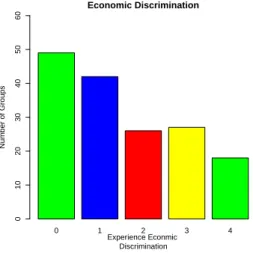
0 1 2 3 4
Frequency of Economic Discrimination
Experience Econmic Discrimination
Number of Groups
0
10
20
30
40
50
60
Fig. 3:Control Variable: Economic Discrimination
Last, I include an ordinal control variable for whether the secessionist group experiences economic discrimination. The variable is coded as 0 if the group does not experience dis-crimination economically (Center for International Development and Conflict Management N.d.). The variable ranges between 1 and 4 as groups experience increasing levels of eco-nomic discrimination, including poverty due to neglect, marginalization, social practices, or political restrictions (Center for International Development and Conflict Management N.d.). This variable is essential because it illustrates whether separatist groups must con-tend with economic inequality on the national stage, which may influence their interest in separating from the larger polity. The majority of separatist groups experience some degree of economic discrimination, and the distribution of levels of discrimination is illustrated by Figure 3.
Methods
in complex power sharing is also likely to encourage violent secession, I employ three generalized linear models using logistic regression. These models vary due to different operationalizations that I have of my major independent variables. In this way, I am able to more robustly test my theory. The first two models test the impact of political institutions and the actual presence of support on likelihood of violent rebellion by separatist groups. These models can be broadly specified as:
Violent Rebellion=β0+β1Regional Autonomy+β2Complex Power Sharing+
β3External Support+β4Regional Autonomy*External Support+
β5Complex Power Sharing*External Support+
β6Group Population+β7Repression Index+β8Economic Discrimination+
(1)
In the first and second models, I use the variables that measure the actual presence of out-side support for the separatist group. In the first model, I use a dichotomous measure of outside support illustrating whether any type of support was received. In the second model, however, I use an additive index of external support that shows the level of support re-ceived. The index for external support increases as the separatist group receives more types of external support from states (political, material, or military).
The third model deals with possible endogeneity issues related to outside support and rebellion. So, this model considers the influence of political institutions and the potential for external support on onset of violent rebellion by secessionist groups. This model can be broadly specified as:
Violent Rebellion=β0+β1Regional Autonomy+β2Complex Power Sharing+
β3Potential of External Support+
β4Regional Autonomy*Potential of External Support+
β5Complex Power Sharing*Potential of External Support+
β6Group Population+β7Repression Index+β8Economic Discrimination+
I use interaction terms in these models because of the likely interactive nature of the effect of existing political institutions and external support on outbreak of secessionist violence. Specifically, the effect of external support on violent rebellion by separatists is likely to be conditioned by the political institution (regional autonomy or complex power sharing) established in the state hosting the separatist group. Similarly, the effect of political institu-tions on outbreak of violence is likely to be conditioned by the presence of outside support received by the separatists.
To deal with possible endogeneity issues between external support and onset of vio-lent rebellion, I operationalize foreign support variables in two manners. In the first two models, I specifically employ variables that show whether, and to what extent, separatist groups receive support from foreign actors. In the third model, I include a variable, which consists of evidence of interstate rivalry, that illustrates only the potential for outside sup-port to rebel groups. Separatist groups present in host states that are involved in rivalries with other states are likely to receive outside support from the hosts’ rivals in an effort to undermine the host state (Maoz and SanAkca 2012; Salehyan 2007; Salehyan, Gleditsch and Cunningham 2011). So, without testing whether states actually send aid (which could depend on separatist groups already having credibly displayed their threat to engage in vi-olence), I can appropriately test my hypotheses by using a variable measuring potential for outside support. I expect the results of the third model, which includes potential of outside support, to corroborate the results of the first two models, which employ actual presence of external support.
Analysis
re-sults of the three models are similar. The rere-sults of this statistical analysis provide evidence largely in support of the hypotheses derived from my theoretical framework.
I use three logistic regression models that include multiple interaction terms, so the immediate results of the regressions are not extremely informative. I will, however, briefly report the noteworthy results of the logistic regression models. The complete results of the models are displayed in Table 12, which is in the Appendix. While not always statistically significant across the three models, both variables representing power sharing institutions are positively related to separatists’ likelihood to use violence. In the second model, which employs an ordinal variable for external support, regional autonomy (even without external support) is statistically significantly related to violent rebellion. Also in the second model, the ordinal variable for outside support is positively and statistically significantly related to rebellious activity. Repression is positive and statistically significant across all three models, indicating that government repression of any member of the separatist group is likely to be associated with secession. Last, the variable measuring group population is positive and statistically significant in the second model.
As previously mentioned, I use several interaction terms in my three models; therefore, I also present and interpret the marginal effects and predicted probabilities of these models. I will now discuss the marginal effects of the first set of models, which considers the impact of actual foreign support and political institution (regional autonomy or complex power sharing) on outbreak of violent rebellion by secessionist groups. It should be noted that the baseline to which I compare regionally autonomous groups is those groups that have neither power sharing institutions3 or are involved in complex power sharing. Likewise, the baseline to which I compare groups involved in complex power sharing is the category of groups that have neither power sharing institution or have regional autonomy.4
3A state lacking power sharing institutions for a separatist group does not imply that the group is operating
in a failed state. For example, in my dataset, a separatist group in South Africa would fall into this category. There are 101 of these groups, as indicated by Table 14.
4I also ran the model estimating the impact of complex power sharing against the baseline of regional
Table 9:Marginal Effects of External Support under Two Separate Institu-tional Conditions
Political Institution External Support Model 1 Regional Autonomy 2.03 (1.03) *
Complex Power Sharing 1.43 (0.70) * Model 2 Regional Autonomy 1.24 (0.65) .
Complex Power Sharing 0.87 (0.58)
Political Institution Potential External Support Model 3 Regional Autonomy 1.37 (0.71) *
Complex Power Sharing 1.17 (0.65) .
Standard errors in parentheses
* indicates significance atp < .05
. indicates significance atp <0.1
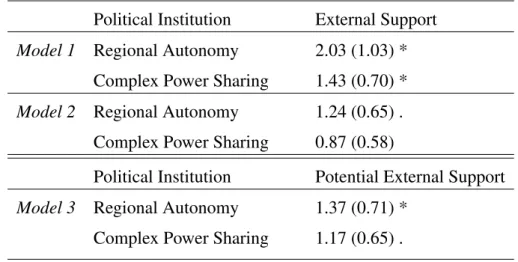
Table 9 displays the marginal effects of the interaction terms in Models 1, 2, and 3. In Model 1, the interaction term between regional autonomy and outside support (as a dichotomous variable) is positive and statistically significant. Additionally, in Model 2, the interaction term between regional autonomy and foreign support, operationalized as an ordinal variable, is positive and statistically significant.5 The marginal effects of the first
two models, therefore, strongly support my hypotheses because the interactions between regional autonomy and outside support (as a dichotomous and as an ordinal variable) is positively related to outbreak of violent rebellion by separatists. The interaction between complex power sharing and outside support is also positively and statistically significantly related to violent secession in Model 1 and positively (but not statistically significantly) related to rebellion in Model 2. So, the marginal effects of the first two models provide some support for my hypothesis regarding the positive impact of the interaction of complex power sharing with external support on secession.
The third model, which I employ to check for endogeneity issues, also displays posi-tive and statistically significant effects of the interactions between political institutions and
5The interaction term in Model 2 is significant at the .057 level, meaning it is only slightly above the .05
potential outside support on violent rebellion. Like the first two models, the effect of the interaction between regional autonomy and potential external support is positive and sta-tistically significantly related to violent rebellion, which further confirms my hypothesis regarding regional autonomy and aid from foreign actors. Also like the first model, the in-teraction term between complex power sharing and potential external support is positively and statistically significantly related to violent rebellious activity.6 This provides further
evidence in support of the second hypothesis regarding complex power sharing and outside aid. The third model generally replicates the results of the first two models. This addresses issues of endogeneity related to the impact of foreign support on the outbreak of violent rebellion because the potential of outside support for the most part parallels the actual pres-ence of external support.
Political Institution
Probability of Violent Rebellion
0.0
0.2
0.4
0.6
0.8
1.0
Regional Autonomy Complex P.S.
●
●
●
● No External Support
External Support
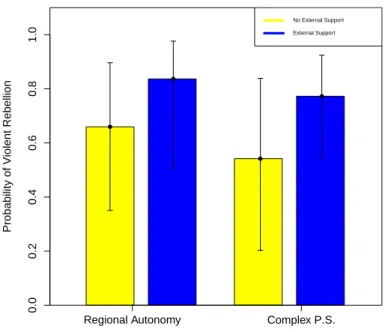
Fig. 4: Predicted Probabilities of Political Institutions and External Support (Model 1)
Because I employ logistic regression, I also present the predicted probabilities associ-ated with each model in Table 13, which is locassoci-ated in the Appendix. In Model 1, both inter-action terms achieve statistical significance, so I will interpret the substantive implications
6The interaction term in Model 3 is significant at the .072 level, meaning it also is only marginally above
of this model by discussing a bar chart associated with its probabilities, presented in Figure 4. As I previously mentioned, the baseline of comparison for groups that have regional autonomy is groups without any power sharing institutions or those with complex power sharing. Similarly, the baseline of comparison for groups participating in complex power sharing is groups lacking power sharing institutions or regionally autonomous groups. Be-cause of the dichotomous variables of interest included in the first model, I display the results in a bar chart in Figure 4. Separatist groups with regional autonomy that also receive outside support are more likely to engage in violent secession than regionally autonomous separatist groups that do not receive outside support, as indicated by the relative height of the blue bar to the yellow bar in Figure 4. The same holds true for groups involved in com-plex power sharing. The solid black lines indicate uncertainty around the point estimates. For example, there is more certainty on the estimate for groups participating in complex power sharing arrangements that receive external support. Generally, this substantive anal-ysis is supportive of both hypotheses.
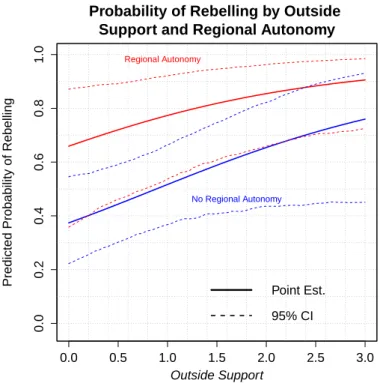
I present the predicted probabilities associated with Model 2, which includes an ordinal independent variable of interest, in Figure 5. In this model, the interaction term between regional autonomy and external support achieves statistical significance, so I will substan-tively interpret this by considering associated predicted probabilities. Figure 5 illustrates the effect of outside support and regional autonomy on the likelihood of rebellious vio-lence. Since probability can only range from 0 to 1, the Y-axis, which has the “Predicted Probability of Rebelling, is bounded between 0 and 1. External support, which is an inde-pendent variable in the model I am estimating, can range from 0 to 3 since this variable is ordinal. This is why the X-axis, which shows outside support, varies between 0 and 3.
0.0 0.5 1.0 1.5 2.0 2.5 3.0
0.0
0.2
0.4
0.6
0.8
1.0
Probability of Rebelling by Outside Support and Regional Autonomy
Predicted Probability of Rebelling
Outside Support
Point Est.
95% CI
Regional Autonomy
No Regional Autonomy
Fig. 5:Predicted Probability of Rebellion Given Regional Autonomy and External Support (Model 2)
autonomy for a group, being associated with a higher probability of rebelling than the solid blue line, which indicates a lack of regional autonomy. The dashed lines indicate the 95% confidence intervals for these estimates. The 95% confidence intervals indicate that, in repeated sampling, 95% of the intervals calculated would contain the population mean.7
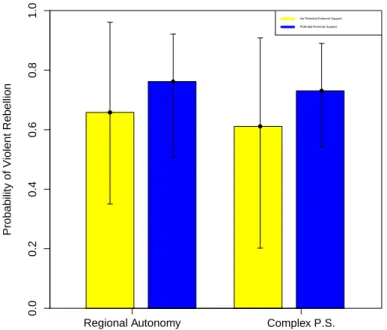
I present the predicted probabilities associated with the third model in Figure 6. Figure 6 shows the predicted probability of outbreak of rebellious violence given political institu-tions and potential of foreign support (using the MID rivalry variable for potential external support). As with Figure 4, I display these predicted probabilities using a bar chart be-cause the models include dichotomous variables. Regionally autonomous groups with the potential to receive outside support are more likely to rebel than groups that have regional autonomy but lack external support potential. Separatist groups participating in complex
7As indicated by Table 9, only the interaction of regional autonomy and external support achieves
Political Institution
Probability of Violent Rebellion
0.0
0.2
0.4
0.6
0.8
1.0
Regional Autonomy Complex P.S.
●
●
●
● No Potential External Support
Potential External Support
Fig. 6: Predicted Probabilities of Political Institutions and Potential External Support (Model 3)
power sharing governments with potential to receive outside support are similarly more likely to violently secede than those without such potential external aid. This parallels the findings related to the impact of actual support and political institutions on the likelihood of violent secession (from Models 1 and 2). Again, this provides support for my hypotheses and deals with possible endogeneity issues between support and rebellion.
Table 10: Variance Inflation Factors for Models 1, 2, and 3
Model 1 Model 2 Model 3
Regional Autonomy 1.90 1.91 4.72
Complex Power Sharing 2.89 2.28 3.90
External Support 1.55 1.54 1.46
Group Population 1.15 1.14 1.10
Repression 1.05 1.06 1.04
Economic Discrimination 1.22 1.18 1.17
Finally, I conduct some diagnostic tests to evaluate the performance of my models. In addition to the tests for problematic correlation (in Tables 2 and 3), I calculate variance inflation factors, which indicate how serious of a problem multicollinearity is, for the three models. As indicated by Table 10, the VIF levels are not above 5, which is recommended (Rogerson 2001). Lower levels of VIF are preferred because the VIF shows the size of the inflation of standard errors that are due to multicollinearity. Also, Herron recommends calculating an expected percent correctly predicted as an alternative to simply the percent correctly predicted, which may imply more precision of estimates than is correct (Herron 1999). As illustrated by Table 11, the majority of the predictions were correctly predicted in all three models.
Table 11: Expected Percent Correctly Predicted for Models 1, 2, and 3
Model 1 Model 2 Model 3
Expected Percent Correctly Predicted (ePCP) 0.70 0.60 0.59
Discussion
external aid to participating substate groups.
As previously discussed, the interaction between regional autonomy and external sup-port is positively and statistically significantly related to outbreak of violent secession across the three models. This empirical finding supports my theory and is intuitively logical. Sep-aratists granted regional autonomy are likely well positioned to violently rebel, and these groups will be further enabled and emboldened by receiving support from state actors. Such outside aid is likely to improve separatists’ logistical capabilities, as well as to provide le-gitimacy for their goals of self determination from established actors in the international community.
Furthermore, this positive, statistically significant relationship is present in the first two models, which include variables for outside support indicating separatists’ actual reception of aid from states, and in the third model, which includes a variable for outside support indicating the mere potential of separatist groups to receive outside aid. Because this rela-tionship is constant across all three models, I can fairly confidently reject the null hypothesis that the interaction between external support and regional autonomy is unrelated to outbreak of violent rebellion. Additionally, the relative stability of this finding across the three mod-els, which include both presence of actual support and potential for such aid, addresses the possible endogeneity problem regarding external support and secessionist violence.
This analysis also provides one unexpected, though not illogical, insight. The three models indicate that, as repression against any member of the group increases, separatists are more likely to engage in rebellious violence. This is unsurprising given that repres-sion, regardless of against whom it is directed, spreads general grievance throughout the group and may spark violence. This variable is not specifically included in my theoretical framework, which focuses on the impact of power sharing structures and foreign support on intrastate conflict. The possibility that repression lowers inhibitions against violence and positively influences rebellion, however, is reasonable.
Future work in the study of the impact of external support and power sharing institutions on violent rebellion will be improved by theoretical and methodological expansion. For ex-ample, I do not consider aid from non-state actors, such as nongovernmental organizations or transnational terrorist groups, in this analysis. Support from such groups, conditional on the political institution present in the state, may influence whether separatists employ violence in rebellion. So, including this in future work may present a more complete story regarding the internal and external factors influencing secessionist violence. Additionally, this study involves some endogeneity issues between the power sharing institution estab-lished in the state, the decision by outside actors to support separatists, and the use of violence by separatist groups. To deal with some of these issues, I include a third model that operationalizes outside support simply as potential for aid from foreign actors (mea-suring whether the separatist group’s home state is involved in a rivalry with another state). When more nuanced data become available, the ideal statistical analysis would include a time series that could deal with some of these endogeneity issues, as well.
APPENDIX
Table 12: Logistic Regression Results of Models 1, 2, and 3
Model 1 Model 2 Model 3
(Intercept) -5.09∗ -5.52∗ -5.00∗
(1.16) (1.18) (1.18)
Regional Autonomy 0.86 1.64∗ 0.95
(0.83) (0.81) (1.27)
Complex Power Sharing 0.33 0.58 0.60
(0.89) (0.81) (1.02)
External Support 0.03
(0.51)
Group Population 0.06 0.08∗ 0.06
(0.04) (0.04) (0.04)
Repression 4.44∗ 4.42∗ 4.43∗
(1.07) (1.07) (1.06)
Economic Discrimination 0.20 0.17 0.19
(0.17) (0.17) (0.16) Regional Autonomy: External Support 1.17
(1.29) Complex Power Sharing: External Support 1.09
(1.11)
External Support (Level) 0.58∗
(0.28) Regional Autonomy: External Support (Level) -0.40
(0.61) Complex Power Sharing: External Support (Level) 0.30
(0.65)
Potential External Support -0.02
(0.55)
Regional Autonomy: Potential External Support 0.43
(1.42) Complex Power Sharing: Potential External Support 0.57
(1.20)
N 158 162 162
AIC 159.06 158.53 165.25
BIC 269.32 269.69 276.41
logL -43.53 -43.27 -46.63
∗indicates significance atp <0.05
Table 13:Predicted Probabilities of Violent Rebellion by External Support and Po-litical Institutions
Regional Autonomy Complex Power Sharing
No External Support
Model 1 0.66 0.54
Model 2 0.66 0.61
Model 3 0.66 0.61
External Support
Model 1 0.84 0.77
Model 2 0.76 0.73
Model 3 0.77 0.73
Table 14: Cross Tabulation of Regional Autonomy and Complex Power Sharing
No Political Institutions Complex Power Sharing
No Political Institutions 101 35
0.0 0.5 1.0 1.5 2.0 2.5 3.0
0.0
0.2
0.4
0.6
0.8
1.0
Probability of Rebelling by Outside Support and Complex Power Sharing
Predicted Probability of Rebelling
Outside Support
Point Est.
95% CI
Complex Power Sharing
No Complex Power Sharing
REFERENCES
Akca, Belgin San. 2009. “Supporting Non-State Armed Groups: A Resort to Illegality?” The Journal of Strategic Studies32(4).
Bapat, Navin. 2007. “The Internationalization of Terrorist Campaigns.” Conflict Manage-ment and Peace Science24(4).
BBC. 2014. “Ukraine Crisis: Timeline.”BBC News.
URL:http://www.bbc.com/news/world-middle-east-26248275
Brancati, Dawn. 2006. “Decentralization: Fueling the fire or dampening the flames of ethnic conflict and secessionism?”International Organization60(3).
Byman, Daniel. 2005. Deadly connections: States that sponsor terrorism. Cambridge University Press.
Byman, Daniel. 2013. “Outside Support for Insurgent Movements.” Studies in Conflict & Terrorism36(12).
Byman, Daniel, Peter Chalk, Bruce Hoffman, William Rosenau and David Brannan. 2001a. Trends in outside support for insurgent movements. Rand Corporation.
Byman, Daniel, Peter Chalk, Bruce Hoffman, William Rosenau and David Brannan. 2001b. Trends in outside support for insurgent movements. Rand Corporation.
Carter, David. 2012. “A blessing or a curse? State support for terrorist groups.” Interna-tional Organization66(1).
Center for International Development and Conflict Management. N.d. “Minorities at Risk Dataset.” Online.
Collier, Paul and Anke Hoeffler. 2006. Negotiating Self-Determination. Lexington Books chapter The political economy of secession.
Connable, Ben and Martin Libicki. 2010. How Insurgencies End. Rand Corporation.
Dekmejian, Richard. 1978. “Consociational democracy in crisis: the case of Lebanon.” Comparative Politics.
Encarnacion, Omar. 2004. “Democracy and Federalism in Spain.”Mediterranean Quarterly 15(1).
Fearon, James D. 1998. The international spread of ethnic conflict. Princeton University Press chapter Commitment problems and the spread of ethnic conflict.
Ghai, Yash. 2000. Autonomy and ethnicity: negotiating competing claims in multi-ethnic states. Cambridge University Press.
Ghosn, Faten, Glenn Palmer and Stuart Bremer. 2004. The MID3 Data Set, 1993–2001: Procedures, Coding Rules, and Description. Conflict Management and Peace Science.
Gleditsch, Kristian, Idean Salehyan and Kenneth Schultz. 2008. “Fighting at home, fighting abroad: How civil wars lead to international disputes.”Journal of Conflict Resolution.
Goertz, Gary and Paul F. Diehl. 1992. “The empirical importance of enduring rivalries.” International Interactions18(2).
Harbom, Lotta and Peter Wallensteen. 2005. “Armed conflict and its international dimen-sions, 1946-2004.”Journal of Peace Research42(5).
Heraclides, Alexis. 1990. “Secessionist Minorities and External Involvement.” Interna-tional Organization44(3).
Herron, Michael. 1999. “Postestimation uncertainty in limited dependent variable models.” Political analysis8(1).
Horowitz, Donald. 1985. Ethnic Groups in Conflict. University of California Press.
Jenkins, Brian. 1986. “Defense Against Terrorism.”Political Science Quarterly.
Kalyvas, Stathis and Laia Balcells. 2010. “International System and Technologies of Rebel-lion: How the End of the Cold War Shaped Internal Conflict.”American Political Science Review104.
Lijphart, Arend. 1977. Democracy in plural societies: A comparatic exploration. Yale University Press.
Lijphart, Arend. 1996. “The puzzle of Indian democracy: a consociational interpretation.” American political science review.
Maoz, Zeev and Belgin SanAkca. 2012. “Rivalry and State Support of NonState Armed Groups (NAGs), 1946–20011.”International Studies Quarterly56(4).
McGarry, John. 2008. Settling Self-determination Disputes: Complex Power Sharing in Theory and Practice. Martinus Nijhoff Publishers chapter Power Sharing Theory: Lessons from the Complex Power-Sharing Project.
Morrow, James. 1989. “Capabilities, uncertainty, and resolve: A limited information model of crisis bargaining.”American Journal of Political Science.
Norris, Pippa. 2005. Stable democracy and good governance in divided societies: Do pow-ersharing institutions work. Research Programs, John F. Kennedy School of Government, Harvard University.
Norton, Richard. 2007. Hezbollah: A Short History. Princeton University Press.
O’Leary, Brendan. 2008. Settling Self-determination Disputes: Complex Power Sharing in Theory and Practice. Martinus Nijhoff Publishers chapter The Logistics of Power-sharing, Consociation, and Pluralist Federations.
Posen, Barry. 1993. “The security dilemma and ethnic conflict.”survival35(1).
Regan, Patrick. 2000. Regan, Patrick M. Civil wars and foreign powers: Outside interven-tion in intrastate conflict. University of Michigan Press.
Regan, Patrick. 2002. “Third party interventions and the duration of intrastate conflicts.” Journal of Conflict Resolution46.
Roeder, Philip and Donald Rothchild, eds. 2005.Sustainable peace: Power and democracy after civil wars. Cornell University Press.
Rogerson, P. A. 2001. Statistical methods for geography. Sage.
Support for Ethnic Groups.”Journal of Peace Research39(1).
Salehyan, Idean. 2007. “Transnational Rebels: Neighboring States as Sanctuary for Rebel Groups.”World Politics59(2).
Salehyan, Idean, David Siroky and Reed Wood. 2014. “External Rebel Sponsorship and Civilian Abuse: A Principal-Agent Analysis of Wartime Atrocities.”International Orga-nization68(3).
Salehyan, Idean, Kristian Gleditsch and David Cunningham. 2011. “Explaining external support for insurgent groups.”International Organization65(4).
Seaver, Brenda. 2000. “The Regional Sources of Power-Sharing Failures: The Case of Lebanon.”Political Science Quarterly115(2).
Sisk, Timothy. 1996. Power sharing and international mediation in ethnic conflicts. US Institute of Peace Press.
Sorens, Jason. 2004. “Globalizaiton, secessionism, and autonomy.”Electoral Studies23(4).
Taylor, Adam. 2014. “To understand Crimea, take a look back at its complicated history.” The Washington Post.
Walter, Barbara. 2009. Reputation and civil war: why separatist conflicts are so violent. Cambridge University Press.
Weber, Max. 1919. Politics As A Vocation. InFrom Max Weber: Essays in Sociology. H.H. Gerth and C. Wright Mills.
Weinstein, Jeremy. 2006. Inside Rebellion: The Politics of Insurgent Violence. Cambridge University Press.
Weller, M. and B. Metzger. 2008. Settling Self-determination Disputes: Complex Power Sharing in Theory and Practice. Martinus Nijhoff Publishers.
Wilkison, Steven. 2000. “India, consociational theory, and ethnic violence.”Asian Survey.
South Tyro.