23.1
Chapter 23
o
The transport layer is responsible for the
delivery of a message from one process to
another
o
The Internet model has three protocols at the
transport layer:
UDP, TCP, and SCTP
.
• UDP: Is the simplest of the three.
• TCP: A complex transport layer protocol.
• SCTP: The new transport layer protocol that is designed for
specific applications such as multimedia.
Process-to-process Delivery
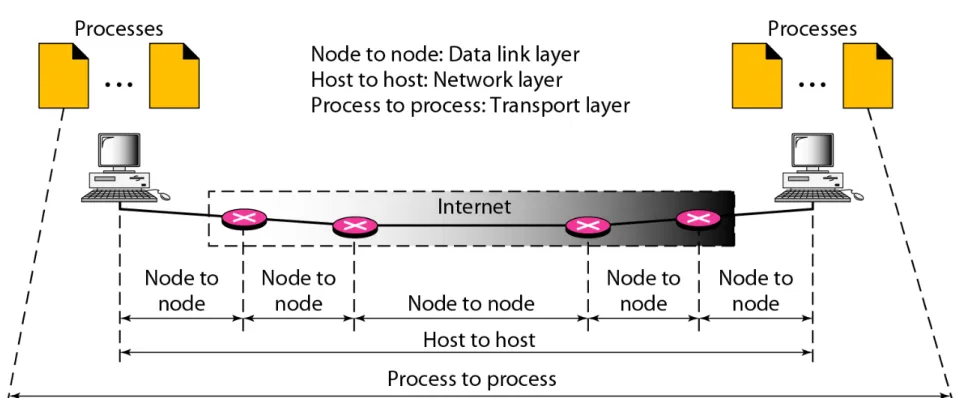
oThe Data link layer is responsible for delivery of frames between nodes over a link node to node delivery
o
The network layer is responsible for delivery of datagrams between two hosts host to host deliveryo
Real communication takes place between two processes (application programs). We need process-to-process delivery.
oWe need a mechanism to deliver data from one of processes running on the source host to the corresponding process running on the destination host.
23.4
The transport layer is responsible for process-to-process delivery.
6. Multiplexing and Demultiplexing –
• Multiplexing allows simultaneous use of different applications over a network which are running on a host.
• Transport layer provides this mechanism which enables us to send packet streams from various applications simultaneously over a network.
• Transport layer accepts these packets from different processes differentiated by their port numbers and passes them to network layer after adding proper headers.
Client/Server Paradigm
oProcess-to-Process communication can be achieved through client/server
oA process on the local host, known as client, needs services from a process usually on the remote host, called a server.
oBoth processes (client and server) have the same name. o For communication, we must define :
Addressing
o
At the
data link layer
, we need a
MAC addres
s
to
choose one node among several nodes
o
At the
network layer
, we need an
IP address
to
choose one host among millions.
o
At the
transport layer
, we need a
port number, to
choose among multiple processes running on the
destination host.
Port number
o A port number is a way to identify a specific process to
which an Internet or other network message is to be
forwarded when it arrives at a server.
oThe Internet uses port numbers for servers called
well-
known port numbers.
oEvery client process knows the well-known port
number of
the corresponding server process•
A port number primarily aids in the transmission of data between a network
and an application.
•
For example,
in an incoming message/packet
, the IP address is used to
identify the destination computer/node, whereas the port number further
specifies the destination application/program in that computer.
•
Similarly,
all outgoing network packets
contain application port numbers in
the packet header to enable the receiver to distinguish the specific
application.
IP addresses versus port numbers
• IP addresses and port numbers play different roles in selecting the final destination of data.
• The destination IP address defines the host among the different hosts
• After the host has been selected, the port number defines one of the processes
Socket Addresses
o
Process-to-process delivery needs two identifiers, IP address and the port number, at each end to make a connection.o The combination of an IP address and a port number is called a socket address.
o A transport layer protocol needs a pair of socket addresses: the client socket address
and the server socket address.
o These four pieces of information are part of the IP header and the transport layer protocol header.
Connectionless Versus
Connection-Oriented Service
o
A transport layer protocol can either be connectionless or
connection-oriented.
o
Connectionless Service
In a connectionless service, the packets are sent from one party to another
with no need for connection establishment or connection release.
The packets are not numbered; they may be delayed or lost or may arrive out
of sequence.
There is no acknowledgment .
Connectionless Versus
Connection-Oriented Service
o
Connection Oriented Service
In a connection-oriented service, a connection is first established between the sender
and the receiver.
Data are transferred.
At the end, the connection is released.
TCP and SCTP (Stream Control Transmission Protocol) are connection-oriented