UNSTABLE IDENTITIES: THE DECLINE OF PARTISANSHIP IN CONTEMPORARY CHILE
Nicol´as De la Cerda Coya
A thesis submitted to the faculty of the University of North Carolina at Chapel Hill in partial fulfillment of the requirements for the degree of Master of Arts in the Department of Political
Science.
Chapel Hill 2020
Approved by: Jonathan Hartlyn Evelyne Huber
c
2020
ABSTRACT
Nicol´as De la Cerda Coya, Unstable Identities: The Decline of Partisanship in Contemporary Chile
(Under the direction of Jonathan Hartlyn)
ACKNOWLEDGEMENTS
TABLE OF CONTENTS
LIST OF FIGURES . . . vii
LIST OF TABLES . . . viii
INTRODUCTION . . . 1
LITERATURE REVIEW . . . 6
Instrumental Approach . . . 6
Expressive Approach . . . 7
THE CHILEAN POST-AUTHORITARIAN POLITICAL LANDSCAPE . . . 9
General Political Context . . . 9
The Decline in Partisanship . . . 9
The Decline in Partisanship . . . 12
Research in Chile: Present explanations of the decline . . . 13
THEORY AND HYPOTHESIS . . . 16
The Authoritarian-Democratic Divide in the early 1990s . . . 17
Institutionalization and Consolidation of the Divide . . . 21
The Decline . . . 22
Political Legacies and Party Identification . . . 23
Hypotheses . . . 24
Main Hypotheses . . . 24
Alternative Hypotheses . . . 25
DATA, VARIABLE OPERATIONALIZATION AND METHODS . . . 27
Methods . . . 29
RESULTS . . . 31
The Authoritarian-Democratic Divide . . . 31
Alternative Explanations . . . 33
Ideological Convergence . . . 33
Economic Performance and Corruption . . . 37
Inequality . . . 38
CONCLUSIONS . . . 42
APPENDIX . . . 44
Age Specification . . . 45
Household Asset Indicator as a Measure of Wealt . . . 46
LIST OF FIGURES
1 Party Identification in Chile 1990-2018 . . . 10
2 Party Identification in Chile 1990-2018 . . . 11
3 Party Identification in Chile 1990-2018 . . . 12
4 Party Identification by Opinion of the Pinochet Regime . . . 19
5 Ideological Preferences by Opinion of the Pinochet Regime . . . 19
6 Presidential Approval by Opinion towards Pinochet . . . 20
7 Incumbents Economic Performance by Opinion towards Pinochet . . . 20
8 Chilean Presidential Elections Electoral Results 1989-2010 (First Round) . . . 23
9 Predicted Probabilities - Logistic Regression Model . . . 36
10 Predicted Probabilities - Multinomial Regression Model . . . 37
11 Ideological Self-Placement among Parliamentary Elites . . . 38
12 Ideological Placement of Political Parties . . . 39
13 Perception of the Economy and Corruption . . . 40
LIST OF TABLES
1 Logistic Regression Models . . . 34
2 Multinomial Regression Model . . . 35
3 Survey and Partisanship Questions . . . 44
4 Logistic Regression Model Fit - Different Specifications . . . 45
5 Logistic Regression Models with Economic Perceptions . . . 48
6 Multinomial Regression Model with Economic Perceptions . . . 49
7 Logistic Regression Models with Inequality Evaluation . . . 50
INTRODUCTION
The academic debate on party identification, broadly speaking, has centered around two
competing views of partisanship, an instrumental one and an expressive one Huddy et al. (2015). The first claims that fluctuations in partisanship are strongly associated with economic and political performance. While strong performance enhances party identification, weak performance drives citizens away from political parties Fiorina (1981); MacKuen et al. (1989). From this perspective, the nature of the relationship between parties and citizens is mainly instrumental and on-going, as citizens evaluate parties over time and choose the ones they believe are most likely to benefit them Lupu (2013).
The second one maintains that the link between the general public and political parties works through a sense of belonging, as groups are emotionally attached to their parties’: “Social identification involves comparing a judgment about oneself and with one’s perception of a social group” (Green et al., 2002, p.8). From this point of view, partisan self-conceptions closely resemble religious or ethnic identification. In this sense, partisanship would be a meaningful part of citizen conceptions of themselves, and we would expect enduring attachments among partisans. Unlike instrumental attachments, driven by evaluations of party performance and therefore highly unsteady, social identities should provide a stable basis for party support Lupu (2016).
The Chilean post-authoritarian political landscape is not explained by either of these two
theoretical models of partisanship. Since the restoration of political democracy in 1989, Chile has experienced overall an outstanding economic and political performance, especially in comparative Latin American perspective. Between 1990 and 2006, the country’s poverty rate dropped from 38.6% to 13.7% Casen (2006), and according to the World Bank, from 1990 to 2010, the country’s GDP per capita tripled. Although Chile has not been fully immune from corruption scandals involving top political leaders, in terms of over-all corruption control, Chile is viewed as having one of the best, if not the best, performance in the region1 Mungiu-Pippidi (2017). Additionally,
the center-left Concertaci´on coalition, which governed the country continuously from 1990 to 2010, managed to strengthen democracy over time, particularly by dismantling several
authoritarian enclaves that the military regime had incorporated into the constitution approved in 1980 while they were in power Luna and Mardones (2010).
At the same time, the Chilean political party system has proven to be one of the most
longstanding and stable party systems in the world Valenzuela (1995). As several scholars have argued, since 1925, and even following the period of military rule and interrupted democracy (1973-1990), the Chilean party system has had a remarkable consistency in voting patterns, with an electorate historically divided in three distinct tendencies: left, center, and right Angell (2003); Valenzuela and Scully (1997).
The stability of these three tendencies in the Chilean electorate is a consequence of how these divisions have been able to develop strong roots in society, resulting in collective memories and identities institutionalized in social organizations and institutions Valenzuela and Scully (1997). This have led scholars to characterize Chile as one of the strongest and most cohesive party systems in the region Diamond et al. (1999).
The presence of both outstanding economic and political performance and a deeply rooted and structured party system would lead us to expect that partisanship would remain high in Chile into the present. Yet, there is considerable evidence pointing towards the opposite direction. For example, over the 1990-2018 period, national representative surveys from the Center of Public Studies2 (CEP) show that identification with political parties has experienced a sharp downturn from 80% in the early 1990s to less than 20% at its lowest point during 2016. According to Latin American Public Opinion Project (LAPOP) surveys, partisanship in Chile was under 10% in 2010, and over 2006 to 2012 Chile has consistently been one of the two countries with the lowest levels of partisanship in the region Lupu (2015).
Furthermore, during this period we see declining rates of executive approval and trust in
institutions. Data from CEP show that the last two presidents achieved the lowest approval rates since the restoration of democracy -at their lowest point, both approval rates were near 20%-. At
by Uruguay (7.8) and Costa Rica (6.6). According to the World Bank, Control of Corruption captures “Perceptions of the extent to which public power is exercised for private gain, including both petty and grand forms of corruption,
as well as “capture” of the state by elites and private interests.” ?.
2
the same time, political institutions have also experienced a growing rates of public distrust: for example, distrust in Congress grew from 7.8% in 1990 to 28.7% in 2011. Finally, political parties and the congress are among the least trusted institutions in the country Bargsted and Maldonado (2018).
All these features together make the Chilean case quite puzzling, as it does not fit the prediction of either of the two main theoretical perspectives on partisanship. While instrumental approaches focused on party performance would predict this dramatic decline in party attachments in
contexts of deep economic, social or political crisis, which were not present in the country during this time period, expressive perspectives that claim that partisanship is a form of social identity also are unable to explain the partisan decline of the past thirty years3.
How can we explain the dramatic decline in party identification with the simultaneous occurrence of outstanding performance and a strong and highly institutionalized party system?
This article argues that the emergence of new expressive ties between political parties and citizens during the authoritarian period (1973-1990), which then became increasingly unstable following the return to democracy, provide the best explanation for the Chilean case of dramatic decline in party identification. In other words, the authoritarian experience created identity-based bonds between parties and citizens which ended being short-lived. This article provides evidence regarding the existence of these unstable expressive ties between political parties and citizens since the 1990 return to democracy in Chile. In sum, this article argues that the authoritarian period created bonds between parties and citizens that are identity based, but were only short-lived, a possibility that has been overlooked in the existing literature on partisanship
?cf.¿green1994, green2002, huddy2015, kalin2018.
Following previous research, I argue that the post-1990 Chilean political landscape is strongly shaped by the political legacies of the authoritarian period Huneeus and Maldonado (2003); Tironi and Ag¨uero (1999); Tironi et al. (2001); Torcal and Mainwaring (2003) and that in the face of continuing democratic electoral competition these legacies play a key role in the decrease of the level of partisanship.
3
In particular, I argue that the previous authoritarian period (1973-1990) gave rise to two distinct and antagonistic political identities: on one side, the supporters of the military dictatorship, and on the other, the advocates of democracy. These identities grew over the 1980s and were clearly established by the 1988 plebiscite and were embodied by the two main political coalitions of the post-authoritarian period: the center-left coalition Concertaci´on de Partidos por la Democracia and the right-wing coalition Alianza por Chile. My main claim is that these two identities not only shaped the political landscape after the 1988 plebiscite, but also are a fundamental element to understand the current low levels of partisanship in Chile.
In the pages below, I provide evidence that the decrease of partisan identification in the Chilean post-authoritarian context can be largely explained by the efforts of the right-wing parties to distance themselves from the authoritarian regime and the figure of the former dictator Augusto Pinochet. This effort, initially motivated by the desire to improve the electoral performance of the right- wing parties, eventually undermined the basis of the linkages between these parties and their core public. Increasingly and very quickly, it also weakened the bonds between the center and left-wing partisans and their parties.
These two identities were forged based on their relationship with the military dictatorship, and thus in opposition with each other. Thus, the right-wing coalition’s effort to distance itself from Augusto Pinochet did not only undermine the basis on which they related with their own
constituency (the support of the dictator). At the same time, this effort harmed the narrative on which the left-wing coalition developed their links with their own political base (the opposition to the dictatorship).
In summary, what I argue is that without a set of parties basing their central identity for their core supporters around the defense of the past military regime, the opposition to that regime quickly lost a key narrative fostering partisanship among the center and center-left population. This does not mean that presidential approval and economic and political shocks do not have any effect over the short-term changes on party identification, but that the overall decreasing trend in partisanship is better explained when we focus on the way in which political parties distanced themselves from the critical cleavage that articulates the Chilean party system.
followed by a general characterization of the Chilean context and research conducted in the country. After that, I present my main claim. Given that my theory assumes that in the 1990s there were two salient political identities (democrats and supporters of the authoritarian regime), in that section I present some evidence of that. The following section introduces my hypothesis and two potential alternative explanations. After that I present the data, variable
operationalization and methods. The result section presents both evidence in support of my hypothesis and evidence contrary to the two other plausible explanations of the decline in
LITERATURE REVIEW
Within the party identification literature, there is an important disagreement regarding the nature of political attachments. In general terms, we can group the literature into two broad competing perspectives: an expressive and an instrumental one Huddy et al. (2015); Kalin and Sambanis (2018).
Instrumental Approach
The instrumental perspective holds the intuition that citizen party identification is strongly associated with economic and political performance. In Retrospective Voting in American
National Elections 1981, Morris P. Fiorina argues that citizens actively monitor how parties
perform and what they promise over time. Thus, party identification is a summary judgment that relies both on past experiences and future expectations, it is “a running tally of retrospective evaluations of party promises and performance” (Fiorina, 1981, p.84). As such, party
identification should vary according to public evaluations of the recent performance of the party in power: “citizen’s party ID waxes and wanes in accord with his/her perceptions of societal conditions, political events, and the performance of incumbent officeholders”1981, p.102. Similarly, Franklin and Jackson 1983 argue that shifts in partisanship can be the result of unsatisfactory perceptions of incumbent’s party performance.
These models do not necessarily assume that every citizen makes political judgments driven by economic performance. Rather, as MacKuen, Erikson and Stimson 1989 suggest, if a small portion of the electorate make judgments in this way, we should expect to see systematic movement in the aggregate . Accordingly, partisan balance should vary over time even if not all citizens have a common understanding on how the government is performing.
other words, it is not clear if the changes in party identification are the product of shifts between parties or changes in the overall levels of party identification.
However, if incumbent party performance is a key aspect of party identification, we should expect increasing party identification with the incumbent party in contexts of good economic
performance, due to partisan shifts or shifts by previously unidentified citizens. By contrast, we should expect migration of partisans from the incumbent party toward other parties or
non-identification in contexts of economic crisis or economic downturns.
Expressive Approach
Conversely, the expressive perspective relies on the assumption that party identification is, to some extent, exogenous to political contingencies. This view holds that party attachment forms in early adulthood and become a consistent characteristic of citizens self-conception. It is a form of social identification and therefore is the result of comparing judgment about oneself with one’s perception of a social group, in this case, a political party Green et al. (2002). From this
standpoint, the causal link between evaluations and party attachments goes in the exact opposite direction that the instrumental approach claims. Citizens evaluate from a position based on their identity. Contrary to the assertion that poor incumbent evaluations result in decreasing
attachments, this perspective argues that party identification is at the base of every given evaluation.
If partisan attachments are predominantly expressive, contrary to what the instrumental approach contends, we should not expect levels of party identification to vary due to economic and political events. In order to have an impact on party attachments, an event should be able to change the stereotypes and even the identity of a partisan group.
THE CHILEAN POST-AUTHORITARIAN POLITICAL LANDSCAPE
General Political Context
The end of General Augusto Pinochet’s dictatorship (1973-1990) marked the beginning of a series of four consecutive center-left coalition governments that ruled Chile from 1990 to 2010.
Originally meant as a political grouping intended to defeat Pinochet in the national plebiscite of 1988, the Coalition of Parties for Democracy (Concertation) was a political coalition that grouped the Christian Democratic Party (PDC), the Party for Democracy (PPD), the Social Democratic Radical Party (PRSD), and the Socialist Party (PS)4. It ruled Chile through the consecutive governments of Patricio Aylwin (PDC, 1990-1994), Eduardo Fre Ruiz-Tagle (PDC, 1994-2000), Ricardo Lagos (PS, 2000-2006) and Michelle Bachelet (PS, 2006-2010).
The Concertation period ended when Sebasti´an Pi˜nera, supported by the center right-wing coalition Alliance for Chile (Alliance)5, defeated ex-president Eduardo Frei in the runoff presidential election of 2010. After that election, the Concertation of Parties for Democracy coalition dissolved and gave birth to the New Majority coalition, which included the Communist Party (PC).
Since the first Michelle Bachelet government (2006-2010), the two main Chilean political coalitions have alternated power. Michelle Bachelet handed the presidential band to Sebasti´an Pi˜nera in 2010, who returned to it her in 2014. Finally, Pi˜nera was elected once again in the 2017 presidential election.
The Decline in Partisanship
The early years of the Chilean post-authoritarian political landscape are characterized by high levels of partisanship. Throughout the presidency of Aylwin, levels of partisanship remained way
4All political parties’ names and acronyms are translated according to Mainwaring 2018 “List of Political Parties
and Coalitions by Country”.
5Alliance is a center-right coalition composed by two major political parties: National Renewal (RN) and right
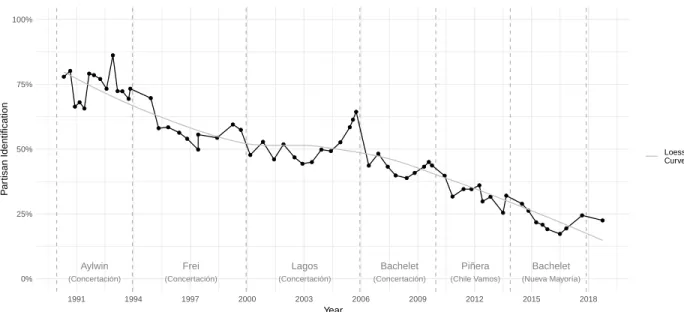
over 60%, reaching 86% in December 1992. Figure 1 shows that the subsequent downward trend in partisanship can be divided into three different periods. First, there is an initial decay from 1994 to the early 2000s, a period that corresponds to Frei’s government, then a second stage of stabilization around mid-levels of partisanship between the years 2000 and 2006 during the Lagos administration, and finally, a third stage characterized by the total collapse of the levels of partisanship between 2006 and 2018. This downward trend hit a record low level of 17% in July 2016, during Michelle Bachelet second term in office.
Figure 1: Party Identification in Chile 1990-2018
● ● ●●● ● ● ● ● ● ● ● ● ● ● ● ● ● ● ● ● ● ● ● ● ● ● ● ● ●● ●● ● ● ● ● ● ● ● ● ●● ●●● ● ● ● ●● ●● ● ● ● ● ●● ● ●● ● ● Aylwin (Concertación) Frei (Concertación) Lagos (Concertación) Bachelet (Concertación) Piñera (Chile Vamos) Bachelet (Nueva Mayoría) 0% 25% 50% 75% 100%
1991 1994 1997 2000 2003 2006 2009 2012 2015 2018
Year P ar tisan Identification Loess Curve
Source: Center of Public Studies (CEP) Survey
Thus, according to this data, over the past 24 years, the country experienced a dramatic 69 percentage point drop in the levels of partisanship across the country’s population. While before 1994, more than four of every five Chileans considered themselves close to a political party, after 2014, less than one of every five citizens considered themselves partisans.
Most of the data on partisanship available in Chile shows a trend that is consistent with the one reported by CEP. Figure 2 shows the levels of partisanship reported by five different surveys: CEP, Latin American Public Opinion Project (LAPOP), Latinobarometer, United Nations Development Program (PNUD), and the Diego Portales University National Survey6 (UDP).
Figure 2: Party Identification in Chile 1990-2018 ●● ●●● ●● ● ● ● ●● ● ● ● ● ● ● ● ● ● ● ● ● ● ● ● ● ● ● ● ● ● ● ● ● ● ● ● ● ● ●●● ●● ● ● ● ●● ●● ● ● ● ● ● ● ● ●● ● ● Aylwin (Concertación) Frei (Concertación) Lagos (Concertación) Bachelet (Concertación) Piñera (Chile Vamos) Bachelet (Nueva Mayoría) 0% 25% 50% 75% 100%
1991 1994 1997 2000 2003 2006 2009 2012 2015 2018
Year P ar tisan Identification Data ● CEP LAPOP Latinobarometer PNUD UDP
Source: Multiple Sources
While most of the different sources are quite consistent in their estimations, two estimations substantially divert from the CEP estimations. First, Latinobarometer estimations between 1995 and 2003 are consistently lower than CEP. These differences are probably due to the universe of each of these surveys in that particular period of time. While CEP surveys were nationally representative since 1994, Latinobarometer surveys were representative of only 70% of the
population until 2006, which suggests that the country’s rural population retained higher levels of partisanship during that period.
Second, LAPOP estimations are way below any other survey reported level of partisanship. The difference between LAPOP and all other estimations could be due to differences in question wording. While CEP survey asks: “Considering the following political parties presented in this card, With which of them do you identify or feel closer?”, LAPOP surveys first use a filter : “Do you currently identify with a political party?”. Section offers a detailed comparison regarding wording phrasing, level of representation of the surveys and sampling procedures with regard to the surveys presented in figure 2.
Regardless of the average levels reflected across the different surveys, overall they show a similar trend, a strong decline in partisanship in Chile from 2006 to 20187.
Analyzing the Evolution of the Decline in Partisanship
The levels of partisanship were not evenly distributed among parties initially in the early nineties and similarly, the decrease in partisanship did not occur at the same pace across political parties.
Figure 3: Party Identification in Chile 1990-2018
● ● ● ●●● ● ● ● ● ● ● ● ● ●● ● ● ● ●● ● ● ●● ● ● ● ● ● ●●● ● ●●● ● ● ● ● ● ●●●● ● ● ● ● ● ● ● ● ● ● ● ● ●● ● ● ● ● 0% 10% 20% 30% 40% 50%
1991 1994 1997 2000 2003 2006 2009 2012 2015 2018
Year P ar tisan Identification 0% 10% 20% 30% 40% 50%
1991 1994 1997 2000 2003 2006 2009 2012 2015 2018
Year P ar tisan Identification Political Party ● PDC
PS + PPD + PRSD
UDI + RN
Source: Center of Public Studies (CEP) Survey
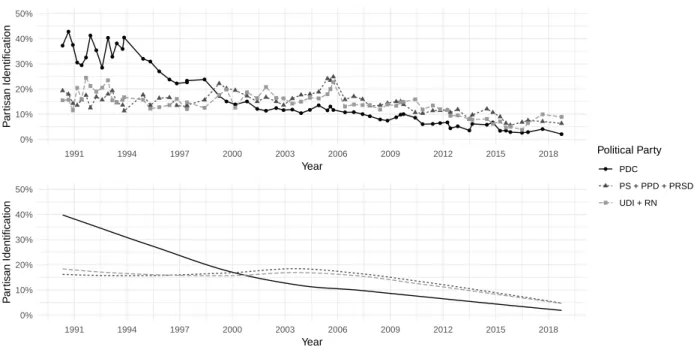
Figure 3 shows the decreasing levels of partisanship for three different types of political parties. The first one shows the trend for the centrist Christian Democratic Party, the second one for the center left political parties (Socialist Party, Party for Democracy and Social Democratic Radical Party), and the third one for the right-wing political parties (National Renewal and Union of Independent Democrats). The smoothed lines are locally weighted curves for each one of those groups, I provide them to allow a easier visualization of the trends.
approval ratings were far lower than Aylwin’s.
The levels of partisanship of both left and right-wing parties did not substantially decrease until the end of Ricardo Lagos government in 2006. In fact, both right and left-wing partisans were almost at their historical highest levels of partisanship in October of 2005. While the left-wing parties achieved their highest levels of partisanship since the restoration of democracy then (24.8%), the right-wing parties reached 22.7%, their second highest recorded scored in this period. After 2006, the levels of partisanship start declining at a similar pace on both sides of the political spectrum. At their lowest point, the levels of partisanship in the right were 3.8%, while in the left 5.6%. Finally, the Christian Democratic party peaked its record low level of partisanship in October 2018, where 2.1% of the respondents identified themselves with the party.
Research in Chile: Present explanations of the decline
As indicated before, I argue that the contemporary Chilean political system is organized around the divisions inherited from the authoritarian period (1973-1990). Democracy was re-established by the national plebiscite of 1988, which structured the country’s political parties around two coalitions determined by the acceptance or rejection of the previous military regime Valenzuela and Scully (1997); Torcal and Mainwaring (2003). The scope and reach of these divisions are at the center of the discussion regarding the nature of the party systems in Chile.
On one hand, Torcal and Mainwaring 2003 argue that the authoritarian experience deeply divided the Chilean society, leading to a persistent realignment in the party system. From this
standpoint, the military dictatorship defined essential aspects of the political system, such as political identities and political preferences that replaced the longstanding class and religion cleavages which formerly characterized the previously highly structured party system in Chile. The discontinuity between the divisions prior to the military regime and the post-authoritarian landscape can be illustrated by the shift from a three thirds system, with a distinct left, center and right political forces, to a two-part system with one center-left and a right-wing coalition. That is to say, the tripartite character of the Chilean political system, characterized by three distinct competitive political forces was replaced by a bipolar system that expressed the divisions between those who supported and those who opposed the military dictatorship. Thus, the
Ag¨uero (1999); Tironi et al. (2001).
On the other hand, other research shows skepticism regarding the extent to which this new cleavage transformed Chilean political identities. Valenzuela and Scully 1997 show a remarkable continuity in the voting patterns before and after the military dictatorship. In other words, according to the authors, the electoral outcomes prior to the authoritarian regime are a strong predictor of electoral outcomes in the years that followed the democratic restoration. These findings lead them to claim that historical traditional class and religious divisions are still shaping the Chilean political identities and preferences. From this perspective, traditional cleavages are deeply rooted into civil society, generating collective memories of past political divisions. Even though there is a consensus regarding the post-Pinochet structure of the political system, namely, that party alliances within the political system are shaped by the authoritarian Pinochet period, “it is unlikely that anew cleavage has emerged with sufficient force to reorganize the basic contours of the Chilean Political landscape” Scully (1995).
Even though there is no consensus on the extent of the change that the dictatorship period inflicted on the Chilean political landscape, there is more agreement that the
authoritarian/democratic divide should diminish over time Valenzuela and Scully (1997); Torcal and Mainwaring (2003); Luna and Mardones (2010); Luna and Altman (2011). Torcal and Mainwaring 2003 suggest three mechanisms through which this divide should fade over time: generational replacement, fading memories of the authoritarian experience as time goes by, and efforts by the right-wing parties to distance themselves from the military dictatorship.
Others agree with the general argument of a declining divide, if not the specific mechanisms. For example, Luna and Altman agree with Torcal and Mainwaring on the fact that the salience of the authoritarian/democratic cleavage should decline over time. According to their view, although the authoritarian/democratic divide is essential in order to understand the nature of the post-authoritarian Chilean political landscape, the salience of this cleavage should decline over time. Moreover, the stability of the two-coalition system has been artificially sustained by the nature of the legislative electoral rules inherited from the military dictatorship which does not provide incentives for political renewal and strongly favors the two bigger coalitions.
elected to Congress, while providing artificial safeguards to the party system status quo Luna and Mardones (2010); Luna and Altman (2011). Likewise, mandatory voting rules in combination with voluntary registration generated high levels of non-registration among the youth, which contributed to the lack of incentives for political renewal. From this perspective, the
democratic-authoritarian divide should also fade over time, both as generational replacement marches on and through changes in the electoral rules, which were enacted in the years 2005 and 2012.
In similar fashion, Valenzuela and Scully 1997 contend that, as the center left coalition was created as an attempt to defeat Pinochet in the national referendum of 1988, winning the presidency and pressing for the full restoration of the democratic institutions, the cleavage between supporters and opponents of the authoritarian regime will lose its strength as time goes by. What these arguments all share is a similar view that generational replacement over time is a likely main driver of decline in the democratic/authoritarian cleavage.
However, the most comprehensive statistical analysis conducted in Chile to date, which employs an age-period-cohort analysis of survey data from 1994 to 2014, finds that the decline in
partisanship is largely not driven by generational replacement. Instead, it appears to be driven more by period effects Bargsted and Maldonado (2018). This analysis finds that the decline in partisanship has affected all age groups simultaneously. This means that, if the
THEORY AND HYPOTHESIS
The Chilean post-authoritarian political landscape challenges two important competing
explanations of party identification in the literature. On one hand, perspectives that portray the ties between political parties and voters as instrumental would predict an increase, or at least stability, in the levels of party identification driven by the outstanding economic and political performance of the country over the 1990-2018 period. On the other, given that existing theories that emphasize political identification as a form of identity claim that partisanship should be fairly stable over time, the sharp decrease in the levels of partisanship among the Chilean population are inconsistent with that type of explanation, especially since they are not driven primarily by generational replacement.
My general claim is that the impressive decrease in party identification experienced in
post-authoritarian Chile can be largely explained by the existence of unstable identity based ties between the political parties and the mass public, a possibility that has been largely overlooked in the existing literature on partisanship in the United States?cf.¿green1994, green2002, huddy2015, kalin2018.
Much of the U.S. politics based literature on partisanship claims that levels of partisanship are stable because partisan attachments are in fact a particular form of social identity. Partisan identification forms in early adulthood, and is an enduring feature of self-conception Green et al. (2002). Given the stability of the United States political system, and the enduring divisions that had characterized this particular political landscape, this literature has neglected the fact that partisanship can be highly dependent on party agency.
I argue that political identities must be constantly reinforced by political actors in order to be stable. Political identities are driven by conflict, dissent, controversy and opposition, a fact that has been strongly underlined by cleavage theory Lipset and Rokkan (1967)8. These oppositions
8““Party” has throughout the History of Western government stood for division, conflict, opposition within a body
that organize party systems are key elements of political identities. Accordingly, a necessary condition of stable partisan identities is the presence of an on-going stable conflict, which is able to constantly fuel those identities within the political system.
The Chilean post-authoritarian political landscape is an example of how political agency can dissolve newly formed partisan identities through the disintegration of the main conflict that articulated the party system. In particular, I claim that the active efforts from the right-wing parties to distance themselves from the military dictatorship and the figure of the dictator Augusto Pinochet, ultimately undermined the key link between political parties and citizens. Since partisanship and political preferences were to a large extent driven by the divisions between supporters of democracy and those nostalgic for the authoritarian period, once the right-wing parties actively managed to distance themselves from their authoritarian identity, the main force driving partisanship ceased to exist. One of the main consequences of this effort is the steady decrease and aggregate low levels of partisanship in contemporary Chile perceived at least since the beginning of the year 2006.
The Authoritarian-Democratic Divide in the early 1990s
The national plebiscite of 1988 played an essential role in the configuration of the Chilean post-authoritarian political landscape Valenzuela and Scully (1997); Tironi and Ag¨uero (1999); Tironi et al. (2001); Torcal and Mainwaring (2003); Toro Maureira (2008); Tironi (2010). It was the actual materialization of the division of the country in two opposite poles: political
authoritarianism and market oriented economic neo-liberalism on one side, and political democracy and state-oriented economy on the other Tironi (2010). The political authoritarian and neo-liberal economic perspective was represented in the option “Si” (Yes) which granted another 8 years to the rule of General Augusto Pinochet, while the political democracy and state-oriented economy pole was represented in the option “No” (No), which favored the end of the authoritarian period Tironi and Ag¨uero (1999).
The relevance of this opposition is due to the fact that the authoritarian period constituted a dramatic collective experience for a whole generation. An important proportion of the electorate
in the early democratic years of the nineties built their political identities during that time Tironi and Ag¨uero (1999).
There is compelling evidence that supports the idea that the authoritarian/democratic divide was a powerful force driving political identities and political choices in the early post-authoritarian Chilean political landscape.
For example, Huneeus and Maldonado 2003 claim that the political legacies of the military dictatorship divided the country between supporters of democracy and those nostalgic for the authoritarian past. Both notions of democracy and autocracy were influenced by the legacy of the dictatorship and coalitions that shaped the Chilean political arena. Torcal and Mainwaring 2003 show that support of democracy and evaluations of the Pinochet regime are the strongest
predictors of both party identification and vote choice during the 90s, over and above left-right economic orientation and type of employment which organized the party system previous to the 1973 coup d’´etat. Likewise, Tironi et al., show that the democratic/authoritarian divide is a strong predictor of vote choice in the 2000 Chilean presidential election. Finally, Bargsted and Somma 2016 argue that support for authoritarian forms of government has a strong effect on ideological attitudes among Chileans, especially in the 90s.
Data from the early 1990s provided by the Center of Public Studies (CEP) support these
arguments. Figures 4 and 5 show how party identification and ideological preferences are strongly shaped by opinion towards the military regime.
Figure 4 shows that Chileans with unfavorable opinions towards the military dictatorship are far more likely to identify themselves with left-wing parties (PS-PRSD-PPD) and the Christian Democratic Party (DC). In turn, right wing partisans (UDI + RN) are mainly constituted by citizens with favorable opinions towards the Pinochet regime.
Figure 5 shows strong differences concerning ideological preferences between supporters and opponents of the military regime. People that have unfavorable opinions towards Pinochet constitute more than 80% of the left-wing partisans. On the contrary, citizens that show a positive perception of the military regime are way more likely to identify themselves with right wing preferences.
Figure 4: Party Identification by Opinion of the Pinochet Regime
0% 25% 50% 75% 100%
PS + PRSD + PPD DC UDI + RN
Political Party
P
ercentage
Opinion Pinochet
Favorable
Indifferent
Unfavorable
Source: Center of Public Studies (CEP) Survey 1990-1992
Figure 5: Ideological Preferences by Opinion of the Pinochet Regime
0% 25% 50% 75% 100%
Left Center Right
Political Preference
P
ercentage
Opinion Pinochet
Favorable
Indifferent
Unfavorable
Source: Center of Public Studies (CEP) Survey 1990-1992
contemporary political events.
Figure 6: Presidential Approval by Opinion towards Pinochet ● ● ● ● ● ● ● ● ● ● ● ● ● ● ● ● ● ● ● ● ● ● ● ● ● ● ● ● Approve Disapprove
1990−Oct 1991−Apr 1991−Oct 1992−Apr 1990−Oct 1991−Apr 1991−Oct 1992−Apr
0% 25% 50% 75% 100% Year P ercentage Opinion Pinochet ● ● Favorable Unfavorable
Source: Center of Public Studies Survey 1990-1992
Figure 7: Incumbents Economic Performance by Opinion towards Pinochet
● ● ● ● ● ● ● ● ● ● ● ● ● ● ●● ● ● ● ● ● ● ● ● ● ● ● ● Good Bad
1990−Oct 1991−Apr 1991−Oct 1992−Apr 1990−Oct 1991−Apr 1991−Oct 1992−Apr
0% 25% 50% 75% 100% Year P ercentage Opinion Pinochet ● ● Favorable Unfavorable
Source: Center of Public Studies Survey 1990-1992
to the perception of the economy and the incumbent9 In both cases, citizens with favorable opinions toward Pinochet tend to have a more critical perspective. This is especially relevant in
9
the case of presidential approval, where the difference is quite striking, of more than 20% points.
Institutionalization and Consolidation of the Divide
These strong differences between supporters of democracy and those supportive of the prior authoritarian regime were institutionalized through at least four mechanisms. First, the plebiscite shaped the two main coalitions that disputed power within the new democratic context: the Concertation coalition grouped the main figures and parties that advocated for the return of the democracy, while the Alliance coalition (latter Go Chile10) cluster the supporters of the military regime. Second, the Binominal System, which established the election of two candidates per congressional district, generated strong incentives for the formation and preservation of those two coalitions. On one side, it was designed to grant an advantage to the second largest coalition giving it the same number of representatives than the biggest one in each district11. Thus, combined with initial gerrymandering by the military government, this helped to systematically over-represent the parties of the Alliance coalition Navia and Rojas (2005); Carey (2006). On the other, giving that only two representatives are elected in each congressional district, it imposed high entry barriers for candidacies outside the two biggest coalition, effectively excluding parties to the left of the Concetation. Consequently, this electoral framework provided constitutional safeguards for the continuity of the political landscape composed of a two moderate coalition party system Luna and Mardones (2010); Luna and Altman (2011). Third, the democratic pole was also reinforced by the continuous efforts of the Concertation coalition to overhaul the
institutional framework inherited from the authoritarian period, while the authoritarian pole was reinforced by the struggles of the right-wing opposition to maintain it12. Finally, political actors, especially the ones in the winning coalition Concertation, actively reinforced the
authoritarian-democratic divide as an electoral strategy Tironi and Ag¨uero (1999).
10Chile Vamos.
11
According to the Binominal System, two representatives must be elected in every district. The two seats are distributed according to the d’Hondt method. Accordingly, if one of the coalitions get more than two thirds of the votes, it takes both seats.
12
At the end of the 1990s, everything pointed towards a continuing crystallization of the division between supporters and opponents of the military dictatorship. The two coalitions that competed in the national plebiscite of 1988 were the main actors in the political sphere. Likewise, Augusto Pinochet was suddenly arrested in England in 1998, indicted for human rights violations. The indictment and arrest bolstered the intensity and salience of the conflicts around the authoritarian period. Finally, the success of the Concertation coalition in all the major elections provided good reasons to actively pursue the continuity of the political status quo Tironi and Ag¨uero (1999).
The Decline
The first clear signs of decline in the authoritarian-democratic divide orienting the party system can be traced to the 2000 presidential election campaign between socialist candidate Ricardo Lagos and Joaqu´ın Lav´ın, a right-wing politician who was an active collaborator of the Pinochet regime. This was the first election in which a right-wing presidential candidate actually posed a threat to the ruling Concertaci´on coalition.
Since the beginning of the 2000 presidential election campaign, the right-wing coalition Alliance changed their electoral strategy, marking the beginning of the erosion of the
authoritarian-democratic cleavage. The Joaqu´ın Lav´ın 2000 campaign led that change, with a political campaign oriented to “do things”, and that highlighted the virtues of change Tironi (2010). According to Tironi et al. 2001, the 2000 presidential election revealed some key changes within the right-wing coalition. It was the first campaign by the rightist coalition that took distance from Pinochet, advocated for the resolution of pending issues regarding the infringement of human rights during the military dictatorship, and was open to reform some non-democratic features of the 1980 Pinochet-era constitution.
Figure 8 shows how successful this strategy was. Joaqu´ın Lavin almost doubled the number of votes and percentage obtained by the candidate that precede him within his coalition in 1993, Arturo Alessandri. This new platform, designed to give the right-wing electoral success,
Figure 8: Chilean Presidential Elections Electoral Results 1989-2010 (First Round)
●
●
● ●
●
0 1,000,000 2,000,000 3,000,000 4,000,000 5,000,000
1989 1991 1993 1995 1997 1999 2001 2003 2005 2007 2009
Year
T
otal V
otes
●
●
● ●
●
0% 25% 50% 75% 100%
1989 1991 1993 1995 1997 1999 2001 2003 2005 2007 2009
Year
P
ercentage
Coalition ● Alliance Concertation Other
Source: Servicio Electoral de Chile (SERVEL).
ex-president Eduardo Frei from the until that moment ruling center-left coalition Concertation. An important consequence of this first shift in power since the restoration of democracy13 was the dismantling of Concertation coalition. That year, the coalition that successfully defeated Augusto Pinochet in the national plebiscite of 1988 and ruled the country for twenty continuous years ended.
Political Legacies and Party Identification
The decrease of the salience of the post-Pinochet cleavage between supporters and opponents of the military dictatorship is a key element in understanding the impressive decrease in partisan identification over the last thirty years. This cleavage has played a key role shaping the linkages between political parties and citizens. Hence, as the conflict fades over time, the partisan links that were initially created around this divide will proportionally erode.
The national plebiscite of 1988 not only shaped the post-authoritarian political landscape,
likewise, it provided a founding moment that forged the ties between the Chilean citizenry and its political parties. It was the first time Chileans voted in eight years and the first election with minimal democratic guarantees since the 1972 election Toro Maureira (2008). The importance of this founding moment should not be understated. As such, the relation between political parties
13
and citizens not only was re-established at that moment, but also provided the primary way in which ties between political parties and the citizens were forged. With democracy restored, the oppositions inherited from the authoritarian past provided both right and left-wing parties with a narrative that linked them with the public. On the right, this was as defenders of the successes of the military dictatorship, especially the economic improvements that resulted from the economic reforms lead by the “Chicago boys”14 in the eighties Lav´ın (1987). On the left, the narrative was as advocates of democracy, human rights and an inclusive way of development, with an accent on redistribution Tironi (1988). Therefore, the linkages between political parties and citizens in the Chilean post-authoritarian context were primarily driven by the identities and oppositions that marked the transition to democracy.
The nature of these linkages is precisely what explains the abrupt decrease in party identification in the last thirty years. The active efforts of the right-wing parties to distance themselves from the authoritarian period not only boosted the right-wing parties’ electoral performance, but also actively contributed to the dissolution of the main opposition that fueled the ties between citizens and political parties.
As I argued before, political identities must be constantly reinforced by political actors in order to be stable. Political identities are driven by conflict, dissent, controversy and opposition. These oppositions that organize party systems are key elements of political identities. Accordingly, a necessary condition of stable partisan identities is stable conflicts fueling those identities within the political system.
Hypotheses
Main Hypotheses
My main claim is that the decline in the levels of partisanship is a consequence of the dissolution of the democratic/authoritarian cleavage. Originally, partisanship was fueled by the divide between supporters of democracy and those supportive of the prior authoritarian regime. Accordingly, my main expectation is that once the parties of the right abandoned their explicit support for the past authoritarian period, we should see a decline in partisanship by both
supporters of the Pinochet regime and supporters of democracy.
Hypothesis 1: The probability of being a partisan among both authoritarians and democrats should decline over time.
The dissolution of the authoritarian/democratic cleavage was mainly driven by efforts from right wing parties to distance themselves from the military dictatorship. Accordingly, I expect that the decrease on partisan identification to by higher among authoritarians than democrats.
Hypothesis 2: The rate of decrease on partisan identification should be higher within authoritarians compared to democrats and indifferent populations.
Furthermore, since partisanship was originally fueled by the division between supporters and opponents of the authoritarian regime, I expect the rate of decline in levels of partisanship to be higher within the democratic and authoritarian populations compared to the rest.
Hypothesis 3: The rate of decline in partisanship levels should be higher among democrats and authoritarians compared to the rest of the population.
Alternative Hypotheses
Based on other theoretical arguments, several alternative hypotheses can be advanced to explain the decline in partisanship in contemporary Chile. First, scholars have claimed that ideological convergence and brand dissolution can lead to a decline of partisanship Lupu (2013, 2016). Previous research in Chile, based on data from the Manifesto Project, argue that there is growing programmatic convergence between the center-left and right coalitions, which, in turn, has
contributed to decrease the levels of partisanship among the Chilean population. According to this view, the ideological convergence is due to programmatic moderation of the right-wing parties. It took place from the beginning of the 2000s, and the highest level of programmatic moderation was reached in the 2013 presidential election Madariaga and Rovira Kaltwasser (2019); Rovira Kaltwasser (2019).
Second, from an instrumental perspective on partisanship it could be claimed that despite the country’s strong macroeconomic performance, perception of this performance might have declined. Accordingly, the downturn in partisanship can be a product of a decline in voters’ perceptions of the country’s economic performance and control of corruption.
Inequality has been characterized as one of the main social problems in the country Luna and Mardones (2010). According to this perspective, the decline of partisanship can be understood as a consequence of the incapacity of the political system to solve the inequality problem, regardless of the economic growth.
These three hypotheses can be formalized in the following way:
Alternative Hypothesis 1: Voters perceive that the Chilean political parties have experienced significant ideological convergence over the post-authoritarian period, leading to a decrease in the overall levels of partisanship in the mass public.
Alternative Hypothesis 2: Voters perceive that the performance of political elites has decreased over the post-authoritarian period, leading to a decrease in the level of partisanship among the citizenry.
DATA, VARIABLE OPERATIONALIZATION AND METHODS
Data and Variable Operationalization
In order to test both my hypotheses and the alternative ones, the analysis employs the Diego Portales University National Survey15, a nationally representative survey that was conducted in Chile between the years 2005 and 201516.
In order to measure the dependent variable, Party Identification, I use the following question: “with which one of the following political parties do you identify or sympathize more?”17. The question presents an exhaustive list of political parties, which was updated as new political parties were founded and old ones were dissolved. Likewise, the question contains a residual category (i.e “other”) in case the respondent’s option is not included. For the first set of models, this question was coded as 1 if the respondent indicated a preference for any political party and 0 otherwise. For the second set, the variable was coded with four different values: 1) Concertation, which grouped all the parties that belong historically to that political coalition, 2) Alliance, which grouped all the right wing parties that formed part of that coalition 3) Other: for the residual parties, and finally, 4) None: for those citizens that claimed none preference.
I use regime preferences in order to measure the division between supporters and critics of the military dictatorship. The question asks “Which of the following statements do you agree with most?” and has three alternatives: “Democracy is preferable to any other kind of government”, “In certain situations, an authoritarian government can be preferable to a democratic one” and “To people like me, it doesn’t matter whether we have a democratic government or a
non-democratic government”. This allow us to divide the respondents into three groups:
supporters of democracy, supporters of authoritarianism and undecided. This strategy has been 15
Encuesta Nacional Universidad Diego Portales.
16I chose that survey over CEP, which covers a wider period of time, because CEP survey does not has a cross
survey consistent predictor of authoritarian and democratic attitudes.
17
Ahora, de los siguientes partidos pol´ıticos que se presentan en esta tarjeta, ¿con cu´al de ellos se identifica m´as o
used previously in Chile Tironi and Ag¨uero (1999); Tironi et al. (2001); Torcal and Mainwaring (2003); Bargsted and Somma (2016); Valenzuela et al. (2018).
I tested several model specifications for the age variable. Table 4 in the appendix shows the model fit for each one of these specifications, I used model 3 of table 1 (the full model) to compare them. I tested seven different specifications: age, age squared, year of birth, 5 years cohorts, 10 years cohorts, a voted in the plebiscite dummy18, and a voted in the plebiscite dummy plus age. There is no substantial difference between any of these specifications. Following
Bargsted and Maldonado, I decided to use 5 years cohorts for the models.
Following C´ordova I use a measure of relative wealth using household asset indicators as an income indicator. Given that income based measures suffer from both under and over reporting, and high non-response rates19, households assets present a more precise measure of well-being for a larger proportion of respondents C´ordova (2009). More details on how the measure was
constructed are provided in the appendix, section .
Likewise, the models include several other control variables such as gender, education, religion and region. Although a rural/urban dummy would have been better suited for these estimations, I use region because there is no urban/rural variable available in the dataframe.
In order to test the alternative hypotheses, I use two different sources. For alternative hypothesis 1, I use both the Latin American Parliamentary Elite Surveys (PELA) and the Diego Portales National Survey. PELA surveys consist of representative samples of democratically elected legislators of eighteen Latin American countries. The survey measures attitudes and opinions of parliamentarians and it is available in Chile since the second legislative period after the return of democracy. Accordingly, it covers a 25 years period, from 1993 to 2018, in which legislators were interviewed once for each one of the legislative periods. PELA asks their respondents to place themselves on a 10 left-right point scale. This question allows me to evaluate to what extent there is self-identified ideological convergence across the parliamentary elites in Chile.
I also estimate the extent to which there is a perceived ideological convergence of the political elites among the general population. The Diego Portales National Surveys include a set of questions where they ask the interviewees to place the political parties and two major political
18Individuals that were 18 years old the year the plebiscite took place.
19
coalitions on a 10 point left-right point scale. However, this set of questions was only asked between 2006 and 2010, which means I can estimate the extent of perceived ideological convergence among political elites only for this four-year period.
In order to test alternative hypothesis 2, I use questions about perception of the state of the economy and corruption. The Diego Portales National Surveys include the perception of the economy question from 2005 to 2015, while the perception of corruption question is included from 2006 to 2013.
Finally, to test alternative hypothesis 3, I use two sources of data. First, using data from the World Developing Indicators I evaluate the extent to which inequality has decreased since the end of the dictatorship in 1990. Second, using data from the Diego Portales National Survey, I use the evaluation of the government regarding inequality in order to test if perceptions of the way in which inequality has been handled are related to the decrease in partisanship.
Methods
The main results are based on two set of models. The first set of models are logistic regression models with party identification coded as a binary variable. The dependent variable is coded as 1 if the respondents identify themselves with a political party and 0 otherwise. The first model includes all predictors but regime preferences, the second one includes regime preferences and the third one includes an interaction between year and regime preferences. The three models include region fixed effects as one of the control variables. To illustrate the main findings of this set of models, I estimated predicted probabilities bases on the third of these models.
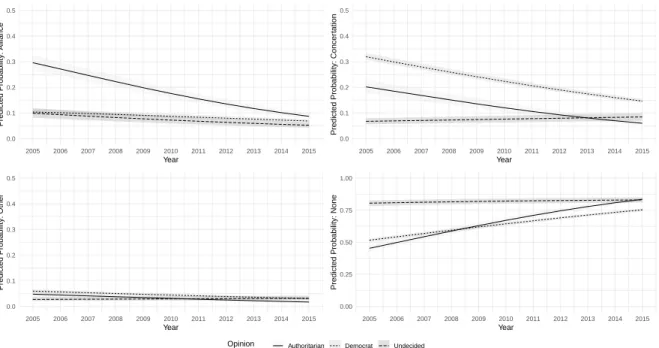
The second set of models is a single estimation of model three but in the context of multinomial logistic regression. In this case, the dependent variable is coded with four values noted above. Given that the categories of interest are mainly Concertation and Alliance, figure 10 shows the predicted probabilities only for these values on the dependent variable.
For the alternative hypothesis 1, figure 11 shows the average self-placement of Chilean
parliamentary elites in the 10-point left-right scale for each one of the main political parties and political coalitions. Figure 12 shows the average placement of the political elites by the general population sample. Accordingly, figure 11 allows me to estimate the extent to which
which the general population perceives ideological convergence among the political elites. For alternative hypothesis 2, I use data regarding perceptions of the economy and corruption in order to evaluate to what extent the decrease in partisanship can be explained by perceptions of declining economic and political performance in the country that can be blamed on the political elites.
Finally, to evaluate alternative hypothesis 3 I use data regarding objective levels of inequality and perceived levels of government performance regarding inequality. This data allows me to evaluate the extent to which the decrease in partisanship is related to the way in which income is
RESULTS
The Authoritarian-Democratic Divide
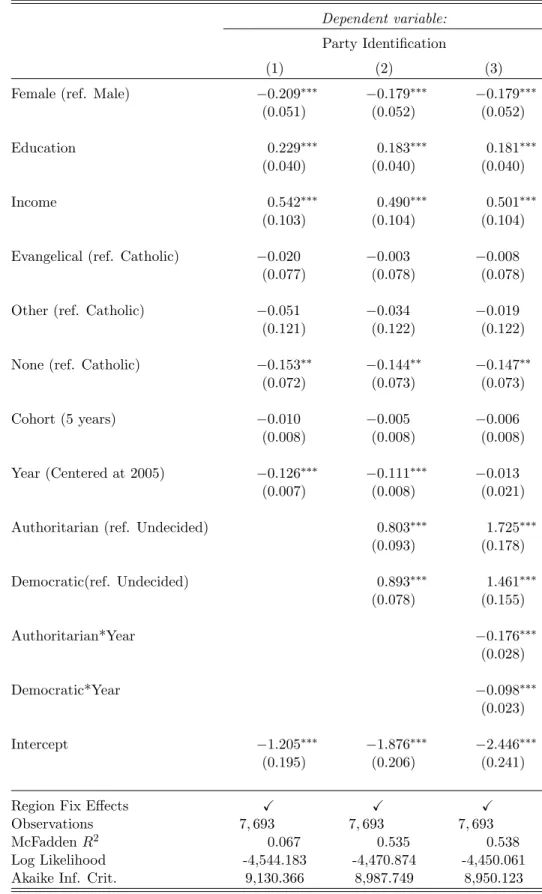
Table 1 shows the results of the logistic regression models. The first model includes all predictors but regime preferences, the second one includes regime preferences and the third one includes an interaction term between year and regime preferences20.
Model 2 shows there are statistically significant differences between authoritarians and
democratic respondents, compared to those who are undecided between the two. Compared to the undecided, the levels of party identification are higher among democrats and authoritarians. Likewise, the model fit increases substantially once regime preferences are included in the estimation. The McFadden R2 increases from .07 to .54 once regime preferences are included, making this variable by far the most important predictor of the model.
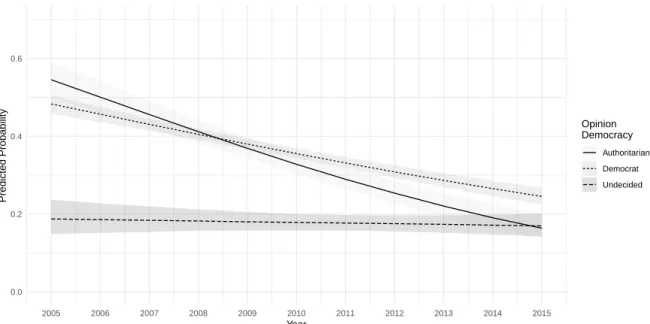
Model 3 includes an interaction term between regime preferences and year. Figure 9 shows a graphical representation of those effects. In the year 2005, the levels of partisanship of both democrats and authoritarians were very high. According to the estimations presented in figure 9, the probability of identifying with a political party for democrats was of 48%, while for
authoritarians it was 54%. Although party identification was higher among authoritarians in 2005, partisanship within this group declined at a much faster rate than for democrats. By the year 2009, compared to authoritarians, democrats presented a greater probability of identifying with a political party. However, both of these groups experience a rapid decline in their levels of partisanship. By the year 2013, the differences in levels of party identification between undecideds and authoritarians is no longer statistically significant at a 95% confidence level. Even though in 2015 the differences in partisanship between democrats and undecideds is still statistically significant, the decrease in the levels of partisanship among democrats is quite striking. By 2015,
20
the probability of identifying with a political party for democrats is only 25%, more than 20 percentage points lower than in 2005.
These findings are consistent with hypotheses 1 and 3, both that there is a decline in the
predicted probability of identifying as a partisan, and that this decrease is much sharper than for the rest of the population, which maintains constant levels of partisanship throughout the period. The sharper decrease among the authoritarian population is consistent with the fact that, during that period, the right-wing parties actively worked to distance themselves from the military dictatorship. As the right-wing parties distanced themselves from the figure of Augusto Pinochet, they weakened the link that tied them to key sectors of the public. Even though, this electoral strategy improved the electoral success of the right, finally leading to the election of Sebasti´an Pi˜nera in the 2010 election, these findings suggest that, at the same time, it weakened the ties between the right-wing parties and their core supporters.
As hypothesized earlier, the ties of the center and left-wing parties of the Concertation to their core supporters were also harmed as a result of the distancing actions of the right-wing parties. What most linked the left and center political parties with their core constituency was the opposition to the military regime. Once the right-wing parties distanced themselves from the dictatorship, the narrative of the opposition ceased to make sense to the mass public.
Accordingly, we can see that the democratic supporters follow a similar trajectory to that of the authoritarians, though at a more gradual pace. All these findings provide strong support for hypothesis 1, 2 and 3.
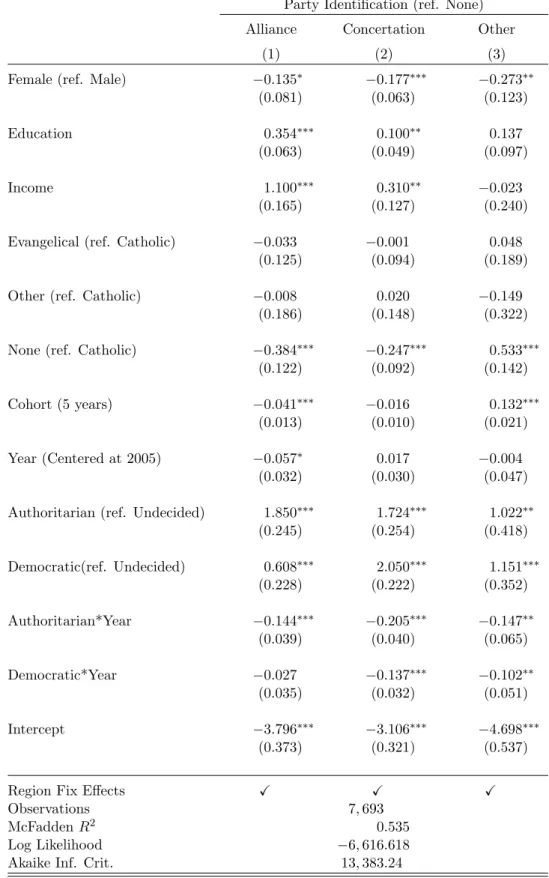
Table 2 presents the results of the multinomial regression logistic models21. The base category for the estimation of these models is identification with the Alliance coalition. Given that the results of multinomial regression models are quite difficult to interpret without a graphical representation, figure 10 summarize the main findings regarding the variables of interest. Table 2 and figure 10 provide a more detailed portrait of the decreasing levels of partisanship during the period under study. According to the expectations, initially, Concertation partisans were mainly composed by individuals who stated that democracy is the best form of government. On the contrary, in 2005
21
the core supporters of the right-wing coalitions were individuals who stated that an authoritarian government can be preferable to a democratic one. In other words, in the year 2005, right and center left-wing partisans were sorted according to their views regarding the military dictatorship. Figure 10 also shows that over time the levels of partisanship among both coalitions weakened as a consequence of the migration of their core constituents towards non-partisan preferences. Among the right-wing partisans, the levels of partisanship decrease primarily as a consequence of the migration of those supportive of the previous authoritarian regime towards non-partisan preference. A similar movement can be appreciated among center-left partisans. Supporters of democracy decrease their levels of party identification with the Concertation coalition over time. Finally, the relationship between party identification and the control variables is consistent across the three models in table 1. With respect to gender, males tend to have higher levels of party identification than females. Levels of partisanship are higher among the more educated and wealthy population. Catholics tend to have higher levels of party identification than individuals that do not identify with a religion. Likewise, people that perceive that the economy is doing better tend to have higher levels of identification than those ones who feel that it is going worse or the same.
While year has a significant negative effect on partisanship, cohort does not22. As years go by, the model predicts that the levels of partisanship should decline for the period studied. These
findings are consistent with Bargsted and Maldonado 2018 who claim that partisanship is mainly decreasing through period effect.
Alternative Explanations
Ideological Convergence
An alternative hypothesis is that the main cause for the decline in partisanship among the Chilean population is ideological convergence among the party elites Madariaga and Rovira Kaltwasser (2019); Rovira Kaltwasser (2019).
However, data from the PELA surveys of parliamentary elites shows no signs of ideological convergence among political elites between 1993 and 2014. Figure 11 show the average
22Table 4 shows the difference in the estimations of the models using different age specifications. There are no
Table 1: Logistic Regression Models
Dependent variable:
Party Identification
(1) (2) (3)
Female (ref. Male) −0.209∗∗∗ −0.179∗∗∗ −0.179∗∗∗ (0.051) (0.052) (0.052)
Education 0.229∗∗∗ 0.183∗∗∗ 0.181∗∗∗
(0.040) (0.040) (0.040)
Income 0.542∗∗∗ 0.490∗∗∗ 0.501∗∗∗
(0.103) (0.104) (0.104)
Evangelical (ref. Catholic) −0.020 −0.003 −0.008 (0.077) (0.078) (0.078)
Other (ref. Catholic) −0.051 −0.034 −0.019
(0.121) (0.122) (0.122)
None (ref. Catholic) −0.153∗∗ −0.144∗∗ −0.147∗∗ (0.072) (0.073) (0.073)
Cohort (5 years) −0.010 −0.005 −0.006
(0.008) (0.008) (0.008)
Year (Centered at 2005) −0.126∗∗∗ −0.111∗∗∗ −0.013 (0.007) (0.008) (0.021)
Authoritarian (ref. Undecided) 0.803∗∗∗ 1.725∗∗∗ (0.093) (0.178)
Democratic(ref. Undecided) 0.893∗∗∗ 1.461∗∗∗
(0.078) (0.155)
Authoritarian*Year −0.176∗∗∗
(0.028)
Democratic*Year −0.098∗∗∗
(0.023)
Intercept −1.205∗∗∗ −1.876∗∗∗ −2.446∗∗∗
(0.195) (0.206) (0.241)
Region Fix Effects X X X
Observations 7,693 7,693 7,693
McFaddenR2 0.067 0.535 0.538
Log Likelihood -4,544.183 -4,470.874 -4,450.061
Akaike Inf. Crit. 9,130.366 8,987.749 8,950.123
Table 2: Multinomial Regression Model
Party Identification (ref. None)
Alliance Concertation Other
(1) (2) (3)
Female (ref. Male) −0.135∗ −0.177∗∗∗ −0.273∗∗ (0.081) (0.063) (0.123)
Education 0.354∗∗∗ 0.100∗∗ 0.137
(0.063) (0.049) (0.097)
Income 1.100∗∗∗ 0.310∗∗ −0.023
(0.165) (0.127) (0.240)
Evangelical (ref. Catholic) −0.033 −0.001 0.048 (0.125) (0.094) (0.189)
Other (ref. Catholic) −0.008 0.020 −0.149
(0.186) (0.148) (0.322)
None (ref. Catholic) −0.384∗∗∗ −0.247∗∗∗ 0.533∗∗∗ (0.122) (0.092) (0.142)
Cohort (5 years) −0.041∗∗∗ −0.016 0.132∗∗∗
(0.013) (0.010) (0.021)
Year (Centered at 2005) −0.057∗ 0.017 −0.004 (0.032) (0.030) (0.047)
Authoritarian (ref. Undecided) 1.850∗∗∗ 1.724∗∗∗ 1.022∗∗ (0.245) (0.254) (0.418)
Democratic(ref. Undecided) 0.608∗∗∗ 2.050∗∗∗ 1.151∗∗∗ (0.228) (0.222) (0.352)
Authoritarian*Year −0.144∗∗∗ −0.205∗∗∗ −0.147∗∗ (0.039) (0.040) (0.065)
Democratic*Year −0.027 −0.137∗∗∗ −0.102∗∗
(0.035) (0.032) (0.051)
Intercept −3.796∗∗∗ −3.106∗∗∗ −4.698∗∗∗
(0.373) (0.321) (0.537)
Region Fix Effects X X X
Observations 7,693
McFaddenR2 0.535
Log Likelihood −6,616.618
Akaike Inf. Crit. 13,383.24
Figure 9: Predicted Probabilities - Logistic Regression Model - Party Identification by Opinion Democracy
0.0 0.2 0.4 0.6
2005 2006 2007 2008 2009 2010 2011 2012 2013 2014 2015
Year
Predicted Probability
Opinion Democracy
Authoritarian
Democrat
Undecided
Source: Diego Portales University National Survey 2005-2015 95% Confidence intervals estimated using Monte Carlo Simulation.
self-placement of legislators for each one of the parliamentary periods for each party and political coalition. Plot 11.a evaluates the extent to which political parties have ideologically converged over the 1993-2014 period. The average ideological placement of left-wing parliamentarians (PPD, PRSD and PS) ranges between 2 and 4 for the whole period. The center-left political party DC ranges between 4 and 5. Parliamentarians of the two right-wing political parties, UDI and RN, place themselves on average between 6 and 8 from 1993 to 2014.
The same is true at the level of political coalitions. Representatives of the Concertation coalition place themselves on average between 4 and 3.5 for the whole period analyzed. Delegates from the right-wing coalition Alliance place themselves on average between 6.5 and 7.5. There are some weak signs of ideological divergence in the last two congressional periods (2006-2014).
Although there are no signs of ideological convergence among the parliamentary elites, an alternative argument would be that it is perception of ideological convergence among the public that is driving the decline in partisanship in Chile.
Figure 10: Predicted Probabilities - Multinomial Regression Model - Party Identification by Opinion Democracy 0.0 0.1 0.2 0.3 0.4 0.5
2005 2006 2007 2008 2009 2010 2011 2012 2013 2014 2015
Year
Predicted Probability: Alliance
0.0 0.1 0.2 0.3 0.4 0.5
2005 2006 2007 2008 2009 2010 2011 2012 2013 2014 2015
Year
Predicted Probability: Concer
tation 0.0 0.1 0.2 0.3 0.4 0.5
2005 2006 2007 2008 2009 2010 2011 2012 2013 2014 2015
Year
Predicted Probability: Other
0.00 0.25 0.50 0.75 1.00
2005 2006 2007 2008 2009 2010 2011 2012 2013 2014 2015
Year
Predicted Probability: None
Opinion
Democracy Authoritarian Democrat Undecided
Source: Diego Portales University National Survey 2005-2015 95% Confidence intervals estimated using Monte Carlo Simulation.
between 9 and 7 for the whole period where data is available. The same is true for left wing political parties and center left political parties. At the levels of coalitions, there is an impressive consistency between the self-placement of representatives and the one the mass public attributes to their parties. The ideological distance between Concertation and Alliance appears larger when citizens place parties than in the case of parliamentarians placing themselves.
Therefore, figures 11 and 12 clearly show that there is no ideological convergence among political parties or coalitions in contemporary Chile. These findings suggest that the downturn in
partisanship is not being be driven by ideological convergence or perceptions of ideological convergence among citizens. Consequently, alternative hypothesis 1 is rejected.
Economic Performance and Corruption