Document Summarization using Central Sentences and Keywords
Girish Keshav Palshikar
Tata Research Development and Design Centre (TRDDC), 54B, Hadapsar Industrial Estate, Pune 411013, India.
email: [email protected]
Abstract
We propose two distinct approaches to sin-gle document sumarization. The first ap-proach is based on the notion that important sentences are somehow central in the docu-ment. We represent the document as a graph, with sentences as vertices and edges labeled with sentence dissimilarities. We then use graph-theoretical notions of vertex centrality (e.g., eccentricity, closeness etc.) to identify central vertices (sentences). In the second approach, we propose to use any of the well-known keyword identification algorithms to extract characteristic keywords from a docu-ment. We then use the number of keywords present in a sentence as a measure of the sen-tence’s importance. Finally, we propose the use of well-known Condorcet methodology to combine the summaries from several al-gorithms into a winner summary.
1 Introduction
The advent of fast and cheap computing, storage and communication technologies have given rise to an information explosion. The Web, digitial libraries, online newspapers and magazines and enterprise-wide document repositories all make an enormous amount of information easily accessible to people. Document summary is an important method which people use to deal with this information overload. Hence automatic techniques for document summa-rization are receiving increasing attention.
The summary can be of two types. An extract is a summary which is a subset of sentences from
the original documents. An abstract, on the other hand, contains generated sentences, not present in the original documents (e.g., to paraphrase, explain or simplify). Much work in document summariza-tion focuses on the extract identificasummariza-tion problem.
A document summarization task is quite involved and can be performed in several ways. In single document summarization, the focus is on creating a summary of a given isolated document. The in-formation in the summary should be (a) complete (should cover all important topics discussed in the document); (b) correctly ordered (c) coherent and consistent (e.g., must not include any ambiguities or redundancies); and (d) understandable for humans. Typically, the length of a summary (i.e., the com-pression ratio) is between 10% to 20% of the total document length.
Multi-document summarization presents chal-lenges which are quite different from those in single document summarization. First, the documents in a collection usually contain overlapping information; hence redundancy in the generated summary should be avoided. Second, the documents in a collection may contain complementary information (e.g., addi-tional details or different perspectives); hence infor-mation cohesion and consistency should be ensured in the generated summary. As a special case, if the documents describe different and partial (but over-lapping) event sequences, then the generated sum-mary should combine them into a coherent and con-sistent event sequence.
no-tion that important sentences are somehow central in the document. We represent the document as a graph, with sentences as vertices and edges labeled with sentence dissimilarities. We then use graph-theoretical notions of vertex centrality (e.g., eccen-tricity, closeness etc.) to identify central vertices (sentences). In the second approach, we propose to use any of the well-known keyword identification al-gorithms to extract characteristic keywords from a document. We use the number of keywords present in a sentence as a measure of the sentence’s impor-tance. Finally, we propose the use of well-known Condorcet methodology (originaly used to decide winner in an election) to combine the summaries from several algorithms into a winner summary.
This paper is organized as follows. Section 2 out-lines related work. Section 3 contains several sum-marization algorithms based on notions of central-ity. Section 4 contains a keyword-based appraoch to summarization. In section 5, we discoss the use of Condorcet methodology to combine multiple sum-maries into a winner summary. Section 6 discusses some evaluation of the proposed algorithms. Section 7 contains conclusions and outlines further work.
2 Related Work
Many different appraoches for text summarization have been proposed. We focus on single docu-ment sumamrization here; see (Hovy, 2005) for an overview. Several summarization systems con-sider the position of a sentence to indicate its importance. Presence of cue phrases, such as
significantly, also indicates that the sentence may be important (Teufel and Moens, 1997), piec et al, 2003), (Hovy, 1998). For example, (Ku-piec et al, 2003) treats summarization as a statistical classification task. They train a Bayesian classifier from a corpus of documents and associated sum-maries. They consider sentence position and cue phrases as important features. Presence of words which are somewhat frequent is also a characteris-tic of important sentences (Edmundson, 1968). One of our algorithms in this paper provides another pre-cise characterization of this approach. We facilitate the use of any of the well-known techniques for key-word identification - e.g., (Matsuo and Ishizuka, 2004) - and use the number of keywords present in a
sentence as a measure of the sentence’s importance. (Zha, 2002) is an interesting work that also repre-sents a document as a bipartite graph and combines keyphrase extraction and summarization using the principle of mutual reinforcement and sentence clus-tering. IR-based summarization methods are closely related to this work (Salton et al, 1994), (Mitra et al, 1997). Like us, they use IR methods, such as TFIDF, to find paragraphs related to a given para-graph. Unlike them, we structure the document as a graph, where the edge weights indicate sentence dissimilarity and then use centrality measures to find important vertices (sentences). Several summariza-tion approaches use some measure of coherence in the text. For example, in (Alam et al, 2003), an ap-proach based on lexical chains is proposed. A lexical chain is a sequence of related words that occurs in a sequence of sentences in the document. A WordNet-based mechanism is used to identify strong chains (based on relationships among the words in a chain such as synonyms, hypernyms etc.). A score is cal-culated for each sentence based on all chains passing through the sentence and highest ranked sentences are included in a summary. See also (Mani et al, 1998). Summarization has also been treated as an information extraction problem; see e.g., (White et al, 1994).
3 Centrality-based Summarization
We consider the following single document summa-rization problem: given an integerk≥1and given a text document (a finite set of sentences), identify a subset ofksentences in the document. The selected
ksentences should constitute a reasonable summary of the document.
We propose an approach for text summarization based on the notion that a summary should identify and include central sentences in the document (in some well-defined sense). We represent the given document as a sentence graph and formalize the no-tion of the centrality of a sentence in a document in terms of the eccentricity of the corresponding vertex in the sentence graph.
3.1 Sentence Graph
TFIDF approach. Basically, we treat each sentnece in the given document as a separate ”document” and compute the TFIDF distance between two sentences.
Definition 1 Let a given document D consist
of N sentences S1, S2, . . . , SN. Let R =< u1, u2, , uM >denote an arbitrarily ordered list of
all M words that occur in D. Then a sentence Sj ∈ D can be viewed as anM-component
docu-ment vectorVj =< s1j, s2j, . . . , sM j >where the
quantitysijis defined as follows:
sij =
tfij×log(nNi)
q PM
k=1(tfkj)2×(log(nNk))
2
wheretfij = the number of times thei-th term inR
appears in sentenceSj
N = total number of sentences inD
M = total number of words inD(M =|R|) nk= number of sentences that containk-th termuk
Definition 2 Given two document vectors Vi and
Vj, the cosine distance between them, denoted cosine(Vi, Vj), is defined as:
cosine(Vi, Vj) =
Vi·Vj ||Vi|| × ||Vj||
whereVi·Vj denotes the dot product of two vectors
and||Vi||is the magnitude of the vectorVi.
For a given documentD, we define an undirected edge-labeled sentence graph, where the sentences in
D are the vertices and edges are labeled with the cosine distance between the two vertices.
Definition 3 Let a given document Dconsist ofN
sentencesS1, S2, . . . , SN. We define an undirected,
edge-labeled sentence graph GD = (V, E, φ) for D where the set V of vertices contains one ver-tex for each sentence Si (|V| = N), the set E of
edges contains an edge from every sentence Si to
every other sentence Sj labeled with φ(Si, Sj) = cosine(Vi, Vj) where Vi, Vj are the document
vec-tors corresponding to sentences Si, Sj, provided cosine(Vi, Vj)>0.
Since cosine is a distance (or dissimilarity) mea-sure between two sentences, lower score indicates sentences which are more similar.
Consider the following news item published on 4th June, 2007 in The Economic Times
(http://economictimes.indiatimes.com) with the headline Oil prices lower after key US gas pipeline reopens. The sentences are numbered for later reference.
1. SINGAPORE: Oil prices fell in Asian trade as gasoline (petrol) supply concerns eased after a key US pipeline re-opened over the weekend, dealers said.
2. At 10:30 am (0230 GMT), New York’s main contract, light sweet crude for July delivery was 40 cents lower at 64.68 US dollars a barrel from 65.08 dollars in late US trades Friday.
3. Brent North Sea for July delivery dropped 34 cents to 68.73 dollars.
4. The re-opening of a pipeline carrying gasoline supplies to the US east coast by the Colonial Pipeline Company Sun-day was the main factor behind the price decline, dealers said.
5. ”The pipeline restarted on Sunday and the pipeline is a main distribution pipeline to get gasoline to the east coast,” said Victor Shum, an analyst with energy consul-tancy Purvin and Gertz in Singapore.
6. ”That is back on line and is reassuring because gasoline supply worries in the US have been driving up crude oil,” he said.
7. US gasoline demand has entered its peak demand period as the US driving season gets underway with millions of Americans due to take to the nation’s highways en route to summer holiday hot spots.
8. Gasoline supply concerns will remain a key factor influ-encing the market after the US Department of Energy showed petrol reserves rose by 1.3 million to 198 mil-lion barrels in the week to May 25, lower than market expectations for an increase of 1.5 million barrel.
9. US crude reserves fell 2.0 million barrels to 342.2 million barrels in the week ending May 25.
10. That caught many analysts, who had forecast an increase of 1.0 million barrels, off guard.
11. Below-average stock levels of gasoline have forced retail gasoline prices higher across the United States.
Fig. 1 shows the sentence graph for this news item, which contains 11 vertices (one for each sen-tence) and 37 edges (pairs of sentences with non-zero distance between them).
3.2 Sentence Centrality
1
2 0.049
4 0.196
5 0.141
6 0.121
7
0.003
8 0.149
9 0.088
11
0.048 3
0.282 0.028
0.022
0.038
0.057
0.087
10 0.023
0.343
0.034
0.003
0.060
0.046 0.005
0.002
0.036
0.067 0.007
0.059
0.024
0.067 0.012 0.032
0.040
0.020 0.006
0.328
0.162 0.006
0.166
Figure 1: Sentence graph for the news item.
Definition 4 Given an edge-labeled graph G, the
distanced(u, v)between two verticesuandvis the sum of the edge weights on a shortest path fromuto v inG. Eccentricityǫ(u)of a vertex u inGis the the maximum distance fromuto any other vertexv in Gi.e., ǫ(u) = max{d(u, v)|v ∈ G}. A vertex u is a center of the graph Gif it has the smallest eccentricity among all vertices inG.
In general, a graph may have more than one center vertex. Computing the eccentricity of a given vertex is easy. Dijkstra’s single source shortest path algo-rithm efficiently computes the shortest paths from a given vertex u to all other vertices. Then the ec-centricityǫ(u)ofuis the length of the longest path among these paths. Intuitively, one may expect low eccentricity sentences (in a sentence graph) to be more important. One approach to automatic selec-tion of summary sentences is now clear. List the sentences in increasing order of their eccentricities inGand pick the firstksentences (having the least eccentricity). This approach is formally specified in the algorithmEccSen.
algorithm EccSen
input document D, integer k≥1
output Set A containing k sentences of D
Form sentence graph G= (V, E, φ) for D
for each vertex u∈V do
Find and store eccentricity ǫ(u) of u
end for
Table 1: Centrality measure for the vertices.
u δ(u) ǫ(u) f(u) = δǫ((uu)) C(u)
1 8 0.310 25.81 0.451 2 8 0.282 28.37 0.564 3 1 0.347 2.88 3.104 4 7 0.310 22.58 0.450 5 8 0.305 26.23 0.429 6 8 0.309 25.89 0.471 7 8 0.307 26.06 0.424 8 9 0.318 28.30 0.519 9 6 0.347 17.29 0.784 10 5 0.306 16.34 0.560 11 6 0.312 19.23 0.462
Select and return top k vertices in increasing order of the values of ǫ(u)
(using vertex degree to break ties)
Table 1 shows the eccentricity ǫ(u) for the sen-tence graph in Fig. 1. Ifk = 3, then vertices 2, 5 and 10 are ranked lowest in terms of the values of
ǫ(u). The summary consists of sentences 2, 5, 10. In general, we found that the algorithmEccSen
works reasonably well in identifying central sen-tences in a document. However, in this example, while sentences 2 and 5 seem acceptable for the summary, sentence 10 is somewhat odd. We pro-pose an improvement to better capture the notion of central sentences.
There is another factor, viz., the degree of a ver-tex, that can be used to refine the eccentricity-based notion of the centrality of a sentence. A sentence having a larger degree is clearly more important (as a summary sentence) than a sentence with a smaller degree. A sentence with a large degree indicates that it is ”related to” more number of sentences and thus is potentially more important. Hence we use the pa-rameterf(u) = δǫ((uu)) to measure the centrality of a vertex u, where δ(u) is the degree of u. This pa-rameter favours vertices with lower eccentricity and higher degree. AlgorithmEccSen2is the same as algorithm EccSen except that it sorts the vertices in decreasing values off(u).
algorithm EccSen2
input document D, integer k≥1
output Set A containing k sentences of D
Form sentence graph G= (V, E, φ) for D
for each vertex u∈V do
Find and store eccetricity ǫ(u) of u
Find and store degree δ(u) of u
end for
Table 1 shows the degreeδ(u), eccentricity ǫ(u)
and the ratiof(u) = δǫ((uu)) for the sentence graph in Fig. 1. Ifk = 3, then vertices 2, 8 and 5 are ranked highest in terms of the values of thef(u) parame-ter. The corresponding summary contains sentences 2, 8, 5. Clearly, the new sentence 8 is better than sentence 10 from the earlier summary.
3.3 Using Other Centrality Measures
We used eccentricity as a measure of the central-ity of a vertex in a graph and identified those sen-tences corresponding to the vertices of largest cen-trality (i.e., least eccentricity) in the sentence graph. Betweenness and closeness are two other notions of vertex centrality, among others, dveloped in the so-cial network analysis community. Either of these could be used as a measure of vertex centrality to identify central sentences from the sentence graph representation of a given document.
Definition 5 (Freeman, 1977) Given an
edge-labeled graphG= (V, E, λ), the betweennessB(v)
of a given vertexvis defined as:
B(v) = X v∈V,v6=s6=t
nst(v) nst
wherenst(v)is the number of shortest paths froms totthat pass throughv andnstis the total number
of shortest paths fromstot.
Definition 6 (Wasserman et al, 1995) Given an
edge-labeled graph G = (V, E, λ), the closeness C(u)of a given vertexuis defined as:
C(u) = X v∈V
d(u, v)
whered(u, v)is the length of the shortest path from utov.
Closeness of a vertexu is related to eccentricity. In computing the eccentricity of a vertexu, we use the max operator over the lengths of the shortest paths fromu; in closeness, we use thesummation
operator. Thus, computing closeness for a vertex is similar to computing the eccentricity of that vertex. Obviously, vertices with lower value of closeness are more central. So the approach to extract the central sentences is the same as for eccentricity. Algorithm
CloSencomputes the closness value for each ver-tex using Floyd-Warshall all-pairs shortest path al-gorithm. Then it sorts the vertices in the ascending order of their closeness values and picks the lowest
kvertices as central sentences. It uses the vertex de-gree to break ties among vertices that have the same closeness value (vertices with larger degree are more preferable).
algorithm CloSen
input document D, integer k≥1
output Set A containing k sentences of D
Form sentence graph G= (V, E, φ) for D
Use Floyd-Warshall all pairs shortest-path algorithm to compute matrix dx where
dx[u][v] denotes the the length of the shortest path between u and v
for each vertex u∈V do
Compute and store C(u) = 1
P
v∈V dx[u][v]
end for
Select and return top k vertices in
increasing order of the values of C(u)
(using vertex degree to break ties)
The summary returned byCloSencontains sen-tences 7, 5, 4, as these have the least closeness values in the example (Table 1).
Just as for eccentricity, we refine algorithm
CloSeninto algorithmCloSen2(not shown here) that takes into account the vertex degree along with the vertex closeness. It then sorts the vertices in the decreasing value of the ratioCδ((uu))and selects the top
k vertices. From Table 1 it is clear that algorithm
CloSen2identifies the sentences 7, 5 and 1 for the example.
4 Keyword-based Text Summarization
In this section, we propose an alternative method for a single document summarization based on key-words. Given the set of characteristics keywords for a document, the idea is to select those sentences which contain maximum number of keywords.
More-Table 2: Keywords in sentences.
No. #Key Keywords words
1 5 gasoline, supply, pipeline, price, trade 2 4 main, barrel, lower, trade
3 0 –
4 6 gasoline, main, supply, pipeline, price, factor 5 4 gasoline, main, pipeline, energy
6 2 gasoline, supply 7 1 gasoline
8 6 gasoline, barrel, supply, lower, energy, factor 9 1 barrel
10 1 barrel 11 2 gasoline, price
over, the keywords are usually ordered in decreasing order of their importance (keywords that are most characteristic of the document occur first). Alterna-tively, the keywords may also be ordered in increas-ing order of their generality (most specific terms oc-cur first). Keywords facilitate classification or cate-gorization of a standalone document whereas the in-dex terms facilitate searching the documents within a collection.
Several algorithms can be used to extract a setW
ofmkeywords from a given documentD, wherem
is a user-specified positive integer. Then the follow-ing algorithm simply ranks (in descendfollow-ing order) the sentences inDin terms of the number of keywords in W that they contain and returns the first k sen-tences.
algorithm KWSummary input document D, k≥1
input set W containing m≥1 keywords output Set A containing k sentences of D
for each sentence Si∈D do
Compute number g(Si) of keywords in W that occur in Si
end for
Order the sentences in D in decreasing order of their g score
Return set A containing first k sentences
Assume that the set of m = 10 keywords for the example is W = {gasoline, main, barrel, supply, pipeline, lower, price, energy,
trade, factor}. We treat any variation of these keywords (e.g., plural, past tense etc.) as the oc-currence of the same keyword. Then the keywords occurring in each sentence are shown in Table 2.
AlgorithmKWSummaryidentifies sentences 8, 4, 1 since they contain the highest number of key-words. In case of ties,KWSummarycan choose the
Table 3: Ranked output of summarization methods.
ID Method Sentences
1 Eccentricity 2, 5, 10 2 Eccentricity + degree 2, 8, 5 3 Closeness 7, 5, 4 4 Closeness + degree 7, 5, 1
5 Keywords 8, 4, 1
sentence having most different keywords than those in the sentences chosen so far.
One expects that the algorithm KWSummary is sensitive to (a) the keyword extraction algorithm used i.e., to the set of keywordsW; and (b) the num-berk of the keywords used. While this is broadly true, experimentally, we found that the algorithm is quite robust to reasonable changes in both the setW
and the numberk. For example, for the same key-word extraction algorithm (and the same set of text documents), we found that the summary sentences chosen byKWSummarydo not vary much over val-ues ofkfrom 10 to 20.
5 Combining Sets of Sentences
We have presented 5 algorithms EccSen, EccSen2, CloSen, CloSen2,
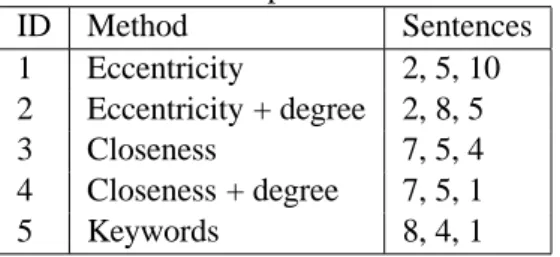
KWSummary to summarize a given document. The sentences identified by these algorithms for the example are shown in Table 3.
Note that several sentences are identified by more than one method. For example, sentence 5 is iden-tified by 4 methods and sentences 1, 2 and 8 are each identified by 2 methods. Thus they have a stronger claim to being the ”true” summary sen-tences of the given news item, over other sensen-tences like 7 which were reported by only 1 of the meth-ods. To formalize this notion, we use a well-known method by which we can systematically combine the results of these various summarization algorithms. This method, called the Condorcet algorithm, is of-ten used to decide winner in a poll or an election.
Definition 7 Let a document D contain N
sen-tences, numbered from 1 to N. Let σi =< Si1, Si2, . . . , Sik > denote the ranked output of i−th summarization method, where each sik
Table 4: Rank matrix for 5 methods and 7 sentences.
- 1 2 4 5 7 8 10 1 - 0 0 0 0 0 0 2 0 - 0 2 0 1 1 4 1 0 - 0 0 0 0 5 1 0 1 - 0 0 1 7 1 0 1 2 - 0 0 8 1 0 1 1 0 - 0 10 0 0 0 0 0 0
-that sentence occurs inσi. If sentence number j does
not occur inσithen its rank is set to some large
num-ber (say, 100). A method iprefers sentence xover sentenceyifr(σi, x)< r(σi, y)i.e.,xappears
ear-lier than y in the ranked output of method i. Let S = {σ1, σ2, . . . , σM} denote the collection of the
outputs ofM summarization algorithms.
In our example, referring to Table 3, we have
M = 5 methods and σ1 =< 2,5,10 >, σ2 =< 2,8,5 > and so on. The rank of sentence 5 in σ1
isr(σ1,5) = 2, since 5 occurs at position 2 in σ1. Method 1 prefers sentence 2 to sentence 5.
We form an N ×N matrix R, where N is the number of sentences in the given documentD(N = 11in the example). The i-th row of Rcorresponds to the i-th sentence inD. We consider each of the
M = 5 summarization methods as a voter. Entry
Ri,j inR indicates the total number of voters (out
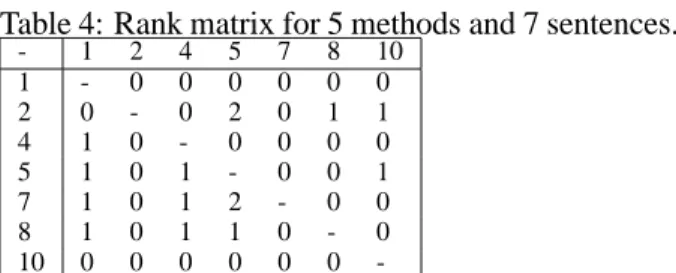
ofM) who prefer sentenceiover sentence j. The matrixRfor the example is shown in Table 4, where for brevity we include only those sentences which are identified by at least 1 method. For example,
R7,5 = 2since 2 methods (3 and 4) prefer sentence
7 over sentence 5.
Condorcet method analyzes the votes ofM sum-marization methods, as represented in the matrixR, to decide the winner among the N candidate sen-tences. For this purpose, it considersN×N imagi-nary contests, pitting every sentenceiagainst every other sentencej. Sentenceiis a winner of this con-test if the number of voters that prefer iis greater than the number of voters that prefer j. In the ex-ample, sentence 8 wins against sentence 5 because
R(8,5)> R(5,8). When all possible pairings of the sentences are considered, we pick up theksentences that have won the maximum number of contests. Ties can be broken by means of well-known vari-ations of the Condorcet method; e.g., ranked pairs or Schulze method. In the example, sentences 2, 5
and 7 constitute a winning summary according to this method.
We found that the summarization methods are sensitive to synonyms. In the example, the news item contains synonyms oil, crude and gasoline. If these words are replaced by a single word (say oil) then the summary results improve a lot.
6 Evaluation
We have experimented with the summarization tech-niques discussed here on several small text docu-ment collections. One such collection consists of 64 news items from well-known Indian news mag-azines, from 5 different categories: environment, economy, defence, health and cinema. In one ex-periment, we generated the summaries using differ-ent algorithms proposed here and measured the over-lap among the sentences identified. The algorithms show considerable overlap i.e., many sentences are common in the outputs of the algorithms on the same document. For example, we found that about 55al-gorithmsEccSen2andKYSummary, when 5 sum-mary lines were extracted for each document (num-ber of keywords used = 10). That is, on the average about 2 to 3 sentences occur in both summaries for any given document. This considerable overlap al-lows us to place more confidence in the extracted summary.
Manual evaluation of the summaries generated has also given good feedback - outputs ofEccSen2
and KWSummarywere generally ranked highest in quality by human users. We are in the process of comparing the results of our algorithms with those of other public-domain and commercial summariz-ers (e.g., Microsoft Word) on publicly-available text collections. Our initial experiments seem to show encouraging results.
7 Conclusions and Further Work
cen-tral vertices (sentences). In the second approach, we propose to use any of the well-known keyword iden-tification algorithms and then use the number of key-words present in a sentence as a measure of the sen-tence’s importance. Keywords characterise a docu-ment; each keyword indicates an important concept or topic present in the document. We also discussed the use of well-known Condorcet methodology to combine the extraction (summaries) from several al-gorithms into a winner summary.
Experimentally, we found that these methods pro-duce good summaries. For a given document, their extractions often overlap considerably, thereby al-lowing us more confidence in the extracted sum-mary. The techniques seem to work reasonably well for documents in a variety of domains.
For further work, we plan to experiment with sev-eral other, more complex, measures of centrality of a vertex in a graph, such as the random walk centrality (Noh and Rieger, 2004) and information centrality (Stephenson and Zelen, 1989). We also plan to experiment with other methods to combine the results of different summarization algorithms. One important choice is the well-known Dempster-Schafer method of evidence combination (Dempster-Schafer, 2001). We are also working on extending these ap-proaches for multi-document summarization. Since these techniqus do not use any language specific knowledge, potentially they can be used as language independent summarization techniques. Finally, we plan to modify our methods to use WordNet to take synonyms into account when generating the sum-maries.
References
H. Alam, A. Kumar, M. Nakamura, F. Rahman1, Y. Tarnikova, C. Wilcox. 2003. Structured and Unstruc-tured Document Summarization: Design of a Com-mercial Summarizer using Lexical Chains. Proc. Sev-enth Int. Conf. Document Analysis and Recognition (ICDAR 2003).
H. P. Edmundson. 1968. New Methods in Automatic Extraction. Journal of the ACM, 16(2), pp. 264-285.
L. C. Freeman. 1977. A set of Measures of Centrality based on Betweenness. Sociometry, 40:35–41.
E. H. Hovy, C. -Y. Lin. 1998. Automated Text Sum-marization in SUMMARIST. In M. Maybury and I.
Mani (eds), Advances in Automatic Text Summariza-tion, MIT Press.
E. H. Hovy. 2005. Automated Text Summarization. In R. Mitkov (ed.), The Oxford Handbook of Computa-tional Linguistics, Oxford University Press, pp. 583– 598.
J. Kupiec, J. Pedersen, F. Chen. 1995. A Trainable Doc-ument Summarizer. Proc. Eighteenth Int. ACM Conf. Research and Development in Information Retrieval (SIGIR), pp. 68–73.
I. Mani, E. Bloedorn, B. Gates. 1998. Using Cohesion and Coherence Models for Text Summarization. In Working Notes of AAAI98 Spring Symposium on In-telligent Text Summarization, pp. 69-76.
Y. Matsuo, M. Ishizuka. 2004. Keyword Extraction from a Single Document using Word Co-occurrence Statisti-cal Information. Int. Journal on Artificial Intelligence Tools, 13(1), pp. 157–169.
M. Mitra, A. Singhal, C. Buckley. 1997. Automatic Text Summarization by Paragraph Extraction. In Proc. Workshop on Intelligent Scalable Summarization at the ACL/EACL Conference, pp. 39-46.
J. D. Noh, H. Rieger. 2004. Random Walks on Complex Networks. Physical Review Letters, 92:118701.
G. Salton, J. Allen, C. Buckley, A. Singhal. 1994. Auto-matic Analysis, Theme Generation, and Summariza-tion of Machine-Readable Texts. Science, 264, pp. 1421-1426.
G. Schafer. 1976. A Mathematical Theory of Evidence. Princeton University Press, USA.
K. A. Stephenson and M. Zelen. 1989. Rethinking centrality: Methods and Examples. Social Networks, 11:1–37.
S. Teufel, M. Moens. 1997. Sentence Extraction as a Classification Task. In Proc. Workshop on Intelligent Scalable Summarization, ACL/EACL Conf., pp. 58-65.
S. Wasserman, K. Faust, D. Iacobucci. 1995. Social Net-work Analysis: Methods and Applications. Cambridge University Press, UK.
M. White, T. Korelsky, C. Cardie, V. Ng, D. Pierce, K. Wagstaff. 2001. Multidocument Summarization via Information Extraction. Proc. Int. Conf. Human Lan-guage Technology and Research (HLT01).