Dynamic ordering and frustration of confined vortex rows studied by mode-locking experiments
N. Kokubo, R. Besseling, and P. H. Kes
Kamerlingh Onnes Laboratorium, Leiden University, P.O. Box 9504, 2300 RA Leiden, The Netherlands 共Received 25 August 2003; published 19 February 2004兲
The flow properties of confined vortex matter driven through disordered mesoscopic channels are investi-gated by mode locking共ML兲experiments. The observed ML effects allow us to trace the evolution of both the structure and the number of confined rows and their match to the channel width as function of magnetic field. From a detailed analysis of the ML behavior for the case of three rows we obtain共i兲the pinning frequency fp, 共ii兲the onset frequency fc for ML (⬀ ordering velocity兲, and共iii兲the fraction LML/L of coherently moving
three-row regions in the channel. The field dependence of these quantities shows that, at matching, where LML
is maximum, the pinning strength is small and the ordering velocity is low, while at mismatch, where LMLis
small, both the pinning force and the ordering velocity are enhanced. Further, we find that fc⬀fp2, consistent with the dynamic ordering theory of Koshelev and Vinokur. The microscopic nature of the flow and the ordering phenomena will also be discussed.
DOI: 10.1103/PhysRevB.69.064504 PACS number共s兲: 74.25.Qt, 83.50.Ha, 74.78.Na
I. INTRODUCTION
Vortex arrays共VA’s兲in type-II superconductors are exem-plary systems to study nonequilibrium states of driven peri-odic media in various pinning environments. A particularly interesting phenomenon in this context is that of a dynamic transition from an elastic, coherent flow state at large veloci-ties to a plastic, incoherent flow state at small velociveloci-ties. The first theoretical description of this issue was provided by Koshelev and Vinokur 共KV兲 共Ref. 1兲 and refined in subse-quent studies2–5 which predicted various novel flow states, including a moving glass characterized by elastically coupled chains oriented along the flow direction and a moving trans-verse smectic with decoupled flow chains. Such structures and the dynamic transitions between them have been exten-sively studied in a number of numerical simulations.5–7
Experimentally, a diversity of flow states has been re-ported in direct imaging experiments on NbSe2 crystals.8 –10 However, quantitatively the effect of pinning strength and/or temperature on the ordering velocity has been studied only through dc transport experiments,11–13based on the assump-tion that an inflecassump-tion point in dc current-voltage共IV兲curve 共i.e., a peak in differential resistance兲 marks the dynamic transition. Recently, different explanations have been given as the reason for such inflection point, like macroscopic co-existence of two phases14and a change in the self-organized, large scale morphology of vortex rivers.15Thus, a more di-rect, microscopic probe is required to study systematically the velocity, magnetic field, and temperature dependence of dynamic ordering.
Recently, we reported on the use of mode-locking 共ML兲 experiments as a direct probe of ordering.16 The ML phe-nomenon occurs due to coupling between, on the one hand, collective lattice modes of frequency fint⫽qvdc/a, with q an integer and a the lattice periodicity, which occur when a VA moves coherently with velocity vdc through a pinning potential,10,17and, on the other hand, a superimposed rf-drive of frequency f at an integer fraction 1/p of fint. This coupling produces steps in the dc-transport 共IV兲 curves when vdc
⫽( p/q) f a,7,18 –21similar to ML steps in sliding charge den-sity waves共CDW’s兲 共Refs. 22,23兲and giant Shapiro steps in Josephson junction arrays.24However, on decreasing the ve-locity vdcor increasing the temperature, incoherent fluctua-tions and plastic ‘‘events’’ due to quenched and thermal dis-order reduce the width of the ML steps compared to that of an elastically moving system. Approaching the regime of fully plastic or liquid flow, the ML amplitude eventually vanishes7,16 and the ML frequency fc at which this occurs provides a direct measure of the ordering velocityvc⫽fca.
The particular system of our studies consists of mesos-copic flow channels in a disordered, strong pinning environment.21,25The geometry of the samples is sketched in Figs. 1共a兲, 1共b兲. Vortices inside the channels are confined by strongly pinned vortices in the channel edges共CE’s兲. When a force is applied along the channel, the shear interaction with these CE vortices provides the dominant pinning mechanism impeding the channel flow. Further, since the natural lattice 共row兲spacing is a0⯝1.075
冑
⌽0/B (b0⫽冑
3a0/2), on vary-ing the magnetic field B one can go through a series of struc-tural transitions from n to n⫾1 vortex rows in the channel 共typically nⱗ10). In addition to its relevance for the study of 共dynamic兲 structural transitions of vortex matter in quenched disorder, the physics of this system is also closely related to layering transitions in confined fluids, flow of col-loids in mesopores and mesoscopic friction.In Ref. 21 we have given a short account of the interesting phenomena which this system displays. First, due to the structural transitions, the dc-critical current for channel flow 共yield strength兲oscillates with field as shown in Fig. 1共e兲. At a given field, the dc IV共force-velocity兲curve with superim-posed rf current exhibits the ML effect, as shown in Fig. 1共c兲. The ML condition in this case attains a form which is particularly useful to study the structural transitions. The voltage V1,1 at which the fundamental ( p⫽q⫽1) ML step occurs is given by21
with⌽0 the flux quantum, Nchthe number of channels mea-sured simultaneously, and n the number of coherently moving
chains in each channel.
As observed in Fig. 1共d兲, on changing field, V1,1increases as a staircase, directly reflecting the evolution of n with field. A comparison with Fig. 1共e兲 shows that at mismatch fields, i.e., where a transition n→n⫾1 occurs and n and n⫾1 steps may coexist, the yield strength ⬀Ic is maximum, whereas around the center of the V1,1 plateau, where an n row con-figuration matches the channel width, it is minimum. As shown in Ref. 21, this phenomenon is caused by positional disorder共roughness兲of the vortex configuration in the CE’s: first of all, on moving away from the matching field this disorder enhances transverse fluctuations of vortex chains in the array, impeding the flow. Secondly, close to mismatch, part of the 共moving兲 n-chain regions within each channel
may switch to n⫾1. In between the n and n⫾1 regions quasistatic fault zones with misaligned dislocations develop where the vortex trajectories are jammed. We note that the presence of degrees of freedom transverse to the average
flow velocity, both in our system and vortex lattices in gen-eral, forms an important difference with CDW’s. Particularly, for CDW’s the ‘‘displacement’’共phase兲field is a scalar(x) and the velocity ⬀t(x) represents longitudinal motion only. Our system, when compared to regular vortex lattices, has the unique property that the transverse response can be tuned.
In this paper we study in detail the ML step width as a function of the rf amplitude and frequency in detail. The experiments provide important information on the dynamic coherence of the arrays and how this coherency varies with mismatch and flow velocity. We focus on ML in the regime where n⫽2→3→4, but our findings are representative for other transitions with limited nⱗ10. The paper is organized as follows. In Sec. II we first review previous theoretical results on ML at high frequency and then present simulation results of a one-dimensional 共1D兲vortex chain to show the full frequency dependence of ML in a system with only elas-tic deformations. In Sec. III we describe the details of our sample and the experimental procedure. The experimental results are presented in Sec. IV. We find clear evidence for an
ordering frequency fc below which no ML occurs. Further-more, from the ML data we extract the pinning frequency fp and the total length LML of coherently moving three row regions. These quantities systematically change with mag-netic field: at matching, where LML is large, fp and fc are both small, while at mismatch where LMLis small, both fp and fc are enhanced. We find that fc⬀fp
2, independent of magnetic field. In Sec. V we compare these results with the ordering theory of Koshelev and Vinokur, and discuss the implications for the microscopic nature of the flow and the ordering phenomena.
II. THEORETICAL CONSIDERATIONS
The velocity 共or frequency兲 dependence of the ML step width is particularly useful as a direct probe of dynamic or-dering. At present, the ML step width has been studied theo-retically only in the high frequency limit, where perturbation theory allows us to obtain an analytical description.26 –30
A. Equation of motion
The 2D displacement field uជ(r,t) of an elastic vortex lat-tice driven through a pinning environment by combined rf and dc external forces is 共at T⫽0)
␥uជt⫽FD⫹FR⫹FP 共2.1兲
with␥⫽⌽0B/f the friction coefficient withfthe flux flow resistivity. FDis a driving force per unit length consisting of dc and rf terms; 兩FD兩⫽jdc⌽0⫹jrf⌽0cos(2ft) with jdc and
jrf the dc and rf current densities, respectively. FR is the elastic restoring force given by (⌽0/B)关(c11⫺c66)ⵜ(ⵜ•uជ) ⫹c66ⵜ2uជ兴 with c11 and c66 the compression and shear moduli, respectively.1,5 In absence of the pinning force FP, the lattice is undistorted and flows uniformly: du/dt
FIG. 1. 共a兲The channel device共side view兲consisting of strong pinning NbN共dark兲and weak pinning amorphous NbGe. The cur-rent and field directions are indicated. 共b兲 Sketch of the vortex structure around a channel共top view兲. The effective channel width
w is also indicated.共c兲Typical ML step in a dc-IV curve at 70 mT and a superimposed rf current of 3 MHz.共d兲Normalized ML volt-age V1,1/( f⌽0) versus magnetic field.共e兲Critical current Ic,
⫽FD/␥⫽vdc⫹vaccos(2ft) with an ac velocity vac ⫽jrf⌽0/␥, i.e., proportional to the rf drive.
B. Amplitude of the ML-interference step
At high velocities where the friction term dominates the pinning term in Eq. 共2.1兲, one can treat the pinning as a perturbation with respect to the undisturbed rf-dc velocity 兩FD兩/␥. We distinguish two cases, namely, a periodic pinning potential and a random pinning potential. In case of a peri-odic potential with periperi-odicities equal to that of the lattice, elastic deformations are absent (FR⫽0) and the whole lattice behaves as a single particle with overdamped dynamics in a sinusoidal potential. At large drive this case is described analogous to a voltage biased, resistively shunted Josephson junction:31substituting u⫽vt in Eq.共2.1兲and assuming FP ⫽sin(ku) with the maximum slope of the potential and
k⫽2/a, one can show that as first order correction a step anomaly appears in the dc velocity-force characteristics at the ML conditionvdc⫽pa f . The current density width of the
pth step oscillates with the rf drive according to
⌬jp,1⫽2 jc兩Jp共vac/ f a兲兩 共2.2兲
with jc⫽/⌽0the critical current density and Jp the Bessel function of the first kind of order p. Note that no subhar-monic ML (q⭓2) occurs in this model.
Turning to a VL in a purely random potential, the first order perturbation correction has zero mean. The second or-der correction is the lowest oror-der of perturbation that pro-vides the ML step. Taking into account the lattice distortions due to the random pinning within the elastic limit, Schmidt and Hauger26 showed that the ML step can appear at both harmonic and subharmonic ML conditionsvdc⫽( p/q)a f and that the associated width of the current density step is
⌬jp,q⫽2 j˜c共qk兲Jp 2共
qvac/ f a兲, 共2.3兲
jc⫽
兺
qj ˜
c共qk兲, 共2.4兲
where j˜c(qk) is the component of the critical current density related to the Fourier transform of the random potential cor-relator at wave vector qk. Thus, for random pinning the ML step width exhibits a squared Bessel-function oscillation with the rf drive. The same conclusion was obtained in a pertur-bation theory of CDW’s in presence of rf and dc drive.29In the following we omit the subscripts p and q in the ML step width since we will discuss only the fundamental ML phe-nomenon for p⫽q⫽1 共where q⫽1 will be justified in Sec. IV兲. We note here that in our case a can be a frustrated lattice spacing different from the natural one in Ref. 26.
C. Frequency dependence
It is clear in Eqs. 共2.2兲and共2.3兲that the dependence on frequency and rf drive only appear in the argument z ⫽vac/ f a of the Bessel functions, irrespective of the type of pinning. Choosing z by varying the rf amplitude such that
J1(z) is maximum, the characteristic maximum value of the fundamental ML width at high frequency is
⌬jmax, P⫽1.16jc, 共2.5兲
⌬jmax,R⫽0.67j˜c共k兲 共2.6兲
for periodic and random pinning, respectively.
These perturbational results are only applicable for fre-quencies 共much兲above the so-called pinning frequency fp. For a sinusoidal pinning potential, fp is analogous to the characteristic frequency of an overdamped Josephson junc-tion and it is given by
fp⬅jc⌽0/␥a. 共2.7兲
For random pinning, the fundamental ML step involves only the k⫽2/a Fourier component of the pinning force
F ˜
p(k)⫽˜jc(k)⌽0 since it is responsible for the dynamic lat-tice mode excited at the washboard frequency ( fint ⫽vdc/a). In this case one can define the pinning frequency
fp共Ref. 32兲such that the strength of the friction term␥a f in Eq. 共2.1兲equals F˜p(k):
fp⬅˜jc共k兲⌽0/␥a. 共2.8兲
Below fp no analytical result for ⌬jmaxis available, not even for sinusoidal pinning.33In this regime numerical simu-lations are a useful tool to obtain the theoretical value of the fundamental ML width.34,35To obtain⌬jmaxvs f for the case of completely elastic motion in our channel system, we have performed molecular dynamics simulations of an rf-dc driven 1D elastic vortex chain both in a channel with peri-odically configured static vortices in the CE’s and in chan-nels with strongly disordered CE vortex arrangements 关see the inset of Fig. 2共c兲and Refs. 36,37 for more details兴. The channel width is w⫽b0, i.e., the共average兲spacing between the first pinned rows is 2b0. Vortex interactions were mod-elled by the London potential with /a0⫽1 ( is the pen-etration depth兲and the average vortex spacing a in the chan-nel was chosen equal to that in the CE’s, a⫽a0.
For the periodic case, the CE potential is sinusoidal and the critical current density jcis given by its maximum slope
jc⫽/⌽0. Simulating a chain of limited length was suffi-cient since all vortices behave as a single particle. Figure 2 shows an example of the ML step for superimposed rf drive of amplitude vac/( f a)⫽2 and frequency f⯝3 fp. In Fig. 2共c兲, we summarize the numerical results of⌬jmax,Pversus frequency, represented by the solid squares. Here,⌬jmax,Pis normalized by jcand the frequency is normalized by fp de-fined by Eq. 共2.7兲. At high frequency f⬎fp, ⌬jmax,P satu-rates at a frequency independent value ⌬js, P/ jc⯝1.13 very close to the theoretical prediction Eq. 共2.5兲for periodic pin-ning. For smaller f,⌬jmax,Pstarts to decrease around fp and then vanishes linearly with f. The whole frequency depen-dence of⌬jmax,Pis well approximated by an empirical func-tion
in which we have omitted the subscript referring to the peri-odic pinning potential. Equation 共2.9兲is represented by the solid line in Fig. 2共c兲.
For the disordered 1D channel, the CE vortices are as-signed relatively large random shifts over distances 兩d兩 with
冑具
(ⵜ•d)2典⫽
0.12 with respect to the regular lattice configuration.37,38 We used a chain of 2000 vortices for which the results have become length independent. Due to the disorder, both the numerically obtained threshold force ⬀jcR and the step width ⌬jmax,R are strongly reduced关by a factor ⬃5 共Ref. 37兲兴 with respect to the ordered case. An example of the simulated ML step is shown in Fig. 2共b兲. There are two distinct differences with the periodic case, displayed in Fig. 2共a兲:共i兲the sharp corners disappear and共ii兲 both below and above the ML condition the curve in 共b兲 is essentially linear with the same slope, with a shift at the ML condition, very similar to the experimental result in Fig. 1共c兲. After normalization ⌬jmax,R/jcR and f / f
p⫽␥a f /( jc
R⌽0), we plot the simulation results collected for various frequencies in Fig. 2共c兲 as the open squares. The saturation value ⌬jmax,R(fⰇfp)⬅⌬js,R⯝0.7jcR, very close to the result in the random pinning limit in Eq.共2.6兲. The whole frequency de-pendence is then again well approximated by Eq. 共2.9兲 关dashed line in Fig. 2共c兲兴in which we have now implicitly assumed the subscript R referring to the quantities in the random case.
It is worth mentioning that the results for the disordered channel were insensitive to small changes in the ratio a/a0.
Further, we note that both in the periodic and the disordered channel simulations ML can be observed down to f⫽0. We believe this is a direct consequence of the fact that vortices in the chain remain elastically connected, because other simu-lations in which also transverse degrees of freedom and plas-ticity are allowed, do not show this feature.39
III. EXPERIMENT
The device consists of a strong pinning layer of polycrys-talline NbN film on top of a weak pinning amorphous (a-兲 Nb1⫺xGex film (x⬇0.3). The thickness of the NbN and
a-NbGe films are 50 and 550 nm, respectively. Using
reac-tive ion etching with proper masking,40narrow straight chan-nels were etched from the top共NbN兲layer leaving a 300 nm (⫽dch) thick (a-NbGe兲 bottom layer, see Fig. 1共a兲. The width and length of each channel are 230 nm and 300 m (⫽L), respectively. The spacing between adjacent channels
is 10m. Magnetic field was applied perpendicular to the films, inducing a vortex array as schematically shown in Fig. 1共b兲. The transport current was applied perpendicularly to the channel, providing a driving force parallel to the channel. For the ML measurement, we recorded dc voltage by sweeping the dc current with superimposed rf current. The transmission lines for the rf current were terminated by matching circuits very close to the sample. To avoid heating, both the sample and the circuits were immersed in superfluid 4He. For consistency, all the data presented in this paper were taken after field cooling in which the magnetic field was applied above Tc’s of a-NbGe共2.68 K兲and NbN共11 K兲 and the sample subsequently cooled to T⫽1.9 K, which is much lower than the vortex lattice melting temperature ⬇2.5 K for the fields we studied. The ML steps in IV curves are always rounded as in Fig. 1共c兲. For definition of the cur-rent step width ⌬I, we took the derivative of the IV curve
and integrated over the ML peak in the differential conductance-voltage curve with respect to the flux-flow base line.21
IV. RESULTS
Our measurements were carried out in the magnetic field regime where three-chain structures exist in the channels, ranging from 45 to 110 mT, see Fig. 1共d兲. We thus focus on the fundamental ML step characterized by V1,1/(⌽0f Nch) ⫽3 originating from coherently moving n⫽3 regions. At the borders of our field range coexistence with n⫽2 or n⫽4 ML steps may occur.
In Fig. 3 we show an example of how the fundamental ML width ⌬I depends on the rf drive Irf for 0H⫽80 mT and f⫽12 MHz. ⌬I(Irf) shows oscillatory behavior with a maximum value ⌬Imax in the first lobe, as indicated in the figure. A qualitative comparison of the data with the theoret-ical predictions Eq. 共2.3兲 共solid line兲 and Eq. 共2.2兲 共dotted line兲 shows that the data follows more closely a J12 than a 兩J1兩 dependence. At ⌬Imax it is found that Irf⫽(1.9 ⫾0.3)Idc over a broad frequency range between fp and 40 MHz共above this frequency the experimental error in Irf be-comes larger兲. This value is in good agreement with Eq.共2.3兲
FIG. 2. 共a兲Normalized force-velocity curves for simulations of a vortex chain with an rf drive of frequency f⫽3 fpand amplitude vac/( f a)⫽2 in a periodic 1D channel; 共b兲same as共a兲in a
which has a maximum at z⫽vac/ f a⫽vac/vdc⬇Irf/Idc⫽1.8. It is important to note that while the values of the rf current might appear rather large, the actual vortex displacements due to the rf drive at or below the first maximum in J12(z), are less than 1.8/(2)⯝0.3 of the lattice spacing.
The J12(z) behavior shows that the pinning potential due to the vortices in the CE acts as a random potential 共RP兲.41 The origin of the RP is the strong positional disorder of the vortex lattice in the NbN edge material. This disorder has recently been observed in scanning tunnelling microscopy experiments on NbN films.42We further note that we did not observe subharmonic ML steps, i.e., there were no ML steps at VML⫽3 f⌽0Nch/q with q⭓2. In the context of our RP this seems in contradiction to the results of others.18 But those experiments have been carried out at relatively low fields where the RP has short range correlations on a scale
Ⰶa. Fourier components qk with q⭓2 are needed to de-scribe such short range fluctuations and therefore subhar-monic ML steps are seen. In our case, the RP is due to the CE vortices which have average spacing a0⯝a.
Conse-quently the most important Fourier component describing this RP is the q⫽1 mode, which explains why we do not see subharmonic ML steps.
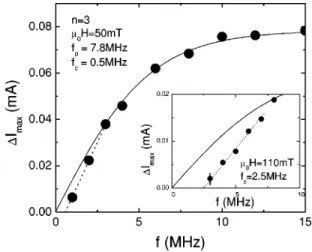
Next we turn to the frequency dependence of⌬Imax. Fig-ure 4 shows⌬Imax(f) at 50 mT obtained from measurements similar to those in Fig. 3 at various frequencies. As in the numerical results in Fig. 2共c兲, ⌬Imax saturates at a value ⌬Is⯝78A at high frequencies, while at low frequencies it decreases monotonically with f. A large part of the data is well approximated by the empirical function discussed in the previous section, ⌬Imax⫽⌬Istanh( f /0.7 fp), and we can ex-tract the pinning frequency fp⫽7.8 MHz as the remaining fit parameter. However, at low frequency共i.e., small dc veloc-ity兲the data lie significantly below the empirical curve. This implies that the vortex motion becomes less coherent due to the disordered CE’s. On reducing f, ⌬Imax vanishes almost linearly at a finite frequency fc determined by the intersec-tion between the dotted line and the ⌬Imax⫽0 axis. In this regime, the rf current for which ⌬I exhibits its maximum
value, starts to saturate at a value ⬃Ic.43 The collapse of
⌬Imax at finite frequency fc is even more clearly visible in the data taken at 110 mT shown in the inset to Fig. 4. Below
fc no ML step appears at any rf drive, indicating the com-plete absence of coherent three-row motion.
The above fitting analysis was performed on⌬Imax(f) data taken at various fields in the n⫽3 field regime and we ex-tracted fp,⌬Is and the dynamic ordering frequency fc. We first discuss the results of fp and⌬Is as a function of mag-netic field, shown in Fig. 5共b兲. As observed, fp has a mini-mum at 70 mT, somewhat below the middle of the plateau in
V1,1in Fig. 5共a兲, and it increases on approaching either end of the plateau. Hence, the associated pinning current density in the coherent three-chain regions j˜c(k) is small at 70 mT and increases away from 70 mT. In fact, the value of j˜c(k) as determined from fp using Eq.共2.8兲agrees within 30% with
jcas determined directly from dc-IV curves, Fig. 1共e兲. Mean-while,⌬Isexhibits a field dependence which differs consid-erably from that of fp: it has a broad peak around B ⫽50 mT and then decreases with increasing field. Clearly, this behavior cannot be explained by simply assuming ⌬Is(B)⬀jc(B)⬀fp(B).
At this point we note that theory assumes all vortices in the channel are moving coherently. However, in our experi-ment only a fraction of the vortices move coherently. Spe-cifically, an n-row region may locally break up due to the strong edge disorder or it may coexist with n⫾1-row regions 共with different ML voltages兲 due to mismatch.21 We define the total length of mode-locked regions with three coherently moving rows as LML and the mode-locked fraction as
LML/L. Since only the coherent n-row regions contribute to ⌬Is, we can link the value of ⌬Is to that of ⌬js by using ⌬Is⫽LMLdch⌬js. In this expression ⌬js can be obtained from the measured pinning frequency via Eqs. 共2.8兲 and 共2.6兲. Using ␥⫽⌽0B/f the result for LMLis given by FIG. 3. Current width ⌬I of the fundamental ML step vs rf
current Irftaken at 12 MHz and 80 mT. The maximum value⌬Imax is indicated. Solid and dotted curves display ⌬I⬀J1
2
(z) and ⌬I
⬀兩J1(z)兩, with z⬀Irf, respectively.
FIG. 4. The maximum current width ⌬Imax as a function of frequency f at 50 mT. The solid curve shows the fit according to the empirical function Eq.共2.9兲. The dotted line shows the linear ex-trapolation to⌬Imax⫽0 for definition of the dynamic ordering fre-quency fc. The inset shows the onset behavior of⌬Imaxand order-ing frequency fcfor a field of 110 mT. The solid curve shows a fit
LML⫽ ⌬Is
fpa
f 0.67Bdch
. 共4.1兲
The different field dependencies of ⌬Is and fp mentioned above should thus be attributed to an additional field depen-dence of LML.
We now evaluate LML using f for amorphous NbGe films44 – 46 and first assume an equilibrium lattice spacing a ⫽a0(⯝1.075
冑
⌽0/B) with B⫽0H. Figure 5共c兲shows LML normalized by the channel length L vs field 共square sym-bols兲. As observed, the coherently moving fraction is maxi-mum at B⯝70 mT. This provides a clear definition of the matching field BMfor n⫽3. At BM, the longitudinal spacinga in the channel should obey a⬅aM⫽a0 and the row spac-ing bM⫽⌽0/BMaM is commensurate with the effective channel width, i.e., 3bM⫽w. However, away from the matching field the array will be frustrated共stretched or com-pressed兲due to the confinement. In particular, for B⬍BMthe lattice spacing a⬎a0, while for B⬎BM, a⬍a0. The maxi-mum possible difference between a and a0 would be
achieved when the row spacing b would not change with mismatch, i.e., b(B)⫽bM.
47
This would imply a
⫽(BM/B)aM. Inserting this relation for a in Eq.共4.1兲, the result for LML, shown by the open circles, is slightly modi-fied but shows essentially the same behavior as our first analysis: upon increasing the frustration, which we define as 兩1⫺(B/BM)兩, the spatial extent of regions with three coher-ently moving rows shrinks progressively. An additional analysis of the n⫽2 ML steps which occur at lower fields (B⯝50 mT, where the transition n⫽3→2 takes place兲, shows consistently that the spatial extent of the 2 row ML regions increases upon further decreasing field.
Finally we discuss the behavior of the ordering frequency
fc. As shown in Fig. 5共b兲, fc(B), denoted by (䊉), exhibits a minimum at the matching field and systematically in-creases with mismatch. Similarly to the decay of LMLwith increasing frustration, this shows that a larger mismatch pro-gressively induces more disorder. We also find that, when the field is reduced below B⯝50 mT, where a two-row configu-ration first appears, the ordering frequency fcn⫽2 for the emergence of the n⫽2 ML effect decreases.
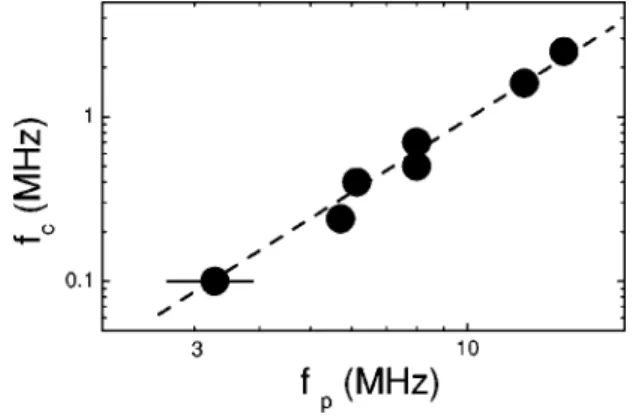
Qualitatively, the behavior of fc is similar to that of the pinning frequency fp 共or Ic). Both are important quantities characterizing the random pinning of a system and are not independent, as follows from a double logarithmic plot of fc as a function of fp, shown in Fig. 6. The data are well described by the relation fc⫽fp
2
with⯝1⫻10⫺8 s, repre-sented by the dashed line. A more detailed fit of the data using a power law relation fc⬀fp␣ yields an exponent ␣ ⫽2.1⫾0.1.
V. ANALYSIS AND DISCUSSION OF DYNAMIC ORDERING AND DEPINNING THRESHOLD BEHAVIOR
A. Comparison with the KV theory
For a proper discussion of the above results, we first shortly describe the phenomenological ordering theory of Koshelev and Vinokur 共KV兲.1 In their study of a 2D vortex system with strong random bulk pinning, they found that the shaking action due to motion through the pinning potential can be represented by a ‘‘shaking temperature’’ Tsh which FIG. 5. 共a兲V1,1/ f⌽0versus field.共b兲The pinning frequency fp
(䊏), the dynamic ordering frequency fc (䊉), and the saturation
value of the maximum current width⌬Is(䊐) for n⫽3 as a
func-tion of field. The data are obtained from fits to the measured ⌬Imax(f).共c兲 The coherently moving fraction LML/L of n⫽3 re-gions vs field, where LML is determined from Eq. 共4.1兲, with a ⫽a0(B) (䊐) and a⫽aMBM/B (䊊), where the subscript M refers
to the matching field, see text. All lines are guides to the eye.
FIG. 6. Dynamic ordering frequency fc versus pinning
fre-quency fp. Dotted line: fc⫽fp
2
decreases with velocity as Tsh⬀1/v. The dynamic ordering transition occurs when the effective temperature T⫹Tsh is reduced below the equilibrium melting temperature Tm, i.e., when the velocity exceedsvc⬀1/(Tm⫺T). In later work4,48it was shown that the shaking temperature refers to 共bond兲 fluctuations transverse to the velocity and that the associated ordering at vc corresponds to so called transverse freezing, where interchain excursions共permeation modes兲are strongly suppressed. Within the KV theory we can express the order-ing frequency fc⫽vc/a as
fc⫽冑3/2 ␥uf ⌽02
a2dchkB共Tm⫺T兲
, 共5.1兲
with␥u the mean squared 2D pinning energy multiplied by the area of a pin, f the flux flow resistivity, a the lattice spacing and dchthe film thickness.
In our channel system the ordering can also be described as transverse freezing. We observed this in simulations共e.g. for w/b0⯝3) as a suppression of the interchain excursions in parts of the channel at sufficient velocity.39However, differ-ent from the 2D system considered by KV, these interchain excursions and the associated shaking temperature now arise from the random interaction with the disordered vortices in the CE’s and a modification of Eq.共5.1兲is required. Think-ing in terms of bond fluctuations or a Lindemann criterion, as in Ref. 4, it is clear that it is the short wavelength ⬃a0 disorder component in the potential due to quenched vortex displacements d in the CE which is relevant for the ‘‘shaking temperature.’’ This component acts only in a range ⬃a0/2 from the first pinned row,39 therefore shaking of the outer rows should govern the transverse freezing. A rough estimate within London theory yields an r.m.s. amplitude of the ran-dom stress near the edge⬃cec66with c66the shear modulus and ce⯝(
冑具
兩d兩2典
/a0)/(
冑
3) representing the random strain.16,39Taking the longitudinal range of a pin also to bea0/2, we replace the parameter ␥u in Eq. 共5.1兲 by ␥ce, re-sulting in
␥ce⯝共cec66a0b0dch兲2
冉
a0 2
冊
2
. 共5.2兲
Further it is important to realize the following: the energy scale kBTmin Eq.共5.1兲should be regarded as the energy for creation of the dislocation pairs that are required for plastic motion, i.e., kBTm→kBTp⯝c66a0
2
dch/(2), with c66 evalu-ated at the field and temperature of the measurement.49 For our temperature and fields, this energy kBTpis two orders of magnitude larger than the thermal energy kBT which we can therefore neglect in Eq. 共5.1兲. Hence, the random shaking (⬀1/v) in our case essentially represents ‘‘cold working’’ of the moving structure. We also anticipate that the energy kBTp should depend on the matching condition since a reduction of this energy eventually drives the transition to n⫽2 or n ⫽4 rows. Therefore we add a mismatch dependent factor
Ap: kBTp⫽Apc66a0 2
dch/(2), where Ap is assumed to be 1 at matching. Taking into account these changes, Eq. 共5.1兲 becomes
fc⯝
冑
ce2
c66f
2Ap⌽0B
. 共5.3兲
Using the experimental parameters with c66 ⫽⌽0B/(1602) and (1.9 K)⯝1.1m, we obtain the value of ce from the value of fc at matching: ce⯝0.025, i.e.,
冑具
兩d兩2典
/a0⯝0.13. This is in very reasonable agreement with our estimate (冑具
兩d兩2典
/a0⯝0.10) near the melting tem-perature in Ref. 16. From Eq. 共5.3兲 and the fc data in Fig. 5共b兲 we can also extract the field dependence of Ap charac-terizing the reduction of the defect creation energy. The re-sult is plotted in Fig. 7, showing that close to mismatch Ap has decreased by an order of magnitude.Next, we turn to the relation between fc and fp. The dc-critical current density can be described phenomenologi-cally by25
jc⫽2Ac66/共Bw兲, 共5.4兲
where in our case A varies from A⯝0.015 at matching to
A⯝0.04⫺0.05 at mismatch, see the open squares in Fig. 7. Further, when we combine Eqs. 共5.3兲, 共5.4兲 with Eq. 共2.8兲 and use ␥⫽⌽0B/f, we obtain the quadratic relation fc ⫽vc/a⫽fp
2 observed experimentally in Fig. 6 with the time scale given by
⯝0.5共ce/A兲2 共wB兲2 Apc66f
. 共5.5兲
We note that the relation fc⬀fp2 is in fact a general result from the KV theory in the strong pinning limit. Considering Eq. 共5.5兲, sincef,c66⬀B and experimentally we found that
⯝10⫺8 s, independent of field, this implies that A ⬀
冑
1/(Ap). Using this relation with the field dependent FIG. 7. (䊉) The parameter Apas determined from fc in Fig.5共b兲and Eq.共5.3兲usingce⫽0.025. (䊐) The parameter A
value of Ap, we obtain A as shown by the open circles in Fig. 7. The minima in both data are slightly shifted and de-viations are seen for B⬎BM, but given the approximations made, the overall agreement is still reasonable. An important physical implication of the relation A⬀
冑
1/(Ap) is that the increase in pinning strength away from matching is directly related to the reduction of the defect creation energy. In other words, the rise in A reflects an effective softening of the array in the channel upon increasing mismatch. Through this soft-ening it is able to better adjust to the random CE pinning potential, very much analogous to the mechanism respon-sible for the peak effect in ordinary superconductors.50In our case a more detailed picture of the softening mechanism is possible. We already mentioned that for B⬎BM, the chains are longitudinally compressed (a⬍a0). This will facilitate deviations in the transverse direction and reduce the energy to 共dynamically兲 create interstitials between rows. For B ⬍BM, the chains are stretched, i.e., a⬎a0. In this case the energy for a chain to accept vortices from a neighboring chain is lowered. This in turn facilitates a configurational change in which the array can better adopt to the CE poten-tial. An additional mechanism for the rise in A for B⬍Bm is that, due to the mismatch, the outer chains will be pushed towards the CE, leading to an enhanced influence of the CE potential.To conclude this section, we shortly discuss the possible influence of ‘‘extrinsic’’ defects in our samples which may be a source of incoherency and limit fc. Such ‘‘extrinsic’’ de-fects could consist of a NbN bridge over the channel or a physical edge roughness on a scale ⭓b0. First, when such defects are important to the behavior, this would rapidly de-stroy the critical current oscillations of the channels, the am-plitude of which quantitatively agreed with that of samples with channels of different width. Secondly, extrinsic defects cannot explain the variation of fcwith magnetic field nor its quadratic dependence on fp 共or jc). The quantitative agree-ment of our data with the modified KV theory decisively shows that the microscopic roughness of the pinned CE ar-rays forms the dominant共intrinsic兲disorder in our system.
B. dc versus dc¿rf driven state
So far we have tacitly assumed that the flow behavior obtained from our rf-dc measurements simply reflects that of the dc-driven structure. We now discuss to what extent the additional rf current itself influences the behavior. Recent measurements of the rf impedance,51 which is a sensitive probe of ML at small rf currents, have shown that on ap-proaching the dc-driven state, i.e., when Irf→0, the voltage broadening ␦V1,1 of the fundamental ML step diverges. Since ␦V1,1⬀␦fint, this broadening reflects fluctuations in the washboard frequency and, via f⫽v/a, fluctuations in the velocity and in the longitudinal lattice spacing a.52 Corre-spondingly, the divergence of ␦V1,1 implies that the dc-driven state lacks temporal coherence. We also did not ob-serve any narrow band noise in the voltage spectrum of the
dc-driven state共even for only 30 channels at large dc drive兲. At the same time, V1,1⬀n remains constant for Irf→0, from which we conclude that the dc state still exhibits local re-gions organized in three moving chains. Thus, at sufficient velocity the dc state would correspond to temporally inco-herent, confined smectic regions3of finite共mismatch depen-dent兲 length, with liquidlike intrachain order and residual interchain excursions.
In presence of rf current the fluctuations are strongly re-duced, as also observed in experiments on CDW’s.53 In simulations we observed that the suppression of the inter-chain excursions plays an important role in this process, causing transversely frozen regions in the channel. However, the rf-dc IV curves always show incomplete ML with the same broadening ␦V1,1as discussed above. This broadening is too large to be explained by the elastic theory in Ref. 26. Therefore, it is either caused by residual slip in the n-row regions or by remaining plastic regions with interconnecting rows, but further experimental and numerical work is re-quired to decide on this issue.
Finally, we shortly return to the frequency dependence of the ML current width⌬Imaxin Fig. 4. Extending the relation ⌬Imax(f)⬀⌬jmax(f)LML( f ) to frequencies below fp and taking the ideal tanh(f) behavior Eq. 共2.9兲for ⌬jmax, we find that the ordering frequency fc would mark the velocity where
LML→0. Such interpretation implies that the dynamic order-ing in our disordered system is a smooth, second order dy-namic phase transition.
VI. SUMMARY
Using mode-locking experiments, we have investigated the dynamics of vortex arrays confined in disordered meso-scopic channels. The ML effect allows us to trace in detail structural transitions from n⫺1→n→n⫹1 confined moving vortex chains on changing field. A study of the amplitude and frequency dependence of the ML steps and comparison to simulations of an elastic chain provide a complete character-ization of the pinning strength, dynamic ordering velocity and coherency of the arrays. We find that the spatial extent
LMLof coherently moving n row regions is large at a match-ing field and shrinks with increasmatch-ing mismatch. At the same time both the pinning frequency fp⬀jcand the ordering fre-quency fc 共proportional to the ordering velocity兲 increase with mismatch. We show that fc⬀fp
2. Together with our pre-vious observation of a divergence of fc near the melting temperature in Ref. 16, these results provide detailed experi-mental evidence for the phenomenological ordering theory of Koshelev and Vinokur.1
ACKNOWLEDGMENTS
1A.E. Koshelev and V.M. Vinokur, Phys. Rev. Lett. 73, 3580 共1994兲.
2T. Giamarchi and P. Le Doussal, Phys. Rev. Lett. 76, 3408共1996兲;
P. Le Doussal and T. Giamarchi, Phys. Rev. B 57, 11 356
共1998兲.
3L. Balents, M.C. Marchetti, and L. Radzihovsky, Phys. Rev. B 57,
7705共1998兲; L. Balents and M.P.A. Fisher, Phys. Rev. Lett. 75, 4270共1995兲.
4S. Scheidl and V.M. Vinokur, Phys. Rev. B 57, 13 800共1998兲;
Phys. Rev. E 57, 2574共1998兲.
5
M.C. Faleski, M.C. Marchetti, and A.A. Middleton, Phys. Rev. B 54, 12 427共1996兲.
6K. Moon, R.T. Scalettar, and G.T. Zimanyi, Phys. Rev. Lett. 77,
2778共1996兲; S. Spencer and H.J. Jensen, Phys. Rev. B 55, 8473
共1997兲; A.B. Kolton, D. Dominguez, and N. Gro”nbech-Jensen, Phys. Rev. Lett. 83, 3061共1999兲.
7A.B. Kolton, D. Dominguez, and N. Gro”nbech-Jensen, Phys. Rev.
Lett. 86, 4112共2001兲.
8M. Marchevsky, J. Aarts, P.H. Kes, and M.V. Indenbom, Phys.
Rev. Lett. 78, 531共1997兲.
9F. Pardo, F. de la Cruz, P.L. Gammel, E. Bucher, and D.J. Bishop,
Nature共London兲396, 348共1998兲.
10A.M. Troyanovski, J. Aarts, and P.H. Kes, Nature共London兲399,
665共1999兲.
11S. Bhattacharya and M.J. Higgins, Phys. Rev. Lett. 70, 2617 共1993兲.
12M.C. Hellerqvist, D. Ephron, W.R. White, M.R. Beasley, and A.
Kapitulnik, Phys. Rev. Lett. 76, 4022共1996兲; M.C. Hellerqvist and A. Kapitulnik, Phys. Rev. B 56, 5521共1997兲.
13
J.M.E. Geers, C. Attanasio, M.B.S. Hesselberth, J. Aarts, and P.H. Kes, Phys. Rev. B 63, 094511共2001兲.
14Y. Paltiel, Y. Myasoedov, E. Zeldov, G. Jung, M.L. Rappaport,
D.E. Feldman, M.J. Higgins, and S. Bhattacharya, Phys. Rev. B 66, 060503共2002兲.
15K.E. Bassler, M. Paczuski, and E. Altshuler, Phys. Rev. B 64,
224517共2001兲.
16R. Besseling, N. Kokubo, and P.H. Kes, Phys. Rev. Lett. 91,
177002共2003兲.
17Y. Togawa, R. Abiru, K. Iwaya, H. Kitano, and A. Maeda, Phys.
Rev. Lett. 85, 3716共2000兲.
18A.T. Fiory, Phys. Rev. Lett. 27, 501共1971兲; Phys. Rev. B 7, 1881 共1973兲; 8, 5039共1973兲; J.M. Harris, N.P. Ong, R. Gagnon, and L. Taillefer, Phys. Rev. Lett. 74, 3684 共1995兲; Y. Togawa, H. Kitano, and A. Maeda, Physica C 378, 448共2002兲.
19P. Martinoli, O. Daldini, C. Leemann, and E. Stocker, Solid State
Commun. 17, 205共1975兲.
20L. Van Look, E. Rosseel, M.J. Van Bael, K. Temst, V.V.
Mosh-chalkov, and Y. Bruynseraede, Phys. Rev. B 60, R6998共1999兲.
21
N. Kokubo, R. Besseling, V.M. Vinokur, and P.H. Kes, Phys. Rev. Lett. 88, 247004共2002兲.
22G. Gru¨ner, Rev. Mod. Phys. 60, 1129共1988兲.
23R.E. Thorne, W.G. Lyons, J.W. Lyding, J.R. Tucker, and J.
Bardeen, Phys. Rev. B 35, 6360共1987兲.
24Ch. Leeman, Ph. Lerch, and P. Martinoli, Physica B 126, 475 共1984兲; S.P. Benz, M.S. Rzchowski, M. Tinkham, and C.J. Lobb, Phys. Rev. Lett. 64, 693 共1990兲; K. Ravindran, L.B. Gomez, R.R. Li, S.T. Herbert, P. Lukens, Y. Jun, S. Elhamri, R.S. Newrock, and D.B. Mast, Phys. Rev. B 53, 5141共1996兲.
25A. Pruymboom, P.H. Kes, E. van der Drift, and S. Radelaar, Phys.
Rev. Lett. 60, 1430共1988兲; M.H. Theunissen, E. Van der Drift, and P.H. Kes, ibid. 77, 159共1996兲.
26A. Schmid and W. Hauger, J. Low Temp. Phys. 11, 667共1973兲. 27A.I. Larkin and Yu.N. Ovchinikov, Sov. Phys. JETP 38, 854
共1974兲.
28P. Martinoli, Phys. Rev. B 17, 1175共1978兲.
29H. Matsukawa, J. Phys. Soc. Jpn. 56, 1507 共1987兲; 56, 1522 共1987兲.
30J. McCarten, D.A. DiCarlo, and R.E. Thorne, Phys. Rev. B 49,
10 113共1994兲.
31
M. Tinkham, Introduction to Superconductivity 共McGraw-Hill, New York, 1996兲.
32For convenience we use the same symbol f
pboth for the periodic
and the random pinning cases. In the following it will be clear from the context which one we use.
33For sinusoidal pinning,⌬j( fⰆf
p) can be obtained analytically
for small rf amplitude jrfⰆjc, see M.J. Renne and D. Polder,
Rev. Phys. Appl. 9, 25 共1974兲. However, both our simulations and those in Ref. 34 show that the maximum value ⌬jmax(f Ⰶfp) is achieved for jrf⯝jc, for which the analytical approach
fails.
34P. Russer, J. Appl. Phys. 43, 2008共1972兲.
35M. Octavio, J.U. Free, S.P. Benz, R.S. Newrock, D.B. Mast, and
C.J. Lobb, Phys. Rev. B 44, 4601共1991兲.
36R. Besseling, R. Niggebrugge, and P.H. Kes, Phys. Rev. Lett. 82,
3144共1999兲.
37R. Besseling, T. Dro¨se, V.M. Vinokur, and P.H. Kes, Europhys.
Lett. 62, 419共2003兲.
38R. Besseling, Ph. D. thesis, Leiden University, 2001. 39
R. Besseling et al.共unpublished兲.
40E. van der Drift, S. Radelaar, A. Pruymboom, and P.H. Kes, J.
Vac. Sci. Technol. B 6, 297共1988兲.
41In recent measurements on ‘‘bulk’’ NbGe films where pinning
originates from intrinsic disorder in the film, ⌬I(Irf) exhibited
an even closer correspondence to the relation ⌬I(Irf)⬀J1 2
(z) at high frequency, see R. Besseling, O. Benningshof, N. Kokubo, and P.H. Kes, cond-mat/0304046共unpublished兲.
42G.J.C. van Baarle, A.M. Troianovski, T. Nishizaki, P.H. Kes, and
J. Aarts, Appl. Phys. Lett. 82, 1081共2003兲.
43In the 1D simulations共both for ordered and disordered channels兲
a similar saturation of the ‘‘optimum’’ rf current was observed for the ML steps with f↓0, see also Refs. 33,34.
44P. Berghuis and P.H. Kes, Phys. Rev. B 47, 262共1993兲. 45A.I. Larkin and Yu. Ovchinikov, J. Low Temp. Phys. 34, 409
共1979兲.
46N. Kokubo, J. Aarts, and P.H. Kes, Phys. Rev. B 64, 014507 共2001兲.
47In reality the row spacing b away from a matching field will be in
between bMand b0. Therefore the true behavior of LML/L will
lie between the dashed and the full curve in Fig. 5共c兲.
48A.B. Kolton, R. Exartier, L.F. Cugliandolo, D. Dominguez, and
N. Gro”nbech-Jensen, Phys. Rev. Lett. 89, 227001共2002兲.
49V.M. Vinokur, P.H. Kes, and A.E. Koshelev, Physica C 168, 29 共1990兲.
50A.B. Pippard, Philos. Mag. 19, 217共1969兲.
51N. Kokubo, R. Besseling, and P.H. Kes, cond-mat/0308372共
un-published兲.
52We note that␦V
1,1is much too large to be attributed to a spread
measurements on only 30 channels.
53For CDW’s,共broadened兲 narrow band noise is generally present
in the dc case. Additional rf driving leads to further synchroni-zation at mode locking, as shown in S. Bhattacharya, J.P. Stokes,
M.J. Higgins, and R.A. Klemm, Phys. Rev. Lett. 59, 1849
共1987兲. This is consistent with a diverging velocity correlation length at ML, which was theoretically predicted by Matsukawa