SAUDI DENTAL HYGIENISTS’ ATTITUDES AND OPINIONS REGARDING ESTABLISHING A PROFESSIONAL ASSOCIATION
Ahlam Ibraheem Joufi
A thesis submitted to the faculty of the University of North Carolina at Chapel Hill in partial fulfillment of the requirements for the degree of Master of Science in Dental Hygiene Education
in the Department of Dental Ecology, School of Dentistry
Chapel Hill 2017
© 2017
ABSTRACT
Ahlam Ibraheem Joufi: Saudi Dental Hygienists’ Attitudes and Opinions Regarding Establishing a Professional Association
(Under the direction of Jennifer Brame)
Professional associations provide resources for members to enhance their careers. Although dental hygiene has been licensed profession in Saudi Arabia since 1980, there is no professional association. Objective: To assess attitudes and opinions of Saudi dental
ACKNOWLEDGEMENTS
TABLE OF CONTENTS
LIST OF TABLES ………...…………..….…..vii
LIST OF FIGURES……….………..………...………viii
LIST OF ABBREVIATIONS……….……….…....…..ix
I. INTRODUCTION....………..……..……...….….1
II. REVIEW OF THE LITERATURE...………..………...……...3
1. Dental Hygiene Profession.………..……….…...……...…....…....3
2. Dental Hygiene Associations Worldwide ...………..……..…....……4
3. Role of Professional Association.…….……….…………...…..…….…..…. 5
4. Professional Associations in Saudi Arabia………...…………..….…...…6
5. History of Dentistry in Saudi Arabia……….……..…….…...7
6. Dental Hygienists’ Needs in Saudi Arabia ...……….…..…..……….……8
III. INTRODUCTION AND LITERATURE REVIEW...………….………....…...…....…....10
IV. METHODS AND MATERIALS....………...…...…….…...…...….14
1. Survey and study design………..……….14
2. Sample identification and selection………..………..….………14
3. Statistical analysis……….………….………..…..15
V. RESULTS....………...……….………...…....…16
1. Demographics………..…16
2. Saudi dental hygienist’s professional needs………...16
4. Willingness to become members of the future Saudi
dental hygiene association ………...……18
VI. DISCUSSION....………..……...…..…….……....….19
1. Limitations of the study………21
2. Implications for future research………..…21
VII. CONCLUSION....………..…….….…….………….….…22
APPENDIX: Survey Instrument.………..……….……..….….…………23
TABLES AND FIGURES....……….……….….27
LIST OF TABLES
Table 1. Saudi dental hygienists’ professional needs ………..………..……...….23 Table 2. Respondents who favor/oppose the establishment of
a professional association and their perception about its role in
meeting their needs …….……….…..23 Table 3. Respondents who favor/oppose the establishment of
a professional association and their perception about its role in
LIST OF FIGURES
Figure 1. Attitudes and opinions of Saudi dental hygienists regarding the role of establishing a professional association
in meeting their personal professional needs ……….………...…….…...….25 Figure 2. Attitudes and opinions of Saudi dental hygienists
Regarding the role of establishing a professional association
in meeting the profession’s needs…….…….………...………....…….25 Figure 3. Attitudes and opinions of Saudi dental hygienists
regarding the role of establishing professional association
LIST OF ABBREVIATIONS
INTRODUCTION
Oral health is an integral part of the overall health and the quality of life. According to the World Health Organization, the percentage of dental caries in schoolchildren ranges between 60% to 90% and it is almost 100% in adults.1 In addition, 15% to 20% of middle-aged people
worldwide suffer from severe periodontitis that may eventually lead to tooth loss.1 Prevention
and treatment of oral diseases require collaboration of oral health professionals. Dental
hygienists are primary oral health care professionals who have variety of roles such as clinician, educator, researcher, administrator, manager, and patient advocate.2 Dental hygienists assess,
plan, implement, evaluate and document oral health care processes of the patients.2,3
Most health care professions have a professional organization. According to Matthews, health professionals should advocate for their profession, patients, and health of the
community.4 Professional associations provide support and guidance for members to reach their
goals, discuss evolving issues and new advances in their profession, promote and afford continuing educational courses, set regulations and legislations for the practice, promote evidence based practice, develop and guide research, and develop its agenda.5,6 They also
encourage and facilitate communication and networking between members and other professional associations to exchange knowledge and provide career opportunities.5,6
The Ministry of Health manages the health system in Saudi Arabia. Its goal is to deliver and improve health care services throughout the country.7 It works to maintain quality
assurance, accreditation of health facilities to protect patient’s privacy and to promote public health.6 Saudi Vision 2030 aims to develop a vibrant society, thriving economy and ambitious
educating and training the Saudi workforce and providing a high quality of preventive and therapeutic health services.8
There are thirty-nine registered Saudi scientific and professional health associations that represent different health specialties.9 The Saudi Commission for Health Specialties has the
royal authorization for establishing the scientific and professional associations.9 They believe
that scientific and professional societies are important in assisting the development of health professionals and creating the opportunity for members to share knowledge and experiences.9
According to the Saudi Commission for Health Specialties, health associations should be approved after application if there is no other association for the same specialty in the country, and when there are at least 50 members trained in that specialty.9 Once the association gets
approval, it should use the name “Saudi Association for (the association specialty).”9 The
association should set its goals that must include the development of the profession and the association’s members, professional improvement, exchange of knowledge and experience both locally and internationally, facilitate learning and production, and promote health awareness in the society. After setting the goals, they should be implemented by organizing activities for that association. Scientific and professional association activities include
conducting professional meetings, research and publishing, continuing education programs and applying public health programs.10 Currently, there are five dental professional organizations in
Saudi Arabia, which are the Saudi Dental Society, the Saudi Orthodontic Society, the Saudi Endodontic Society, the Saudi Oral and Maxillofacial Surgery Society, and the Saudi Pedodontic Society.9
In Saudi Arabia, there are nine dental hygiene programs in governmental universities and private colleges.11 The role of the dental hygienist is becoming more recognized as oral disease
REVIEW OF THE LITERATURE
Dental Hygiene Profession:
Oral health is an integral part of the overall health and the quality of life. According to the World Health Organization, the percentage of dental caries in schoolchildren ranges between 60% to 90% and it is almost 100% in adults.1 In addition, 15% to 20% of middle-aged people
worldwide suffer from severe periodontitis that may eventually lead to tooth loss.1 Prevention
and treatment of oral diseases require collaboration of oral health professionals. Dental
hygienists are primary oral health care professionals who have variety of roles such as clinician, educator, researcher, administrator, manager, and patient advocate.2 Dental hygienists assess,
plan, implement, evaluate and document oral health care processes of the patients.2,3 They are
responsible for preventive, educational and therapeutic services. 2,3 Clinical services include
patient’s screening, removing soft and hard tooth deposits, root planing for periodontal therapy, exposing radiographs, providing diagnostic tests, administering local anesthesia, administering and monitoring nitrous oxide sedation, preventing oral caries by application of pit and fissure sealants and fluoride, administering antimicrobial agents, educating patients about oral hygiene procedures, completion of nutritional counseling, removing sutures, and polishing teeth and restorations.3,13 Educational services involve promotion of oral health awareness and practices
for the individual patient and the community.2
work independently without dentists’ supervision to serve different populations of the community.12 Furthermore, there are different dental hygiene workforce models aimed to
provide proper oral health care and disease prevention. These models are dental or dental hygiene therapist, dental or dental hygiene practitioner and advanced practice dental hygienist. They all require the dental hygienist to be dual licensed.13 They provide mainly preventive and
limited restorative procedures.13
Currently there are 328 entry level, 55 degree completion, and 21 masters dental hygiene programs in the United States and over 185,000 licensed dental hygienists.13, 14 In
2013, the dental hygiene professionals celebrated their 100th Anniversary.15 Dental Hygiene Associations Worldwide:
The American Dental Hygienists’ Association (ADHA), the first professional dental hygienists’ association, was established in 1923.15 Soon thereafter the establishment of the
American Dental Hygienists’ Association, there was interest in the international collaboration of dental hygienists. ADHA assisted in the formation of many dental hygiene programs.16 With the
help of the World Health Organization, it facilitated access to dental hygiene services for several developing countries 16 It also sponsored the first international symposium for dental
hygienists.16 Dental hygienists all over the world participated in the creation of the future of
dental hygiene profession.17 In 1986, the International Federation of Dental Hygiene (IFDH) was
established in Oslo, Norway.18,19 It currently consists of 28 dental hygiene association members
including from European countries, Canada, Japan and the United states where it is registered as an international non-governmental organization.18,19
The IFDH was formed to promote professional networking and provide advocacy.19 It
“IFDH 2013-2016 Goals are to improve oral health worldwide, strengthen the professional profile of dental hygienists, link dental hygienists worldwide and strengthen the leadership and infrastructure of the IFDH.”18
Role of Professional Associations:
According to Matthews, health professionals should advocate for their profession, patients, and health of the whole community.4 Professional associations provide support and
guidance for members to reach their goals, discuss evolving issues and new advances in their profession, promote and afford continuous professional educational courses, set regulations and legislations for the practice, promote evidence based practice, develop and guide research, and develop its agenda.5,6 They also encourage and regulate communication and networking
between members and other professional associations to exchange knowledge and provide career opportunities.5,20 Elective society leaders have an important role in setting the goals and
objectives of an association, listen to the members’ voices, and determine their needs in order to improve their knowledge and skills that will help promote and maintain optimum oral and general health.4
Wolff and colleagues completed a longitudinal study that provide a dynamic perspective on the effects of networking on career success.22 They concluded that career success can be
promoted by increasing communication and interaction between members in the profession.22
Establishment of professional organizations, high quality education, and licensure are important parameters of professional identity.23 The professional association is responsible for meeting its
objectives for the current members and aiming to formulate new objectives for future members. It also helps to make a consistent vision for the members and to help them at different career levels.21 The members have the opportunity to develop their knowledge and skills by interacting
the association and facilitate its functions.22 It is essential to consider the new professionals’
ideas and plans for improving the professional association.21 Professional Associations in Saudi Arabia:
The Ministry of Health manages the health system in Saudi Arabia. Its goal is to deliver and improve health care services throughout the country.7 It works to maintain quality assurance
and accreditations of health facilities and also to protect patient’s privacy and promotes public health.6 Health services in Saudi Arabia are going through different phases of development by
applying an intersectional approach and elimination of decentralization.7 The current strategy of
health care services is patient centered primary health care and referrals. Saudi workforce in different sectors including healthcare professionals are getting more attention from the
government overtime. In 2016, Saudi Arabia has started to apply the pillars of its new vision for the future of the country.8 Saudi Vision 2030 aims to develop a vibrant society, thriving economy
and ambitious nation by the year 2030. Goals of this vision include empowering health system by educating and training Saudi workforce and providing high quality of preventive and
therapeutic health services.8
There are thirty-nine registered Saudi scientific and professional health associations that represent different health specialties.7 In Saudi Arabia the Saudi Commission for Health
Specialties has the royal authorization for establishing the scientific and professional
associations.7 They believe that scientific and professional societies are important in assisting
the development of health professionals and creating the opportunity for members to share knowledge and experiences.9 It also promotes the improvement of healthcare system and
practitioners in Saudi Arabia by increasing the quality of health services in the area.9
According to the Saudi Commission for Health Specialties, health associations should be approved after application if there is no other association for the same specialty in the country, and when there are at least 50 members trained in that specialty.10 Once the association gets
association should set its goals that must include the development of the profession and the association’s members, professional improvement, exchange of knowledge and experience both locally and internationally, facilitate learning and production, and promote health
awareness in the society.10 After setting the goals, they should be reflected by setting activities
for that association. Scientific and professional and association’s activities include conducting professional meetings, workshops, research and publishing, medical continuing education programs and applying public health programs.10
The rules of the Saudi Commission for Health Specialties also include regulation and supervision of professional and scientific associations, supervision of nominations and elections of the associations’ board of directors and accreditations. Each association has to send an annual report to the Commission and proposal for annual aid.10
History of Dentistry in Saudi Arabia
The beginning of dental education in Saudi Arabia was a natural response to the development of education in the country since it was established by King Abdul-Aziz Al Saud.26
The country encouraged education throughout the Kingdom of Saudi Arabia. King Saud University in Riyadh is the first university there built with a royal act in 1957, and it includes the first dental college in Saudi Arabia and in the Arabic Gulf area, which was established also with a royal act in 1975. 26-28 Goals of the dental college were to afford a high level of dental training,
improve the quality of faculty and dental education, apply technology and new advances in dentistry, achieve international academic accreditation in five years, expand higher education programs to accept larger numbers of students, and to have collaboration with other colleges and offer consultations.28
According to the Ministry of Education in Saudi Arabia, there are currently fourteen dental colleges in governmental universities and six private dental colleges throughout the country.11
In 1981 the Saudi Dental Society was established in Saudi Arabia under the authority of King Saud University.29 The association participated in improving dental education throughout
the country by conducting several scientific meetings in different cities as well as the annual International Dental Meeting.29 There are also five additional dental associations in different
dental specialties. 7
In Saudi Arabia, there are a total of nine schools of dental hygiene. Five dental hygiene programs are in governmental universities, which are King Saud University, King Abdul Aziz University, Al Baha University, Qassim University, and King Khalid Military College.11 There are
also four private colleges that offer a dental hygiene degree. They are Riyadh College for Dentistry and Pharmacology, Braidah College, Al Enayah College, and Al Farabi College.11 The
first dental hygiene program was located in the College of Applied Medical Sciences at King Saud University. That program has graduated many dental hygienists with a bachelor’s degree who are currently working in different areas of the country in education, governmental hospitals, and private dental clinics.30
Dental hygienists’ needs in Saudi Arabia
With the increasing number of licensed dental hygienists in Saudi Arabia, the establishment of a professional organization may be important to meet the needs of the professionals. There are many aspects of the profession that could improve by having professional meetings in order to exchange knowledge and experiences, provide continuing educational courses, promote higher educational degrees to improve academic and
professional opportunities, and disseminate dental hygiene research. Similar to the majority of dental hygienists practicing in the United States, dental hygienists in Saudi Arabia must obtain continuing education credit for license renewal.31 A dental hygiene professional organization
continuing education. To date, there are no known studies that have investigated the needs of dental hygienists in Saudi Arabia. The aim of this study was to assess the need for a
INTRODUCTION AND REVIEW OF THE LITERATURE
Oral health is an integral part of the overall health and the quality of life. According to the World Health Organization, the percentage of dental caries in school children ranges between 60% to 90% and it is almost 100% in adults.1 In addition, there are 15% to 20% of middle aged
people worldwide who suffer from severe periodontitis, which may eventually lead to tooth loss.1
Treatment and prevention of oral diseases require collaboration of oral health professionals. Dental hygienists are primary oral health care professionals who have variety of roles such as clinician, educator, researcher, administrator, manager, and patient advocate.2 Dental hygienists
assess, plan, implement, evaluate and document oral health care processes of the patients.2,3
Dental hygiene associations represent their professional members and advocate for their professional needs.2, They work to improve the profession and ensure high quality oral health
care for the community.2 Professionals can share ideas and experiences as well as provide
insight about the future of their career through active participation in a professional society.2
According to Matthews, health professionals should advocate for their profession, patients, and health of the whole community.4 Professional associations provide support and guidance for
members to reach their goals, discuss evolving issues and new advances in their profession, promote and afford continuous professional educational courses, set regulations and
legislations for the practice, promote evidence based practice, develop and guide research, and develop its agenda.5,6 They also encourage and facilitate communication and networking
between members and other professional associations to exchange knowledge and provide career opportunities.5,20 Elective society leaders have an important role in setting the goals and
to improve their knowledge and skills that will help promote and maintain optimum oral and general health.4
The American Dental Hygienists’ Association (ADHA), the first professional dental hygienists’ association, was established in 1923.15 Soon thereafter the establishment of the
American Dental Hygienists’ Association, there was interest in the international collaboration of dental hygienists. ADHA assisted in the formation of many dental hygiene programs.16 With the
help of the World Health Organization, it facilitated access to dental hygiene services for several developing countries.16 It also sponsored the first international symposium for dental
hygienists.16 Dental hygienists all over the world participated in the creation of the future of
dental hygiene profession.17 In 1986, the International Federation of Dental Hygiene (IFDH) was
established in Oslo, Norway.18,19 It consists of 28 dental hygiene association members including
from European countries, Canada, Japan and the United States where it is registered as an international non-governmental organization.18,19 The IFDH was formed to promote professional
networking and provide advocacy.19 It supports dental hygiene education and facilitates
patient’s access to care, as well as promotion of community preventive oral health services.19
Also, it supports dental hygiene education overall the world and facilitates patient’s access to care and promotes community preventive oral health services.19
Professional associations provide career support through professional networking and opportunities for continuing education.7 To improve a developing profession, early
communication between its professionals is paramount.16 Furthermore, there are many
advantages that professional associations can provide its members by promoting interaction and help them achieve their goals.4 Junior professionals can be mentored by experts in the
profession to help formulate and achieve their own ideas and directions.25
Wolff and colleagues completed a longitudinal study that provides a dynamic perspective on the effects of networking on career success.22 They concluded that career success can be
Establishment of professional organizations, high quality education, and licensure are important parameters of professional identity.23 The professional association is responsible for meeting its
objectives for the current members and aiming to formulate new objectives for future members.21 It also helps to make a consistent vision for the members and to help them at
different career levels.21 The members have the opportunity to develop their knowledge and
skills by interacting with other members. It is essential to consider the new professionals’ ideas and plans for improving the professional association.21
The health system in Saudi Arabia is managed by the Ministry of Health. It delivers and improves health care services throughout the country.7 It works to maintain quality assurance
and accreditations of health facilities and also to protect patient’s privacy and promotes public health.6 Saudi workforce in different sectors including healthcare professionals are getting more
attention from the government overtime. In 2016, Saudi Arabia has started to apply the pillars of its new vision for the future of the country.8 Saudi Vision 2030 aims to develop vibrant society,
thriving economy and ambitious nation by the year 2030. Goals of this vision include
empowering health system by educating and training Saudi workforce and providing high quality of preventive and therapeutic health services.8
There are thirty-nine registered Saudi scientific and professional health associations that represent different health specialties.7 In Saudi Arabia the Saudi Commission for Health
Specialties has the royal authorization for establishing the scientific and professional
associations.7 They believe that scientific and professional societies are important in assisting
the development of health professionals and creating the opportunity for members to share knowledge and experiences.9 It also promotes the improvement of healthcare system and
practitioners in Saudi Arabia by increasing the quality of health services in the area.9
approval, it should use the name “Saudi Association for (the association specialty).”10 The
association should set its goals that must include the development of the profession and the association’s members, professional improvement, exchange of knowledge and experience both locally and internationally, facilitate learning and production, and promote health
awareness in the society.10 After setting the goals, they should be reflected by setting activities
for that association. Scientific and professional association’s activities include conducting professional meetings, workshops, research and publishing, medical continuing education programs and applying public health programs.10
In Saudi Arabia, there are nine schools of dental hygiene. Five dental hygiene programs are in governmental colleges and four in private colleges.11 The first dental hygiene program
was located in the College of Applied Medical Sciences at King Saud University. That program has graduated many dental hygienists with a bachelor’s degree who are currently working in different areas of the country in education, governmental hospitals, and private dental clinics.30
With the increasing number of licensed dental hygienists in Saudi Arabia, the question of
establishing of a professional organization has arisen. There are many aspects of the profession that could improve by having professional meetings in order to exchange knowledge and
experiences, provide continuing educational courses, promote higher educational degrees to improve academic and professional opportunities, and disseminate dental hygiene research. Similar to the majority of dental hygienists practicing in the US, dental hygienists in Saudi Arabia must obtain continuing education credits for license renewal.31 A dental hygiene professional
organization could assist dental hygienists in identification of courses and provide a means to receive continuing education. To date, there are no known studies that investigate the needs of dental hygienists in Saudi Arabia. The aim of this study was to assess the need for a
MATERIALS AND METHODS
Survey and study design:
A 36-item cross sectional survey was designed by the investigators to assess dental hygienists’ professional needs in different regions of Saudi Arabia, and their opinions and attitudes about establishing a professional association. This project was exempted by the Institutional Review Board at the University of North Carolina. (IRB #16-1445). The survey was pilot tested by five dental hygienists who are currently working in Saudi Arabia and revised prior to distribution.
The survey employed Qualtrics and consisted of five sections covering the following topics: 1) professional association memberships; 2) dental hygienists’ professional needs; 3) attitudes and opinions about the establishment of a Saudi Association for Dental Hygiene (SADH); 4) willingness to become members of the future SADH; 5) demographics. The survey was emailed in October 2016 and responses were collected through of December 2016. An email reminder was sent to non-respondents two weeks after the initial email. No personal identifiers were requested on the survey. All data were stored in a password-protected database.
Sample identification and selection
Statistical analysis
RESULTS
Seventy-seven dental hygienists responded to the survey, which consists of (49.4%) email and (50.6%) snowball anonymous link recruitments. Six respondents only provided demographic information for a response rate of 70.3%.
Demographics:
Ages of the respondents ranged from 22 to 47 years; 77.61% (n=52) were females and 22.4% (n=15) were males. The percentage of respondents who currently work in dental hygiene is 91% (n=61). The highest percentage work in the ministry of health hospitals and primary care centers 40.7% (n=24), followed by military hospitals 22% (n=13), and the lowest was 18.6% (n=11) for those who work in academic institutions. In addition, 18.6% (n=11) work in private dental clinics and other practice settings.
Regarding educational background, a bachelor’s degree was the highest earned degree for 68.8% (n=44) of respondents, while 3.13% (n=2) reported a diploma or certificate. In
addition, 25% (n=16) of respondents have a masters’ degree and 3.13% (n=2) have a doctoral degree.
Saudi dental hygienist’s professional needs:
Attitudes and opinions about the establishment of a Saudi Association for Dental Hygiene:
Of those who responded, 91.5% (n=65) favored the establishment of a Saudi dental hygiene professional association. Regarding their expectations of the SADH, 88% (n = 59) responded that such an association would promote development of the profession in the country, and 86.6% (n=58) agreed that their professional needs could be met by its establishment (Figure 1). Of the respondents, 85.1% (n=57) believe that a professional
association would advocate and support the profession in the country and 79.1% (n=53) agree that it would provide them with regular professional meetings (Figure 2).
Regarding the role of a professional association in improving the oral health status of Saudi society, 94.4% (n=67) responded that a professional association can improve oral health services and awareness of the Saudi Society. In addition, 89.6% (n=60) of respondents agreed that establishment of a professional association can help promote the Saudi Vision 2030
(Figure 3).
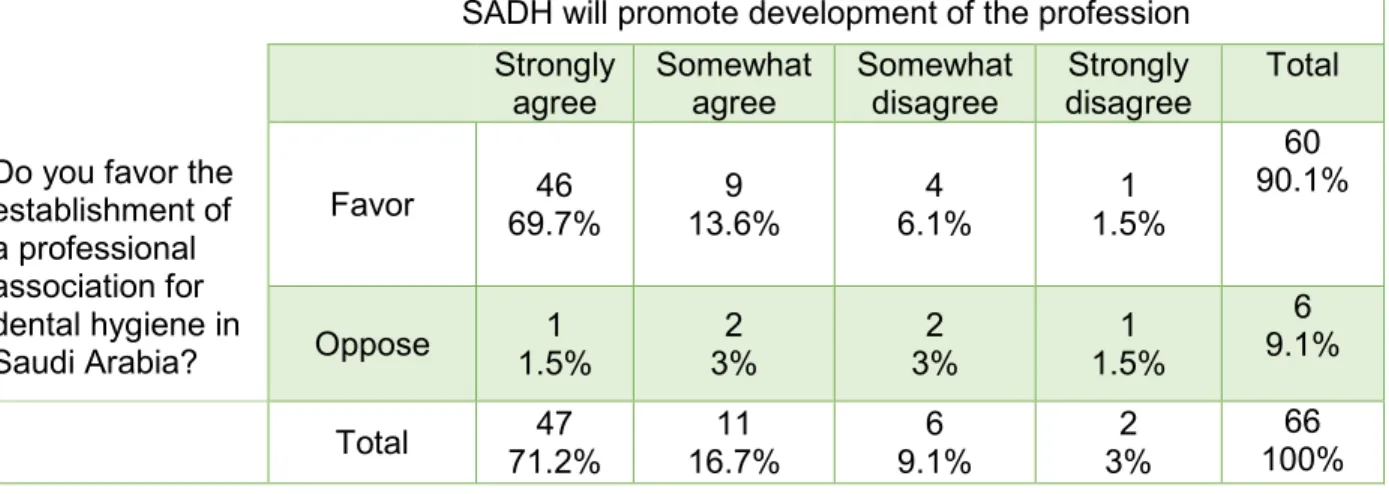
Bivariate statistical analysis indicated that half of those who did not support the creation of the professional association (n=3) believed it would promote development of the profession and meet professional needs. (Tables 2 & 3). The bivariate analysis also indicated that among those who favored the establishment of a professional association, 95.3% (n=61) reported that it would provide them with increased knowledge about oral health (p=0.0166). In addition, 92.2% (n=59) reported that it would provide them with continuing education courses and specialized training (p=0.0186). There were also 90.6% (n=58) who agreed that it would increase their networking and sharing of professional experiences (p=0.0207). Interestingly, two thirds of those who opposed its establishment still agreed that it can provide them with increased
knowledge about oral health, provide continuing education courses and specialized training, and increase their networking and sharing professional experience at least somewhat (p<0.05).
DISCUSSION
The purpose of this study was to assess the professional needs of dental hygienists in Saudi Arabia and investigate their attitudes and opinions regarding establishment of a
professional association in the country. Although the dental hygiene profession started in Saudi Arabia more than thirty years ago, there is no professional association for dental hygiene professionals.9 This study was the first of its kind to investigate the current issues of dental
hygiene professionals in Saudi Arabia. It reflected the attitudes and opinions about the role of an association in improving the profession in the country and helped to identify the professional needs of dental hygienists’ in Saudi Arabia.
The ratio of male and female respondents was significant with 22.7% (n=15) male, and 77.3% (n=52) females. This might be related to the history of enrolling female dental hygiene students only into the dental hygiene program in King Saud University until 2008 after which it began to enroll males. Also, there are a few additional dental hygiene programs that have recently been established in the country that teach both males and females. Consistent with other countries, ratios of female to male dental hygienists in most countries worldwide indicate that there are more females than males dental hygienists.18 For example, in 2014, Canada
reported that there were 21,000 female dental hygienists and 500 males. Also in 2011, Australia reported that of the dental hygienists in the country, 98% were females18
Ansmann and colleagues reported in 2014 that professional societies provide networking, mentoring for new graduates, and sharing of knowledge and experience.23
experiences would be facilitated by the establishment of the SADH at least somewhat. In addition, most felt that an additional benefit would be to receive mentoring from senior professionals and that it will provide them with increased knowledge about oral health.
Matthews stated that professional associations have an important role in keeping its members updated by disseminating knowledge and publications periodically about new advances in the profession.4 They also emphasized the role of professional associations in facilitating the
access to members and keep them updated by providing publications and notifying them about new issues. Furthermore, regular communication and collaboration of the association and its members is important for the professional development.4 Findings of this study indicated that
88.1% of the respondents agreed on the role of the SADH in promoting the development of the profession in the country.
Matthews found that a strong advocacy for a profession can result from the consensus of lots of professionals to reach their goals.4 Results of this study suggest that most of dental
hygienists in Saudi Arabia share the same needs with varying degrees of agreement. Regarding their expectations, 86.6% (n=58) of the respondents reported that establishing professional association in the country would help them meet their professional needs.
According to the Saudi Commission for Health Specialties, professional associations should be approved if there is no other association for the same specialty in the country, and when there are at least fifty members trained in that specialty.10 The number of licensed dental
establishment. Of the respondents, most were interested in leadership positions in the future dental hygiene professional association, which requires dental hygienists in Saudi Arabia to attend leadership training. Leadership courses could be conducted during Saudi dental
hygienists’ meeting once the association is established or it could be included within the dental hygiene education programs in the country.
Limitations of the study:
Limitations of the study include a small sample size. The Saudi Commission for Health Specialties identified a list of 298 dental hygienists in Saudi Arabia. The authors were not allowed to obtain email addresses of all the licensed Saudi dental hygienists from the commission because of privacy issues. As a result, investigators utilized a list of email addresses that were collected after obtaining permission from participants. In addition,
investigators supplemented the email list by the use of the snowball technique to increase the rate of access to dental hygienists in different regions in the country. Hopefully a more
organized method of tracking dental hygienists in Saudi will be established in the future.
Implications for future research:
One future research question suggested by this paper is assessment of the current state of leadership training available to Saudi dental hygienists and if Saudi dental hygienists are prepared for this leadership role. Also a formal needs assessment of senior dental hygiene students and faculty about the establishment of a professional association for dental hygiene could be conducted with more specific contact information. After establishing a Saudi
CONCLUSION
APPENDIX
Q1 Are you a member of any of the professional associations listed below? (Please choose all applicable answers)
Saudi Dental association International dental associations
American Dental Hygienists’ Association
International Federation of Dental Hygienists’ Association
Other health associations, please specify ____________________ Q2 What is the primary benefit you receive from membership?
Professional networking at local or international levels Free or discounted publications
Exclusive online resources
Seminars, workshops, or symposiums Professional certification opportunities Published or internet job listings Other benefits
Q3 please specify
Q4 Which of the following do you currently need to help you met your professional goals? Critical need (1) Desirable but not critical (2) Not needed (3) Not Applicable (4)
1. Attending professional meetings
2. Mentoring from experiemced dental hygienists
3. Conducting oral health research
4. Attending workshops / continuous education
Q5 To what degree is each of the following are needed to help you meet your personal professional needs? Critical need (1) Desirable but not critical (2) Not needed (3) Not Applicable (4)
1. A master / PhD program to attend
2. Participating in public oral health programs
3. Access to online educational courses
Q6 Strongly Favor (1) Somewhat Favor (2) Somewhat Oppose (3) Strongly Oppose (4) Do you favor the establishment of a professional
association for dental hygiene in Saudi Arabia?
Q7 To what degree do you believe the SADH can meet your individual needs? A lot (1) Only a little (2) Somewhat (3)
Not at all (4) 1. Provide me with increased knowledge about oral
health.
2. Improve my professional skills.
3. Provide me with continuing education courses
and specialized training.
4. Increase my networking and sharing of
professional experience
5. Improve my chances for meeting other dental
hygienists
Q8 Please indicate your level of agreement with the following statements regarding the Saudi Dental Hygiene Association (SADH)
Strongly agree (1) Somewhat Agree (2) Somewhat Disagree (3) Strongly disagree (4) 1. Dental hygienists in Saudi Arabia have
professional needs that can be met by the SADH
2. SADH will promote development of the
profession
3. SADH can improve oral health awareness of
the Saudi Society
4. SADH can improve oral health services for the
Saudi Society
Q9 How Important is it to you that the SADH provide following opportunities? A lot (1) Only a little (2) Somewhat (3)
Not at all (4)
1. Provide regular professional meetings
2. Provide mentoring for the newly graduates
3. Emphasize on the role of primary oral health
clinician
4. Advocate and support the profession in the
country
5. Help create job opportunities
Q10 Once the SADH is established, will you become a member? Yes
No
Q11 what would prevent you from becoming a member? (Check all that apply) No time to participate
Cost of membership Lack of interest
My needs are met by other professional activities Other (please specify) ____________________ Q12 Are you interested in a leadership role in the SADH ?
Yes No
Q13 What is your age? Q14 What is your gender?
Male Female
Q15 Are you currently working in dental hygiene? Yes
No
Q16 For how many years have you been practicing dental hygiene? Q17 In which type of setting are you employed?
Ministry of Health hospital Military hospital
Private hospital
Academic education institution
Q18 What is your highest educational degree? Diploma or certificate
Bachelor’s degree
TABLES AND FIGURES
Table 1. Saudi dental hygienists’ professional needs (N=73)
critical need Desirable but not critical Not Applicable Not needed Attending professional meetings 48 65.8% 18 24.7% 4 5.5% 3 4.1% Receiving mentoring from
experienced dental hygienists 36 49.3% 29 39.7% 2 2.7% 6 8.2% Conducting oral health
research 43 58.9% 24 32.9% 5 6.9% 1 1.4% Attending workshops and
continuing education 59 80.8% 11 15.1% 1 1.4% 2 2.7% Establishing master/PhD programs 46 63% 22 30.1% 2 2.7% 3 4.1% Participating in public oral
health programs 47 64.4% 20 27.4% 1 1.4% 5 6.9% Access to online
educational courses 38 52.1% 26 35.6% 3 4.1% 6 8.2% Networking with dental
hygienists in the country
46 63% 22 30.1% 2 2.7% 3 4.1%
Table 2. Respondents who favor/oppose the establishment of a professional association and
their perception about its role in meeting their needs (p= 0.0079)
Do you favor the establishment of a professional association for dental hygiene in Saudi Arabia?
Dental hygienists in Saudi Arabia have professional needs that can be met by the SADH
Strongly agree Somewhat agree Somewhat disagree Strongly disagree Total
Favor 46
69.7% 8 12.1% 5 7.6% 1 1.5% 60 90.1%
Oppose 1
1.5% 2 3% 2 3% 1 1.5% 6 9.1%
Table 3. Respondents who favor/oppose the establishment of a professional association and their perception about its role in promoting the development of the profession (p= 0.0053)
Do you favor the establishment of a professional association for dental hygiene in Saudi Arabia?
SADH will promote development of the profession Strongly agree Somewhat agree Somewhat disagree Strongly disagree Total
Favor 46
69.7% 9 13.6% 4 6.1% 1 1.5% 60 90.1%
Oppose 1
1.5% 2 3% 2 3% 1 1.5% 6 9.1%
Total 47
Figure 1. Attitudes and opinions of Saudidental hygienists regarding the role of establishing a professional association in meeting their personal professional needs. (N=71)
66.2
60.6 64.8 66.2
70.4
9.9 15.5 12.7
5.6 8.5
18.3 18.3
12.7 16.9 12.7
5.6 5.6 9.9
11.3 8.5
Provide me with increased knowledge
about oral health
Improve my professional skills
Provide me with continuing education courses and specialized
training
Increase my networking and sharing of professional experience
Improve my chances for meeting other dental
hygienists
%
A lot Only a little Somewhat Not at all
Figure 2. Attitudes and opinions of Saudidental hygienists regarding the role of establishing a
professional association in meeting the profession’s needs. (N=67)
79.1 77.6 79.1
85.1 64.2 10.5 17.9 14.9 9 20.9 9
1.5 4.5 4.5
11.9
1.5 3 1.5 1.5 3
Provide regular professional meetings
Provide mentoring for the newly graduates
Emphasize on the role of primary oral health clinician
Advocate and support the profession in the country
Help create job opportunities
%
Figure 3. Attitudes and opinions of Saudidental hygienists regarding the role of establishing a professional association in improving the profession and the oral health of Saudi Society. (N=67)
71.6 73.1
65.7
70.2
16.4 14.9
22.4
19.4
9 9 7.5 9
3 3 4.5 1.5
SADH will promote development of the profession
SADH can improve oral health awareness of the Saudi Society
SADH can improve oral health services for the Saudi Society
SADH can help promote Saudi Vision 2030
%
REFERENCES
1. World Health Organization. Oral health [Internet]. 2012. [cited 2017]. Available from: http://www.who.int/mediacentre/factsheets/fs318/en/
2. Dental Hygienist [Internet]. American Dental Association. Available from:
http://www.ada.org/en/education-careers/careers-in-dentistry/dental-team-careers/dental-hygienist
3. Wilkins EM. The Professional Dental Hygienist In: Clinical Practice of the Dental Hygienist. Twelfth ed. Philadelphia: Wolters Kluwer Health: Lippincott Williams & Wilkins; 2016 p. 3-18. 4. Matthews JH. Role of professional organizations in advocating for the nursing profession. Online J Issues Nurs [Internet]. 2012;17(1):3. Available from:
http://www.ncbi.nlm.nih.gov/pubmed/22320879
5. Mission Statement & Goals [Internet]. Dental Hygienists' Association of Australia Ltd. 2015 [cited 2015]. Available from: http://www.dhaa.info/information-1/mission-policies-goals/mission-statement-goals/
6. Advocacy [Internet]. American Dental Hygienists' Association 2015 [cited 2015]. Available from:
http://www.cdha.ca/cdha/The_Profession_folder/Policy__Advocacy_folder/Advocacy_Toolkit/CD HA/The_Profession/Policy_Advocacy/Advocacy_Toolkit.aspx?hkey=ba83b85a-d845-4fb5-ae7c-07e77c3c3c08
7. Country Cooperation Strategy for WHO and Saudi Arabia 2012–2016 [Internet]. 2016 [cited 2016]; [28]. Available from:
http://apps.who.int/iris/bitstream/10665/136842/1/ccsbrief_sau_en.pdf
8. Saudi Vision 2030 [Internet]. [cited 2017] Available from: http://vision2030.gov.sa/en
9. Saudi Commission for Health Specialties, Scientific Health Societies [Internet]. Saudi Arabia: 2016 [cited 2016]. Available from: http://www.scfhs.org.sa/en/pages/default.aspx
10. The Saudi Commission for Health Specialties: Scientific Health Societies-Regulations [Internet]. 2014 [cited 2017]. Translated from Arabic. Available from: http://goo.gl/tZo0Vw. 11. Ministry of Education-Higher education. [Internet]. Saudi Arabia: 2016[ cited 2016]. Available from: https://www.moe.gov.sa/en/Pages/default.aspx
12. Facts about the Dental Hygiene Workforce in the United States [Internet]. 2016 [cited 2017].
-https://www.adha.org/resources 4. Available from:
– p. 1
docs/75118_Facts_About_the_Dental_Hygiene_Workforce.pdf
13. The Benefits of Dental Hygiene-Based Oral Health Provider Models [Internet]. 2016 [cited 2017]. Available from:
14. Number of Dental Hygiene Education Programs Offered by State [Internet]. 2016 [cited 2017]. Available from:
http://www.adha.org/resources-docs/7525_Map_of_DH_Programs_Per_State.pdf
15. 100 Years of Dental Hygiene [Internet]. American Dental Hygiene Association 2015 [cited 2015]. Available from: http://www.adha.org/timeline
16. Motley W. American dental hygienists' association 50 years of growth. J Am Dent Assoc. 1973;87(5):1125-13.
17. Lawlor S. The dental hygiene profession: Predicting the future by creating it. Can J Dent Hyg [Internet]. 2013;47(3):105. Available from: http://goo.gl/L3mEoz
18. International Federation of Dental Hygienists [Internet]. International Federation of Dental Hygienists 2015 [cited 2015]. Available from: http://www.ifdh.org/about.html
19. Elliott-Smith S. Dental Hygiene's Worldwide Community [Internet]. Newsmagazine of the American Dental Hygienists' Association. 2010 [cited 2015]. Available from:
http://search.proquest.com/docview/865651674?pq-origsite=summon
20. Advocacy Toolkit [Internet]. Canadian Dental Hygienists' Association 2015 [cited 2015]. Available from:
http://www.cdha.ca/cdha/The_Profession_folder/Policy__Advocacy_folder/Advocacy_Toolkit/CD HA/The_Profession/Policy_Advocacy/Advocacy_Toolkit.aspx?hkey=ba83b85a-d845-4fb5-ae7c-07e77c3c3c08
21. Bickel J. The role of professional societies in career development in academic medicine. Acad Psychiatry [Internet]. 2007 Mar-Apr;31(2):91-4. Available from:
http://search.proquest.com/docview/196534047?pq-origsite=gscholar
22. Wolff H. Effects of networking on career success: A longitudinal study. J Appl Psychol [Internet]. 01 /01/2009;94(1):196; 196.
23. Ansmann L, Flickinger TE, Barello S, Kunneman M, Mantwill S, Quilligan S, et al. Patient Education and Counseling Career development for early career academics : Benefits of networking and the role of professional societies. Patient Educ Couns [Internet].
2014;97(1):132–4.
24. Hupp JR. The role of staff in successful professional organizations. J Oral Maxillofac Surg. 2015 3;73(3):375-6.
25. Mige H. Professionalisation and professional identities of environmental experts: the case of Switzerland [Internet]. Taylor & Francis 2009 [cited 2015]. Available from:
http://www.mieg.ethz.ch/docs/MiegEnvironmentalProfessionals.pdf
27. King Saud University, College of Dentistry [Internet]. 2016 cited 2016]. Available from: http://dent.ksu.edu.sa/en
28. Kolliyat Teb Al Asnan Ayn Ala Al Tamayoz Wa Al Okhra Ala Al Tatweer [College of Dentistry, eye on uniqueness, and another on development] [Internet]. Al Jazirah Newspaper 2010 cited 2016]; [1]. Available from: http://www.al-jazirah.com/2010/20100209/fe21.htm Arabic. 29. Saudi Dental Society, History [Internet]. Saudi Arabia: 2016 [cited 2016]. Available from: http://www.sds.org.sa/node/131
30. College of Applied Medical Sciences. King Saud University [Internet]. 2016 [cited 2016]. Available from: http://cams.ksu.edu.sa/ar/Dental_female-programs Arabic.
31. Re-registration requirements. Saudi Commission for Health Specialties [Internet]. 2015 [cited 2016]. Available from: