DOI 10.1007/s00787-017-0967-1
ORIGINAL CONTRIBUTION
The role of infants’ mother‑directed gaze, maternal sensitivity,
and emotion recognition in childhood callous unemotional
behaviours
R. Bedford1 · N. J. Wagner2 · P. D. Rehder3 · C. Propper4 · M. T. Willoughby5 · R. W. Mills‑Koonce3
Received: 31 October 2016 / Accepted: 21 February 2017 / Published online: 28 February 2017 © The Author(s) 2017. This article is published with open access at Springerlink.com
predicting CU behaviours (β = −0.275, S.E. = 0.084, p = 0.001). While the main effects of infants’ mother-directed gaze and maternal sensitivity were not significant, their interaction significantly predicted CU behaviours (β = 0.194, S.E. = 0.081, p = 0.016) with region of
sig-nificance analysis showing a significant negative relation-ship between infant gaze and later CU behaviours only for those with low maternal sensitivity. There were no indirect effects of infants’ mother-directed gaze, maternal sensitivity or the mother-directed gaze by maternal sensi-tivity interaction via emotion recognition. Emotion rec-ognition appears to act as an independent predictor of CU behaviours, rather than mediating the relationship between infants’ mother-directed gaze and maternal sensitivity with later CU behaviours. This supports the idea of multiple risk factors for CU behaviours.
Keywords Callous unemotional behaviours · Infant ·
Face · Sensitive parenting · Emotion recognition
Introduction
Callous unemotional (CU) behaviours are a proposed pre-cursor of adult psychopathy. Children with CU behaviours are characterized by shallow affect, reduced emotionality, and a lack of feelings of guilt or empathy [30]. Although research with older children demonstrates links between CU behaviours and difficulty recognizing emotional expressions [18], the developmental pathways underlying this association are not well understood. Recent studies have begun the search for antecedents, infant behaviours which are associated with the subsequent development of CU behaviours, and one proposed early CU precursor is reduced attention to the face of a caregiver [6, 16]. Early
Abstract While some children with callous unemotional
(CU) behaviours show difficulty recognizing emotional expressions, the underlying developmental pathways are not well understood. Reduced infant attention to the car-egiver’s face and a lack of sensitive parenting have previ-ously been associated with emerging CU features. The cur-rent study examined whether facial emotion recognition mediates the association between infants’ mother-directed gaze, maternal sensitivity, and later CU behaviours. Partici-pants were 206 full-term infants and their families from a prospective longitudinal study, the Durham Child Health and Development Study (DCHDS). Measures of infants’ mother-directed gaze, and maternal sensitivity were col-lected at 6 months, facial emotion recognition perfor-mance at 6 years, and CU behaviours at 7 years. A path analysis showed a significant effect of emotion recognition
R. Bedford and N.J. Wagner are Joint first authors.
Electronic supplementary material The online version of this article (doi:10.1007/s00787-017-0967-1) contains supplementary material, which is available to authorized users.
* R. Bedford
1 Biostatistics and Health Informatics Department, Institute of Psychology, Psychiatry and Neuroscience, King’s College London, London, England
2 Human Development and Quantitative Methodology, University of Maryland, College Park, USA
3 Human Development and Family Studies Department, University of North Carolina-Greensboro, Greensboro, USA 4 Center for Developmental Science, University of North
Carolina-Chapel Hill, Chapel Hill, USA
interactions with caregivers, which play an important role in the emergence of adaptive behavioural and emotional functioning [9, 58], contribute to the consolidation and maturation of socio-emotional systems that underlie later adjustment or maladjustment [12]. In the current study we aimed first to examine the associations between maternal sensitivity in infancy and infants’ mother-directed gaze with later CU behaviours, and second, to test whether emotion expression recognition mediates the associations between infants’ mother-directed gaze, maternal sensitivity, and later CU behaviours.
Early socio-environmental factors, such as parenting, are known to play an important role in the development of CU behaviours [68]. Although the majority of parenting stud-ies have been cross-sectional, several studstud-ies have found prospective associations between positive parenting, such as sensitive responding, warmth and positive reinforce-ment, and lower CU behaviours later in development [5, 6, 32, 46, 66, 77]. Passive and evocative gene–environment correlations, whereby parents who are more sensitive and warm have children with lower CU behaviours, are always difficult to rule out. However, Waller et al. [70] used an adoptive design to show that lower levels of parent rein-forcement were related to higher CU behaviours in parents who were not genetically related to their children (also see [33]). This provides strong evidence that aspects of sensi-tive parenting in early life contribute to lower levels of CU behaviours.
One mechanism through which parenting may play a role in the development of social-emotional problems char-acteristic of callous unemotional behaviours is emotional understanding [11]. It is well established that adult psy-chopaths show impaired emotion recognition abilities and, although the most commonly reported difficulty is in rec-ognising fearful facial expressions, a recent meta-analysis found impairments across a range of emotions [18]. Blair [7] suggested that a failure to recognise distress cues in oth-ers may play a role in atypical empathy development. This has been supported by the finding that children with CU behaviours show difficulties in recognising facial affect, particularly for negative emotions such as fear, sadness, and anger (e.g., [8, 17, 29, 49, 60]. Dadds et al. [16] expanded this idea, arguing that impaired emotion recognition may reflect more general deficits in attention to social-emotional stimuli. They suggest that the developmental pathway to CU traits may actually be via reduced emotional engage-ment and attention to caregivers.
Attention to the face, and specifically the eye region, has been identified in the literature as a potential con-tributor to the emergence of emotion recognition, particu-larly for the recognition of fearful facial expressions [13, 15–17]. In the current paper we suggest that emotion rec-ognition may serve as one potential mechanism through
which early attention to caregivers influences the devel-opment of CU behaviours. In infancy, increased face pref-erence at just 5 weeks of age has been shown to predict lower CU behaviours later in development [6]. Addition-ally, using data from the current sample, Wagner and col-leagues found that high levels of gaze toward the mother may protect against the development of CU behaviours, particularly for infants who show deficits in normative patterns of reactivity early in life [67]. The current study extends this work by including CU outcomes later in childhood and by examining the mediating role of emo-tion recogniemo-tion. Although previous studies suggest clear links between attention to the face, emotion recognition, and CU traits, establishing whether emotion recognition mediates the relationship between infant attention to the face and later CU traits is of particular importance, given the ability to intervene on this behaviour [14].
In addition to the independent contributions of early attention to the face and sensitive parenting to lower CU behaviours, there is both theoretical and empirical sup-port for these factors eliciting an interactive influence on the development of CU behaviours [16]. Infants’ visual orientation is an important mechanism of communica-tion with caregivers, promoting affiliacommunica-tion and continued reciprocity that, when responded to sensitively by the parent, contributes to the formation of secure attachment relationships [2, 9]. Interestingly, in addition to deficits in eye-contact, children with CU behaviours are more likely to form insecure attachments than youth with nor-mative levels of behaviour problems and CU behaviours [26, 52, 53]. Although Bedford et al. [6] did not find evi-dence for an interaction between maternal sensitivity and face preference, work by Dadds et al. [13, 16]—which found reduced eye contact in high CU-behaviour boys during interactions with their parents, despite the fact that mothers showed typical levels of eye-contact—provides support for links between early dyadic processes and the development of CU behaviours. It is clear that sensi-tive parenting and infant attention to caregivers serve to enhance the positive outcomes associated with adaptive parenting [35] and buffer against maladaptive trajectories of antisocial behaviours [39]. As such, the current study will also test the extent to which maternal sensitivity and infants’ mother-directed gaze interactively predict later CU behaviours.
Method
Participants
The current study used participants from the Durham Child Health and Development Study (DCHDS), a prospective longitudinal study of 206 full-term infants and their fami-lies who were recruited when the children were 3 months of age (see Table 1). The sample was 57% African Ameri-can and 43% European AmeriAmeri-can, and approximately 53% of families were low income (below 200% of the federal poverty level). This study was approved by the Institu-tional Review Board at the University of North Carolina at Chapel Hill.
Procedure and measures
The current study uses data collection from the 6-month and 2.5-, 6-, and 7-year time points. Information on chil-dren’s sex and race was collected upon entry into the study. All ratings and observations occurred in a laboratory set-ting, except for the observation of parent–child interactions during free play, which were conducted at the participants’ homes. At each visit, infants and their mothers participated in a number of joint and individual activities and mothers completed a standardized interview and demographic ques-tionnaires. Transportation was provided to families who required assistance getting to and from the laboratory.
Infant and parent gaze
The infants were observed in the Face-to-Face Still-Face Paradigm (FFSFP; [3, 63] during the 6-month lab visit to
assess infant behaviours, specifically mother-directed gaze. Mothers placed infants in an infant chair on a table and sit-uated themselves in a chair that was placed directly in front of the infants’ chair. Mothers were given a set of standard-ized instructions for each episode of the FFSFP (i.e., face-to-face, still-face, reunion). During the face-to-face epi-sode, mothers were instructed to play with their babies as they normally would for 2 min. Then, mothers were told to turn away from their infant for 15 s, and then to turn back toward their infants for the still-face episode. Moth-ers were to look at their infant for 2 min without providing any verbal or facial response to the infant (i.e., maintaining a still face). Only behaviour during the initial face-to-face episode was analysed in the current study. The FFSFP was stopped if the infant was unable to be soothed at any point during the procedure. The episodes were video recorded using a split-screen procedure to ensure that the behaviours of both mothers and infants could be observed during the entire interaction.
Infants’ and mothers’ gaze during the FFSFP episodes was coded by trained coders. In separate viewings of the videotapes, different research assistants coded infants’ and mothers’ direction of gaze in one second intervals. Gaze was coded as toward or away from the partner. Coders were initially trained to reliability using pre-existing video-recorded FFSFP interactions. Inter-observer agreement was determined by randomly selecting 15% of the interactions to be coded by a second coder. The coders were consid-ered to be in agreement if they coded the same behaviour within one second of each other. Reliability was calculated using kappa to correct for chance agreement (see [47] for more information about this coding procedure). Overall, coders reliably identified mother affect (K = 0.83), infant affect (K = 0.89), infants’ direction of gaze (K = 0.90), and
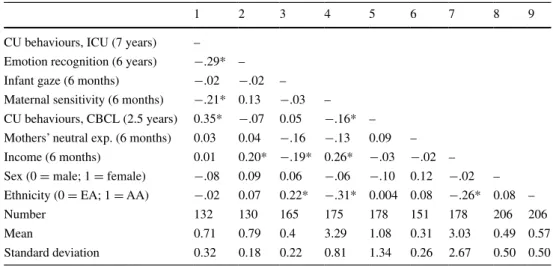
Table 1 Descriptive statistics and bivariate correlation matrix
ICU inventory of callous unemotional traits, CBCL child behaviour checklist, AA African American, EA European American
* p values <0.05
1 2 3 4 5 6 7 8 9
CU behaviours, ICU (7 years) – Emotion recognition (6 years) −.29* – Infant gaze (6 months) −.02 −.02 – Maternal sensitivity (6 months) −.21* 0.13 −.03 – CU behaviours, CBCL (2.5 years) 0.35* −.07 0.05 −.16* – Mothers’ neutral exp. (6 months) 0.03 0.04 −.16 −.13 0.09 – Income (6 months) 0.01 0.20* −.19* 0.26* −.03 −.02 – Sex (0 = male; 1 = female) −.08 0.09 0.06 −.06 −.10 0.12 −.02 – Ethnicity (0 = EA; 1 = AA) −.02 0.07 0.22* −.31* 0.004 0.08 −.26* 0.08 –
Number 132 130 165 175 178 151 178 206 206
Mean 0.71 0.79 0.4 3.29 1.08 0.31 3.03 0.49 0.57
mothers’ direction of gaze (K = 0.85). Only data from the face-to-face interaction was analysed in the current study. The primary measure of interest which has been validated in multiple studies (e.g., [47, 48, 67] was infants’ gaze toward the mother’s face during the face-to-face interaction computed as a proportion of the total valid interaction time. Mothers’ affect during the face-to-face interaction was included as a covariate.
Maternal sensitivity
Mothers and their infant were observed during a free-play task lasting 10 min as part of the home visit completed when the infants were 6 months of age. A set of standard toys were arranged on a blanket and the mothers were asked to play with their infants as they normally would on a typical day. All interactions were videotaped and later viewed by trained and reliable coders who rated the inter-actions using 5-point subscales (measures adapted from the [51]. Previous factor analysis supported the creation of a maternal sensitivity composite which included meas-ures of sensitivity, detachment (reverse-scored), stimulation of development, positive regard, and animation (see Wil-loughby et al. [72–74]). Each coding team consisted of four to five coders and included one or two master coders. Each coder was trained to be reliable with the master coder(s), and ongoing reliability was calculated using intraclass cor-relations across coding pairs for each parenting subscale. Reliability across subscales and composites was high (intraclass correlations >0.80).
Emotion recognition
Children’s emotion identification was assessed using the facial expressions subscale of the Assessment of Children’s Emotional Skills (ACES; [56] administered at the 6-year visit. In the facial expressions section, children were pre-sented with still photographs of elementary-aged children posing various facial expressions. For each photograph, the administrator asked, “Does he/she feel happy, sad, mad, scared, or no feeling?” and recorded the child’s response. There were eight emotion trials (2× happy, sad, mad, and scared) which were scored correct or incorrect, and a total score was computed. There were also and eight ambigu-ous trials, where the expression did not clearly show any one emotion; however, for the current study only responses from the eight emotion recognition trials were analysed.
Callous unemotional behaviours
The inventory of callous unemotional traits (ICU; [28] was used to assess CU behaviours when children were 7 years old (Cronbach’s alpha = 0.83). The ICU was completed by
maternal primary caregivers who responded to 24 items on a 4-point Likert scale ranging from 0 (not at all true) to 3 (definitely true). After reverse coding the items based [34] we calculated Cronbach’s alpha, which suggested that item 10 was loaded in the opposite direction to all other items, so it was also reverse coded (range of scores 2–39). How-ever, we also reran the analysis removing items 2 and 10, based on Kimonis et al. [34], see supplementary materials. The items, which are comprised of highly established clini-cal assessments (e.g., APSD, PCL-YV) and include ques-tions about the extent to which the child uses emoques-tions, expresses feelings, cares about getting in trouble, seems cold and uncaring, and hurts others’ feelings, demonstrate acceptable factor structure and predictive utility with sam-ples ranging in age from 13 to 20 years of age (see [23, 25, 34, 55]), and with samples as young as age 3 (see [24]).
Additional covariates
Child’s sex and race were collected at the time of recruit-ment. Poverty status was collected at the 6-month home visit and determined using federal guidelines. Earlier CU behaviours were derived from the Achenbach System of Empirically Based Assessment, Preschool Forms (ASEBA; [1]), which was completed by primary caregivers at the 2.5-year visit. This standardized assessment indexes children’s behavioural and emotional problems using caregivers’ rat-ings of their child’s behaviour currently or within the past 2 months [1]. Data from the current study [75] and data from the NICHD Study of Early Child Care and Youth Develop-ment [76], suggest that five items drawn from the ASEBA (“no guilt after misbehave”, “punish doesn’t change behav-iour”, “unresponsive to affection”, “shows little affec-tion”, and “too little fear”) can reliably be used to meas-ure individual differences in CU behaviours at these early ages. Sex, race, income, and earlier CU behaviours were included as covariates in each analytic model.
Statistical analysis
gaze and later CU behaviours, we re-ran the model to include the interaction effect of infants’ mother-directed gaze by maternal sensitivity on later emotion recognition and CU behaviours. Significant interactions were probed using the online utility and computational tools for prob-ing two-way interaction effects in multiple linear regres-sions [54]. Following Roisman et al. [54], we ran region of significance analyses. Exogenous variables were allowed to covary, and all predictors and outcomes were centred to aid interpretation. Missing data were handled using the full information maximum likelihood methods [22]. All path analyses were estimated using Mplus [50] and descriptive statistics were obtained using STATA [59]. Standardized model results are reported.
Results
Descriptive statistics and correlations between covariates and variables of interest are presented in Table 1. The cor-relation matrix showed significant associations between increased CU behaviours at 7 years and reduced 6-year emotion recognition (r = −0.29), lower 6-month mater-nal sensitivity (r =−0.21), and higher early 30-month CU behaviours (r = 0.35). Emotion recognition was not signifi-cantly correlated with either maternal sensitivity or infant mother-directed gaze.
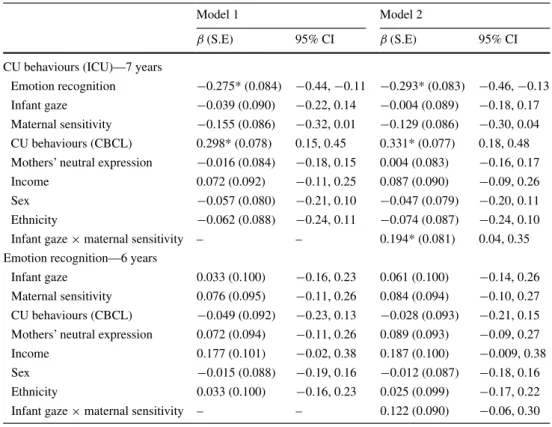
A saturated path analysis model was estimated using a maximum likelihood estimator (see Fig. 1; Table 2). Emo-tion recogniEmo-tion at 6 years significantly predicted 7-year CU behaviours, β = −0.275, S.E. = 0.084, p = 0.001,
with poorer emotion recognition ability associated with
higher CU behaviours. The effect of maternal sensitivity was only marginally significant, β=−0.155, S.E. = 0.086, p = 0.072, and contrary to our hypothesis, there was no main effect of infants’ mother-directed gaze, β=−0.039,
S.E. = 0.09, p = 0.66. Children’s early CU behaviours at 2.5 years significantly predicted later CU at age 7,
β= 0.298, S.E. = 0.078, p < 0.001, but none of the other
covariates reached significance (p values >0.432). The model accounted for 22.1% of the variance in CU traits. No significant associations were found between infants’ mother-directed gaze, β= 0.033, S.E. = 0.10, p = 0.739,
or maternal sensitivity, β= 0.076, S.E. = 0.095, p = 0.420,
and later emotion recognition, and none of the covari-ates significantly predicted emotion recognition (p val-ues >0.081). Finally, no significant indirect effects were found for either infants’ mother-directed gaze, β=−0.013,
S.E. = 0.040, p = 0.741, or maternal sensitivity,
β =−0.008, S.E. = 0.011, p = 0.433, to CU behaviours
via emotion recognition. Although we controlled for sex in the analysis, we also tested whether sex moderates the association between infant measures and later CU behav-iours, finding a marginal interaction for maternal sensitivity by sex (see supplementary materials).
Next, we re-ran the model adding the interaction between infants’ mother-directed gaze by maternal sensi-tivity as a predictor of emotion recognition and CU behav-iours. While there was no significant effect of the mother-directed gaze by maternal sensitivity interaction on emotion recognition, β= 0.122, S.E. = 0.090, p = 0.178, there was
a significant interaction effect in the prediction of later CU behaviours, β= 0.194, S.E. = 0.081, p = 0.016. Region of
significance (RoS) and simple slopes analysis showed that
Fig. 1 Path diagram showing the significant effect of emotion recognition accuracy at 6 years in the prediction of 7-year CU
the association between infants’ mother-directed gaze and CU behaviours was significant only at low levels of infant gaze (scores below 0.03, i.e., <0.14 SDs below the mean, simple slope at −1 SD =−0.22, t(196) = 3.19, p = 0.002), and for maternal sensitivity scores below −1.0 (i.e., <1.2 SDs below the mean), simple slope at −1 SD =−0.81 is
−0.30, t(196) = 1.81, p = 0.072 (see Fig. 2 for a plot of the simple slopes at the RoS). In other words, there was a sig-nificant negative association between infant gaze and later
CU behaviours only for those with low levels of mater-nal sensitivity. The R2 value for CU traits in Model 2 was
25.3%.
Discussion
The current study tested whether early maternal sensi-tivity and infants’ mother-directed gaze independently
Table 2 Standardised model
results Model 1 Model 2
β (S.E) 95% CI β (S.E) 95% CI
CU behaviours (ICU)—7 years
Emotion recognition −0.275* (0.084) −0.44, −0.11 −0.293* (0.083) −0.46, −0.13 Infant gaze −0.039 (0.090) −0.22, 0.14 −0.004 (0.089) −0.18, 0.17 Maternal sensitivity −0.155 (0.086) −0.32, 0.01 −0.129 (0.086) −0.30, 0.04 CU behaviours (CBCL) 0.298* (0.078) 0.15, 0.45 0.331* (0.077) 0.18, 0.48 Mothers’ neutral expression −0.016 (0.084) −0.18, 0.15 0.004 (0.083) −0.16, 0.17
Income 0.072 (0.092) −0.11, 0.25 0.087 (0.090) −0.09, 0.26
Sex −0.057 (0.080) −0.21, 0.10 −0.047 (0.079) −0.20, 0.11
Ethnicity −0.062 (0.088) −0.24, 0.11 −0.074 (0.087) −0.24, 0.10 Infant gaze × maternal sensitivity – – 0.194* (0.081) 0.04, 0.35 Emotion recognition—6 years
Infant gaze 0.033 (0.100) −0.16, 0.23 0.061 (0.100) −0.14, 0.26 Maternal sensitivity 0.076 (0.095) −0.11, 0.26 0.084 (0.094) −0.10, 0.27 CU behaviours (CBCL) −0.049 (0.092) −0.23, 0.13 −0.028 (0.093) −0.21, 0.15 Mothers’ neutral expression 0.072 (0.094) −0.11, 0.26 0.089 (0.093) −0.09, 0.27
Income 0.177 (0.101) −0.02, 0.38 0.187 (0.100) −0.009, 0.38
Sex −0.015 (0.088) −0.19, 0.16 −0.012 (0.087) −0.18, 0.16
Ethnicity 0.033 (0.100) −0.16, 0.23 0.025 (0.099) −0.17, 0.22 Infant gaze × maternal sensitivity – – 0.122 (0.090) −0.06, 0.30
and interactively predict later CU behaviours, as well as the extent to which deficits in emotion recognition medi-ate these associations. Although the main effect of infant gaze was not significant, and maternal sensitivity was only a marginally significant predictor of later CU behaviours, we found evidence for an interaction between 6-month-olds’ gaze to their mother’s face and maternal sensitivity in the prediction of CU behaviours at 7 years of age. Infants with low levels of gaze to the parent’s face during a face-to-face interaction showed higher levels of CU behaviours at age 7 years, only when maternal sensitivity was low. Further, we found that lower emotion recognition accuracy at 6 years directly predicted later CU behaviours, but we did not find associations of infants’ mother-directed gaze or maternal sensitivity with emotion recognition, nor an indirect pathway to CU behaviours. Emotion recognition thus appears to act as an independent predictor, rather than mediating the relationship between infants’ mother-directed gaze and maternal sensitivity with later CU behaviours, consistent with the idea of additive contributions of multi-ple risk factors to the development of psychopathology [20, 62].
Our results showed a significant longitudinal association between emotion recognition difficulties and CU behav-iours, with poorer emotion recognition performance at 6 years associated with higher CU behaviours at 7 years, controlling for earlier CU behaviours. This finding is con-sistent with the literature showing impaired emotion rec-ognition in children with CU behaviours (e.g., [18, 29]). One hypothesised mechanism to explain this association is attention to emotional expressions, specifically distress cues, which is known to be important in the development of empathic responses and conscience, and may deter mali-cious acts [7, 57]. Concurrent attention to the eye region of faces plays an important role in emotion recognition, par-ticularly for fear recognition. Indeed, fear recognition defi-cits in children with high CU behaviours abate following instruction to attend to the eyes [4]. Contrary to our hypoth-esis, we did not find a significant association between infant attention to the face and later emotion recognition perfor-mance, nor any indirect effects. It is possible that concur-rent attention during an emotion recognition task is more important than the longitudinal impact of infants’ attention to the face 5 years earlier. There are several other possible explanations of these results to consider. First, our infant measure is video-coded attention to the face, and it may be that a more fine-grained measure of attention to the eyes, using real-time eye-tracking, would show significant asso-ciations with later emotion recognition. It is also possible that attention to the face during this face-to-face episode, where parents may or may not be emotionally expressive, is not generalizable to the wider context of infant’s atten-tion to emoatten-tional expressions.
Parents’ early sensitivity and emotion socialization prac-tices contribute to conscience development, influence the formation of attachment relationships, and have implica-tions for children’s abilities to understand and recognize emotion [21, 40, 42, 43, 45], all of which may play a role in the development of CU behaviours [11, 41]. Despite an increasing number of studies demonstrating links between early sensitivity and eventual CU behaviours [46, 66, 69, 72], and work suggesting that the influences of early sen-sitivity on later CU behaviours are mediated through chil-dren’s emotional understanding [11], the current study found no support for the hypothesis that maternal sensitiv-ity at 6 months predicts CU behaviours via its influences on children’s emotion recognition. This is consistent with an RCT in children with high CU traits which showed no mediating effect of emotion recognition [14], although emotion recognition training did lead to improvements in affective empathy and conduct problems in these children. There are also a diversity of mechanisms through which parents socialize children’s emotional capacities, and it is possible that the measure of maternal sensitivity used in the current study does not capture specific emotion-related practices relevant for the tested processes. For example, Eisenberg et al. [21] suggest that parents’ reactions to chil-dren’s emotional expressions, parents’ emotional expres-siveness, and parent–child discussion of emotion are pri-mary ways in which children’s emotional competencies are supported. Extant literature shows that emotion language use at 15 months is positively associated with emotion understanding in toddlerhood [61]. Mothers of children demonstrating elevated CU behaviours have been shown to use emotion socialization practices that dismiss or devalue children’s emotions (Pasalich et al. [52, 53], and Centi-fanti and colleagues [11] found that mental-state language at 8 months indirectly predicted children’s CU behaviours through emotion understanding. Future studies which incorporate a diversity of emotion socialization experiences in infancy may identify mediated pathways to CU behav-iours through emotion recognition.
Early dyadic interactions between infants and their car-egivers are often discussed in terms of synchronization and play a distinct role in the emergence of behavioural and emotional regulation and healthy attachment rela-tionships [58, 71]. An infant’s propensity for engaging in dyadic, or synchronized, interactions with a caregiver may have important implications for the development of CU behaviours, especially given their association with inse-cure attachment relationships [52] and disrupted emotional bonds [27]. Our findings suggest that these fundamental developmental processes may be undermined by infants’ reduced gaze toward their caregiver during interactions, but only in the context of caregiving characterized by a lack of sensitivity and warmth. As suggested by the Mutual Regu-lation Model (MRM; [64], mother–infant dyads are jointly regulated toward reciprocal interaction through behavioural and affective feedback, a process which is supported by consistent maternal sensitivity and support [36, 37, 65]. The joint contribution of a lack of infants’ mother-directed gaze and low maternal sensitivity likely undermines the establishment of mutually responsive behaviour, resulting in a cascade of emotional and regulatory difficulties and subsequent CU behaviours.
The current study has several key strengths, which include a longitudinal design, diverse observational meas-urement, and the inclusion of earlier CU behaviours as a covariate in path analyses. Although this study contributes to our understanding of the development of CU behaviours, future research should examine the possibility of bidirec-tional associations between infant and parent behaviours. Waller and colleagues found that CU behaviours pre-dicted less maternal sensitivity in toddlerhood [69], and insensitive and harsh parenting behaviours in very early life may inhibit infants’ willingness to openly respond to parents’ attempts to engage [31, 38]. Infants may learn to avert attention away from a chronically insensitive parent as a form of coping [19, 44], a process associated with the formation of insecure attachment relationships [10]. One important limitation of the current method is the relatively blunt measure of emotion recognition. Given that we know that the distribution of attention to the eyes versus mouth regions differs in children with CU behaviours and impacts recognition ability [16], having eye-tracking data would be helpful. In addition, collecting a higher number of emo-tion recogniemo-tion trials, looking at a wider range of different expressions, would make it possible to test whether specific emotions (namely fear and distress cues) mediate the asso-ciation between infant attention to the face and later CU behaviours.
The results of the current study provide evidence for the longitudinal prediction of childhood CU behaviours by ear-lier emotion recognition abilities at 6 years. Further, while no significant associations were found between 6-month
mother-directed gaze or maternal sensitivity and later CU behaviours, their interaction was significant, with reduced infant gaze associated with higher CU traits only for those with low levels of maternal sensitivity. No indirect effects via emotion recognition were found, with emotion recogni-tion acting as an independent predictor of CU behaviours, rather than mediating the relationship between infants’ mother-directed gaze, maternal sensitivity, and later CU behaviours. In addition to highlighting the benefit of incor-porating the measurement of multiple influences in infancy, including both parent and child behaviours, the current study emphasises the importance of considering how multi-ple risk factors work both directly and interactively to pre-dict emerging CU behaviours.
Acknowledgements We would like to thank all the parents and chil-dren who participated in the Durham Child Health and Development Study and the research assistants for their important role in collecting this data. This research was supported by the National Science Foun-dation through Children’s Research Initiative Grant (BCS-0126475) for the study, and a Sir Henry Wellcome Postdoctoral Fellowship to R. Bedford.
Compliance with ethical standards
Conflict of interest On behalf of all authors, the corresponding author states that there is no conflict of interest.
Open Access This article is distributed under the terms of the Crea-tive Commons Attribution 4.0 International License (http://crea-tivecommons.org/licenses/by/4.0/), which permits unrestricted use, distribution, and reproduction in any medium, provided you give appropriate credit to the original author(s) and the source, provide a link to the Creative Commons license, and indicate if changes were made.
References
1. Achenbach TM, Rescorla L (2000). Child behavior checklist. Burlington
2. Ainsworth MS, Blehar MC, Waters E, Wall S (1978) Patterns of attachment: a psychological study of the strange situation. Erl-baum, Oxford
3. Adamson LB, Frick JE (2003) The still face: a history of a shared experimental paradigm. Infancy 4(4):451–473
4. Adolphs R, Gosselin F, Buchanan TW, Tranel D, Schyns P, Damasio AR (2005) A mechanism for impaired fear recognition after amygdala damage. Nature 433(7021):68–72
5. Barker E, Oliver B, Viding E, Salekin R, Maughan B (2011) The impact of prenatal maternal risk, fearless temperament, and early parenting on adolescent callous-unemotional traits: a 14-year longitudinal investigation. J Child Psychol Psychiatry 52:878–888
6. Bedford R, Pickles A, Sharp H, Wright N, Hill J (2015) Reduced face preference in infancy: a developmental precursor to callous-unemotional traits? Biol Psychiatry 78(2):144–150
8. Blair RJR, Colledge E, Murray L, Mitchell DGV (2001) A selec-tive impairment in the processing of sad and fearful expressions in children with psychopathic tendencies. J Abnorm Child Psy-chol 29(6):491–498
9. Bowlby J (1969). Attachment and loss: attachment, vol. 3. Basic books
10. Bretherton I, Munholland KA (1999). Internal working models in attachment relationships: a construct revisited. In Handbook of attachment: theory, research, and clinical applications, pp 89–111
11. Centifanti LCM, Meins E, Fernyhough C (2015) Callous-une-motional traits and impulsivity: distinct longitudinal relations with mind-mindedness and understanding of others. J Child Psy-chol Psychiatry. doi:10.1111/jcpp.12445
12. Cicchetti D, Tucker D (1994) Development and self-regulatory structures of the mind. Dev Psychopathol 6:533–549
13. Dadds MR, Allen JL, McGregor K, Woolgar M, Viding E, Scott S (2014) Callous-unemotional traits in children and mechanisms of impaired eye contact during expressions of love: a treatment target? J Child Psychol Psychiatry 55:771–780
14. Dadds MR, Cauchi AJ, Wimalaweera S, Hawes DJ, Brennan J (2012) Outcomes, moderators, and mediators of empathic-emo-tion recogniempathic-emo-tion training for complex conduct problems in child-hood. Psychiatry Res 199(3):201–207
15. Dadds MR, El Masry Y, Wimalaweera S, Guastella AJ (2008) Reduced eye gaze explains fear blindness in childhood psycho-pathic traits. J Am Acad Child Adolesc Psychiatry 47:455–463 16. Dadds MR, Jambrak J, Pasalich D, Hawes DJ, Brennan J (2011)
Impaired attention to the eyes of attachment figures and the developmental origins of psychopathy. J Child Psychol Psychia-try 52:238–245
17. Dadds MR, Perry Y, Hawes DJ, Merz S, Riddell AC et al (2006) Attention to the eyes and fear-recognition deficits in child psy-chopathy. Br J Psychiatry 189:280–281
18. Dawel A, O’Kearney R, McKone E, Palermo R (2012) Not just fear and sadness: meta-analytic evidence of pervasive emotion recognition deficits for facial and vocal expressions in psychopa-thy. Neurosci Biobehav Rev 36(10):2288–2304
19. Deklyen M, Greenberg MT (2008) Attachment and psycho-pathology in childhood. In Handbook of attachment: theory, research, and clinical applications
20. Doan SN, Fuller-Rowell TE, Evans GW (2012) Cumulative risk and adolescent’s internalizing and externalizing problems: the mediating roles of maternal responsiveness and self-regulation. Dev Psychol 48(6):1529–1539. doi:10.1037/a0027815
21. Eisenberg N, Cumberland A, Spinrad TL (1998) Parental sociali-zation of emotion. Psychol Inq 9(4):241–273. doi:10.1207/ s15327965pli0904_1
22. Enders CK, Bandalos DL (2001) The relative performance of full information maximum likelihood estimation for missing data in structural equation models. Struct Equ Model 8(3):430–457 23. Essau CA, Sasagawa S, Frick PJ (2006) Callous-unemotional
traits in a community sample of adolescents. Assessment 13(4):454–469
24. Ezpeleta L, Osa NDL, Granero R, Penelo E, Domènech JM (2013) Inventory of callous-unemotional traits in a commu-nity sample of preschoolers. J Clin Child Adolesc Psychol 42(1):91–105
25. Fanti KA, Frick PJ, Georgiou S (2009) Linking callous-une-motional traits to instrumental and non-instrumental forms of aggression. J Psychopathol Behav Assess 31(4):285–298 26. Fearon RP, Bakermans-Kranenburg MJ, Van IJzendoorn MH,
Lapsley AM, Roisman GI (2010) The significance of insecure attachment and disorganization in the development of chil-dren’s externalizing behavior: a meta-analytic study. Child Dev 81(2):435–456
27. Fite PJ, Greening L, Stoppelbein L (2008) Relation between par-enting stress and psychopathic traits among children. Behav Sci Law 26(2):239–248. doi:10.1002/bsl.803
28. Frick PJ (2004). The inventory of callous-unemotional traits. Unpublished rating scale: University of New Orleans
29. Frick PJ, Ray JV, Thornton LC, Kahn RE (2014) Can callous-unemotional traits enhance the understanding, diagnosis, and treatment of serious conduct problems in children and adoles-cents? A comprehensive review. Psychol Bull 140(1):1
30. Frick PJ, White SF (2008) Research review: the importance of callous-unemotional traits for developmental models of aggressive and antisocial behavior. J Child Psychol Psychiatry 49(4):359–375
31. Fury G, Carlson EA, Sroufe LA (1997) Children’s representa-tions of attachment relarepresenta-tionships in family drawings. Child Dev 68:1154–1164. doi:10.1111/j.1467-8624.1997.tb01991.x 32. Hawes DJ, Dadds MR, Frost AD, Hasking PA (2011) Do
child-hood callous-unemotional traits drive change in parenting prac-tices? J Clin Child Adolesc Psychol 40(4):507–518
33. Hyde LW, Waller R, Trentacosta CJ, Shaw DS, Neiderhiser JM, Ganiban JM, Leve LD (2016) Heritable and nonheritable path-ways to early callous-unemotional behaviors. Am J Psychiatry. doi:10.1176/appi.ajp.2016.15111381
34. Kimonis ER, Frick PJ, Skeem JL, Marsee MA, Cruise K, Munoz LC, Morris AS (2008) Assessing callous–unemotional traits in adolescent offenders: validation of the inventory of callous-une-motional traits. Int J Law Psychiatry 31(3):241–252
35. Kochanska G, Aksan N, Knaack A, Rhines HM (2004) Maternal parenting and children’s conscience: early security as moderator. Child Dev 75(4):1229–1242
36. Kochanska G, Forman DR, Aksan N, Dunbar SB (2005) Path-ways to conscience: early mother-child mutually responsive orientation and children’s moral emotion, conduct, and cogni-tion. J Child Psychol Psychiatry Allied Discipl 46(1):19–34. doi:10.1111/j.1469-7610.2004.00348.x
37. Kochanska G, Murray KT (2013) Mother-child mutually respon-sive orientation and conscience development: from toddler to early school’ age. Child Dev 71(2):417–431
38. Kochanska G, Kim S (2012) Toward a new understanding of legacy of early attachments for future antisocial trajectories: evidence from two longitudinal studies. Dev Psychopathol 24(3):783–806. doi:10.1017/S0954579412000375
39. Kochanska G, Barry RA, Stellern SA, O’bleness JJ (2009) Early attachment organization moderates the parent–child mutually coercive pathway to children’s antisocial conduct. Child Dev 80(4):1288–1300
40. Kochanska G, Thompson RA (1997). The emergence and devel-opment of conscience in toddlerhood and early childhood. In Parenting and children’s internalization of values: a handbook of contemporary theory, pp 53–77
41. Kochanska G, Kim S, Boldt LJ, Yoon JE (2013) Children’s cal-lous-unemotional traits moderate links between their positive relationships with parents at preschool age and externalizing behavior problems at early school age. J Child Psychol Psychia-try Allied Discipl 54(11):1251–1260. doi:10.1111/jcpp.12084 42. Laible DJ, Thompson RA (2000) Mother-child discourse,
attachment security, shared positive affect, and early con-science development. Child Dev 71(5):1424–1440. doi:10.1111/1467-8624.00237
43. Laranjo J, Bernier A, Meins E (2008) Associations between maternal mind-mindedness and infant attachment security: investigating the mediating role of maternal sensitivity. Infant Behav Dev 31:688–695. doi:10.1016/j.infbeh.2008.04.008 44. McElwain NL, Cox MJ, Burchinal MR, Macfie J (2003)
during solitary play at 36 months. Attach Hum Dev 5(2):136– 164. doi:10.1080/1461673031000108513
45. McMahon CA, Meins E (2012) Mind-mindedness, parent-ing stress, and emotional availability in mothers of preschool-ers. Early Child Res Quart 27(2):245–252. doi:10.1016/j. ecresq.2011.08.002
46. Mills-Koonce WR, Willoughby MT, Garrett-Peters P, Wagner N, Vernon-Feagans L (2016) The interplay among socioeconomic status, household chaos, and parenting in the prediction of child conduct problems and callous–unemotional behaviors. Dev Psy-chopathol 28(3):757–771
47. Moore GA, Hill-Soderlund AL, Propper CB, Calkins SD, Mills-Koonce WR, Cox MJ (2009) Mother–infant vagal regulation in the face-to-face still-face paradigm is moderated by maternal sensitivity. Child Dev 80(1):209–223
48. Moore GA, Powers CJ, Bass AJ, Cohn JF, Propper CB, Allen NB, Lewinsohn PM (2013) Dyadic interaction: greater than the sum of its parts? Infancy 18(4):490–515
49. Muñoz LC (2009) Callous-unemotional traits are related to com-bined deficits in recognizing afraid faces and body poses. J Am Acad Child Adolesc Psychiatry 48(5):554–562
50. Muthén LK, Muthén BO (1998–2007) Mplus user’s guide. 5th edn. Muthén & Muthén, Los Angeles
51. NICHD ECCRN (1999) Child care and mother-child interac-tion in the first three years of life. Dev Psychol 35:1399–1413. doi:10.1037/0012-1649.35.6.1399
52. Pasalich DS, Dadds MR, Hawes DJ, Brennan J (2012) Attach-ment and callous-unemotional traits in children with early-onset conduct problems. J Child Psychol Psychiatry Allied Discipl 53(8):838–845. doi:10.1111/j.1469-7610.2012.02544.x
53. Pasalich DS, Dadds MR, Vincent LC, Cooper FA, Hawes DJ, Brennan J (2012) Emotional communication in families of con-duct problem children with high versus low callous-unemotional traits. J Clin Child Adolesc Psychol 41(3):302–313
54. Roisman GI, Newman DA, Fraley RC, Haltigan JD, Groh AM, Haydon KC (2012) Distinguishing differential susceptibility from diathesis–stress: recommendations for evaluating interac-tion effects. Dev Psychopathol 24(02):389–409
55. Roose A, Bijttebier P, Decoene S, Claes L, Frick PJ (2010) Assessing the affective features of psychopathy in adolescence: a further validation of the inventory of callous and unemotional traits. Assessment 17(1):44–57
56. Schultz D, Izard CE, Bear G (2004) Children’s emotion process-ing: relations to emotionality and aggression. Dev Psychopathol 16(02):371–387
57. Skuse D (2003) Fear recognition and the neural basis of social cognition. Child Adolesc Ment Health 8(2):50–60
58. Sroufe LA (1996) Emotional development: the organization of emotional life in the early years. Camb Stud Soc Emot Dev. doi:10.1017/CBO9780511527661
59. StataCorp (2015) Stata statistical software: release 14. StataCorp LP, College Station
60. Stevens D, Charman T, Blair RJR (2001) Recognition of emotion in facial expressions and vocal tones in children with psycho-pathic tendencies. J Genet Psychol 162(2):201–211
61. Taumoepeau M, Ruffman T (2006) Mother and infant talk about mental states relates to desire language and emotion understanding. Child Dev 77(2):465–481. doi:10.1111/j.1467-8624.2006.00882.x
62. Trentacosta CJ, Hyde LW, Shaw DS, Dishion TJ, Gardner F, Wilson M (2008) The relations among cumulative risk, par-enting, and behavior problems during early childhood. J Child Psychol Psychiatry Allied Discipl 49(11):1211–1219. doi:10.1111/j.1469-7610.2008.01941.x
63. Tronick EZ, Als H, Adamson L, Wise S, Brazelton TB (1978) The infant’s response to entrapment between contradictory
messages in face-to-face interaction. J Am Acad Child Psychia-try 17:1–13
64. Tronick EZ (1989) Emotions and emotional com-munication in infants. Am Psychol 44(2):112–119. doi:10.1037/0003-066X.44.2.112
65. Tronick EZ, Bruschweiler-Stern N, Harrison AM, Lyons-Ruth K, Morgan AC, Nahum JP, Stern DN (1998) Dyadically expanded states of consciousness and the process of therapeutic change. Infant Ment Health J 19(3):290–299
66. Wagner NJ, Mills-koonce WR, Willoughby MT, Zvara B, Martha J, Behaviors C, Willoughby MT (2015) Parenting and children’ s representations of family predict disruptive and callous-unemo-tional behaviors. Dev Psychol 51:935
67. Wagner NJ, Mills-Koonce WR, Propper CB, Willoughby MT, Rehder PD, Moore GA, Cox MJ (2016) Associations between infant behaviors during the face-to-face still-face paradigm and oppositional defiant and callous-unemotional behaviors in early childhood. J Abnorm Child Psychol 44:1439. doi:10.1007/ s10802-016-0141-0
68. Waller R, Gardner F, Hyde LW (2013) What are the associations between parenting, callous–unemotional traits, and antisocial behavior in youth? A systematic review of evidence. Clin Psy-chol Rev 33(4):593–608
69. Waller R, Gardner F, Viding E, Shaw DS, Dishion TJ, Wil-son MN, Hyde LW (2014) Bidirectional associations between parental warmth, callous unemotional behavior, and behavior problems in high-risk preschoolers. J Abnorm Child Psychol 42(8):1275–1285. doi:10.1007/s10802-014-9871-z
70. Waller R, Shaw DS, Neiderhiser JM, Ganiban JM, Natsuaki MN, Reiss D, Hyde LW (2015) Toward an understanding of the role of the environment in the development of early callous behavior. J Personal
71. Waters E, Wippman J, Sroufe LA (1979) Attachment, positive affect, and competence in the peer group: two studies in con-struct validation. Child Dev 50:821–829. doi:10.2307/1128949 72. Willoughby MT, Mills-Koonce WR, Propper CB, Waschbusch
DA (2013) Observed parenting behaviors interact with a poly- morphism of the brain derived neurotrophic factor gene to pre-dict the emergence of oppositional defiant and callous-unemo-tional behaviors at age 3 years. Dev Psychopathol 25:903–917. doi:10.1017/S0954579413000266
73. Willoughby M, Burchinal M, Garrett-peters P, Mills-koonce R, Vernon-feagans L, Cox M (2013) Recruitment of the family life project sample. Monogr Soc Res Child Dev 78(5):24–35. doi:10.1111/mono.12048
74. Willoughby MT, Mills-Koonce R, Propper CB, Waschbusch DA (2013) Observed parenting behaviors interact with a polymor-phism of the brain-derived neurotrophic factor gene to predict the emergence of oppositional defiant and callous-unemotional behaviors at age 3 years. Dev Psychopathol 25(4 Pt 1):903–917. doi:10.1017/S0954579413000266
75. Willoughby MT, Waschbusch DA, Moore GA, Propper CB (2011) Using the ASEBA to screen for callous unemotional traits in early childhood: factor structure, temporal stability, and utility. J Psychopathol Behav Assess 33(1):19–30
76. Willoughby MT, Mills-Koonce WR, Gottfredson NC, Wagner N (2014) Measuring attention-deficit/hyperactive-impulsive, conduct, and callous unemotional behaviors in early child-hood: factor structure, predictive validity, and the moderating role of attachment disorganization. Psychopathol Behav Assess 36(1):30–42